CHETANVAIDYA
MBA-A(1st sem.)
13018
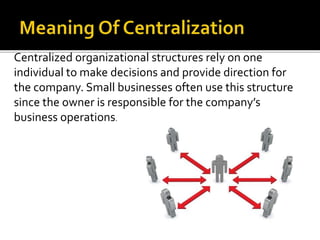
Centralized organizational structures rely on one
individual to make decisions and provide direction for
the company. Small businesses often use this structure
since the owner is responsible for the company’s
business operations.
 Effective utilization of talents of the top
management.
 It reduces co-ordination problems as a unifying force
integrates all operations.
 It allows the development of a strong co-ordinates
top management team.
 There is uniformity of policies and plans across the
organization.
 Centralization organizations are best suited where
resources and information has to move swiftly,
especially in emergencies.
 Duplication of functions and facilities is minimized
which in turn reduces costs.
 Due to the fact that all decisions are made at the top it
might result in delays in decision-making and
communication.
 Centralised power and authority might be abused.
 Doesn’t give an opportunity to lower level
managers/supervisors to develop their managerial
skills.
 Centralised organisation faces the problem of lower
motivation levels among workforce.
 The success of organisation depends on the
competence of top executives which might be quite
risky.
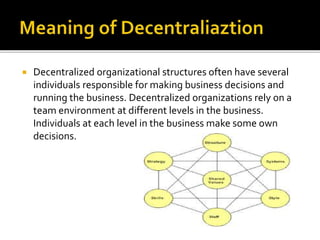
 Decentralized organizational structures often have several
individuals responsible for making business decisions and
running the business. Decentralized organizations rely on a
team environment at different levels in the business.
Individuals at each level in the business make some own
decisions.
 Decentralization reduces the workload of top executives.
 It improves job satisfaction and morale of lower level
managers by satisfying their needs for independence,
participation and status.
 Decision making is quicker.
 It facilitates growth and diversification. As each product
division is given sufficient autonomy for innovation and
creativity.
 It gives opportunity to subordinates to exercise their own
judgment.
 They develop managerial skills which will be useful to the
organization in the longer run.
 Decentralization requires wider span of control and fewer
levels of organization. It speeds up communication.
 Decentralization increases the administrative
expenses and each division or department has to
be sufficient in terms of physical facilities and
trained personnel.
 As each department or division enjoys
substantial autonomy it might lead to co-
ordination problems.
 There might be lack of uniformity and
inconsistent procedures as each department
might have the authority to formulate its own
policies and procedures.
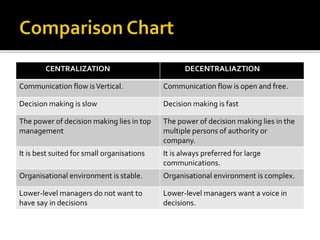
CENTRALIZATION DECENTRALIAZTION
Communication flow isVertical. Communication flow is open and free.
Decision making is slow Decision making is fast
The power of decision making lies in top
management
The power of decision making lies in the
multiple persons of authority or
company.
It is best suited for small organisations It is always preferred for large
communications.
Organisational environment is stable. Organisational environment is complex.
Lower-level managers do not want to
have say in decisions
Lower-level managers want a voice in
decisions.
The difference between centralization and
decentralization is one of the hot topics these days. Some
people think that centralization is better while others are
in favor of decentralization. In ancient times, people used
to run their organization in a centralized manner, but now
the scenario has been changed completely due to rise in
extreme competition where quick decision making is
required and therefore many organizations opted for
decentralization. However, centralization still exists in
some of the organizations. Coming to the point, no
organization is completely centralized or decentralized,
they are centralized or decentralized only up to the extent
of the delegation of authority.
THANKYOU

Ppm part 1

  • 1.
  • 2.
    Centralized organizational structuresrely on one individual to make decisions and provide direction for the company. Small businesses often use this structure since the owner is responsible for the company’s business operations.
  • 3.
     Effective utilizationof talents of the top management.  It reduces co-ordination problems as a unifying force integrates all operations.  It allows the development of a strong co-ordinates top management team.  There is uniformity of policies and plans across the organization.  Centralization organizations are best suited where resources and information has to move swiftly, especially in emergencies.  Duplication of functions and facilities is minimized which in turn reduces costs.
  • 4.
     Due tothe fact that all decisions are made at the top it might result in delays in decision-making and communication.  Centralised power and authority might be abused.  Doesn’t give an opportunity to lower level managers/supervisors to develop their managerial skills.  Centralised organisation faces the problem of lower motivation levels among workforce.  The success of organisation depends on the competence of top executives which might be quite risky.
  • 5.
     Decentralized organizationalstructures often have several individuals responsible for making business decisions and running the business. Decentralized organizations rely on a team environment at different levels in the business. Individuals at each level in the business make some own decisions.
  • 6.
     Decentralization reducesthe workload of top executives.  It improves job satisfaction and morale of lower level managers by satisfying their needs for independence, participation and status.  Decision making is quicker.  It facilitates growth and diversification. As each product division is given sufficient autonomy for innovation and creativity.  It gives opportunity to subordinates to exercise their own judgment.  They develop managerial skills which will be useful to the organization in the longer run.  Decentralization requires wider span of control and fewer levels of organization. It speeds up communication.
  • 7.
     Decentralization increasesthe administrative expenses and each division or department has to be sufficient in terms of physical facilities and trained personnel.  As each department or division enjoys substantial autonomy it might lead to co- ordination problems.  There might be lack of uniformity and inconsistent procedures as each department might have the authority to formulate its own policies and procedures.
  • 8.
    CENTRALIZATION DECENTRALIAZTION Communication flowisVertical. Communication flow is open and free. Decision making is slow Decision making is fast The power of decision making lies in top management The power of decision making lies in the multiple persons of authority or company. It is best suited for small organisations It is always preferred for large communications. Organisational environment is stable. Organisational environment is complex. Lower-level managers do not want to have say in decisions Lower-level managers want a voice in decisions.
  • 9.
    The difference betweencentralization and decentralization is one of the hot topics these days. Some people think that centralization is better while others are in favor of decentralization. In ancient times, people used to run their organization in a centralized manner, but now the scenario has been changed completely due to rise in extreme competition where quick decision making is required and therefore many organizations opted for decentralization. However, centralization still exists in some of the organizations. Coming to the point, no organization is completely centralized or decentralized, they are centralized or decentralized only up to the extent of the delegation of authority.
  • 10.