To accompany A Framework for Slide 1 in
©2003 Prentice Hall, Inc.
Chapter 17
Managing theManaging the
Sales ForceSales Force
PowerPoint by Karen E.
James Louisiana State University
- Shreveport
To accompany A Framework for Slide 2 in
©2003 Prentice Hall, Inc.
Objectives
 Review the types of decisions firms
face in designing a sales force.
 Learn how companies recruit, select,
train, supervise, motivate, and evaluate
a sales force.
 Understand how salespeople improve
their selling, negotiation, and
relationship-building skills.
To accompany A Framework for Slide 3 in
©2003 Prentice Hall, Inc.
Designing the Sales Force
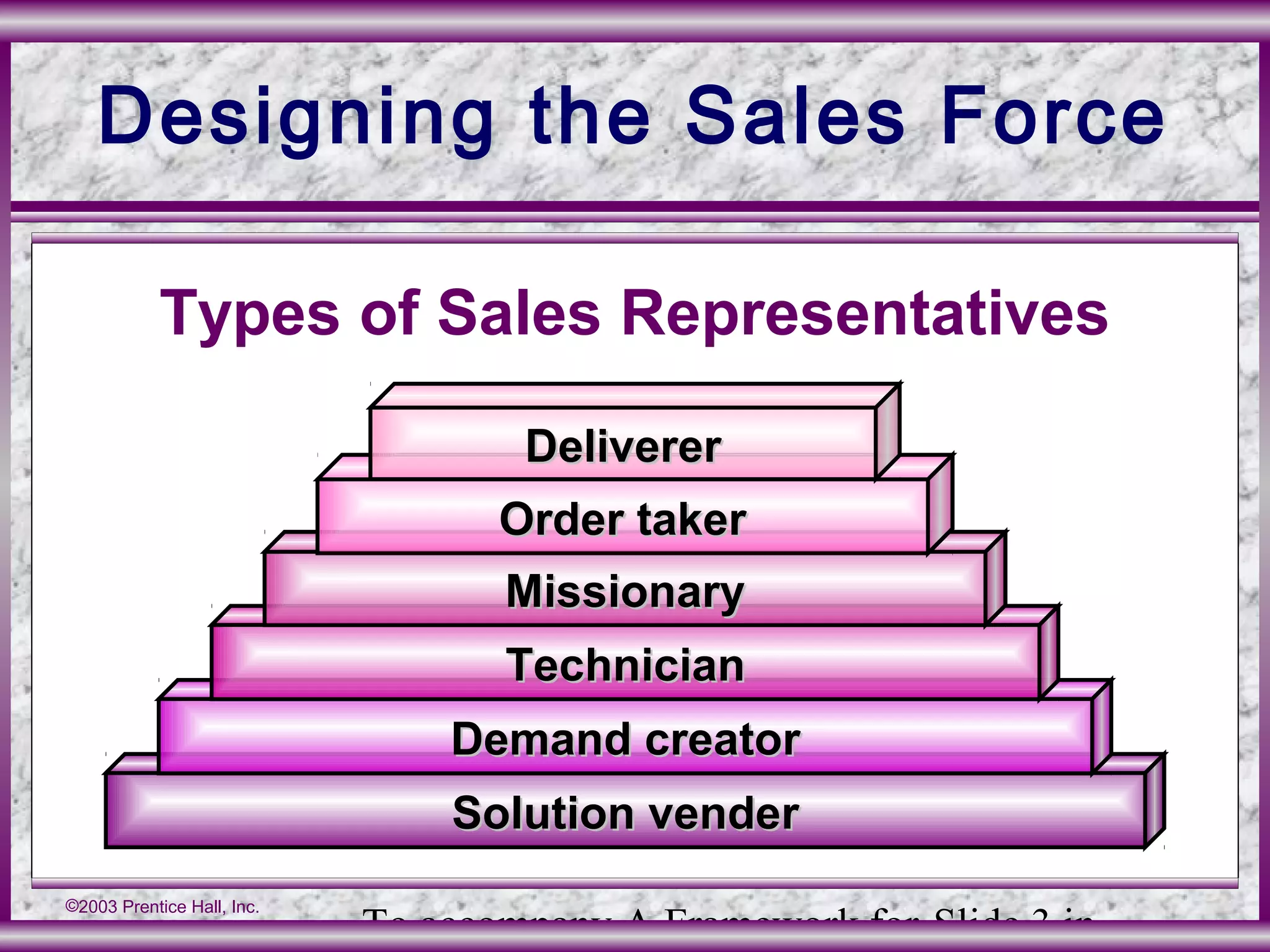
Types of Sales Representatives
Solution venderSolution vender
Demand creatorDemand creator
TechnicianTechnician
MissionaryMissionary
Order takerOrder taker
DelivererDeliverer
To accompany A Framework for Slide 4 in
©2003 Prentice Hall, Inc.
Designing the Sales Force
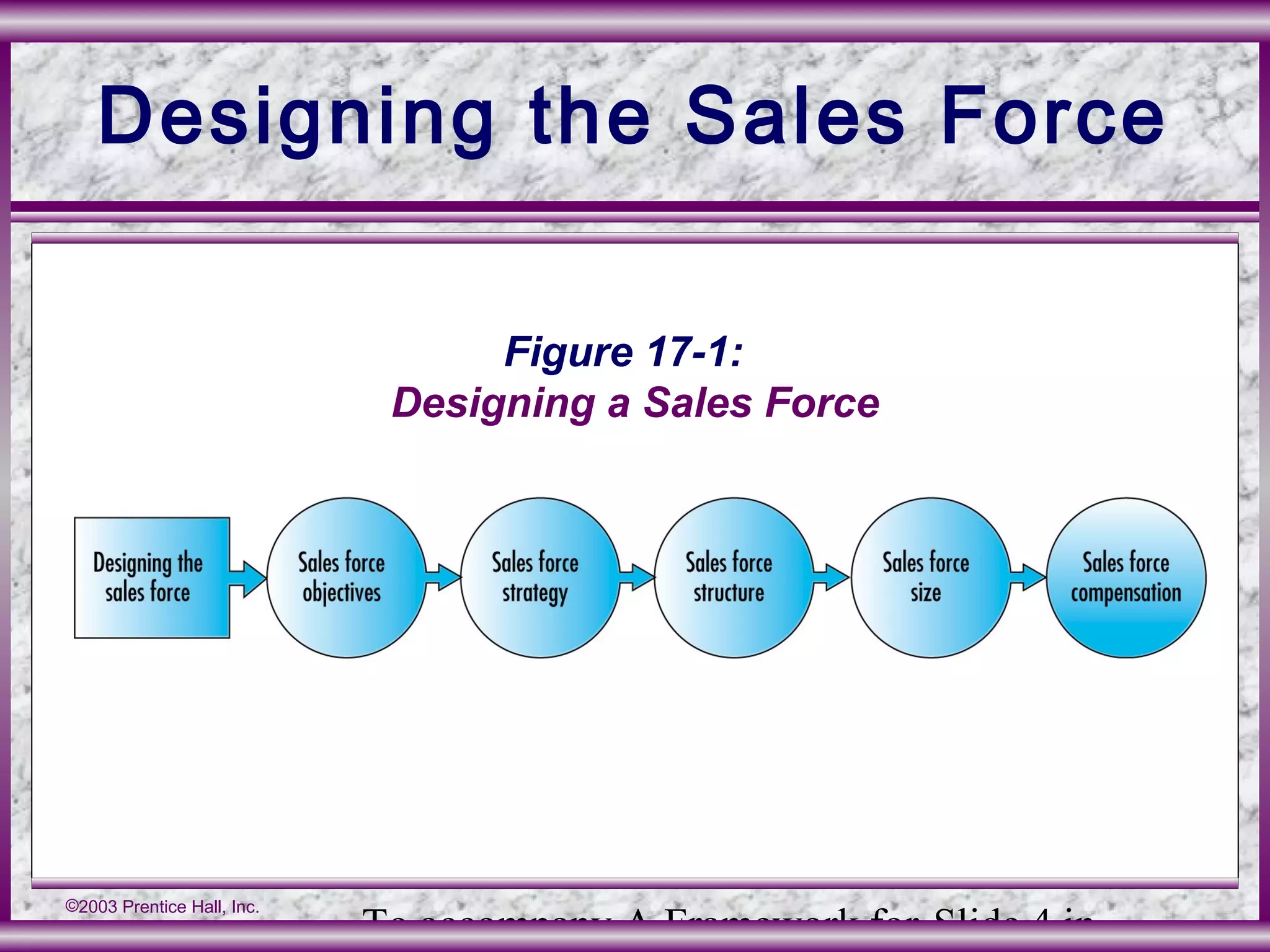
Figure 17-1:
Designing a Sales Force
To accompany A Framework for Slide 5 in
©2003 Prentice Hall, Inc.
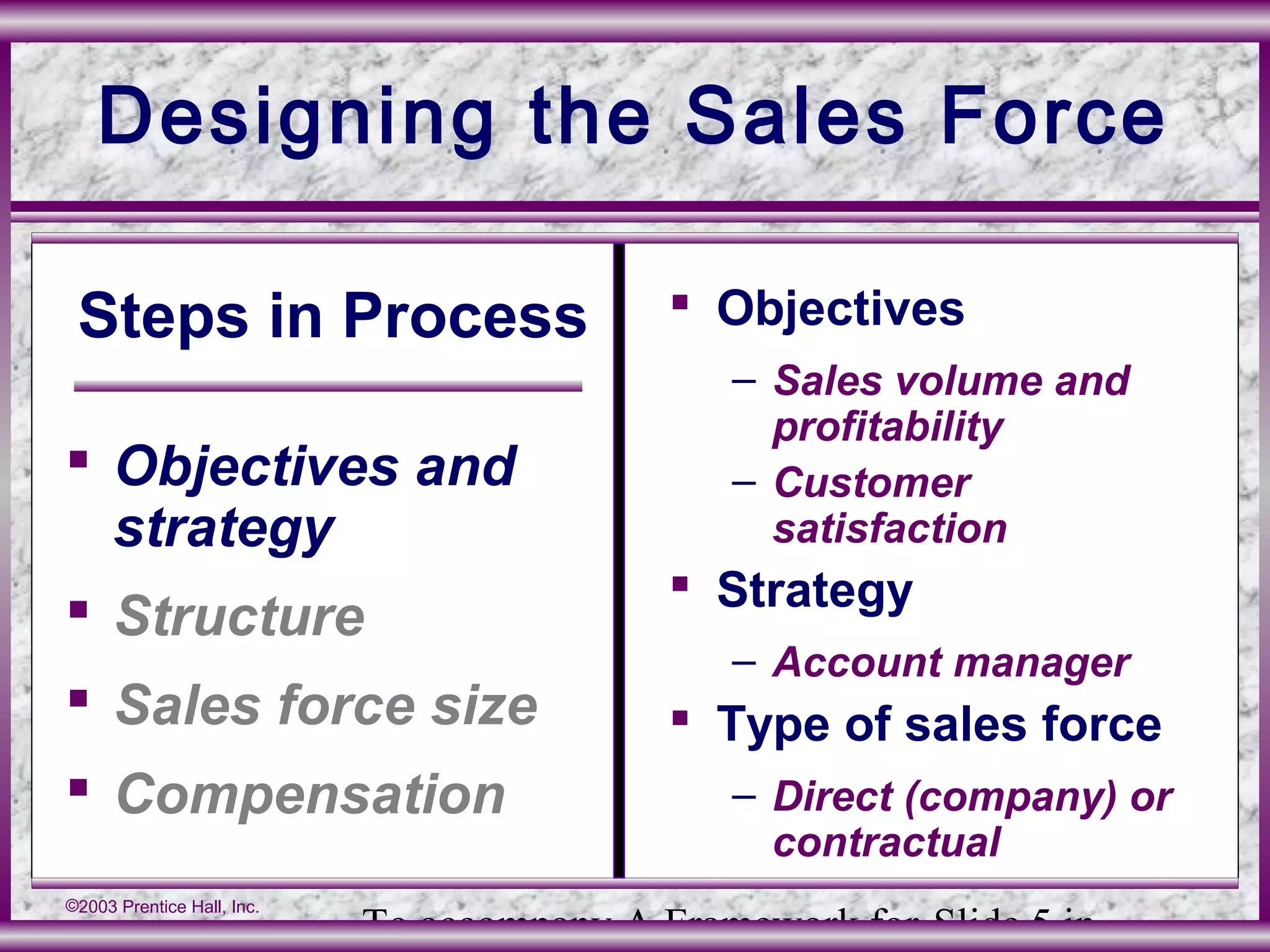
Designing the Sales Force
Steps in Process
 Objectives and
strategy
 Structure
 Sales force size
 Compensation
 Objectives
– Sales volume and
profitability
– Customer
satisfaction
 Strategy
– Account manager
 Type of sales force
– Direct (company) or
contractual
To accompany A Framework for Slide 6 in
©2003 Prentice Hall, Inc.
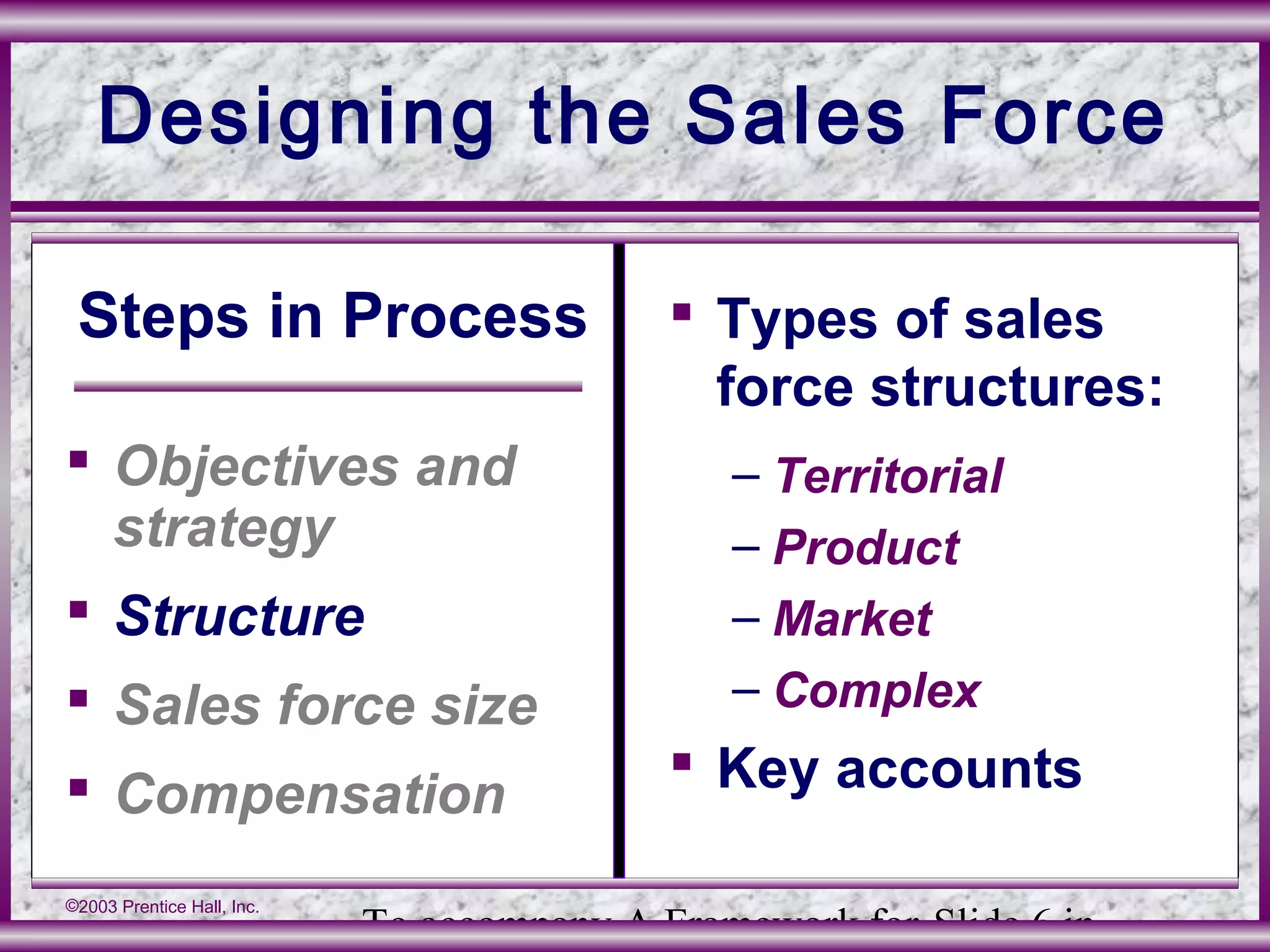
Designing the Sales Force
Steps in Process
 Objectives and
strategy
 Structure
 Sales force size
 Compensation
 Types of sales
force structures:
– Territorial
– Product
– Market
– Complex
 Key accounts
To accompany A Framework for Slide 7 in
©2003 Prentice Hall, Inc.
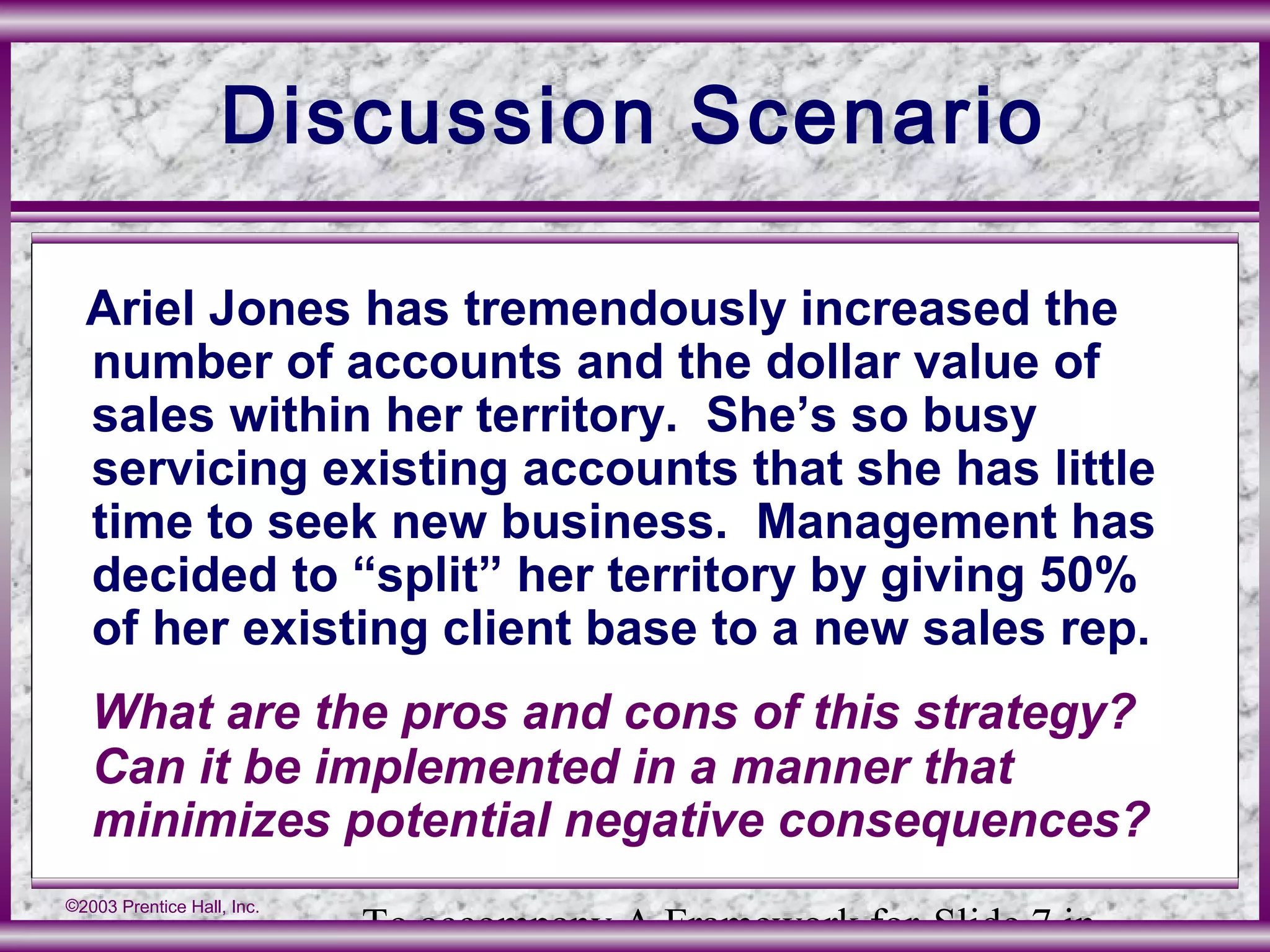
Discussion Scenario
Ariel Jones has tremendously increased the
number of accounts and the dollar value of
sales within her territory. She’s so busy
servicing existing accounts that she has little
time to seek new business. Management has
decided to “split” her territory by giving 50%
of her existing client base to a new sales rep.
What are the pros and cons of this strategy?
Can it be implemented in a manner that
minimizes potential negative consequences?
To accompany A Framework for Slide 8 in
©2003 Prentice Hall, Inc.
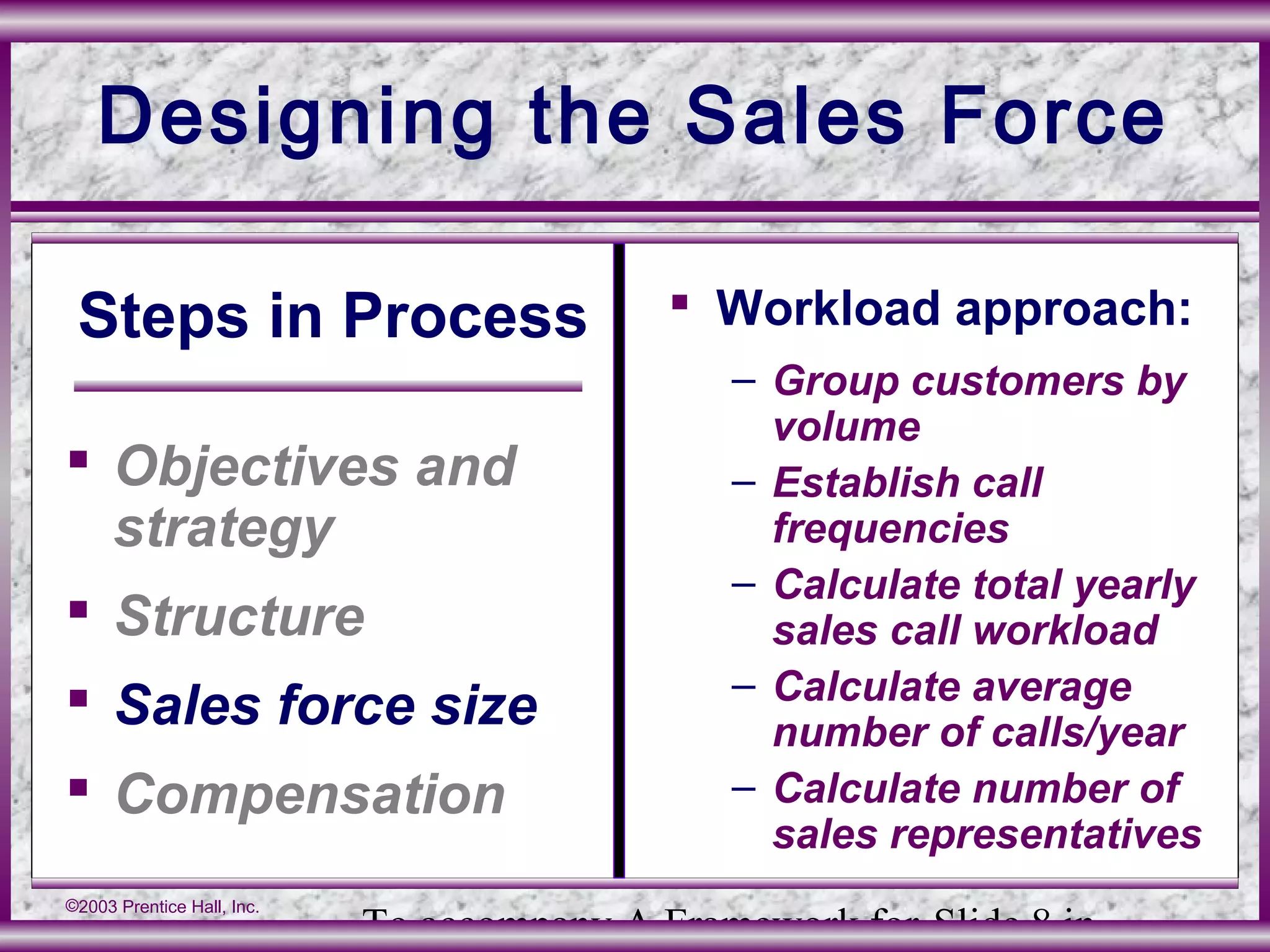
Designing the Sales Force
Steps in Process
 Objectives and
strategy
 Structure
 Sales force size
 Compensation
 Workload approach:
– Group customers by
volume
– Establish call
frequencies
– Calculate total yearly
sales call workload
– Calculate average
number of calls/year
– Calculate number of
sales representatives
To accompany A Framework for Slide 9 in
©2003 Prentice Hall, Inc.
Designing the Sales Force
Steps in Process
 Objectives and
strategy
 Structure
 Sales force size
 Compensation
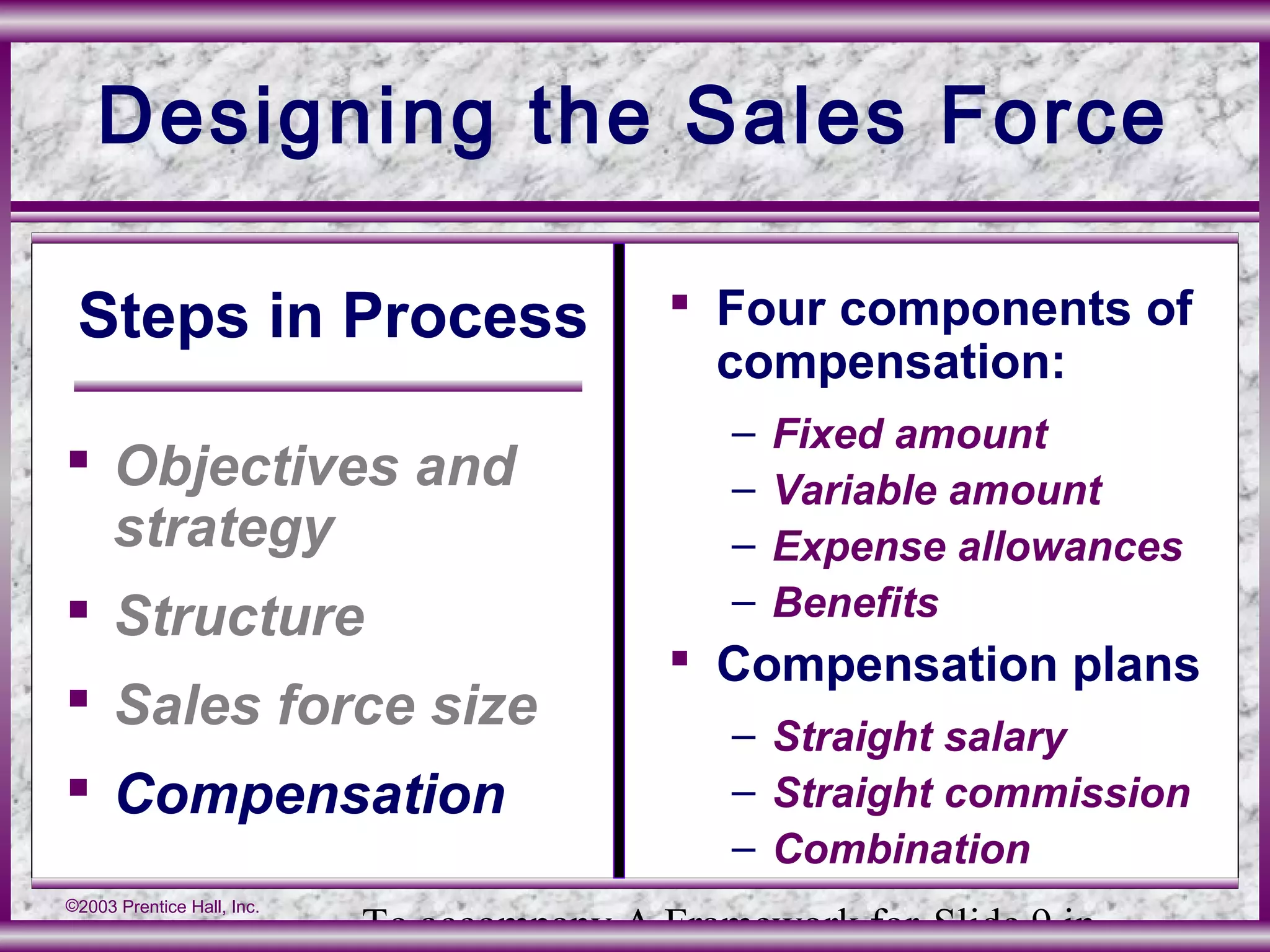
 Four components of
compensation:
– Fixed amount
– Variable amount
– Expense allowances
– Benefits
 Compensation plans
– Straight salary
– Straight commission
– Combination
To accompany A Framework for Slide 10 in
©2003 Prentice Hall, Inc.
Designing the Sales Force
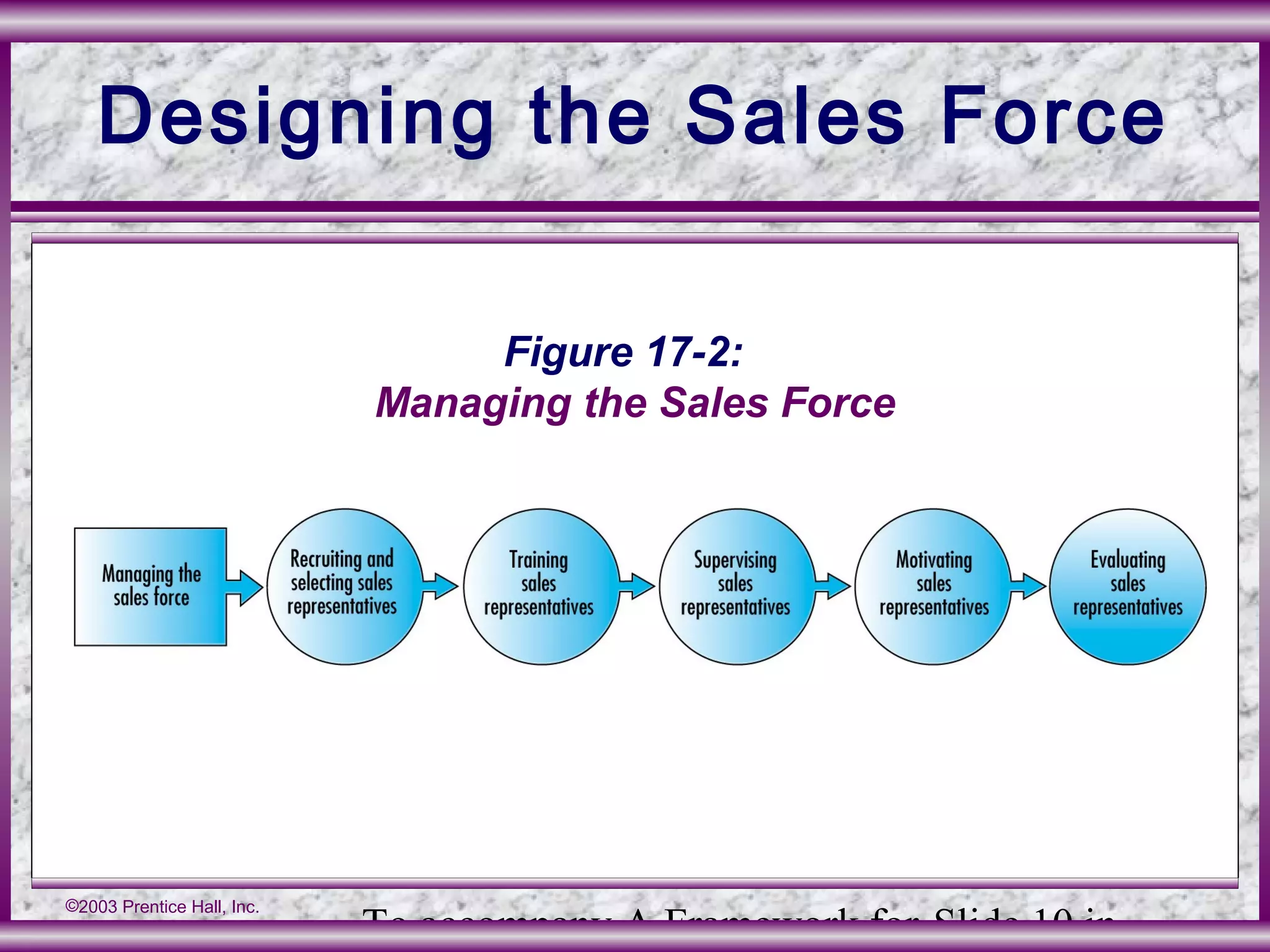
Figure 17-2:
Managing the Sales Force
To accompany A Framework for Slide 11 in
©2003 Prentice Hall, Inc.
Managing the Sales Force
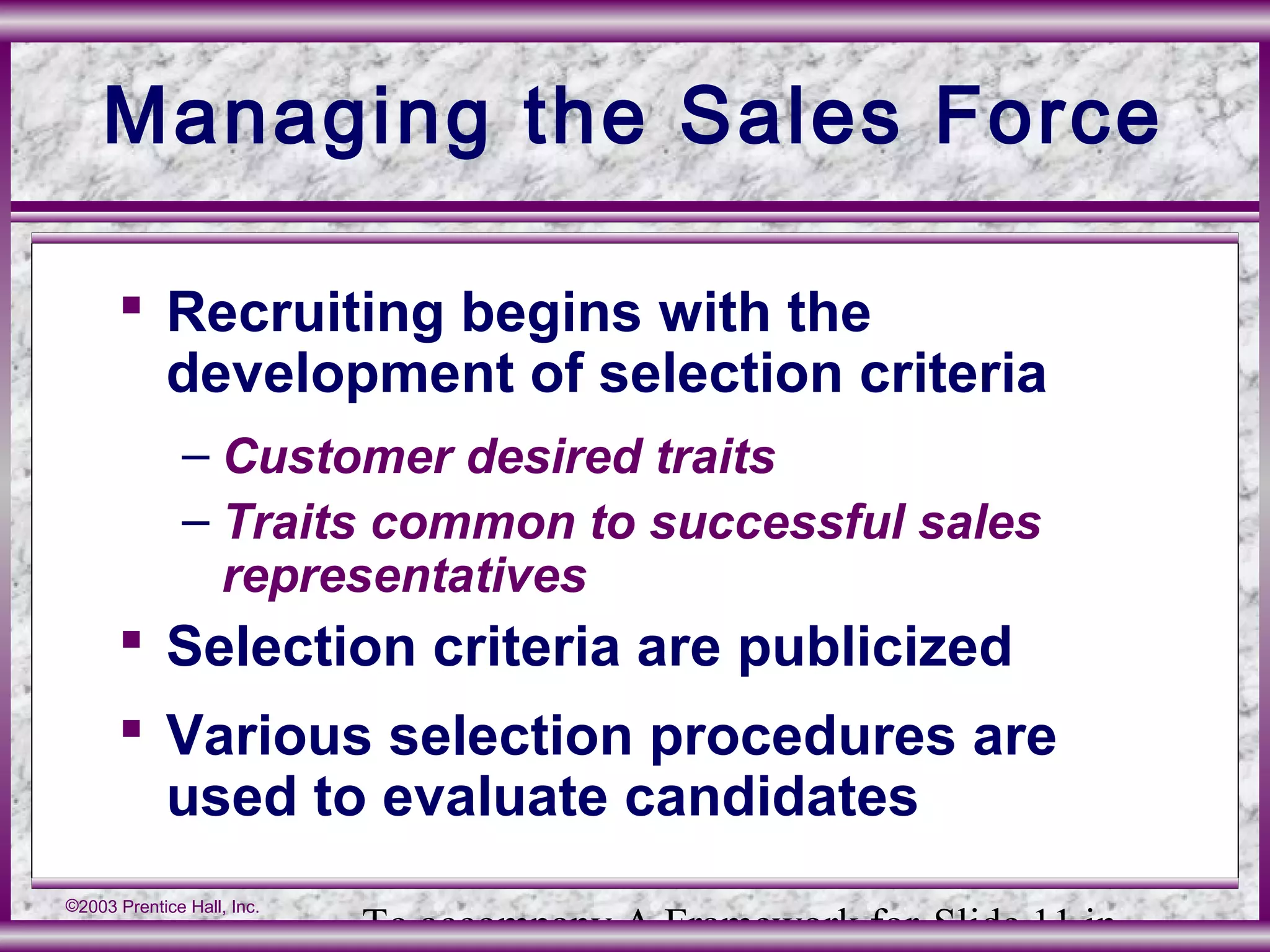
 Recruiting begins with the
development of selection criteria
– Customer desired traits
– Traits common to successful sales
representatives
 Selection criteria are publicized
 Various selection procedures are
used to evaluate candidates
To accompany A Framework for Slide 12 in
©2003 Prentice Hall, Inc.
Managing the Sales Force
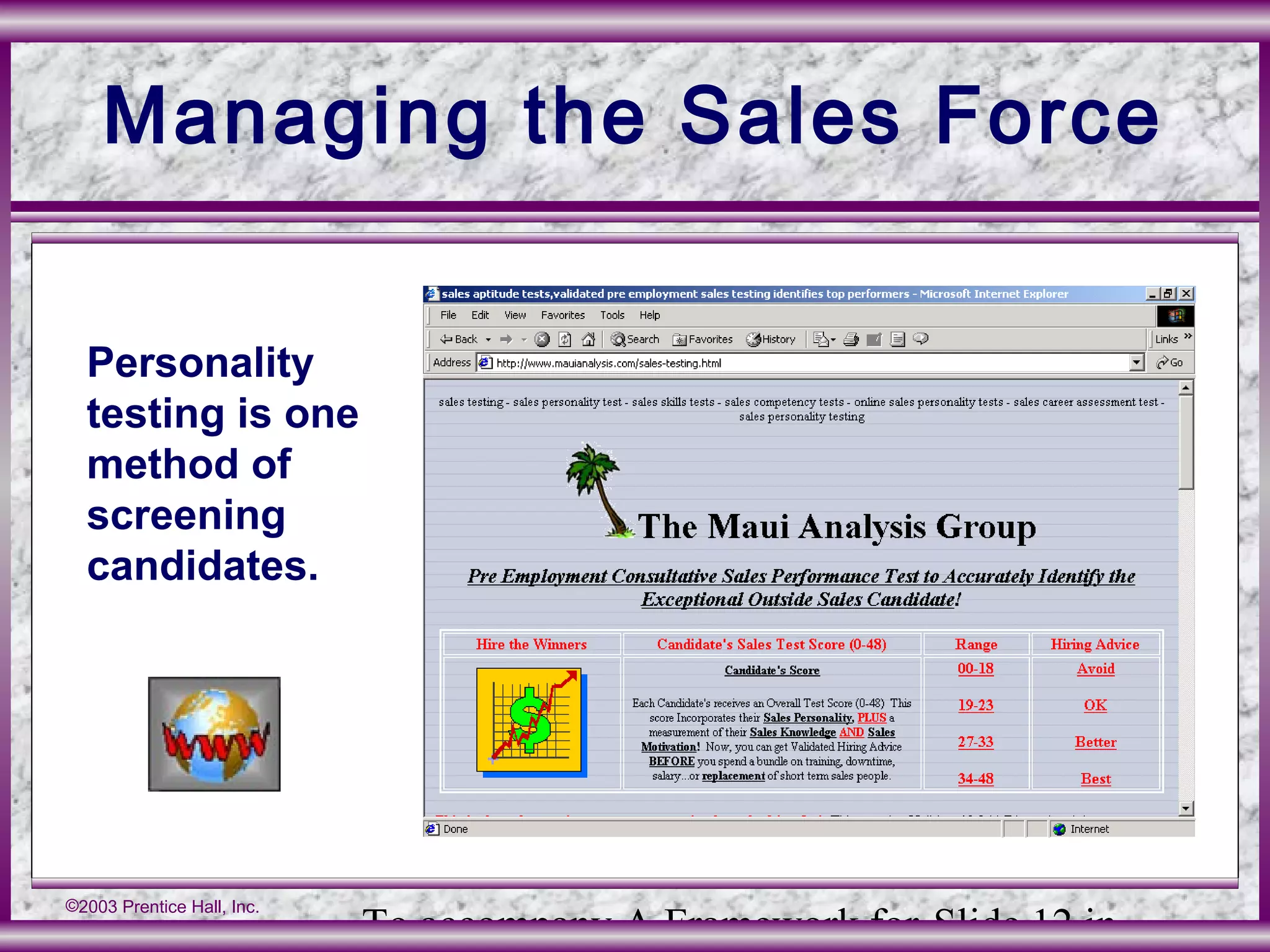
Personality
testing is one
method of
screening
candidates.
To accompany A Framework for Slide 13 in
©2003 Prentice Hall, Inc.
Managing the Sales Force
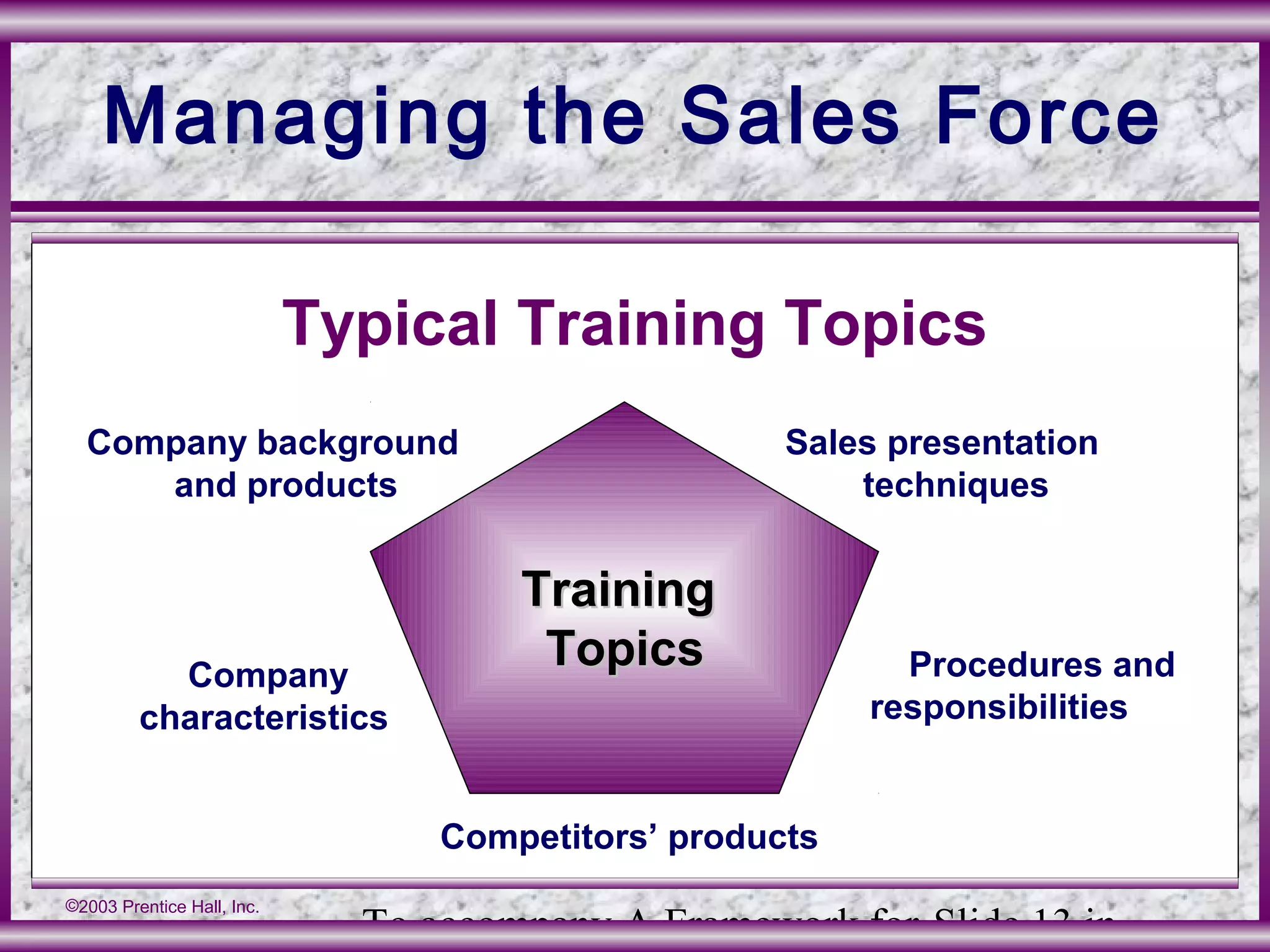
Typical Training Topics
Sales presentation
techniques
Company background
and products
Company
characteristics
Procedures and
responsibilities
Competitors’ products
TrainingTraining
TopicsTopics
To accompany A Framework for Slide 14 in
©2003 Prentice Hall, Inc.
Managing the Sales Force
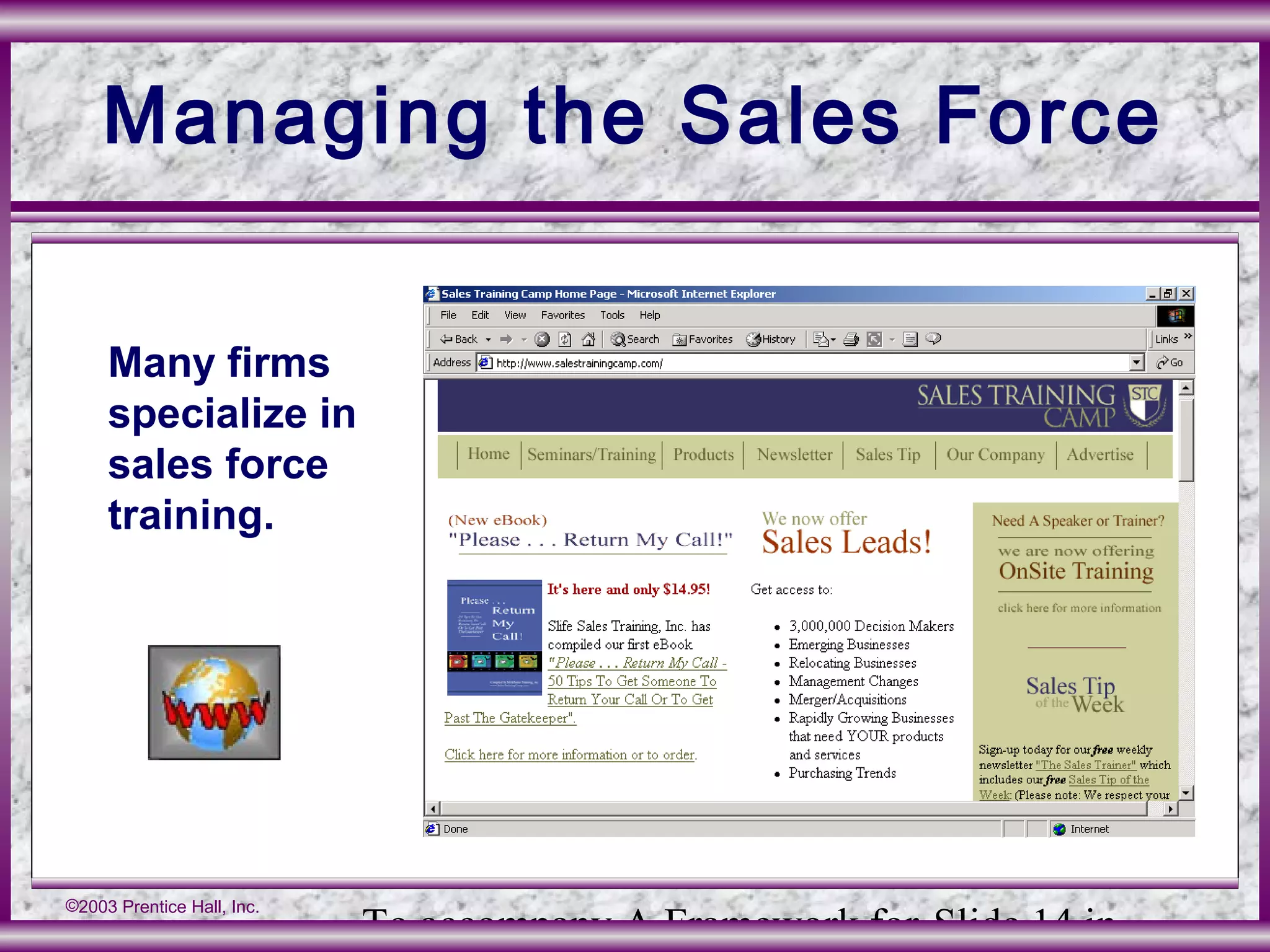
Many firms
specialize in
sales force
training.
To accompany A Framework for Slide 15 in
©2003 Prentice Hall, Inc.
Managing the Sales Force
 The amount of time needed and the
training method used vary with the
level of task complexity.
 Successful firms have procedures to
aid in evaluating the sales force:
– Norms for customer calls
– Norms for prospect calls
– Using sales time efficiently
To accompany A Framework for Slide 16 in
©2003 Prentice Hall, Inc.
Managing the Sales Force
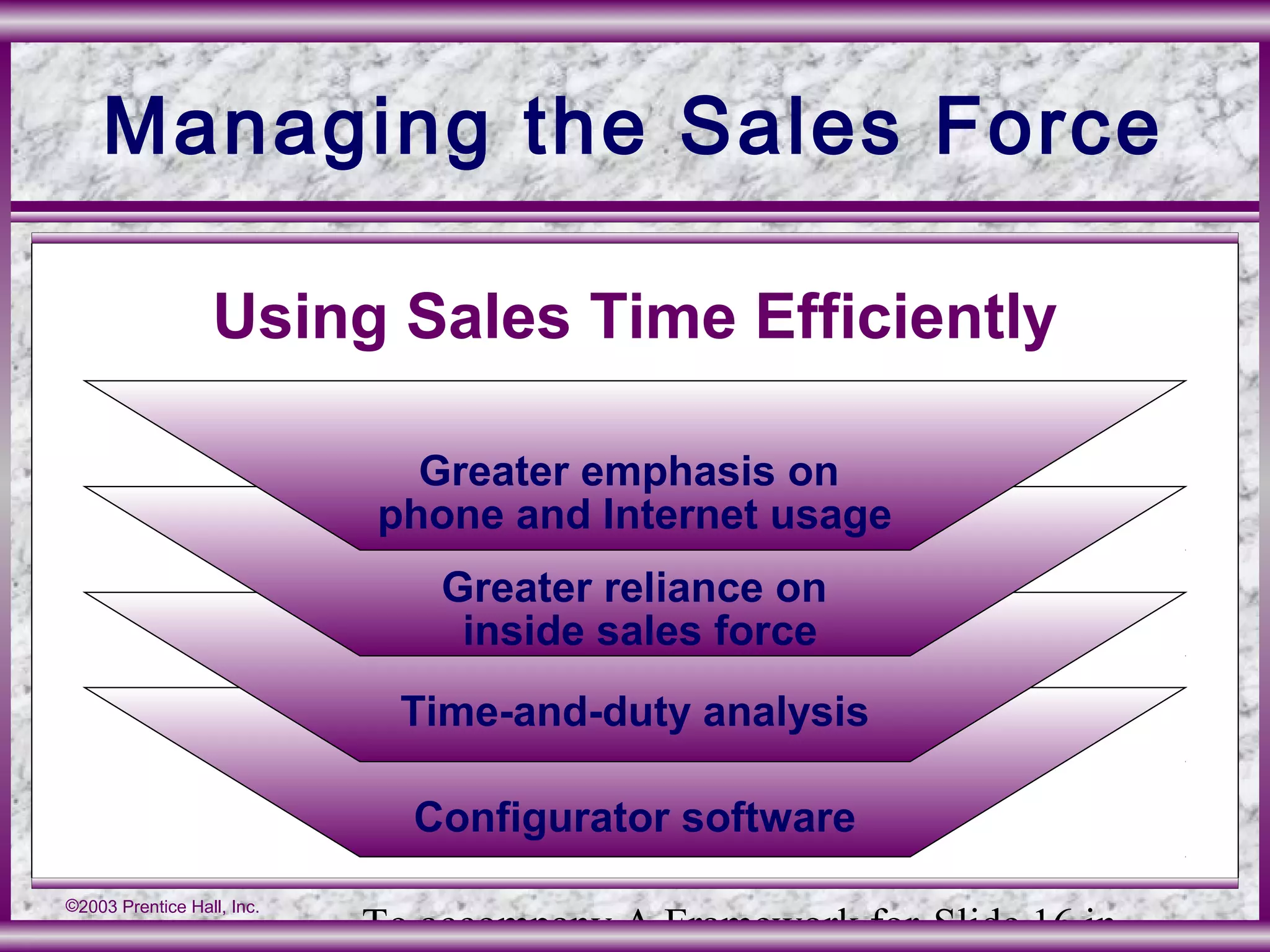
Greater emphasis on
phone and Internet usage
Greater reliance on
inside sales force
Time-and-duty analysis
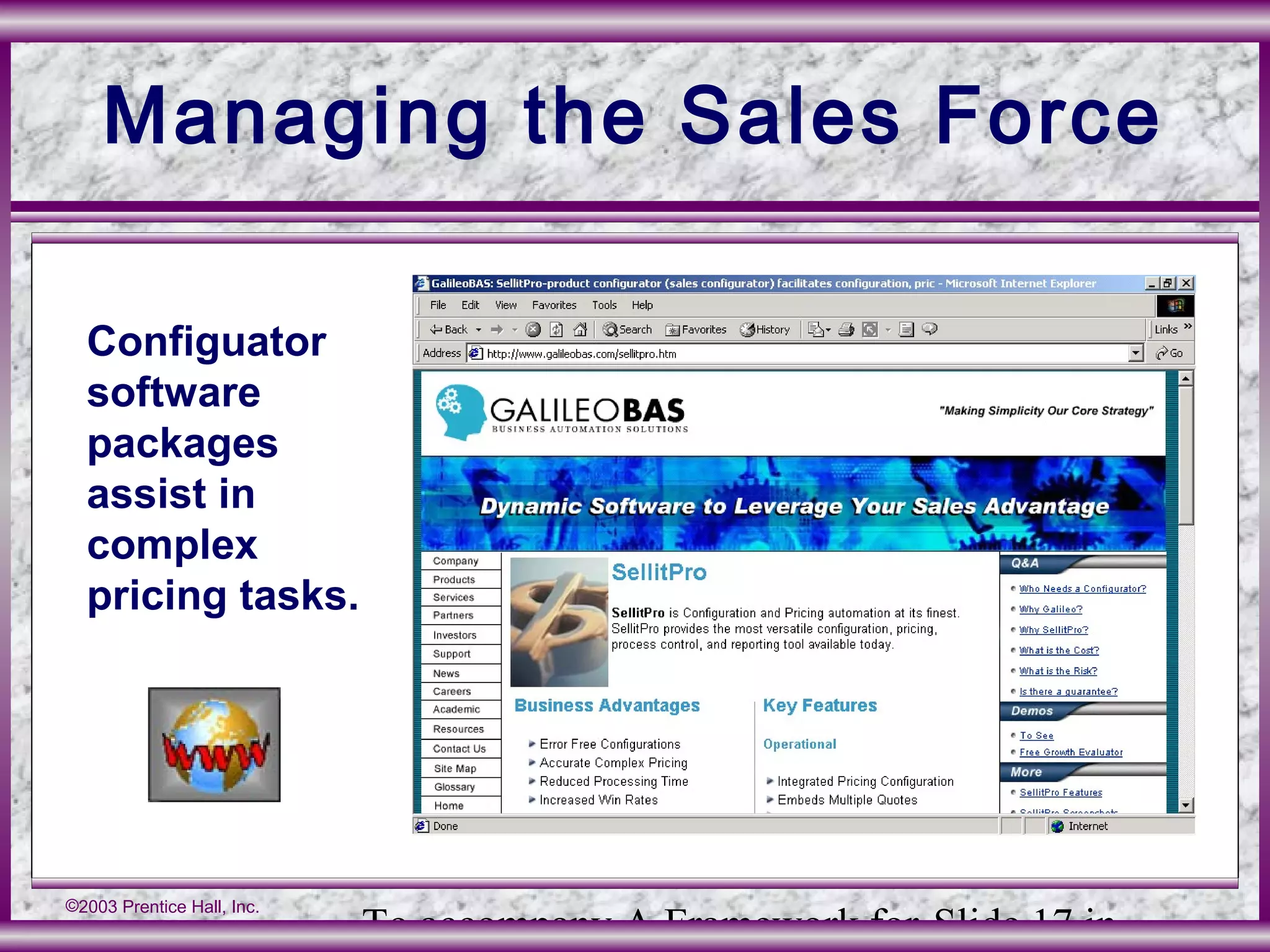
Configurator software
Using Sales Time Efficiently
To accompany A Framework for Slide 17 in
©2003 Prentice Hall, Inc.
Managing the Sales Force
Configuator
software
packages
assist in
complex
pricing tasks.
To accompany A Framework for Slide 18 in
©2003 Prentice Hall, Inc.
Managing the Sales Force
 Motivating the Sales Force
– Most valued rewards
• Pay, promotion, personal growth, sense
of accomplishment
– Least valued rewards
• Liking and respect, security, recognition
– Sales quotas as motivation tools
– Supplementary motivators
To accompany A Framework for Slide 19 in
©2003 Prentice Hall, Inc.
Managing the Sales Force
 Evaluating the Sales Force
–Various sources of information
may be used
–Types of formal evaluation include:
• Performance comparisons
• Knowledge assessments
To accompany A Framework for Slide 20 in
©2003 Prentice Hall, Inc.
Managing the Sales Force
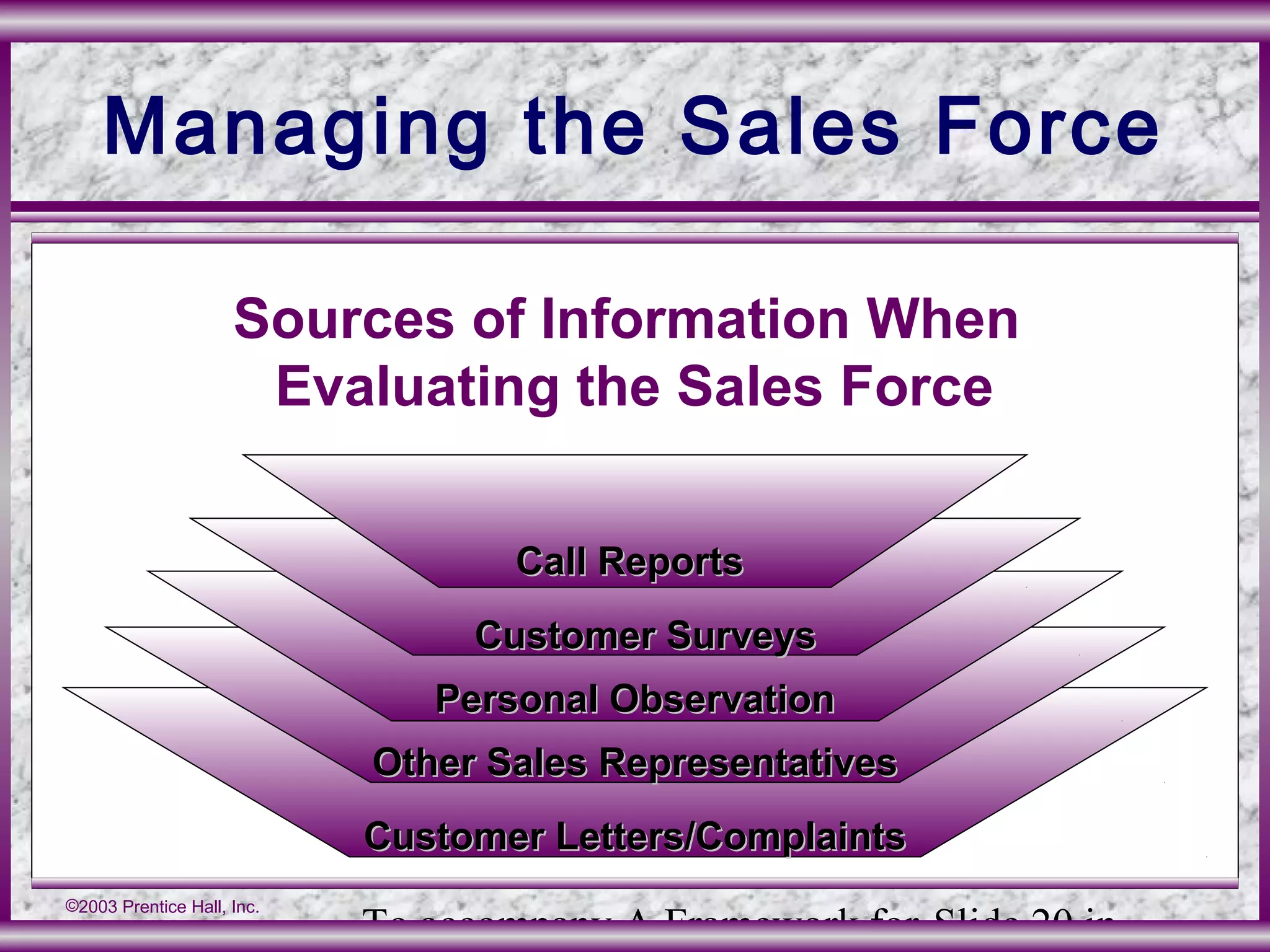
Sources of Information When
Evaluating the Sales Force
Call ReportsCall Reports
Customer SurveysCustomer Surveys
Other Sales RepresentativesOther Sales Representatives
Personal ObservationPersonal Observation
Customer Letters/ComplaintsCustomer Letters/Complaints
To accompany A Framework for Slide 21 in
©2003 Prentice Hall, Inc.
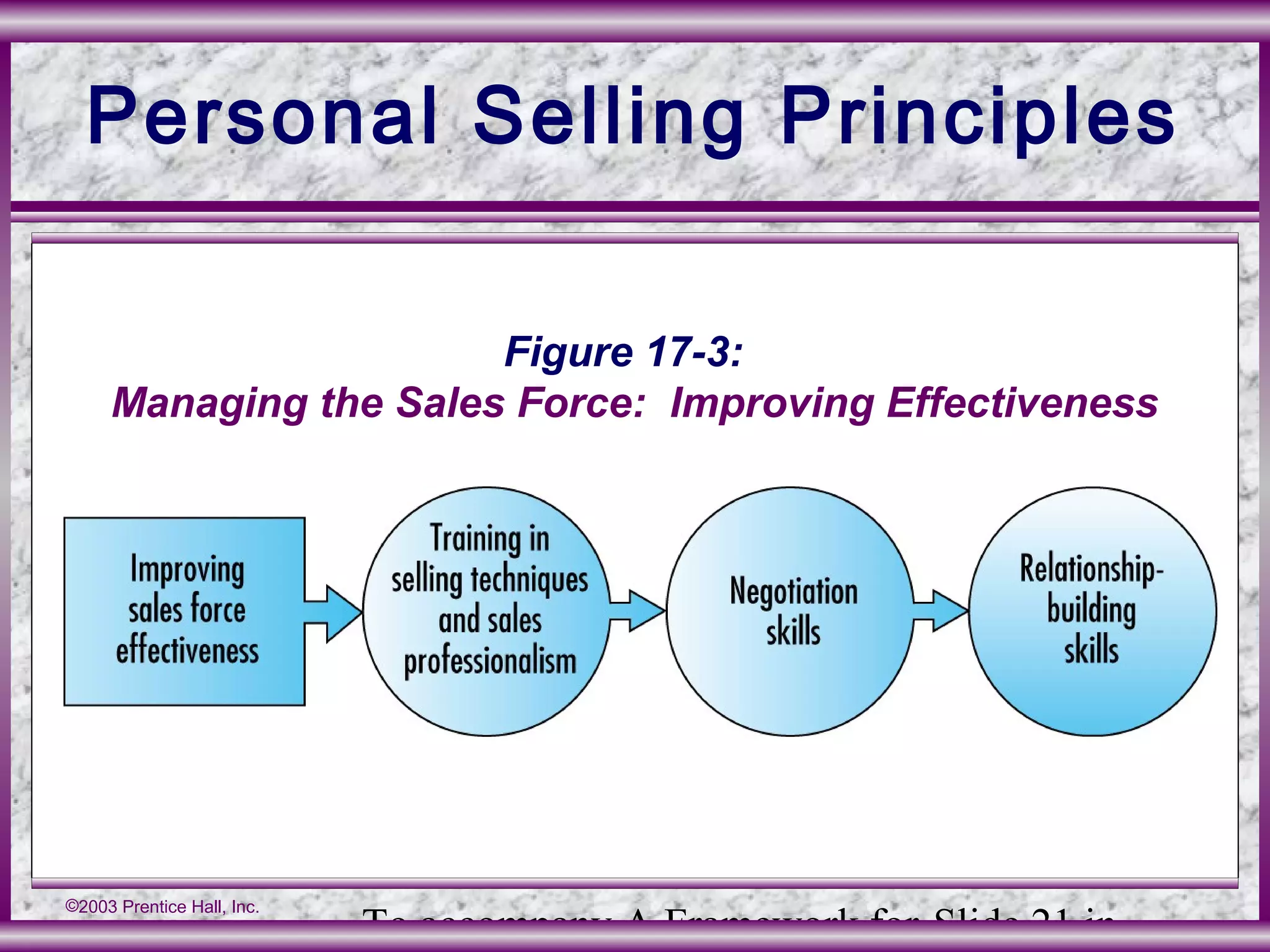
Personal Selling Principles
Figure 17-3:
Managing the Sales Force: Improving Effectiveness
To accompany A Framework for Slide 22 in
©2003 Prentice Hall, Inc.
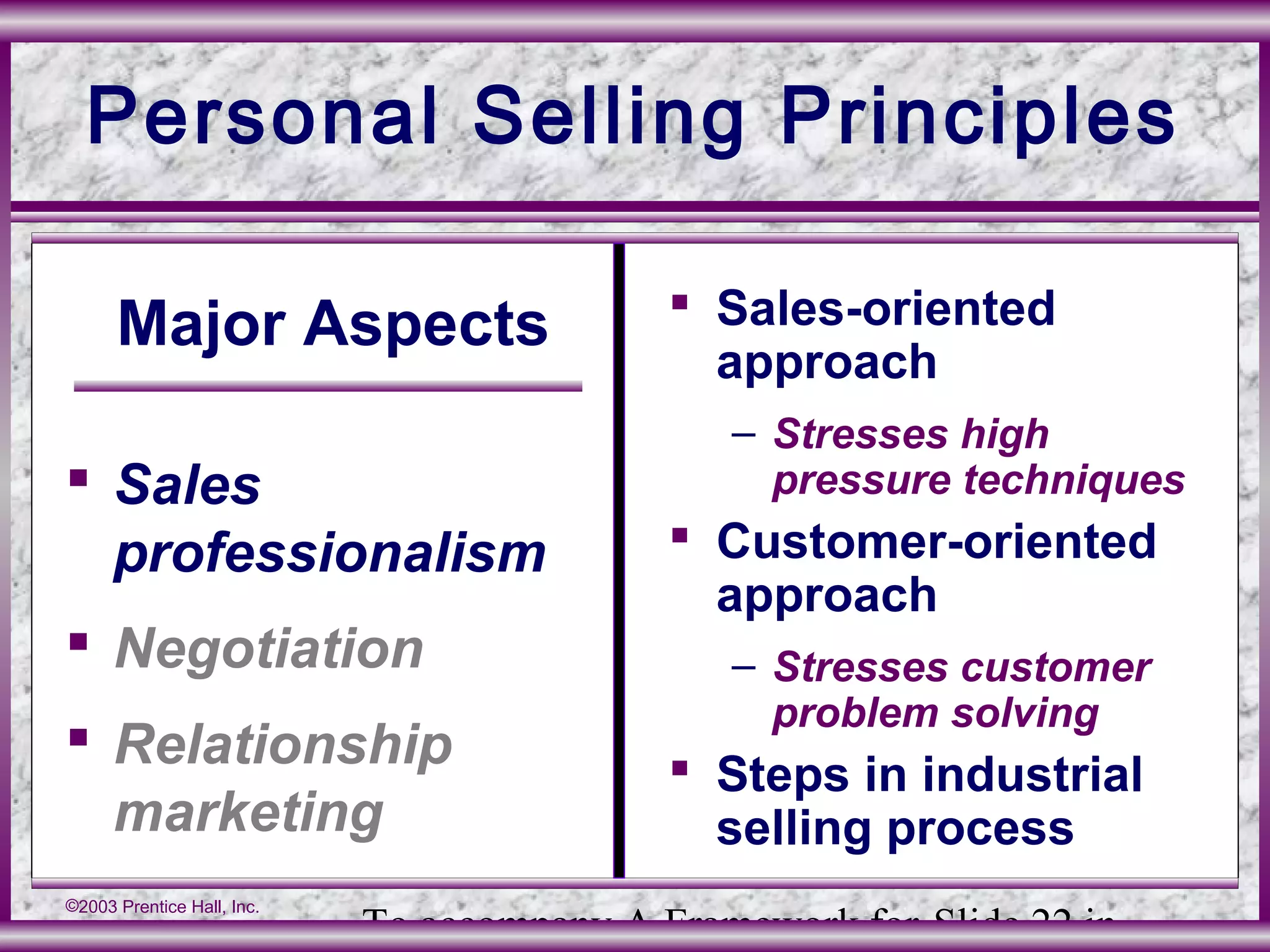
Personal Selling Principles
Major Aspects
 Sales
professionalism
 Negotiation
 Relationship
marketing
 Sales-oriented
approach
– Stresses high
pressure techniques
 Customer-oriented
approach
– Stresses customer
problem solving
 Steps in industrial
selling process
To accompany A Framework for Slide 23 in
©2003 Prentice Hall, Inc.
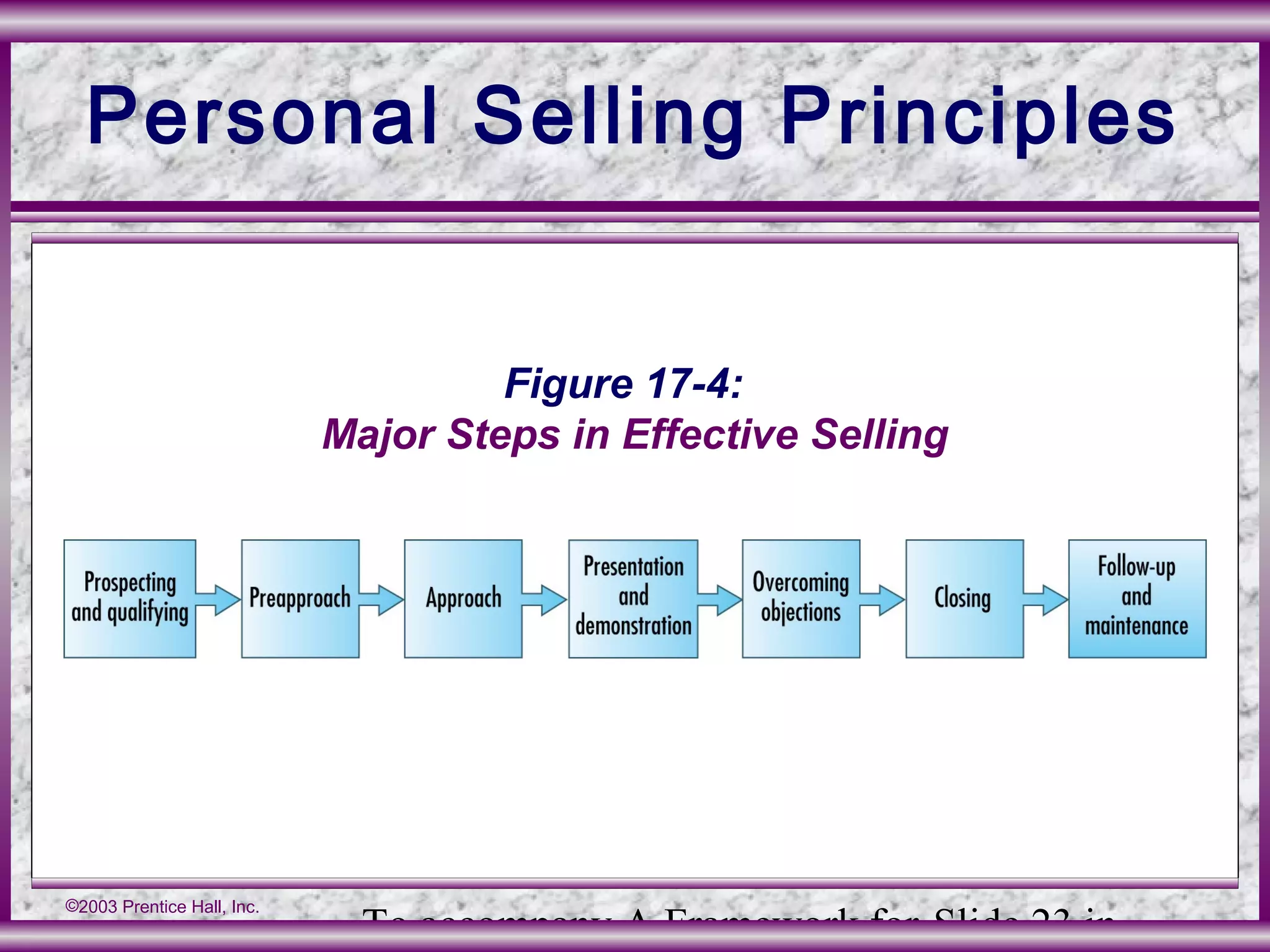
Personal Selling Principles
Figure 17-4:
Major Steps in Effective Selling
To accompany A Framework for Slide 24 in
©2003 Prentice Hall, Inc.
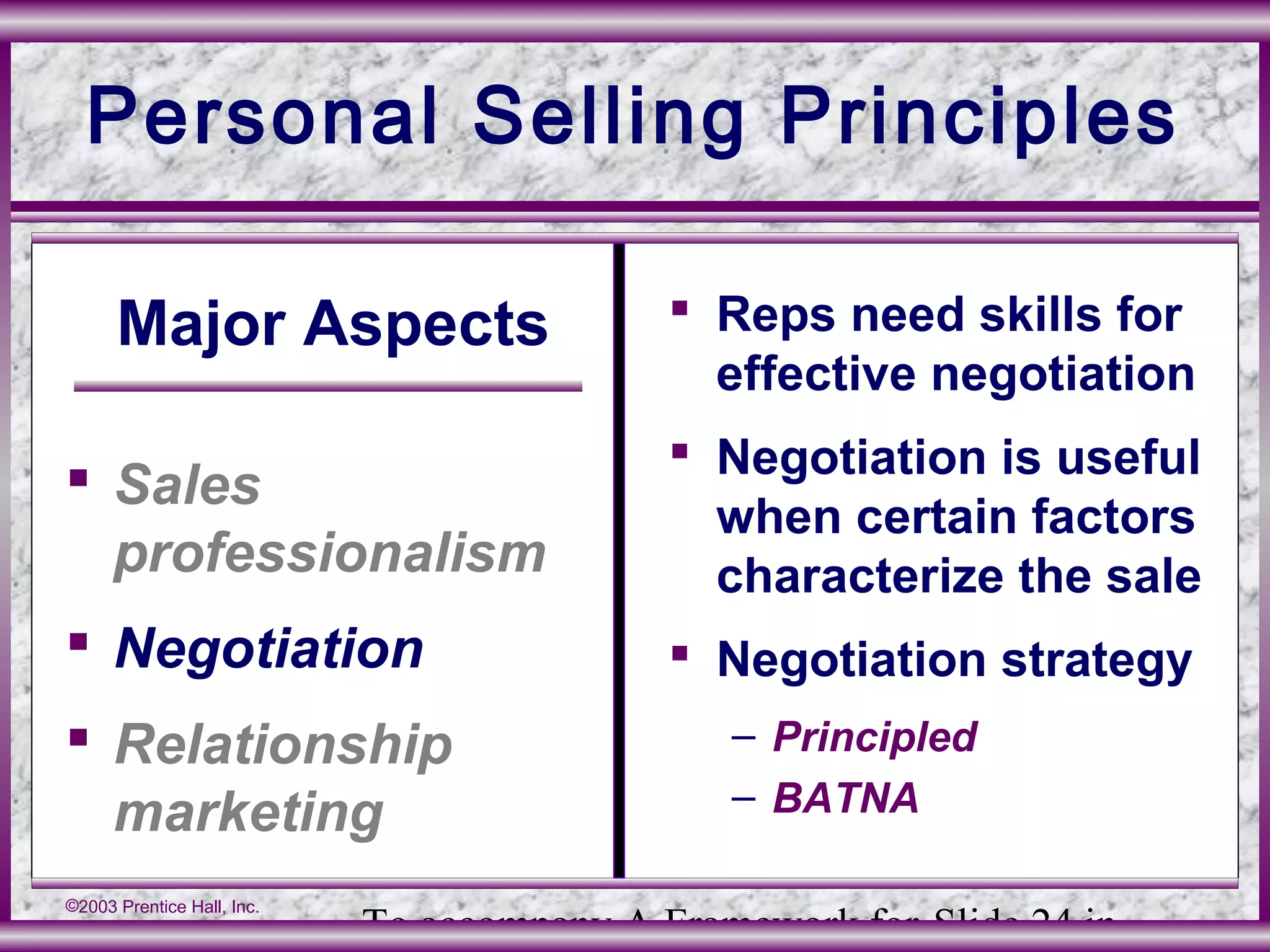
Personal Selling Principles
Major Aspects
 Sales
professionalism
 Negotiation
 Relationship
marketing
 Reps need skills for
effective negotiation
 Negotiation is useful
when certain factors
characterize the sale
 Negotiation strategy
– Principled
– BATNA
To accompany A Framework for Slide 25 in
©2003 Prentice Hall, Inc.
Personal Selling Principles
Major Aspects
 Sales
professionalism
 Negotiation
 Relationship
marketing
 Building long-term
supplier-customer
relationships has
grown in importance
 Companies are
shifting focus away
from transaction
marketing to
relationship
marketing
To accompany A Framework for Slide 26 in
©2003 Prentice Hall, Inc.
Discussion Scenario
Salespeople who meet or exceed their
assigned quotas are typically given
higher quotas the following year.
How might this practice impact a
company’s 1) internal marketing
efforts with employees, and 2)
relationship marketing efforts with
external customers?

Pp sales force

  • 1.
    To accompany AFramework for Slide 1 in ©2003 Prentice Hall, Inc. Chapter 17 Managing theManaging the Sales ForceSales Force PowerPoint by Karen E. James Louisiana State University - Shreveport
  • 2.
    To accompany AFramework for Slide 2 in ©2003 Prentice Hall, Inc. Objectives  Review the types of decisions firms face in designing a sales force.  Learn how companies recruit, select, train, supervise, motivate, and evaluate a sales force.  Understand how salespeople improve their selling, negotiation, and relationship-building skills.
  • 3.
    To accompany AFramework for Slide 3 in ©2003 Prentice Hall, Inc. Designing the Sales Force Types of Sales Representatives Solution venderSolution vender Demand creatorDemand creator TechnicianTechnician MissionaryMissionary Order takerOrder taker DelivererDeliverer
  • 4.
    To accompany AFramework for Slide 4 in ©2003 Prentice Hall, Inc. Designing the Sales Force Figure 17-1: Designing a Sales Force
  • 5.
    To accompany AFramework for Slide 5 in ©2003 Prentice Hall, Inc. Designing the Sales Force Steps in Process  Objectives and strategy  Structure  Sales force size  Compensation  Objectives – Sales volume and profitability – Customer satisfaction  Strategy – Account manager  Type of sales force – Direct (company) or contractual
  • 6.
    To accompany AFramework for Slide 6 in ©2003 Prentice Hall, Inc. Designing the Sales Force Steps in Process  Objectives and strategy  Structure  Sales force size  Compensation  Types of sales force structures: – Territorial – Product – Market – Complex  Key accounts
  • 7.
    To accompany AFramework for Slide 7 in ©2003 Prentice Hall, Inc. Discussion Scenario Ariel Jones has tremendously increased the number of accounts and the dollar value of sales within her territory. She’s so busy servicing existing accounts that she has little time to seek new business. Management has decided to “split” her territory by giving 50% of her existing client base to a new sales rep. What are the pros and cons of this strategy? Can it be implemented in a manner that minimizes potential negative consequences?
  • 8.
    To accompany AFramework for Slide 8 in ©2003 Prentice Hall, Inc. Designing the Sales Force Steps in Process  Objectives and strategy  Structure  Sales force size  Compensation  Workload approach: – Group customers by volume – Establish call frequencies – Calculate total yearly sales call workload – Calculate average number of calls/year – Calculate number of sales representatives
  • 9.
    To accompany AFramework for Slide 9 in ©2003 Prentice Hall, Inc. Designing the Sales Force Steps in Process  Objectives and strategy  Structure  Sales force size  Compensation  Four components of compensation: – Fixed amount – Variable amount – Expense allowances – Benefits  Compensation plans – Straight salary – Straight commission – Combination
  • 10.
    To accompany AFramework for Slide 10 in ©2003 Prentice Hall, Inc. Designing the Sales Force Figure 17-2: Managing the Sales Force
  • 11.
    To accompany AFramework for Slide 11 in ©2003 Prentice Hall, Inc. Managing the Sales Force  Recruiting begins with the development of selection criteria – Customer desired traits – Traits common to successful sales representatives  Selection criteria are publicized  Various selection procedures are used to evaluate candidates
  • 12.
    To accompany AFramework for Slide 12 in ©2003 Prentice Hall, Inc. Managing the Sales Force Personality testing is one method of screening candidates.
  • 13.
    To accompany AFramework for Slide 13 in ©2003 Prentice Hall, Inc. Managing the Sales Force Typical Training Topics Sales presentation techniques Company background and products Company characteristics Procedures and responsibilities Competitors’ products TrainingTraining TopicsTopics
  • 14.
    To accompany AFramework for Slide 14 in ©2003 Prentice Hall, Inc. Managing the Sales Force Many firms specialize in sales force training.
  • 15.
    To accompany AFramework for Slide 15 in ©2003 Prentice Hall, Inc. Managing the Sales Force  The amount of time needed and the training method used vary with the level of task complexity.  Successful firms have procedures to aid in evaluating the sales force: – Norms for customer calls – Norms for prospect calls – Using sales time efficiently
  • 16.
    To accompany AFramework for Slide 16 in ©2003 Prentice Hall, Inc. Managing the Sales Force Greater emphasis on phone and Internet usage Greater reliance on inside sales force Time-and-duty analysis Configurator software Using Sales Time Efficiently
  • 17.
    To accompany AFramework for Slide 17 in ©2003 Prentice Hall, Inc. Managing the Sales Force Configuator software packages assist in complex pricing tasks.
  • 18.
    To accompany AFramework for Slide 18 in ©2003 Prentice Hall, Inc. Managing the Sales Force  Motivating the Sales Force – Most valued rewards • Pay, promotion, personal growth, sense of accomplishment – Least valued rewards • Liking and respect, security, recognition – Sales quotas as motivation tools – Supplementary motivators
  • 19.
    To accompany AFramework for Slide 19 in ©2003 Prentice Hall, Inc. Managing the Sales Force  Evaluating the Sales Force –Various sources of information may be used –Types of formal evaluation include: • Performance comparisons • Knowledge assessments
  • 20.
    To accompany AFramework for Slide 20 in ©2003 Prentice Hall, Inc. Managing the Sales Force Sources of Information When Evaluating the Sales Force Call ReportsCall Reports Customer SurveysCustomer Surveys Other Sales RepresentativesOther Sales Representatives Personal ObservationPersonal Observation Customer Letters/ComplaintsCustomer Letters/Complaints
  • 21.
    To accompany AFramework for Slide 21 in ©2003 Prentice Hall, Inc. Personal Selling Principles Figure 17-3: Managing the Sales Force: Improving Effectiveness
  • 22.
    To accompany AFramework for Slide 22 in ©2003 Prentice Hall, Inc. Personal Selling Principles Major Aspects  Sales professionalism  Negotiation  Relationship marketing  Sales-oriented approach – Stresses high pressure techniques  Customer-oriented approach – Stresses customer problem solving  Steps in industrial selling process
  • 23.
    To accompany AFramework for Slide 23 in ©2003 Prentice Hall, Inc. Personal Selling Principles Figure 17-4: Major Steps in Effective Selling
  • 24.
    To accompany AFramework for Slide 24 in ©2003 Prentice Hall, Inc. Personal Selling Principles Major Aspects  Sales professionalism  Negotiation  Relationship marketing  Reps need skills for effective negotiation  Negotiation is useful when certain factors characterize the sale  Negotiation strategy – Principled – BATNA
  • 25.
    To accompany AFramework for Slide 25 in ©2003 Prentice Hall, Inc. Personal Selling Principles Major Aspects  Sales professionalism  Negotiation  Relationship marketing  Building long-term supplier-customer relationships has grown in importance  Companies are shifting focus away from transaction marketing to relationship marketing
  • 26.
    To accompany AFramework for Slide 26 in ©2003 Prentice Hall, Inc. Discussion Scenario Salespeople who meet or exceed their assigned quotas are typically given higher quotas the following year. How might this practice impact a company’s 1) internal marketing efforts with employees, and 2) relationship marketing efforts with external customers?