L12-44-32 (EQUIPMENT MAINTENANCE)
Introduction to Maintenance
PREPARED BY:MOHD EKHWAN BIN RAHIM
MECHATRONICS ADTEC MELAKA
Introduction:
Plant maintenance is animportantservicefunction ofany
efficient production system.
 It helps in maintaining and increasing the operational
efficiency ofplant facilities.
Maintenance is the procedure of finding the faults in any
equipment/Machine andalsoremovalof fault.
 I t maybe before the breakdownor after thebreakdown.
Plant maintenance usually refers to the methods, strategies,
and practices used to keep an industrial factory running
efficiently. This can include anything from regular checks of
equipment to makesure they are functioning properly.
The general aim of plant maintenance isto create a
productive
workingenvironment that isalsosafefor workers.
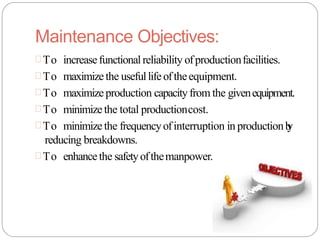
Maintenance Objectives:
 To increasefunctionalreliability ofproductionfacilities.
 To maximizethe usefullifeoftheequipment.
 To maximizeproduction capacityfrom the givenequipment.
 To minimizethe total productioncost.
 To minimizethe frequencyofinterruption in productionb
y
reducing breakdowns.
 To enhancethe safetyofthemanpower.
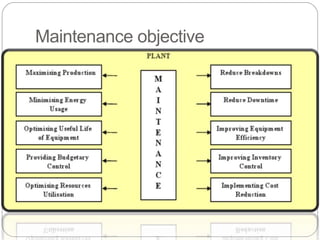
Maintenance objective
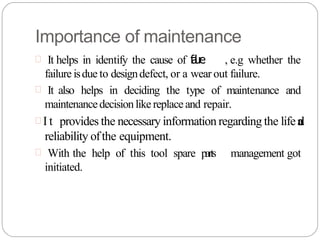
Importance of maintenance
 It helps in identify the cause of f
a
i
l
u
r
e , e.g whether the
failure isdue to designdefect, or a wear out failure.
 It also helps in deciding the type of maintenance and
maintenancedecisionlike replace and repair.
 I t provides the necessary information regarding the lifea
n
d
reliability ofthe equipment.
 With the help of this tool spare parts management got
initiated.
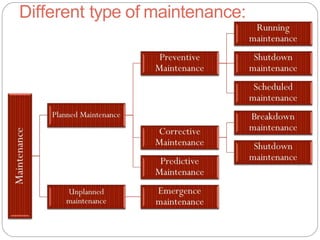
Different type of maintenance:
Planned Maintenance-
In planned maintenance the maintenance action is carried out
with some fore thoughts, prior planning , record keeping and
control action. Thesecanbefurther classifiedas:-
Preventive maintenance
Corrective maintenance
Predictive maintenance
 It isbasedupon the principle that ‘prevention isbetter than cure’.
 It isaset ofactivitiesthat are performed on plant equipment,
machinery, andsystemsbefore the occurrence ofafailure in
order to protect them andto prevent or eliminate any
degradationin their operating conditions.
 Or the maintenance carried out at predetermined intervalsor
accordingto prescribed criteria andintended to reduce the
probability offailure or the degradationofthe functioningandthe
effects limited.
 It hasthree types
 Running maintenance
 Scheduled maintenance
 Shutdown maintenance
Running maintenance:
Running maintenance which includes those maintenance
activities that are carried out while the machine or
equipment is running.
Example – lubrication, adjustment of nuts and screws,
tightening ofloosenut and bolts.
Scheduled Maintenance:
Scheduled Maintenance is any variety of scheduled
maintenanceto anobject or item of equipment.
Specifically, Planned Maintenance is a scheduled service visit
carried out by a competent and suitable agent, to ensure that
an item of equipment is operating correctly and to therefore
avoidanyunscheduledbreakdownand downtime.
Good example of PM program is car maintenance. After s
o
many kilometers or miles oil should be changed, parts
renewed.
Shut Down Maintenance:
Which is a set of preventive maintenance activities
that are carried out when the production line is in
total stoppage situation.
These are performed generally after three or six
months.
These involves the inspection of plant items which
are known or suspected to occur.
Corrective maintenance:
 In this type, actions such asrepair, replacement, or restore will b
e carried
out after the occurrence of a failure in order to eliminate the source of
this failure or reduce the frequency ofits occurrence.
 I t also include the different types of actions like typical adjustment
ofredesign equipment.
The difference between corrective maintenance a
n
dpreventive
maintenance is that for the corrective maintenance, the
failure shouldoccur before anycorrective action is taken.
 I t isoftwotypes
1. Breakdown maintenance
2. Shutdown maintenance
Breakdown Maintenance:
 I t isanemergencybasedpolicyin whichthe plant or
equipment isoperated until it failsandthen it isbrought back
into runningconditionby repair.
The maintenancestafflocate anymechanical, electrical o
r
anyother fault to correct it immediately.
 I t isfeasible for the smallfactorieswhere
1. There are fewtypesof equipment.
2. Machineandequipments are simpleanddoes not require any
specialist.
3. Where suddenfailuredoesnot causeanyseriousfinancial
loss.
Predictive maintenance:
As the names implies it involves the prediction of the failure
before it occurs, identifying the root cause for those failures
symptoms and eliminating those causes before they result in
extensive damageofthe equipment.
Type of maintenance performed continuously or at intervals
according to the requirements to diagnose and monitor a
condition or system. Also called condition based
maintenance.
Unplanned Maintenance:
Maintenance action whichiscarried out without anyfore
thoughtsor prior planning is called unplanned maintenance.
Emergency maintenanceisone ofthe exampleofunplanned
maintenance.
 In this type ofmaintenancethe maintenanceaction is
executed with the helpofallavailablemaintenanceresources
in least possibletime, without anymajor time lag.
Examples are gasleakagein chemicalplant, fire hazards,
breakdown ofboiler, turbine etc.
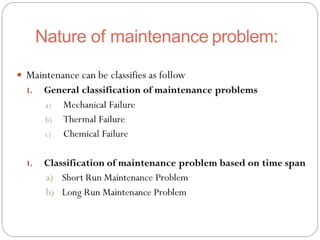
Nature of maintenance problem:
General classification Maintenance problem.
MechanicalFailure




Worn out bushesandbearingsandother movingparts.
Fatigueofmachine members
Creep ofmaterial at high temp
Excessiveforced vibration, misalignments etc.
ThermalFailure




Overheatingofthe component
Lackoflubrication
Inadequateofcooling
Electrical insulationfailure
ChemicalFailure


Highlycorrosive fluidscontainingabrasiveparticles
Failureofprotective liningslikeglass, rubber etc.
Classification maintenance problem
based on time span:
Short run productionproblem
Maintenanceproblem whichare carried out in asort period oftime
are known asshort run production system. It maybe hourly, daily
,weekly and monthly.
Example:-
Hourly- inspection ofcorrect lubricant, levelofcoolant, sharpness
ofcutting tool.
Daily- cleaningofm/c, tightening ofnuts, correct cooling,
inspection ofvariousindicators, minor adjustmentof parts.
Weekly- Majoradjustment, lubrication, tightening of parts.
Monthly- checkingfor insulation, corrosion, safetyguards,
checkingofworn-out anddistorted parts.
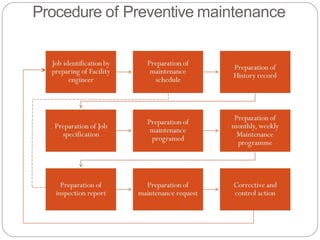
Procedure of Preventive maintenance
1. Job identification by preparing of
facility engineer
The veryfirst step ofPMPisto prepare the facility register
whichdefinesthat whatto be maintained.
2. Preparation of maintenance schedule
 I n this step we prepare a maintenance schedule. It is
simply a
comprehensive list of all the incident and their time of
incidence.
 I t givesthe usefulinformationregardingthe method, time a
n
dplace
of maintenance work, besides it also provides secondary
information aboutmaintenancemanpower requirement etc.
 I t gives the various details regarding maintenance like what, when,
how, where.
3. Preparation of historycard
 I t not only gives the useful information about the result o
f
maintenance events but also furnishes the essential details
regarding the uses of machines, free of failures and failure
modes.
4. Preparation of Jobspecification
 I n this step the job specification is prepared. It is
simply a
document which provide the essential information
regardingthe maintenancework to be done.
 I n general practice these job details are specifications compiled
from maintenance schedules.
They are a means of communicating the engineer’s requirement to
guidethe workers.
They are prepared separatelyfor eachjob.
5. Preparation of maintenance
Programming
 I t is a sequential list which allocates specific maintenance
work to aspecific period.
 I n order to apply the job specification, the maintenance
programme is generally prepared for long run when the
machines/ equipment are to be inspected.
 I t is not a good practice because an industry can not prepare a
long run production well in advance since too many factors
arise and they will result into change in production and
maintenance requirement.
 I t presents aoverall picture ofpresent and future maintenance
commitments.
6. Preparation of weekly/Monthly
maintenance programmes
The next step under plant maintenanceprocedure isto
prepare the weekly/ Monthlymaintenanceprogrammes.
Themaintenanceprogrammesinclude the following topics.
1. Reconditioningor replacingthe lubricating oil
2. Repairingandreplacingworn out parts andtools etc
3. Checkingallthe electrical connections ofthe system
4. Checkingthe control system
5. Checkingthe performance ofeach parts.
6. Cleaningthe interior parts likesparkplugs, filters radiators,
crankcase,cylinders etc.
7. It will lie under the longrun maintenance programmes.
7. Preparing of inspection report
This step is followed after the maintenance programme i
s
over. This is simply a document which furnishes the useful
information about the maintenance inspections which were
performed in the past.
8. Preparing of maintenance request
The next step under plant maintenance procedure is t
opreparation
of maintenance request. It is simply a document or various
maintenance suggestions and recommendation given by the
inspection report. Suggestions are the useful feedback information
that comesfrom users end workers.
9. Feedback mechanism
 I n the last step the application of corrective and control
actions are available on the basis of feedback mechanism.
These corrective actions should be applied to respective plant
facilities at the initial stage of maintenance planning or
design.
Schedules of preventive maintenance:
 I t is simply a comprehensive list of all the incident and their
time of incident. It gives the following useful information
regardingthe maintenance work.
i. What isto be done or maintained?
ii. Howisto be maintained?
iii. When isto be maintained?
Besides this it may also provide the secondary information
regarding the place of maintenance and maintenance
requirement.
Maintenance Strategy :
 A maintenancestrategy definesthe rules for the sequenceo
f
plannedmaintenancework. It containsgeneral scheduling
information, andcantherefore be assignedto asmany
maintenancetasklists (PMtasklists) andmaintenanceplans
asrequired.Amaintenancestrategy containsmaintenance
packagesin whichthe followinginformation is defined:
The cyclein whichthe individualwork shouldbe performed
(for example, everytwo months, every3,106.86 miles,
every500 operating hours)
Other datawhichaffectsscheduling
Structure:
Amaintenancestrategy consists of:
Strategy header: Nameofthe strategy,
Scheduling parameters: Contain the schedulingdata for
the respective maintenancestrategy, whichinfluencethe
schedulingofmaintenance plans.
Scheduling indicators
Maintenance packages
Scheduling Indicators:
Within amaintenancestrategy, youcanusedifferent
schedulingindicators to specifythe type ofschedulingyou
require or to defineacycle set:
Time-based (for example, every30 days)
Time-basedbykeydate (for example, every30 dayson t
h
e
30th dayofthe month)
Time-basedbyfactory calendar(for example, every3
0
working days)
 Performance-based(for example, every50 operating hours)
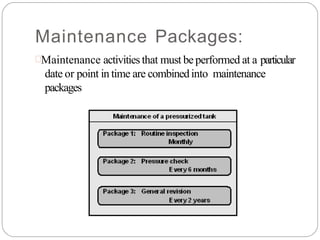
Maintenance Packages:
Maintenance activitiesthat must be performed at a particular
date or point in time are combinedinto maintenance
packages
Total Productive Maintenance
(TPM)
Total productive maintenance (TPM) originated in Japan in
1971 as a method for improved machine availability through
better utilization of maintenance and production resources
 I t can be considered as the medical science of machines.
Total Productive Maintenance (TPM) is a maintenance
program which involves a newly defined concept for
maintaining plants and equipment.
 The goal of the TPM program is to markedly increase
production while, at the same time, increasing employee
morale and job satisfaction.

TPM brings maintenance into focus as a
necessary and vitally important part ofthe
business.
 It is no longer regarded as a non-profitactivity.
Down time for maintenance is scheduled as a
part of the manufacturing day and, in some
cases, as an integral part of themanufacturing
process.
 The goal is to hold emergency and unscheduled
maintenance to aminimum.
Why TPM :
TPM wasintroduced to achievethe following objectives.
Theimportant onesare listed below.
Avoid wastagein aquicklychangingeconomicenvironment.
Producing goodswithout reducing product quality.
Reduce cost.
Produce alowbatchquantity at the earliest possibletime.
Goods sendto the customers must be non defective.
Conclusion:
Today, with competition in industry at analltime high,T
P
M
maybe the onlything that standsbetween successandtotal
failure for some companies.
 I t hasbeen proven to be aprogramthat works. It canbe adapted
to work not onlyin industrial plants, but in construction,
buildingmaintenance, transportation, andin avariety ofother
situations.
 If everyoneinvolvedin aTPMprogram doeshisor her part, a
n
unusuallyhighrate ofreturn compared to resources invested
maybe expected.

INTRODUCTION OF MAINTENANCE.pptx

  • 1.
    L12-44-32 (EQUIPMENT MAINTENANCE) Introductionto Maintenance PREPARED BY:MOHD EKHWAN BIN RAHIM MECHATRONICS ADTEC MELAKA
  • 2.
    Introduction: Plant maintenance isanimportantservicefunction ofany efficient production system.  It helps in maintaining and increasing the operational efficiency ofplant facilities. Maintenance is the procedure of finding the faults in any equipment/Machine andalsoremovalof fault.  I t maybe before the breakdownor after thebreakdown.
  • 3.
    Plant maintenance usuallyrefers to the methods, strategies, and practices used to keep an industrial factory running efficiently. This can include anything from regular checks of equipment to makesure they are functioning properly. The general aim of plant maintenance isto create a productive workingenvironment that isalsosafefor workers.
  • 4.
    Maintenance Objectives:  Toincreasefunctionalreliability ofproductionfacilities.  To maximizethe usefullifeoftheequipment.  To maximizeproduction capacityfrom the givenequipment.  To minimizethe total productioncost.  To minimizethe frequencyofinterruption in productionb y reducing breakdowns.  To enhancethe safetyofthemanpower.
  • 5.
  • 6.
    Importance of maintenance It helps in identify the cause of f a i l u r e , e.g whether the failure isdue to designdefect, or a wear out failure.  It also helps in deciding the type of maintenance and maintenancedecisionlike replace and repair.  I t provides the necessary information regarding the lifea n d reliability ofthe equipment.  With the help of this tool spare parts management got initiated.
  • 7.
    Different type ofmaintenance:
  • 8.
    Planned Maintenance- In plannedmaintenance the maintenance action is carried out with some fore thoughts, prior planning , record keeping and control action. Thesecanbefurther classifiedas:- Preventive maintenance Corrective maintenance Predictive maintenance
  • 9.
     It isbaseduponthe principle that ‘prevention isbetter than cure’.  It isaset ofactivitiesthat are performed on plant equipment, machinery, andsystemsbefore the occurrence ofafailure in order to protect them andto prevent or eliminate any degradationin their operating conditions.  Or the maintenance carried out at predetermined intervalsor accordingto prescribed criteria andintended to reduce the probability offailure or the degradationofthe functioningandthe effects limited.  It hasthree types  Running maintenance  Scheduled maintenance  Shutdown maintenance
  • 10.
    Running maintenance: Running maintenancewhich includes those maintenance activities that are carried out while the machine or equipment is running. Example – lubrication, adjustment of nuts and screws, tightening ofloosenut and bolts.
  • 11.
    Scheduled Maintenance: Scheduled Maintenanceis any variety of scheduled maintenanceto anobject or item of equipment. Specifically, Planned Maintenance is a scheduled service visit carried out by a competent and suitable agent, to ensure that an item of equipment is operating correctly and to therefore avoidanyunscheduledbreakdownand downtime. Good example of PM program is car maintenance. After s o many kilometers or miles oil should be changed, parts renewed.
  • 12.
    Shut Down Maintenance: Whichis a set of preventive maintenance activities that are carried out when the production line is in total stoppage situation. These are performed generally after three or six months. These involves the inspection of plant items which are known or suspected to occur.
  • 13.
    Corrective maintenance:  Inthis type, actions such asrepair, replacement, or restore will b e carried out after the occurrence of a failure in order to eliminate the source of this failure or reduce the frequency ofits occurrence.  I t also include the different types of actions like typical adjustment ofredesign equipment. The difference between corrective maintenance a n dpreventive maintenance is that for the corrective maintenance, the failure shouldoccur before anycorrective action is taken.  I t isoftwotypes 1. Breakdown maintenance 2. Shutdown maintenance
  • 14.
    Breakdown Maintenance:  It isanemergencybasedpolicyin whichthe plant or equipment isoperated until it failsandthen it isbrought back into runningconditionby repair. The maintenancestafflocate anymechanical, electrical o r anyother fault to correct it immediately.  I t isfeasible for the smallfactorieswhere 1. There are fewtypesof equipment. 2. Machineandequipments are simpleanddoes not require any specialist. 3. Where suddenfailuredoesnot causeanyseriousfinancial loss.
  • 15.
    Predictive maintenance: As thenames implies it involves the prediction of the failure before it occurs, identifying the root cause for those failures symptoms and eliminating those causes before they result in extensive damageofthe equipment. Type of maintenance performed continuously or at intervals according to the requirements to diagnose and monitor a condition or system. Also called condition based maintenance.
  • 16.
    Unplanned Maintenance: Maintenance actionwhichiscarried out without anyfore thoughtsor prior planning is called unplanned maintenance. Emergency maintenanceisone ofthe exampleofunplanned maintenance.  In this type ofmaintenancethe maintenanceaction is executed with the helpofallavailablemaintenanceresources in least possibletime, without anymajor time lag. Examples are gasleakagein chemicalplant, fire hazards, breakdown ofboiler, turbine etc.
  • 17.
  • 18.
    General classification Maintenanceproblem. MechanicalFailure     Worn out bushesandbearingsandother movingparts. Fatigueofmachine members Creep ofmaterial at high temp Excessiveforced vibration, misalignments etc. ThermalFailure     Overheatingofthe component Lackoflubrication Inadequateofcooling Electrical insulationfailure ChemicalFailure   Highlycorrosive fluidscontainingabrasiveparticles Failureofprotective liningslikeglass, rubber etc.
  • 19.
    Classification maintenance problem basedon time span: Short run productionproblem Maintenanceproblem whichare carried out in asort period oftime are known asshort run production system. It maybe hourly, daily ,weekly and monthly. Example:- Hourly- inspection ofcorrect lubricant, levelofcoolant, sharpness ofcutting tool. Daily- cleaningofm/c, tightening ofnuts, correct cooling, inspection ofvariousindicators, minor adjustmentof parts. Weekly- Majoradjustment, lubrication, tightening of parts. Monthly- checkingfor insulation, corrosion, safetyguards, checkingofworn-out anddistorted parts.
  • 20.
  • 21.
    1. Job identificationby preparing of facility engineer The veryfirst step ofPMPisto prepare the facility register whichdefinesthat whatto be maintained. 2. Preparation of maintenance schedule  I n this step we prepare a maintenance schedule. It is simply a comprehensive list of all the incident and their time of incidence.  I t givesthe usefulinformationregardingthe method, time a n dplace of maintenance work, besides it also provides secondary information aboutmaintenancemanpower requirement etc.  I t gives the various details regarding maintenance like what, when, how, where.
  • 22.
    3. Preparation ofhistorycard  I t not only gives the useful information about the result o f maintenance events but also furnishes the essential details regarding the uses of machines, free of failures and failure modes. 4. Preparation of Jobspecification  I n this step the job specification is prepared. It is simply a document which provide the essential information regardingthe maintenancework to be done.  I n general practice these job details are specifications compiled from maintenance schedules. They are a means of communicating the engineer’s requirement to guidethe workers. They are prepared separatelyfor eachjob.
  • 23.
    5. Preparation ofmaintenance Programming  I t is a sequential list which allocates specific maintenance work to aspecific period.  I n order to apply the job specification, the maintenance programme is generally prepared for long run when the machines/ equipment are to be inspected.  I t is not a good practice because an industry can not prepare a long run production well in advance since too many factors arise and they will result into change in production and maintenance requirement.  I t presents aoverall picture ofpresent and future maintenance commitments.
  • 24.
    6. Preparation ofweekly/Monthly maintenance programmes The next step under plant maintenanceprocedure isto prepare the weekly/ Monthlymaintenanceprogrammes. Themaintenanceprogrammesinclude the following topics. 1. Reconditioningor replacingthe lubricating oil 2. Repairingandreplacingworn out parts andtools etc 3. Checkingallthe electrical connections ofthe system 4. Checkingthe control system 5. Checkingthe performance ofeach parts. 6. Cleaningthe interior parts likesparkplugs, filters radiators, crankcase,cylinders etc. 7. It will lie under the longrun maintenance programmes.
  • 25.
    7. Preparing ofinspection report This step is followed after the maintenance programme i s over. This is simply a document which furnishes the useful information about the maintenance inspections which were performed in the past. 8. Preparing of maintenance request The next step under plant maintenance procedure is t opreparation of maintenance request. It is simply a document or various maintenance suggestions and recommendation given by the inspection report. Suggestions are the useful feedback information that comesfrom users end workers.
  • 26.
    9. Feedback mechanism I n the last step the application of corrective and control actions are available on the basis of feedback mechanism. These corrective actions should be applied to respective plant facilities at the initial stage of maintenance planning or design.
  • 27.
    Schedules of preventivemaintenance:  I t is simply a comprehensive list of all the incident and their time of incident. It gives the following useful information regardingthe maintenance work. i. What isto be done or maintained? ii. Howisto be maintained? iii. When isto be maintained? Besides this it may also provide the secondary information regarding the place of maintenance and maintenance requirement.
  • 28.
    Maintenance Strategy : A maintenancestrategy definesthe rules for the sequenceo f plannedmaintenancework. It containsgeneral scheduling information, andcantherefore be assignedto asmany maintenancetasklists (PMtasklists) andmaintenanceplans asrequired.Amaintenancestrategy containsmaintenance packagesin whichthe followinginformation is defined: The cyclein whichthe individualwork shouldbe performed (for example, everytwo months, every3,106.86 miles, every500 operating hours) Other datawhichaffectsscheduling
  • 29.
    Structure: Amaintenancestrategy consists of: Strategyheader: Nameofthe strategy, Scheduling parameters: Contain the schedulingdata for the respective maintenancestrategy, whichinfluencethe schedulingofmaintenance plans. Scheduling indicators Maintenance packages
  • 30.
    Scheduling Indicators: Within amaintenancestrategy,youcanusedifferent schedulingindicators to specifythe type ofschedulingyou require or to defineacycle set: Time-based (for example, every30 days) Time-basedbykeydate (for example, every30 dayson t h e 30th dayofthe month) Time-basedbyfactory calendar(for example, every3 0 working days)  Performance-based(for example, every50 operating hours)
  • 31.
    Maintenance Packages: Maintenance activitiesthatmust be performed at a particular date or point in time are combinedinto maintenance packages
  • 32.
    Total Productive Maintenance (TPM) Totalproductive maintenance (TPM) originated in Japan in 1971 as a method for improved machine availability through better utilization of maintenance and production resources  I t can be considered as the medical science of machines. Total Productive Maintenance (TPM) is a maintenance program which involves a newly defined concept for maintaining plants and equipment.  The goal of the TPM program is to markedly increase production while, at the same time, increasing employee morale and job satisfaction. 
  • 33.
    TPM brings maintenanceinto focus as a necessary and vitally important part ofthe business.  It is no longer regarded as a non-profitactivity. Down time for maintenance is scheduled as a part of the manufacturing day and, in some cases, as an integral part of themanufacturing process.  The goal is to hold emergency and unscheduled maintenance to aminimum.
  • 34.
    Why TPM : TPMwasintroduced to achievethe following objectives. Theimportant onesare listed below. Avoid wastagein aquicklychangingeconomicenvironment. Producing goodswithout reducing product quality. Reduce cost. Produce alowbatchquantity at the earliest possibletime. Goods sendto the customers must be non defective.
  • 35.
    Conclusion: Today, with competitionin industry at analltime high,T P M maybe the onlything that standsbetween successandtotal failure for some companies.  I t hasbeen proven to be aprogramthat works. It canbe adapted to work not onlyin industrial plants, but in construction, buildingmaintenance, transportation, andin avariety ofother situations.  If everyoneinvolvedin aTPMprogram doeshisor her part, a n unusuallyhighrate ofreturn compared to resources invested maybe expected.