Marketing Research & Social Communication
Lesson 9
Customer Satisfaction
Ray Poynter
1Ray Poynter, Marketing Research & Social Communication, 2015
Agenda
1. Updates and last week’s homework
2. Why do brands conduct customer
satisfaction research?
3. A typical customer satisfaction study
4. Further topics
5. Big Picture
6. Quiz and assignment for next week
Ray Poynter, Marketing Research & Social Communication, 2015 2
Updates
• http://newmr.org/saitama-2015/
• Previous Quizzes – all previous quizzes,
i.e. Lesson 3 onwards, now on the website
• Review of last week’s quiz
Ray Poynter, Marketing Research & Social Communication, 2015 3
Homework Feedback
Information you have found out about the
Japanese Kombini market (Convenience
Stores in English outside of Japan)
Ray Poynter, Marketing Research & Social Communication, 2015 4
Key Words
• Customer Satisfaction: The study of what
customers think about a service or product
and the impact that has on the business
• Brand Equity: A measure of how much
people like a brand
• NPS: Net Promoter Score, one method of
measuring satisfaction and brand equity
• B2B: Business to Business, research where
the participants represent organizations
• Research participants: We used to call
these respondents, e.g. people who fill in
surveys or take part in focus groups
Ray Poynter, Marketing Research & Social Communication, 2015 5
Why do brands conduct
customer satisfaction research?
Belief that satisfied customers are good for business
– Belief that dissatisfied customers are bad for business
Key factors/beliefs
– Customers have choices
– Acquiring new customers costs more than retaining an existing
customer
– Satisfaction makes re-purchase more likely – and leads to
positive word of mouth (WOM)
– Dissatisfaction discourages repurchase and leads to negative
word of mouth (WOM)
– Customers can tell you useful things about your own products or
services, including how to improve them and how to meet unmet
needs.
– Involving customers in evaluating the brand makes them more
engaged, which can help build brand loyalty/engagement/affinity
Ray Poynter, Marketing Research & Social Communication, 2015 6
Maritz Customer Satisfaction
Ray Poynter, Marketing Research & Social Communication, 2015 7
Types of Customer
Satisfaction Research
Most Customer Research is quant
– Surveys (most common tool)
– Social media research
– Mystery shopping (sometimes qual)
Qual mostly used to explore issues
Ray Poynter, Marketing Research & Social Communication, 2015 8
Typical Customer Satisfaction Survey
1. Screener and Quota questions
– Are we talking to the right people?
2. Overall satisfaction
– Followed by Reasons
3. Services/features used
4. Satisfaction with services/features
– Reasons
5. Demographics
– B2B, firmographics or corpographics
6. Final questions
– e.g. comments on survey
Ray Poynter, Marketing Research & Social Communication, 2015 9
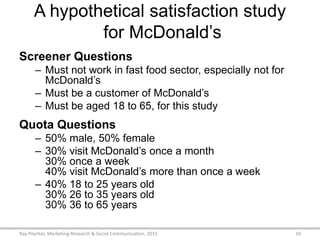
A hypothetical satisfaction study
for McDonald’s
Screener Questions
– Must not work in fast food sector, especially not for
McDonald’s
– Must be a customer of McDonald’s
– Must be aged 18 to 65, for this study
Quota Questions
– 50% male, 50% female
– 30% visit McDonald’s once a month
30% once a week
40% visit McDonald’s more than once a week
– 40% 18 to 25 years old
30% 26 to 35 years old
30% 36 to 65 years
Ray Poynter, Marketing Research & Social Communication, 2015 10
A satisfaction study for McDonald’s
Screener Questions
– Do you work in any of the following areas?
• Health services
• Financial services
• Market research [Close]
• Restaurants or fast food outlets [Close]
• Sports and entertainment
• None of these
Ray Poynter, Marketing Research & Social Communication, 2015 11
A satisfaction study for McDonald’s
Quota/Screener Questions
– How old are you?
• Under 18 years [Close]
• 18 to 25 years [Check Quota]
• 26 to 35 years [Check Quota]
• 36 to 45 years [Check Quota]
• 46 to 55 years [Check Quota]
• 56 to 65 years [Check Quota]
• Over 65 years [Close]
Ray Poynter, Marketing Research & Social Communication, 2015 12
A satisfaction study for McDonald’s
Quota/Screener Questions
– How often do you visit a McDonald’s?
• More than once a week [Check Quota]
• About once a week [Check Quota]
• At least once a month [Check Quota]
• Less than once a month [Close]
• Never [Close]
Ray Poynter, Marketing Research & Social Communication, 2015 13
A satisfaction study for McDonald’s
Overall Satisfaction
– In general, how satisfied are you with
McDonald’s?
1. Very Dissatisfied
2. Dissatisfied
3. Neither Satisfied nor Dissatisfied
4. Satisfied
5. Very Satisfied
Ray Poynter, Marketing Research & Social Communication, 2015 14
A satisfaction study for McDonald’s
Overall Satisfaction
– You said you were [PIPED TEXT] with
McDonald’s. In you own words can you tell us
why, typing in the box below?
Ray Poynter, Marketing Research & Social Communication, 2015 15
PIPED TEXT is the option they picked in the previous question, e.g. “Very Satisfied”
A satisfaction study for McDonald’s
Services/features used
– Which of the following have you done at
McDonald’s in the last month?
• Eat breakfast
• Eat a burger or hot sandwich
• Eat fries
• Eat a salad
• Used the toilet
• Drank a hot drink
• Drank a cold drink
• Spoken with the staff
Ray Poynter, Marketing Research & Social Communication, 2015 16
In the ‘old days’ we might ask
people questions about every
service/feature they had used.
Which made a very long survey.
Today, it is more usual to ask about
a sub-set, perhaps 3 services
features, often selected via quotas.
A satisfaction study for McDonald’s
Detailed Questions
– For example eating breakfast
• When did you last eat a McDonald’s breakfast?
• What did you order?
• Did you eat it at McDonald’s or take it away?
• How satisfied were you with the service?
• How satisfied were you with the food?
• Would you recommend McDonald’s breakfast to
your friends, colleagues, or family?
Ray Poynter, Marketing Research & Social Communication, 2015 17
A satisfaction study for McDonald’s
Demographics
– For example
• Marital status
• City/Region
• Other fast food outlets used
• Employment
• TV channels watched
• Social Media used
Ray Poynter, Marketing Research & Social Communication, 2015 18
A satisfaction study for McDonald’s
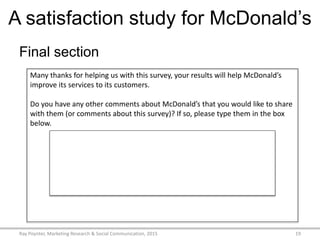
Final section
Ray Poynter, Marketing Research & Social Communication, 2015 19
Many thanks for helping us with this survey, your results will help McDonald’s
improve its services to its customers.
Do you have any other comments about McDonald’s that you would like to share
with them (or comments about this survey)? If so, please type them in the box
below.
Car Dealer Example
Ray Poynter, Marketing Research & Social Communication, 2015 20
Further Topics
• More key terms
• B2B vs B2C
• Social media
• Mystery shopping
• Qualitative customer satisfaction research
• Online communities
• NPS
• Driver analysis
Ray Poynter, Marketing Research & Social Communication, 2015 21
More Key Terms
• Churn – the percentage of customers who leave a brand
each year. For example 10% of people may change their
telephone provider from one year to another – meaning the
churn is 10%.
• Loyalty – the degree to which customers stay with a brand.
Loyalty is not easy to define. If you are the only supplier, are
your customers loyal? If you are the cheapest, are your
customers loyal?
• Lifetime Customer Value – assessing a customer in terms of
what they might spend in the future. This increases the value
of the customer and helps justify dealing with their problems.
• Advocacy – when your customers start persuading other
people to start buying your service or product.
• WOM – Word of Mouth – many messages in society spread
from person-to-person, not from brand to people – this is
called Word of Mouth.
Ray Poynter, Marketing Research & Social Communication, 2015 22
B2B – Business to Business
(B2C – Business to Consumer)
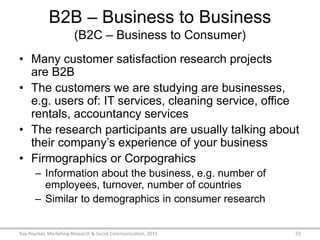
• Many customer satisfaction research projects
are B2B
• The customers we are studying are businesses,
e.g. users of: IT services, cleaning service, office
rentals, accountancy services
• The research participants are usually talking about
their company’s experience of your business
• Firmographics or Corpograhics
– Information about the business, e.g. number of
employees, turnover, number of countries
– Similar to demographics in consumer research
Ray Poynter, Marketing Research & Social Communication, 2015 23
Social Media and Customer
Satisfaction
Most brands now listen to social media to
help identify problems
– Some also use it more formally to calculate
customer satisfaction scores
Three uses of social media
– Dealing with problems, ideally a census
– Quant research – measuring performance
– Qual research – trying to understand what is
happening
Ray Poynter, Marketing Research & Social Communication, 2015 24
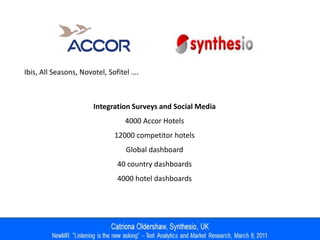
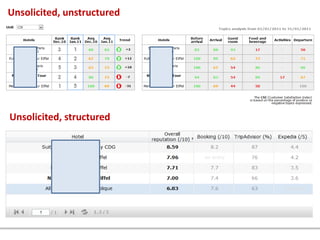
Ibis, All Seasons, Novotel, Sofitel ….
Integration Surveys and Social Media
4000 Accor Hotels
12000 competitor hotels
Global dashboard
40 country dashboards
4000 hotel dashboards
Unsolicited, unstructured
Unsolicited, structured
Mystery Shopping
• Research participants use a service to
‘secretly’ check out the quality
– Ring a help line, check the procedures and
delays
– Shop in a store, check products, the way people
are served, the way the bag is packed
– Eat in a restaurant and score it on speed,
cleanliness, quality etc
• Sometimes quant, but sometimes simply an
investigation
• Usually uses a systematic system of scoring
performance
Ray Poynter, Marketing Research & Social Communication, 2015 28
Qualitative Customer
Satisfaction Research
Most customer satisfaction research is
focused on measuring, so it is quant
Qual is used for:
– Exploring problems
– Exploring solutions
– In mystery shopping
Ray Poynter, Marketing Research & Social Communication, 2015 29
Online Communities
and Customer Satisfaction
Ray Poynter, Marketing Research & Social Communication, 2015 30
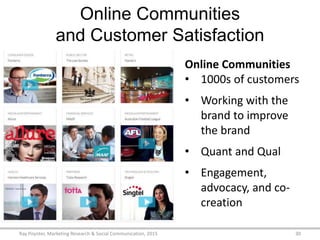
Online Communities
• 1000s of customers
• Working with the
brand to improve
the brand
• Quant and Qual
• Engagement,
advocacy, and co-
creation
NPS – Net Promoter Score
A single number
– Developed by US Fred Reichheld in 2003
– Very popular with some businesses
– Especially CEOs, COOs and CFOs
– Researchers are not convinced that it does
what it claims
• The claim is that it has a causal link with sales
growth (or profit) but that has not been supported
– But, important people like it
• And it probably is useful, even if it is not the ‘ONE’
number you need to know
Ray Poynter, Marketing Research & Social Communication, 2015 31
NPS
Ray Poynter, Marketing Research & Social Communication, 2015 32
Calculating NPS
– How likely is it that you would recommend
Lawsons to a friend or colleague?
Please use the 0-10 scale where 10 means Extremely
Likely and 0 means Extremely Unlikely
– Calculate the following percentages
• 9 or 10 – the Promoters
• 7 or 8 – the Neutral
• 0 to 6 – the Detractors
– NPS = Promoters% - Detractors %
– NPS can range from -100 to +100
Ray Poynter, Marketing Research & Social Communication, 2015 33
Driver Analysis
For example, for McDonald’s estimate the link
between satisfaction with the following
elements and future sales
– Price
– The eating area
– The burgers
– The chips
– The drinks
– The staff
The answers can inform management action
and help determine spending priorities
Ray Poynter, Marketing Research & Social Communication, 2015 34
Trends in Customer
Satisfaction Research
• The starting point is measuring satisfaction
via surveys
– The trends are movement away from this
• Social Media Research
• Online communities
• Engagement
• Advocacy
• Customer Centricity
Ray Poynter, Marketing Research & Social Communication, 2015 35
Customer Centricity
Ray Poynter, Marketing Research & Social Communication, 2015 36
Key Words
• Customer Satisfaction: The study of what
customers think about a service or product
and the impact that has on the business
• Brand Equity: A measure of how much
people like a brand
• NPS: Net Promoter Score, one method of
measuring satisfaction and brand equity
• B2B: Business to Business, research where
the participants represent organizations
• Research participants: We used to call
these respondents, e.g. people who fill in
surveys or take part in focus groups
Ray Poynter, Marketing Research & Social Communication, 2015 37
Big Picture
1. Customer satisfaction research is currently a
large part of many research budgets
2. Customer satisfaction research is mainly
quant and at the moment mostly conducted
via surveys
– But that is likely to change
3. The aim of companies conducting customer
satisfaction research is to increase growth
and profit by increasing customers’
satisfaction with the services or product
Ray Poynter, Marketing Research & Social Communication, 2015 38
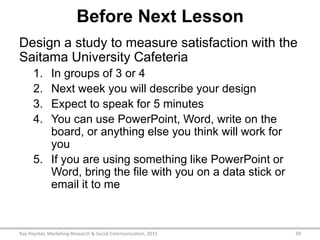
Before Next Lesson
Design a study to measure satisfaction with the
Saitama University Cafeteria
1. In groups of 3 or 4
2. Next week you will describe your design
3. Expect to speak for 5 minutes
4. You can use PowerPoint, Word, write on the
board, or anything else you think will work for
you
5. If you are using something like PowerPoint or
Word, bring the file with you on a data stick or
email it to me
Ray Poynter, Marketing Research & Social Communication, 2015 39
Questions?
Ray Poynter, Marketing Research & Social Communication, 2015 40
Quiz Lesson 9
Ray Poynter, Marketing Research & Social Communication, 2015 41
Please complete the quiz sheet
Put your name on the sheet
Resources and Links
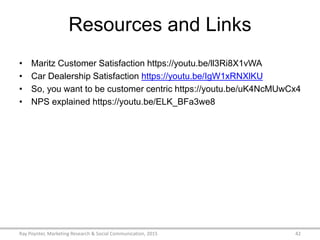
• Maritz Customer Satisfaction https://youtu.be/ll3Ri8X1vWA
• Car Dealership Satisfaction https://youtu.be/IgW1xRNXlKU
• So, you want to be customer centric https://youtu.be/uK4NcMUwCx4
• NPS explained https://youtu.be/ELK_BFa3we8
Ray Poynter, Marketing Research & Social Communication, 2015 42

Poynter Lesson 9

  • 1.
    Marketing Research &Social Communication Lesson 9 Customer Satisfaction Ray Poynter 1Ray Poynter, Marketing Research & Social Communication, 2015
  • 2.
    Agenda 1. Updates andlast week’s homework 2. Why do brands conduct customer satisfaction research? 3. A typical customer satisfaction study 4. Further topics 5. Big Picture 6. Quiz and assignment for next week Ray Poynter, Marketing Research & Social Communication, 2015 2
  • 3.
    Updates • http://newmr.org/saitama-2015/ • PreviousQuizzes – all previous quizzes, i.e. Lesson 3 onwards, now on the website • Review of last week’s quiz Ray Poynter, Marketing Research & Social Communication, 2015 3
  • 4.
    Homework Feedback Information youhave found out about the Japanese Kombini market (Convenience Stores in English outside of Japan) Ray Poynter, Marketing Research & Social Communication, 2015 4
  • 5.
    Key Words • CustomerSatisfaction: The study of what customers think about a service or product and the impact that has on the business • Brand Equity: A measure of how much people like a brand • NPS: Net Promoter Score, one method of measuring satisfaction and brand equity • B2B: Business to Business, research where the participants represent organizations • Research participants: We used to call these respondents, e.g. people who fill in surveys or take part in focus groups Ray Poynter, Marketing Research & Social Communication, 2015 5
  • 6.
    Why do brandsconduct customer satisfaction research? Belief that satisfied customers are good for business – Belief that dissatisfied customers are bad for business Key factors/beliefs – Customers have choices – Acquiring new customers costs more than retaining an existing customer – Satisfaction makes re-purchase more likely – and leads to positive word of mouth (WOM) – Dissatisfaction discourages repurchase and leads to negative word of mouth (WOM) – Customers can tell you useful things about your own products or services, including how to improve them and how to meet unmet needs. – Involving customers in evaluating the brand makes them more engaged, which can help build brand loyalty/engagement/affinity Ray Poynter, Marketing Research & Social Communication, 2015 6
  • 7.
    Maritz Customer Satisfaction RayPoynter, Marketing Research & Social Communication, 2015 7
  • 8.
    Types of Customer SatisfactionResearch Most Customer Research is quant – Surveys (most common tool) – Social media research – Mystery shopping (sometimes qual) Qual mostly used to explore issues Ray Poynter, Marketing Research & Social Communication, 2015 8
  • 9.
    Typical Customer SatisfactionSurvey 1. Screener and Quota questions – Are we talking to the right people? 2. Overall satisfaction – Followed by Reasons 3. Services/features used 4. Satisfaction with services/features – Reasons 5. Demographics – B2B, firmographics or corpographics 6. Final questions – e.g. comments on survey Ray Poynter, Marketing Research & Social Communication, 2015 9
  • 10.
    A hypothetical satisfactionstudy for McDonald’s Screener Questions – Must not work in fast food sector, especially not for McDonald’s – Must be a customer of McDonald’s – Must be aged 18 to 65, for this study Quota Questions – 50% male, 50% female – 30% visit McDonald’s once a month 30% once a week 40% visit McDonald’s more than once a week – 40% 18 to 25 years old 30% 26 to 35 years old 30% 36 to 65 years Ray Poynter, Marketing Research & Social Communication, 2015 10
  • 11.
    A satisfaction studyfor McDonald’s Screener Questions – Do you work in any of the following areas? • Health services • Financial services • Market research [Close] • Restaurants or fast food outlets [Close] • Sports and entertainment • None of these Ray Poynter, Marketing Research & Social Communication, 2015 11
  • 12.
    A satisfaction studyfor McDonald’s Quota/Screener Questions – How old are you? • Under 18 years [Close] • 18 to 25 years [Check Quota] • 26 to 35 years [Check Quota] • 36 to 45 years [Check Quota] • 46 to 55 years [Check Quota] • 56 to 65 years [Check Quota] • Over 65 years [Close] Ray Poynter, Marketing Research & Social Communication, 2015 12
  • 13.
    A satisfaction studyfor McDonald’s Quota/Screener Questions – How often do you visit a McDonald’s? • More than once a week [Check Quota] • About once a week [Check Quota] • At least once a month [Check Quota] • Less than once a month [Close] • Never [Close] Ray Poynter, Marketing Research & Social Communication, 2015 13
  • 14.
    A satisfaction studyfor McDonald’s Overall Satisfaction – In general, how satisfied are you with McDonald’s? 1. Very Dissatisfied 2. Dissatisfied 3. Neither Satisfied nor Dissatisfied 4. Satisfied 5. Very Satisfied Ray Poynter, Marketing Research & Social Communication, 2015 14
  • 15.
    A satisfaction studyfor McDonald’s Overall Satisfaction – You said you were [PIPED TEXT] with McDonald’s. In you own words can you tell us why, typing in the box below? Ray Poynter, Marketing Research & Social Communication, 2015 15 PIPED TEXT is the option they picked in the previous question, e.g. “Very Satisfied”
  • 16.
    A satisfaction studyfor McDonald’s Services/features used – Which of the following have you done at McDonald’s in the last month? • Eat breakfast • Eat a burger or hot sandwich • Eat fries • Eat a salad • Used the toilet • Drank a hot drink • Drank a cold drink • Spoken with the staff Ray Poynter, Marketing Research & Social Communication, 2015 16 In the ‘old days’ we might ask people questions about every service/feature they had used. Which made a very long survey. Today, it is more usual to ask about a sub-set, perhaps 3 services features, often selected via quotas.
  • 17.
    A satisfaction studyfor McDonald’s Detailed Questions – For example eating breakfast • When did you last eat a McDonald’s breakfast? • What did you order? • Did you eat it at McDonald’s or take it away? • How satisfied were you with the service? • How satisfied were you with the food? • Would you recommend McDonald’s breakfast to your friends, colleagues, or family? Ray Poynter, Marketing Research & Social Communication, 2015 17
  • 18.
    A satisfaction studyfor McDonald’s Demographics – For example • Marital status • City/Region • Other fast food outlets used • Employment • TV channels watched • Social Media used Ray Poynter, Marketing Research & Social Communication, 2015 18
  • 19.
    A satisfaction studyfor McDonald’s Final section Ray Poynter, Marketing Research & Social Communication, 2015 19 Many thanks for helping us with this survey, your results will help McDonald’s improve its services to its customers. Do you have any other comments about McDonald’s that you would like to share with them (or comments about this survey)? If so, please type them in the box below.
  • 20.
    Car Dealer Example RayPoynter, Marketing Research & Social Communication, 2015 20
  • 21.
    Further Topics • Morekey terms • B2B vs B2C • Social media • Mystery shopping • Qualitative customer satisfaction research • Online communities • NPS • Driver analysis Ray Poynter, Marketing Research & Social Communication, 2015 21
  • 22.
    More Key Terms •Churn – the percentage of customers who leave a brand each year. For example 10% of people may change their telephone provider from one year to another – meaning the churn is 10%. • Loyalty – the degree to which customers stay with a brand. Loyalty is not easy to define. If you are the only supplier, are your customers loyal? If you are the cheapest, are your customers loyal? • Lifetime Customer Value – assessing a customer in terms of what they might spend in the future. This increases the value of the customer and helps justify dealing with their problems. • Advocacy – when your customers start persuading other people to start buying your service or product. • WOM – Word of Mouth – many messages in society spread from person-to-person, not from brand to people – this is called Word of Mouth. Ray Poynter, Marketing Research & Social Communication, 2015 22
  • 23.
    B2B – Businessto Business (B2C – Business to Consumer) • Many customer satisfaction research projects are B2B • The customers we are studying are businesses, e.g. users of: IT services, cleaning service, office rentals, accountancy services • The research participants are usually talking about their company’s experience of your business • Firmographics or Corpograhics – Information about the business, e.g. number of employees, turnover, number of countries – Similar to demographics in consumer research Ray Poynter, Marketing Research & Social Communication, 2015 23
  • 24.
    Social Media andCustomer Satisfaction Most brands now listen to social media to help identify problems – Some also use it more formally to calculate customer satisfaction scores Three uses of social media – Dealing with problems, ideally a census – Quant research – measuring performance – Qual research – trying to understand what is happening Ray Poynter, Marketing Research & Social Communication, 2015 24
  • 25.
    Ibis, All Seasons,Novotel, Sofitel …. Integration Surveys and Social Media 4000 Accor Hotels 12000 competitor hotels Global dashboard 40 country dashboards 4000 hotel dashboards
  • 27.
  • 28.
    Mystery Shopping • Researchparticipants use a service to ‘secretly’ check out the quality – Ring a help line, check the procedures and delays – Shop in a store, check products, the way people are served, the way the bag is packed – Eat in a restaurant and score it on speed, cleanliness, quality etc • Sometimes quant, but sometimes simply an investigation • Usually uses a systematic system of scoring performance Ray Poynter, Marketing Research & Social Communication, 2015 28
  • 29.
    Qualitative Customer Satisfaction Research Mostcustomer satisfaction research is focused on measuring, so it is quant Qual is used for: – Exploring problems – Exploring solutions – In mystery shopping Ray Poynter, Marketing Research & Social Communication, 2015 29
  • 30.
    Online Communities and CustomerSatisfaction Ray Poynter, Marketing Research & Social Communication, 2015 30 Online Communities • 1000s of customers • Working with the brand to improve the brand • Quant and Qual • Engagement, advocacy, and co- creation
  • 31.
    NPS – NetPromoter Score A single number – Developed by US Fred Reichheld in 2003 – Very popular with some businesses – Especially CEOs, COOs and CFOs – Researchers are not convinced that it does what it claims • The claim is that it has a causal link with sales growth (or profit) but that has not been supported – But, important people like it • And it probably is useful, even if it is not the ‘ONE’ number you need to know Ray Poynter, Marketing Research & Social Communication, 2015 31
  • 32.
    NPS Ray Poynter, MarketingResearch & Social Communication, 2015 32
  • 33.
    Calculating NPS – Howlikely is it that you would recommend Lawsons to a friend or colleague? Please use the 0-10 scale where 10 means Extremely Likely and 0 means Extremely Unlikely – Calculate the following percentages • 9 or 10 – the Promoters • 7 or 8 – the Neutral • 0 to 6 – the Detractors – NPS = Promoters% - Detractors % – NPS can range from -100 to +100 Ray Poynter, Marketing Research & Social Communication, 2015 33
  • 34.
    Driver Analysis For example,for McDonald’s estimate the link between satisfaction with the following elements and future sales – Price – The eating area – The burgers – The chips – The drinks – The staff The answers can inform management action and help determine spending priorities Ray Poynter, Marketing Research & Social Communication, 2015 34
  • 35.
    Trends in Customer SatisfactionResearch • The starting point is measuring satisfaction via surveys – The trends are movement away from this • Social Media Research • Online communities • Engagement • Advocacy • Customer Centricity Ray Poynter, Marketing Research & Social Communication, 2015 35
  • 36.
    Customer Centricity Ray Poynter,Marketing Research & Social Communication, 2015 36
  • 37.
    Key Words • CustomerSatisfaction: The study of what customers think about a service or product and the impact that has on the business • Brand Equity: A measure of how much people like a brand • NPS: Net Promoter Score, one method of measuring satisfaction and brand equity • B2B: Business to Business, research where the participants represent organizations • Research participants: We used to call these respondents, e.g. people who fill in surveys or take part in focus groups Ray Poynter, Marketing Research & Social Communication, 2015 37
  • 38.
    Big Picture 1. Customersatisfaction research is currently a large part of many research budgets 2. Customer satisfaction research is mainly quant and at the moment mostly conducted via surveys – But that is likely to change 3. The aim of companies conducting customer satisfaction research is to increase growth and profit by increasing customers’ satisfaction with the services or product Ray Poynter, Marketing Research & Social Communication, 2015 38
  • 39.
    Before Next Lesson Designa study to measure satisfaction with the Saitama University Cafeteria 1. In groups of 3 or 4 2. Next week you will describe your design 3. Expect to speak for 5 minutes 4. You can use PowerPoint, Word, write on the board, or anything else you think will work for you 5. If you are using something like PowerPoint or Word, bring the file with you on a data stick or email it to me Ray Poynter, Marketing Research & Social Communication, 2015 39
  • 40.
    Questions? Ray Poynter, MarketingResearch & Social Communication, 2015 40
  • 41.
    Quiz Lesson 9 RayPoynter, Marketing Research & Social Communication, 2015 41 Please complete the quiz sheet Put your name on the sheet
  • 42.
    Resources and Links •Maritz Customer Satisfaction https://youtu.be/ll3Ri8X1vWA • Car Dealership Satisfaction https://youtu.be/IgW1xRNXlKU • So, you want to be customer centric https://youtu.be/uK4NcMUwCx4 • NPS explained https://youtu.be/ELK_BFa3we8 Ray Poynter, Marketing Research & Social Communication, 2015 42

Editor's Notes

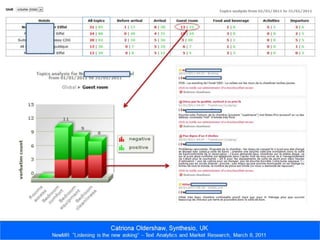
  • #28 Working with Accor, we have developed a Customer Satisfaction Index which looks at the percentage of positive versus negative sentiment verbatim published about a hotel each month. This is an easy way to benchmark each hotel’s customer experience with that of their four nearest competitors. We also synthesise the structured scores provided on third party review websites such as Booking.com and Expedia (which all use different scoring methods) into one score out of ten to enable clear benchmarking and measurement against customer satisfaction KPIs.