Customer Satisfaction Measurement in
the Restaurant Industry in Mexico:
a PLS-PM Approach
School of Business and Economics
Universidad Panamericana Guadalajara, Mexico
Omar Rojas (PhD, La Trobe)
orojas@up.edu.mx
November 2015
Outline
• Problem context
• Survey
• Results
• PLS-PM
• Other marketing applications
Problem context
Abstract
• We present an application of the European Customer Satisfaction
Index to the Mexican Restaurant Industry. We model the Index using
Partial Least Squares Path Modeling. We will present the literature
review that supports the construction of the manifest variables that
serve as a proxy for the latent variables of the model. We also give an
economic background on the importance of the Restaurant industry
in Mexico, in particular in Guadalajara´s Metropolitan Area. We aim
to contribute to the literature with a better understanding of
customer satisfaction, which is measured through loyalty.
Measurement of quality in Mexico
• Measurement of quality in services and products entered the realm
of academics and industry in Mexico in the late 90s. To date, the
Mexican consumer has become more demanding, having had contact
with robust systems of excellence, including global franchises. Even
the government is beginning to feel the demands of taxpayers who
ask for accountability and transparency in regards to their taxes.
From quality to satisfaction
• In the early 70s, quality gurus emphasized the fact that quality is free,
and that it was enough to produce quality goods or offer quality
services in order to increase sales.
• However, the 80s saw a different trend. Firms opted to keep their
customers satisfied, as this was cheaper than implementing costly
campaigns to find new customers. As a consequence, measures of
satisfaction were required to clarify a firm’s areas of opportunity.
Satisfaction and loyalty
• Currently, companies have taken a step forward to include, not only
satisfaction, but loyalty (or confidence) as well. The key to success lies
in focusing on customer satisfaction and, in turn, satisfaction is linked
to loyalty (in the form of repeated purchases or referral to potential
clients).
Internal and external satisfaction
• The model of satisfaction begins with the construction of internal quality of
the good or service. This is because, internally, employees adopt company
objectives as their own and transmit them indirectly to their customers.
Internal quality includes not only care in the product or service offered, but
employee satisfaction, as well.
• Internal quality includes consumer experience: attributes, benefits
obtained from the service or product, costs, and company image held by
the customers. At the same time, satisfied customers tend to remain loyal
to the brand, or to have confidence in the service. Loyalty includes the
predisposition towards repeat purchases and referral to friends. Hence,
customer satisfaction correlates to sales through brand loyalty.
• External satisfaction, meanwhile, has several repercussions. The most
important of these are increased sales and financial success of the
company.
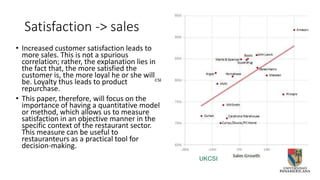
Satisfaction -> sales
• Increased customer satisfaction leads to
more sales. This is not a spurious
correlation; rather, the explanation lies in
the fact that, the more satisfied the
customer is, the more loyal he or she will
be. Loyalty thus leads to product
repurchase.
• This paper, therefore, will focus on the
importance of having a quantitative model
or method, which allows us to measure
satisfaction in an objective manner in the
specific context of the restaurant sector.
This measure can be useful to
restauranteurs as a practical tool for
decision-making.
UKCSI
How to measure satisfaction
• Satisfaction cannot be measured solely by answering the question:
How satisfied is my customer with the goods or service. Thus, we will
begin with a model which analyzes variables such as perceived
quality, customer expectations, image, perceived value, the
relationship among these factors, and the effects they can produce:
complaints or referrals.
First studies in customer satisfaction
• Engel, Kouat, & Blackwell (1968, p.512-15) and Howard & Sheth (1969. P
145-50) established that satisfaction is directly related to product
expectations.
• This point of view was based, in large part, on laboratory studies carried
out by Cardozo (1965).
• Later research by Anderson (1973), Cohen & Goldberg (1970), Olshavsky &
Miller (1972), Olson (1976), Woodside (1972) and Oliver (1977), confirmed
that satisfaction is a more complex issue than had previously been
understood.
• Bishop (1984), Doyle (1984), Jacoby & Olson (1985), Sawyer & Dickson
(1984), and Schlechter (1984), dealt with the relationship between price
and quality and their fundamental power in determining production
selection and purchases.
First customer satisfaction index
• The first country to develop a customer satisfaction index was
Sweden in 1989. The Customer Satisfaction Barometer (CSB) offered
an annual measure of customer satisfaction in over 30 industries and
100 firms. The new index was intended to be a complement to
productivity measures and to examine the quota of market

participation. The model proposes that satisfaction will be lower in
industries with a homogenous supply and a heterogeneous demand
(Fornell, 1992).
ACSI
• In 1994 in the United States, the American Customer Satisfaction
Index (ACSI) was implemented by researchers at the University of
Michigan, in conjunction with the American Society for Quality in
Milwaukee, Wisconsin, and the CFI Group in Ann Arbor, Michigan. The
index was developed to provide information about quality satisfaction
for both products and services available to consumers. This index was
based on the Swedish model (Fornell, 1996).
Customer satisfaction in Mexico
• In Mexico, there is no way to measure customer satisfaction and
loyalty in a uniform manner or to track these indicators against
international standards on global index reports. The problem is that
there is no Mexican satisfaction index that includes a model
considering measurement errors and standardized with a unique
methodology, to compare satisfaction and establish benchmarking
per sector.
Model of customer satisfaction
• Satisfaction is a subjective perception; thus, it should be measured
using models that include measurement error, analysis of variables,
and the relationships between these, in a quantitative manner.
• This study was carried out based on the model of the European
Customer Satisfaction Index (ECSI), which allowed us to carry out a
multivariable analysis of the restaurant industry in the Mexican state
of Jalisco, to obtain correlations among construct variables, using
structural equations, in particular using the Partial Least Squares Path
Modeling (PLS-PM) approach. By means of multivariable analysis, we
intend to eliminate subjectivity in quality measurements. A
measurable objective instrument will allow for correct decision
making by restauranteurs.
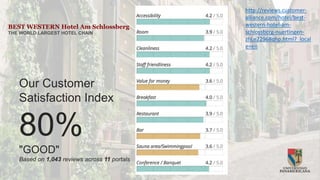
Our Customer
Satisfaction Index
80%
"GOOD"
Based on 1,043 reviews across 11 portals
BEST WESTERN Hotel Am Schlossberg
THE WORLD LARGEST HOTEL CHAIN
http://reviews.customer-
alliance.com/hotel/best-
western-hotel-am-
schlossberg-nuertingen-
zhLe22968qhp.html?_local
e=en
SATISFACTION
EXPECTATIONS
PERCEIVED QUALITY
PERCEIVED VALUE
COMPLAINTS
LOYALTY
Table 1. Literature review about satisfaction factors
Reference Image
Expecta
tions
Perceived
Value
Perceived
Quality
Satisfacti
on
Loyalty
Complain
s
(Fornell C. J., 1996) x x x x x x
(Raquel Sánchez Fernándeza, 2013) x x x x
(Mohammad Hossein Askariazad, 2013) x x x x x x x
(Prybutok, 2009) x x x x
(Demirel, 2013) x x x x x x x
(Odette Lobato-Calleros, 2013) x x x x x
(Andreassen & Lindestad, 1997) x x
(Bayol, 2000) x x
(Ball, Coelho, & Machas, 2003) x x x x x x x
(LeBlanc & & Nguyen, 1996) x x
(O’Loughlin & & Coenders, 2002) x x
(Parasuraman, Zeithaml, & & Berry, 1988) x x x
(Lam, Shankar, Erramilli, & & Murthy, 2004) x x
(Mathwick, Malhotra, & Rigdon, 2001) x x x
(Overby & Lee, 2006) x x
(Ryu, Han, & Soocheong, 2010) x x
(Yang & Lee, 2010) x x
(Babin, Lee,, Kim, & Griffin, 2005) x x
(Jones, Reynolds, & Arnold, 2006) x x
(Chiu, Hsieh, Li, & Lee, 2005) x x
(Stoel, Wickliffe, & Lee, 2004) x x
(Johns & Howard, 1998) x x x
(Cronin & Taylor, 1992) x x x
(Olorunniwo, Hsu, & Udo, 2006) x x x
(Kivela, Inbakaran, & Reece, 1999) x x x x
(Kara, Kaynak, & Kucukemiroglu, 1995) x x x
(Kim & Kim, 2004) x x x
(Boulding, Kalra, Staelin, & Zeithaml, 1993) x x x x
(Keillor, Hult, & Kandemir, 2004) x x x x
(Andreassen & Lindestad, 1998) x x x
(Martensen, Kristensen, & Grønholdt, 2000) x x x
(Johnson, Gustafsson, Andressen, Lervik, & Cha, 2001) x x x
(Anderson & Fornell, 2000) x x x
(Chan, y otros, 2003) x x x x x
(Fornell C. , 1992) x x x
(Ball, Simões Coelho, & Machás, 2004) x x x x x x
Lee, Y. and N. Hing (1995) x x x x
LITERATURE
REVIEW
ABOUT
SATISFACTION
FACTORS
Restaurant industry
• World income from the food and beverage industry is four times
greater than that of the hotel industry (Montecinos 2002).
• On the other hand, Espejel (2000) states that, with over 6 billion
people on the planet, there is a demand for 18 billion meals daily
• The restaurant industry has evolved globally, to become a
fundamental part of a country’s economy, and of the daily life of the
consumers as well. This highlights what Lessard (2004) points out:
restaurant meals account for 46% of the family budget in the United
States, but only 9.8% in Mexico.
Restaurant industry in Mexico
• Implementing the customer satisfaction index model will be carried
out in the restaurant sector, since it generates direct employment for
over 1,300,000 families in the Mexico, with around 3,250,000 indirect
jobs.
• These numbers place the industry as the second largest employer at
the national level. In the country, there are over 400,000 fixed and
non-fixed location restaurants, accounting for 1.4% of the GDP and
13% of the tourism-based GDP.
Restaurant industry in Guadalajara
• Jalisco occupies the third place at the national level in number of
fixed-location restaurants, with a total of 24,875 establishments, out
of the 347,199 countrywide; that is 7.16% of the total.
• Guadalajara is the second most import metropolitan area of the
country in regards to the sector, with 14,631 establishments
(economic units) 4.2% of the country’s total, with 65,785 occupied
employees, 5% of the total.
Full-service restaurants
• This study will be carried out in full-service restaurants, defined as
economic units devoted mainly to the preparation of foods and
beverages for immediate consumption, offering full service to the
customers, including taking orders, serving the foods and beverages
ordered, and presenting the bill for payment after consumption. This
includes full-service restaurants devoted principally to serving non-
alcoholic beverages (coffee, tea, chocolate) for immediate
consumption together with baked goods, and full-service restaurants,
devoted to preparing and serving coffee for immediate consumption,
together with the roasting and grinding of coffee beans (INEGI, 2014).
Survey
Perceived quality
Food presentation Drink variety
Food freshness Drink portions
Food degree of cooking Drink quality
Food taste Waiter brought what asked
Food temperature Waiters helped with the order decision
Food variety Waiters offered specials
Dish portions Waiters were kind
Condiments and complements Waiters were well informed
Variety of desserts The bill was right
Food quality Service quality
Food temperature
Perceived value
Waiting time for the food
Waiting time fo the bill
Food prices
Drink prices
Price was right
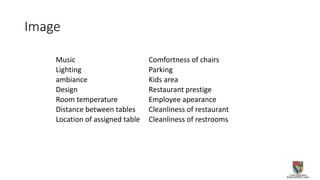
Image
Music Comfortness of chairs
Lighting Parking
ambiance Kids area
Design Restaurant prestige
Room temperature Employee apearance
Distance between tables Cleanliness of restaurant
Location of assigned table Cleanliness of restrooms
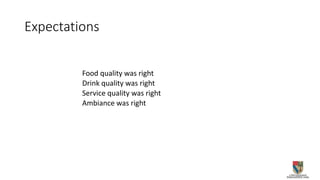
Expectations
Food quality was right
Drink quality was right
Service quality was right
Ambiance was right
Complaints
Easyness to express a complain
Manager was available
The waiter acknowledge the fault
The personnel replied kindly
Any compensation received
Satisfaction
The experience was pleasant
Restaurant choice was right
Loyalty
Would you come back
Would you speak nice abut it
Would you recommend it
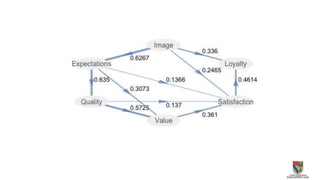
Results
PLS-PM
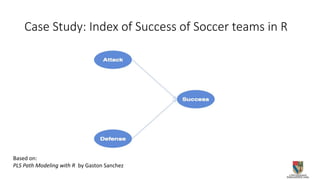
Case Study: Index of Success of Soccer teams in R
Based on:
PLS Path Modeling with R by Gaston Sanchez
Other PLS-PM applications
Thanks for your attention

Customer satisfaction nurtingen

  • 1.
    Customer Satisfaction Measurementin the Restaurant Industry in Mexico: a PLS-PM Approach School of Business and Economics Universidad Panamericana Guadalajara, Mexico Omar Rojas (PhD, La Trobe) orojas@up.edu.mx November 2015
  • 2.
    Outline • Problem context •Survey • Results • PLS-PM • Other marketing applications
  • 3.
  • 4.
    Abstract • We presentan application of the European Customer Satisfaction Index to the Mexican Restaurant Industry. We model the Index using Partial Least Squares Path Modeling. We will present the literature review that supports the construction of the manifest variables that serve as a proxy for the latent variables of the model. We also give an economic background on the importance of the Restaurant industry in Mexico, in particular in Guadalajara´s Metropolitan Area. We aim to contribute to the literature with a better understanding of customer satisfaction, which is measured through loyalty.
  • 5.
    Measurement of qualityin Mexico • Measurement of quality in services and products entered the realm of academics and industry in Mexico in the late 90s. To date, the Mexican consumer has become more demanding, having had contact with robust systems of excellence, including global franchises. Even the government is beginning to feel the demands of taxpayers who ask for accountability and transparency in regards to their taxes.
  • 6.
    From quality tosatisfaction • In the early 70s, quality gurus emphasized the fact that quality is free, and that it was enough to produce quality goods or offer quality services in order to increase sales. • However, the 80s saw a different trend. Firms opted to keep their customers satisfied, as this was cheaper than implementing costly campaigns to find new customers. As a consequence, measures of satisfaction were required to clarify a firm’s areas of opportunity.
  • 7.
    Satisfaction and loyalty •Currently, companies have taken a step forward to include, not only satisfaction, but loyalty (or confidence) as well. The key to success lies in focusing on customer satisfaction and, in turn, satisfaction is linked to loyalty (in the form of repeated purchases or referral to potential clients).
  • 8.
    Internal and externalsatisfaction • The model of satisfaction begins with the construction of internal quality of the good or service. This is because, internally, employees adopt company objectives as their own and transmit them indirectly to their customers. Internal quality includes not only care in the product or service offered, but employee satisfaction, as well. • Internal quality includes consumer experience: attributes, benefits obtained from the service or product, costs, and company image held by the customers. At the same time, satisfied customers tend to remain loyal to the brand, or to have confidence in the service. Loyalty includes the predisposition towards repeat purchases and referral to friends. Hence, customer satisfaction correlates to sales through brand loyalty. • External satisfaction, meanwhile, has several repercussions. The most important of these are increased sales and financial success of the company.
  • 9.
    Satisfaction -> sales •Increased customer satisfaction leads to more sales. This is not a spurious correlation; rather, the explanation lies in the fact that, the more satisfied the customer is, the more loyal he or she will be. Loyalty thus leads to product repurchase. • This paper, therefore, will focus on the importance of having a quantitative model or method, which allows us to measure satisfaction in an objective manner in the specific context of the restaurant sector. This measure can be useful to restauranteurs as a practical tool for decision-making. UKCSI
  • 10.
    How to measuresatisfaction • Satisfaction cannot be measured solely by answering the question: How satisfied is my customer with the goods or service. Thus, we will begin with a model which analyzes variables such as perceived quality, customer expectations, image, perceived value, the relationship among these factors, and the effects they can produce: complaints or referrals.
  • 11.
    First studies incustomer satisfaction • Engel, Kouat, & Blackwell (1968, p.512-15) and Howard & Sheth (1969. P 145-50) established that satisfaction is directly related to product expectations. • This point of view was based, in large part, on laboratory studies carried out by Cardozo (1965). • Later research by Anderson (1973), Cohen & Goldberg (1970), Olshavsky & Miller (1972), Olson (1976), Woodside (1972) and Oliver (1977), confirmed that satisfaction is a more complex issue than had previously been understood. • Bishop (1984), Doyle (1984), Jacoby & Olson (1985), Sawyer & Dickson (1984), and Schlechter (1984), dealt with the relationship between price and quality and their fundamental power in determining production selection and purchases.
  • 12.
    First customer satisfactionindex • The first country to develop a customer satisfaction index was Sweden in 1989. The Customer Satisfaction Barometer (CSB) offered an annual measure of customer satisfaction in over 30 industries and 100 firms. The new index was intended to be a complement to productivity measures and to examine the quota of market participation. The model proposes that satisfaction will be lower in industries with a homogenous supply and a heterogeneous demand (Fornell, 1992).
  • 13.
    ACSI • In 1994in the United States, the American Customer Satisfaction Index (ACSI) was implemented by researchers at the University of Michigan, in conjunction with the American Society for Quality in Milwaukee, Wisconsin, and the CFI Group in Ann Arbor, Michigan. The index was developed to provide information about quality satisfaction for both products and services available to consumers. This index was based on the Swedish model (Fornell, 1996).
  • 14.
    Customer satisfaction inMexico • In Mexico, there is no way to measure customer satisfaction and loyalty in a uniform manner or to track these indicators against international standards on global index reports. The problem is that there is no Mexican satisfaction index that includes a model considering measurement errors and standardized with a unique methodology, to compare satisfaction and establish benchmarking per sector.
  • 15.
    Model of customersatisfaction • Satisfaction is a subjective perception; thus, it should be measured using models that include measurement error, analysis of variables, and the relationships between these, in a quantitative manner. • This study was carried out based on the model of the European Customer Satisfaction Index (ECSI), which allowed us to carry out a multivariable analysis of the restaurant industry in the Mexican state of Jalisco, to obtain correlations among construct variables, using structural equations, in particular using the Partial Least Squares Path Modeling (PLS-PM) approach. By means of multivariable analysis, we intend to eliminate subjectivity in quality measurements. A measurable objective instrument will allow for correct decision making by restauranteurs.
  • 16.
    Our Customer Satisfaction Index 80% "GOOD" Basedon 1,043 reviews across 11 portals BEST WESTERN Hotel Am Schlossberg THE WORLD LARGEST HOTEL CHAIN http://reviews.customer- alliance.com/hotel/best- western-hotel-am- schlossberg-nuertingen- zhLe22968qhp.html?_local e=en
  • 18.
  • 19.
  • 20.
  • 21.
  • 22.
  • 23.
  • 24.
    Table 1. Literaturereview about satisfaction factors Reference Image Expecta tions Perceived Value Perceived Quality Satisfacti on Loyalty Complain s (Fornell C. J., 1996) x x x x x x (Raquel Sánchez Fernándeza, 2013) x x x x (Mohammad Hossein Askariazad, 2013) x x x x x x x (Prybutok, 2009) x x x x (Demirel, 2013) x x x x x x x (Odette Lobato-Calleros, 2013) x x x x x (Andreassen & Lindestad, 1997) x x (Bayol, 2000) x x (Ball, Coelho, & Machas, 2003) x x x x x x x (LeBlanc & & Nguyen, 1996) x x (O’Loughlin & & Coenders, 2002) x x (Parasuraman, Zeithaml, & & Berry, 1988) x x x (Lam, Shankar, Erramilli, & & Murthy, 2004) x x (Mathwick, Malhotra, & Rigdon, 2001) x x x (Overby & Lee, 2006) x x (Ryu, Han, & Soocheong, 2010) x x (Yang & Lee, 2010) x x (Babin, Lee,, Kim, & Griffin, 2005) x x (Jones, Reynolds, & Arnold, 2006) x x (Chiu, Hsieh, Li, & Lee, 2005) x x (Stoel, Wickliffe, & Lee, 2004) x x (Johns & Howard, 1998) x x x (Cronin & Taylor, 1992) x x x (Olorunniwo, Hsu, & Udo, 2006) x x x (Kivela, Inbakaran, & Reece, 1999) x x x x (Kara, Kaynak, & Kucukemiroglu, 1995) x x x (Kim & Kim, 2004) x x x (Boulding, Kalra, Staelin, & Zeithaml, 1993) x x x x (Keillor, Hult, & Kandemir, 2004) x x x x (Andreassen & Lindestad, 1998) x x x (Martensen, Kristensen, & Grønholdt, 2000) x x x (Johnson, Gustafsson, Andressen, Lervik, & Cha, 2001) x x x (Anderson & Fornell, 2000) x x x (Chan, y otros, 2003) x x x x x (Fornell C. , 1992) x x x (Ball, Simões Coelho, & Machás, 2004) x x x x x x Lee, Y. and N. Hing (1995) x x x x LITERATURE REVIEW ABOUT SATISFACTION FACTORS
  • 25.
    Restaurant industry • Worldincome from the food and beverage industry is four times greater than that of the hotel industry (Montecinos 2002). • On the other hand, Espejel (2000) states that, with over 6 billion people on the planet, there is a demand for 18 billion meals daily • The restaurant industry has evolved globally, to become a fundamental part of a country’s economy, and of the daily life of the consumers as well. This highlights what Lessard (2004) points out: restaurant meals account for 46% of the family budget in the United States, but only 9.8% in Mexico.
  • 26.
    Restaurant industry inMexico • Implementing the customer satisfaction index model will be carried out in the restaurant sector, since it generates direct employment for over 1,300,000 families in the Mexico, with around 3,250,000 indirect jobs. • These numbers place the industry as the second largest employer at the national level. In the country, there are over 400,000 fixed and non-fixed location restaurants, accounting for 1.4% of the GDP and 13% of the tourism-based GDP.
  • 27.
    Restaurant industry inGuadalajara • Jalisco occupies the third place at the national level in number of fixed-location restaurants, with a total of 24,875 establishments, out of the 347,199 countrywide; that is 7.16% of the total. • Guadalajara is the second most import metropolitan area of the country in regards to the sector, with 14,631 establishments (economic units) 4.2% of the country’s total, with 65,785 occupied employees, 5% of the total.
  • 28.
    Full-service restaurants • Thisstudy will be carried out in full-service restaurants, defined as economic units devoted mainly to the preparation of foods and beverages for immediate consumption, offering full service to the customers, including taking orders, serving the foods and beverages ordered, and presenting the bill for payment after consumption. This includes full-service restaurants devoted principally to serving non- alcoholic beverages (coffee, tea, chocolate) for immediate consumption together with baked goods, and full-service restaurants, devoted to preparing and serving coffee for immediate consumption, together with the roasting and grinding of coffee beans (INEGI, 2014).
  • 29.
  • 30.
    Perceived quality Food presentationDrink variety Food freshness Drink portions Food degree of cooking Drink quality Food taste Waiter brought what asked Food temperature Waiters helped with the order decision Food variety Waiters offered specials Dish portions Waiters were kind Condiments and complements Waiters were well informed Variety of desserts The bill was right Food quality Service quality Food temperature
  • 31.
    Perceived value Waiting timefor the food Waiting time fo the bill Food prices Drink prices Price was right
  • 32.
    Image Music Comfortness ofchairs Lighting Parking ambiance Kids area Design Restaurant prestige Room temperature Employee apearance Distance between tables Cleanliness of restaurant Location of assigned table Cleanliness of restrooms
  • 33.
    Expectations Food quality wasright Drink quality was right Service quality was right Ambiance was right
  • 34.
    Complaints Easyness to expressa complain Manager was available The waiter acknowledge the fault The personnel replied kindly Any compensation received
  • 35.
    Satisfaction The experience waspleasant Restaurant choice was right
  • 36.
    Loyalty Would you comeback Would you speak nice abut it Would you recommend it
  • 37.
  • 39.
  • 40.
    Case Study: Indexof Success of Soccer teams in R Based on: PLS Path Modeling with R by Gaston Sanchez
  • 41.
  • 42.
    Thanks for yourattention

Editor's Notes

  • #19 * customer satisfaction is calculated as a weighted average of the three survey questions that measure different facets of satisfaction with a service or good.
  • #20 * Customer expectation is a measure of the pre-conceived ideas of a customer about a company´s products or services. Expectations represent previous experiences as well as hearsay, such as advertising, word of mouth, and trust that the company will continue to offer quality in the future
  • #21 * is the measure of recent consumer experience. Quality is measured in terms of personalization
  • #22 * is the measure of quality in relation to price. Though the price (value for money) tends to be of prime importance in a first purchase, generally its impact lessens through satisfaction with repeated purchases
  • #23 * complaints are measured as a percentage of respondents who have complained directly to the company about a product or service within a specified time. Satisfaction correlates negatively to customer complaints, since the more satisfied they are, the lesser the likelihood of their complaining
  • #24 is a combination of the likelihood expressed by the customer of a repurchase from the same provider in the future, and the possibility of acquiring goods or services from the same company at different prices is a critical component of the model in its current form, as a proxy for profitability
  • #29 The North American Industrial Classification System (NAICS) defines six types of activities related to the restaurant industry: full-service restaurants, self-service restaurants, restaurants with take-out service, restaurants with limited service, catering services for companies or institutions, and private catering for special occasions.