
By Andrew Benstead
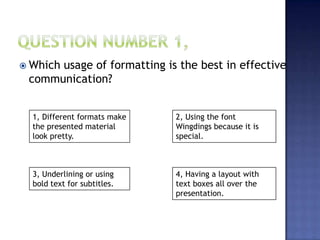
 Which usage of formatting is the best in effective
communication?
1, Different formats make
the presented material
look pretty.
2, Using the font
Wingdings because it is
special.
3, Underlining or using
bold text for subtitles.
4, Having a layout with
text boxes all over the
presentation.
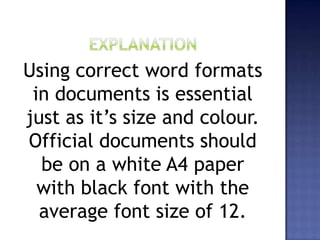
Using correct word formats
in documents is essential
just as it’s size and colour.
Official documents should
be on a white A4 paper
with black font with the
average font size of 12.
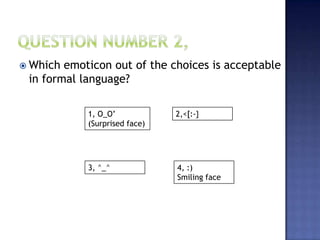
 Which emoticon out of the choices is acceptable
in formal language?
1, O_O’
(Surprised face)
2,<[:-}
3, ^_^ 4, :)
Smiling face
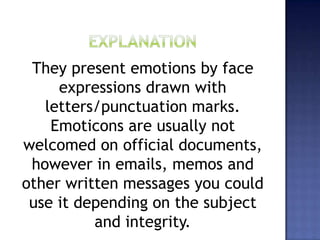
They present emotions by face
expressions drawn with
letters/punctuation marks.
Emoticons are usually not
welcomed on official documents,
however in emails, memos and
other written messages you could
use it depending on the subject
and integrity.
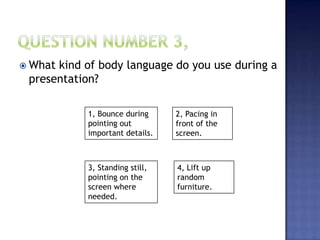
 What kind of body language do you use during a
presentation?
1, Bounce during
pointing out
important details.
2, Pacing in
front of the
screen.
3, Standing still,
pointing on the
screen where
needed.
4, Lift up
random
furniture.
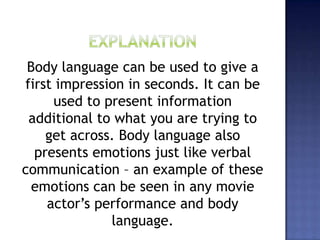
Body language can be used to give a
first impression in seconds. It can be
used to present information
additional to what you are trying to
get across. Body language also
presents emotions just like verbal
communication – an example of these
emotions can be seen in any movie
actor’s performance and body
language.
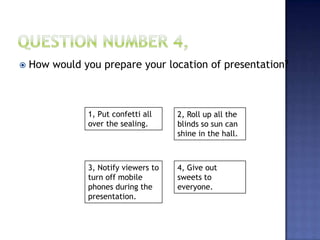
 How would you prepare your location of presentation?
1, Put confetti all
over the sealing.
4, Give out
sweets to
everyone.
3, Notify viewers to
turn off mobile
phones during the
presentation.
2, Roll up all the
blinds so sun can
shine in the hall.
Preparing your location of
presentation is very beneficial as
there are many sources of
background noise which can
interrupt the presentation.
Background noise also interrupts
the flow of thoughts in both the
audience and the presenter.
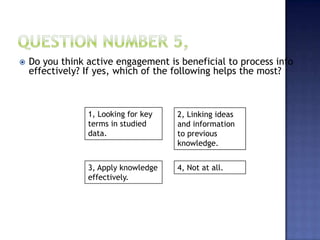
 Do you think active engagement is beneficial to process info
effectively? If yes, which of the following helps the most?
1, Looking for key
terms in studied
data.
4, Not at all.3, Apply knowledge
effectively.
2, Linking ideas
and information
to previous
knowledge.
Definition: Parties acknowledge the
conflict and deal with it assertively. Leads
to either contention or collaboration.
Linking ideas and information to previous
knowledge is a skill that is vastly looked for
in individuals by many people mainly
employers. It is one of the most valued
employee attributes as It involves
justification. Through this process, you can
also double-check the validity of
information.
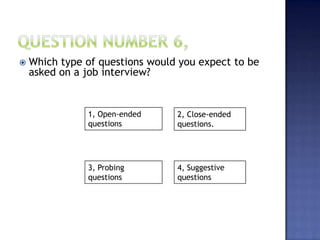
 Which type of questions would you expect to be
asked on a job interview?
1, Open-ended
questions
4, Suggestive
questions
3, Probing
questions
2, Close-ended
questions.
Definition: A question that attempts to
discover additional information following a
primary or secondary question and cannot
stand alone out of context.
As the definition implies, probing questions
are used mainly during job interviews or
verbal exams as they ask around to get an
indebt information about the person’s
qualification, experience or just about
himself.
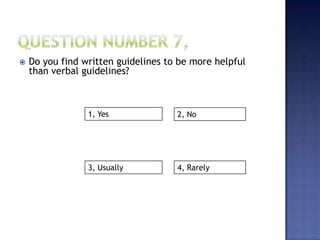
 Do you find written guidelines to be more helpful
than verbal guidelines?
1, Yes
4, Rarely3, Usually
2, No
Definition: A question that attempts to
discover additional information following a
primary or secondary question and cannot
stand alone out of context.
As the definition implies, probing questions
are used mainly during job interviews or
verbal exams as they ask around to get an
indebt information about the person’s
qualification, experience or just about
himself.
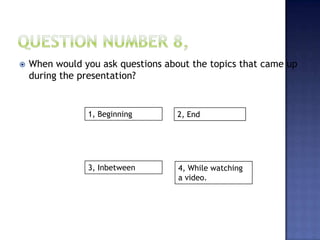
 When would you ask questions about the topics that came up
during the presentation?
1, Beginning
3, Inbetween
2, End
4, While watching
a video.
It is the best to ask questions at the
end of the presentation as otherwise,
you would distract the audience and
the presenter, interrupting their flow
of thoughts. It can be hard to
remember all the questions during a
longer presentation, however you can
take a note of what you would like to
ask of the presenter.
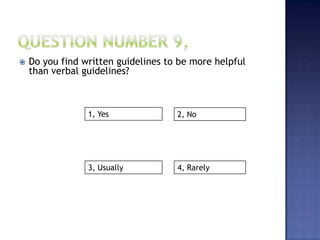
 Do you find written guidelines to be more helpful
than verbal guidelines?
1, Yes
4, Rarely3, Usually
2, No
Definition: Guidelines are basic ideas that
give you a rough estimate.
Guidelines are structured to be simple, yet
detailed enough to be followed with
relative ease. They are also flexible so you
don’t have to stick to it while you stay on
task.
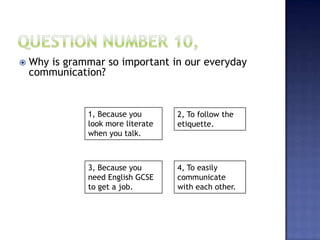
 Why is grammar so important in our everyday
communication?
1, Because you
look more literate
when you talk.
4, To easily
communicate
with each other.
3, Because you
need English GCSE
to get a job.
2, To follow the
etiquette.
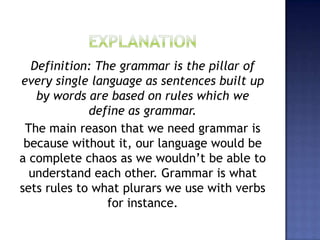
Definition: The grammar is the pillar of
every single language as sentences built up
by words are based on rules which we
define as grammar.
The main reason that we need grammar is
because without it, our language would be
a complete chaos as we wouldn’t be able to
understand each other. Grammar is what
sets rules to what plurars we use with verbs
for instance.
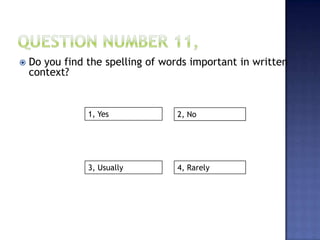
 Do you find the spelling of words important in written
context?
1, Yes
4, Rarely3, Usually
2, No
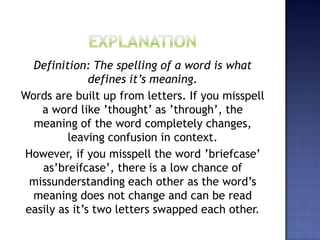
Definition: The spelling of a word is what
defines it’s meaning.
Words are built up from letters. If you misspell
a word like ’thought’ as ’through’, the
meaning of the word completely changes,
leaving confusion in context.
However, if you misspell the word ’briefcase’
as’breifcase’, there is a low chance of
missunderstanding each other as the word’s
meaning does not change and can be read
easily as it’s two letters swapped each other.
 In what way do you structurise your presentation
information wise?
1, Choosing a
colourful theme.
4, Using a master
slide to structure
the layout.
3, Open with an
introduction, and
finish with a
summary.
2, Adding images
to get an idea of
something.
It is key to structurise a presentation
properly as it can cause difficulties to
understand the details if it does not
follow a logical pattern.
Start with a brief introduction,
highlighting key areas as subheadings
to give an overview about the
presentation. Using handouts is also a
good idea in this scenario.
 Which area does proofreading NOT target on?
1, Spelling.
4, Guidelines3, Punctuation
2, Grammar.
Proofreading is when you check over
your own written work for
grammatical errors. Grammatical
errors include punctuation, spelling
mistakes and travelling though
different tenses.
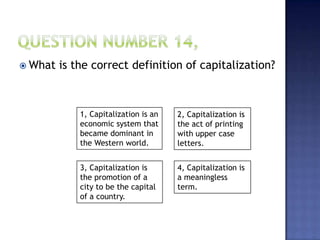
 What is the correct definition of capitalization?
1, Capitalization is an
economic system that
became dominant in
the Western world.
4, Capitalization is
a meaningless
term.
3, Capitalization is
the promotion of a
city to be the capital
of a country.
2, Capitalization is
the act of printing
with upper case
letters.
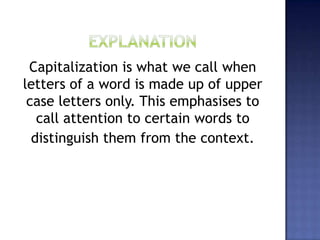
Capitalization is what we call when
letters of a word is made up of upper
case letters only. This emphasises to
call attention to certain words to
distinguish them from the context.
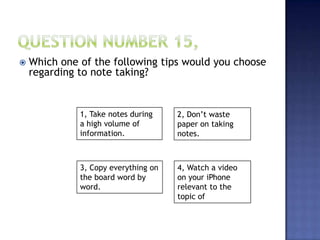
 Which one of the following tips would you choose
regarding to note taking?
1, Take notes during
a high volume of
information.
4, Watch a video
on your iPhone
relevant to the
topic of
3, Copy everything on
the board word by
word.
2, Don’t waste
paper on taking
notes.
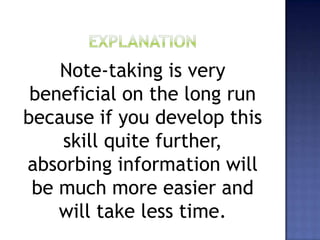
Note-taking is very
beneficial on the long run
because if you develop this
skill quite further,
absorbing information will
be much more easier and
will take less time.
1, Being
overconfident
2, Paying attention
to your conversation
3, Being uninterested 4, Being incautious
 Which mind-set would help you in your speed of
response?
‘Speed of response’ is the
amount of time it takes to
react to what has been said in
a conversation.
High speed of response
between two people means
that their insight with the
topic is rather high.
1, Handshaking 2, Winking
3, Swearing 4, Eye contact
 Which action could follow up to misunderstanding
between two people of different cultures?
Cultural differences: When the
languages are different, and
translation has to be used to
communicate, the potential for
misunderstandings increases.
Same words can mean different
things to people from different
cultures, even when they talk the
"same" language.
1, Yes 2, No
3, Maybe 4, Only if my
viewpoint is better
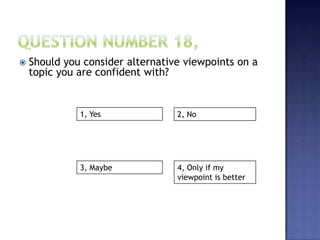
 Should you consider alternative viewpoints on a
topic you are confident with?
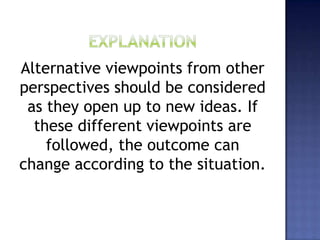
Alternative viewpoints from other
perspectives should be considered
as they open up to new ideas. If
these different viewpoints are
followed, the outcome can
change according to the situation.
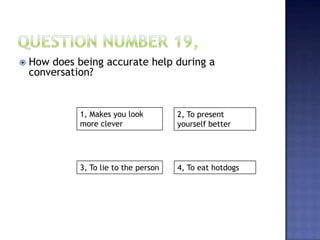
1, Makes you look
more clever
2, To present
yourself better
3, To lie to the person 4, To eat hotdogs
 How does being accurate help during a
conversation?
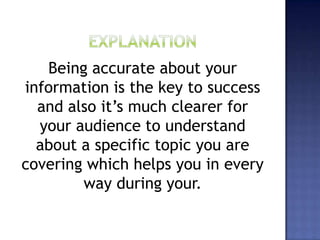
Being accurate about your
information is the key to success
and also it’s much clearer for
your audience to understand
about a specific topic you are
covering which helps you in every
way during your.
1, So that the
information given is
clear to relate to.
2, So you can write
better guidelines
3, For the purpose of
better grammar
4, To be positive.
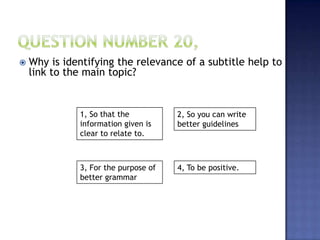
 Why is identifying the relevance of a subtitle help to
link to the main topic?
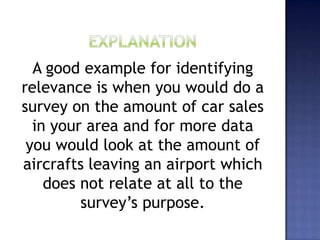
A good example for identifying
relevance is when you would do a
survey on the amount of car sales
in your area and for more data
you would look at the amount of
aircrafts leaving an airport which
does not relate at all to the
survey’s purpose.
1, To pretend to be
clever
2, To answer quicker
to questions
3, To encourage
others to interact
with you
4, To feel better
about yourself.
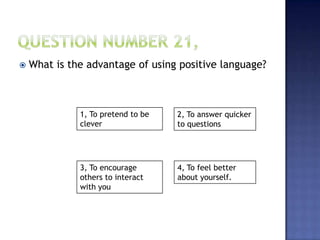
 What is the advantage of using positive language?
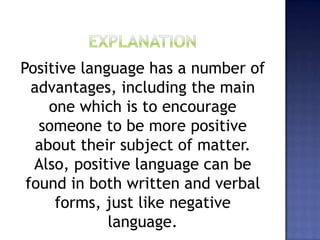
Positive language has a number of
advantages, including the main
one which is to encourage
someone to be more positive
about their subject of matter.
Also, positive language can be
found in both written and verbal
forms, just like negative
language.
1, People will like you
more
2, People will feel
uncomfortable with
talking to you
3, To use proper
capitalization
4, To get to know
more about the
subject
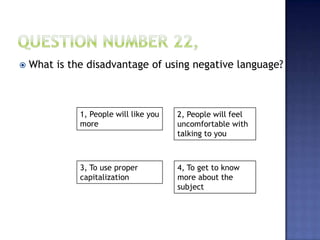
 What is the disadvantage of using negative language?
Using negative language in oppose to
positive language has a number of
disadvantages, but the most commonly
found issue is that people using such
attitude only point out negative points in
people’s work, while positive language
users would point out the positive bits of
the subject. Also, negative language can be
found in both written and verbal forms,
just like positive language.
Yes, take me back
to the previous question.
 Congratulations for finishing this Quiz!

Power point game 444

  • 1.
  • 2.
     Which usageof formatting is the best in effective communication? 1, Different formats make the presented material look pretty. 2, Using the font Wingdings because it is special. 3, Underlining or using bold text for subtitles. 4, Having a layout with text boxes all over the presentation.
  • 3.
    Using correct wordformats in documents is essential just as it’s size and colour. Official documents should be on a white A4 paper with black font with the average font size of 12.
  • 4.
     Which emoticonout of the choices is acceptable in formal language? 1, O_O’ (Surprised face) 2,<[:-} 3, ^_^ 4, :) Smiling face
  • 5.
    They present emotionsby face expressions drawn with letters/punctuation marks. Emoticons are usually not welcomed on official documents, however in emails, memos and other written messages you could use it depending on the subject and integrity.
  • 6.
     What kindof body language do you use during a presentation? 1, Bounce during pointing out important details. 2, Pacing in front of the screen. 3, Standing still, pointing on the screen where needed. 4, Lift up random furniture.
  • 7.
    Body language canbe used to give a first impression in seconds. It can be used to present information additional to what you are trying to get across. Body language also presents emotions just like verbal communication – an example of these emotions can be seen in any movie actor’s performance and body language.
  • 8.
     How wouldyou prepare your location of presentation? 1, Put confetti all over the sealing. 4, Give out sweets to everyone. 3, Notify viewers to turn off mobile phones during the presentation. 2, Roll up all the blinds so sun can shine in the hall.
  • 9.
    Preparing your locationof presentation is very beneficial as there are many sources of background noise which can interrupt the presentation. Background noise also interrupts the flow of thoughts in both the audience and the presenter.
  • 10.
     Do youthink active engagement is beneficial to process info effectively? If yes, which of the following helps the most? 1, Looking for key terms in studied data. 4, Not at all.3, Apply knowledge effectively. 2, Linking ideas and information to previous knowledge.
  • 11.
    Definition: Parties acknowledgethe conflict and deal with it assertively. Leads to either contention or collaboration. Linking ideas and information to previous knowledge is a skill that is vastly looked for in individuals by many people mainly employers. It is one of the most valued employee attributes as It involves justification. Through this process, you can also double-check the validity of information.
  • 12.
     Which typeof questions would you expect to be asked on a job interview? 1, Open-ended questions 4, Suggestive questions 3, Probing questions 2, Close-ended questions.
  • 13.
    Definition: A questionthat attempts to discover additional information following a primary or secondary question and cannot stand alone out of context. As the definition implies, probing questions are used mainly during job interviews or verbal exams as they ask around to get an indebt information about the person’s qualification, experience or just about himself.
  • 14.
     Do youfind written guidelines to be more helpful than verbal guidelines? 1, Yes 4, Rarely3, Usually 2, No
  • 15.
    Definition: A questionthat attempts to discover additional information following a primary or secondary question and cannot stand alone out of context. As the definition implies, probing questions are used mainly during job interviews or verbal exams as they ask around to get an indebt information about the person’s qualification, experience or just about himself.
  • 16.
     When wouldyou ask questions about the topics that came up during the presentation? 1, Beginning 3, Inbetween 2, End 4, While watching a video.
  • 17.
    It is thebest to ask questions at the end of the presentation as otherwise, you would distract the audience and the presenter, interrupting their flow of thoughts. It can be hard to remember all the questions during a longer presentation, however you can take a note of what you would like to ask of the presenter.
  • 18.
     Do youfind written guidelines to be more helpful than verbal guidelines? 1, Yes 4, Rarely3, Usually 2, No
  • 19.
    Definition: Guidelines arebasic ideas that give you a rough estimate. Guidelines are structured to be simple, yet detailed enough to be followed with relative ease. They are also flexible so you don’t have to stick to it while you stay on task.
  • 20.
     Why isgrammar so important in our everyday communication? 1, Because you look more literate when you talk. 4, To easily communicate with each other. 3, Because you need English GCSE to get a job. 2, To follow the etiquette.
  • 21.
    Definition: The grammaris the pillar of every single language as sentences built up by words are based on rules which we define as grammar. The main reason that we need grammar is because without it, our language would be a complete chaos as we wouldn’t be able to understand each other. Grammar is what sets rules to what plurars we use with verbs for instance.
  • 22.
     Do youfind the spelling of words important in written context? 1, Yes 4, Rarely3, Usually 2, No
  • 23.
    Definition: The spellingof a word is what defines it’s meaning. Words are built up from letters. If you misspell a word like ’thought’ as ’through’, the meaning of the word completely changes, leaving confusion in context. However, if you misspell the word ’briefcase’ as’breifcase’, there is a low chance of missunderstanding each other as the word’s meaning does not change and can be read easily as it’s two letters swapped each other.
  • 24.
     In whatway do you structurise your presentation information wise? 1, Choosing a colourful theme. 4, Using a master slide to structure the layout. 3, Open with an introduction, and finish with a summary. 2, Adding images to get an idea of something.
  • 25.
    It is keyto structurise a presentation properly as it can cause difficulties to understand the details if it does not follow a logical pattern. Start with a brief introduction, highlighting key areas as subheadings to give an overview about the presentation. Using handouts is also a good idea in this scenario.
  • 26.
     Which areadoes proofreading NOT target on? 1, Spelling. 4, Guidelines3, Punctuation 2, Grammar.
  • 27.
    Proofreading is whenyou check over your own written work for grammatical errors. Grammatical errors include punctuation, spelling mistakes and travelling though different tenses.
  • 28.
     What isthe correct definition of capitalization? 1, Capitalization is an economic system that became dominant in the Western world. 4, Capitalization is a meaningless term. 3, Capitalization is the promotion of a city to be the capital of a country. 2, Capitalization is the act of printing with upper case letters.
  • 29.
    Capitalization is whatwe call when letters of a word is made up of upper case letters only. This emphasises to call attention to certain words to distinguish them from the context.
  • 30.
     Which oneof the following tips would you choose regarding to note taking? 1, Take notes during a high volume of information. 4, Watch a video on your iPhone relevant to the topic of 3, Copy everything on the board word by word. 2, Don’t waste paper on taking notes.
  • 31.
    Note-taking is very beneficialon the long run because if you develop this skill quite further, absorbing information will be much more easier and will take less time.
  • 32.
    1, Being overconfident 2, Payingattention to your conversation 3, Being uninterested 4, Being incautious  Which mind-set would help you in your speed of response?
  • 33.
    ‘Speed of response’is the amount of time it takes to react to what has been said in a conversation. High speed of response between two people means that their insight with the topic is rather high.
  • 34.
    1, Handshaking 2,Winking 3, Swearing 4, Eye contact  Which action could follow up to misunderstanding between two people of different cultures?
  • 35.
    Cultural differences: Whenthe languages are different, and translation has to be used to communicate, the potential for misunderstandings increases. Same words can mean different things to people from different cultures, even when they talk the "same" language.
  • 36.
    1, Yes 2,No 3, Maybe 4, Only if my viewpoint is better  Should you consider alternative viewpoints on a topic you are confident with?
  • 37.
    Alternative viewpoints fromother perspectives should be considered as they open up to new ideas. If these different viewpoints are followed, the outcome can change according to the situation.
  • 38.
    1, Makes youlook more clever 2, To present yourself better 3, To lie to the person 4, To eat hotdogs  How does being accurate help during a conversation?
  • 39.
    Being accurate aboutyour information is the key to success and also it’s much clearer for your audience to understand about a specific topic you are covering which helps you in every way during your.
  • 40.
    1, So thatthe information given is clear to relate to. 2, So you can write better guidelines 3, For the purpose of better grammar 4, To be positive.  Why is identifying the relevance of a subtitle help to link to the main topic?
  • 41.
    A good examplefor identifying relevance is when you would do a survey on the amount of car sales in your area and for more data you would look at the amount of aircrafts leaving an airport which does not relate at all to the survey’s purpose.
  • 42.
    1, To pretendto be clever 2, To answer quicker to questions 3, To encourage others to interact with you 4, To feel better about yourself.  What is the advantage of using positive language?
  • 43.
    Positive language hasa number of advantages, including the main one which is to encourage someone to be more positive about their subject of matter. Also, positive language can be found in both written and verbal forms, just like negative language.
  • 44.
    1, People willlike you more 2, People will feel uncomfortable with talking to you 3, To use proper capitalization 4, To get to know more about the subject  What is the disadvantage of using negative language?
  • 45.
    Using negative languagein oppose to positive language has a number of disadvantages, but the most commonly found issue is that people using such attitude only point out negative points in people’s work, while positive language users would point out the positive bits of the subject. Also, negative language can be found in both written and verbal forms, just like positive language.
  • 46.
    Yes, take meback to the previous question.
  • 48.
     Congratulations forfinishing this Quiz!