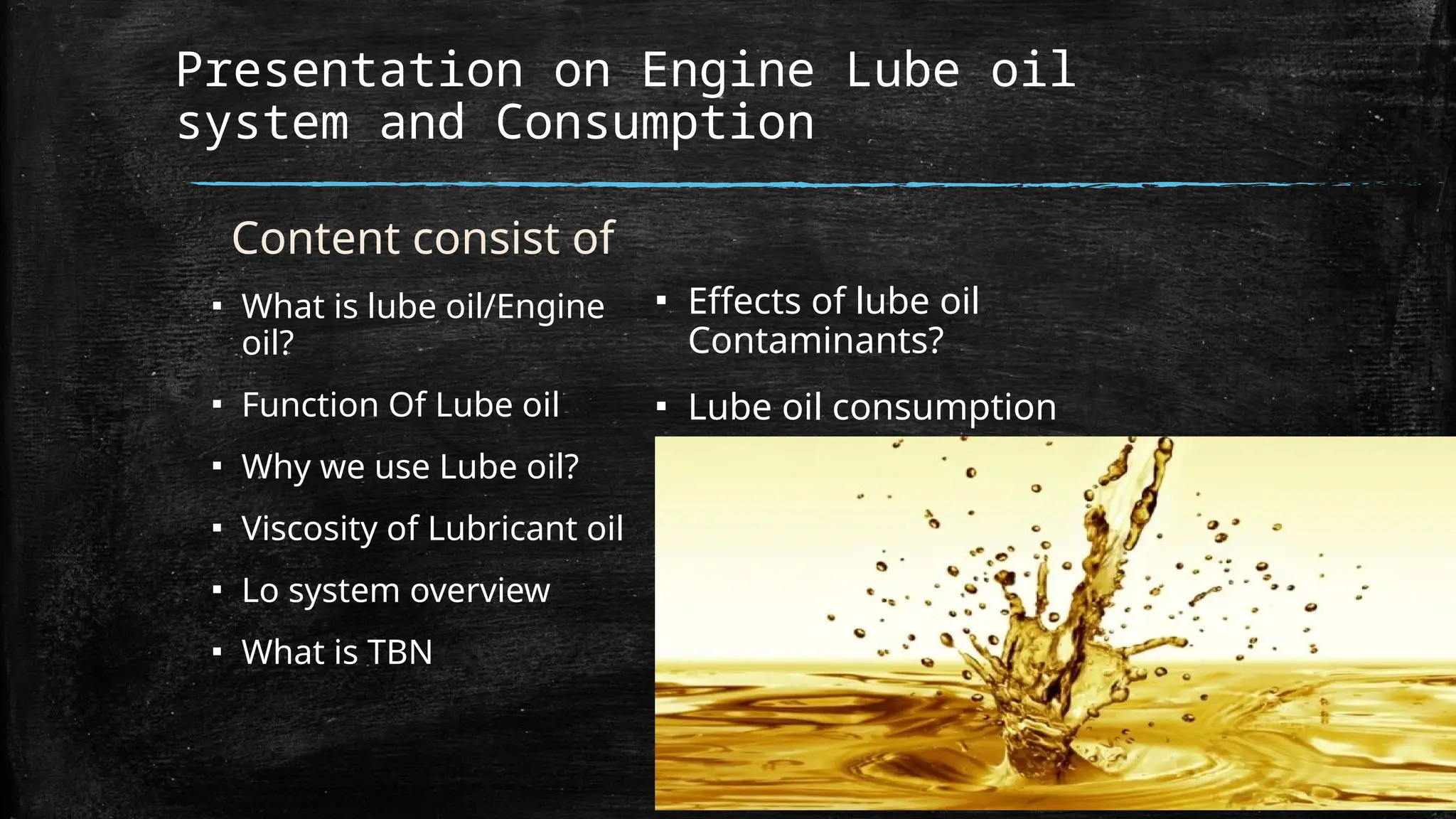
Presentation on EngineLube oil
system and Consumption
▪ Effects of lube oil
Contaminants?
▪ Lube oil consumption
Content consist of
▪ What is lube oil/Engine
oil?
▪ Function Of Lube oil
▪ Why we use Lube oil?
▪ Viscosity of Lubricant oil
▪ Lo system overview
▪ What is TBN
2.
What Is LubeOil?
▪ Lube Oil or lubricating oil is a engine Oil that should have
high heat resistance & high thermal conductivity. It reduce
heat & create a thin film layer on the surface which reduce
corrosion.
3.
Lube Oil Function
Lubricatingoil is an integrated engine component. Main function
of lubricating oil is to maintain power producing efficiency .
▪ Separate entirely the contact surfaces, thereby reducing static and
dynamic friction to least possible value to prevent wear and tear.
▪ Remove heat generated within the bearing.
▪ Protection of the working surfaces against corrosion while staying in
good condition.
▪ Removal of contaminants.
▪ Dampen noise produced.
▪ Act as a sealant.
4.
Why we useLube oil
▪ Lube oil, also known as lubricating oil, is a class of oils used
to reduce the friction, heat, and wear between mechanical
components that are in contact with each other. It is largely
used in automobiles, marine engines, and other machinery
▪ In an engine, lube oil must lubricate the various parts of an
engine to reduce friction and minimize unnecessary loss of
power. A well-lubricated engine will burn fuel more
effectively and therefore perform better. Lubrication,
however, is just one task. As friction is reduced, the parts
and surfaces being subject to friction are protected
5.
Viscosity Of LubeOil
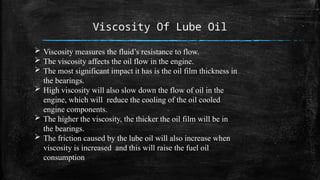
Viscosity measures the fluid’s resistance to flow.
The viscosity affects the oil flow in the engine.
The most significant impact it has is the oil film thickness in
the bearings.
High viscosity will also slow down the flow of oil in the
engine, which will reduce the cooling of the oil cooled
engine components.
The higher the viscosity, the thicker the oil film will be in
the bearings.
The friction caused by the lube oil will also increase when
viscosity is increased and this will raise the fuel oil
consumption
Engine Lube oilsystem
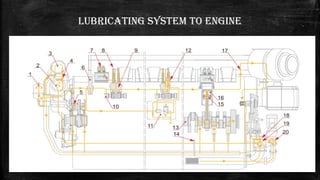
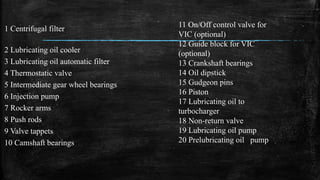
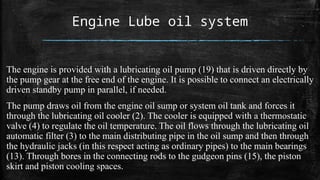
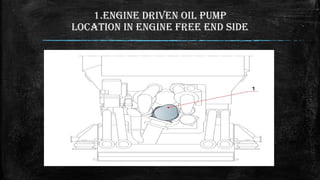
The engine is provided with a lubricating oil pump (19) that is driven directly by
the pump gear at the free end of the engine. It is possible to connect an electrically
driven standby pump in parallel, if needed.
The pump draws oil from the engine oil sump or system oil tank and forces it
through the lubricating oil cooler (2). The cooler is equipped with a thermostatic
valve (4) to regulate the oil temperature. The oil flows through the lubricating oil
automatic filter (3) to the main distributing pipe in the oil sump and then through
the hydraulic jacks (in this respect acting as ordinary pipes) to the main bearings
(13). Through bores in the connecting rods to the gudgeon pins (15), the piston
skirt and piston cooling spaces.
9.
Lubricating system toengine
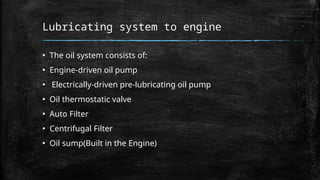
▪ The oil system consists of:
▪ Engine-driven oil pump
▪ Electrically-driven pre-lubricating oil pump
▪ Oil thermostatic valve
▪ Auto Filter
▪ Centrifugal Filter
▪ Oil sump(Built in the Engine)
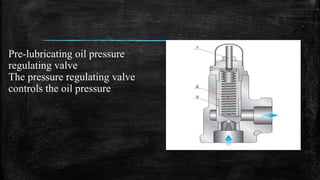
The oil pressurein the distributing pipe is regulated by a pressure regulating
valve on the pump. It is essential to maintain correct pressure to ensure
appropriate lubrication of the bearings and cooling of the pistons. Normally,
the oil pressure remains constant when adjusted to the correct value, although
varying with the temperature.. To avoid any problems caused by cold oil, the
engine oil must be heated up to 40–50ºC .
12.
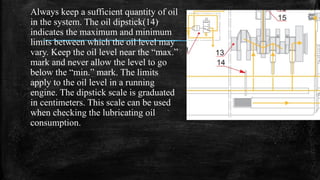
Always keep asufficient quantity of oil
in the system. The oil dipstick(14)
indicates the maximum and minimum
limits between which the oil level may
vary. Keep the oil level near the “max.”
mark and never allow the level to go
below the “min.” mark. The limits
apply to the oil level in a running
engine. The dipstick scale is graduated
in centimeters. This scale can be used
when checking the lubricating oil
consumption.
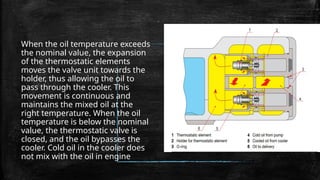
When the oiltemperature exceeds
the nominal value, the expansion
of the thermostatic elements
moves the valve unit towards the
holder, thus allowing the oil to
pass through the cooler. This
movement is continuous and
maintains the mixed oil at the
right temperature. When the oil
temperature is below the nominal
value, the thermostatic valve is
closed, and the oil bypasses the
cooler. Cold oil in the cooler does
not mix with the oil in engine
15.
Oil thermostatic valve
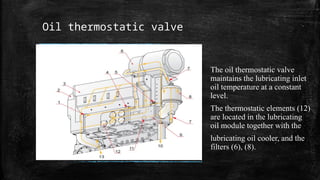
Theoil thermostatic valve
maintains the lubricating inlet
oil temperature at a constant
level.
The thermostatic elements (12)
are located in the lubricating
oil module together with the
lubricating oil cooler, and the
filters (6), (8).
16.
Lubricating Oil cooler
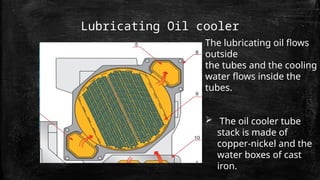
Thelubricating oil flows
outside
the tubes and the cooling
water flows inside the
tubes.
The oil cooler tube
stack is made of
copper-nickel and the
water boxes of cast
iron.
17.
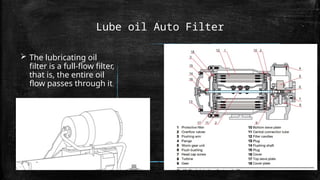
Lube oil AutoFilter
The lubricating oil
filter is a full-flow filter,
that is, the entire oil
flow passes through it.
18.
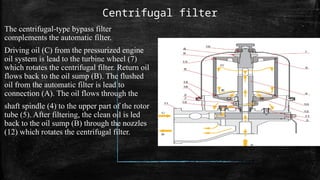
Centrifugal filter
The centrifugal-typebypass filter
complements the automatic filter.
Driving oil (C) from the pressurized engine
oil system is lead to the turbine wheel (7)
which rotates the centrifugal filter. Return oil
flows back to the oil sump (B). The flushed
oil from the automatic filter is lead to
connection (A). The oil flows through the
shaft spindle (4) to the upper part of the rotor
tube (5). After filtering, the clean oil is led
back to the oil sump (B) through the nozzles
(12) which rotates the centrifugal filter.
19.
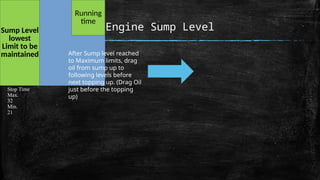
Engine Sump Level
SumpLevel Limits
Running time
Max.
23
Min.
12
Stop Time
Max.
32
Min.
21
Sump Level
lowest
Limit to be
maintained
Running
time
After Sump level reached
to Maximum limits, drag
oil from sump up to
following levels before
next topping up. (Drag Oil
just before the topping
up)
20.
What is TBN
TotalBase Number (TBN) is a measurement of basicity that is
expressed in terms of the number of milligrams of potassium hydroxide
per gram of oil sample (mg KOH/g). TBN is an important measurement
in petroleum products, and the value varies depending on its application.
Normal BN values to be used (follow engine makers’ instructions).
For natural gas operation → BN should be 4…7 mg KOH/g
For light distillate fuel operation → BN should be 10…20 mg KOH/g
For heavy fuel operation → BN should be 30…65 mg KOH/g
21.
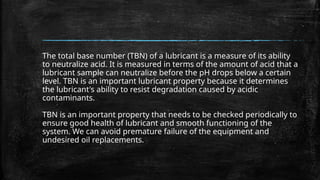
The total basenumber (TBN) of a lubricant is a measure of its ability
to neutralize acid. It is measured in terms of the amount of acid that a
lubricant sample can neutralize before the pH drops below a certain
level. TBN is an important lubricant property because it determines
the lubricant's ability to resist degradation caused by acidic
contaminants.
TBN is an important property that needs to be checked periodically to
ensure good health of lubricant and smooth functioning of the
system. We can avoid premature failure of the equipment and
undesired oil replacements.
22.
Effects of lubeoil Contaminants
• Water: even in small amounts, water causes rusting of iron or
steel. The water also results in forming water sludge (emulsions),
which may clog oil passages, pump valves and other oil handling
equipment. Water also contributes to foaming problems.
• Solid particles of dirt, dust, grit and metallic fragments, which
were circulated by the lubricant: these contaminants cause
excessive wear, scoring of bearing surface, and possible failure
due to seizing of metal fatigue.
23.
• Sludge andlacquers: the sludge deposits clog small oil passages and
clearances. Lacquers or varnish cause sticking of valves, and resist against the
continuous operation of oil pump.
• Liquid contaminants such as unburned fuel from engines dilute lubricating oil
and possibly reduce their viscosity beyond a safe load. Contaminants of the
lubricant with heavier oil increase viscosity and interfere with the oil
circulation. This affects the lubricating valve and heat transfer capacity ,
24.
Lube Oil Consumption
1Unit =1 kwh
That means,
1 kwh = 1kw Power Producing or Consuming within
1 hour.
8924 kw = Power Producing or Generating by one
generator within 1 hour.
0.39 gm/Unit or gm/1 kwh.
25.
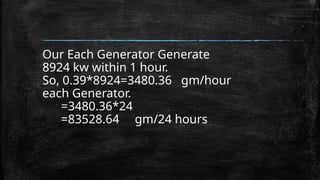
Our Each GeneratorGenerate
8924 kw within 1 hour.
So, 0.39*8924=3480.36 gm/hour
each Generator.
=3480.36*24
=83528.64 gm/24 hours
26.
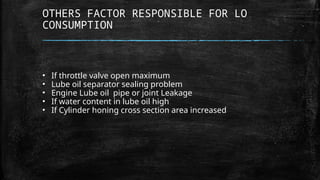
OTHERS FACTOR RESPONSIBLEFOR LO
CONSUMPTION
• If throttle valve open maximum
• Lube oil separator sealing problem
• Engine Lube oil pipe or joint Leakage
• If water content in lube oil high
• If Cylinder honing cross section area increased