Philippine Politics and Governance
General Academic Strand | Humanities and Social Sciences
Lesson 3.1
Power in Politics
What do you feel
whenever you
see police cars?
2
What authority does this
officer have?
3
What do these people
have in common?
4
4
People get intimidated by
others because of the
latter’s character, power,
and position in society
that may be caused by a
previous discrimination,
self-esteem, abuse, and
violence.
5
Learning
Competencies
6
● Define power (HUMSS_PG12-Id-11).
● Recognize the nature, dimensions, types, and
consequences of power (HUMSS_PG12-Id-12).
● Analyze the nature, dimensions, types,
deployments, and consequences of power
(HUMSS_PG12-Id-13).
Essential
Question
7
What is power in political aspect?
Power and Political Science
Power
ability of a person to
influence the actions,
decisions, and
behavior of another
individual
8
Power and Political Science
Definition of
Power
ability to control people’s
behavior and influence the
results and consequences of
events
(Oxford University Press, 2015)
9
Power and Political Science
ability to address resistance
and to persuade people to do
things that they would not
otherwise do
(Pfeffer 1990, 30)
Definition of
Power
10
Power and Political Science
Power is present in all forms of
social relationships, including
political institutions.
(Foucault, 1996)
Definition of
Power
11
Power and Political Science
12
Downward Influence
The leader can influence the
actions or undertakings of
his or her subordinates.
Upward Influence
The subordinates can also
influence the decisions of
their leader.
● Power is related to leadership.
● Leaders can exert “downward” or “upward” influence.
Check
Your
Progress
13
13
What are the results of exercising power?
How Is Power Related to Authority?
People who are in a position to wield power
are said to have authority.
14
How Is Power Related to Authority?
15
● People who have
authority have
legitimate power.
● Legitimacy is when the
right and ability to wield
power is recognized.
How Is Power Related to Authority?
Religious leaders have authority over their congregations.
16
How Is Power Related to Authority?
School administrators
have authority over
faculty members and the
student body.
17
Sources of Power
18
Source Definition Example
1. Force use of coercion to
impose one’s will
on his or her
members or
subordinates
mobilization of the
armed forces of the
country to arrest
political opponents
Sources of Power
19
Source Definition Example
2. Influence pertains to the
ability of affecting
the decisions of
other people
change of one’s
opinion on an
electoral process
after listening to
the platforms of a
candidate
Sources of Power
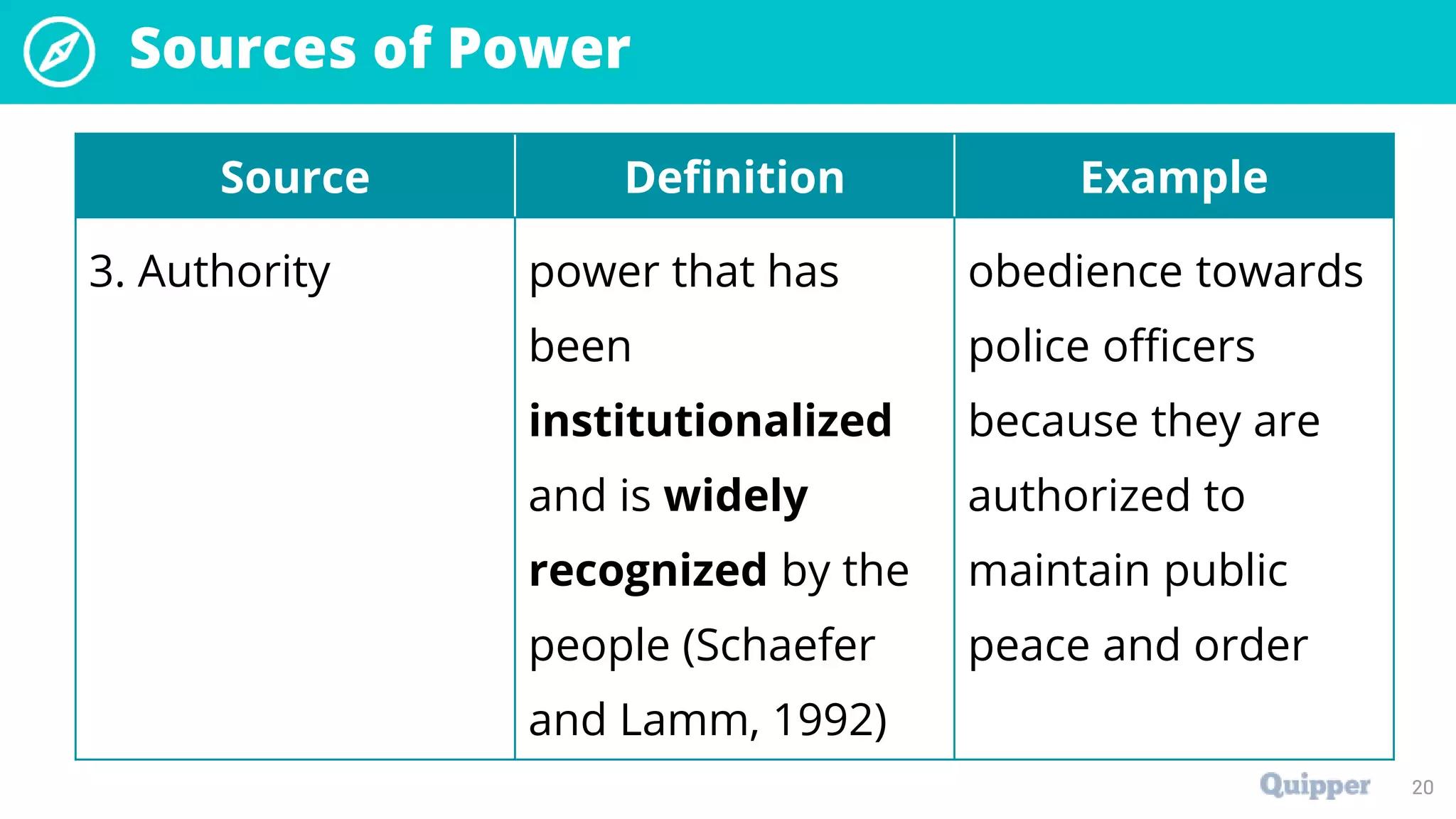
20
Source Definition Example
3. Authority power that has
been
institutionalized
and is widely
recognized by the
people (Schaefer
and Lamm, 1992)
obedience towards
police officers
because they are
authorized to
maintain public
peace and order
Effects of Exercising Power
21
Positive Effects Negative Effects
● Power enables the citizens
to take immediate actions.
● Powerful people are more
proactive and responsive to
political and social
dilemmas.
● Leaders can abuse their
power by making unethical
decisions.
● Having more power in
politics gives rise to
ineptitude and corruption.
Effects of Exercising Power
22
Positive Effects Negative Effects
● Powerful people are focused
on the end results in suitable
in a certain situation.
● Leaders focus their attention
on resolving conflicts
promptly.
● Powerful leaders bring out
negative emotional reactions
to their members or
subordinates.
● People with power tend to
distance themselves from
their subordinates that
oftentimes result in a hateful
environment.
Effects of Exercising Power
23
Positive Effects Negative Effects
● Powerful people tend to
execute their tasks more
rapidly and successfully
especially those concerning
administration,
management, and decision-
making.
● Too much exercise of power
leads to devaluing the work,
skill, and ability of less
powerful individuals.
Check
Your
Progress
24
24
When is there abuse of power?
Try This!
True or False
Identify if the statement is true or false.
1. Authority refers to the ability of a
person to influence the actions,
decisions, and behavior of another
individual.
25
Try This!
True or False
Identify if the statement is true or false.
2. Power is only recognized in political
institutions.
26
Try This!
True or False
Identify if the statement is true or false.
3. Power has a broad spectrum of
meanings in both social and political
aspects.
27
Try This!
True or False
Identify if the statement is true or false.
4. Power pertains to the capability of
controlling the behavior of people.
28
Try This!
True or False
Identify if the statement is true or false.
5. Leadership is the ability to influence the
results and consequences of events.
29
Wrap-Up ● Power refers to the ability of a person to influence
the actions, decisions, and behavior of another
individual.
● Power can be expressed downward, whereby a
leader influences the actions or undertakings of his
or her subordinates. It can also be expressed
upward, whereby the subordinates influence the
decisions of their leader.
30
Wrap-Up
● There are three sources of power:
○ force
○ authority
○ influence
● The exercise of power can have positive and
negative consequences.
31
32
Challenge
Yourself
What steps do you think should be taken to
avoid abuse of power in the government?

POWER IN POLITICS..pptx

  • 1.
    Philippine Politics andGovernance General Academic Strand | Humanities and Social Sciences Lesson 3.1 Power in Politics
  • 2.
    What do youfeel whenever you see police cars? 2
  • 3.
    What authority doesthis officer have? 3
  • 4.
    What do thesepeople have in common? 4 4
  • 5.
    People get intimidatedby others because of the latter’s character, power, and position in society that may be caused by a previous discrimination, self-esteem, abuse, and violence. 5
  • 6.
    Learning Competencies 6 ● Define power(HUMSS_PG12-Id-11). ● Recognize the nature, dimensions, types, and consequences of power (HUMSS_PG12-Id-12). ● Analyze the nature, dimensions, types, deployments, and consequences of power (HUMSS_PG12-Id-13).
  • 7.
  • 8.
    Power and PoliticalScience Power ability of a person to influence the actions, decisions, and behavior of another individual 8
  • 9.
    Power and PoliticalScience Definition of Power ability to control people’s behavior and influence the results and consequences of events (Oxford University Press, 2015) 9
  • 10.
    Power and PoliticalScience ability to address resistance and to persuade people to do things that they would not otherwise do (Pfeffer 1990, 30) Definition of Power 10
  • 11.
    Power and PoliticalScience Power is present in all forms of social relationships, including political institutions. (Foucault, 1996) Definition of Power 11
  • 12.
    Power and PoliticalScience 12 Downward Influence The leader can influence the actions or undertakings of his or her subordinates. Upward Influence The subordinates can also influence the decisions of their leader. ● Power is related to leadership. ● Leaders can exert “downward” or “upward” influence.
  • 13.
    Check Your Progress 13 13 What are theresults of exercising power?
  • 14.
    How Is PowerRelated to Authority? People who are in a position to wield power are said to have authority. 14
  • 15.
    How Is PowerRelated to Authority? 15 ● People who have authority have legitimate power. ● Legitimacy is when the right and ability to wield power is recognized.
  • 16.
    How Is PowerRelated to Authority? Religious leaders have authority over their congregations. 16
  • 17.
    How Is PowerRelated to Authority? School administrators have authority over faculty members and the student body. 17
  • 18.
    Sources of Power 18 SourceDefinition Example 1. Force use of coercion to impose one’s will on his or her members or subordinates mobilization of the armed forces of the country to arrest political opponents
  • 19.
    Sources of Power 19 SourceDefinition Example 2. Influence pertains to the ability of affecting the decisions of other people change of one’s opinion on an electoral process after listening to the platforms of a candidate
  • 20.
    Sources of Power 20 SourceDefinition Example 3. Authority power that has been institutionalized and is widely recognized by the people (Schaefer and Lamm, 1992) obedience towards police officers because they are authorized to maintain public peace and order
  • 21.
    Effects of ExercisingPower 21 Positive Effects Negative Effects ● Power enables the citizens to take immediate actions. ● Powerful people are more proactive and responsive to political and social dilemmas. ● Leaders can abuse their power by making unethical decisions. ● Having more power in politics gives rise to ineptitude and corruption.
  • 22.
    Effects of ExercisingPower 22 Positive Effects Negative Effects ● Powerful people are focused on the end results in suitable in a certain situation. ● Leaders focus their attention on resolving conflicts promptly. ● Powerful leaders bring out negative emotional reactions to their members or subordinates. ● People with power tend to distance themselves from their subordinates that oftentimes result in a hateful environment.
  • 23.
    Effects of ExercisingPower 23 Positive Effects Negative Effects ● Powerful people tend to execute their tasks more rapidly and successfully especially those concerning administration, management, and decision- making. ● Too much exercise of power leads to devaluing the work, skill, and ability of less powerful individuals.
  • 24.
  • 25.
    Try This! True orFalse Identify if the statement is true or false. 1. Authority refers to the ability of a person to influence the actions, decisions, and behavior of another individual. 25
  • 26.
    Try This! True orFalse Identify if the statement is true or false. 2. Power is only recognized in political institutions. 26
  • 27.
    Try This! True orFalse Identify if the statement is true or false. 3. Power has a broad spectrum of meanings in both social and political aspects. 27
  • 28.
    Try This! True orFalse Identify if the statement is true or false. 4. Power pertains to the capability of controlling the behavior of people. 28
  • 29.
    Try This! True orFalse Identify if the statement is true or false. 5. Leadership is the ability to influence the results and consequences of events. 29
  • 30.
    Wrap-Up ● Powerrefers to the ability of a person to influence the actions, decisions, and behavior of another individual. ● Power can be expressed downward, whereby a leader influences the actions or undertakings of his or her subordinates. It can also be expressed upward, whereby the subordinates influence the decisions of their leader. 30
  • 31.
    Wrap-Up ● There arethree sources of power: ○ force ○ authority ○ influence ● The exercise of power can have positive and negative consequences. 31
  • 32.
    32 Challenge Yourself What steps doyou think should be taken to avoid abuse of power in the government?

Editor's Notes

  • #14 For the answer key, please refer to the Answer Key of the study guide provided in the Teacher's Content.
  • #19 Coercion- Pamimilit
  • #25 For the answer key, please refer to the Answer Key of the study guide provided in the Teacher's Content.
  • #26 For the answer key, please refer to the Answer Key of the study guide provided in the Teacher's Content.
  • #27 For the answer key, please refer to the Answer Key of the study guide provided in the Teacher's Content.
  • #28 For the answer key, please refer to the Answer Key of the study guide provided in the Teacher's Content.
  • #29 For the answer key, please refer to the Answer Key of the study guide provided in the Teacher's Content.
  • #30 For the answer key, please refer to the Answer Key of the study guide provided in the Teacher's Content.
  • #33 For the suggested rubric, please refer to the study guide.