Philippine Politics and Governance
General Academic Strand | Humanities and Social Sciences
Lesson 2.1
Liberalism
Do you want to edit this presentation?
2
Make a copy and edit in
Google Slides.
1. On the menu bar, click File and
then Make a copy and Entire
Presentation.
2. Type a name for the file.
3. Choose where to save it on your
Google Drive.
4. Click Ok.
5. A new tab will open. Wait for the
file to be completely loaded on a
new tab.
6. Once the file has loaded, edit this
presentation using Google Slides.
Download an offline copy and
edit in Microsoft PowerPoint.
1. On the menu bar, click File and then
Download as.
2. Choose a file type. Select Microsoft
PowerPoint (.pptx).
3. Wait for the file to be downloaded to your
local disk.
4. Once completely downloaded, open the file
and edit it using Microsoft PowerPoint or any
offline presentation program.
What does it
mean to be
“free” in a
society?
3
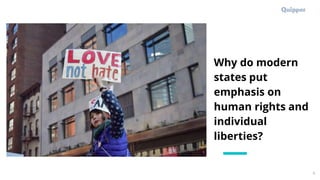
Why do modern
states put
emphasis on
human rights and
individual
liberties?
4
Learning
Competencies
5
● Identify the basic tenets of major political
ideologies (i.e., liberalism, socialism,
conservatism, etc.) (HUMSS_PG12-Ib-c-6).
● Differentiate the political ideologies
(HUMSS_PG12-Ib-c-7).
Learning
Objectives
6
● Define liberalism and its key principles.
● Explain the historical development of
liberalism.
● Identify key liberal thinkers.
● Compare the variations of liberalism.
● Assess political systems founded on liberal
principles.
Explore
7
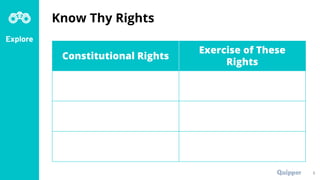
Know Thy Rights
1. Read Article 3 (Bill of Rights) of the 1987 Constitution.
2. Choose three from the different rights listed in the
Constitution.
3. Provide concrete examples on how you are exercising
these rights either as a student or as a member of
society.
4. Answer the guide questions.
Explore
8
Constitutional Rights
Exercise of These
Rights
Know Thy Rights
Explore
What is your basis for choosing the three
constitutional rights out of the ones
provided in Article 3 of the 1987
Constitution?
9
Explore
Based on your answers, do you think
that you are able to meaningfully
exercise your constitutional rights?
Explain your answer.
10
Explore
What do you think is the importance of
having these constitutional rights in a
liberal society?
11
Essential
Question
12
Which principles of liberalism are evident in
contemporary Philippine society?
Defining Liberalism
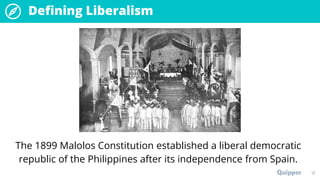
The 1899 Malolos Constitution established a liberal democratic
republic of the Philippines after its independence from Spain.
13
14
Defining Liberalism
● An ideology refers to a set of ideas that “structure political
understanding and so set goal and inspire activism, shape
the nature of political systems, and act as a form of social
cement” (Heywood 2017, 2)
● The study of political ideologies often begins with
liberalism.
Defining Liberalism
● Liberal values are the
building blocks of
democracies.
● Majority of political
systems in the world
today are democracies.
15
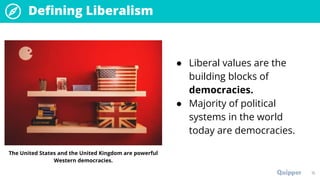
The United States and the United Kingdom are powerful
Western democracies.
16
Defining Liberalism
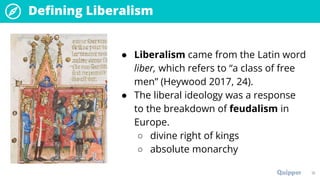
● Liberalism came from the Latin word
liber, which refers to “a class of free
men” (Heywood 2017, 24).
● The liberal ideology was a response
to the breakdown of feudalism in
Europe.
○ divine right of kings
○ absolute monarchy
17
Principles of Liberalism
liberalism
individualism
freedom reason
justice
toleration
Defining Liberalism
18
Principles of Liberalism
liberalism
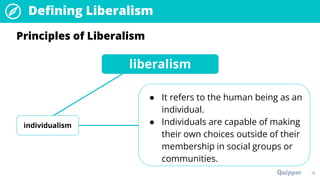
individualism
● It refers to the human being as an
individual.
● Individuals are capable of making
their own choices outside of their
membership in social groups or
communities.
Defining Liberalism
19
Principles of Liberalism
liberalism
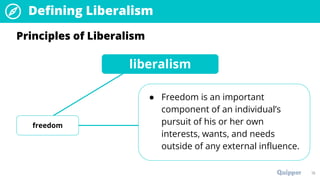
freedom
● Freedom is an important
component of an individual’s
pursuit of his or her own
interests, wants, and needs
outside of any external influence.
Defining Liberalism
20
Principles of Liberalism
liberalism
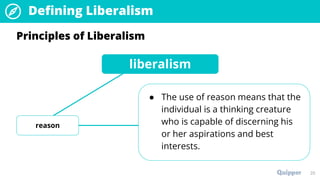
reason
● The use of reason means that the
individual is a thinking creature
who is capable of discerning his
or her aspirations and best
interests.
Defining Liberalism
21
Principles of Liberalism
liberalism
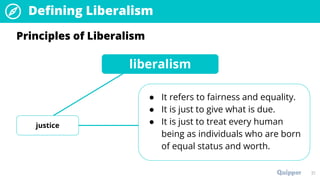
justice
● It refers to fairness and equality.
● It is just to give what is due.
● It is just to treat every human
being as individuals who are born
of equal status and worth.
Defining Liberalism
22
Principles of Liberalism
liberalism
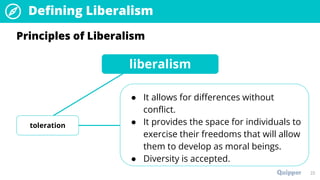
toleration
● It allows for differences without
conflict.
● It provides the space for individuals to
exercise their freedoms that will allow
them to develop as moral beings.
● Diversity is accepted.
Defining Liberalism
23
Principles of Liberalism
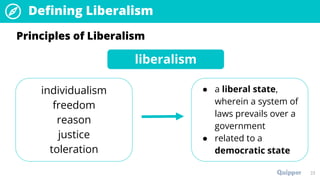
liberalism
individualism
freedom
reason
justice
toleration
● a liberal state,
wherein a system of
laws prevails over a
government
● related to a
democratic state
Defining Liberalism
Check
Your
Progress
24
24
What are the key principles of liberalism
and how are they related to one another?
Historical Context of Liberalism
25
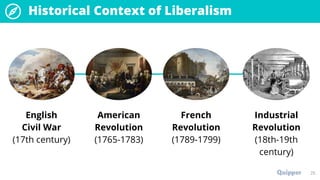
English
Civil War
(17th century)
American
Revolution
(1765-1783)
French
Revolution
(1789-1799)
Industrial
Revolution
(18th-19th
century)
26
Historical Context of Liberalism
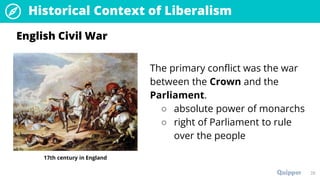
The primary conflict was the war
between the Crown and the
Parliament.
○ absolute power of monarchs
○ right of Parliament to rule
over the people
English Civil War
17th century in England
27
Historical Context of Liberalism
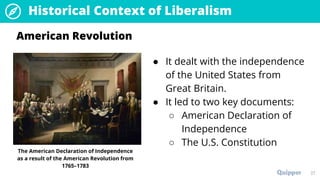
● It dealt with the independence
of the United States from
Great Britain.
● It led to two key documents:
○ American Declaration of
Independence
○ The U.S. Constitution
American Revolution
The American Declaration of Independence
as a result of the American Revolution from
1765–1783
28
Historical Context of Liberalism
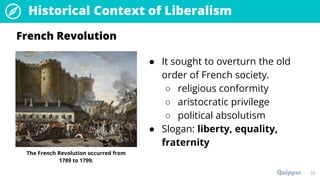
● It sought to overturn the old
order of French society.
○ religious conformity
○ aristocratic privilege
○ political absolutism
● Slogan: liberty, equality,
fraternity
French Revolution
The French Revolution occurred from
1789 to 1799.
29
Historical Context of Liberalism
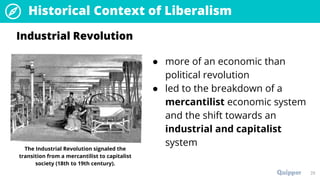
● more of an economic than
political revolution
● led to the breakdown of a
mercantilist economic system
and the shift towards an
industrial and capitalist
system
Industrial Revolution
The Industrial Revolution signaled the
transition from a mercantilist to capitalist
society (18th to 19th century).
30
Historical Context of Liberalism
Mercantilism
● economic strength as
measured at the expense of
others
● ownership of gold and silver
as key to economic and
political power
● economic theory behind
colonialism
Industrial Revolution
Capitalism
● invention of steam
machinery
● free market principle
(laissez faire, laissez passer)
● supply and demand
determined the price of
goods
● no government intervention
Check
Your
Progress
31
31
What are the core events in the
development of liberalism as an ideology?
Main Liberal Thinkers
32
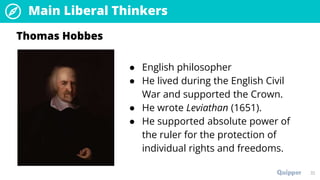
● English philosopher
● He lived during the English Civil
War and supported the Crown.
● He wrote Leviathan (1651).
● He supported absolute power of
the ruler for the protection of
individual rights and freedoms.
Thomas Hobbes
Main Liberal Thinkers
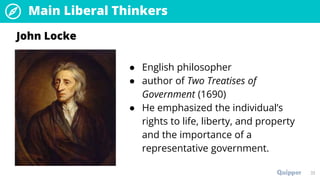
33
● English philosopher
● author of Two Treatises of
Government (1690)
● He emphasized the individual’s
rights to life, liberty, and property
and the importance of a
representative government.
John Locke
Main Liberal Thinkers
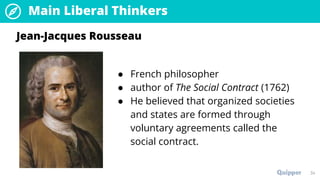
34
● French philosopher
● author of The Social Contract (1762)
● He believed that organized societies
and states are formed through
voluntary agreements called the
social contract.
Jean-Jacques Rousseau
Main Liberal Thinkers
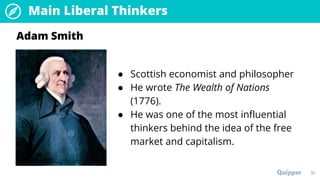
35
● Scottish economist and philosopher
● He wrote The Wealth of Nations
(1776).
● He was one of the most influential
thinkers behind the idea of the free
market and capitalism.
Adam Smith
Main Liberal Thinkers
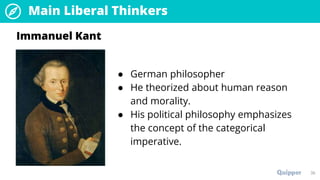
36
● German philosopher
● He theorized about human reason
and morality.
● His political philosophy emphasizes
the concept of the categorical
imperative.
Immanuel Kant
Main Liberal Thinkers
37
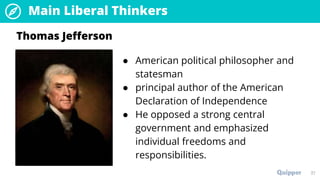
● American political philosopher and
statesman
● principal author of the American
Declaration of Independence
● He opposed a strong central
government and emphasized
individual freedoms and
responsibilities.
Thomas Jefferson
Main Liberal Thinkers
38
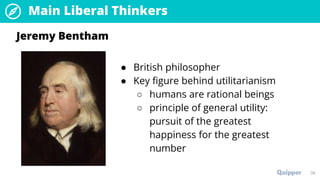
● British philosopher
● Key figure behind utilitarianism
○ humans are rational beings
○ principle of general utility:
pursuit of the greatest
happiness for the greatest
number
Jeremy Bentham
Main Liberal Thinkers
39
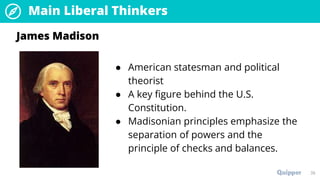
● American statesman and political
theorist
● A key figure behind the U.S.
Constitution.
● Madisonian principles emphasize the
separation of powers and the
principle of checks and balances.
James Madison
Main Liberal Thinkers
40
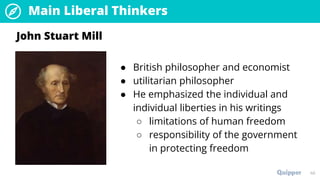
● British philosopher and economist
● utilitarian philosopher
● He emphasized the individual and
individual liberties in his writings
○ limitations of human freedom
○ responsibility of the government
in protecting freedom
John Stuart Mill
Variations of Liberalism
41
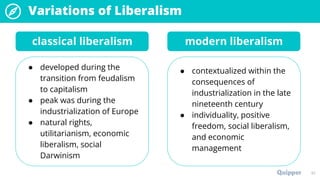
classical liberalism
● developed during the
transition from feudalism
to capitalism
● peak was during the
industrialization of Europe
● natural rights,
utilitarianism, economic
liberalism, social
Darwinism
modern liberalism
● contextualized within the
consequences of
industrialization in the late
nineteenth century
● individuality, positive
freedom, social liberalism,
and economic
management
Variations of Liberalism
42
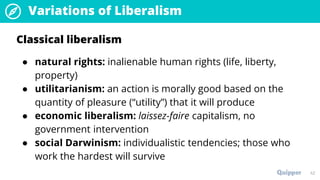
Classical liberalism
● natural rights: inalienable human rights (life, liberty,
property)
● utilitarianism: an action is morally good based on the
quantity of pleasure (“utility”) that it will produce
● economic liberalism: laissez-faire capitalism, no
government intervention
● social Darwinism: individualistic tendencies; those who
work the hardest will survive
Variations of Liberalism
43
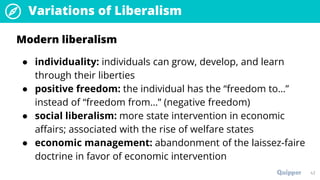
Modern liberalism
● individuality: individuals can grow, develop, and learn
through their liberties
● positive freedom: the individual has the “freedom to…”
instead of “freedom from…” (negative freedom)
● social liberalism: more state intervention in economic
affairs; associated with the rise of welfare states
● economic management: abandonment of the laissez-faire
doctrine in favor of economic intervention
Check
Your
Progress
44
44
What are the key features of classical and
modern liberalism?
Try This!
Identify if the statement is true. Otherwise, replace
the underlined word or phrase to make the
statement true.
1. Liberalism came from the Latin word liber, which
refers to a class of free men.
45
Try This!
Identify if the statement is true. Otherwise, replace
the underlined word or phrase to make the
statement true.
2. The liberal principle of toleration means that
individual differences are respected and these
differences do not result in conflict.
46
Try This!
Identify if the statement is true. Otherwise, replace
the underlined word or phrase to make the
statement true.
3. The emergence of a liberal ideology was seen as a
response to feudalism in Western Europe.
47
Try This!
Identify if the statement is true. Otherwise, replace
the underlined word or phrase to make the
statement true.
4. Feudalism refers to an industrial-based political and
economic system.
48
Try This!
Identify if the statement is true. Otherwise, replace
the underlined word or phrase to make the
statement true.
5. The English Civil War was due to the conflict
between the Crown and the Parliament.
49
Wrap-Up
● An ideology refers to a set of ideas that “structure
political understanding and so set goal and inspire
activism, shape the nature of political systems, and
act as a form of social cement” (Heywood 2017, 2).
● Liberalism is one of the most dominant political
ideologies. It puts prime emphasis on the value of
the individual and is best defined in terms of its key
principles of individualism, freedom, reason,
justice, and toleration.
50
Wrap-Up
● Liberalism is often associated with a democratic
political system and a capitalist economic system.
● Key events in history that shaped liberal thought
are the English Civil War, the American
Revolution, the French Revolution, and the
Industrial Revolution.
● Variations of liberalism can be generally classified
into two: classical liberalism and modern
liberalism.
51
52
Challenge
Yourself
How does liberalism emphasize the value of
the individual human being?
Bibliography
Ball, Terence and Richard Dagger. Political Ideologies and the Democratic Ideal, 6th edition. New York: Pearson Education,
2006.
Heywood, Andrew. Political Ideologies: An Introduction, 6th edition. London: Palgrave Macmillan, 2017.
Heywood, Andrew. Politics, 4th edition. London: Palgrave Macmillan, 2013.
The U.S. National Archives and Records Administration. “Declaration of Independence: A Transcription.” Accessed April
21, 2021. https://www.archives.gov/founding-docs/declaration-transcript.
53

PPG 11_1 Q1 0201 PS.pptx

  • 1.
    Philippine Politics andGovernance General Academic Strand | Humanities and Social Sciences Lesson 2.1 Liberalism
  • 2.
    Do you wantto edit this presentation? 2 Make a copy and edit in Google Slides. 1. On the menu bar, click File and then Make a copy and Entire Presentation. 2. Type a name for the file. 3. Choose where to save it on your Google Drive. 4. Click Ok. 5. A new tab will open. Wait for the file to be completely loaded on a new tab. 6. Once the file has loaded, edit this presentation using Google Slides. Download an offline copy and edit in Microsoft PowerPoint. 1. On the menu bar, click File and then Download as. 2. Choose a file type. Select Microsoft PowerPoint (.pptx). 3. Wait for the file to be downloaded to your local disk. 4. Once completely downloaded, open the file and edit it using Microsoft PowerPoint or any offline presentation program.
  • 3.
    What does it meanto be “free” in a society? 3
  • 4.
    Why do modern statesput emphasis on human rights and individual liberties? 4
  • 5.
    Learning Competencies 5 ● Identify thebasic tenets of major political ideologies (i.e., liberalism, socialism, conservatism, etc.) (HUMSS_PG12-Ib-c-6). ● Differentiate the political ideologies (HUMSS_PG12-Ib-c-7).
  • 6.
    Learning Objectives 6 ● Define liberalismand its key principles. ● Explain the historical development of liberalism. ● Identify key liberal thinkers. ● Compare the variations of liberalism. ● Assess political systems founded on liberal principles.
  • 7.
    Explore 7 Know Thy Rights 1.Read Article 3 (Bill of Rights) of the 1987 Constitution. 2. Choose three from the different rights listed in the Constitution. 3. Provide concrete examples on how you are exercising these rights either as a student or as a member of society. 4. Answer the guide questions.
  • 8.
    Explore 8 Constitutional Rights Exercise ofThese Rights Know Thy Rights
  • 9.
    Explore What is yourbasis for choosing the three constitutional rights out of the ones provided in Article 3 of the 1987 Constitution? 9
  • 10.
    Explore Based on youranswers, do you think that you are able to meaningfully exercise your constitutional rights? Explain your answer. 10
  • 11.
    Explore What do youthink is the importance of having these constitutional rights in a liberal society? 11
  • 12.
    Essential Question 12 Which principles ofliberalism are evident in contemporary Philippine society?
  • 13.
    Defining Liberalism The 1899Malolos Constitution established a liberal democratic republic of the Philippines after its independence from Spain. 13
  • 14.
    14 Defining Liberalism ● Anideology refers to a set of ideas that “structure political understanding and so set goal and inspire activism, shape the nature of political systems, and act as a form of social cement” (Heywood 2017, 2) ● The study of political ideologies often begins with liberalism.
  • 15.
    Defining Liberalism ● Liberalvalues are the building blocks of democracies. ● Majority of political systems in the world today are democracies. 15 The United States and the United Kingdom are powerful Western democracies.
  • 16.
    16 Defining Liberalism ● Liberalismcame from the Latin word liber, which refers to “a class of free men” (Heywood 2017, 24). ● The liberal ideology was a response to the breakdown of feudalism in Europe. ○ divine right of kings ○ absolute monarchy
  • 17.
    17 Principles of Liberalism liberalism individualism freedomreason justice toleration Defining Liberalism
  • 18.
    18 Principles of Liberalism liberalism individualism ●It refers to the human being as an individual. ● Individuals are capable of making their own choices outside of their membership in social groups or communities. Defining Liberalism
  • 19.
    19 Principles of Liberalism liberalism freedom ●Freedom is an important component of an individual’s pursuit of his or her own interests, wants, and needs outside of any external influence. Defining Liberalism
  • 20.
    20 Principles of Liberalism liberalism reason ●The use of reason means that the individual is a thinking creature who is capable of discerning his or her aspirations and best interests. Defining Liberalism
  • 21.
    21 Principles of Liberalism liberalism justice ●It refers to fairness and equality. ● It is just to give what is due. ● It is just to treat every human being as individuals who are born of equal status and worth. Defining Liberalism
  • 22.
    22 Principles of Liberalism liberalism toleration ●It allows for differences without conflict. ● It provides the space for individuals to exercise their freedoms that will allow them to develop as moral beings. ● Diversity is accepted. Defining Liberalism
  • 23.
    23 Principles of Liberalism liberalism individualism freedom reason justice toleration ●a liberal state, wherein a system of laws prevails over a government ● related to a democratic state Defining Liberalism
  • 24.
    Check Your Progress 24 24 What are thekey principles of liberalism and how are they related to one another?
  • 25.
    Historical Context ofLiberalism 25 English Civil War (17th century) American Revolution (1765-1783) French Revolution (1789-1799) Industrial Revolution (18th-19th century)
  • 26.
    26 Historical Context ofLiberalism The primary conflict was the war between the Crown and the Parliament. ○ absolute power of monarchs ○ right of Parliament to rule over the people English Civil War 17th century in England
  • 27.
    27 Historical Context ofLiberalism ● It dealt with the independence of the United States from Great Britain. ● It led to two key documents: ○ American Declaration of Independence ○ The U.S. Constitution American Revolution The American Declaration of Independence as a result of the American Revolution from 1765–1783
  • 28.
    28 Historical Context ofLiberalism ● It sought to overturn the old order of French society. ○ religious conformity ○ aristocratic privilege ○ political absolutism ● Slogan: liberty, equality, fraternity French Revolution The French Revolution occurred from 1789 to 1799.
  • 29.
    29 Historical Context ofLiberalism ● more of an economic than political revolution ● led to the breakdown of a mercantilist economic system and the shift towards an industrial and capitalist system Industrial Revolution The Industrial Revolution signaled the transition from a mercantilist to capitalist society (18th to 19th century).
  • 30.
    30 Historical Context ofLiberalism Mercantilism ● economic strength as measured at the expense of others ● ownership of gold and silver as key to economic and political power ● economic theory behind colonialism Industrial Revolution Capitalism ● invention of steam machinery ● free market principle (laissez faire, laissez passer) ● supply and demand determined the price of goods ● no government intervention
  • 31.
    Check Your Progress 31 31 What are thecore events in the development of liberalism as an ideology?
  • 32.
    Main Liberal Thinkers 32 ●English philosopher ● He lived during the English Civil War and supported the Crown. ● He wrote Leviathan (1651). ● He supported absolute power of the ruler for the protection of individual rights and freedoms. Thomas Hobbes
  • 33.
    Main Liberal Thinkers 33 ●English philosopher ● author of Two Treatises of Government (1690) ● He emphasized the individual’s rights to life, liberty, and property and the importance of a representative government. John Locke
  • 34.
    Main Liberal Thinkers 34 ●French philosopher ● author of The Social Contract (1762) ● He believed that organized societies and states are formed through voluntary agreements called the social contract. Jean-Jacques Rousseau
  • 35.
    Main Liberal Thinkers 35 ●Scottish economist and philosopher ● He wrote The Wealth of Nations (1776). ● He was one of the most influential thinkers behind the idea of the free market and capitalism. Adam Smith
  • 36.
    Main Liberal Thinkers 36 ●German philosopher ● He theorized about human reason and morality. ● His political philosophy emphasizes the concept of the categorical imperative. Immanuel Kant
  • 37.
    Main Liberal Thinkers 37 ●American political philosopher and statesman ● principal author of the American Declaration of Independence ● He opposed a strong central government and emphasized individual freedoms and responsibilities. Thomas Jefferson
  • 38.
    Main Liberal Thinkers 38 ●British philosopher ● Key figure behind utilitarianism ○ humans are rational beings ○ principle of general utility: pursuit of the greatest happiness for the greatest number Jeremy Bentham
  • 39.
    Main Liberal Thinkers 39 ●American statesman and political theorist ● A key figure behind the U.S. Constitution. ● Madisonian principles emphasize the separation of powers and the principle of checks and balances. James Madison
  • 40.
    Main Liberal Thinkers 40 ●British philosopher and economist ● utilitarian philosopher ● He emphasized the individual and individual liberties in his writings ○ limitations of human freedom ○ responsibility of the government in protecting freedom John Stuart Mill
  • 41.
    Variations of Liberalism 41 classicalliberalism ● developed during the transition from feudalism to capitalism ● peak was during the industrialization of Europe ● natural rights, utilitarianism, economic liberalism, social Darwinism modern liberalism ● contextualized within the consequences of industrialization in the late nineteenth century ● individuality, positive freedom, social liberalism, and economic management
  • 42.
    Variations of Liberalism 42 Classicalliberalism ● natural rights: inalienable human rights (life, liberty, property) ● utilitarianism: an action is morally good based on the quantity of pleasure (“utility”) that it will produce ● economic liberalism: laissez-faire capitalism, no government intervention ● social Darwinism: individualistic tendencies; those who work the hardest will survive
  • 43.
    Variations of Liberalism 43 Modernliberalism ● individuality: individuals can grow, develop, and learn through their liberties ● positive freedom: the individual has the “freedom to…” instead of “freedom from…” (negative freedom) ● social liberalism: more state intervention in economic affairs; associated with the rise of welfare states ● economic management: abandonment of the laissez-faire doctrine in favor of economic intervention
  • 44.
    Check Your Progress 44 44 What are thekey features of classical and modern liberalism?
  • 45.
    Try This! Identify ifthe statement is true. Otherwise, replace the underlined word or phrase to make the statement true. 1. Liberalism came from the Latin word liber, which refers to a class of free men. 45
  • 46.
    Try This! Identify ifthe statement is true. Otherwise, replace the underlined word or phrase to make the statement true. 2. The liberal principle of toleration means that individual differences are respected and these differences do not result in conflict. 46
  • 47.
    Try This! Identify ifthe statement is true. Otherwise, replace the underlined word or phrase to make the statement true. 3. The emergence of a liberal ideology was seen as a response to feudalism in Western Europe. 47
  • 48.
    Try This! Identify ifthe statement is true. Otherwise, replace the underlined word or phrase to make the statement true. 4. Feudalism refers to an industrial-based political and economic system. 48
  • 49.
    Try This! Identify ifthe statement is true. Otherwise, replace the underlined word or phrase to make the statement true. 5. The English Civil War was due to the conflict between the Crown and the Parliament. 49
  • 50.
    Wrap-Up ● An ideologyrefers to a set of ideas that “structure political understanding and so set goal and inspire activism, shape the nature of political systems, and act as a form of social cement” (Heywood 2017, 2). ● Liberalism is one of the most dominant political ideologies. It puts prime emphasis on the value of the individual and is best defined in terms of its key principles of individualism, freedom, reason, justice, and toleration. 50
  • 51.
    Wrap-Up ● Liberalism isoften associated with a democratic political system and a capitalist economic system. ● Key events in history that shaped liberal thought are the English Civil War, the American Revolution, the French Revolution, and the Industrial Revolution. ● Variations of liberalism can be generally classified into two: classical liberalism and modern liberalism. 51
  • 52.
    52 Challenge Yourself How does liberalismemphasize the value of the individual human being?
  • 53.
    Bibliography Ball, Terence andRichard Dagger. Political Ideologies and the Democratic Ideal, 6th edition. New York: Pearson Education, 2006. Heywood, Andrew. Political Ideologies: An Introduction, 6th edition. London: Palgrave Macmillan, 2017. Heywood, Andrew. Politics, 4th edition. London: Palgrave Macmillan, 2013. The U.S. National Archives and Records Administration. “Declaration of Independence: A Transcription.” Accessed April 21, 2021. https://www.archives.gov/founding-docs/declaration-transcript. 53

Editor's Notes

  • #10 For the answer key, please refer to the Answer Key of the study guide provided in the Teacher's Content.
  • #11 For the answer key, please refer to the Answer Key of the study guide provided in the Teacher's Content.
  • #12 For the answer key, please refer to the Answer Key of the study guide provided in the Teacher's Content.
  • #25 For the answer key, please refer to the Answer Key of the study guide provided in the Teacher's Content.
  • #32 For the answer key, please refer to the Answer Key of the study guide provided in the Teacher's Content.
  • #46 For the answer key, please refer to the Answer Key of the study guide provided in the Teacher's Content.
  • #47 For the answer key, please refer to the Answer Key of the study guide provided in the Teacher's Content.
  • #48 For the answer key, please refer to the Answer Key of the study guide provided in the Teacher's Content.
  • #49 For the answer key, please refer to the Answer Key of the study guide provided in the Teacher's Content.
  • #50 For the answer key, please refer to the Answer Key of the study guide provided in the Teacher's Content.
  • #53 For the suggested rubric, please refer to the study guide.