LIFE IN POVERTY
Our Objective

   Our objective is to educate and
inform the public, that is, you, about
 the severity of poverty in the world.
Poverty
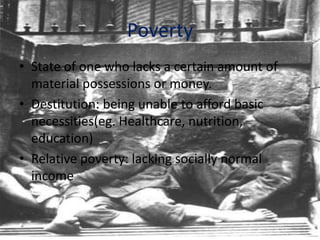
• State of one who lacks a certain amount of
  material possessions or money.
• Destitution: being unable to afford basic
  necessities(eg. Healthcare, nutrition,
  education)
• Relative poverty: lacking socially normal
  income
Statistics
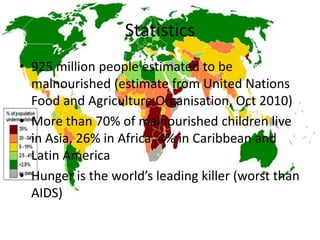
• 925 million people estimated to be
  malnourished (estimate from United Nations
  Food and Agriculture Organisation, Oct 2010)
• More than 70% of malnourished children live
  in Asia, 26% in Africa, 4% in Caribbean and
  Latin America
• Hunger is the world’s leading killer (worst than
  AIDS)
Statistics
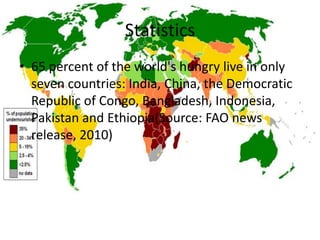
• 65 percent of the world's hungry live in only
  seven countries: India, China, the Democratic
  Republic of Congo, Bangladesh, Indonesia,
  Pakistan and Ethiopia(Source: FAO news
  release, 2010)
Causes resulting in poverty
• Bad governing of the nation
• Most of the poorer nations were former
  colonies of colonial powers. After their
  colonial masters left the country fell into
  disarray and chaos, especially countries in
  Africa.
• Corruption : Money is not directed towards
  social services to raise standards of living but
  instead to officials’ pockets
Consequences of Poverty
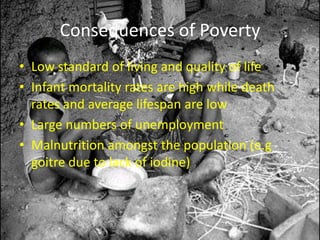
• Low standard of living and quality of life
• Infant mortality rates are high while death
  rates and average lifespan are low
• Large numbers of unemployment
• Malnutrition amongst the population (e.g
  goitre due to lack of iodine)
Measures to alleviate poverty
• Aid
- Help given from a richer country to another country, ranging from
    monetary to labour
- E.g: United Nations, USA

• Debt relief
- Partial/complete forgiveness of debt

• Microfinance
- Provision of financial services to low-income clients or solidarity
    lending groups including consumers and the self-employed, who
    traditionally lack access to banking and related services.
- E.g: Grameen Bank, Bangladesh
THE END

Life in poverty

  • 1.
  • 2.
    Our Objective Our objective is to educate and inform the public, that is, you, about the severity of poverty in the world.
  • 3.
    Poverty • State ofone who lacks a certain amount of material possessions or money. • Destitution: being unable to afford basic necessities(eg. Healthcare, nutrition, education) • Relative poverty: lacking socially normal income
  • 4.
    Statistics • 925 millionpeople estimated to be malnourished (estimate from United Nations Food and Agriculture Organisation, Oct 2010) • More than 70% of malnourished children live in Asia, 26% in Africa, 4% in Caribbean and Latin America • Hunger is the world’s leading killer (worst than AIDS)
  • 5.
    Statistics • 65 percentof the world's hungry live in only seven countries: India, China, the Democratic Republic of Congo, Bangladesh, Indonesia, Pakistan and Ethiopia(Source: FAO news release, 2010)
  • 6.
    Causes resulting inpoverty • Bad governing of the nation • Most of the poorer nations were former colonies of colonial powers. After their colonial masters left the country fell into disarray and chaos, especially countries in Africa. • Corruption : Money is not directed towards social services to raise standards of living but instead to officials’ pockets
  • 7.
    Consequences of Poverty •Low standard of living and quality of life • Infant mortality rates are high while death rates and average lifespan are low • Large numbers of unemployment • Malnutrition amongst the population (e.g goitre due to lack of iodine)
  • 8.
    Measures to alleviatepoverty • Aid - Help given from a richer country to another country, ranging from monetary to labour - E.g: United Nations, USA • Debt relief - Partial/complete forgiveness of debt • Microfinance - Provision of financial services to low-income clients or solidarity lending groups including consumers and the self-employed, who traditionally lack access to banking and related services. - E.g: Grameen Bank, Bangladesh
  • 9.