Marwan Alhalabi
Professor of Reproductive Medicine and Infertility,
Damascus University
Head of Assisted Reproduction Unit, Orient Hospital
President of Middle East FertilitySociety
President of Syrian Society of Obstetricians and
Gynecologists
• The progeny of organism develops characters similar to that
organism
• The resemblance of offspring to their parents depends on
the precise transmission of principle component from one
generation to the next
• That component is-
The Genetic Material
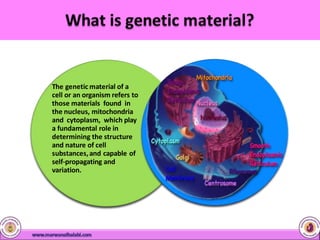
The genetic material of a
cell or an organism refers to
those materials found in
the nucleus, mitochondria
and cytoplasm, which play
a fundamental role in
determining the structure
and nature of cell
substances,and capable of
self-propagating and
variation.
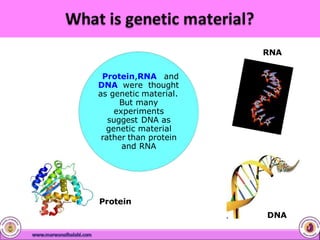
DNA
Protein
RNA
Protein,RNA and
DNA were thought
as genetic material.
But many
experiments
suggest DNA as
genetic material
rather than protein
and RNA
• Must carry information
– Cracking the genetic code
• Must self replicate
– DNA replication
• Must allow for
informationto change
– Mutation
• Must govern the
expressionof the
phenotype
– Gene function
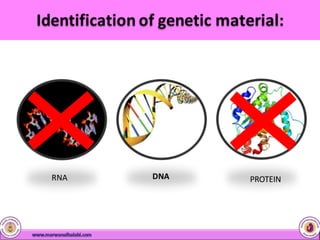
RNA PROTEIN
DNA
• The process of identification of genetic material began in
1928 with experiments of Griffith and concluded in 1952
with the studies of Hershey and Chase.
• Between these two experiments other three scientists,
Avery, Macloed and McCarty were did an experiment to
identify the genetic material.
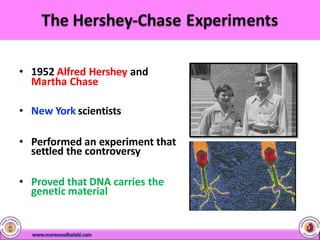
• 1952 Alfred Hershey and
Martha Chase
• New York scientists
• Performed an experiment that
settled the controversy
• Proved that DNA carries the
genetic material
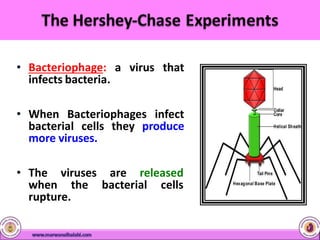
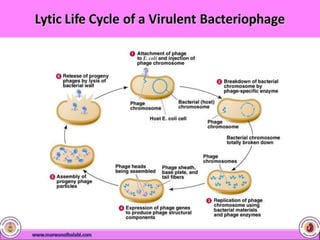
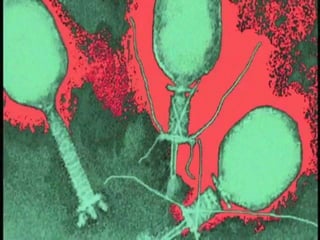
• Bacteriophage: a virus that
infects bacteria.
• When Bacteriophages infect
bacterial cells they produce
more viruses.
• The viruses are released
when the bacterial cells
rupture.
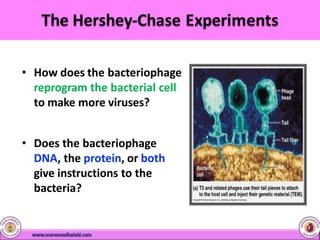
• How does the bacteriophage
reprogram the bacterial cell
to make more viruses?
• Does the bacteriophage
DNA, the protein, or both
give instructions to the
bacteria?
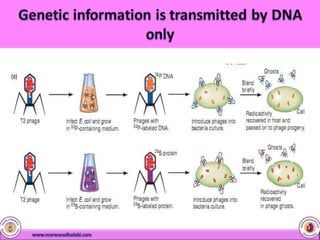
• Bacteriophage DNA was labeled with radioactive phosphorus
(32P)
• Bacteriophage protein was labeled with radioactive sulphur
(35S)
• only the bacteriophage DNA (as indicated by the 32P) entered
the bacteria and was used to produce more bacteriophage
• Conclusion: DNA is the genetic material
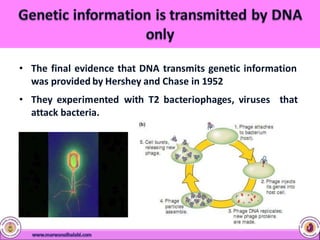
• The final evidence that DNA transmits genetic information
was provided by Hershey and Chase in 1952
• They experimented with T2 bacteriophages, viruses that
attack bacteria.
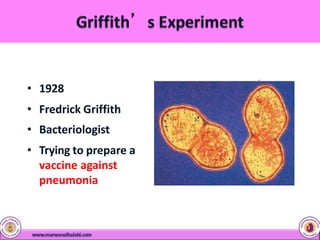
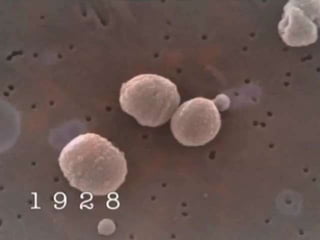
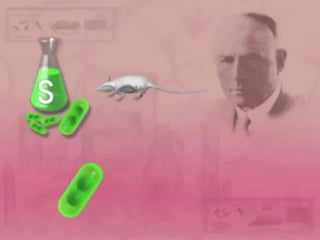
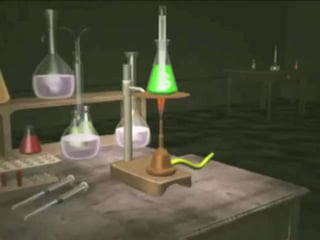
• 1928
• Fredrick Griffith
• Bacteriologist
• Trying to prepare a
vaccine against
pneumonia
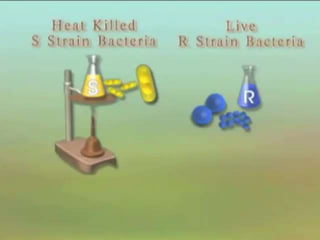
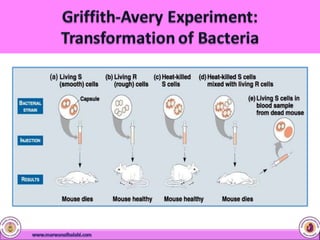
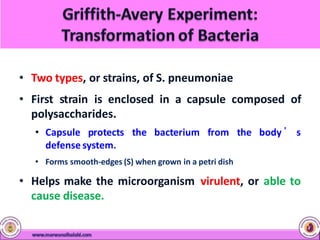
• Two types, or strains, of S. pneumoniae
• First strain is enclosed in a capsule composed of
polysaccharides.
• Capsule protects the bacterium from the body ’ s
defense system.
• Forms smooth-edges (S) when grown in a petri dish
• Helps make the microorganism virulent, or able to
cause disease.
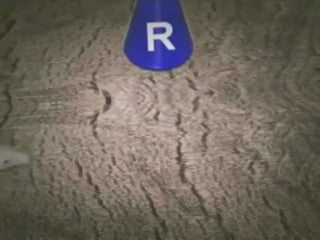
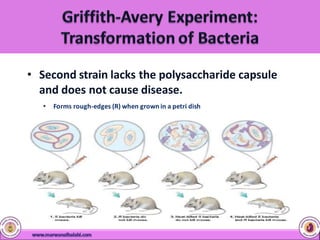
• Second strain lacks the polysaccharide capsule
and does not cause disease.
• Forms rough-edges (R) when grown in a petri dish
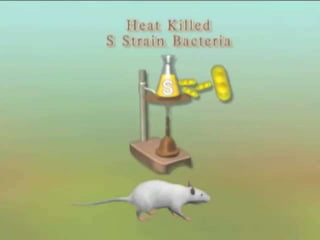
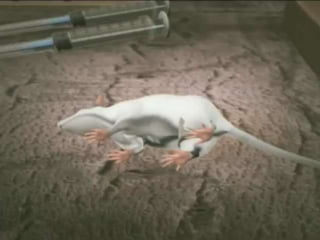
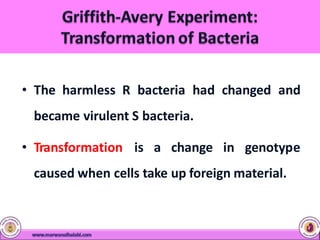
• The harmless R bacteria had changed and
became virulent S bacteria.
• Transformation is a change in genotype
caused when cells take up foreign material.
• Based on these observations he concluded that some of
the cells of type II R had changed into type III S due to
influence of dead type III S cells
• He called this phenomenon as transformation
• Principle Componentof type III S cells which induced
the conversionof type II R cells into type III S was
named transforming principle.
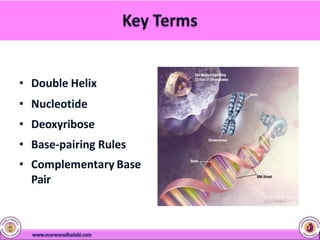
The Structure of DNA
• Double Helix
• Nucleotide
• Deoxyribose
• Base-pairing Rules
• Complementary Base
Pair
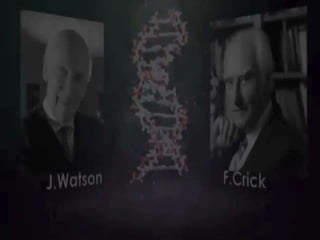
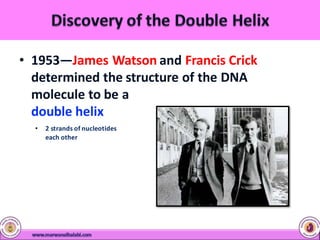
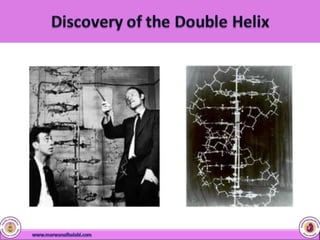
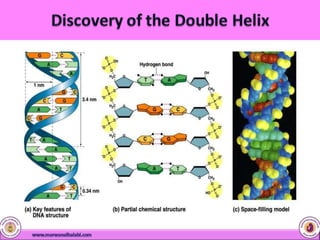
• 1953—James Watson and Francis Crick
determined the structure of the DNA
molecule to be a
twisted around
double helix
• 2 strands of nucleotides
each other
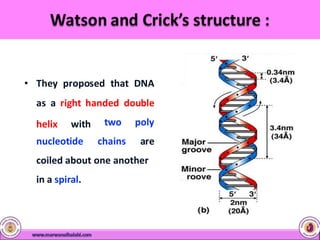
• They proposed that DNA
as a right handed double
helix with two poly
nucleotide chains are
coiled about one another
in a spiral.
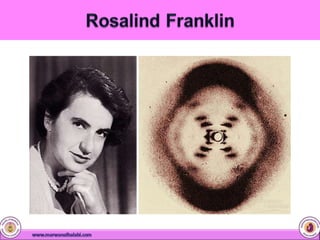
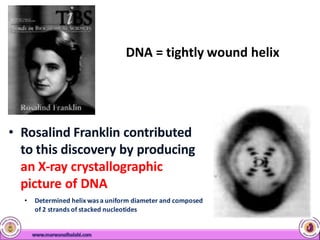
• Rosalind Franklin contributed
to this discovery by producing
an X-ray crystallographic
picture of DNA
• Determined helix was a uniform diameter and composed
of 2 strands of stacked nucleotides
DNA = tightly wound helix
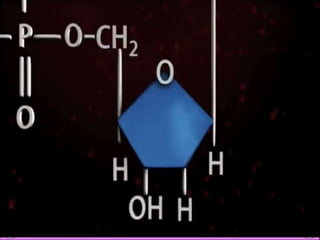
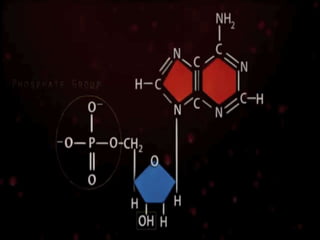
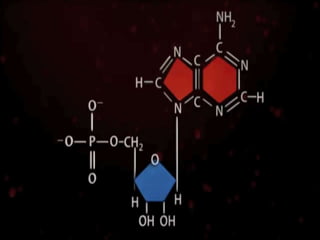
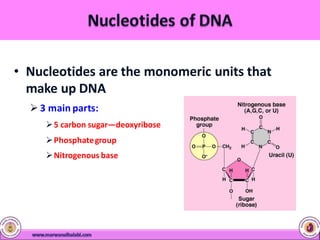
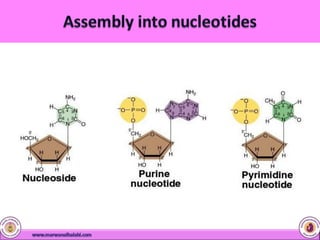
• Nucleotides are the monomeric units that
make up DNA
 3 main parts:
5 carbon sugar—deoxyribose
Phosphategroup
Nitrogenous base
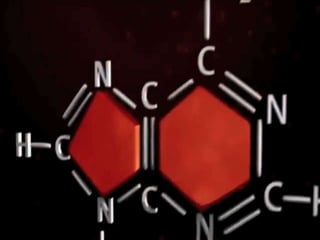
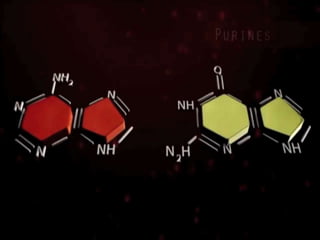
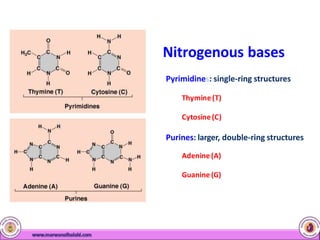
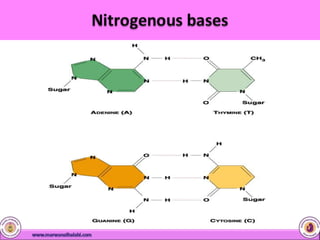
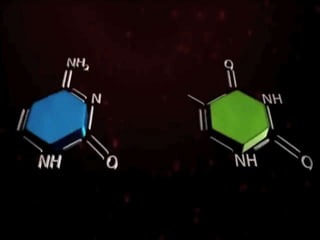
Nitrogenous bases
Pyrimidines: single-ring structures
Thymine(T)
Cytosine(C)
Purines: larger, double-ring structures
Adenine(A)
Guanine (G)
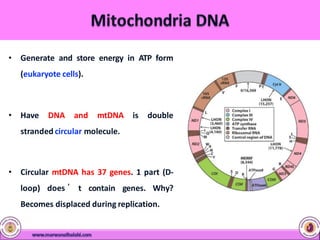
• Generate and store energy in ATP form
(eukaryote cells).
• Have DNA and mtDNA is double
stranded circular molecule.
• Circular mtDNA has 37 genes. 1 part (D-
loop) does ’ t contain genes. Why?
Becomes displaced during replication.
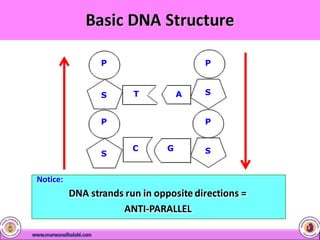
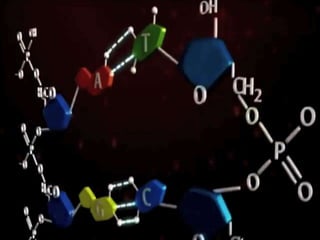
Notice:
DNA strands run in opposite directions =
ANTI-PARALLEL
P
S
S
S
P P
P
S
G
C
A
T
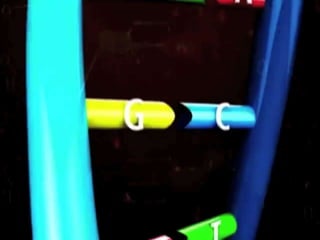
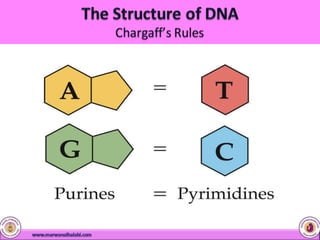
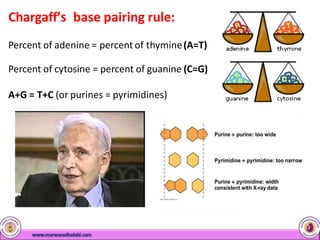
Chargaff’s base pairing rule:
Percent of adenine = percent of thymine(A=T)
Percent of cytosine = percent of guanine (C=G)
A+G = T+C (or purines = pyrimidines)
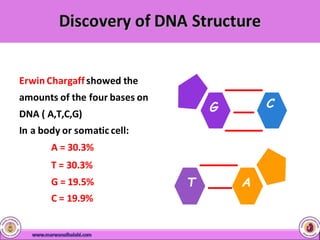
Erwin Chargaffshowed the
amounts of the four bases on
DNA ( A,T,C,G)
In a body or somatic cell:
A = 30.3%
T = 30.3%
G = 19.5%
C = 19.9%
T A
G C
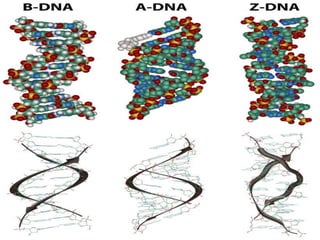
 Three major forms:
 B-DNA
 A-DNA
 Z-DNA
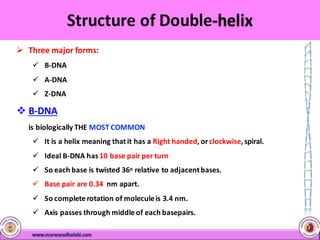
 B-DNA
is biologically THE MOST COMMON
 It is a helix meaning thatit has a Right handed, or clockwise, spiral.
 Ideal B-DNA has10 base pair per turn
 So each base is twisted 36o relative to adjacentbases.
 Base pair are 0.34 nm apart.
 So completerotation of moleculeis 3.4 nm.
 Axis passes through middleof each basepairs.
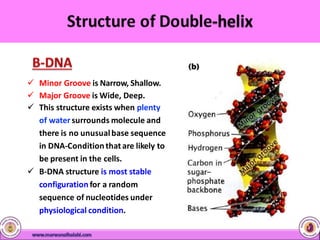
 Minor Groove is Narrow, Shallow.
 Major Groove is Wide, Deep.
 This structure exists when plenty
of water surrounds molecule and
there is no unusualbase sequence
in DNA-Conditionthatare likely to
be present in the cells.
 B-DNA structure is most stable
configuration for a random
sequence of nucleotides under
physiological condition.
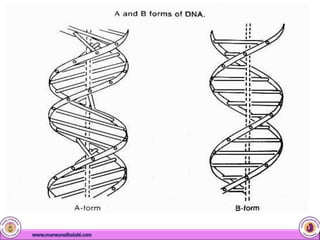
A-DNA
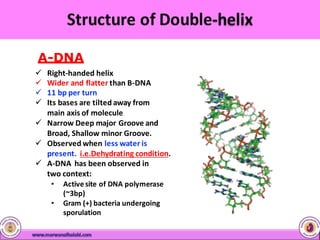
 Right-handed helix
 Wider and flatter than B-DNA
 11 bp per turn
 Its bases are tilted away from
main axis of molecule
 Narrow Deep major Groove and
Broad, Shallow minor Groove.
 Observed when less water is
present. i.e.Dehydrating condition.
 A-DNA has been observed in
two context:
• Active site of DNA polymerase
(~3bp)
• Gram (+) bacteria undergoing
sporulation
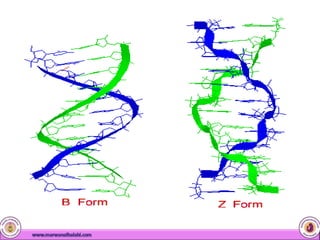
Z-DNA
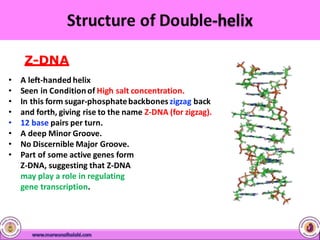
• A left-handed helix
• Seen in Conditionof High salt concentration.
• In this form sugar-phosphatebackboneszigzag back
• and forth, giving rise to the name Z-DNA (for zigzag).
• 12 base pairs per turn.
• A deep Minor Groove.
• No Discernible Major Groove.
• Part of some active genes form
Z-DNA, suggesting that Z-DNA
may play a role in regulating
gene transcription.
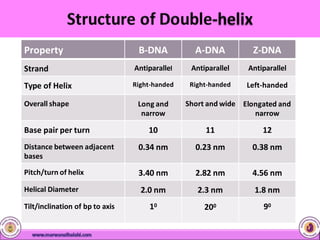
Property B-DNA A-DNA Z-DNA
Strand Antiparallel Antiparallel Antiparallel
Type of Helix Right-handed Right-handed Left-handed
Overall shape Long and
narrow
Short and wide Elongated and
narrow
Base pair per turn 10 11 12
Distance between adjacent
bases
0.34 nm 0.23 nm 0.38 nm
Pitch/turn of helix 3.40 nm 2.82 nm 4.56 nm
Helical Diameter 2.0 nm 2.3 nm 1.8 nm
Tilt/inclination of bp to axis 10 200 90
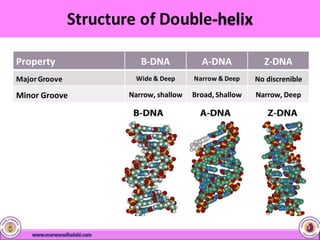
Property B-DNA A-DNA Z-DNA
MajorGroove Wide & Deep Narrow & Deep No discrenible
Minor Groove Narrow, shallow Broad, Shallow Narrow, Deep
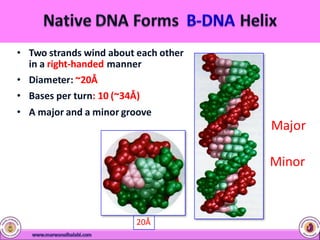
• Two strands wind about each other
in a right-handed manner
• Diameter: ~20Å
• Bases per turn: 10 (~34Å)
• A major and a minor groove
20Å
Major
Minor
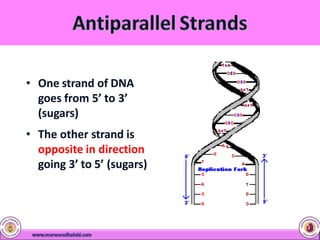
• One strand of DNA
goes from 5’ to 3’
(sugars)
• The other strand is
opposite in direction
going 3’ to 5’ (sugars)
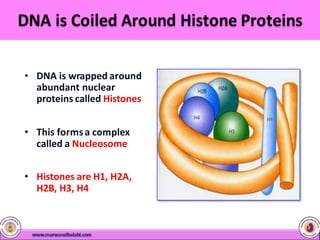
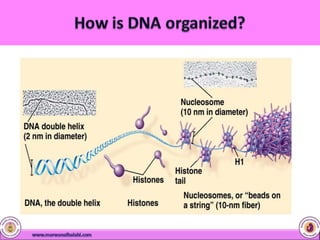
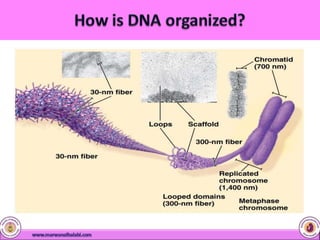
• DNA is wrapped around
abundant nuclear
proteins called Histones
• This formsa complex
called a Nucleosome
• Histones are H1, H2A,
H2B, H3, H4
1-geneticmaterial-160926221754  (1).pptx

1-geneticmaterial-160926221754 (1).pptx

  • 1.
    Marwan Alhalabi Professor ofReproductive Medicine and Infertility, Damascus University Head of Assisted Reproduction Unit, Orient Hospital President of Middle East FertilitySociety President of Syrian Society of Obstetricians and Gynecologists
  • 2.
    • The progenyof organism develops characters similar to that organism • The resemblance of offspring to their parents depends on the precise transmission of principle component from one generation to the next • That component is- The Genetic Material
  • 3.
    The genetic materialof a cell or an organism refers to those materials found in the nucleus, mitochondria and cytoplasm, which play a fundamental role in determining the structure and nature of cell substances,and capable of self-propagating and variation.
  • 4.
    DNA Protein RNA Protein,RNA and DNA werethought as genetic material. But many experiments suggest DNA as genetic material rather than protein and RNA
  • 5.
    • Must carryinformation – Cracking the genetic code • Must self replicate – DNA replication • Must allow for informationto change – Mutation • Must govern the expressionof the phenotype – Gene function
  • 6.
  • 7.
    • The processof identification of genetic material began in 1928 with experiments of Griffith and concluded in 1952 with the studies of Hershey and Chase. • Between these two experiments other three scientists, Avery, Macloed and McCarty were did an experiment to identify the genetic material.
  • 8.
    • 1952 AlfredHershey and Martha Chase • New York scientists • Performed an experiment that settled the controversy • Proved that DNA carries the genetic material
  • 9.
    • Bacteriophage: avirus that infects bacteria. • When Bacteriophages infect bacterial cells they produce more viruses. • The viruses are released when the bacterial cells rupture.
  • 10.
    • How doesthe bacteriophage reprogram the bacterial cell to make more viruses? • Does the bacteriophage DNA, the protein, or both give instructions to the bacteria?
  • 11.
    • Bacteriophage DNAwas labeled with radioactive phosphorus (32P) • Bacteriophage protein was labeled with radioactive sulphur (35S) • only the bacteriophage DNA (as indicated by the 32P) entered the bacteria and was used to produce more bacteriophage • Conclusion: DNA is the genetic material
  • 12.
    • The finalevidence that DNA transmits genetic information was provided by Hershey and Chase in 1952 • They experimented with T2 bacteriophages, viruses that attack bacteria.
  • 16.
    • 1928 • FredrickGriffith • Bacteriologist • Trying to prepare a vaccine against pneumonia
  • 27.
    • Two types,or strains, of S. pneumoniae • First strain is enclosed in a capsule composed of polysaccharides. • Capsule protects the bacterium from the body ’ s defense system. • Forms smooth-edges (S) when grown in a petri dish • Helps make the microorganism virulent, or able to cause disease.
  • 28.
    • Second strainlacks the polysaccharide capsule and does not cause disease. • Forms rough-edges (R) when grown in a petri dish
  • 29.
    • The harmlessR bacteria had changed and became virulent S bacteria. • Transformation is a change in genotype caused when cells take up foreign material.
  • 30.
    • Based onthese observations he concluded that some of the cells of type II R had changed into type III S due to influence of dead type III S cells • He called this phenomenon as transformation • Principle Componentof type III S cells which induced the conversionof type II R cells into type III S was named transforming principle.
  • 31.
  • 43.
    • Double Helix •Nucleotide • Deoxyribose • Base-pairing Rules • Complementary Base Pair
  • 44.
    • 1953—James Watsonand Francis Crick determined the structure of the DNA molecule to be a twisted around double helix • 2 strands of nucleotides each other
  • 46.
    • They proposedthat DNA as a right handed double helix with two poly nucleotide chains are coiled about one another in a spiral.
  • 48.
    • Rosalind Franklincontributed to this discovery by producing an X-ray crystallographic picture of DNA • Determined helix was a uniform diameter and composed of 2 strands of stacked nucleotides DNA = tightly wound helix
  • 50.
    • Nucleotides arethe monomeric units that make up DNA  3 main parts: 5 carbon sugar—deoxyribose Phosphategroup Nitrogenous base
  • 51.
    Nitrogenous bases Pyrimidines: single-ringstructures Thymine(T) Cytosine(C) Purines: larger, double-ring structures Adenine(A) Guanine (G)
  • 54.
    • Generate andstore energy in ATP form (eukaryote cells). • Have DNA and mtDNA is double stranded circular molecule. • Circular mtDNA has 37 genes. 1 part (D- loop) does ’ t contain genes. Why? Becomes displaced during replication.
  • 56.
    Notice: DNA strands runin opposite directions = ANTI-PARALLEL P S S S P P P S G C A T
  • 57.
    Chargaff’s base pairingrule: Percent of adenine = percent of thymine(A=T) Percent of cytosine = percent of guanine (C=G) A+G = T+C (or purines = pyrimidines)
  • 58.
    Erwin Chargaffshowed the amountsof the four bases on DNA ( A,T,C,G) In a body or somatic cell: A = 30.3% T = 30.3% G = 19.5% C = 19.9% T A G C
  • 59.
     Three majorforms:  B-DNA  A-DNA  Z-DNA  B-DNA is biologically THE MOST COMMON  It is a helix meaning thatit has a Right handed, or clockwise, spiral.  Ideal B-DNA has10 base pair per turn  So each base is twisted 36o relative to adjacentbases.  Base pair are 0.34 nm apart.  So completerotation of moleculeis 3.4 nm.  Axis passes through middleof each basepairs.
  • 61.
     Minor Grooveis Narrow, Shallow.  Major Groove is Wide, Deep.  This structure exists when plenty of water surrounds molecule and there is no unusualbase sequence in DNA-Conditionthatare likely to be present in the cells.  B-DNA structure is most stable configuration for a random sequence of nucleotides under physiological condition.
  • 62.
    A-DNA  Right-handed helix Wider and flatter than B-DNA  11 bp per turn  Its bases are tilted away from main axis of molecule  Narrow Deep major Groove and Broad, Shallow minor Groove.  Observed when less water is present. i.e.Dehydrating condition.  A-DNA has been observed in two context: • Active site of DNA polymerase (~3bp) • Gram (+) bacteria undergoing sporulation
  • 63.
    Z-DNA • A left-handedhelix • Seen in Conditionof High salt concentration. • In this form sugar-phosphatebackboneszigzag back • and forth, giving rise to the name Z-DNA (for zigzag). • 12 base pairs per turn. • A deep Minor Groove. • No Discernible Major Groove. • Part of some active genes form Z-DNA, suggesting that Z-DNA may play a role in regulating gene transcription.
  • 64.
    Property B-DNA A-DNAZ-DNA Strand Antiparallel Antiparallel Antiparallel Type of Helix Right-handed Right-handed Left-handed Overall shape Long and narrow Short and wide Elongated and narrow Base pair per turn 10 11 12 Distance between adjacent bases 0.34 nm 0.23 nm 0.38 nm Pitch/turn of helix 3.40 nm 2.82 nm 4.56 nm Helical Diameter 2.0 nm 2.3 nm 1.8 nm Tilt/inclination of bp to axis 10 200 90
  • 65.
    Property B-DNA A-DNAZ-DNA MajorGroove Wide & Deep Narrow & Deep No discrenible Minor Groove Narrow, shallow Broad, Shallow Narrow, Deep
  • 68.
    • Two strandswind about each other in a right-handed manner • Diameter: ~20Å • Bases per turn: 10 (~34Å) • A major and a minor groove 20Å Major Minor
  • 69.
    • One strandof DNA goes from 5’ to 3’ (sugars) • The other strand is opposite in direction going 3’ to 5’ (sugars)
  • 70.
    • DNA iswrapped around abundant nuclear proteins called Histones • This formsa complex called a Nucleosome • Histones are H1, H2A, H2B, H3, H4