Management of
ECLAMPSIA
K . Mohan Ram
The management of
eclampsia involves six
stages:
1. Making sure the airways are
clear and the woman can breathe.
2. Controlling the fits.
3. Controlling the blood pressure.
4. General care and monitoring.
5. Delivering the baby.
6. Care after delivery.
Making sure the woman
can breathe
• Place the woman on her left side
to reduce the risk of aspiration.
• Give oxygen and continue for five
minutes after each fit, or longer
if cyanosis persists.
• After a convulsion, aspirate the
mouth and throat as necessary to
clear the airway.
• Monitor her and ensure that her
airway is clear.
Controlling the fits
• MAGNESIUM SULFATE is the drug
of choice
– How to administer?
– What all to monitor?
– In case of Respiratory Arrest?
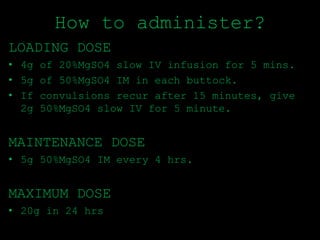
How to administer?
LOADING DOSE
• 4g of 20%MgSO4 slow IV infusion for 5 mins.
• 5g of 50%MgSO4 IM in each buttock.
• If convulsions recur after 15 minutes, give
2g 50%MgSO4 slow IV for 5 minute.
MAINTENANCE DOSE
• 5g 50%MgSO4 IM every 4 hrs.
MAXIMUM DOSE
• 20g in 24 hrs
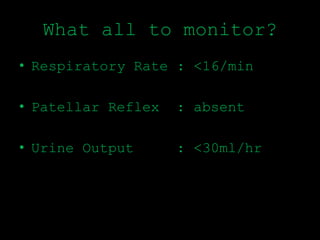
What all to monitor?
• Respiratory Rate : <16/min
• Patellar Reflex : absent
• Urine Output : <30ml/hr
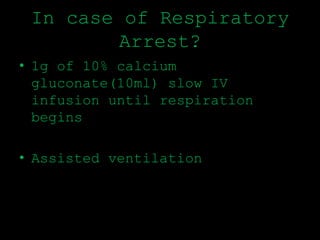
In case of Respiratory
Arrest?
• 1g of 10% calcium
gluconate(10ml) slow IV
infusion until respiration
begins
• Assisted ventilation
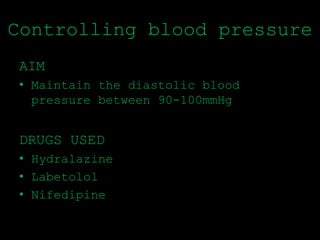
Controlling blood pressure
AIM
• Maintain the diastolic blood
pressure between 90-100mmHg
DRUGS USED
• Hydralazine
• Labetolol
• Nifedipine
General care and
monitoring
• Turning the woman two-hourly.
• Quiet dark room with an attendant.
• NPO.
• Bladder is catherised.
• Antibiotics.
• Throat is kept clear of mucus.
• Anaesthetic instruments, suction
apparatus and oxygen equipment
must be ready for use by the
bedside
• Restlessness/twitching
• Color is observed for cyanosis
• Temperature 4 hourly
• Pulse & Respiration hourly
• BP twice hourly
• Fetal heart hourly
• Signs of labour
• Fluid balance
• Clotting status
Delivering the baby
FAVOURABLE CERVIX
(soft,thin,partly dilated)
• ROM  induction  vaginal delivery
UNFAVOURABLE CERVIX
(firm,thick,closed)
• Caesarean section
Caesarean Section
INDICATIONS
• Unfavourable cervix
• Fetal heart abnormalities
• vaginal delivery not anticipated
within 12 hours
CONTRAINDICATIONS
• Unsafe anaesthesia
• Fetus too premature for survival
• Intrauterine fetal death.
• delivery should occur within 12
hours of the onset of
convulsions
Care after delivery
• Careful observations for at least 48 hours after
delivery.
• Anticonvulsive therapy should be maintained for 24
hours after
• delivery/last convulsion, whichever occurs last.
• Antihypertensive therapy is continued until the
diastolic blood
• pressure decreases to less than 100 mmHg.
• Quiet, dark room with attendant.
• Monitor urinary output
• If after 48 hours there are no fits, the urinary
output is good and the diastolic blood pressure is
below 100 mmHg, the woman can be transferred to the
main ward to recover.
• Continue four–hourly blood pressure checks for a few
days.
• Follow up six weeks after delivery.
Complications
• Aspiration pneumonitis
• Pulmonary edema
• Renal failure
• Cerebral hemorrhage
• Thank You

Managment of eclampsia

  • 1.
  • 2.
    The management of eclampsiainvolves six stages: 1. Making sure the airways are clear and the woman can breathe. 2. Controlling the fits. 3. Controlling the blood pressure. 4. General care and monitoring. 5. Delivering the baby. 6. Care after delivery.
  • 4.
    Making sure thewoman can breathe • Place the woman on her left side to reduce the risk of aspiration. • Give oxygen and continue for five minutes after each fit, or longer if cyanosis persists. • After a convulsion, aspirate the mouth and throat as necessary to clear the airway. • Monitor her and ensure that her airway is clear.
  • 6.
    Controlling the fits •MAGNESIUM SULFATE is the drug of choice – How to administer? – What all to monitor? – In case of Respiratory Arrest?
  • 7.
    How to administer? LOADINGDOSE • 4g of 20%MgSO4 slow IV infusion for 5 mins. • 5g of 50%MgSO4 IM in each buttock. • If convulsions recur after 15 minutes, give 2g 50%MgSO4 slow IV for 5 minute. MAINTENANCE DOSE • 5g 50%MgSO4 IM every 4 hrs. MAXIMUM DOSE • 20g in 24 hrs
  • 8.
    What all tomonitor? • Respiratory Rate : <16/min • Patellar Reflex : absent • Urine Output : <30ml/hr
  • 9.
    In case ofRespiratory Arrest? • 1g of 10% calcium gluconate(10ml) slow IV infusion until respiration begins • Assisted ventilation
  • 11.
    Controlling blood pressure AIM •Maintain the diastolic blood pressure between 90-100mmHg DRUGS USED • Hydralazine • Labetolol • Nifedipine
  • 13.
    General care and monitoring •Turning the woman two-hourly. • Quiet dark room with an attendant. • NPO. • Bladder is catherised. • Antibiotics. • Throat is kept clear of mucus. • Anaesthetic instruments, suction apparatus and oxygen equipment must be ready for use by the bedside
  • 14.
    • Restlessness/twitching • Coloris observed for cyanosis • Temperature 4 hourly • Pulse & Respiration hourly • BP twice hourly • Fetal heart hourly • Signs of labour • Fluid balance • Clotting status
  • 16.
    Delivering the baby FAVOURABLECERVIX (soft,thin,partly dilated) • ROM  induction  vaginal delivery UNFAVOURABLE CERVIX (firm,thick,closed) • Caesarean section
  • 17.
    Caesarean Section INDICATIONS • Unfavourablecervix • Fetal heart abnormalities • vaginal delivery not anticipated within 12 hours CONTRAINDICATIONS • Unsafe anaesthesia • Fetus too premature for survival • Intrauterine fetal death.
  • 18.
    • delivery shouldoccur within 12 hours of the onset of convulsions
  • 20.
    Care after delivery •Careful observations for at least 48 hours after delivery. • Anticonvulsive therapy should be maintained for 24 hours after • delivery/last convulsion, whichever occurs last. • Antihypertensive therapy is continued until the diastolic blood • pressure decreases to less than 100 mmHg. • Quiet, dark room with attendant. • Monitor urinary output • If after 48 hours there are no fits, the urinary output is good and the diastolic blood pressure is below 100 mmHg, the woman can be transferred to the main ward to recover. • Continue four–hourly blood pressure checks for a few days. • Follow up six weeks after delivery.
  • 21.
    Complications • Aspiration pneumonitis •Pulmonary edema • Renal failure • Cerebral hemorrhage
  • 22.