CASE PRESENTATION
• MRM
PATIENT PARTICULARS
• NAME : Swapnali Sakat
• AGE : 32 yrs
• HUSBAND'S NAME : mohit
• ADDRESS : F-12 ESIS Flat, Anudh,Pune
• DATE OF ADMISSION :14/05/2023
• RELIGION :Hindu
• OCCUPATION :Housewife
• Marital status: Married
• DIAGNOSIS : CA BREAST ( RT)
PRESENTING COMPLAINTS
• 33 yr old female with no known co
morbidities, a case of Triple
negative breast cancer got
admitted at Command Hospital
(SC) Pune on 14-5-23 for
MRM.Patient had H/O lump RT
Breast 10 months back
,underwent lumpectomy.
• Post lumpectomy HPE report(
Invasive ductal carcinoma)
PRESENT HISTORY OF ILLNESS
Patient apparently well 10 months back when developed lump in
RT Breast ( insidious onset, gradually progressive initially 2x2
cm
Underwent lumpectomy in civil in oct 2022 based on FNAC
Report( Fibroadenoma with fibrocystic changes)
post lumpectomy HPE report shows Neoplastic ductal
epithelial cells ,Invasive Ductal Carcinoma ( RB Score-
2+3+2=7) Grade II
Reported to this hospital for further management
Contd…
• CECT ( C+ A+P) – NO evidence of metastatis
• 4 cycles of NACT done
Last dose of NACT on 7-3-23
Planned for MRM on 16-5-23
PAST MEDICAL/SURGICAL HISTORY
OF ILLNESS
• No significant medical history
• Patent had Classical LSCS 17 Yrs back and
lumpectomy in oct 2022.
FAMILY HISTORY OF ILLNESS
• No significant medical or surgical history of illness
PERSONAL HISTORY
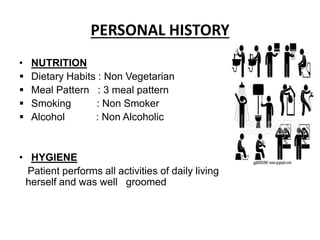
• NUTRITION
 Dietary Habits : Non Vegetarian
 Meal Pattern : 3 meal pattern
 Smoking : Non Smoker
 Alcohol : Non Alcoholic
• HYGIENE
Patient performs all activities of daily living
herself and was well groomed
PHYSICAL EXAMINATION
 VITAL SIGNS:
 Temp : 98.4F
 Pulse : 90/min
 Respiration : 22/min
 BP : 110/70
 Nutritional status : Good
 Build : Average
 Height : 167cms
 Weight : 66 kg
 BMI :
CONTINUED
 Pallor : Not present
 Icterus : Not present
 Thyroid : normal
 Pedal oedema : not present
 Varicose vein : Not present
 Heart, liver & spleen : NAD
 Lungs : No signs of breathlessness, normal
lung sounds
Breast Examination ( RT)
 INSPECTION
• No visible lump or swelling
• Scar of previous surgery ( 6cm) in upper
quadrant
• RT NAC higher than left
• No discoloration /
crackles/ulceration/peau d orange/
dimpling/puckering of skin
CONTINUED
 PALPATION
• No local rise of temp
• Non tender
• Lump not palpable
 AXILLA
NO palpable lymph nodes
DIAGNOSTIC EVALUATION
• Blood investigations- WNL
• Chest x ray- NAD
• ECG- Normal
• FNAC Report post lumpectomy- Invasive
ductal carcinoma Grade II
• CECT ( Abdomen+ chest+pelvis)- No sighns of
metastais
BREAST ANATOMY
.
• Latin word Breast = Mammary gland.
• Modified sweat gland.
• Accessory organ of female reproduction
system
Situation and
extend
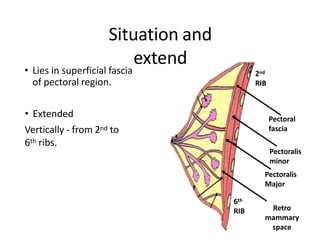
• Lies in superficial fascia
of pectoral region.
• Extended
Vertically - from 2nd to
6th ribs.
2nd
RIB
6th
RIB
Pectoral
fascia
Pectoralis
minor
Pectoralis
Major
Retro
mammary
space
Situation and
extend
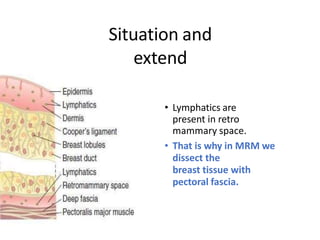
• Lymphatics are
present in retro
mammary space.
• That is why in MRM we
dissect the
breast tissue with
pectoral fascia.
CONTD….
• Upper lateral quadrant
has lateral extension –
known as axillary tail of
Spence.
• It piers deep pectoral
fascia – known as foramen
of langer.
• It has direct
communication with
anterior group of
axillary lymph nodes.
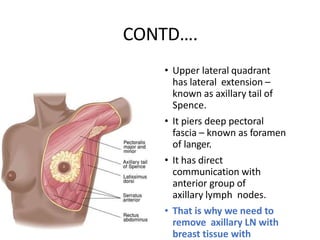
• That is why we need to
remove axillary LN with
breast tissue with
Structure of breast
• It can be divided in 3 components
1. Skin with nipple areola
2. Parenchyma
3. Stroma
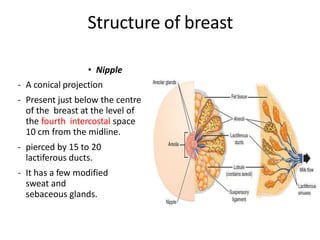
Structure of breast
• Nipple
- A conical projection
- Present just below the centre
of the breast at the level of
the fourth intercostal space
10 cm from the midline.
- pierced by 15 to 20
lactiferous ducts.
- It has a few modified
sweat and
sebaceous glands.
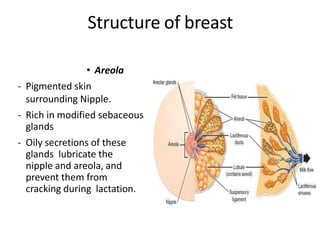
Structure of breast
• Areola
- Pigmented skin
surrounding Nipple.
- Rich in modified sebaceous
glands
- Oily secretions of these
glands lubricate the
nipple and areola, and
prevent them from
cracking during lactation.
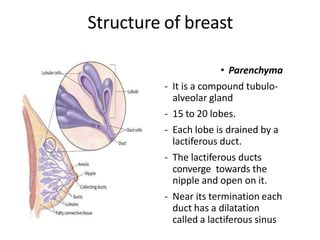
Structure of breast
• Parenchyma
- It is a compound tubulo-
alveolar gland
- 15 to 20 lobes.
- Each lobe is drained by a
lactiferous duct.
- The lactiferous ducts
converge towards the
nipple and open on it.
- Near its termination each
duct has a dilatation
called a lactiferous sinus
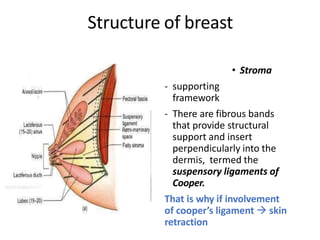
Structure of breast
• Stroma
- supporting
framework
- There are fibrous bands
that provide structural
support and insert
perpendicularly into the
dermis, termed the
suspensory ligaments of
Cooper.
That is why if involvement
of cooper’s ligament  skin
retraction
Blood
supply
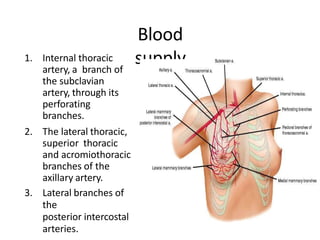
1. Internal thoracic
artery, a branch of
the subclavian
artery, through its
perforating
branches.
2. The lateral thoracic,
superior thoracic
and acromiothoracic
branches of the
axillary artery.
3. Lateral branches of
the
posterior intercostal
arteries.
Lymphatic
drainage
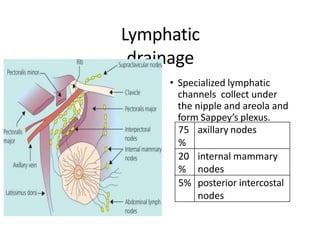
• Specialized lymphatic
channels collect under
the nipple and areola and
form Sappey’s plexus.
75
%
axillary nodes
20
%
internal mammary
nodes
5% posterior intercostal
nodes
CONTD….
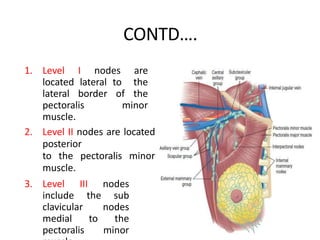
1. Level I nodes are
located lateral to the
lateral border of the
pectoralis minor
muscle.
2. Level II nodes are located
posterior
to the pectoralis minor
muscle.
3. Level III nodes
include the sub
clavicular nodes
medial to the
pectoralis minor
CONTD…
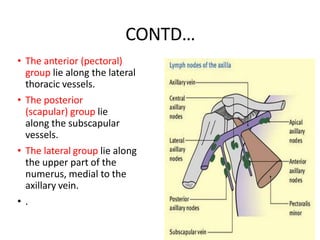
• The anterior (pectoral)
group lie along the lateral
thoracic vessels.
• The posterior
(scapular) group lie
along the subscapular
vessels.
• The lateral group lie along
the upper part of the
numerus, medial to the
axillary vein.
• .
CONTD….
• The central group lie in the fat of the upper
axilla.
• The apical (infraclaaicular) group lie deep to
the clavipectoral fascia, along the axillary
vessels
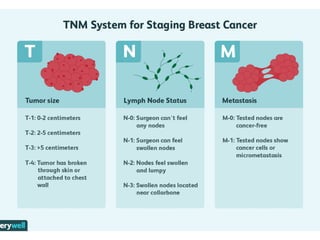
BREAST CANCER
• It is a disease in which cells of breast grow out
of control.
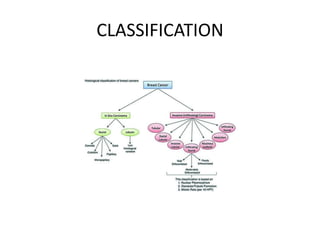
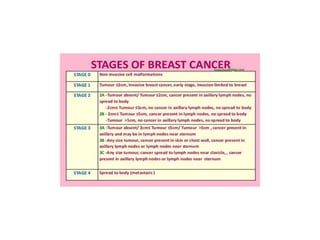
CLASSIFICATION
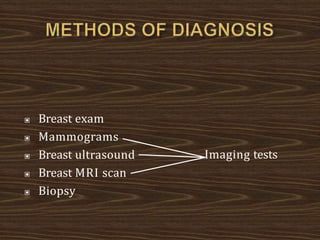
Imaging tests
▣ Breast exam
▣ Mammograms
▣ Breast ultrasound
▣ Breast MRI scan
▣ Biopsy
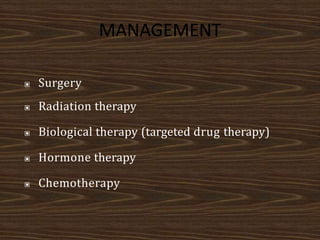
▣ Surgery
▣ Radiation therapy
▣ Biological therapy (targeted drug therapy)
▣ Hormone therapy
▣ Chemotherapy
MANAGEMENT
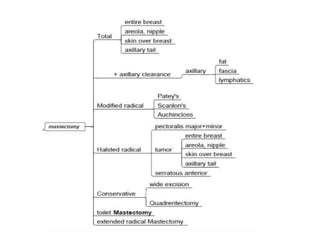
MANAGEMENT IN MY PATIENT
• Preoperative investigations – WNL
• PAC fit
• Pre op instructions carried out as advised
trolley
Special instruments include
Skin hooks
Morris retractor
Liga clip applicator- 100,200,300
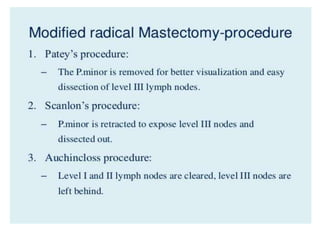
STEPS OF SURGERY
• 1. Anaesthesia
• 2.Position
-Supine position with arm abducted < 90 degree
-sandbag or bolster placed under thorax and
shoulder of affected side
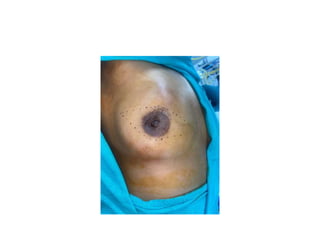
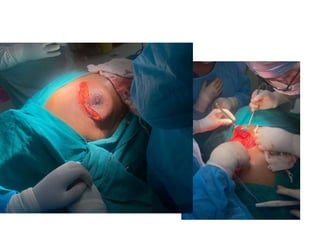
• 3. Incision
• - oblique elliptical incision angled towards
axilla
• - includes entire areolar complex and previous
scar if any
• - 1-2 cm away from tumor margin
• 4. Extent of dissection
• - Superiorly till clavicle
• -laterally till anterior margin of latissimus dorsi
• -Medially to sternal border
• -Inferiorly till costal margin
• 5. Specimen retracted upwards and laterally to expose
P.minor
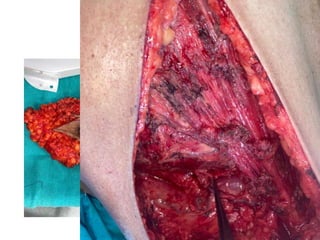
• 6.Dissection carried out till axillary node clearance.
• 7. Axillary investing fascia incised to expose axillary
group of lymph nodes
• 8. The interpectoral ( Rotter) group of lymph nodes
removed.
• 9. Dissection done from medial to lateral side or vice-
versa.
• 11. Investing layer of axillary vessels cut,
tributaries transfixed and cut
• 12.lateral group ( level 1) lymph nodes
removed
• 13. Thoracodorsal neurovascular bundle lies
over lat.dorsi with nerve more laterally,
subscapular (level 1) removed
• 14. level II Lymph nodes removed.
• 15. Central group of lymph nodes removed
carefully seprating from axillary vein.
• 16. Dissection carried out anterior and medial
to long thoracic nerve and specimen delivered
Care to be taken to preserve……
• Medial and long pectoral nerve
• Long thoracic nerve
• Nerve to latissimus dorsi
• Axillary vein
17. wound irrigated with saline
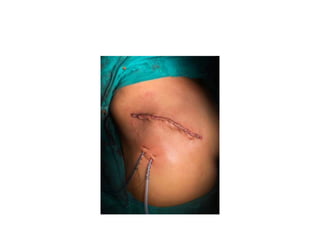
• 18 .2 drains 1 below and other above p.major
• 19. skin closed with stapler
IMMEDIATE POST OPERATIVE INSTRUCTIONS
• NPO till 1700 hrs
• Nourished on IV Fluids NS/RL/DNS @ 110ml/ hr
• Treatment
 Inj omnatax 1 gm TDS
 Inj PCM 1 gm TDS
 INJ Voveran75 mg TDS
• Watch for soakage
• Vitals monitoring
NURSING DIAGNOSIS
1. Acute pain related to skin incision and surgical
intervention
2. Risk for fluid volume deficit related to fluid and blood loss
during surgery
3. Risk for infection related to inadequate primary defence
secondary to surgical incision
4. Knowledge deficit related to postoperative care
5. Impaired self deficit related to surgical intervention
HEALTH EDUCATION
• Maintaining respiratory function
• Achieving rest and comfort
• Drug compliance
• Dietary changes: High protein diet
• Do and don’ts after surgery
• Care of wound and drain
• Staple removal at 14 days
• Family support
• Post mastectomy exercises
breast cancer 23.pptx

breast cancer 23.pptx

  • 1.
  • 2.
    PATIENT PARTICULARS • NAME: Swapnali Sakat • AGE : 32 yrs • HUSBAND'S NAME : mohit • ADDRESS : F-12 ESIS Flat, Anudh,Pune • DATE OF ADMISSION :14/05/2023 • RELIGION :Hindu • OCCUPATION :Housewife • Marital status: Married • DIAGNOSIS : CA BREAST ( RT)
  • 3.
    PRESENTING COMPLAINTS • 33yr old female with no known co morbidities, a case of Triple negative breast cancer got admitted at Command Hospital (SC) Pune on 14-5-23 for MRM.Patient had H/O lump RT Breast 10 months back ,underwent lumpectomy. • Post lumpectomy HPE report( Invasive ductal carcinoma)
  • 4.
    PRESENT HISTORY OFILLNESS Patient apparently well 10 months back when developed lump in RT Breast ( insidious onset, gradually progressive initially 2x2 cm Underwent lumpectomy in civil in oct 2022 based on FNAC Report( Fibroadenoma with fibrocystic changes) post lumpectomy HPE report shows Neoplastic ductal epithelial cells ,Invasive Ductal Carcinoma ( RB Score- 2+3+2=7) Grade II Reported to this hospital for further management
  • 5.
    Contd… • CECT (C+ A+P) – NO evidence of metastatis • 4 cycles of NACT done Last dose of NACT on 7-3-23 Planned for MRM on 16-5-23
  • 6.
    PAST MEDICAL/SURGICAL HISTORY OFILLNESS • No significant medical history • Patent had Classical LSCS 17 Yrs back and lumpectomy in oct 2022. FAMILY HISTORY OF ILLNESS • No significant medical or surgical history of illness
  • 7.
    PERSONAL HISTORY • NUTRITION Dietary Habits : Non Vegetarian  Meal Pattern : 3 meal pattern  Smoking : Non Smoker  Alcohol : Non Alcoholic • HYGIENE Patient performs all activities of daily living herself and was well groomed
  • 8.
    PHYSICAL EXAMINATION  VITALSIGNS:  Temp : 98.4F  Pulse : 90/min  Respiration : 22/min  BP : 110/70  Nutritional status : Good  Build : Average  Height : 167cms  Weight : 66 kg  BMI :
  • 9.
    CONTINUED  Pallor :Not present  Icterus : Not present  Thyroid : normal  Pedal oedema : not present  Varicose vein : Not present  Heart, liver & spleen : NAD  Lungs : No signs of breathlessness, normal lung sounds
  • 10.
    Breast Examination (RT)  INSPECTION • No visible lump or swelling • Scar of previous surgery ( 6cm) in upper quadrant • RT NAC higher than left • No discoloration / crackles/ulceration/peau d orange/ dimpling/puckering of skin
  • 11.
    CONTINUED  PALPATION • Nolocal rise of temp • Non tender • Lump not palpable  AXILLA NO palpable lymph nodes
  • 12.
    DIAGNOSTIC EVALUATION • Bloodinvestigations- WNL • Chest x ray- NAD • ECG- Normal • FNAC Report post lumpectomy- Invasive ductal carcinoma Grade II • CECT ( Abdomen+ chest+pelvis)- No sighns of metastais
  • 13.
  • 14.
    . • Latin wordBreast = Mammary gland. • Modified sweat gland. • Accessory organ of female reproduction system
  • 15.
    Situation and extend • Liesin superficial fascia of pectoral region. • Extended Vertically - from 2nd to 6th ribs. 2nd RIB 6th RIB Pectoral fascia Pectoralis minor Pectoralis Major Retro mammary space
  • 16.
    Situation and extend • Lymphaticsare present in retro mammary space. • That is why in MRM we dissect the breast tissue with pectoral fascia.
  • 17.
    CONTD…. • Upper lateralquadrant has lateral extension – known as axillary tail of Spence. • It piers deep pectoral fascia – known as foramen of langer. • It has direct communication with anterior group of axillary lymph nodes. • That is why we need to remove axillary LN with breast tissue with
  • 18.
    Structure of breast •It can be divided in 3 components 1. Skin with nipple areola 2. Parenchyma 3. Stroma
  • 19.
    Structure of breast •Nipple - A conical projection - Present just below the centre of the breast at the level of the fourth intercostal space 10 cm from the midline. - pierced by 15 to 20 lactiferous ducts. - It has a few modified sweat and sebaceous glands.
  • 20.
    Structure of breast •Areola - Pigmented skin surrounding Nipple. - Rich in modified sebaceous glands - Oily secretions of these glands lubricate the nipple and areola, and prevent them from cracking during lactation.
  • 21.
    Structure of breast •Parenchyma - It is a compound tubulo- alveolar gland - 15 to 20 lobes. - Each lobe is drained by a lactiferous duct. - The lactiferous ducts converge towards the nipple and open on it. - Near its termination each duct has a dilatation called a lactiferous sinus
  • 22.
    Structure of breast •Stroma - supporting framework - There are fibrous bands that provide structural support and insert perpendicularly into the dermis, termed the suspensory ligaments of Cooper. That is why if involvement of cooper’s ligament  skin retraction
  • 23.
    Blood supply 1. Internal thoracic artery,a branch of the subclavian artery, through its perforating branches. 2. The lateral thoracic, superior thoracic and acromiothoracic branches of the axillary artery. 3. Lateral branches of the posterior intercostal arteries.
  • 24.
    Lymphatic drainage • Specialized lymphatic channelscollect under the nipple and areola and form Sappey’s plexus. 75 % axillary nodes 20 % internal mammary nodes 5% posterior intercostal nodes
  • 25.
    CONTD…. 1. Level Inodes are located lateral to the lateral border of the pectoralis minor muscle. 2. Level II nodes are located posterior to the pectoralis minor muscle. 3. Level III nodes include the sub clavicular nodes medial to the pectoralis minor
  • 26.
    CONTD… • The anterior(pectoral) group lie along the lateral thoracic vessels. • The posterior (scapular) group lie along the subscapular vessels. • The lateral group lie along the upper part of the numerus, medial to the axillary vein. • .
  • 27.
    CONTD…. • The centralgroup lie in the fat of the upper axilla. • The apical (infraclaaicular) group lie deep to the clavipectoral fascia, along the axillary vessels
  • 28.
    BREAST CANCER • Itis a disease in which cells of breast grow out of control.
  • 29.
  • 32.
    Imaging tests ▣ Breastexam ▣ Mammograms ▣ Breast ultrasound ▣ Breast MRI scan ▣ Biopsy
  • 37.
    ▣ Surgery ▣ Radiationtherapy ▣ Biological therapy (targeted drug therapy) ▣ Hormone therapy ▣ Chemotherapy MANAGEMENT
  • 40.
    MANAGEMENT IN MYPATIENT • Preoperative investigations – WNL • PAC fit • Pre op instructions carried out as advised
  • 41.
    trolley Special instruments include Skinhooks Morris retractor Liga clip applicator- 100,200,300
  • 42.
    STEPS OF SURGERY •1. Anaesthesia • 2.Position -Supine position with arm abducted < 90 degree -sandbag or bolster placed under thorax and shoulder of affected side
  • 43.
    • 3. Incision •- oblique elliptical incision angled towards axilla • - includes entire areolar complex and previous scar if any • - 1-2 cm away from tumor margin
  • 45.
    • 4. Extentof dissection • - Superiorly till clavicle • -laterally till anterior margin of latissimus dorsi • -Medially to sternal border • -Inferiorly till costal margin
  • 47.
    • 5. Specimenretracted upwards and laterally to expose P.minor • 6.Dissection carried out till axillary node clearance. • 7. Axillary investing fascia incised to expose axillary group of lymph nodes • 8. The interpectoral ( Rotter) group of lymph nodes removed. • 9. Dissection done from medial to lateral side or vice- versa.
  • 48.
    • 11. Investinglayer of axillary vessels cut, tributaries transfixed and cut • 12.lateral group ( level 1) lymph nodes removed • 13. Thoracodorsal neurovascular bundle lies over lat.dorsi with nerve more laterally, subscapular (level 1) removed
  • 49.
    • 14. levelII Lymph nodes removed. • 15. Central group of lymph nodes removed carefully seprating from axillary vein. • 16. Dissection carried out anterior and medial to long thoracic nerve and specimen delivered
  • 51.
    Care to betaken to preserve…… • Medial and long pectoral nerve • Long thoracic nerve • Nerve to latissimus dorsi • Axillary vein 17. wound irrigated with saline • 18 .2 drains 1 below and other above p.major • 19. skin closed with stapler
  • 53.
    IMMEDIATE POST OPERATIVEINSTRUCTIONS • NPO till 1700 hrs • Nourished on IV Fluids NS/RL/DNS @ 110ml/ hr • Treatment  Inj omnatax 1 gm TDS  Inj PCM 1 gm TDS  INJ Voveran75 mg TDS • Watch for soakage • Vitals monitoring
  • 54.
    NURSING DIAGNOSIS 1. Acutepain related to skin incision and surgical intervention 2. Risk for fluid volume deficit related to fluid and blood loss during surgery 3. Risk for infection related to inadequate primary defence secondary to surgical incision 4. Knowledge deficit related to postoperative care 5. Impaired self deficit related to surgical intervention
  • 55.
    HEALTH EDUCATION • Maintainingrespiratory function • Achieving rest and comfort • Drug compliance • Dietary changes: High protein diet • Do and don’ts after surgery • Care of wound and drain • Staple removal at 14 days • Family support • Post mastectomy exercises

Editor's Notes