British Cinema History
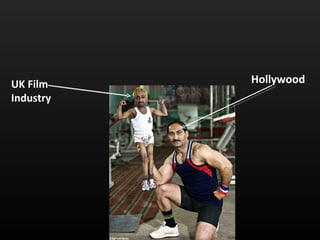
UK Film Industry Hollywood
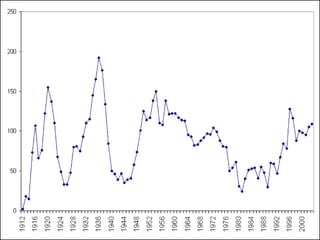
British film has always had its ups and downs
 
Film production in the UK has experienced a number of booms and recessions over the years.  Although many factors can be used to measure the success of the industry, the number of British films produced each year gives an overview of its development.
Source: BFI
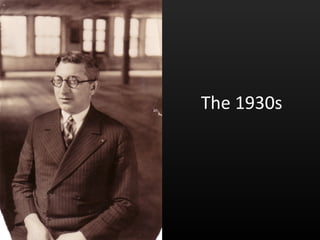
The 1930s
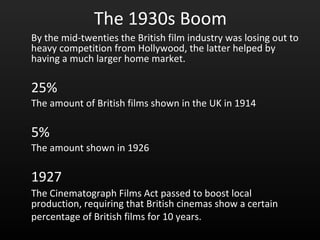
The 1930s Boom By the mid-twenties the British film industry was losing out to heavy competition from Hollywood, the latter helped by having a much larger home market. 25%  The amount of British films shown in the UK in 1914 5%  The amount shown in 1926  1927 The Cinematograph Films Act passed to boost local production, requiring that British cinemas show a certain percentage of British films for 10 years.
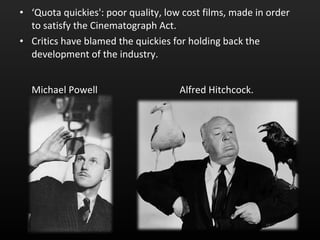
‘ Quota quickies': poor quality, low cost films, made in order to satisfy the Cinematograph Act.  Critics have blamed the quickies for holding back the development of the industry.  Michael Powell  Alfred Hitchcock.
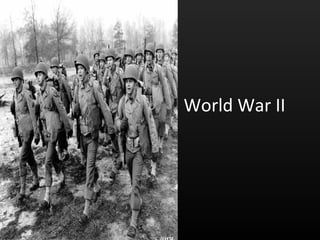
World War II
The war years also saw the flowering partnership of Michael Powell and Emeric Pressburger who produced such films as… The Life and Death of Colonel Blimp   (1943)  A Canterbury Tale   (1944)  These films were more about the people affected by war rather than battles. Post-War Cinema Building on the success British cinema had enjoyed during World War II, the industry hit new heights of creativity in the immediate post-war years.  The Red Shoes Hamlet – 1 st  non-US film to win Oscar for Best Picture
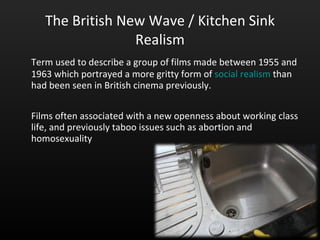
The British New Wave / Kitchen Sink Realism Term used to describe a group of films made between 1955 and 1963 which portrayed a more gritty form of  social realism  than had been seen in British cinema previously.  Films often associated with a new openness about working class life, and previously taboo issues such as abortion and homosexuality
Key filmmakers of New Wave British Cinema Lindsay Anderson Tony Richardson Karl Reisz Together with future James Bond producer Harry Saltzman, John Osborne and Tony Richardson established the company  Woodfall Films  to produce their early feature films.
These included… Look Back in Anger Saturday Night and Sunday Morning A Kind of Loving This Sporting Life
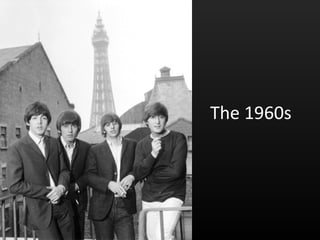
The 1960s
Overseas film makers were attracted to Britain at this time. The most important perhaps being  Stanley Kubrick  who remained in England for the rest of his life  Films:  2001: A Space Odyssey A Clockwork Orange   The Shining
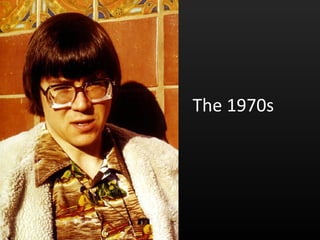
The 1970s
The 1970s US & UK Recession - American studios cut back on domestic production, and in many cases withdrew from financing British films altogether.  Big Screen versions of TV shows  Steptoe and Son  and  On the Buses  proved successful with domestic audiences.  The other major influence on British comedy films in the decade was the Monty Python group, also from television.  Most successful films: Monty Python and the Holy Grail   (1975)  Monty Python's Life of Brian   (1979)
Relaxed censorship meant several controversial films: Straw Dogs   (1971),  Quadrophenia  (1979),  A Clockwork Orange   (1971). 1977-79 - American productions return to the major British studios including  Star Wars   at Elstree Studios,  Superman  at Pinewood, and  Alien  at Shepperton.
The 1980s
The 1980’s Early 80’s - Worst recession ever seen by the industry 31  Number of British films made in 1980 Lowest output since 1914 24 Number of British films made in 1981 Goldcrest, Channel 4, Handmade Films and Merchant Ivory Productions. These companies gave the industry renewed optimism
1984   Conservative Government gets rid of the Eady tax concession The concession made it possible for a foreign film company to write off a large amount of its production costs by filming in the UK — this was what attracted a succession of blockbuster productions to British studios in the 1970s. With Eady gone many studios closed or focused on television work.
1989  Film production in Britain hit one of its all-time lows
The 1990s
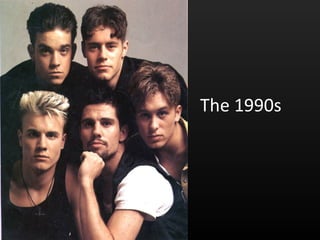
British Cinema in the 1990s UK Cinema audiences were climbing in the UK in the early 1990s  But few British films were enjoying significant commercial success, even in the home market.
The Madness of King George   (1994) proved there was still a market for the traditional British costume drama, and a large number of other period films followed, including  Sense and Sensibility   (1995)  Restoration  (1995)  Emma   (1996)  Mrs. Brown   (1997) The Wings of the Dove   (1997) Shakespeare in Love   (1998)
Several of these were funded by  Miramax Films , who also took over Anthony Minghella's  The English Patient   (1996) when the production ran into difficulties during filming. Although technically an American production, the success of this film, including its 9 Academy Award wins would bring further prestige to British film-makers.
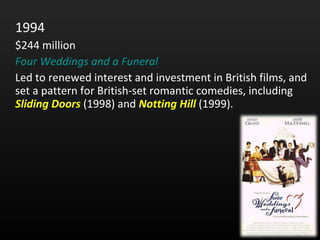
1994 $244 million Four Weddings and a Funeral   Led to renewed interest and investment in British films, and set a pattern for British-set romantic comedies, including  Sliding Doors   (1998) and  Notting Hill   (1999).
Working Title Films , the company behind many of these films, quickly became one of the most successful British production companies of recent years, with other box office hits including: Bean  (1997)  Elizabeth  (1998)  Captain Corelli's Mandolin   (2001).
New appetite for British comedy films lead to the popular comedies  Brassed Off   (1996), and  The Full Monty   (1997).  $4m – Production cost $257m international gross Studios were encouraged to start smaller subsidiaries dedicated to looking for other low budget productions capable of producing similar returns.
National Lottery funding  A production boom occurred  Only a few of these films found significant commercial success, many went unreleased.  These included several gangster films attempting to imitate Guy Ritchie's black comedies  Lock, Stock and Two Smoking Barrels  (1998) and  Snatch  (2000).
American productions also began to return to British studios in the mid-1990s Interview with the Vampire  (1994),  Mission: Impossible  (1996),  The Fifth Element  (1997),  Saving Private Ryan  (1998),  Star Wars Episode I: The Phantom Menace  (1999) and  The Mummy  (1999),
2000 and beyond…
British cinema since 2000 The new century has so far been a relatively successful one for the British film industry.  Many British films have found a wide international audience, and some of the independent production companies, such as  Working Title , have secured financing and distribution deals with major American studios.
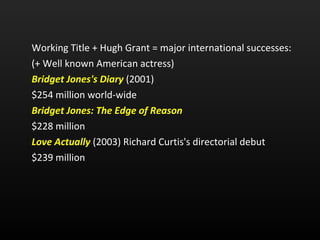
Working Title + Hugh Grant = major international successes: (+ Well known American actress) Bridget Jones's Diary   (2001)  $254 million world-wide  Bridget Jones: The Edge of Reason  $228 million Love Actually   (2003) Richard Curtis's directorial debut $239 million
Critically-acclaimed films such as  Gosford Park   (2001),  Pride and Prejudice   (2005),  The Constant Gardener   (2005),  The Queen   (2006) The Last King of Scotland   (2006)  brought prestige to the British film industry.
The turn of the new century saw a revival of the British horror film.  Led by Danny Boyle's acclaimed hit  28 Days Later   (2002), other examples include: The Hole Dog Soldiers The Descent   Shaun of the Dead Woody Allen became a convert to British filmmaking, choosing to shoot his 2005 film  Match Point  entirely in London, with a largely British cast and financing from BBC Films
2007  A number of new British films achieved critical and commercial recognition: Control Hot Fuzz Elizabeth Elizabeth: The Golden Age   Atonement   Nominated for 7 Academy Awards, including Best Film.
British studios such as Pinewood, Shepperton and Leavesden remained successful in hosting major foreign productions such as  Finding Neverland   V for Vendetta   Closer   The Mummy Returns   Troy   Charlie and the Chocolate Factory   Corpse Bride   United 93
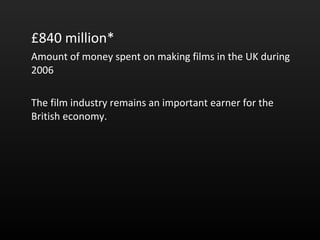
£840 million*  Amount of money spent on making films in the UK during 2006  The film industry remains an important earner for the British economy.
 
The British film industry and Hollywood Films with a British dimension have had enormous worldwide commercial success.  The top seven highest-grossing films worldwide of all time have some British historical, cultural or creative dimensions:  Titanic ,  Two episodes of  The Lord of the Rings ,  Two  Pirates of the Caribbean   Two  Harry Potter   movies.
Yet these are mostly American films, only the  Harry Potters  are classified as British, and even these had US finance, so virtually all the most successful British-flavoured movies are American-made and the profits go to the US.  The reasons for this have been put down to British film-makers shying away from commercialism, and an unwillingness to learn or to play by the winning Hollywood formulas for successful commercial films.
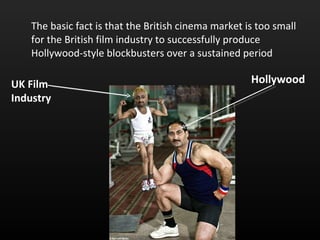
The basic fact is that the British cinema market is too small for the British film industry to successfully produce Hollywood-style blockbusters over a sustained period UK Film Industry Hollywood
The British film industry consequently has a complex and divided attitude to Hollywood.  On the one hand Hollywood provides work to British directors, actors, writers, production staff and studios and enables British history and stories to be made as films. On the other hand, the loss of control and profits, and the market requirements of the US distributors, are often seen to endanger and distort British film culture.
Representations of Britain Think of 2 contrasting British films you’ve seen e.g.  This is England /  Notting Hill How are the following represented differently? People Places Values Attitudes Relationships

British Cinema History

  • 1.
  • 2.
  • 3.
    British film hasalways had its ups and downs
  • 4.
  • 5.
    Film production inthe UK has experienced a number of booms and recessions over the years. Although many factors can be used to measure the success of the industry, the number of British films produced each year gives an overview of its development.
  • 6.
  • 7.
  • 8.
    The 1930s BoomBy the mid-twenties the British film industry was losing out to heavy competition from Hollywood, the latter helped by having a much larger home market. 25% The amount of British films shown in the UK in 1914 5% The amount shown in 1926 1927 The Cinematograph Films Act passed to boost local production, requiring that British cinemas show a certain percentage of British films for 10 years.
  • 9.
    ‘ Quota quickies':poor quality, low cost films, made in order to satisfy the Cinematograph Act. Critics have blamed the quickies for holding back the development of the industry. Michael Powell Alfred Hitchcock.
  • 10.
  • 11.
    The war yearsalso saw the flowering partnership of Michael Powell and Emeric Pressburger who produced such films as… The Life and Death of Colonel Blimp (1943) A Canterbury Tale (1944) These films were more about the people affected by war rather than battles. Post-War Cinema Building on the success British cinema had enjoyed during World War II, the industry hit new heights of creativity in the immediate post-war years. The Red Shoes Hamlet – 1 st non-US film to win Oscar for Best Picture
  • 12.
    The British NewWave / Kitchen Sink Realism Term used to describe a group of films made between 1955 and 1963 which portrayed a more gritty form of social realism than had been seen in British cinema previously. Films often associated with a new openness about working class life, and previously taboo issues such as abortion and homosexuality
  • 13.
    Key filmmakers ofNew Wave British Cinema Lindsay Anderson Tony Richardson Karl Reisz Together with future James Bond producer Harry Saltzman, John Osborne and Tony Richardson established the company Woodfall Films to produce their early feature films.
  • 14.
    These included… LookBack in Anger Saturday Night and Sunday Morning A Kind of Loving This Sporting Life
  • 15.
  • 16.
    Overseas film makerswere attracted to Britain at this time. The most important perhaps being Stanley Kubrick who remained in England for the rest of his life Films: 2001: A Space Odyssey A Clockwork Orange The Shining
  • 17.
  • 18.
    The 1970s US& UK Recession - American studios cut back on domestic production, and in many cases withdrew from financing British films altogether. Big Screen versions of TV shows Steptoe and Son and On the Buses proved successful with domestic audiences. The other major influence on British comedy films in the decade was the Monty Python group, also from television. Most successful films: Monty Python and the Holy Grail (1975) Monty Python's Life of Brian (1979)
  • 19.
    Relaxed censorship meantseveral controversial films: Straw Dogs (1971), Quadrophenia (1979), A Clockwork Orange (1971). 1977-79 - American productions return to the major British studios including Star Wars at Elstree Studios, Superman at Pinewood, and Alien at Shepperton.
  • 20.
  • 21.
    The 1980’s Early80’s - Worst recession ever seen by the industry 31 Number of British films made in 1980 Lowest output since 1914 24 Number of British films made in 1981 Goldcrest, Channel 4, Handmade Films and Merchant Ivory Productions. These companies gave the industry renewed optimism
  • 22.
    1984 Conservative Government gets rid of the Eady tax concession The concession made it possible for a foreign film company to write off a large amount of its production costs by filming in the UK — this was what attracted a succession of blockbuster productions to British studios in the 1970s. With Eady gone many studios closed or focused on television work.
  • 23.
    1989 Filmproduction in Britain hit one of its all-time lows
  • 24.
  • 25.
    British Cinema inthe 1990s UK Cinema audiences were climbing in the UK in the early 1990s But few British films were enjoying significant commercial success, even in the home market.
  • 26.
    The Madness ofKing George (1994) proved there was still a market for the traditional British costume drama, and a large number of other period films followed, including Sense and Sensibility (1995) Restoration (1995) Emma (1996) Mrs. Brown (1997) The Wings of the Dove (1997) Shakespeare in Love (1998)
  • 27.
    Several of thesewere funded by Miramax Films , who also took over Anthony Minghella's The English Patient (1996) when the production ran into difficulties during filming. Although technically an American production, the success of this film, including its 9 Academy Award wins would bring further prestige to British film-makers.
  • 28.
    1994 $244 millionFour Weddings and a Funeral Led to renewed interest and investment in British films, and set a pattern for British-set romantic comedies, including Sliding Doors (1998) and Notting Hill (1999).
  • 29.
    Working Title Films, the company behind many of these films, quickly became one of the most successful British production companies of recent years, with other box office hits including: Bean (1997) Elizabeth (1998) Captain Corelli's Mandolin (2001).
  • 30.
    New appetite forBritish comedy films lead to the popular comedies Brassed Off (1996), and The Full Monty (1997). $4m – Production cost $257m international gross Studios were encouraged to start smaller subsidiaries dedicated to looking for other low budget productions capable of producing similar returns.
  • 31.
    National Lottery funding A production boom occurred Only a few of these films found significant commercial success, many went unreleased. These included several gangster films attempting to imitate Guy Ritchie's black comedies Lock, Stock and Two Smoking Barrels (1998) and Snatch (2000).
  • 32.
    American productions alsobegan to return to British studios in the mid-1990s Interview with the Vampire (1994), Mission: Impossible (1996), The Fifth Element (1997), Saving Private Ryan (1998), Star Wars Episode I: The Phantom Menace (1999) and The Mummy (1999),
  • 33.
  • 34.
    British cinema since2000 The new century has so far been a relatively successful one for the British film industry. Many British films have found a wide international audience, and some of the independent production companies, such as Working Title , have secured financing and distribution deals with major American studios.
  • 35.
    Working Title +Hugh Grant = major international successes: (+ Well known American actress) Bridget Jones's Diary (2001) $254 million world-wide Bridget Jones: The Edge of Reason $228 million Love Actually (2003) Richard Curtis's directorial debut $239 million
  • 36.
    Critically-acclaimed films suchas Gosford Park (2001), Pride and Prejudice (2005), The Constant Gardener (2005), The Queen (2006) The Last King of Scotland (2006) brought prestige to the British film industry.
  • 37.
    The turn ofthe new century saw a revival of the British horror film. Led by Danny Boyle's acclaimed hit 28 Days Later (2002), other examples include: The Hole Dog Soldiers The Descent Shaun of the Dead Woody Allen became a convert to British filmmaking, choosing to shoot his 2005 film Match Point entirely in London, with a largely British cast and financing from BBC Films
  • 38.
    2007 Anumber of new British films achieved critical and commercial recognition: Control Hot Fuzz Elizabeth Elizabeth: The Golden Age Atonement Nominated for 7 Academy Awards, including Best Film.
  • 39.
    British studios suchas Pinewood, Shepperton and Leavesden remained successful in hosting major foreign productions such as Finding Neverland V for Vendetta Closer The Mummy Returns Troy Charlie and the Chocolate Factory Corpse Bride United 93
  • 40.
    £840 million* Amount of money spent on making films in the UK during 2006 The film industry remains an important earner for the British economy.
  • 41.
  • 42.
    The British filmindustry and Hollywood Films with a British dimension have had enormous worldwide commercial success. The top seven highest-grossing films worldwide of all time have some British historical, cultural or creative dimensions: Titanic , Two episodes of The Lord of the Rings , Two Pirates of the Caribbean Two Harry Potter movies.
  • 43.
    Yet these aremostly American films, only the Harry Potters are classified as British, and even these had US finance, so virtually all the most successful British-flavoured movies are American-made and the profits go to the US. The reasons for this have been put down to British film-makers shying away from commercialism, and an unwillingness to learn or to play by the winning Hollywood formulas for successful commercial films.
  • 44.
    The basic factis that the British cinema market is too small for the British film industry to successfully produce Hollywood-style blockbusters over a sustained period UK Film Industry Hollywood
  • 45.
    The British filmindustry consequently has a complex and divided attitude to Hollywood. On the one hand Hollywood provides work to British directors, actors, writers, production staff and studios and enables British history and stories to be made as films. On the other hand, the loss of control and profits, and the market requirements of the US distributors, are often seen to endanger and distort British film culture.
  • 46.
    Representations of BritainThink of 2 contrasting British films you’ve seen e.g. This is England / Notting Hill How are the following represented differently? People Places Values Attitudes Relationships

Editor's Notes

  • #13 The New Wave filmmakers were influenced by the documentary film movement and by the Angry Young Men, who were writing plays and literature from the mid-1950s. They were also influenced by the documentary films of everyday life commissioned by the British Post Office, Ministry of Information, and several commercial sponsors such as Ford of Britain, during and after the Second World War.
  • #22 Although major American productions, such as The Empire Strikes Back and Superman II , continued to be filmed at British studios in the 1980s
  • #40 Despite increasing competition from film studios in Australia and Eastern Europe (especially the Czech Republic)
  • #41 According to a UK Film Council press release of January 15, 2007