English Identity:
modernism, race and sexuality
Francis Gilbert Goldsmiths
Learning objectives
• To revisit/revise some of the key
  issues/theories/texts brought up so far
• To consolidate our ideas about post-c0lonialism
  and post-modernism
• To explore some of the issues connected with
  race and sexuality within the context of
  modernist and postmodernist thinkers and
  writers;
Recap
• What are some of things you‟ve learnt on this
  course so far?
• What has interested you the most? Why?
• What have you found challenging and why?
What do you know?
• What do you know about modernism and post-
  modernism?
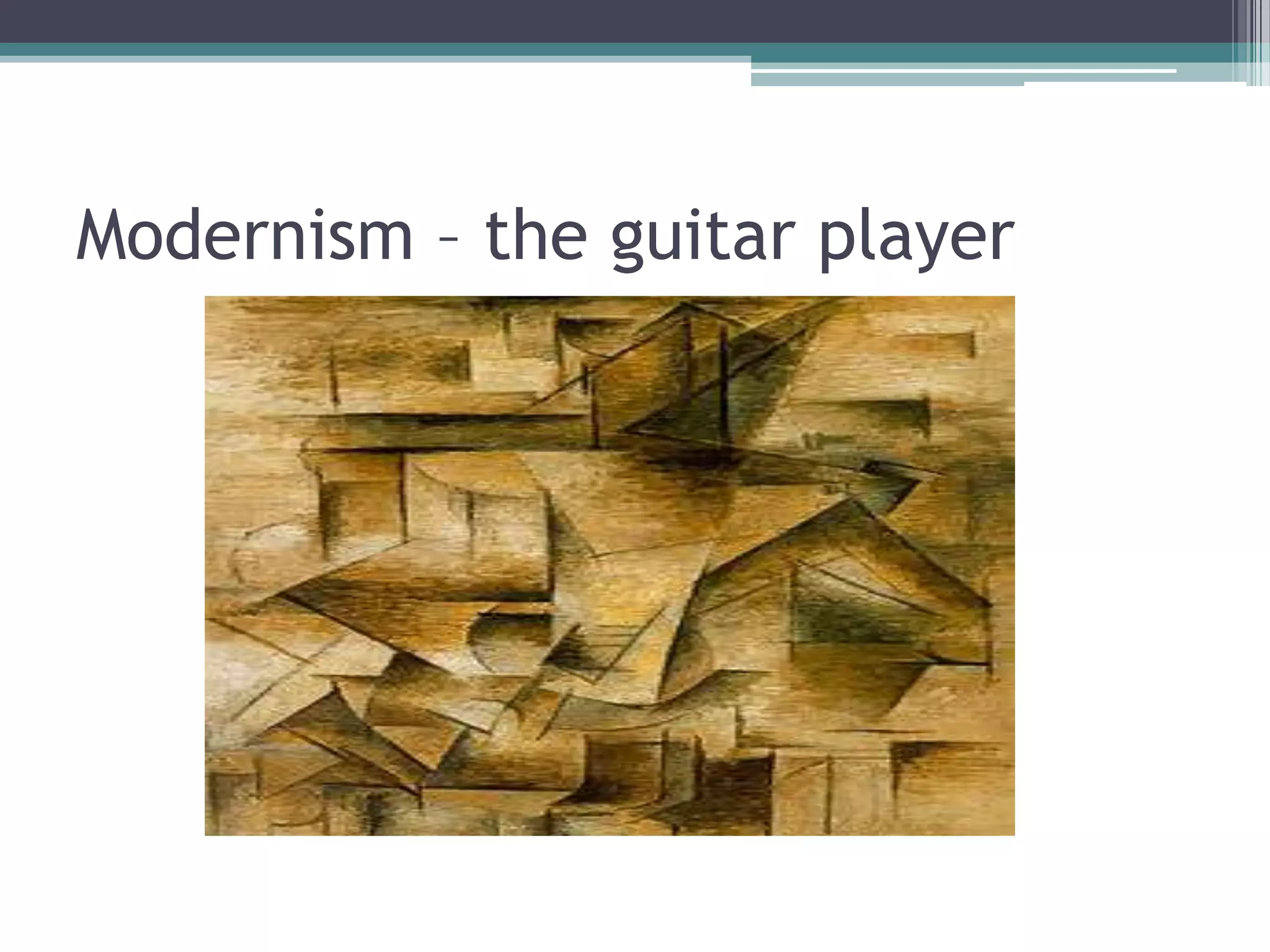
Modernism – the guitar player
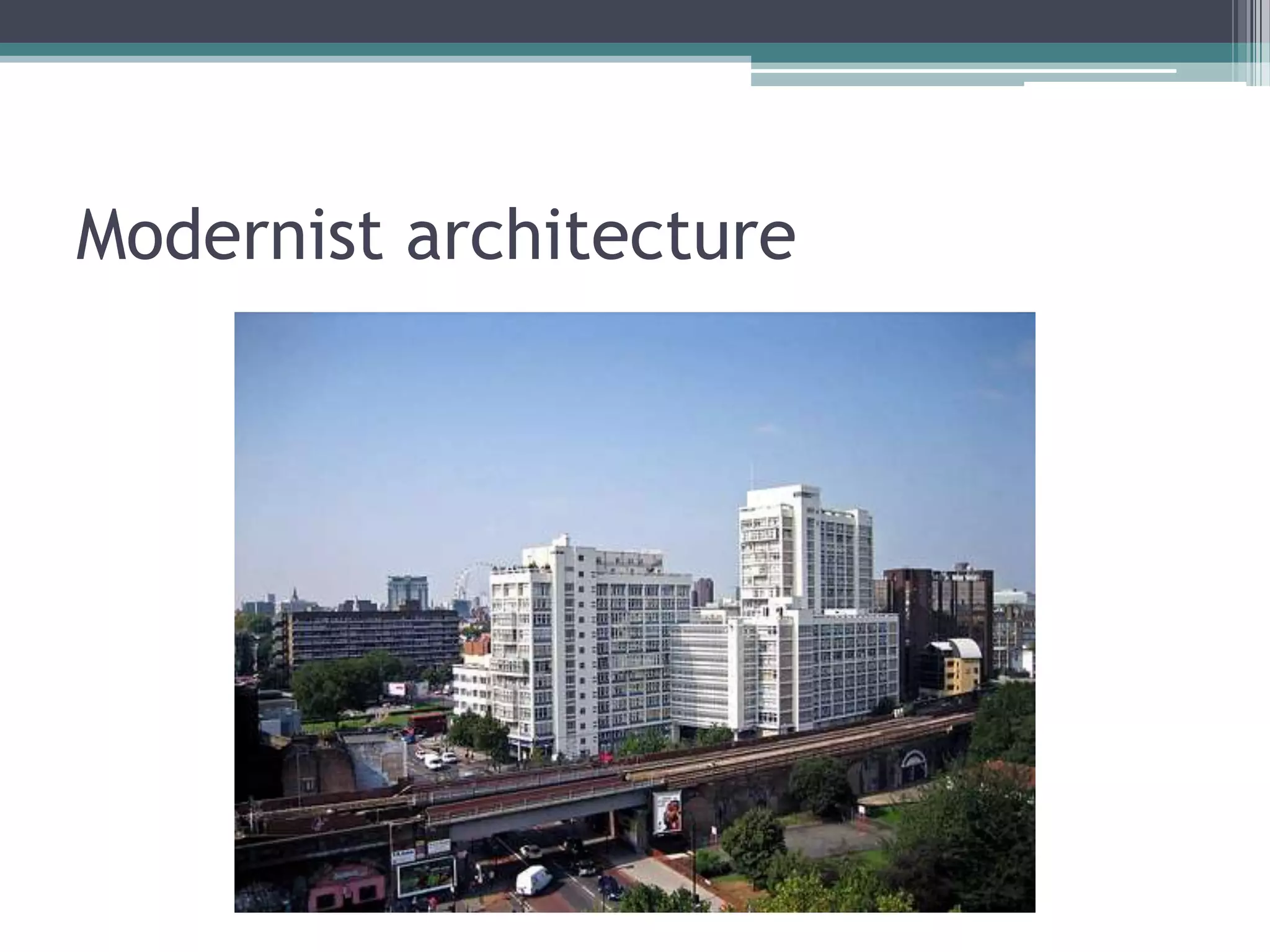
Modernist architecture
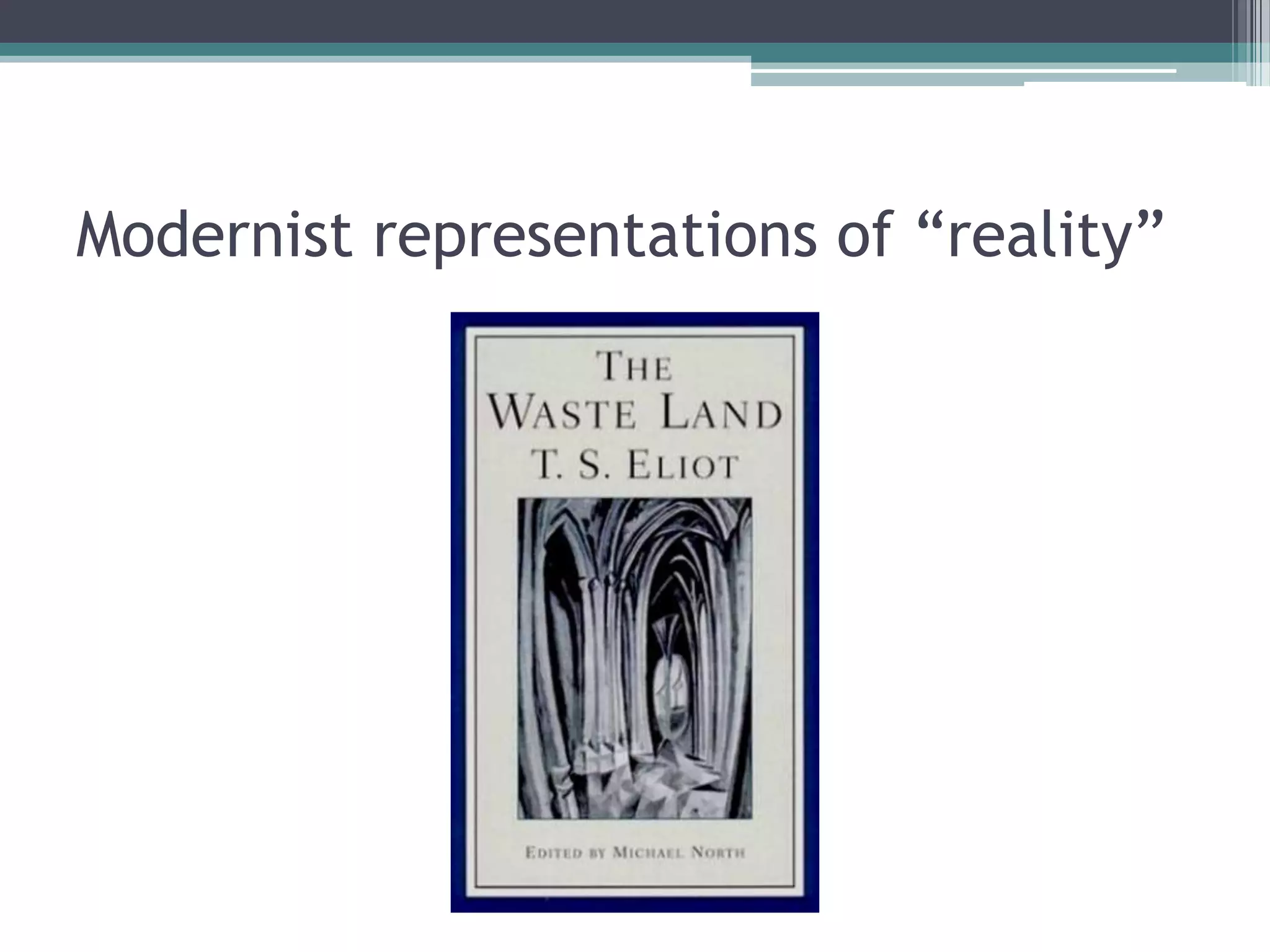
Modernist representations of “reality”
Modernist representations of the city
•   Unreal City,
•   Under the brown fog of a winter dawn,
•   A crowd flowed over London Bridge, so many,
•   I had not thought death had undone so many.
•   Sighs, short and infrequent, were exhaled,
•   And each man fixed his eyes before his feet.
•   Flowed up the hill and down King William Street,
•   To where Saint Mary Woolnoth kept the hours
•    With a dead sound on the final stroke of nine.
•   There I saw one I knew, and stopped him, crying “Stetson!
•   You who were with me in the ships at Mylae!
•   That corpse you planted last year in your garden,
•   Has it begun to sprout? Will it bloom this year?”
Key ideas
• A concentration upon new forms of
  representation
• An obsession with “form”:
  poetic, architectural, artistic, musical
• A rejection of “realist” depictions of the world
• An exploration of multiple forms of alienation
• A terrible sense of alienation from the industrial
  modern world
• A tendency to romanticise the past; to seek
  spiritual salvation there, eg Forster
Your thoughts…
• Do you have any particular thoughts or views on
  race and racism? Have you read any writers that
  are striking in this regard?
Modernism: Truth, race and elitism
• A fascination and belief that art can unearth
  fundamental truths about the world
• A distinct hierarchy in culture
• High art is very distinct from popular culture
• A belief that there is an elite that can have access to
  the truth
• This elite is always alienated from the mainstream
  society
• A profound interest in “race”; that there are
  “essential” racial identities, eg Forster, Yeats, Eliot
Your thoughts
• Do you have any views about sexuality? How
  important is sexuality in defining oneself? What
  role does it play in shaping one‟s identity?
Sexuality and modernism
• There is a growing frankness about human
  sexuality; an exploration of Freud‟s ideas in the
  writings of DH Lawrence; James Joyce; even
  Eliot.
• But there is much that is still “taboo”:
  homosexuality
• A fear of female sexuality permeates much of the
  literature
Activity
• What do you think modernism is?
• How would you define it?
• Have you experienced it in your own life/reading
  etc?
• Why do you think so many modernist were both
  sexist and possibly racist in their views?
• Why did many flirt with or explicitly support
  fascism?
Forster: the modernist?
• Pg 172: “she would double her kingdom by
  opening the door that concealed the stairs.
• Not she thought of the map of Africa; of empires;
  of her father; of the two supreme
  nations, streams of whose life warmed her
  blood, but, mingling, had cooled her brain. She
  paced back into the hall, and as she did so the
  house reverberated.”
• What does this passage tell us about the context
  of the time?
Realizing England at Howards End
• Pg 174: “She recaptured her sense of space, which is
  the basis of all earthly beauty, and, starting from
  Howards End she attempted to realize England. She
  failed…But an unexpected love of the island awoke
  in her, connecting on this side with the joys of the
  flesh, on that with the inconceivable. Helen and her
  father had known this love, poor Leonard Bast was
  groping after it, but it had been hidden from
  Margaret until this afternoon.”
• What does Howards End awaken in Margaret? Why
  does Forster focus upon this moment?
Contextual factors
• Len Platt, „Germanism, the Modern and
  “England” – 1880–1930: a literary overview‟
  in Modernism and Race (2011).

• Pg 32, Platt: “HE…worries away about defining
  culture in an age of degeneration.”
Literary and cultural background
• “Aryanised Celticism”
• 1853, Grammatica Celtica, Johann Caspar
  Zeuss, trying to prove the Celtic language was
  Indo-European and therefore “Aryan”.
The Wilcox family
• Pg 32: “For all its authority, the mercantile
  Wilcox identity is obviously limited and
  compromised – even fragile.”
• The New Woman identity counters the Wilcox
  identity; the feminised world of England is its
  new identity?
• Modern, feminised and German…
Anglo-Saxon England
• Revisionist and Celtic?
• The true England is represented by Mrs Wilcox
  and her country house with its path that the
  Kings of Mercia travelled down and its “wych-
  elm”?
• Invoking an ancient “Anglo-Saxon” identity for
  England, linking it with its antique German past.
• Devoted to spiritualised vision of England‟s past;
  belief in the ancient feudal order of England…
The attack on the suburbs
• Withering attack on Leonard Bast
• Mythologised feudalism
• Mysterious belief in the powers of a pseudo-
  mystical landlordism…
• Vision of a revised past; not a new future…
Forster’s ideal English identity
• Pg 33: “For all the attempted assimilation of
  commercial individualism to tradition and authentic
  culture, it is clear that Forster‟s ideal social
  organisation, and national identity, remain
  essentially rooted in the past and firmly linked to
  ideas about social obligation and distinction…Here a
  contented neo-peasantry, the hybrid he despises as
  „England‟s hope…half-clod hopper, half boardschool
  prig‟, serves under those who have the „wisdom‟ to
  worship the past, „that wisdom‟ Forster says, „that
  we give the clumsy name of aristocracy.‟”
Activity
• What do you think of the attitudes implicit in
  Forster‟s novel?
• Revisit your notes that you made on what
  England means to you; do you have anything to
  add to them? Any more thoughts?
Forster and sexuality
• Forster has a vision of a better “feminised”
  England; a spiritual place which is “mothered”
  by a Mrs Wilcox…
• He suppressed a major novel Maurice because it
  explored the topic of homosexuality; it was
  published after his death…
Sexuality and English identity
• Wide Sargasso Sea: Rochester is disgusted but
  attracted by Antoinette‟s sexuality
• Small Island: Bernard disgusted by Queenie‟s
  sexual desire
• Howards End: sexual attraction threatens the
  very fabric of the society
Activity
• Is there a sexual component to English identity?
• What are these novels saying about sexuality do
  you think?
• Race and sexuality: do these novels explore the
  ways in which these two factors inter-sect?
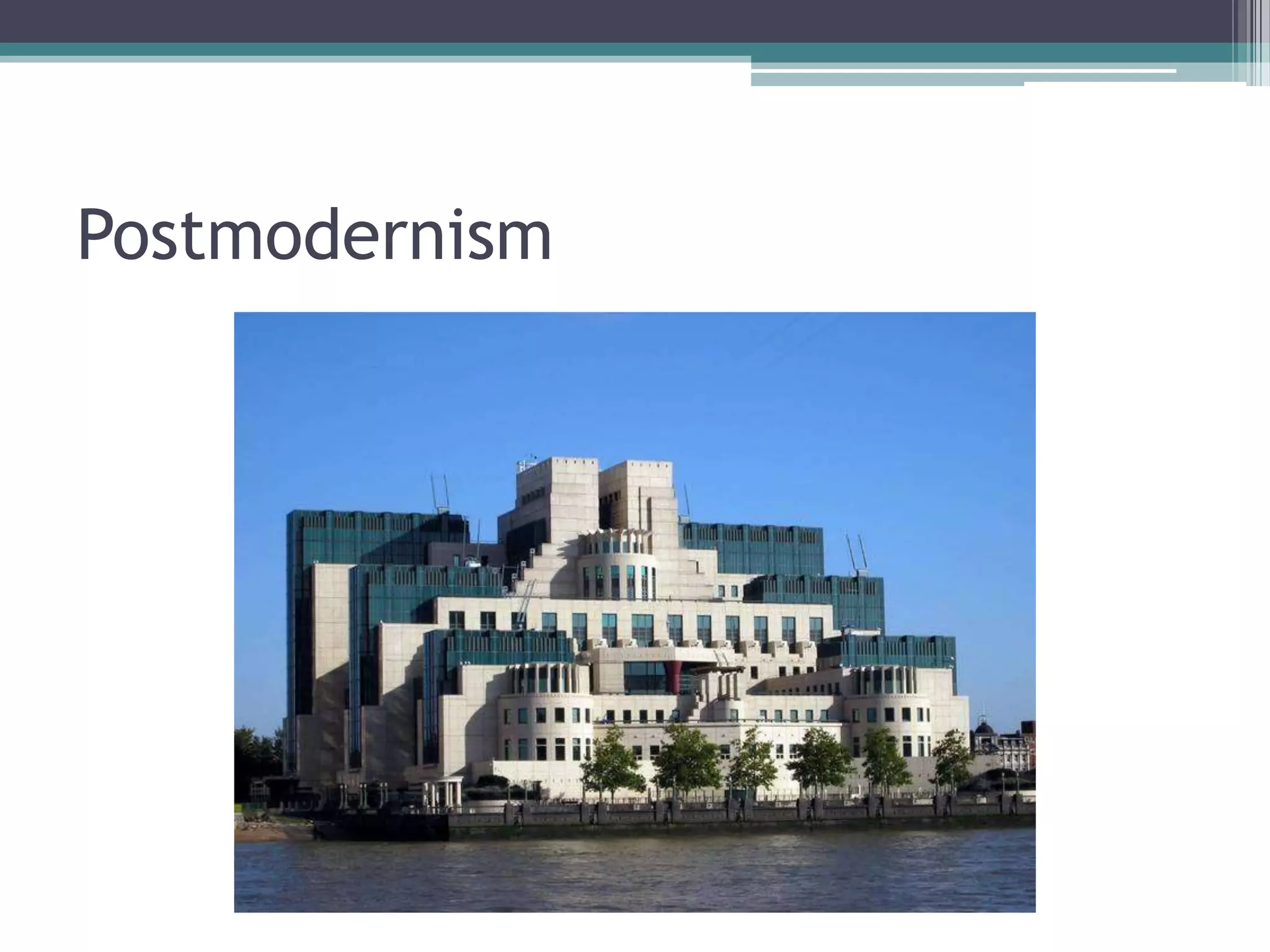
Postmodernism
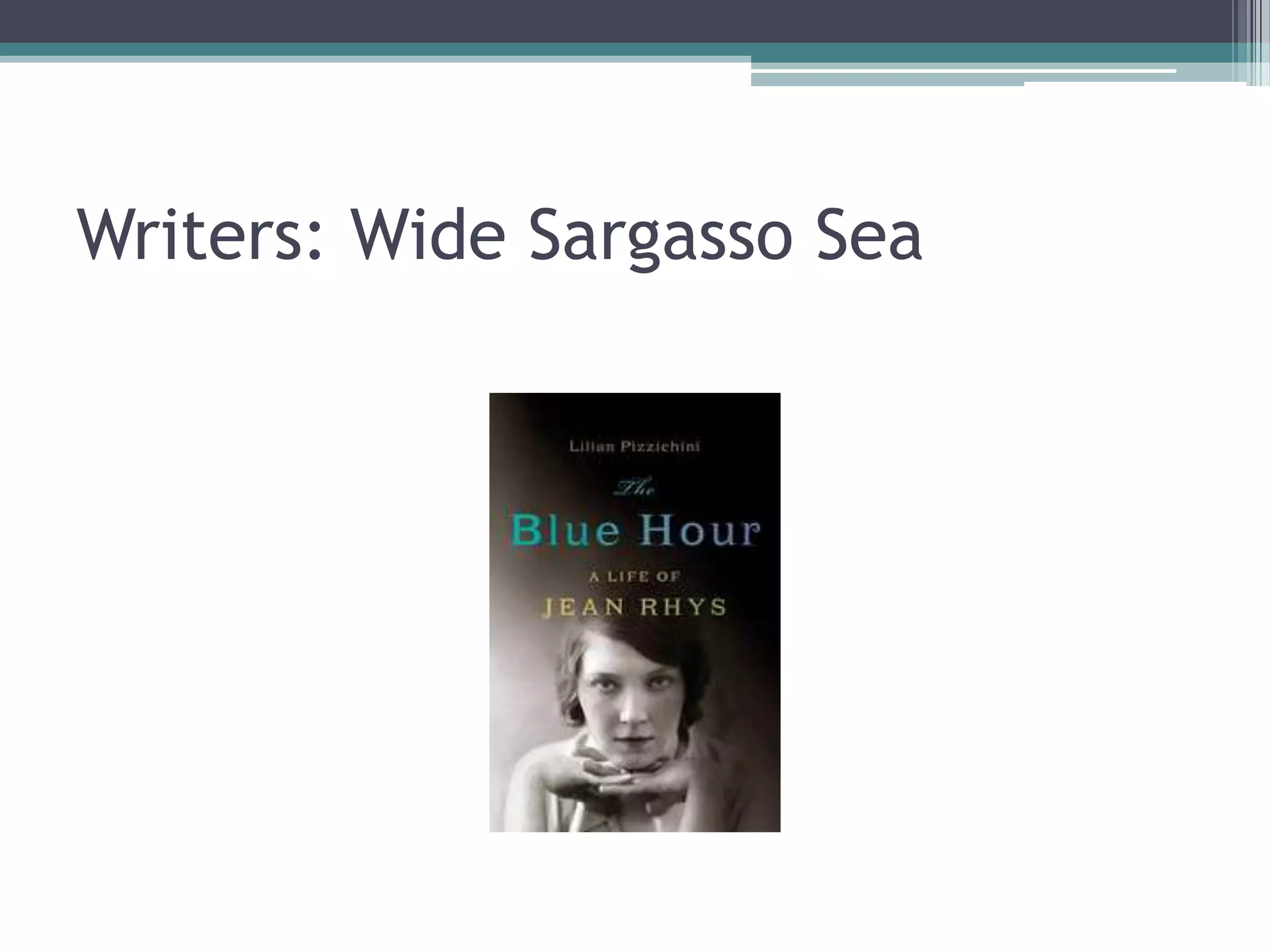
Writers: Wide Sargasso Sea
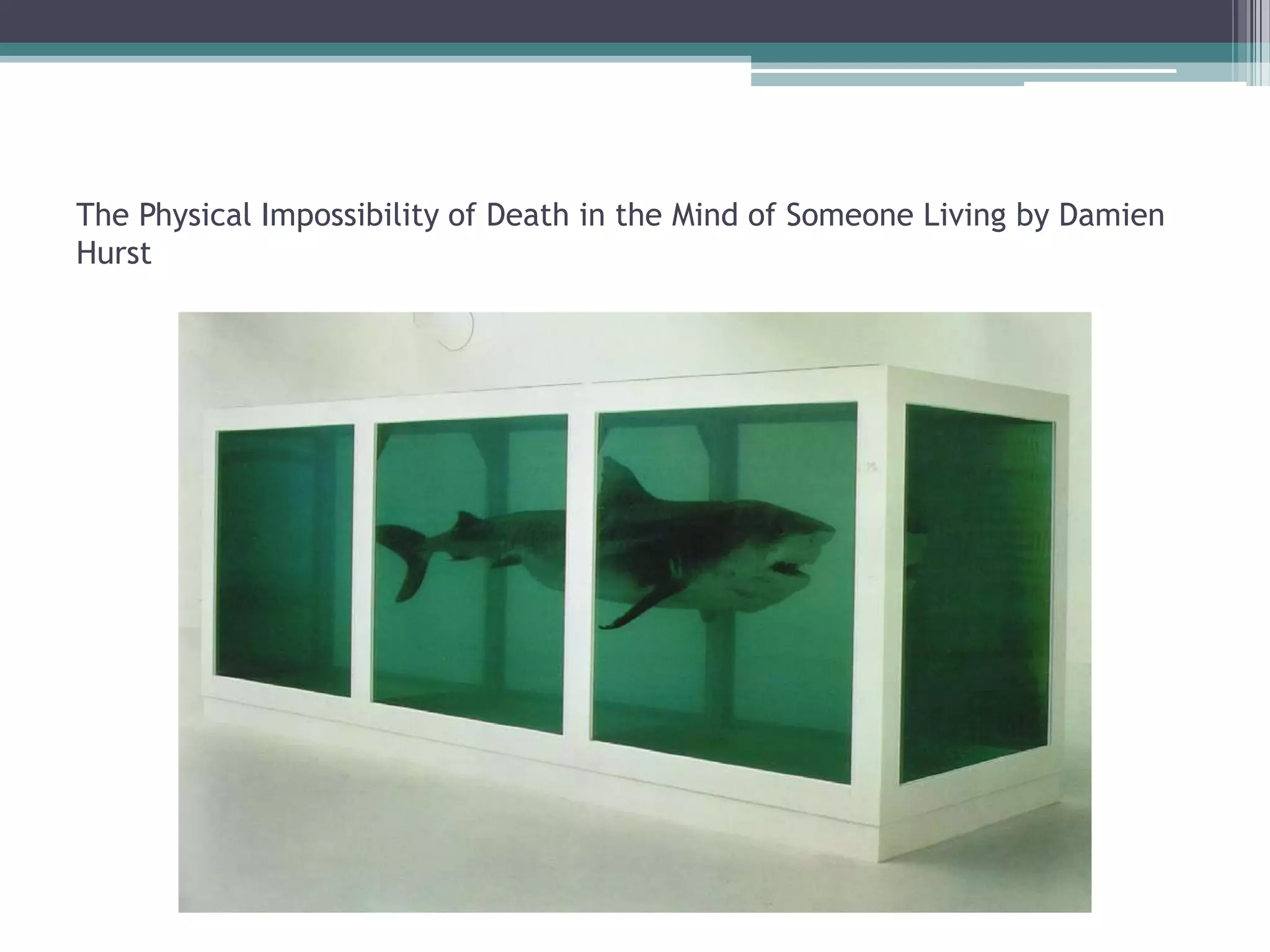
The Physical Impossibility of Death in the Mind of Someone Living by Damien
Hurst
Postmodernism
• Playful in its exploration of “form”
• Full of quotations from popular culture
• Rejecting distinction between “high” and “low” art
• Inter-textual
• A delight in “hybrid” identities: rejection of
  “essentialism”
• Multiple voices
• Often political: postcolonial; feminist; queer
• Crossing boundaries/genres: the YouTube poem;
  the novel that responds to another…
Questioning “essentialism”
• Is there any such thing as “literature”? What is
  it?
  Is there any subject thing as the “true self”? Are
  we all social constructs?
• Are all our attitudes and beliefs “socially
  constructed”?
• We are all “mediums” for a shared social
  language
Important “postmodern” thinkers have
worked in the “postcolonial” field
• Lamming: the myth of English
  supremacy, predicated upon certain cultural
  assumptions that have subjugated colonial
  subjects…

• Spivak – the impossibility of the subaltern
  “speaking”, making their views known from a
  position of equality; always the “Other”, the invisible
  one…

• Said – the discourses of colonialism have filtered
  into every sphere: science, anthropology, art
Trainspotting
• http://www.youtube.com/watch?v=G1tJJO_pV
  vQ&feature=related


• What do you think this clip tells us about
  Scottish identity, and the issue of national
  identity in general?
This is England
• http://www.youtube.com/watch?v=X8uAtsaPO-
  E&feature=related

• What do you think makes this a post-modern
  film?
Postmodern and sexuality
• Foucalt an important thinker
• A much greater openness and honesty about
  sexuality
• An acknowledgement that sexuality is a key
  component of an individual‟s and nation‟s
  identity but that there are no easy definitions, eg
  questioning the labels we give different sexual
  groups…
Queer theory
• Foucault noted that a vague grouping of actions
  were replaced by a group of sexual categories and
  questioned whether this was justified or meaningful;
  is it enough to speak of heterosexual and
  homosexual or is this binary either/or not enough to
  account for the varieties of human behaviour? Even
  if we add other designations, the same question
  remains: are we describing divisions that actually
  exist or instead forcing individuals into moulds that
  they do not fit? What are the consequences of the
  latter, especially for those questioning their
  sexuality? Queer theory studies these and other
  similar questions.
Tying things together
• What are your views on modernism and
  postmodernism?
• What do you think you have learnt about
  race, sexuality and English identity from this
  session?

Postmodern british identity

  • 1.
    English Identity: modernism, raceand sexuality Francis Gilbert Goldsmiths
  • 2.
    Learning objectives • Torevisit/revise some of the key issues/theories/texts brought up so far • To consolidate our ideas about post-c0lonialism and post-modernism • To explore some of the issues connected with race and sexuality within the context of modernist and postmodernist thinkers and writers;
  • 3.
    Recap • What aresome of things you‟ve learnt on this course so far? • What has interested you the most? Why? • What have you found challenging and why?
  • 4.
    What do youknow? • What do you know about modernism and post- modernism?
  • 5.
    Modernism – theguitar player
  • 6.
  • 7.
  • 8.
    Modernist representations ofthe city • Unreal City, • Under the brown fog of a winter dawn, • A crowd flowed over London Bridge, so many, • I had not thought death had undone so many. • Sighs, short and infrequent, were exhaled, • And each man fixed his eyes before his feet. • Flowed up the hill and down King William Street, • To where Saint Mary Woolnoth kept the hours • With a dead sound on the final stroke of nine. • There I saw one I knew, and stopped him, crying “Stetson! • You who were with me in the ships at Mylae! • That corpse you planted last year in your garden, • Has it begun to sprout? Will it bloom this year?”
  • 9.
    Key ideas • Aconcentration upon new forms of representation • An obsession with “form”: poetic, architectural, artistic, musical • A rejection of “realist” depictions of the world • An exploration of multiple forms of alienation • A terrible sense of alienation from the industrial modern world • A tendency to romanticise the past; to seek spiritual salvation there, eg Forster
  • 10.
    Your thoughts… • Doyou have any particular thoughts or views on race and racism? Have you read any writers that are striking in this regard?
  • 11.
    Modernism: Truth, raceand elitism • A fascination and belief that art can unearth fundamental truths about the world • A distinct hierarchy in culture • High art is very distinct from popular culture • A belief that there is an elite that can have access to the truth • This elite is always alienated from the mainstream society • A profound interest in “race”; that there are “essential” racial identities, eg Forster, Yeats, Eliot
  • 12.
    Your thoughts • Doyou have any views about sexuality? How important is sexuality in defining oneself? What role does it play in shaping one‟s identity?
  • 13.
    Sexuality and modernism •There is a growing frankness about human sexuality; an exploration of Freud‟s ideas in the writings of DH Lawrence; James Joyce; even Eliot. • But there is much that is still “taboo”: homosexuality • A fear of female sexuality permeates much of the literature
  • 14.
    Activity • What doyou think modernism is? • How would you define it? • Have you experienced it in your own life/reading etc? • Why do you think so many modernist were both sexist and possibly racist in their views? • Why did many flirt with or explicitly support fascism?
  • 15.
    Forster: the modernist? •Pg 172: “she would double her kingdom by opening the door that concealed the stairs. • Not she thought of the map of Africa; of empires; of her father; of the two supreme nations, streams of whose life warmed her blood, but, mingling, had cooled her brain. She paced back into the hall, and as she did so the house reverberated.” • What does this passage tell us about the context of the time?
  • 16.
    Realizing England atHowards End • Pg 174: “She recaptured her sense of space, which is the basis of all earthly beauty, and, starting from Howards End she attempted to realize England. She failed…But an unexpected love of the island awoke in her, connecting on this side with the joys of the flesh, on that with the inconceivable. Helen and her father had known this love, poor Leonard Bast was groping after it, but it had been hidden from Margaret until this afternoon.” • What does Howards End awaken in Margaret? Why does Forster focus upon this moment?
  • 17.
    Contextual factors • LenPlatt, „Germanism, the Modern and “England” – 1880–1930: a literary overview‟ in Modernism and Race (2011). • Pg 32, Platt: “HE…worries away about defining culture in an age of degeneration.”
  • 18.
    Literary and culturalbackground • “Aryanised Celticism” • 1853, Grammatica Celtica, Johann Caspar Zeuss, trying to prove the Celtic language was Indo-European and therefore “Aryan”.
  • 19.
    The Wilcox family •Pg 32: “For all its authority, the mercantile Wilcox identity is obviously limited and compromised – even fragile.” • The New Woman identity counters the Wilcox identity; the feminised world of England is its new identity? • Modern, feminised and German…
  • 20.
    Anglo-Saxon England • Revisionistand Celtic? • The true England is represented by Mrs Wilcox and her country house with its path that the Kings of Mercia travelled down and its “wych- elm”? • Invoking an ancient “Anglo-Saxon” identity for England, linking it with its antique German past. • Devoted to spiritualised vision of England‟s past; belief in the ancient feudal order of England…
  • 21.
    The attack onthe suburbs • Withering attack on Leonard Bast • Mythologised feudalism • Mysterious belief in the powers of a pseudo- mystical landlordism… • Vision of a revised past; not a new future…
  • 22.
    Forster’s ideal Englishidentity • Pg 33: “For all the attempted assimilation of commercial individualism to tradition and authentic culture, it is clear that Forster‟s ideal social organisation, and national identity, remain essentially rooted in the past and firmly linked to ideas about social obligation and distinction…Here a contented neo-peasantry, the hybrid he despises as „England‟s hope…half-clod hopper, half boardschool prig‟, serves under those who have the „wisdom‟ to worship the past, „that wisdom‟ Forster says, „that we give the clumsy name of aristocracy.‟”
  • 23.
    Activity • What doyou think of the attitudes implicit in Forster‟s novel? • Revisit your notes that you made on what England means to you; do you have anything to add to them? Any more thoughts?
  • 24.
    Forster and sexuality •Forster has a vision of a better “feminised” England; a spiritual place which is “mothered” by a Mrs Wilcox… • He suppressed a major novel Maurice because it explored the topic of homosexuality; it was published after his death…
  • 25.
    Sexuality and Englishidentity • Wide Sargasso Sea: Rochester is disgusted but attracted by Antoinette‟s sexuality • Small Island: Bernard disgusted by Queenie‟s sexual desire • Howards End: sexual attraction threatens the very fabric of the society
  • 26.
    Activity • Is therea sexual component to English identity? • What are these novels saying about sexuality do you think? • Race and sexuality: do these novels explore the ways in which these two factors inter-sect?
  • 27.
  • 28.
  • 29.
    The Physical Impossibilityof Death in the Mind of Someone Living by Damien Hurst
  • 30.
    Postmodernism • Playful inits exploration of “form” • Full of quotations from popular culture • Rejecting distinction between “high” and “low” art • Inter-textual • A delight in “hybrid” identities: rejection of “essentialism” • Multiple voices • Often political: postcolonial; feminist; queer • Crossing boundaries/genres: the YouTube poem; the novel that responds to another…
  • 31.
    Questioning “essentialism” • Isthere any such thing as “literature”? What is it? Is there any subject thing as the “true self”? Are we all social constructs? • Are all our attitudes and beliefs “socially constructed”? • We are all “mediums” for a shared social language
  • 32.
    Important “postmodern” thinkershave worked in the “postcolonial” field • Lamming: the myth of English supremacy, predicated upon certain cultural assumptions that have subjugated colonial subjects… • Spivak – the impossibility of the subaltern “speaking”, making their views known from a position of equality; always the “Other”, the invisible one… • Said – the discourses of colonialism have filtered into every sphere: science, anthropology, art
  • 33.
    Trainspotting • http://www.youtube.com/watch?v=G1tJJO_pV vQ&feature=related • What do you think this clip tells us about Scottish identity, and the issue of national identity in general?
  • 34.
    This is England •http://www.youtube.com/watch?v=X8uAtsaPO- E&feature=related • What do you think makes this a post-modern film?
  • 35.
    Postmodern and sexuality •Foucalt an important thinker • A much greater openness and honesty about sexuality • An acknowledgement that sexuality is a key component of an individual‟s and nation‟s identity but that there are no easy definitions, eg questioning the labels we give different sexual groups…
  • 36.
    Queer theory • Foucaultnoted that a vague grouping of actions were replaced by a group of sexual categories and questioned whether this was justified or meaningful; is it enough to speak of heterosexual and homosexual or is this binary either/or not enough to account for the varieties of human behaviour? Even if we add other designations, the same question remains: are we describing divisions that actually exist or instead forcing individuals into moulds that they do not fit? What are the consequences of the latter, especially for those questioning their sexuality? Queer theory studies these and other similar questions.
  • 37.
    Tying things together •What are your views on modernism and postmodernism? • What do you think you have learnt about race, sexuality and English identity from this session?