ELIT 48C CLASS
37
Hence
Thus
Therefore
Hence/Thus/Therefore
• Hence means from this place: Away; from this time; because of a
preceding fact or premise: Therefore*.
• We will reunite five years hence.
• She won the talent competition, hence her good spirits.
• She grew up in Florida, hence her familiarity with palmetto bugs.
• Therefore means for that reason: Consequently; because of that; on that
ground; to that end*. It directly relates to reasoning.
• I think, therefore I am.
• She was early and therefore had to wait out in the cold.
• He has a race tomorrow; therefore, he can’t stay out late tonight.
• Thus means in this or that manner or way; to this degree or extend: So;
because of this or that: Hence, Consequently; as an example*
• The professor described it thus…
• We’ve had quite a few examples thus far.
• He studied a lot, thus making it easier for him to pass the test.
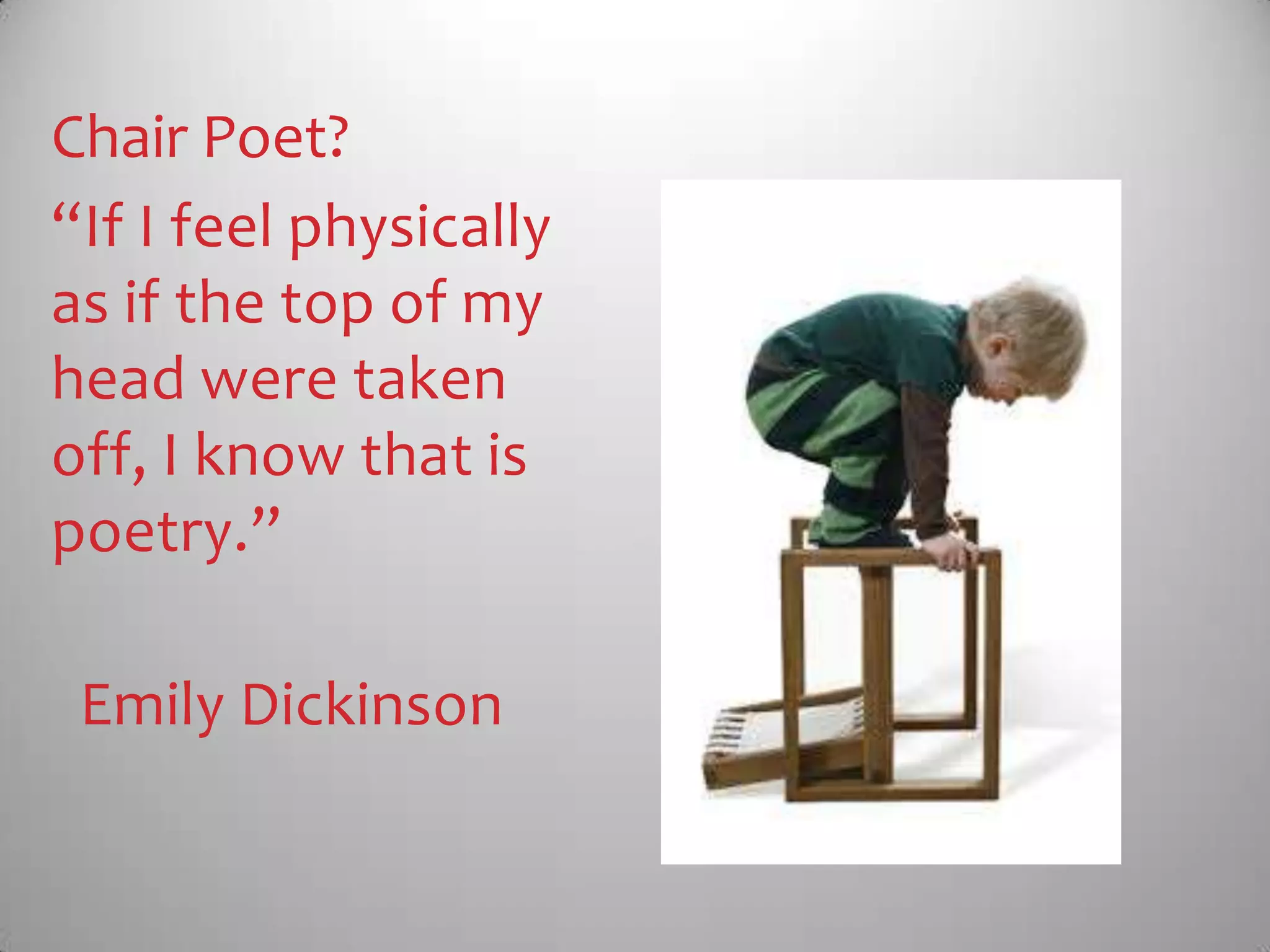
Chair Poet?
“If I feel physically
as if the top of my
head were taken
off, I know that is
poetry.”
Emily Dickinson
AGENDA
•Maxine Hong Kingston
•Historical Context
•Themes and Style
•Discussion
•QHQ
•Theme
•Critical Lens
Discuss
Five
minutes!
Historical Context: Women in Chinese Society
• Kingston takes revenge on centuries of Chinese female oppression
in The Woman Warrior, the larger work from which “No-Name
Woman” was taken. Through her stories about herself and her
female relatives, Kingston paints a picture of Chinese tradition that
portrays women as objectified and enslaved by men. From the days
of Confucius through the early twentieth century, the Chinese
placed men above women and family above social order. When
people married, new family ties formed, and new wives became
subservient to their grooms’ parents. Women from the higher
classes lived extremely secluded lives and suffered such treatments
as foot-binding. The Chinese chose young girls who were especially
pretty to undergo foot-binding. The binder bent the large toe
backward, forever deforming the foot. Men favored women with
bound feet, a sign of beauty and gentility, because it signified that
they could support these women who were incapable of physical
labor.
Setting
The narrator grows up in
Stockton, California, where she was born in 1940.
The events that actually occur in her life take
place in California. Her imagined warrior life and
her mother's "talk stories," however, take place in
China. For example, the story of No-Name
Aunt, the ghost aunt, occurs in China from about
1924 to 1934.
Style
Kingston combines fact with fiction—relying on her
own memories, her mother's "talk stories," and her
own vivid imagination—to create a view of what it is
like to grow up a Chinese-American female.
She reworks traditional myths and legends to
modernize their messages.
Some critics argue that her dependence on
inventiveness (from the myths and legends) renders
her writing difficult to classify as autobiography or
fiction.
Postmodern Aspects
 Shrugs off old forms and limits: Her work differs from most autobiographies in
that it is not a first-person narration of the author's life.
 Multiple genres and approaches: memory, fantasy, speculation, translation, and
point of view.
 Moves away from the metanarrative: Kingston struggles to reconcile her
identity as a member of two cultures, Chinese and American, who does not feel
entirely at home in either culture. It is a story of an individual.
 Themes: Kingston combats what Shirley Geok-Lin Lim has called "the cultural
silencing of Chinese in American society and ….. the gendered silencing of
women in Chinese society,” through the telling of stories about women who are
either literally or mythically her ancestors. Her words are her weapons against
silence, racism, and sexism.
Critical Lens: Marxism
• I think it would be interesting to look at this story through a Marxist
lens.
• one of the first things the townsfolk did was to slaughter the family’s
animal stock, trash the seemingly few material items they owned, and take
“sugar and oranges” as well as “cut pieces from the dead animals” and
“took bowls that were not broken and clothes that were not torn.” The
livestock, and their material possessions were the two things focused on
by these people? That seems like they were trying to shame them
financially.
Feminist Lens
• The aunt obviously suffered greatly if she had to get to the point
where she threw herself and her newborn down a well. This whole
idea of “slut shaming” by the villagers destroying her house and
killing her livestock gave her almost nothing to live for. No other
options were even considered.
• The clear message is that the narrator finds the traditional Chinese
culture to be masogenistic and inconsiderate of women’s desires
and independence. However, the more interesting feminist
discourse that one can engage in is how the speaker sees the
dichotomy between how women operate in America in contrast to
China
Themes
A common theme I saw throughout this was the
idea of beauty and what is considered beautiful in
Chinese culture.
Theme of Sexual Repression
The place of women in traditional Chinese society is
a theme in this chapter.
An overlying theme in Warrior Woman is shame.
Symbol
• The well/water
• A well is filled with water and water symbolizes purity, so when the aunt
jumps I to the well, perhaps it symbolizes that she is trying to purify herself.
It also symbolizes that because she dies in the water, a pure place, that her
pregnancy was not her fault, so she dies pure.
• the importance of the circle
• “The round moon cakes and round doorways, the round tables of
graduated size that fit one roundness inside another, round windows and
rice bowls…”
• Pig
• Pork is revered as a life-giving food that nourishes the essence and
strengthens the weak. is the traditional character for pig. It you take
the left hand side of the character and put a “roof” over the top, you get
the character for family .
QHQ
Does the No Name Woman fit into Anzaldua’s idea of the three
symbols for women (The Fucked One, La Llorona, and La Virgin de
Guadalupe)?
What empowering symbols does the narrator try to create out of
the story of the aunt?
How do we do this [punish women] in America? (Because I am
certain we do. As early as Scarlet Letter to Kristen Stewart)
Why did the narrator treat the No Named Woman differently than
the villagers?
If the Chinese have a hard life in China, then how would their lives
be if they leave for America?
Author Introduction: Sandra Cisneros
Born in Chicago in 1954, Sandra Cisneros grew up with her
Mexican father, Mexican-American mother, and six brothers. Her
family moved back and forth between Chicago and Mexico City.
As a child, her defense against loneliness was reading books
and writing poetry. In high school, she continued writing, trying
to distinguish her own voice from the voices of the literary giants
she studied. It was not until a creative writing class in college in
1974, described in "Ghost Voices: Writing from Obsession," that
she began to realize that she had not only a unique voice, but
also a new story to tell that had not been told in American
literature. It is the story of immigrant families living on the
borders between countries, neighborhoods, social classes,
linguistic groups, and races.
HOMEWORK
•Read Sandra Cisneros
•“Woman Hollering Creek” 1131-1139
•Post #35
•Discuss a theme: love and passion or sex roles or?
•Discuss the text in terms of postmodernism or in
articulation with a postmodern manifesto.
•Discuss the story as it reads through a feminist and/or
minority lens.

Elit 48 c class 37

  • 1.
  • 2.
    Hence/Thus/Therefore • Hence meansfrom this place: Away; from this time; because of a preceding fact or premise: Therefore*. • We will reunite five years hence. • She won the talent competition, hence her good spirits. • She grew up in Florida, hence her familiarity with palmetto bugs. • Therefore means for that reason: Consequently; because of that; on that ground; to that end*. It directly relates to reasoning. • I think, therefore I am. • She was early and therefore had to wait out in the cold. • He has a race tomorrow; therefore, he can’t stay out late tonight. • Thus means in this or that manner or way; to this degree or extend: So; because of this or that: Hence, Consequently; as an example* • The professor described it thus… • We’ve had quite a few examples thus far. • He studied a lot, thus making it easier for him to pass the test.
  • 3.
    Chair Poet? “If Ifeel physically as if the top of my head were taken off, I know that is poetry.” Emily Dickinson
  • 4.
    AGENDA •Maxine Hong Kingston •HistoricalContext •Themes and Style •Discussion •QHQ •Theme •Critical Lens
  • 5.
  • 6.
    Historical Context: Womenin Chinese Society • Kingston takes revenge on centuries of Chinese female oppression in The Woman Warrior, the larger work from which “No-Name Woman” was taken. Through her stories about herself and her female relatives, Kingston paints a picture of Chinese tradition that portrays women as objectified and enslaved by men. From the days of Confucius through the early twentieth century, the Chinese placed men above women and family above social order. When people married, new family ties formed, and new wives became subservient to their grooms’ parents. Women from the higher classes lived extremely secluded lives and suffered such treatments as foot-binding. The Chinese chose young girls who were especially pretty to undergo foot-binding. The binder bent the large toe backward, forever deforming the foot. Men favored women with bound feet, a sign of beauty and gentility, because it signified that they could support these women who were incapable of physical labor.
  • 7.
    Setting The narrator growsup in Stockton, California, where she was born in 1940. The events that actually occur in her life take place in California. Her imagined warrior life and her mother's "talk stories," however, take place in China. For example, the story of No-Name Aunt, the ghost aunt, occurs in China from about 1924 to 1934.
  • 8.
    Style Kingston combines factwith fiction—relying on her own memories, her mother's "talk stories," and her own vivid imagination—to create a view of what it is like to grow up a Chinese-American female. She reworks traditional myths and legends to modernize their messages. Some critics argue that her dependence on inventiveness (from the myths and legends) renders her writing difficult to classify as autobiography or fiction.
  • 9.
    Postmodern Aspects  Shrugsoff old forms and limits: Her work differs from most autobiographies in that it is not a first-person narration of the author's life.  Multiple genres and approaches: memory, fantasy, speculation, translation, and point of view.  Moves away from the metanarrative: Kingston struggles to reconcile her identity as a member of two cultures, Chinese and American, who does not feel entirely at home in either culture. It is a story of an individual.  Themes: Kingston combats what Shirley Geok-Lin Lim has called "the cultural silencing of Chinese in American society and ….. the gendered silencing of women in Chinese society,” through the telling of stories about women who are either literally or mythically her ancestors. Her words are her weapons against silence, racism, and sexism.
  • 10.
    Critical Lens: Marxism •I think it would be interesting to look at this story through a Marxist lens. • one of the first things the townsfolk did was to slaughter the family’s animal stock, trash the seemingly few material items they owned, and take “sugar and oranges” as well as “cut pieces from the dead animals” and “took bowls that were not broken and clothes that were not torn.” The livestock, and their material possessions were the two things focused on by these people? That seems like they were trying to shame them financially.
  • 11.
    Feminist Lens • Theaunt obviously suffered greatly if she had to get to the point where she threw herself and her newborn down a well. This whole idea of “slut shaming” by the villagers destroying her house and killing her livestock gave her almost nothing to live for. No other options were even considered. • The clear message is that the narrator finds the traditional Chinese culture to be masogenistic and inconsiderate of women’s desires and independence. However, the more interesting feminist discourse that one can engage in is how the speaker sees the dichotomy between how women operate in America in contrast to China
  • 12.
    Themes A common themeI saw throughout this was the idea of beauty and what is considered beautiful in Chinese culture. Theme of Sexual Repression The place of women in traditional Chinese society is a theme in this chapter. An overlying theme in Warrior Woman is shame.
  • 13.
    Symbol • The well/water •A well is filled with water and water symbolizes purity, so when the aunt jumps I to the well, perhaps it symbolizes that she is trying to purify herself. It also symbolizes that because she dies in the water, a pure place, that her pregnancy was not her fault, so she dies pure. • the importance of the circle • “The round moon cakes and round doorways, the round tables of graduated size that fit one roundness inside another, round windows and rice bowls…” • Pig • Pork is revered as a life-giving food that nourishes the essence and strengthens the weak. is the traditional character for pig. It you take the left hand side of the character and put a “roof” over the top, you get the character for family .
  • 14.
    QHQ Does the NoName Woman fit into Anzaldua’s idea of the three symbols for women (The Fucked One, La Llorona, and La Virgin de Guadalupe)? What empowering symbols does the narrator try to create out of the story of the aunt? How do we do this [punish women] in America? (Because I am certain we do. As early as Scarlet Letter to Kristen Stewart) Why did the narrator treat the No Named Woman differently than the villagers? If the Chinese have a hard life in China, then how would their lives be if they leave for America?
  • 15.
    Author Introduction: SandraCisneros Born in Chicago in 1954, Sandra Cisneros grew up with her Mexican father, Mexican-American mother, and six brothers. Her family moved back and forth between Chicago and Mexico City. As a child, her defense against loneliness was reading books and writing poetry. In high school, she continued writing, trying to distinguish her own voice from the voices of the literary giants she studied. It was not until a creative writing class in college in 1974, described in "Ghost Voices: Writing from Obsession," that she began to realize that she had not only a unique voice, but also a new story to tell that had not been told in American literature. It is the story of immigrant families living on the borders between countries, neighborhoods, social classes, linguistic groups, and races.
  • 16.
    HOMEWORK •Read Sandra Cisneros •“WomanHollering Creek” 1131-1139 •Post #35 •Discuss a theme: love and passion or sex roles or? •Discuss the text in terms of postmodernism or in articulation with a postmodern manifesto. •Discuss the story as it reads through a feminist and/or minority lens.