POSTGRE(NO)SQL
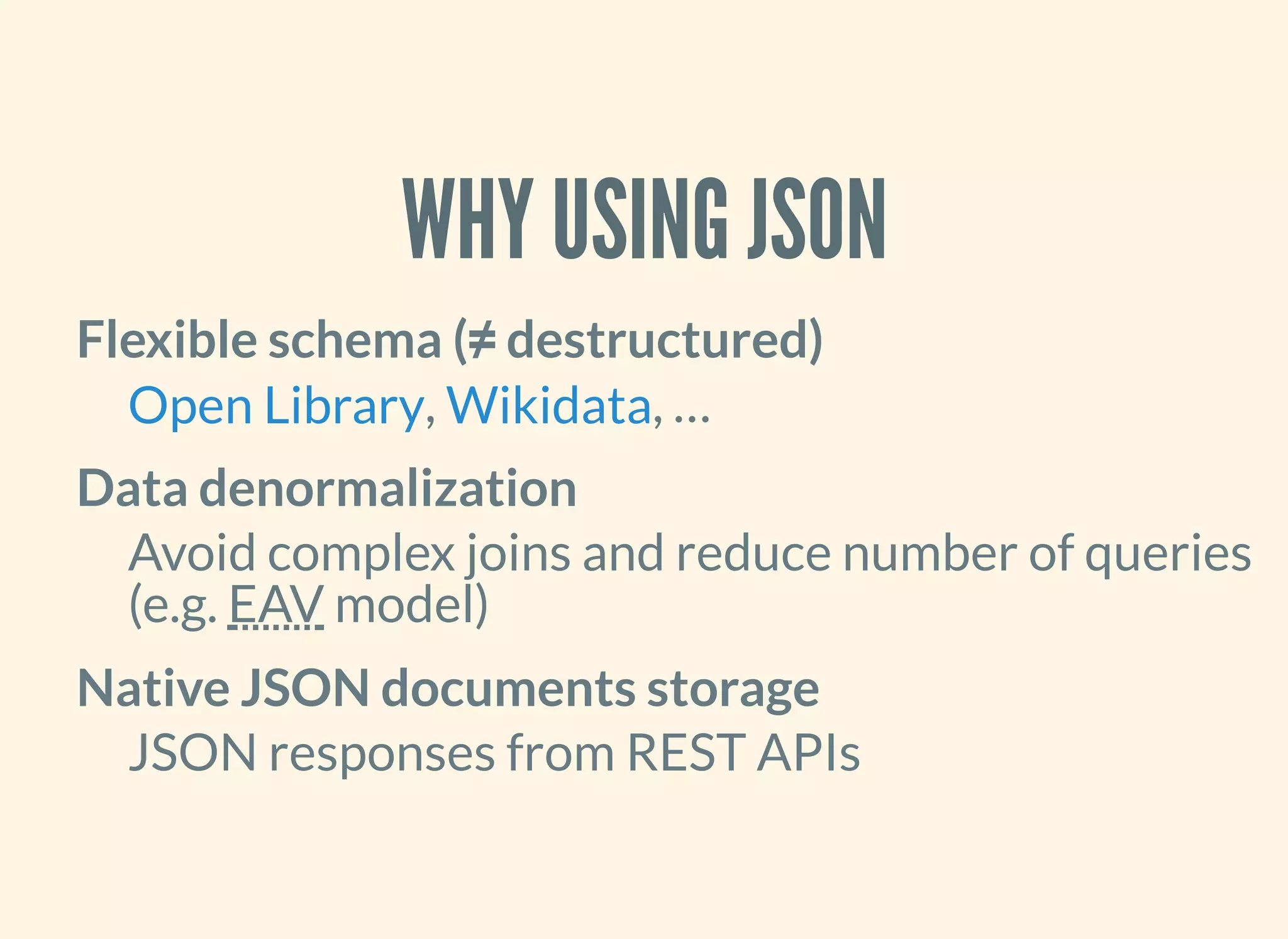
WHY USING JSON
Flexible schema (≠ destructured)
, , …
Data denormalization
Avoid complex joins and reduce number of queries
(e.g. EAV model)
Native JSON documents storage
JSON responses from REST APIs
Open Library Wikidata
THE OLD WAY
Before NoSQL and native JSON
EAV (ENTITY-ATTRIBUTE-VALUE) MODEL
One table contains the entities, another table contains the names of the
properties (attributes) and a third table links the entities with their
attributes and holds the value. This gives you the exibility for having
different sets of properties […].
Selecting one or more entities based on 1 attribute value requires 2 joins
[…]. Also, the properties usually are all stored as strings, which results in
type casting, both for the result as for the WHERE clause.
JSONB has potential for greatly simplifying schema design without
sacri cing query performance.
via
Replacing EAV with JSONB in PostgreSQL
Wikipedia / Entity–attribute–value model
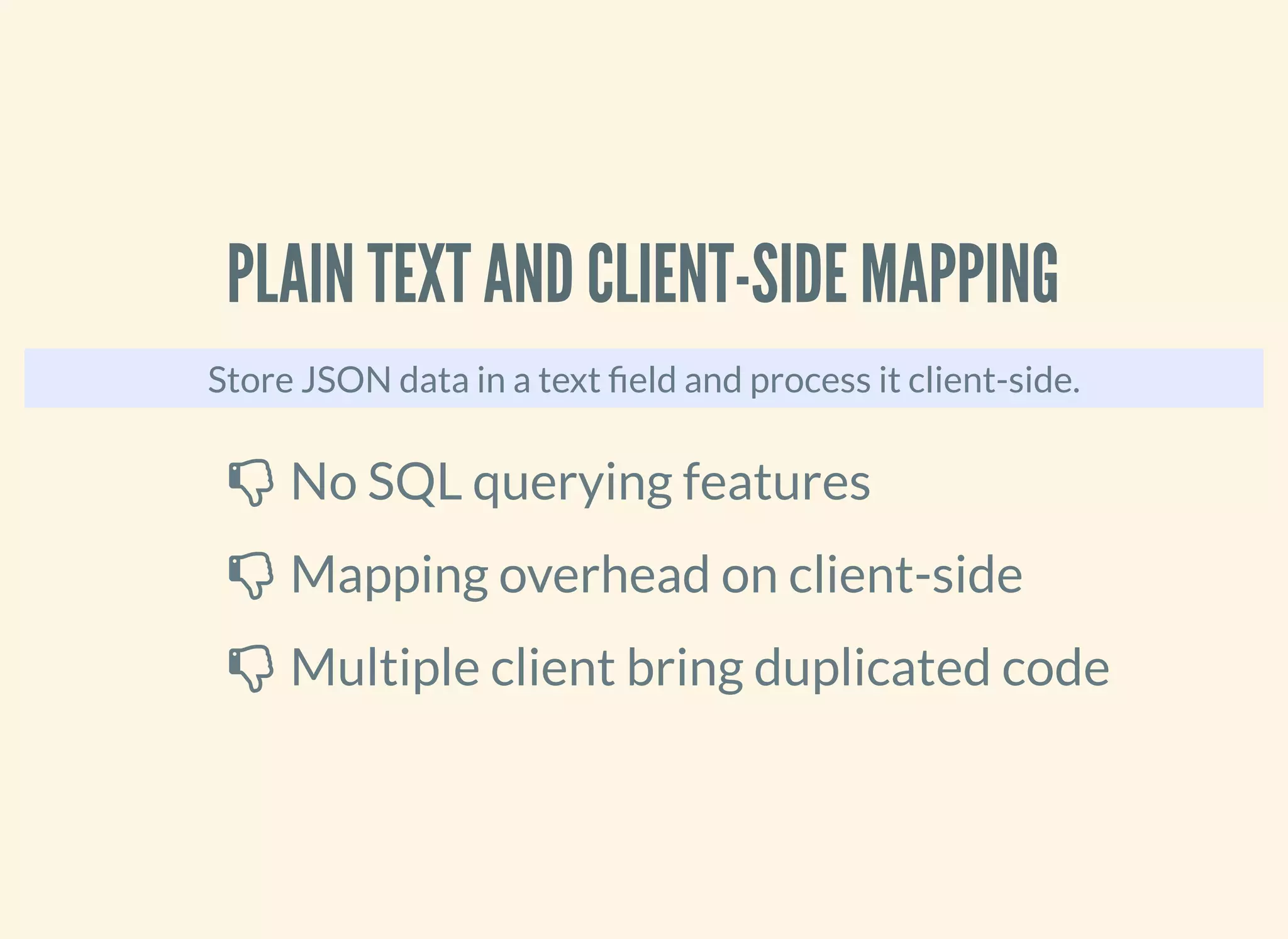
PLAIN TEXT AND CLIENT-SIDE MAPPING
Store JSON data in a text eld and process it client-side.
 No SQL querying features
 Mapping overhead on client-side
 Multiple client bring duplicated code
THE MODERN WAY
2013 and beyond
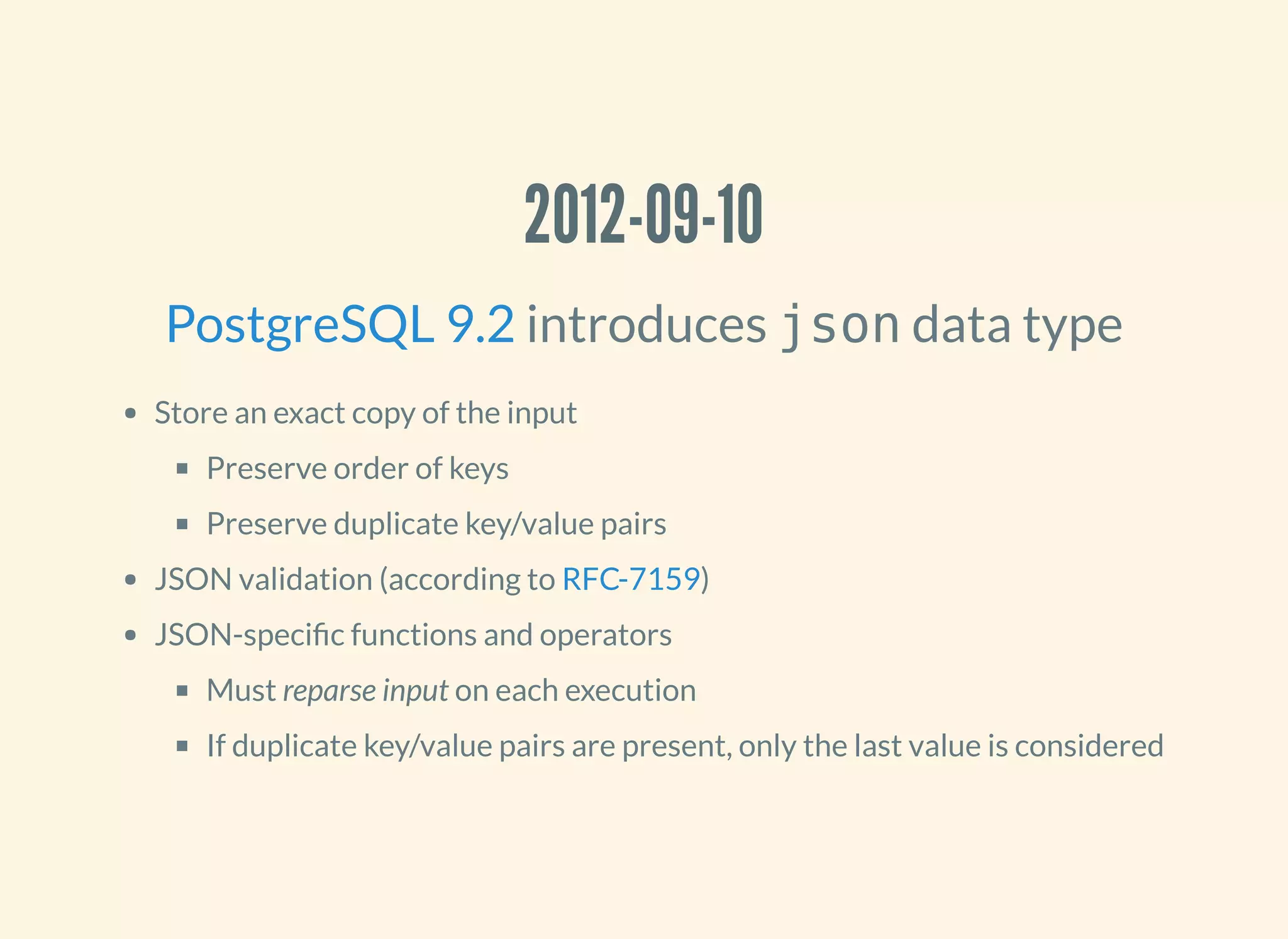
2012-09-10
introduces json data type
Store an exact copy of the input
Preserve order of keys
Preserve duplicate key/value pairs
JSON validation (according to )
JSON-speci c functions and operators
Must reparse input on each execution
If duplicate key/value pairs are present, only the last value is considered
PostgreSQL 9.2
RFC-7159
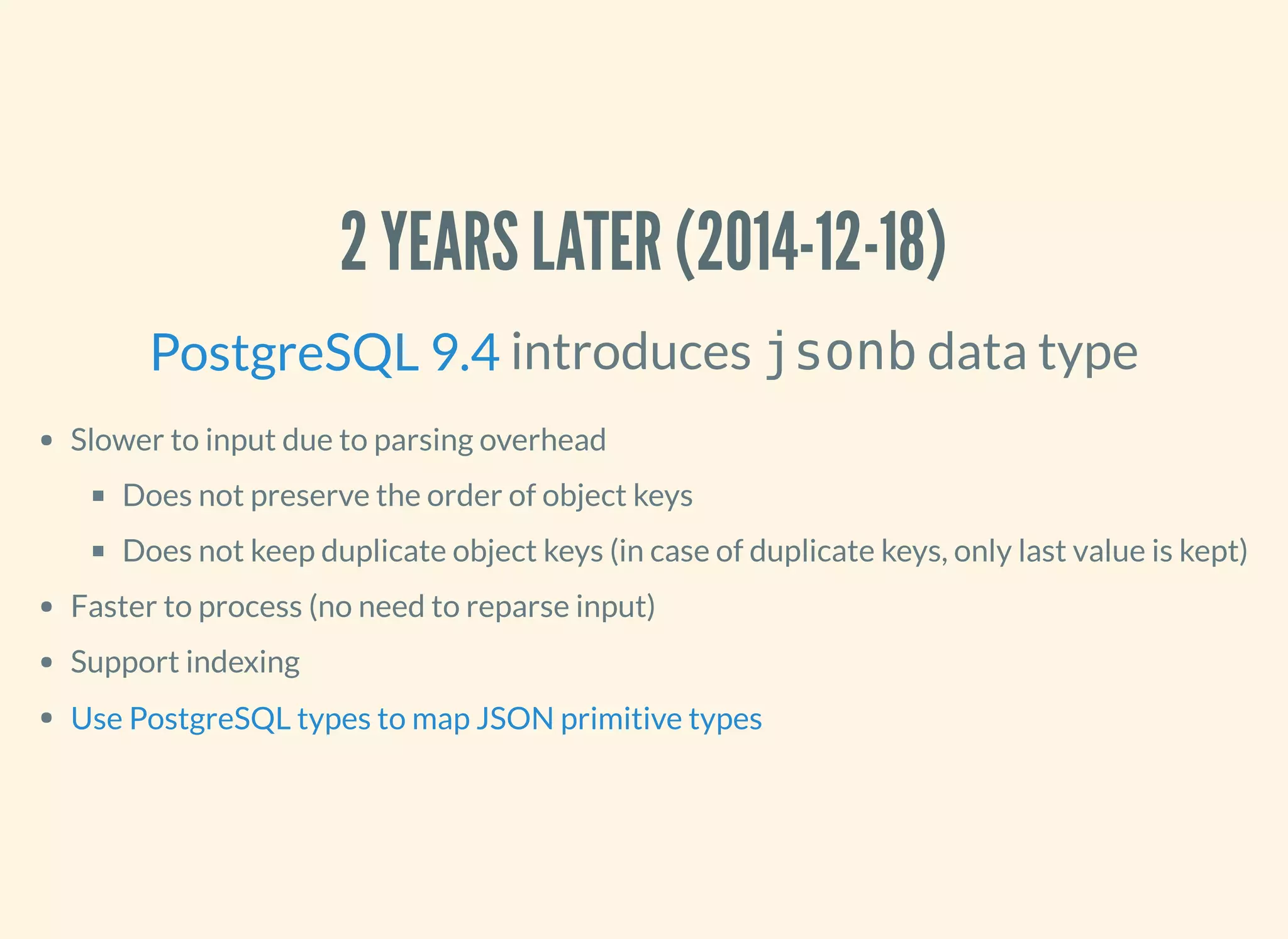
2 YEARS LATER (2014-12-18)
introduces jsonb data type
Slower to input due to parsing overhead
Does not preserve the order of object keys
Does not keep duplicate object keys (in case of duplicate keys, only last value is kept)
Faster to process (no need to reparse input)
Support indexing
PostgreSQL 9.4
Use PostgreSQL types to map JSON primitive types
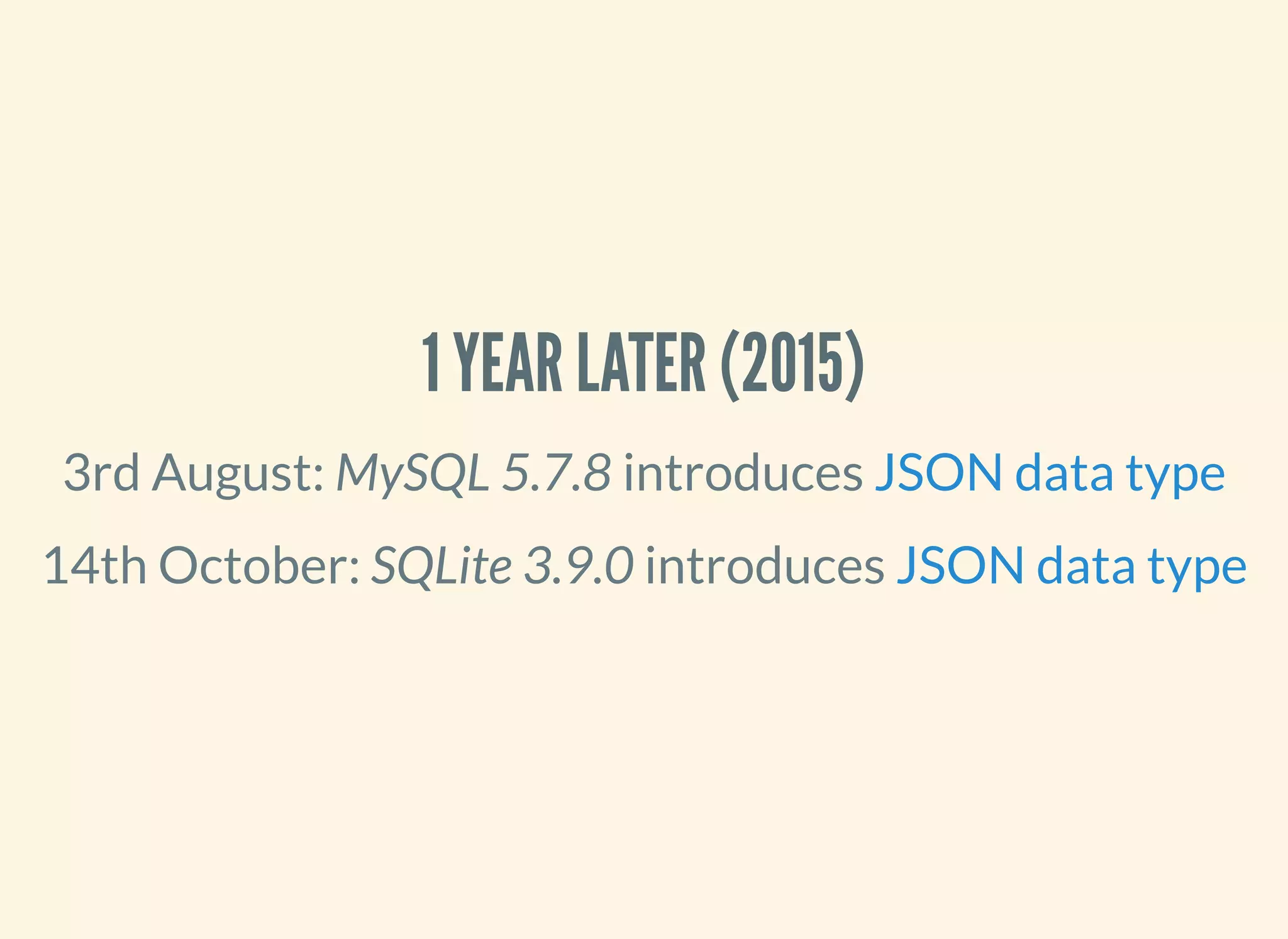
1 YEAR LATER (2015)
3rd August: MySQL 5.7.8 introduces
14th October: SQLite 3.9.0 introduces
JSON data type
JSON data type
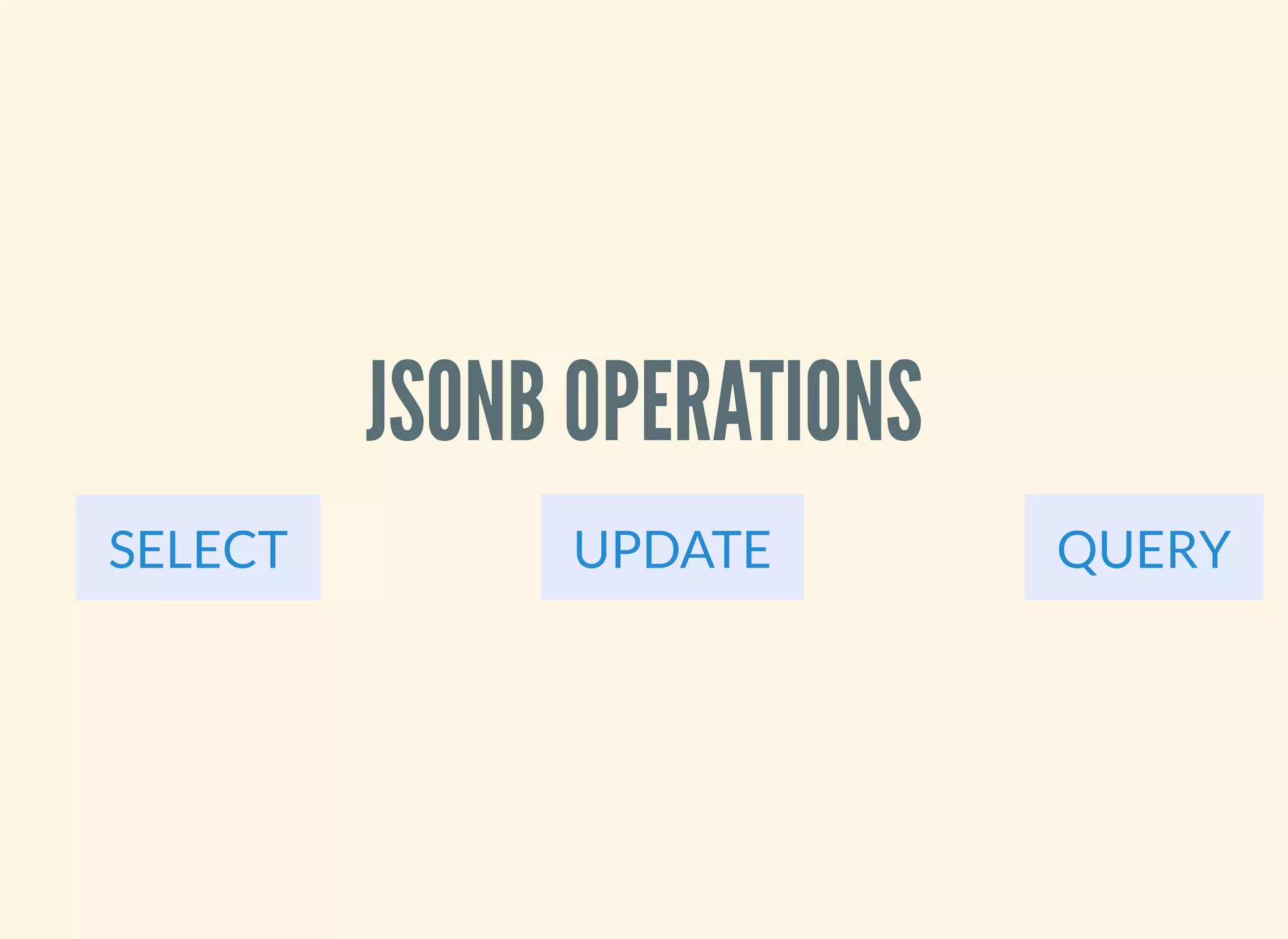
JSONB OPERATIONS
SELECT UPDATE QUERY
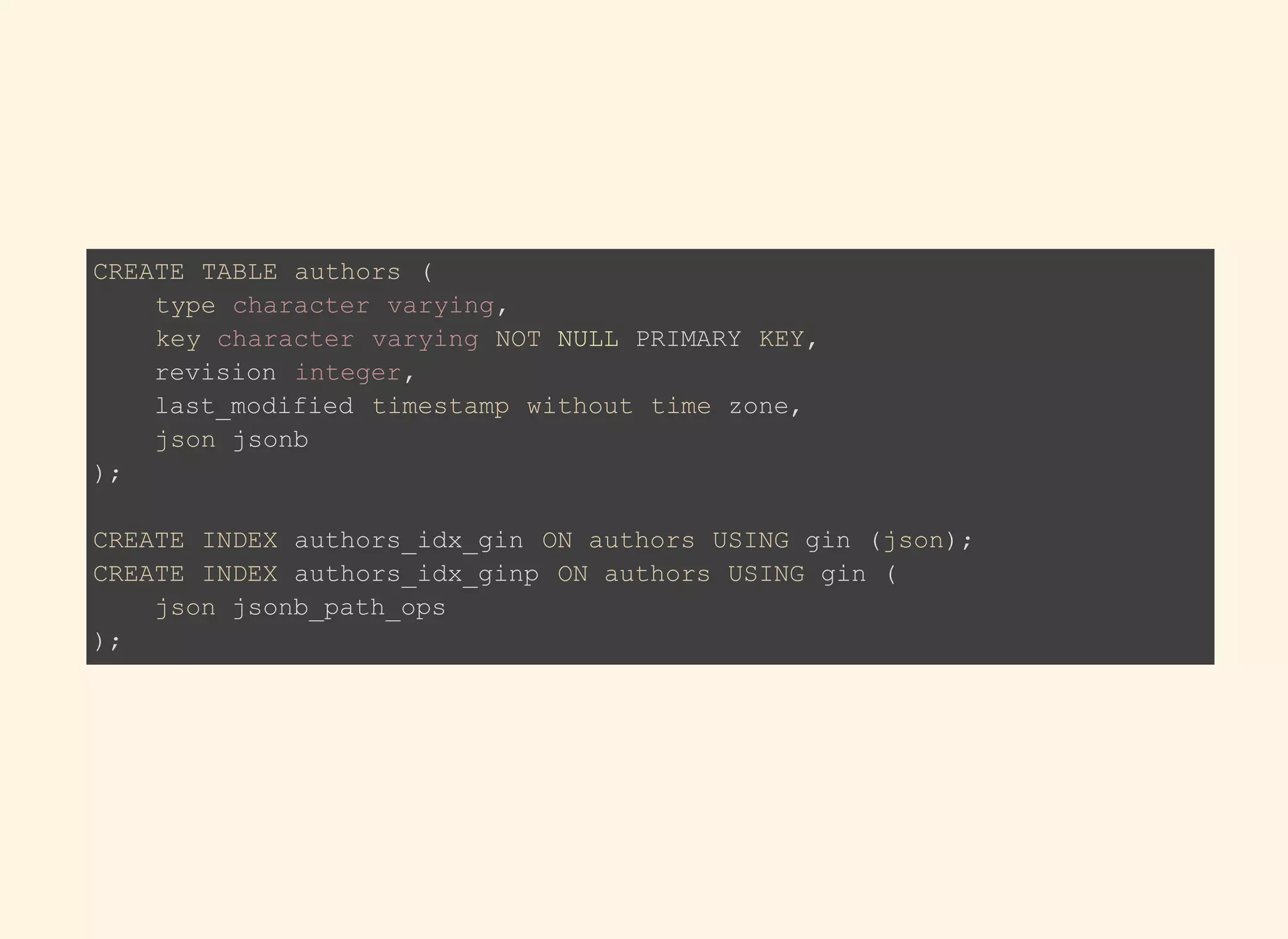
CREATE TABLE authors (
type character varying,
key character varying NOT NULL PRIMARY KEY,
revision integer,
last_modified timestamp without time zone,
json jsonb
);
CREATE INDEX authors_idx_gin ON authors USING gin (json);
CREATE INDEX authors_idx_ginp ON authors USING gin (
json jsonb_path_ops
);
{
"key": "/authors/OL2623297A",
"name": "Sir Arthur Conan Doyle" ,
"photos": [5541405],
"created": {
"type": "/type/datetime", "value": "2008-04-29T13:35:46.876380"
},
"remote_ids": {
"wikidata": "Q35610"
},
"last_modified": {
"type": "/type/datetime", "value": "2017-03-31T14:21:52.424685"
}
}
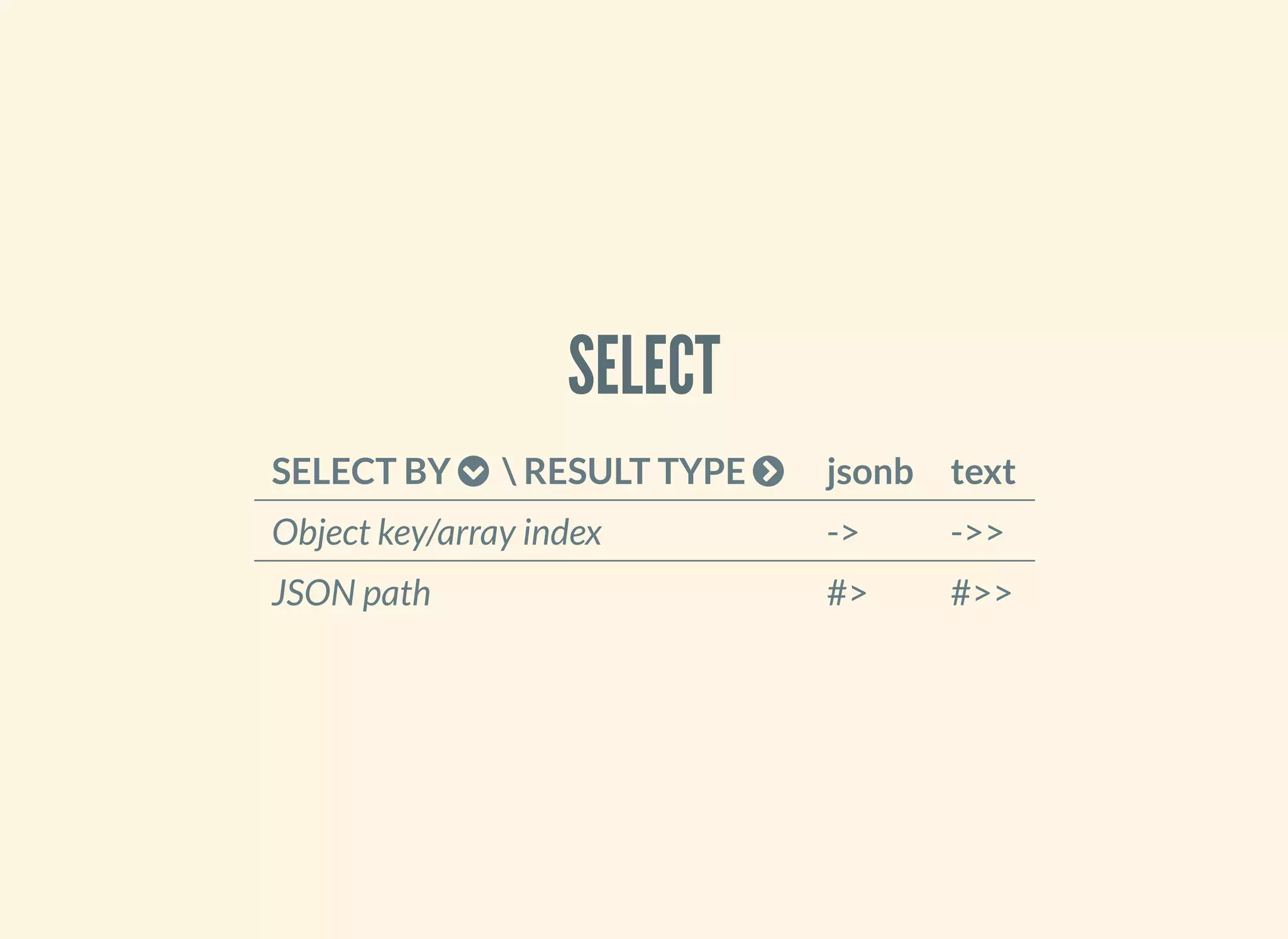
SELECT
SELECT BY   RESULT TYPE  jsonb text
Object key/array index -> ->>
JSON path #> #>>
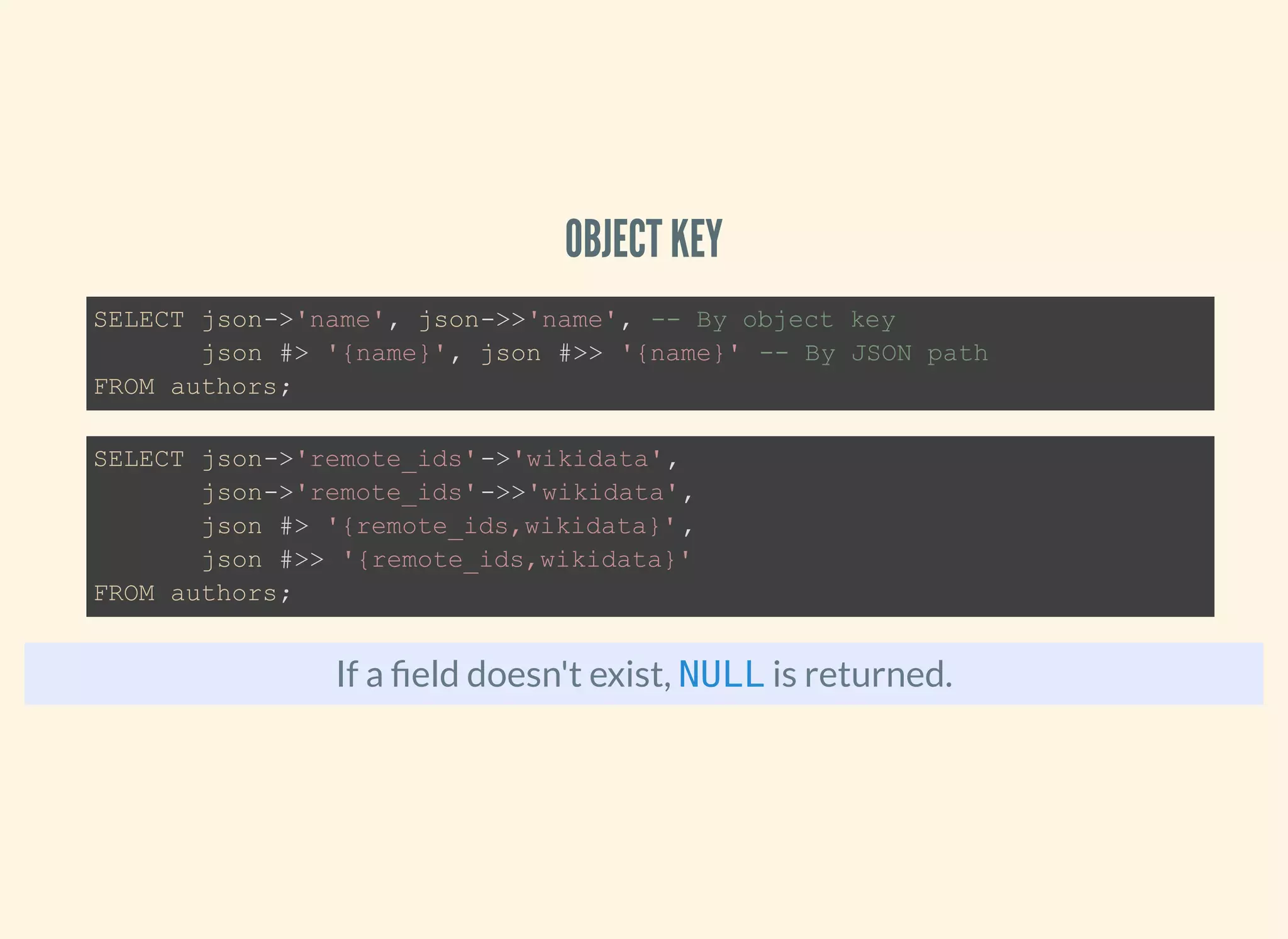
OBJECT KEY
If a eld doesn't exist, is returned.
SELECT json->'name', json->>'name', -- By object key
json #> '{name}', json #>> '{name}' -- By JSON path
FROM authors;
SELECT json->'remote_ids'->'wikidata',
json->'remote_ids'->>'wikidata',
json #> '{remote_ids,wikidata}',
json #>> '{remote_ids,wikidata}'
FROM authors;
NULL
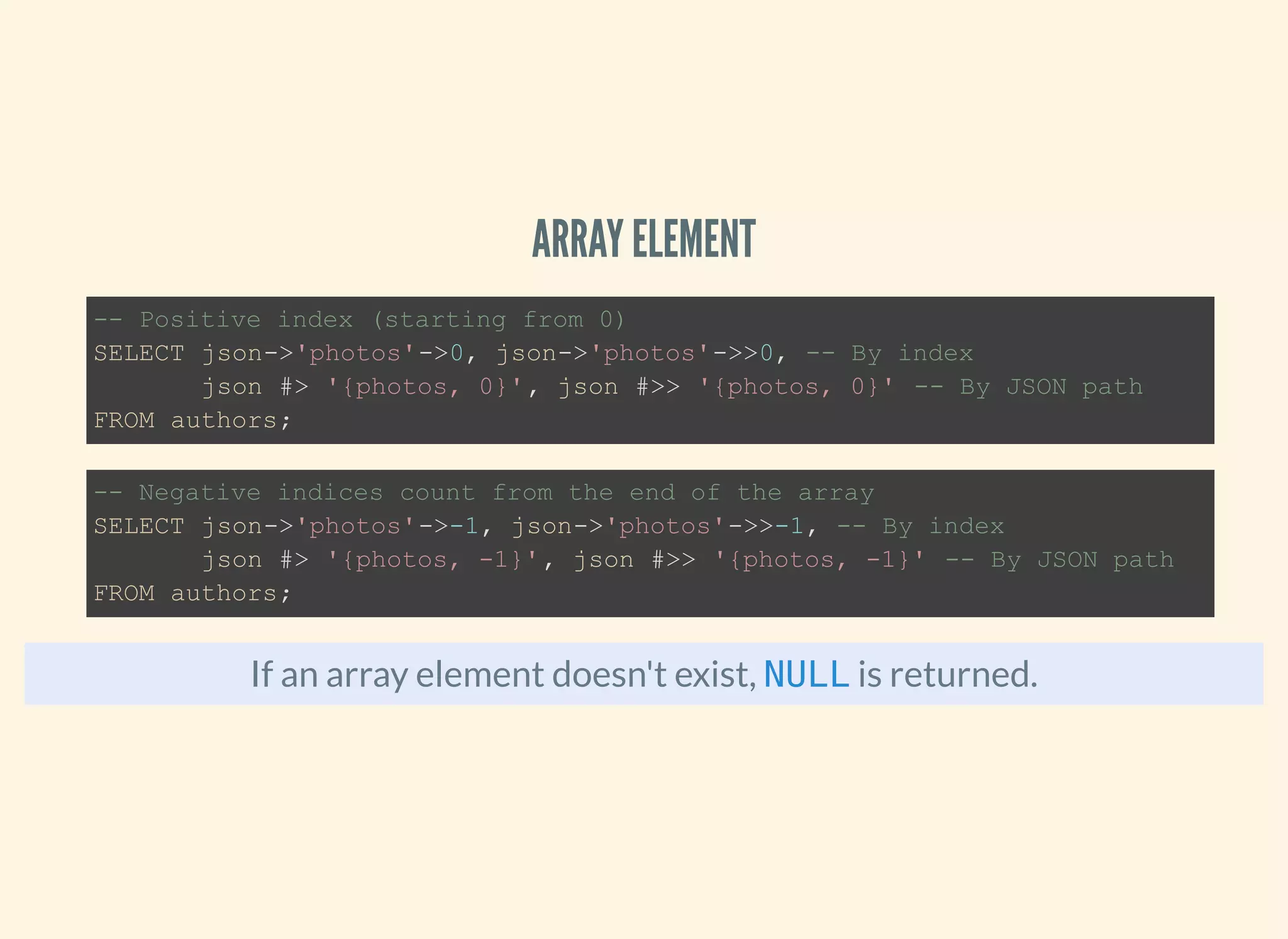
ARRAY ELEMENT
If an array element doesn't exist, is returned.
-- Positive index (starting from 0)
SELECT json->'photos'->0, json->'photos'->>0, -- By index
json #> '{photos, 0}', json #>> '{photos, 0}' -- By JSON path
FROM authors;
-- Negative indices count from the end of the array
SELECT json->'photos'->-1, json->'photos'->>-1, -- By index
json #> '{photos, -1}', json #>> '{photos, -1}' -- By JSON path
FROM authors;
NULL
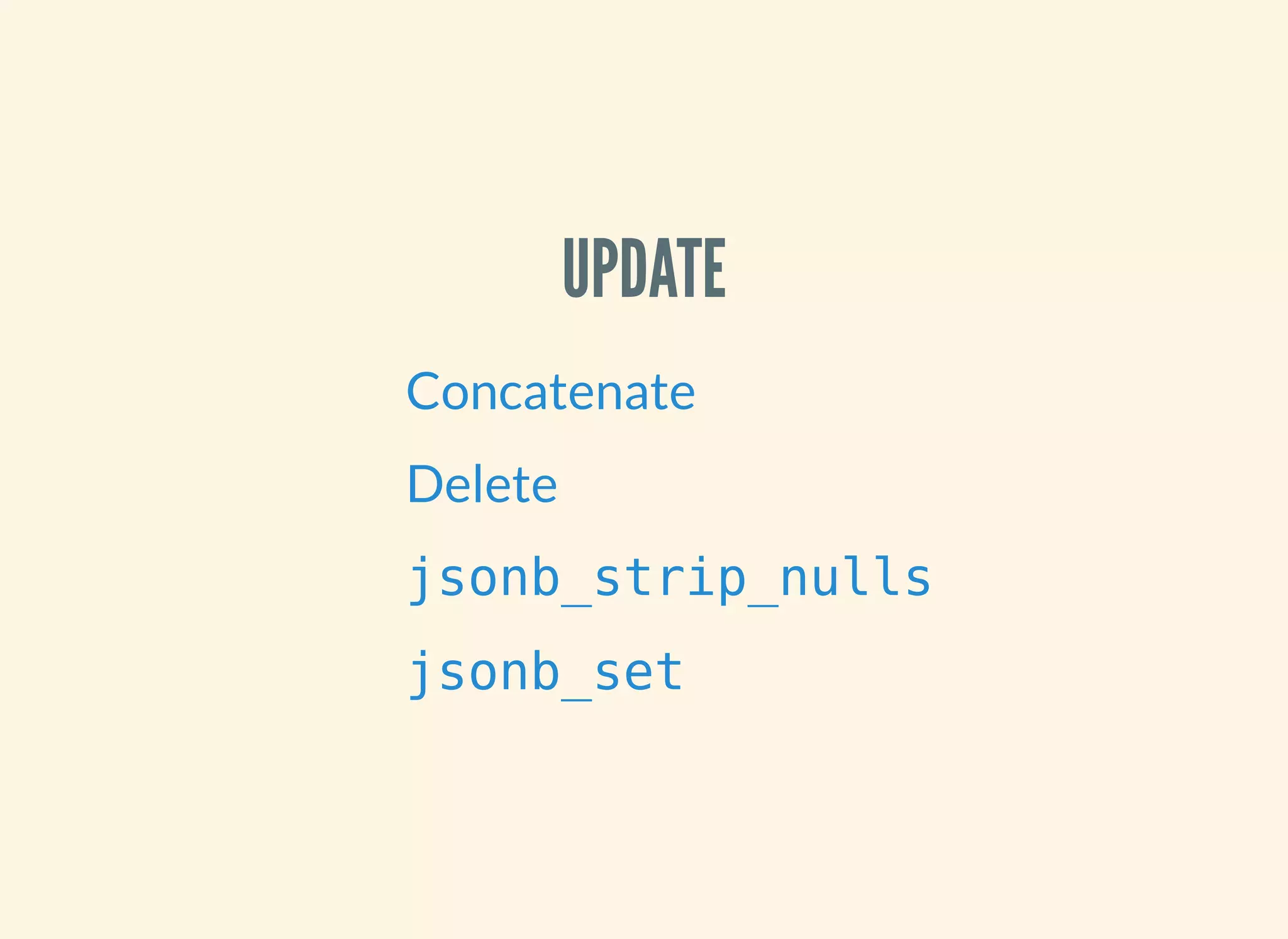
UPDATE
Concatenate
Delete
jsonb_strip_nulls
jsonb_set
CONCATENATE (||)
-- ARRAY
SELECT '["EUR", "USD"]'::jsonb || '"GBP"'::jsonb;
-- '["EUR", "USD", "GBP"]'
SELECT '["EUR", "USD"]'::jsonb || '{"GBP": "Pound Sterling"}' ::jsonb;
-- '["EUR", "USD", {"GBP": "Pound Sterling"}]'
SELECT '["EUR", "USD"]'::jsonb || '["GBP", "CAD"]'::jsonb;
-- '["EUR", "USD", "GBP", "CAD"]'
-- OBJECTS
-- If duplicate keys are found, only last value is kept
SELECT '{"EUR": "Euro", "USD": "United States Dollar"}' ::jsonb ||
'{"GBP": "Pound Sterling", "USD": "US Dollar"}' ::jsonb;
-- '{"EUR": "Euro", "GBP": "Pound Sterling", "USD": "US Dollar"}'
DELETE (-, #-)
-- OBJECT FIELD
SELECT '{"EUR": "Euro", "USD": "United States Dollar",
"GBP": "Pound Sterling"}' ::jsonb - 'USD', -- By key name
'{"EUR": "Euro", "USD": "United States Dollar",
"GBP": "Pound Sterling"}' ::jsonb #- '{"USD"}'; -- By key path
-- '{"EUR": "Euro", "GBP": "Pound Sterling"}'
-- ARRAY ELEMENT
SELECT '["EUR", "USD", "GBP"]'::jsonb - 1, -- '["EUR", "GBP"]'
'["EUR", "USD", "GBP"]'::jsonb #- '{1}', -- '["EUR", "GBP"]'
'["EUR", "USD", "GBP"]'::jsonb - -1, -- '["EUR", "USD"]'
'["EUR", "USD", "GBP"]'::jsonb #- '{-1}'; -- '["EUR", "USD"]'
JSONB_STRIP_NULLS(FROM_JSON)
Remove object elds with null value.
Has no effects on arrays with null elements.
SELECT jsonb_strip_nulls('{"EUR": "Euro", "GBP": null}' ::jsonb);
-- '{"EUR": "Euro"}'
SELECT jsonb_strip_nulls('["EUR", null, null, "CAD"]' ::jsonb);
-- '["EUR", null, null, "CAD"]'
JSONB_SET(TARGET, PATH, NEW_VALUE[, CREATE_IF_MISSING])
Update/insert a JSON value at given object path and/or array position.
SELECT jsonb_set(
'{"code": "EUR", "name": "Euro", "symbol": null}' , '{symbol}', '"€"'
); -- '{"code": "EUR", "name": "Euro", "symbol": "€"}'
SELECT jsonb_set(
'{"code": "EUR", "name": "Euro"}' , '{symbol}', '"€"'
); -- '{"code": "EUR", "name": "Euro", "symbol": "€"}'
SELECT jsonb_set(
'{"code": "EUR", "name": "Euro"}' , '{symbol}', '"€"', false
); -- '{"code": "EUR", "name": "Euro"}'
QUERY
Existence
Containment
Expansion
EXISTENCE (?, ?|, ?&)
Check if a string appears as an object key or array element at the top level.
-- ARRAY ELEMENTS
SELECT '["EUR", "USD", "GBP"]'::jsonb ? 'EUR'; -- true
SELECT '["EUR", "USD", "GBP"]'::jsonb ?| ARRAY['EUR', 'CAD']; -- true
SELECT '["EUR", "USD", "GBP"]'::jsonb ?& ARRAY['EUR', 'CAD']; -- false
-- Work only with elements on top-level array
SELECT '["EUR", ["USD", "GBP"]]' ::jsonb ? 'USD'; -- false
-- OBJECT KEYS
SELECT '{"EUR": "Euro", "USD": "United States Dollar", "GBP":
"Pound Sterling"}' ::jsonb ? 'EUR'; -- true
SELECT '{"EUR": "Euro", "USD": "United States Dollar", "GBP":
"Pound Sterling"}' ::jsonb ?| ARRAY['EUR', 'CAD']; -- true
SELECT '{"EUR": "Euro", "USD": "United States Dollar", "GBP":
"Pound Sterling"}' ::jsonb ?& ARRAY['EUR', 'CAD']; -- false
-- Work only with keys on top-level object
SELECT '{"currencies": {"EUR": "Euro", "USD": "United States Dollar",
"GBP": "Pound Sterling"}}' ::jsonb ? 'EUR'; -- false
CONTAINMENT (@>, <@)
-- PRIMITIVE TYPES
-- Check absolute equality
SELECT '"EUR"'::jsonb @> '"EUR"'::jsonb; -- true
SELECT '"EUR"'::jsonb @> '"GBP"'::jsonb; -- false
-- ARRAYS
-- Order of elements is ignored
-- Duplicate elements are considered only once
SELECT '["EUR", "GBP", "USD"]'::jsonb
@> '["GBP", "EUR", "EUR"]'::jsonb; -- true
SELECT '["EUR", "GBP", "USD"]'::jsonb @> '"EUR"'::jsonb; -- true
SELECT '["EUR", "GBP", "USD"]'::jsonb @> '"CAD"'::jsonb; -- false
-- OBJECTS
-- Structure and data contents must both match
SELECT '{"id": 12345, "name": "Nicola", "surname": "Moretto"}' ::jsonb
@> '{"name": "Nicola"}'; -- true
SELECT '{"id": 12345, "name": "Nicola", "surname": "Moretto"}' ::jsonb
@> '{"name": "Francesco"}'; -- false
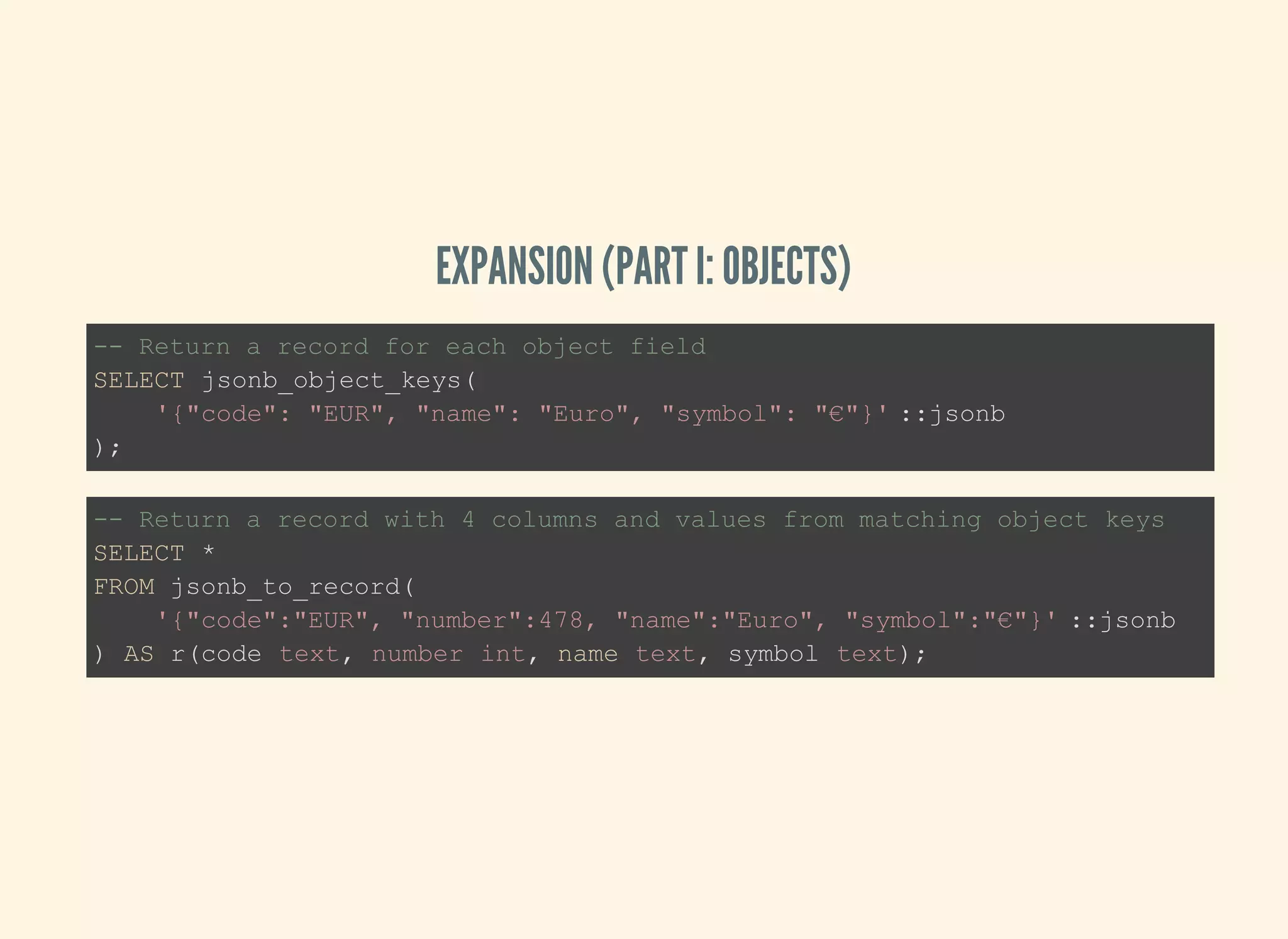
EXPANSION (PART I: OBJECTS)
-- Return a record for each object field
SELECT jsonb_object_keys(
'{"code": "EUR", "name": "Euro", "symbol": "€"}' ::jsonb
);
-- Return a record with 4 columns and values from matching object keys
SELECT *
FROM jsonb_to_record(
'{"code":"EUR", "number":478, "name":"Euro", "symbol":"€"}' ::jsonb
) AS r(code text, number int, name text, symbol text);
EXPANSION (PART II: ARRAYS)
-- Return a record for each array element (as jsonb or text)
SELECT jsonb_array_elements('["EUR", "GBP", "CAD", "USD"]' ::jsonb),
jsonb_array_elements_text( '["EUR", "GBP", "CAD", "USD"]' ::jsonb);
-- Return for each object a record with two columns (code and name)
-- and values from matching object fields
SELECT *
FROM jsonb_to_recordset('[
{"code": "GBP", "name": "Pound Sterling", "symbol": "£"},
{"code": "EUR", "name": "Euro", "symbol": "€"},
{"code": "USD", "name": "United States Dollar", "symbol": "$"}
]'::jsonb) AS c(code text, name text)
ORDER BY code ASC; -- Sort records by currency ISO code
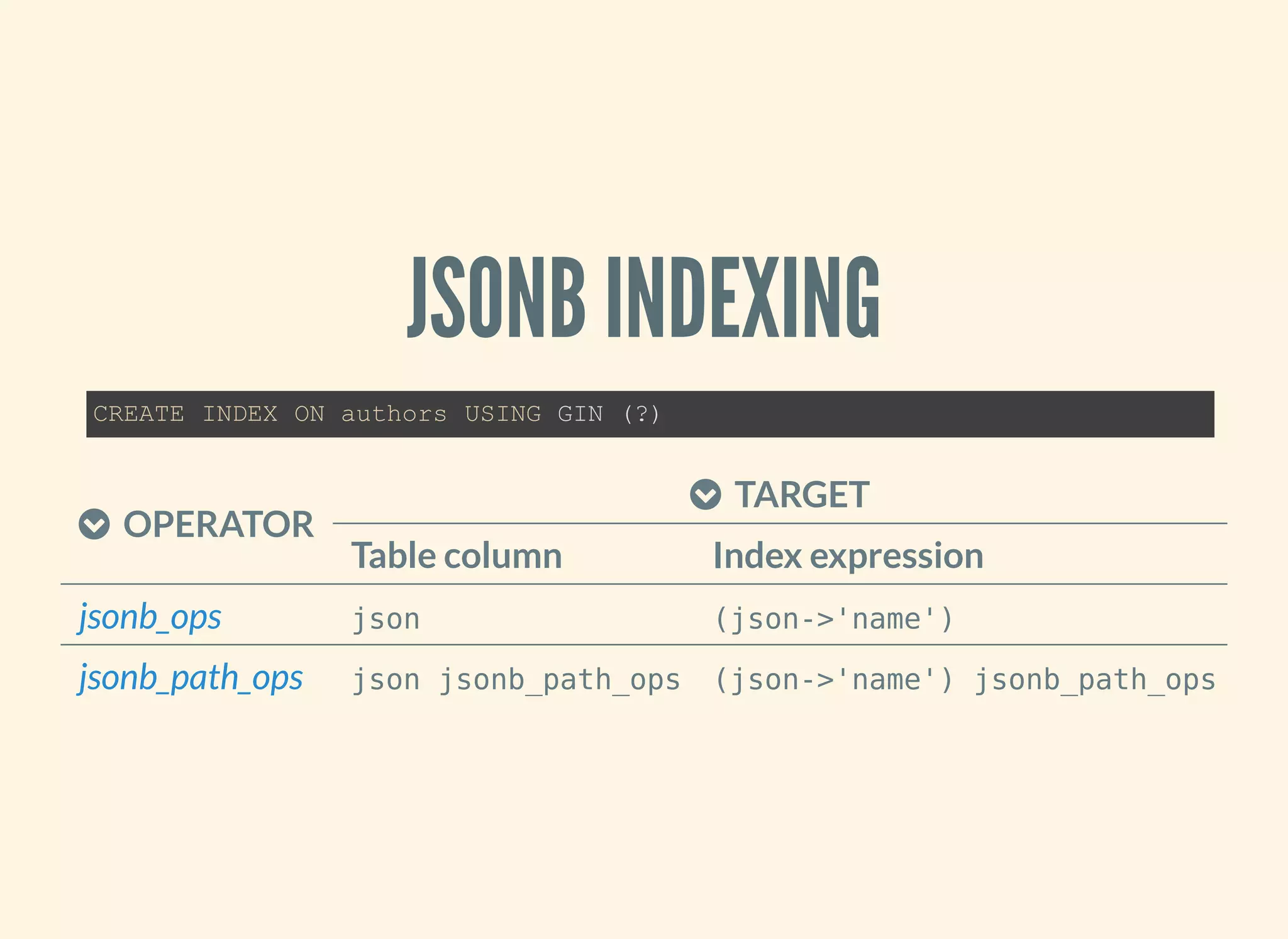
JSONB INDEXING
 OPERATOR
 TARGET
Table column Index expression
json (json->'name')
json jsonb_path_ops (json->'name') jsonb_path_ops
CREATE INDEX ON authors USING GIN (?)
jsonb_ops
jsonb_path_ops
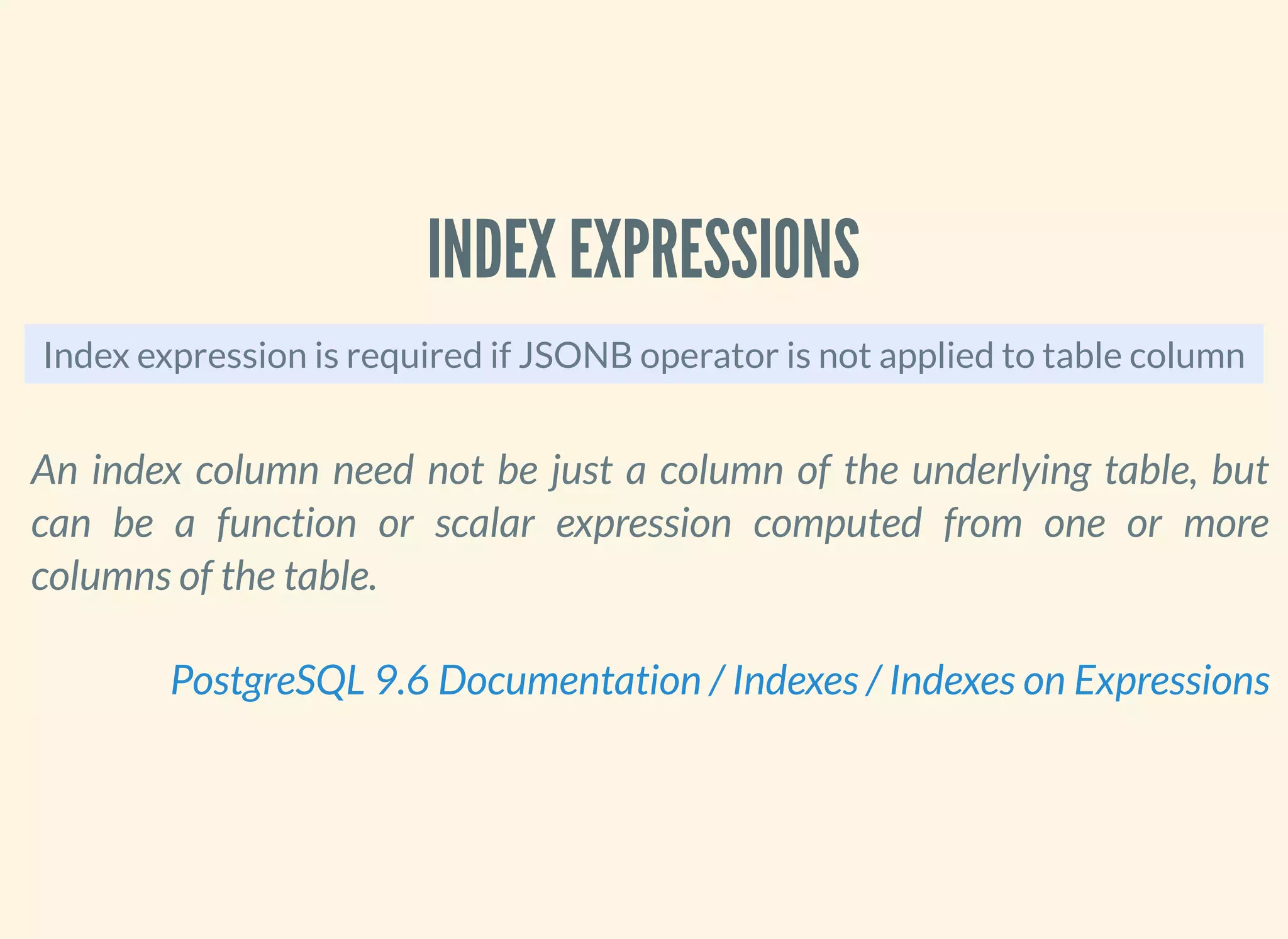
INDEX EXPRESSIONS
Index expression is required if JSONB operator is not applied to table column
An index column need not be just a column of the underlying table, but
can be a function or scalar expression computed from one or more
columns of the table.
PostgreSQL 9.6 Documentation / Indexes / Indexes on Expressions
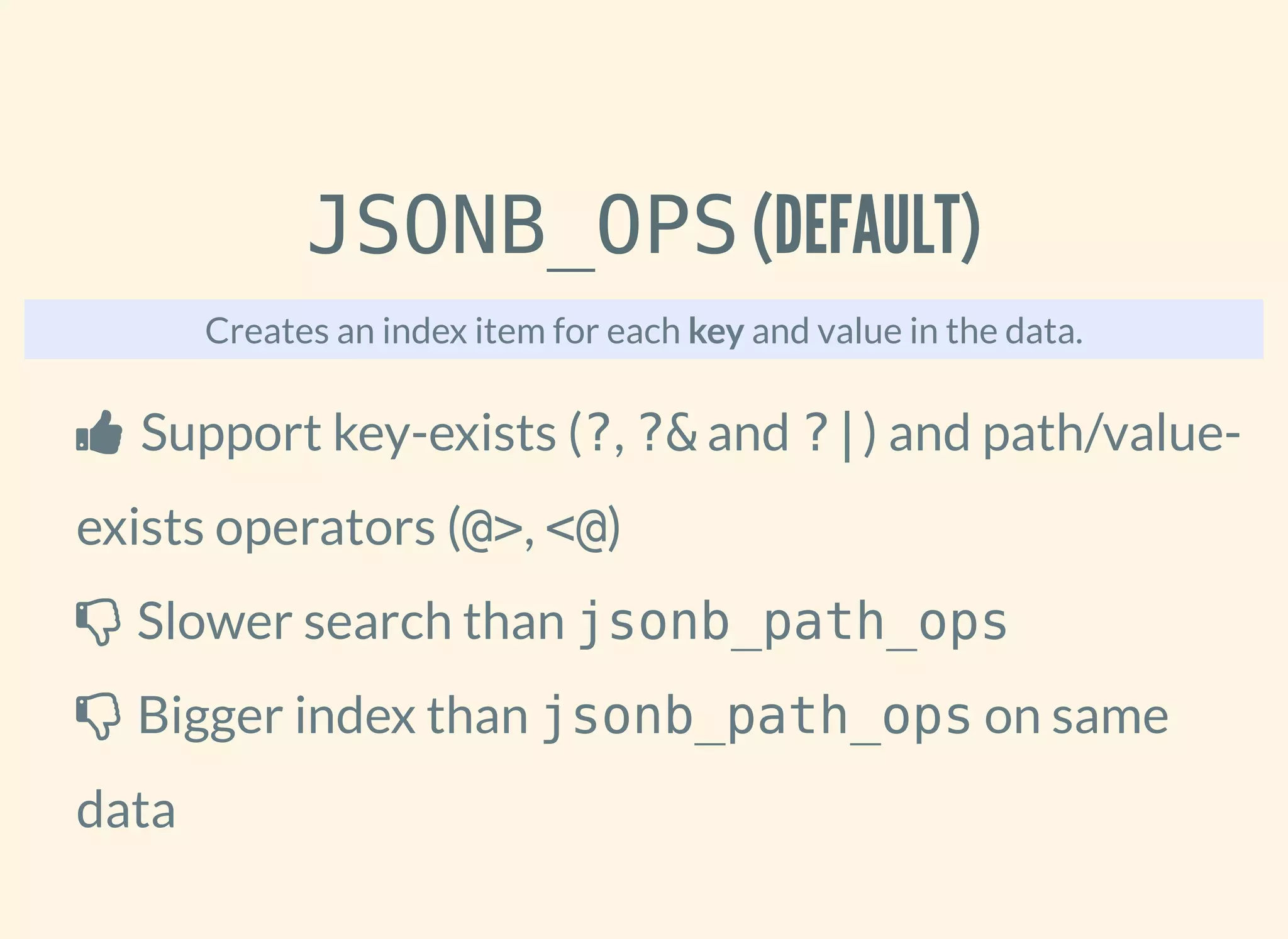
JSONB_OPS (DEFAULT)
Creates an index item for each key and value in the data.
 Support key-exists (?, ?& and ?|) and path/value-
exists operators (@>, <@)
 Slower search than jsonb_path_ops
 Bigger index than jsonb_path_ops on same
data
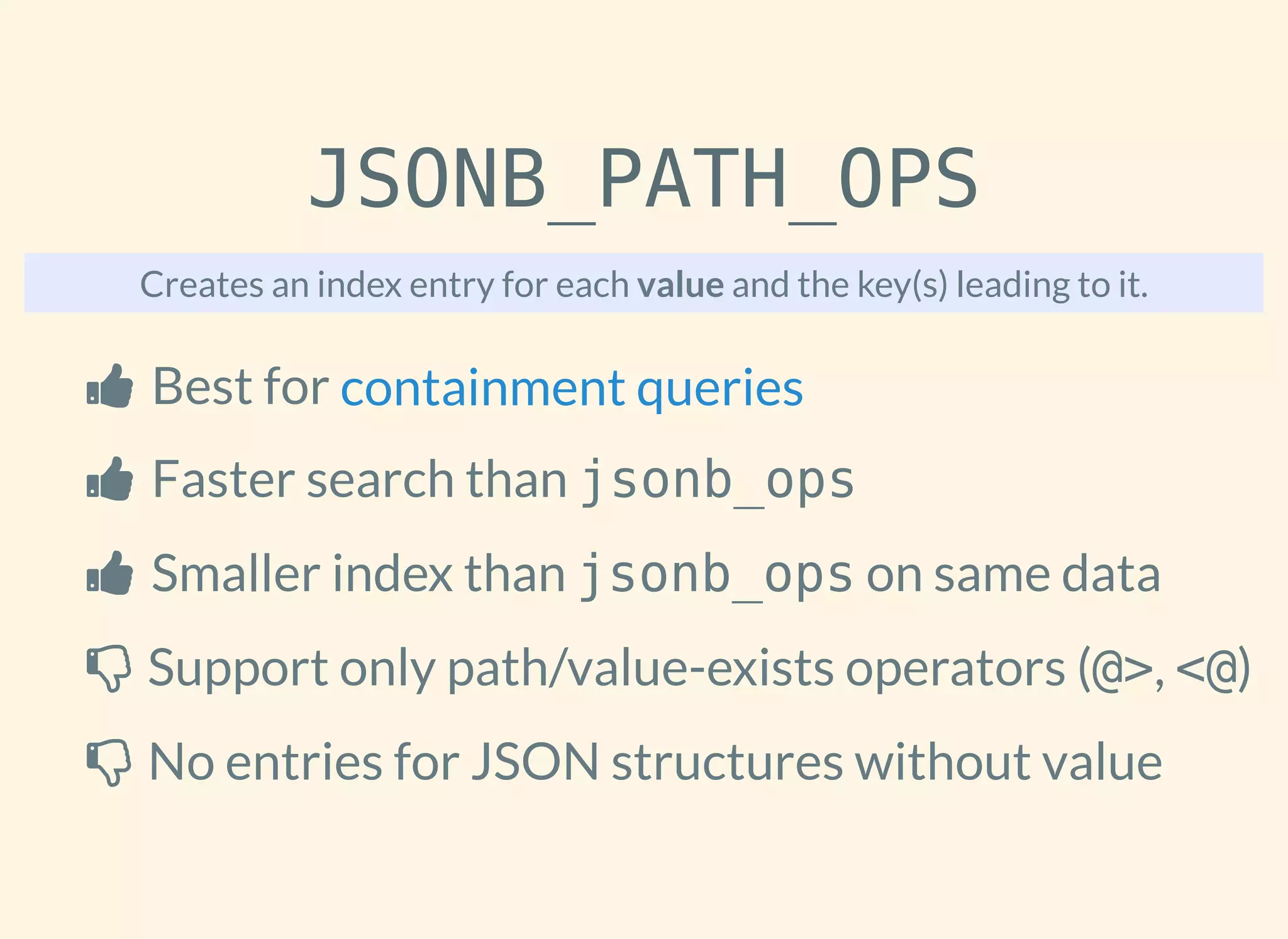
JSONB_PATH_OPS
Creates an index entry for each value and the key(s) leading to it.
 Best for
 Faster search than jsonb_ops
 Smaller index than jsonb_ops on same data
 Support only path/value-exists operators (@>, <@)
 No entries for JSON structures without value
containment queries
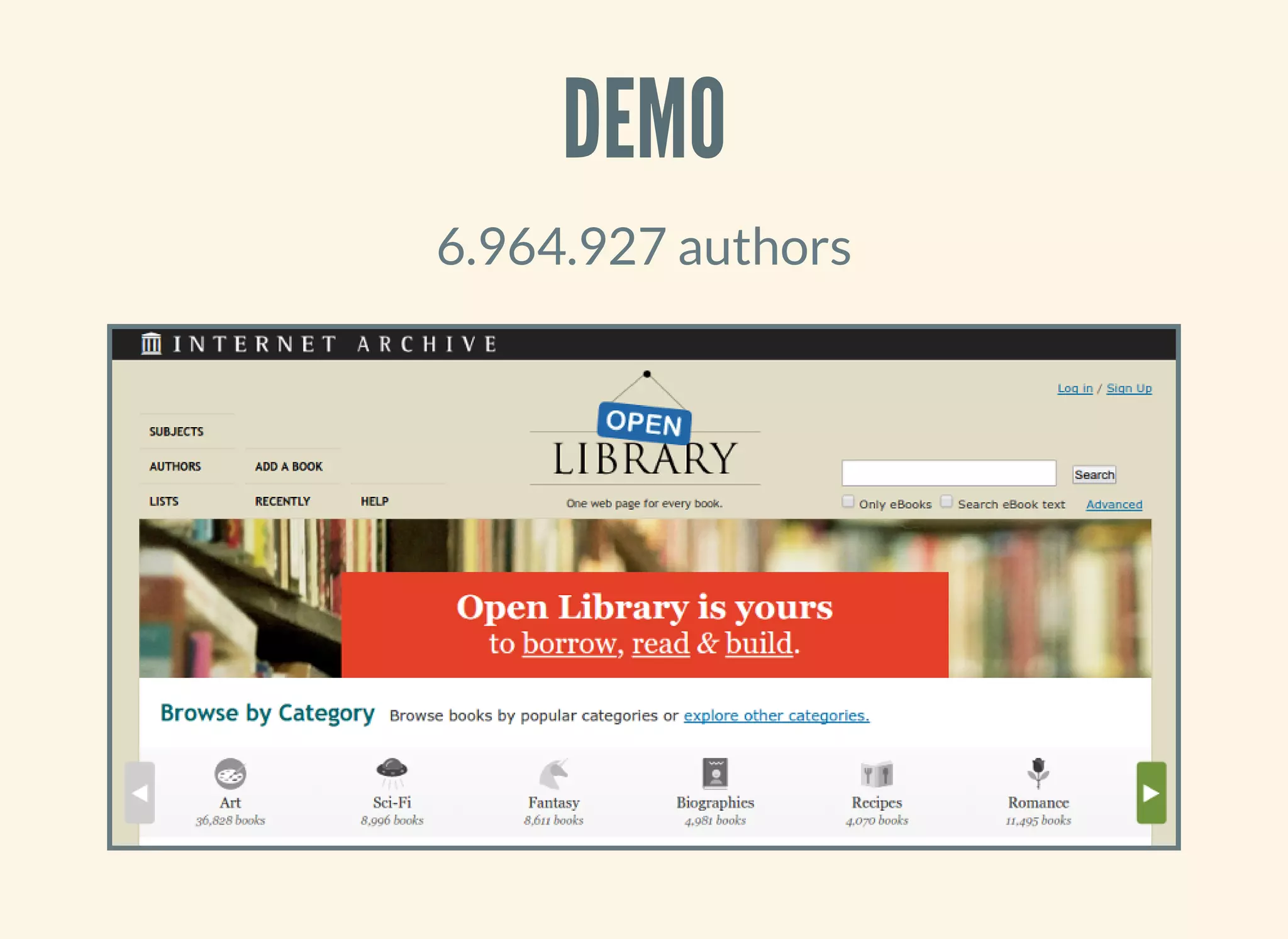
DEMO
6.964.927 authors
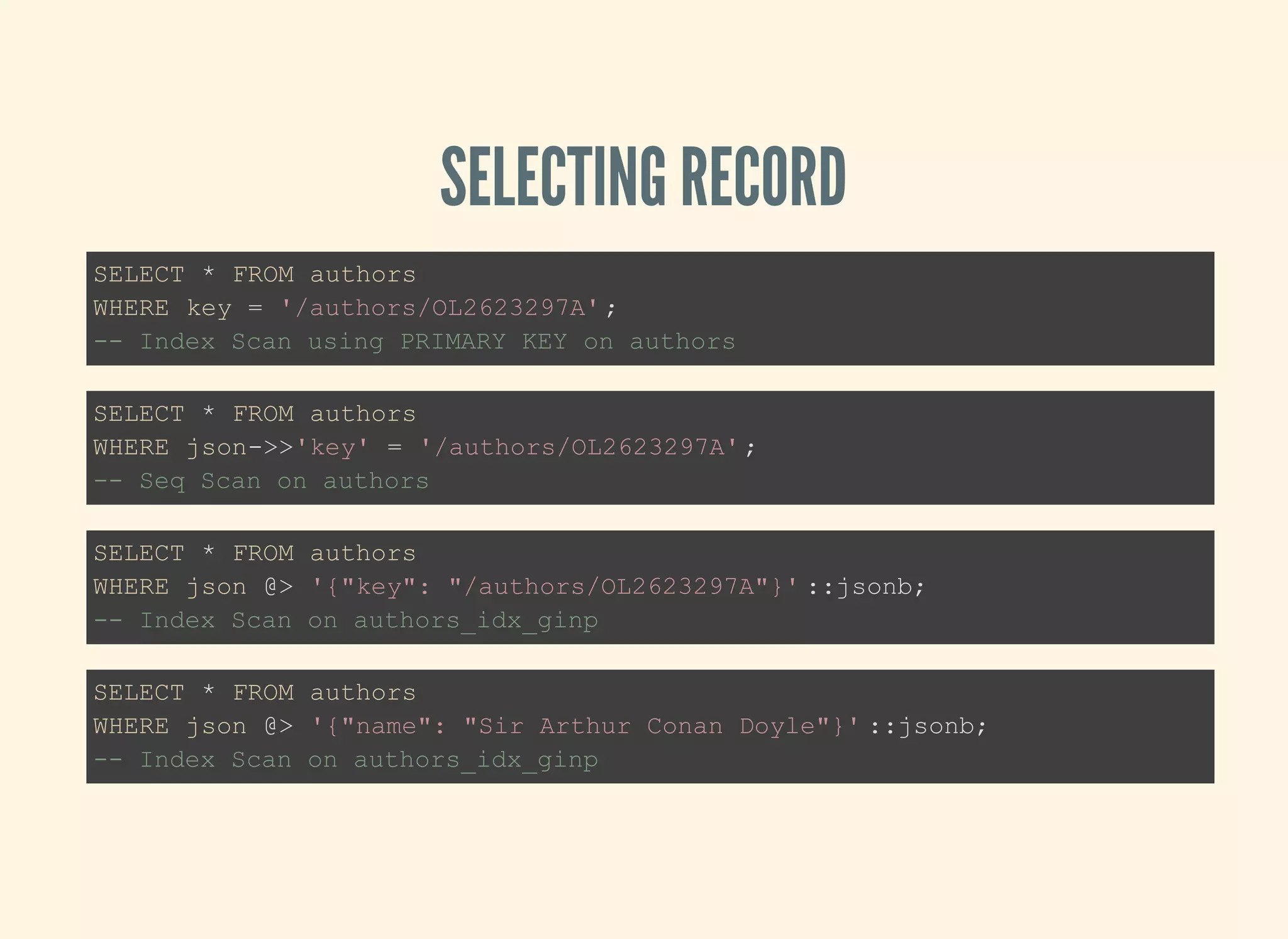
SELECTING RECORD
SELECT * FROM authors
WHERE key = '/authors/OL2623297A';
-- Index Scan using PRIMARY KEY on authors
SELECT * FROM authors
WHERE json->>'key' = '/authors/OL2623297A';
-- Seq Scan on authors
SELECT * FROM authors
WHERE json @> '{"key": "/authors/OL2623297A"}' ::jsonb;
-- Index Scan on authors_idx_ginp
SELECT * FROM authors
WHERE json @> '{"name": "Sir Arthur Conan Doyle"}' ::jsonb;
-- Index Scan on authors_idx_ginp
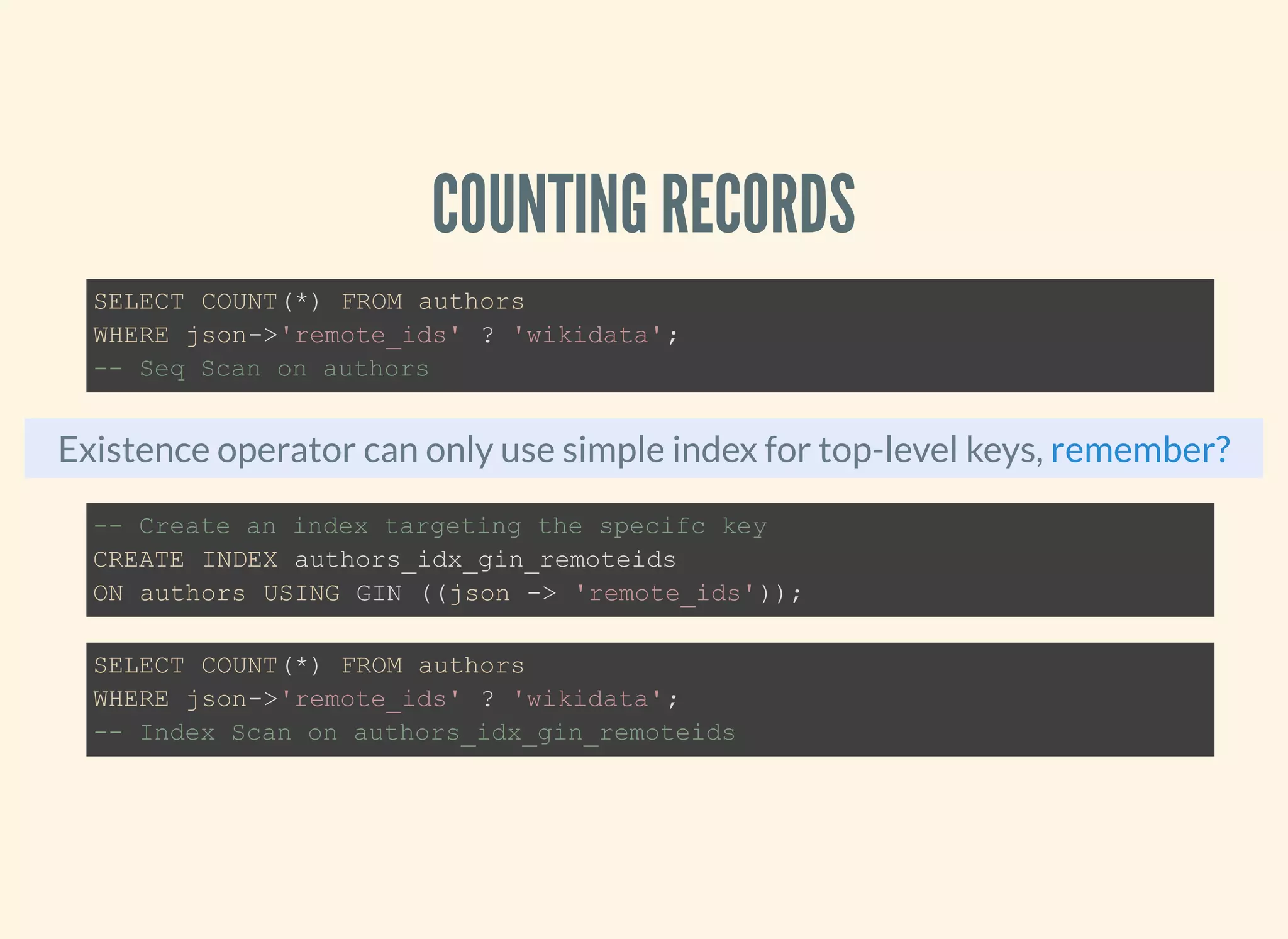
COUNTING RECORDS
Existence operator can only use simple index for top-level keys,
SELECT COUNT(*) FROM authors
WHERE json->'remote_ids' ? 'wikidata';
-- Seq Scan on authors
remember?
-- Create an index targeting the specifc key
CREATE INDEX authors_idx_gin_remoteids
ON authors USING GIN ((json -> 'remote_ids'));
SELECT COUNT(*) FROM authors
WHERE json->'remote_ids' ? 'wikidata';
-- Index Scan on authors_idx_gin_remoteids
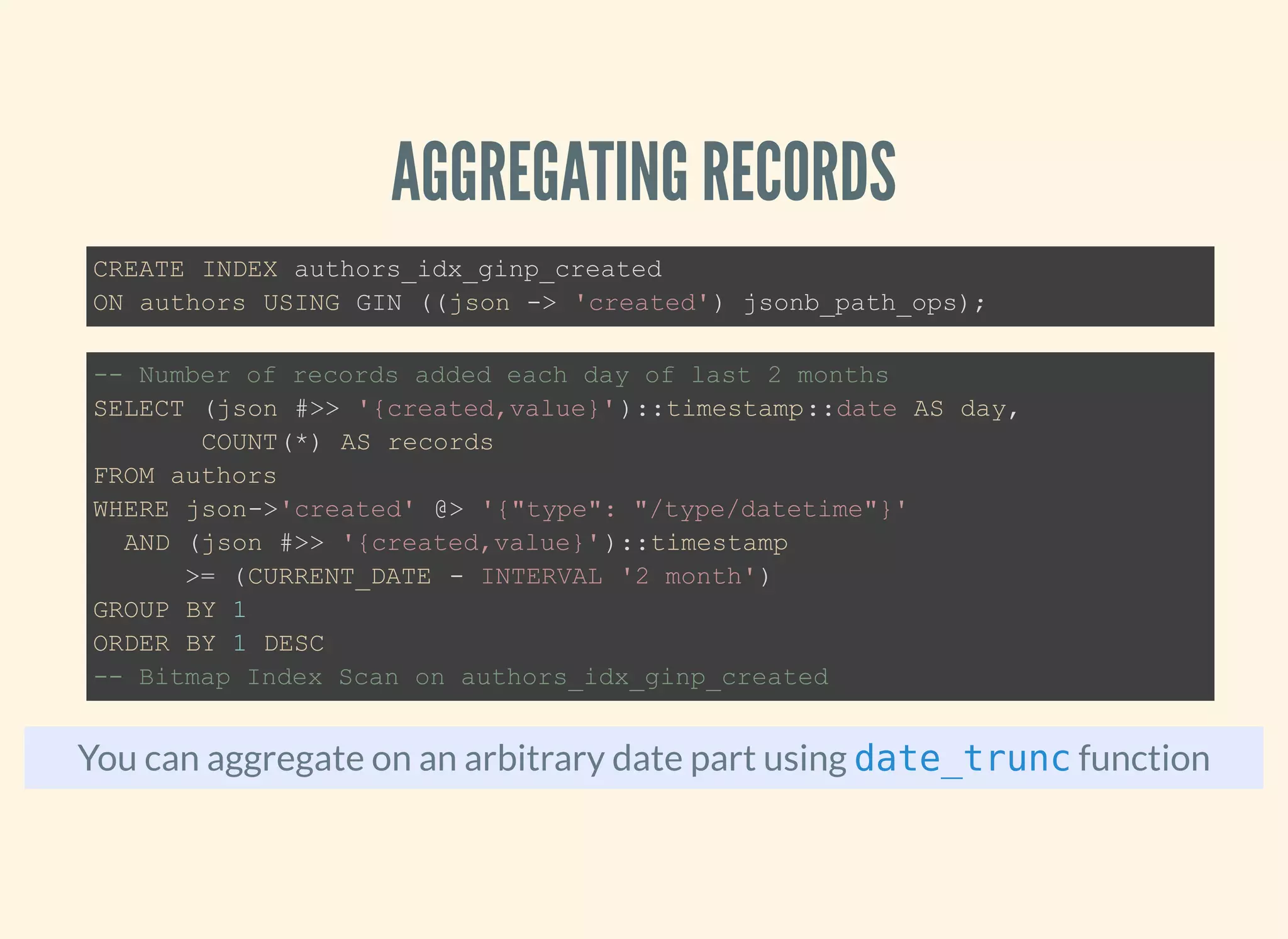
AGGREGATING RECORDS
You can aggregate on an arbitrary date part using function
CREATE INDEX authors_idx_ginp_created
ON authors USING GIN ((json -> 'created') jsonb_path_ops);
-- Number of records added each day of last 2 months
SELECT (json #>> '{created,value}')::timestamp::date AS day,
COUNT(*) AS records
FROM authors
WHERE json->'created' @> '{"type": "/type/datetime"}'
AND (json #>> '{created,value}')::timestamp
>= (CURRENT_DATE - INTERVAL '2 month')
GROUP BY 1
ORDER BY 1 DESC
-- Bitmap Index Scan on authors_idx_ginp_created
date_trunc
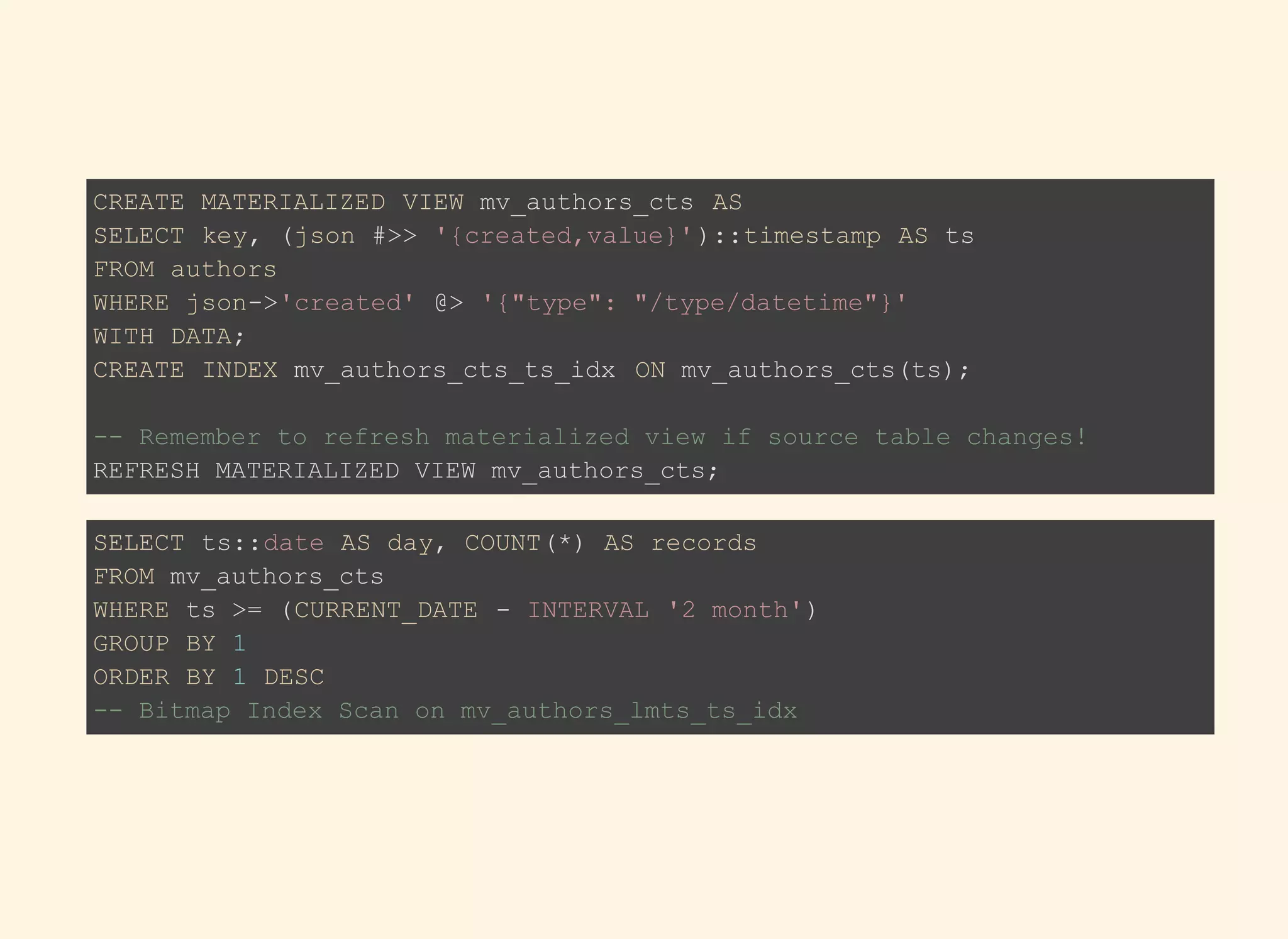
CREATE MATERIALIZED VIEW mv_authors_cts AS
SELECT key, (json #>> '{created,value}')::timestamp AS ts
FROM authors
WHERE json->'created' @> '{"type": "/type/datetime"}'
WITH DATA;
CREATE INDEX mv_authors_cts_ts_idx ON mv_authors_cts(ts);
-- Remember to refresh materialized view if source table changes!
REFRESH MATERIALIZED VIEW mv_authors_cts;
SELECT ts::date AS day, COUNT(*) AS records
FROM mv_authors_cts
WHERE ts >= (CURRENT_DATE - INTERVAL '2 month')
GROUP BY 1
ORDER BY 1 DESC
-- Bitmap Index Scan on mv_authors_lmts_ts_idx
Thank you!
Full presentation and curated links on GitHub
 Nicola Moretto
 n.moretto@nicolamoretto.eu
 nicola88 (GitHub)
 nicola88 (BitBucket)

Postgre(No)SQL - A JSON journey

  • 1.
  • 2.
    WHY USING JSON Flexibleschema (≠ destructured) , , … Data denormalization Avoid complex joins and reduce number of queries (e.g. EAV model) Native JSON documents storage JSON responses from REST APIs Open Library Wikidata
  • 3.
    THE OLD WAY BeforeNoSQL and native JSON
  • 4.
    EAV (ENTITY-ATTRIBUTE-VALUE) MODEL Onetable contains the entities, another table contains the names of the properties (attributes) and a third table links the entities with their attributes and holds the value. This gives you the exibility for having different sets of properties […]. Selecting one or more entities based on 1 attribute value requires 2 joins […]. Also, the properties usually are all stored as strings, which results in type casting, both for the result as for the WHERE clause. JSONB has potential for greatly simplifying schema design without sacri cing query performance. via Replacing EAV with JSONB in PostgreSQL Wikipedia / Entity–attribute–value model
  • 5.
    PLAIN TEXT ANDCLIENT-SIDE MAPPING Store JSON data in a text eld and process it client-side.  No SQL querying features  Mapping overhead on client-side  Multiple client bring duplicated code
  • 6.
  • 7.
    2012-09-10 introduces json datatype Store an exact copy of the input Preserve order of keys Preserve duplicate key/value pairs JSON validation (according to ) JSON-speci c functions and operators Must reparse input on each execution If duplicate key/value pairs are present, only the last value is considered PostgreSQL 9.2 RFC-7159
  • 8.
    2 YEARS LATER(2014-12-18) introduces jsonb data type Slower to input due to parsing overhead Does not preserve the order of object keys Does not keep duplicate object keys (in case of duplicate keys, only last value is kept) Faster to process (no need to reparse input) Support indexing PostgreSQL 9.4 Use PostgreSQL types to map JSON primitive types
  • 9.
    1 YEAR LATER(2015) 3rd August: MySQL 5.7.8 introduces 14th October: SQLite 3.9.0 introduces JSON data type JSON data type
  • 10.
  • 11.
    CREATE TABLE authors( type character varying, key character varying NOT NULL PRIMARY KEY, revision integer, last_modified timestamp without time zone, json jsonb ); CREATE INDEX authors_idx_gin ON authors USING gin (json); CREATE INDEX authors_idx_ginp ON authors USING gin ( json jsonb_path_ops );
  • 12.
    { "key": "/authors/OL2623297A", "name": "SirArthur Conan Doyle" , "photos": [5541405], "created": { "type": "/type/datetime", "value": "2008-04-29T13:35:46.876380" }, "remote_ids": { "wikidata": "Q35610" }, "last_modified": { "type": "/type/datetime", "value": "2017-03-31T14:21:52.424685" } }
  • 13.
    SELECT SELECT BY  RESULT TYPE  jsonb text Object key/array index -> ->> JSON path #> #>>
  • 14.
    OBJECT KEY If aeld doesn't exist, is returned. SELECT json->'name', json->>'name', -- By object key json #> '{name}', json #>> '{name}' -- By JSON path FROM authors; SELECT json->'remote_ids'->'wikidata', json->'remote_ids'->>'wikidata', json #> '{remote_ids,wikidata}', json #>> '{remote_ids,wikidata}' FROM authors; NULL
  • 15.
    ARRAY ELEMENT If anarray element doesn't exist, is returned. -- Positive index (starting from 0) SELECT json->'photos'->0, json->'photos'->>0, -- By index json #> '{photos, 0}', json #>> '{photos, 0}' -- By JSON path FROM authors; -- Negative indices count from the end of the array SELECT json->'photos'->-1, json->'photos'->>-1, -- By index json #> '{photos, -1}', json #>> '{photos, -1}' -- By JSON path FROM authors; NULL
  • 16.
  • 17.
    CONCATENATE (||) -- ARRAY SELECT'["EUR", "USD"]'::jsonb || '"GBP"'::jsonb; -- '["EUR", "USD", "GBP"]' SELECT '["EUR", "USD"]'::jsonb || '{"GBP": "Pound Sterling"}' ::jsonb; -- '["EUR", "USD", {"GBP": "Pound Sterling"}]' SELECT '["EUR", "USD"]'::jsonb || '["GBP", "CAD"]'::jsonb; -- '["EUR", "USD", "GBP", "CAD"]' -- OBJECTS -- If duplicate keys are found, only last value is kept SELECT '{"EUR": "Euro", "USD": "United States Dollar"}' ::jsonb || '{"GBP": "Pound Sterling", "USD": "US Dollar"}' ::jsonb; -- '{"EUR": "Euro", "GBP": "Pound Sterling", "USD": "US Dollar"}'
  • 18.
    DELETE (-, #-) --OBJECT FIELD SELECT '{"EUR": "Euro", "USD": "United States Dollar", "GBP": "Pound Sterling"}' ::jsonb - 'USD', -- By key name '{"EUR": "Euro", "USD": "United States Dollar", "GBP": "Pound Sterling"}' ::jsonb #- '{"USD"}'; -- By key path -- '{"EUR": "Euro", "GBP": "Pound Sterling"}' -- ARRAY ELEMENT SELECT '["EUR", "USD", "GBP"]'::jsonb - 1, -- '["EUR", "GBP"]' '["EUR", "USD", "GBP"]'::jsonb #- '{1}', -- '["EUR", "GBP"]' '["EUR", "USD", "GBP"]'::jsonb - -1, -- '["EUR", "USD"]' '["EUR", "USD", "GBP"]'::jsonb #- '{-1}'; -- '["EUR", "USD"]'
  • 19.
    JSONB_STRIP_NULLS(FROM_JSON) Remove object eldswith null value. Has no effects on arrays with null elements. SELECT jsonb_strip_nulls('{"EUR": "Euro", "GBP": null}' ::jsonb); -- '{"EUR": "Euro"}' SELECT jsonb_strip_nulls('["EUR", null, null, "CAD"]' ::jsonb); -- '["EUR", null, null, "CAD"]'
  • 20.
    JSONB_SET(TARGET, PATH, NEW_VALUE[,CREATE_IF_MISSING]) Update/insert a JSON value at given object path and/or array position. SELECT jsonb_set( '{"code": "EUR", "name": "Euro", "symbol": null}' , '{symbol}', '"€"' ); -- '{"code": "EUR", "name": "Euro", "symbol": "€"}' SELECT jsonb_set( '{"code": "EUR", "name": "Euro"}' , '{symbol}', '"€"' ); -- '{"code": "EUR", "name": "Euro", "symbol": "€"}' SELECT jsonb_set( '{"code": "EUR", "name": "Euro"}' , '{symbol}', '"€"', false ); -- '{"code": "EUR", "name": "Euro"}'
  • 21.
  • 22.
    EXISTENCE (?, ?|,?&) Check if a string appears as an object key or array element at the top level. -- ARRAY ELEMENTS SELECT '["EUR", "USD", "GBP"]'::jsonb ? 'EUR'; -- true SELECT '["EUR", "USD", "GBP"]'::jsonb ?| ARRAY['EUR', 'CAD']; -- true SELECT '["EUR", "USD", "GBP"]'::jsonb ?& ARRAY['EUR', 'CAD']; -- false -- Work only with elements on top-level array SELECT '["EUR", ["USD", "GBP"]]' ::jsonb ? 'USD'; -- false -- OBJECT KEYS SELECT '{"EUR": "Euro", "USD": "United States Dollar", "GBP": "Pound Sterling"}' ::jsonb ? 'EUR'; -- true SELECT '{"EUR": "Euro", "USD": "United States Dollar", "GBP": "Pound Sterling"}' ::jsonb ?| ARRAY['EUR', 'CAD']; -- true SELECT '{"EUR": "Euro", "USD": "United States Dollar", "GBP": "Pound Sterling"}' ::jsonb ?& ARRAY['EUR', 'CAD']; -- false -- Work only with keys on top-level object SELECT '{"currencies": {"EUR": "Euro", "USD": "United States Dollar", "GBP": "Pound Sterling"}}' ::jsonb ? 'EUR'; -- false
  • 23.
    CONTAINMENT (@>, <@) --PRIMITIVE TYPES -- Check absolute equality SELECT '"EUR"'::jsonb @> '"EUR"'::jsonb; -- true SELECT '"EUR"'::jsonb @> '"GBP"'::jsonb; -- false -- ARRAYS -- Order of elements is ignored -- Duplicate elements are considered only once SELECT '["EUR", "GBP", "USD"]'::jsonb @> '["GBP", "EUR", "EUR"]'::jsonb; -- true SELECT '["EUR", "GBP", "USD"]'::jsonb @> '"EUR"'::jsonb; -- true SELECT '["EUR", "GBP", "USD"]'::jsonb @> '"CAD"'::jsonb; -- false -- OBJECTS -- Structure and data contents must both match SELECT '{"id": 12345, "name": "Nicola", "surname": "Moretto"}' ::jsonb @> '{"name": "Nicola"}'; -- true SELECT '{"id": 12345, "name": "Nicola", "surname": "Moretto"}' ::jsonb @> '{"name": "Francesco"}'; -- false
  • 24.
    EXPANSION (PART I:OBJECTS) -- Return a record for each object field SELECT jsonb_object_keys( '{"code": "EUR", "name": "Euro", "symbol": "€"}' ::jsonb ); -- Return a record with 4 columns and values from matching object keys SELECT * FROM jsonb_to_record( '{"code":"EUR", "number":478, "name":"Euro", "symbol":"€"}' ::jsonb ) AS r(code text, number int, name text, symbol text);
  • 25.
    EXPANSION (PART II:ARRAYS) -- Return a record for each array element (as jsonb or text) SELECT jsonb_array_elements('["EUR", "GBP", "CAD", "USD"]' ::jsonb), jsonb_array_elements_text( '["EUR", "GBP", "CAD", "USD"]' ::jsonb); -- Return for each object a record with two columns (code and name) -- and values from matching object fields SELECT * FROM jsonb_to_recordset('[ {"code": "GBP", "name": "Pound Sterling", "symbol": "£"}, {"code": "EUR", "name": "Euro", "symbol": "€"}, {"code": "USD", "name": "United States Dollar", "symbol": "$"} ]'::jsonb) AS c(code text, name text) ORDER BY code ASC; -- Sort records by currency ISO code
  • 26.
    JSONB INDEXING  OPERATOR TARGET Table column Index expression json (json->'name') json jsonb_path_ops (json->'name') jsonb_path_ops CREATE INDEX ON authors USING GIN (?) jsonb_ops jsonb_path_ops
  • 27.
    INDEX EXPRESSIONS Index expressionis required if JSONB operator is not applied to table column An index column need not be just a column of the underlying table, but can be a function or scalar expression computed from one or more columns of the table. PostgreSQL 9.6 Documentation / Indexes / Indexes on Expressions
  • 28.
    JSONB_OPS (DEFAULT) Creates anindex item for each key and value in the data.  Support key-exists (?, ?& and ?|) and path/value- exists operators (@>, <@)  Slower search than jsonb_path_ops  Bigger index than jsonb_path_ops on same data
  • 29.
    JSONB_PATH_OPS Creates an indexentry for each value and the key(s) leading to it.  Best for  Faster search than jsonb_ops  Smaller index than jsonb_ops on same data  Support only path/value-exists operators (@>, <@)  No entries for JSON structures without value containment queries
  • 30.
  • 31.
    SELECTING RECORD SELECT *FROM authors WHERE key = '/authors/OL2623297A'; -- Index Scan using PRIMARY KEY on authors SELECT * FROM authors WHERE json->>'key' = '/authors/OL2623297A'; -- Seq Scan on authors SELECT * FROM authors WHERE json @> '{"key": "/authors/OL2623297A"}' ::jsonb; -- Index Scan on authors_idx_ginp SELECT * FROM authors WHERE json @> '{"name": "Sir Arthur Conan Doyle"}' ::jsonb; -- Index Scan on authors_idx_ginp
  • 32.
    COUNTING RECORDS Existence operatorcan only use simple index for top-level keys, SELECT COUNT(*) FROM authors WHERE json->'remote_ids' ? 'wikidata'; -- Seq Scan on authors remember? -- Create an index targeting the specifc key CREATE INDEX authors_idx_gin_remoteids ON authors USING GIN ((json -> 'remote_ids')); SELECT COUNT(*) FROM authors WHERE json->'remote_ids' ? 'wikidata'; -- Index Scan on authors_idx_gin_remoteids
  • 33.
    AGGREGATING RECORDS You canaggregate on an arbitrary date part using function CREATE INDEX authors_idx_ginp_created ON authors USING GIN ((json -> 'created') jsonb_path_ops); -- Number of records added each day of last 2 months SELECT (json #>> '{created,value}')::timestamp::date AS day, COUNT(*) AS records FROM authors WHERE json->'created' @> '{"type": "/type/datetime"}' AND (json #>> '{created,value}')::timestamp >= (CURRENT_DATE - INTERVAL '2 month') GROUP BY 1 ORDER BY 1 DESC -- Bitmap Index Scan on authors_idx_ginp_created date_trunc
  • 34.
    CREATE MATERIALIZED VIEWmv_authors_cts AS SELECT key, (json #>> '{created,value}')::timestamp AS ts FROM authors WHERE json->'created' @> '{"type": "/type/datetime"}' WITH DATA; CREATE INDEX mv_authors_cts_ts_idx ON mv_authors_cts(ts); -- Remember to refresh materialized view if source table changes! REFRESH MATERIALIZED VIEW mv_authors_cts; SELECT ts::date AS day, COUNT(*) AS records FROM mv_authors_cts WHERE ts >= (CURRENT_DATE - INTERVAL '2 month') GROUP BY 1 ORDER BY 1 DESC -- Bitmap Index Scan on mv_authors_lmts_ts_idx
  • 35.
    Thank you! Full presentationand curated links on GitHub  Nicola Moretto  n.moretto@nicolamoretto.eu  nicola88 (GitHub)  nicola88 (BitBucket)