www.postgrespro.ru
Oh, that ubiquitous JSON!
Oleg Bartunov, Alexander Korotkov, Teodor Sigaev
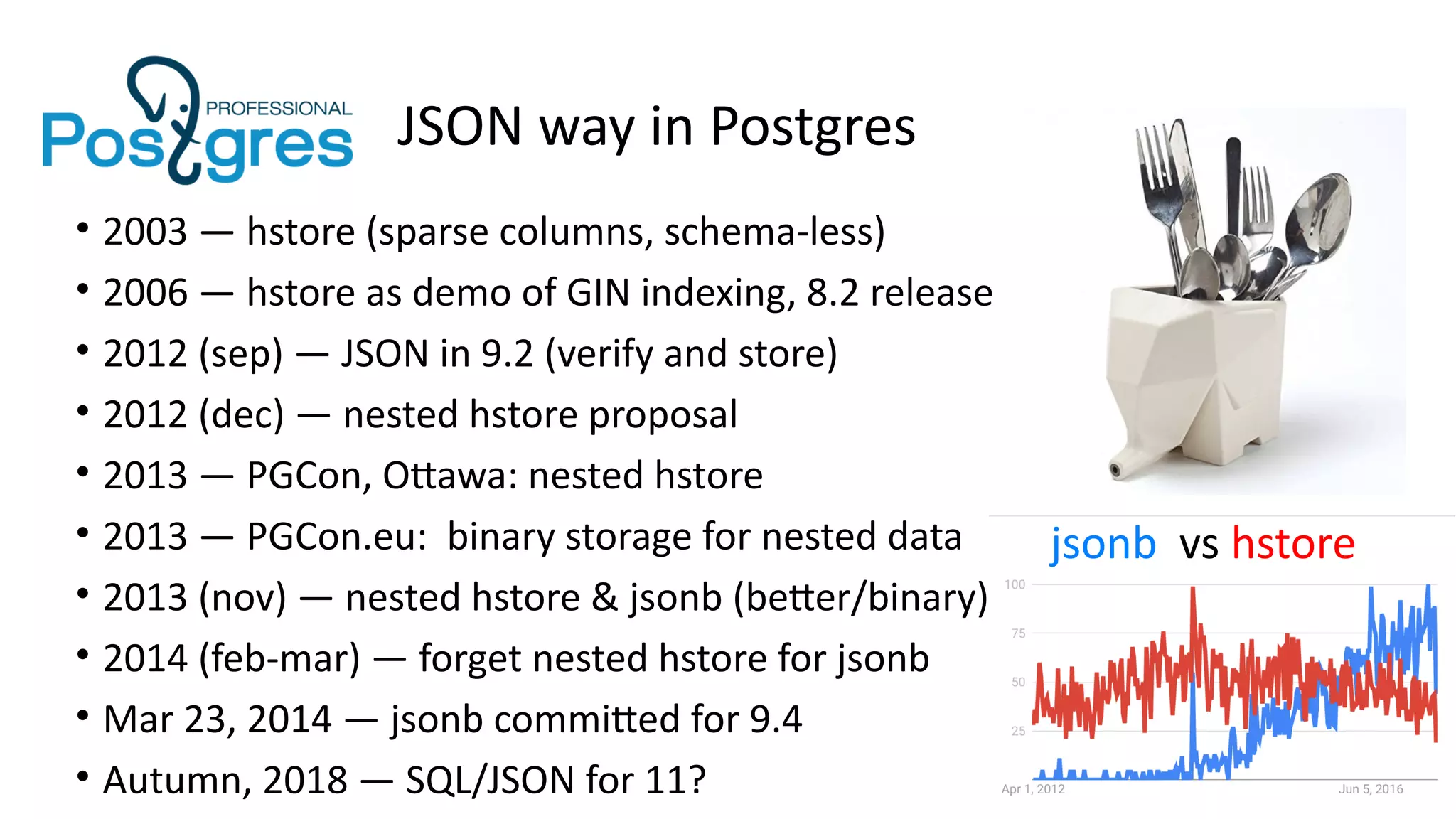
JSON way in Postgres
• 2003 — hstore (sparse columns, schema-less)
• 2006 — hstore as demo of GIN indexing, 8.2 release
• 2012 (sep) — JSON in 9.2 (verify and store)
• 2012 (dec) — nested hstore proposal
• 2013 — PGCon, Ottawa: nested hstore
• 2013 — PGCon.eu: binary storage for nested data
• 2013 (nov) — nested hstore & jsonb (better/binary)
• 2014 (feb-mar) — forget nested hstore for jsonb
• Mar 23, 2014 — jsonb committed for 9.4
• Autumn, 2018 — SQL/JSON for 11?
jsonb vs hstore
Two JSON data types !!!
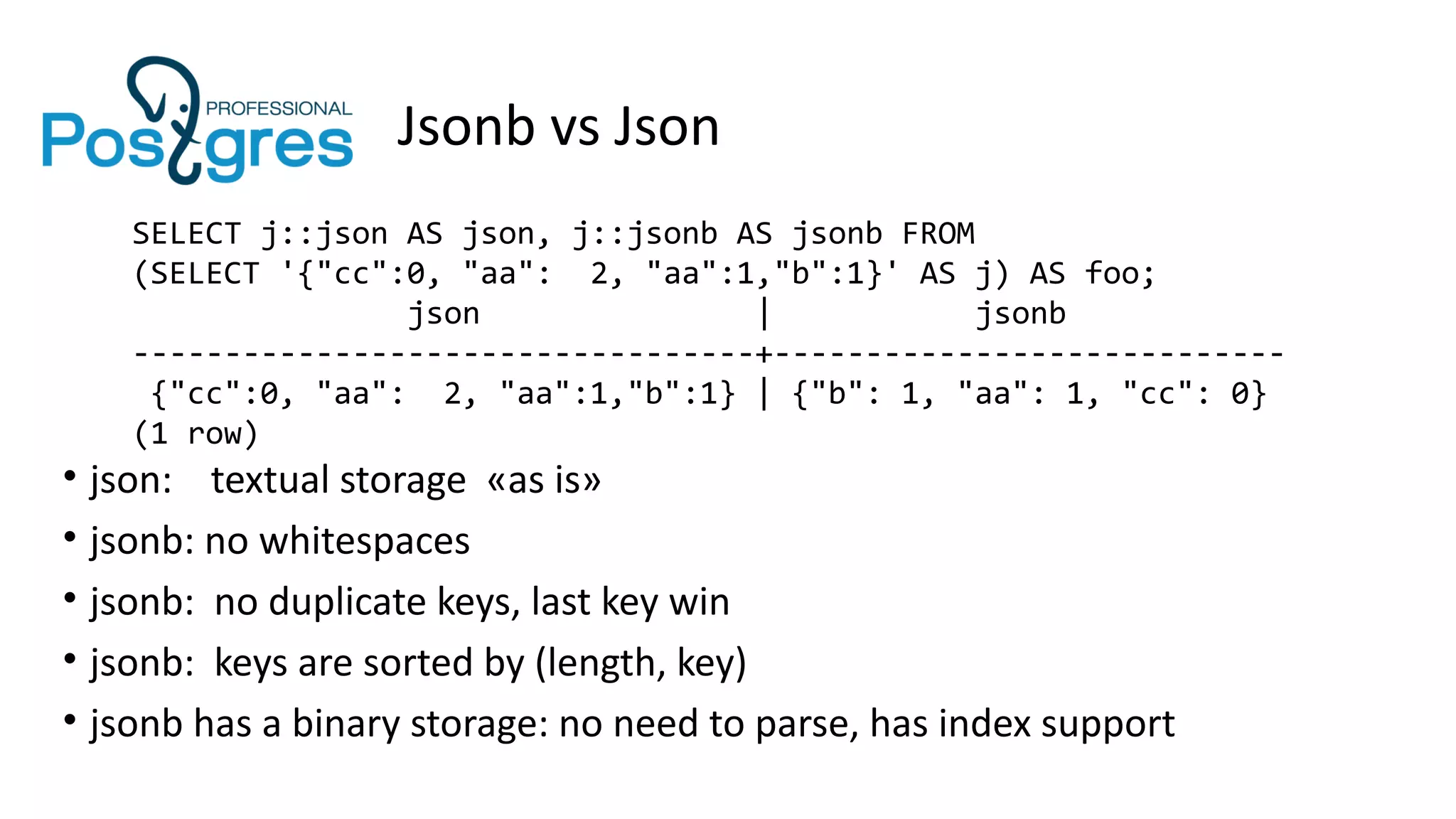
Jsonb vs Json
SELECT j::json AS json, j::jsonb AS jsonb FROM
(SELECT '{"cc":0, "aa": 2, "aa":1,"b":1}' AS j) AS foo;
json | jsonb
----------------------------------+----------------------------
{"cc":0, "aa": 2, "aa":1,"b":1} | {"b": 1, "aa": 1, "cc": 0}
(1 row)
• json: textual storage «as is»
• jsonb: no whitespaces
• jsonb: no duplicate keys, last key win
• jsonb: keys are sorted by (length, key)
• jsonb has a binary storage: no need to parse, has index support
JSONB is great, BUT
no good query language —
jsonb is a «black box» for SQL
Find color «red» somewhere
• Table "public.js_test"
Column | Type | Modifiers
--------+---------+-----------
id | integer | not null
value | jsonb |
select * from js_test;
id | value
----+-----------------------------------------------------------------------
1 | [1, "a", true, {"b": "c", "f": false}]
2 | {"a": "blue", "t": [{"color": "red", "width": 100}]}
3 | [{"color": "red", "width": 100}]
4 | {"color": "red", "width": 100}
5 | {"a": "blue", "t": [{"color": "red", "width": 100}], "color": "red"}
6 | {"a": "blue", "t": [{"color": "blue", "width": 100}], "color": "red"}
7 | {"a": "blue", "t": [{"color": "blue", "width": 100}], "colr": "red"}
8 | {"a": "blue", "t": [{"color": "green", "width": 100}]}
9 | {"color": "green", "value": "red", "width": 100}
(9 rows)
Find color «red» somewhere
• VERY COMPLEX SQL QUERY
WITH RECURSIVE t(id, value) AS ( SELECT * FROM
js_test
UNION ALL
(
SELECT
t.id,
COALESCE(kv.value, e.value) AS value
FROM
t
LEFT JOIN LATERAL
jsonb_each(
CASE WHEN jsonb_typeof(t.value) =
'object' THEN t.value
ELSE NULL END) kv ON true
LEFT JOIN LATERAL
jsonb_array_elements(
CASE WHEN
jsonb_typeof(t.value) = 'array' THEN t.value
ELSE NULL END) e ON true
WHERE
kv.value IS NOT NULL OR e.value IS
NOT NULL
)
)
SELECT
js_test.*
FROM
(SELECT id FROM t WHERE value @> '{"color":
"red"}' GROUP BY id) x
JOIN js_test ON js_test.id = x.id;
id | value
----+-----------------------------------------------------------------------
2 | {"a": "blue", "t": [{"color": "red", "width": 100}]}
3 | [{"color": "red", "width": 100}]
4 | {"color": "red", "width": 100}
5 | {"a": "blue", "t": [{"color": "red", "width": 100}], "color": "red"}
6 | {"a": "blue", "t": [{"color": "blue", "width": 100}], "color": "red"}
(5 rows)
PGCon-2014, Ottawa
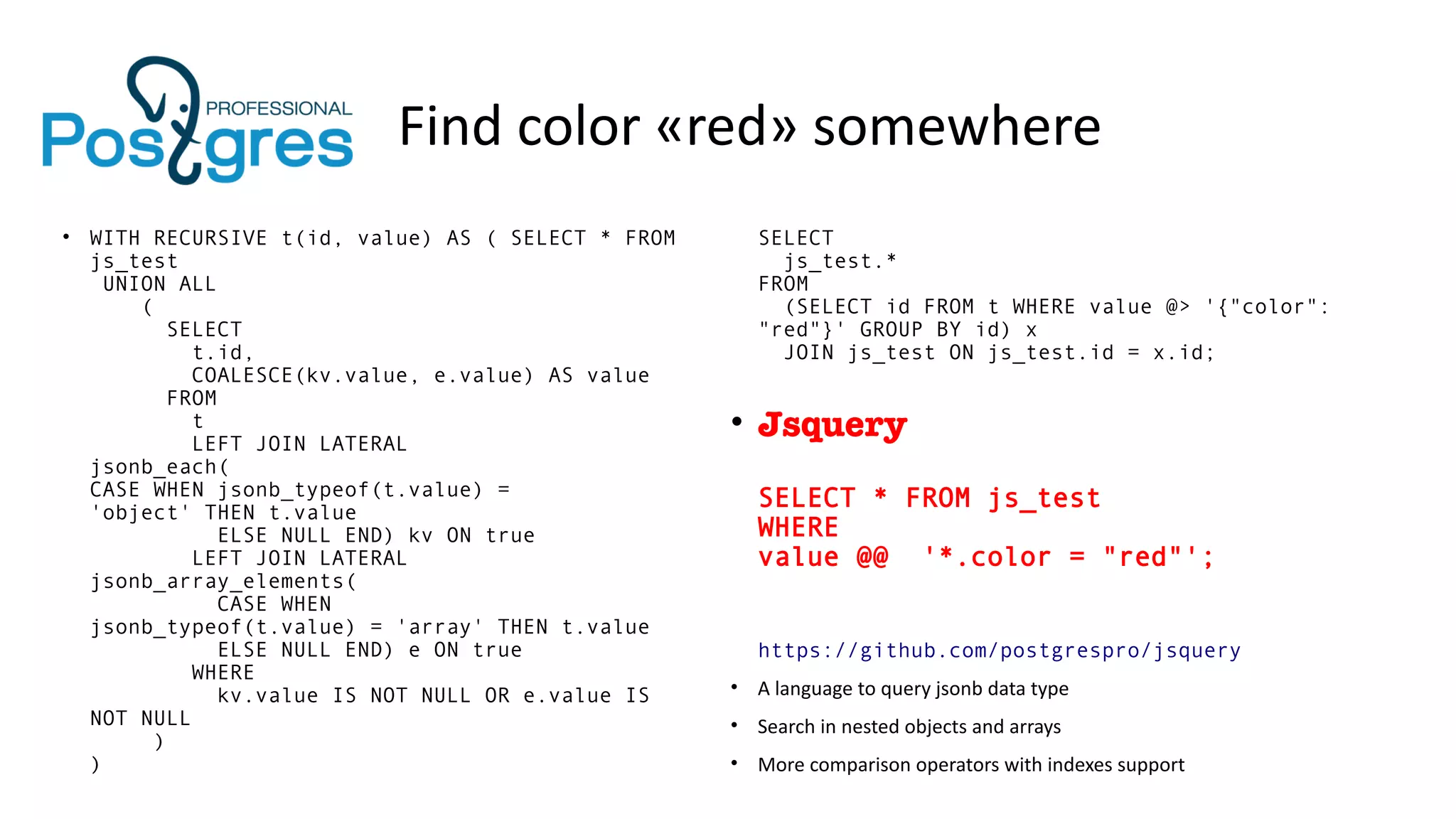
Find color «red» somewhere
• WITH RECURSIVE t(id, value) AS ( SELECT * FROM
js_test
UNION ALL
(
SELECT
t.id,
COALESCE(kv.value, e.value) AS value
FROM
t
LEFT JOIN LATERAL
jsonb_each(
CASE WHEN jsonb_typeof(t.value) =
'object' THEN t.value
ELSE NULL END) kv ON true
LEFT JOIN LATERAL
jsonb_array_elements(
CASE WHEN
jsonb_typeof(t.value) = 'array' THEN t.value
ELSE NULL END) e ON true
WHERE
kv.value IS NOT NULL OR e.value IS
NOT NULL
)
)
SELECT
js_test.*
FROM
(SELECT id FROM t WHERE value @> '{"color":
"red"}' GROUP BY id) x
JOIN js_test ON js_test.id = x.id;
• Jsquery
SELECT * FROM js_test
WHERE
value @@ '*.color = "red"';
https://github.com/postgrespro/jsquery
• A language to query jsonb data type
• Search in nested objects and arrays
• More comparison operators with indexes support
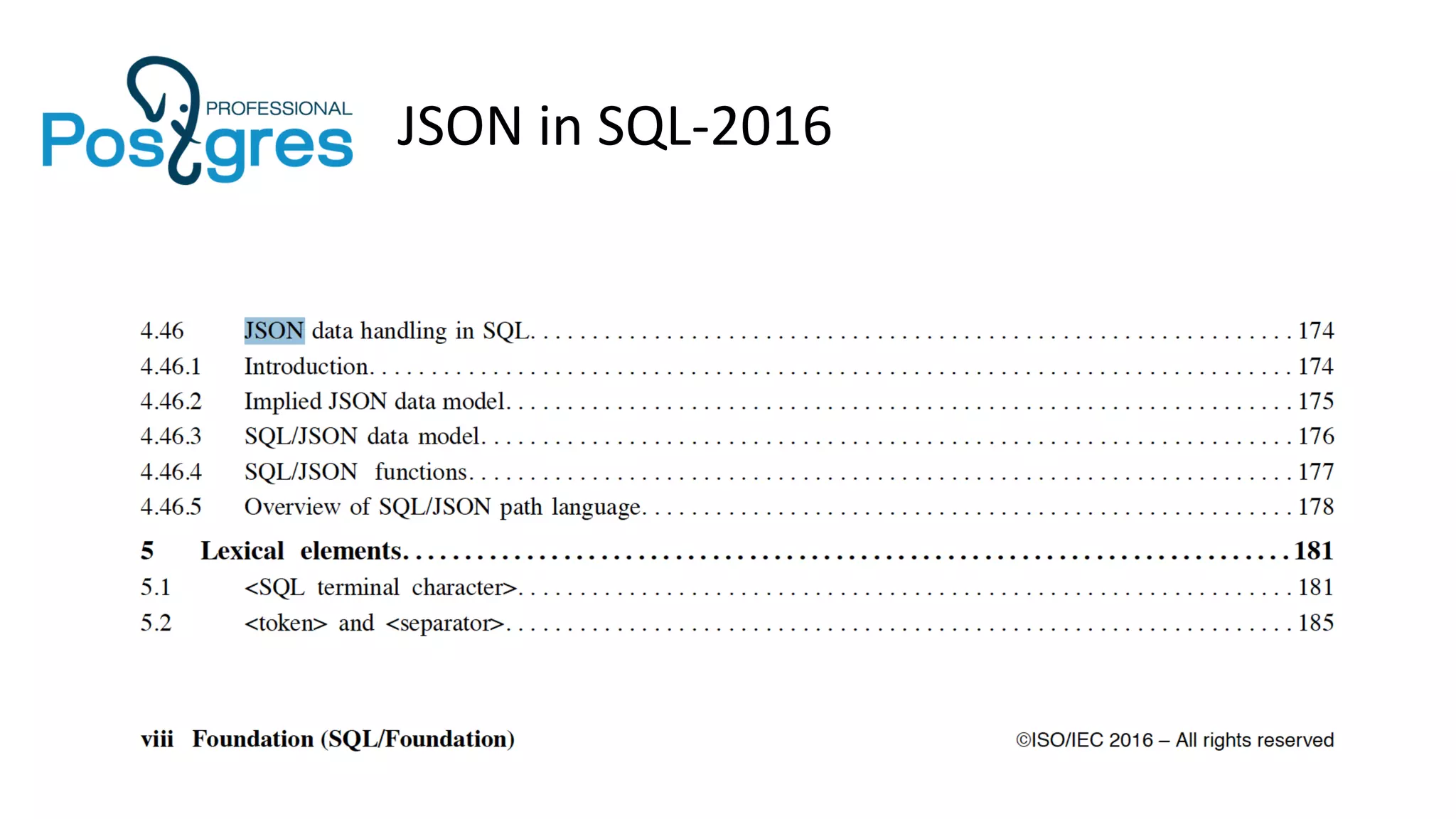
JSON in SQL-2016
JSON in SQL-2016
• ISO/IEC 9075-2:2016(E) - https://www.iso.org/standard/63556.html
• BNF
https://github.com/elliotchance/sqltest/blob/master/standards/2016/bnf
.txt
• Discussed at Developers meeting Jan 28, 2017 in Brussels
• Post -hackers, Feb 28, 2017 (March commitfest)
«Attached patch is an implementation of SQL/JSON data model from
SQL-2016 standard (ISO/IEC 9075-2:2016(E)), which was published 2016-
12-15 ...»
• Patch was too big (now about 16,000 loc) and too late for Postgres 10 :(
SQL/JSON in PostgreSQL
• It‘s not a new data type, it‘s a JSON data model for SQL
• PostgreSQL implementation is a subset of standard:
• JSONB – ORDERED and UNIQUE KEYS
• JSON – UNORDERED and NONUNIQUE KEYS
• jsonpath data type for SQL/JSON path language
• nine functions, implemented as SQL CLAUSEs
SQL/JSON in PostgreSQL
• The SQL/JSON construction functions:
• JSON_OBJECT - serialization of an JSON object.
• json[b]_build_object()
• JSON_ARRAY - serialization of an JSON array.
• json[b]_build_array()
• JSON_ARRAYAGG - serialization of an JSON object from aggregation of SQL data
• json[b]_agg()
• JSON_OBJECTAGG - serialization of an JSON array from aggregation of SQL data
• json[b]_object_agg()
SQL/JSON in PostgreSQL
JSON_OBJECT (
[{ expression { VALUE | ':' } json_value_expression }[, ...]]
[ { NULL | ABSENT } ON NULL]
[ { WITH | WITHOUT } UNIQUE [ KEYS ] ]
[ RETURNING data_type [ FORMAT json_representation ] ]
)
... RETURNING {JSON|JSONB|TEXT|BYTEA}
... FORMAT {JSON [ ENCODING { UTF8 | UTF16 | UTF32 } ] | JSONB}
RETURNING … FORMAT … o_O
x RETURNING x RETURNING x FORMAT json[b]*
RETURNING x FORMAT json
ENCONDING … *
bytea
(cast without
function)
+ + +
string types + + –
json[b]** + + –
all other + – –
Looks like
managable cast
Returns binary representation
of given encoding
* In standard, it was designed for DBMS which doesn't have special JSON datatype
** This is our PostgreSQL-specific extension since it has json[b] datatypes
SQL/JSON in PostgreSQL
SELECT JSON_OBJECT(
'key1': 'string',
'key2' VALUE 123, -- alternative syntax for key-value delimiter, but no KEY keyword
'key3': TRUE,
'key4': ARRAY[1, 2, 3], -- postgres arrays
'key5': jsonb '{"a": ["b", 1]}', -- composite json/jsonb
'key6': date '18.03.2017', -- datetime types
'key7': row(1, 'a') -- row types
);
{"key1" : "string", "key2" : 123, "key3" : true, "key4" : [1,2,3], "key5" : {"a": ["b", 1]}}
SQL/JSON in PostgreSQL
-- used json[b]_build_object()
SELECT JSON_OBJECT('a': 1);
SELECT JSON_OBJECT('a': 1 RETURNING json);
SELECT JSON_OBJECT('a': 1 RETURNING jsonb);
-- used json[b]_build_object()::text
SELECT JSON_OBJECT('a': 1 RETURNING text FORMAT json);
-- used convert_to(json_build_object()::text, 'UTF8')
SELECT JSON_OBJECT('a': 1 RETURNING bytea FORMAT JSON ENCODING UTF8);
SQL/JSON in PostgreSQL
Input FORMAT clause (equivalent to ::json/::jsonb):
SELECT JSON_OBJECT('a': '[1, 2, 3]' FORMAT JSON);
{"a" : [1, 2, 3]}
SELECT JSON_OBJECT('a': '[1, 2, 3]');
{"a" : "[1, 2, 3]"}
SELECT JSON_OBJECT('a': bytea 'x5b312c20322c20335d' FORMAT JSON);
{"a" : [1, 2, 3]}
SELECT JSON_OBJECT('a': bytea 'x5b312c20322c20335d');
{"a" : "x5b312c20322c20335d"}
SQL/JSON in PostgreSQL
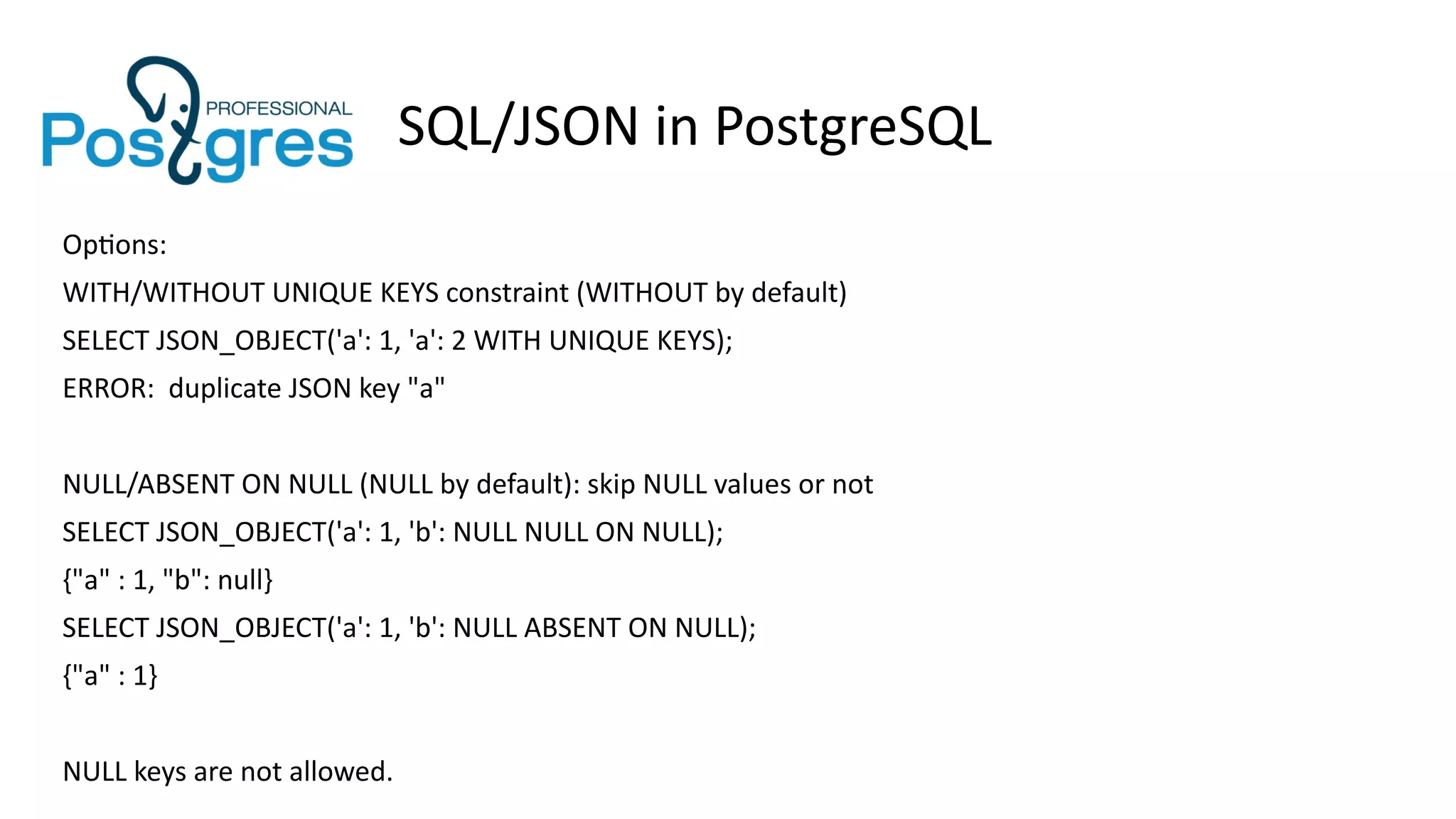
Options:
WITH/WITHOUT UNIQUE KEYS constraint (WITHOUT by default)
SELECT JSON_OBJECT('a': 1, 'a': 2 WITH UNIQUE KEYS);
ERROR: duplicate JSON key "a"
NULL/ABSENT ON NULL (NULL by default): skip NULL values or not
SELECT JSON_OBJECT('a': 1, 'b': NULL NULL ON NULL);
{"a" : 1, "b": null}
SELECT JSON_OBJECT('a': 1, 'b': NULL ABSENT ON NULL);
{"a" : 1}
NULL keys are not allowed.
SQL/JSON in PostgreSQL
JSON_ARRAY(
[ json_value_expression [, ...]] [ { NULL | ABSENT } ON NULL ]
[ RETURNING data_type [ FORMAT json_representation [ENCODING ...] ] ]
)
SELECT JSON_ARRAY(
'string', 123, TRUE, ARRAY[1,2,3], jsonb '{"a": ["b", 1]}'
);
["string", 123, true, [1,2,3], {"a": ["b", 1]}]
SQL/JSON in PostgreSQL
Additional options:
NULL/ABSENT ON NULL (ABSENT by default)
SELECT JSON_ARRAY(1, NULL, 'a' NULL ON NULL); -> [1, null, "a"]
SELECT JSON_ARRAY(1, NULL, 'a' ABSENT ON NULL); -> [1, "a"]
Subquery as an argument:
JSON_ARRAY (
query_expression [ { NULL | ABSENT } ON NULL ]
[ RETURNING data_type [ FORMAT json_representation ] ]
)
SELECT JSON_ARRAY(SELECT * FROM generate_series(1, 3)); -> [1, 2, 3]
SQL/JSON in PostgreSQL
SELECT JSON_ARRAYAGG(i) FROM generate_series(1, 5) i;
[1, 2, 3, 4, 5]
SELECT JSON_OBJECTAGG('key' || i : 'val' || i) FROM generate_series(1, 3) i;
{ "key1" : "val1", "key2" : "val2", "key3" : "val3" }
SQL/JSON in PostgreSQL
• The SQL/JSON retrieval functions:
• JSON_VALUE - Extract an SQL value of a predefined type from a JSON value.
• JSON_QUERY - Extract a JSON text from a JSON text using an SQL/JSON path
expression.
• JSON_TABLE - Query a JSON text and present it as a relational table.
• IS [NOT] JSON - test whether a string value is a JSON text.
• JSON_EXISTS - test whether a JSON path expression returns any SQL/JSON items
SQL/JSON in PostgreSQL
SELECT
Js,
js IS JSON "is json", js IS JSON SCALAR "is scalar",
js IS JSON OBJECT "is object", js IS JSON ARRAY "is array"
FROM (VALUES ('123'), ('"abc"'), ('{"a": "b"}'), ('[1,2]'), ('abc')) foo(js);
js | is json | is scalar | is object | is array
123 | t | t | f | f
"abc" | t | t | f | f
{"a": "b"} | t | f | t | f
[1,2] | t | f | f | t
abc | f | f | f | f
SQL/JSON in PostgreSQL
•Jsonpath provides an ability to operate (in standard specified way)
with json structure at SQL-language level
• Dot notation — $.a.b.c
• Array - [*], [1], [1,2], [1 to 10], [last]
• Filter ? - $.a.b.c ? (@.x > 10)
• Methods - $.a.b.c.x.type()
• Implemented as datatype
SELECT * FROM js WHERE JSON_EXISTS(js, 'strict $.tags[*] ? (@.term ==
"NYC")');
SELECT * FROM js WHERE js @> '{"tags": [{"term": "NYC"}]}';
SQL/JSON in PostgreSQL
-- root extraction
JSON_QUERY('{"a": {"b" : 1}, "c": 2}', '$') ; -> {"a": {"b" : 1}, "c": 2}
-- simple path extraction
JSON_QUERY('{"a": {"b" : 1}, "c": 2}', '$.a') -> {"b": 1}
JSON_QUERY('{"a": {"b" : 1}, "c": 2}', '$.a.b') -> 1
-- wildcard key extraction
JSON_QUERY('{"a": {"b" : 1}, "c": 2}', '$.*' WITH WRAPPER) -> [{"b" : 1}, 2]
SQL/JSON in PostgreSQL
-- automatic unwrapping of arrays in lax mode
JSON_QUERY('[{"a": 1}, {"a": 2}]', 'lax $.a' WITH WRAPPER)
[1, 2]
-- error if accessing members of non-object items in strict mode
JSON_QUERY(jsonb '[{"a": 1}, {"a": 2}]', 'strict $.a' WITH WRAPPER ERROR ON ERROR);
ERROR: SQL/JSON member not found
SQL/JSON in PostgreSQL
JSON_QUERY( '[1, 1.3, -3, -3.8]', '$[*].ceiling()' WITH WRAPPER)
[1, 2, -3, -3]
-- .datetime(): convert string to datetime type using standard formats
-- date
JSON_QUERY('"2017-03-21"', '$.datetime()')
"2017-03-21"
JSON_QUERY('"2017-03-21"', '$.datetime().type()')
"date"
SQL/JSON in PostgreSQL
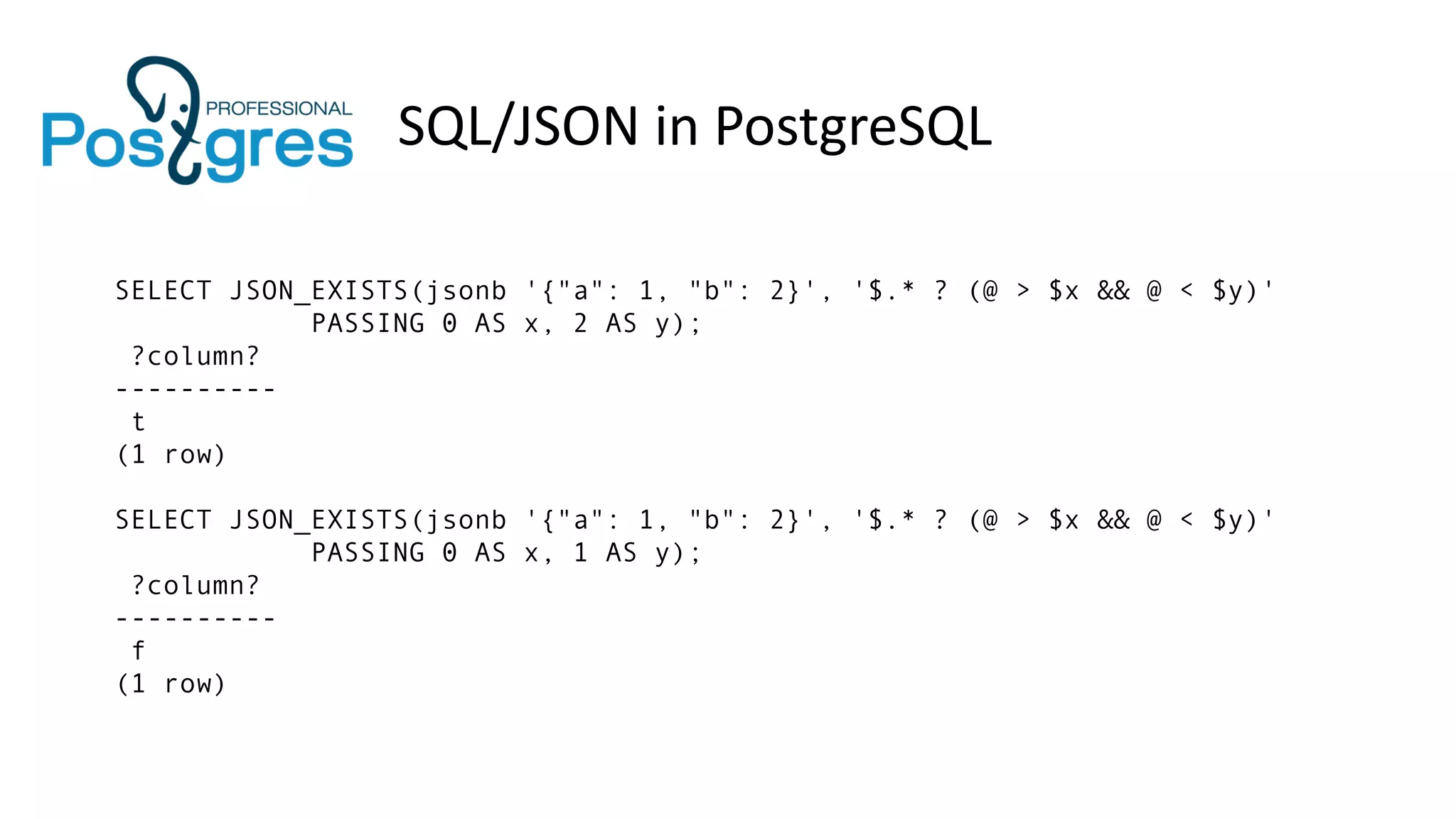
SELECT JSON_EXISTS(jsonb '{"a": 1, "b": 2}', '$.* ? (@ > $x && @ < $y)'
PASSING 0 AS x, 2 AS y);
?column?
----------
t
(1 row)
SELECT JSON_EXISTS(jsonb '{"a": 1, "b": 2}', '$.* ? (@ > $x && @ < $y)'
PASSING 0 AS x, 1 AS y);
?column?
----------
f
(1 row)
SQL/JSON in PostgreSQL
-- using jsonb path variables
-- (selection of all elements of $[] containing in $js[])
JSON_QUERY('[1, 2, 3, 4]', '$[*] ? (@ == $js[*])'
PASSING jsonb '[2, 3, 4, 5]' AS js WITH WRAPPER)
[2, 3, 4]
-- using datetime path variables
JSON_QUERY('["01.01.17", "21.03.17", "01.01.18"]',
'$[*] ? (@.datetime("dd.mm.yy") >= $date)'
PASSING date '21.03.17' AS date WITH WRAPPER)
["21.03.17", "01.01.18"]
SQL/JSON in PostgreSQL (Extention)
-- object subscripting
JSON_QUERY('{"a": 1, "b": 2}', '$[$field]' PASSING 'a' AS field)
1
-- map item method
JSON_QUERY('[1,2,3]', '$.map(@ + 10)')
[11, 12, 13]
-- boolean expressions
JSON_VALUE('[1,2,3]', '$[*] > 2' RETURNING bool)
t
SQL/JSON in PostgreSQL
JSON_EXISTS (
json_api_common_syntax
[ { TRUE | FALSE | UNKNOWN | ERROR } ON ERROR ]
)
- analogous to jsonb '{"a": 1}' ? 'a'
SELECT JSON_EXISTS(jsonb '{"a": 1}', 'strict $.a');
SELECT JSON_EXISTS(jsonb '{"a": [1,2,3]}', 'strict $.a[*] ? (@ > 2)');
Error behavior (FALSE by default):
SELECT JSON_EXISTS(jsonb '{"a": [1,2,3]}', 'strict $.a[5]' ERROR ON ERROR);
ERROR: Invalid SQL/JSON subscript
SELECT JSON_EXISTS(jsonb '{"a": [1,2,3]}', 'lax $.a[5]' ERROR ON ERROR);
f
SQL/JSON in PostgreSQL
Native Postgres arrays, record and domain types are also supported for
RETURNING (analogous to json[b]_populate_record()):
SELECT JSON_QUERY(jsonb '[1,null,"3"]', '$[*]' RETURNING int[] WITH WRAPPER);
{1,NULL,3}
CREATE TYPE rec AS (i int, t text, js json[]);
SELECT * FROM JSON_QUERY(jsonb '{"i": 123, "js": [1, "foo", {}]}', '$' RETURNING rec);
i | t | js
-----+---+--------------------
123 | | {1,""foo"","{}"}
(1 row)
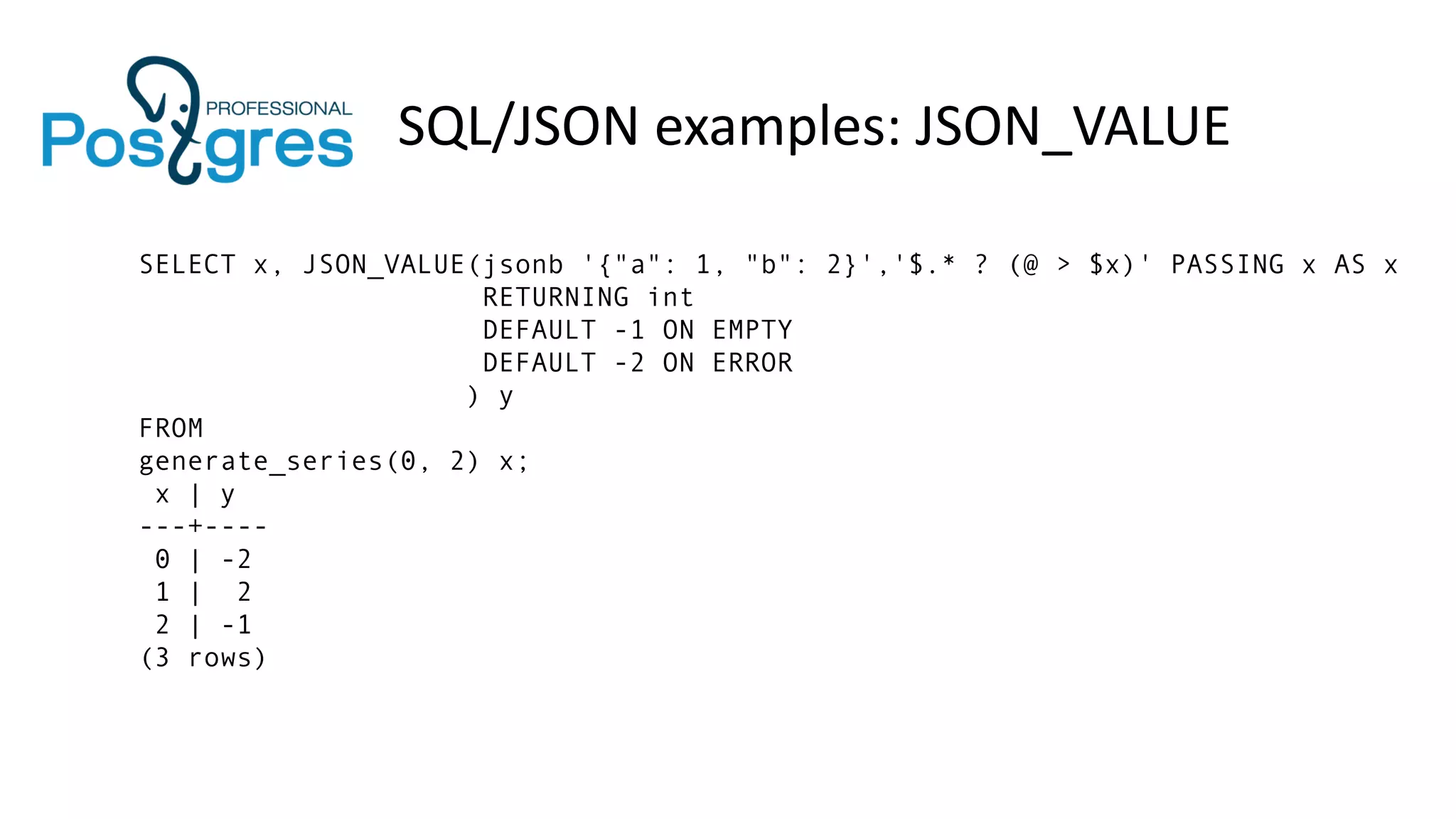
SQL/JSON examples: JSON_VALUE
SELECT x, JSON_VALUE(jsonb '{"a": 1, "b": 2}','$.* ? (@ > $x)' PASSING x AS x
RETURNING int
DEFAULT -1 ON EMPTY
DEFAULT -2 ON ERROR
) y
FROM
generate_series(0, 2) x;
x | y
---+----
0 | -2
1 | 2
2 | -1
(3 rows)
SQL/JSON examples: JSON_QUERY
SELECT
JSON_QUERY(js FORMAT JSONB, '$'),
JSON_QUERY(js FORMAT JSONB, '$' WITHOUT WRAPPER),
JSON_QUERY(js FORMAT JSONB, '$' WITH CONDITIONAL ARRAY WRAPPER),
JSON_QUERY(js FORMAT JSONB, '$' WITH UNCONDITIONAL ARRAY WRAPPER),
JSON_QUERY(js FORMAT JSONB, '$' WITH ARRAY WRAPPER)
FROM
(VALUES
('null'),
('12.3'),
('true'),
('"aaa"'),
('[1, null, "2"]'),
('{"a": 1, "b": [2]}')
) foo(js);
?column? | ?column? | ?column? | ?column? | ?column?
--------------------+--------------------+--------------------+----------------------+----------------------
null | null | [null] | [null] | [null]
12.3 | 12.3 | [12.3] | [12.3] | [12.3]
true | true | [true] | [true] | [true]
"aaa" | "aaa" | ["aaa"] | ["aaa"] | ["aaa"]
[1, null, "2"] | [1, null, "2"] | [1, null, "2"] | [[1, null, "2"]] | [[1, null, "2"]]
{"a": 1, "b": [2]} | {"a": 1, "b": [2]} | {"a": 1, "b": [2]} | [{"a": 1, "b": [2]}] | [{"a": 1, "b": [2]}]
(6 rows)
SQL/JSON examples: Constraints
CREATE TABLE test_json_constraints (
js text,
i int,
x jsonb DEFAULT JSON_QUERY(jsonb '[1,2]', '$[*]' WITH WRAPPER)
CONSTRAINT test_json_constraint1
CHECK (js IS JSON)
CONSTRAINT test_json_constraint2
CHECK (JSON_EXISTS(js FORMAT JSONB, '$.a' PASSING i + 5 AS int, i::text AS txt))
CONSTRAINT test_json_constraint3
CHECK (JSON_VALUE(js::jsonb, '$.a' RETURNING int DEFAULT ('12' || i)::int
ON EMPTY ERROR ON ERROR) > i)
CONSTRAINT test_json_constraint4
CHECK (JSON_QUERY(js FORMAT JSONB, '$.a'
WITH CONDITIONAL WRAPPER EMPTY OBJECT ON ERROR) < jsonb '[10]')
);
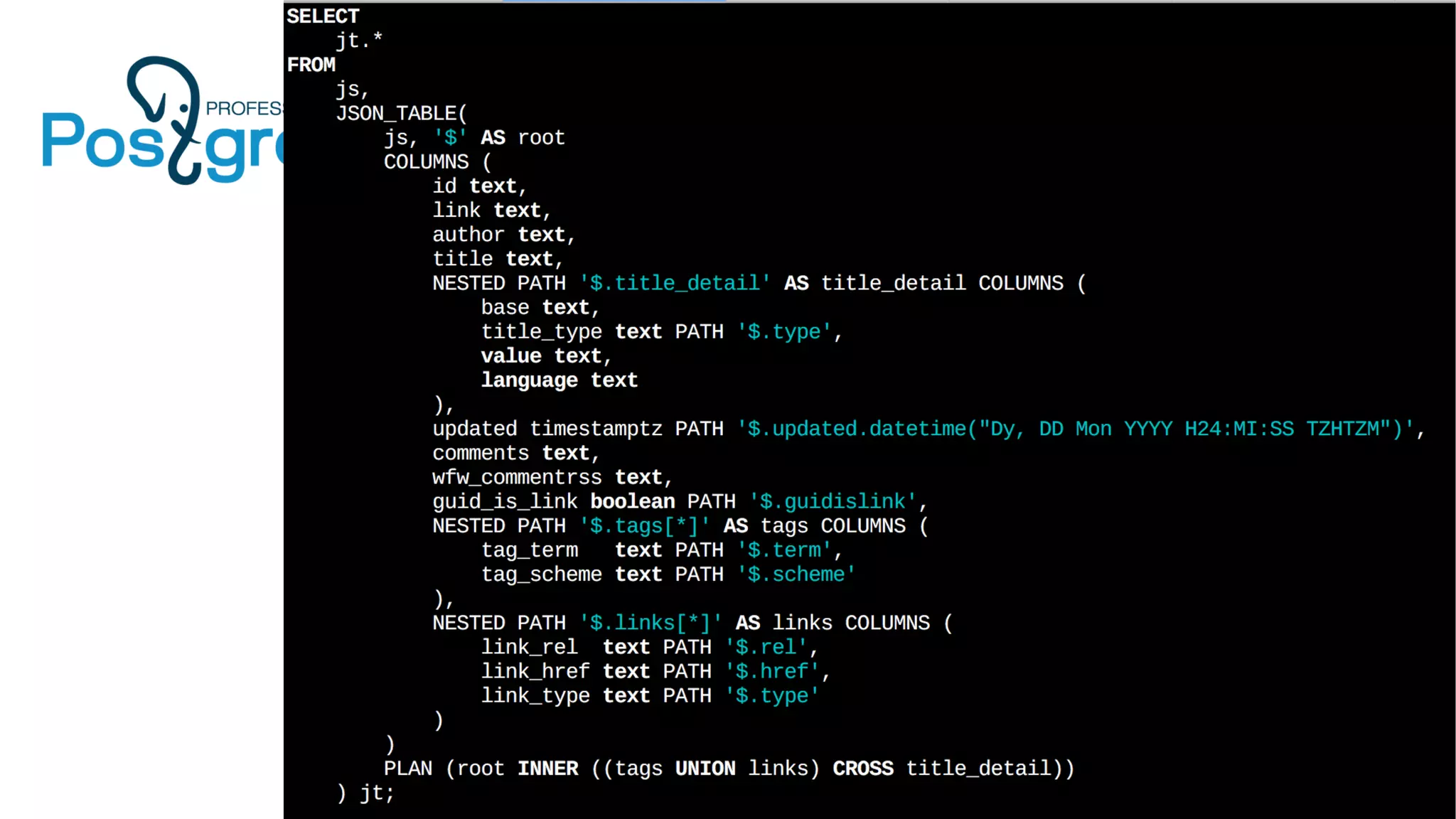
SQL/JSON examples: JSON_TABLE
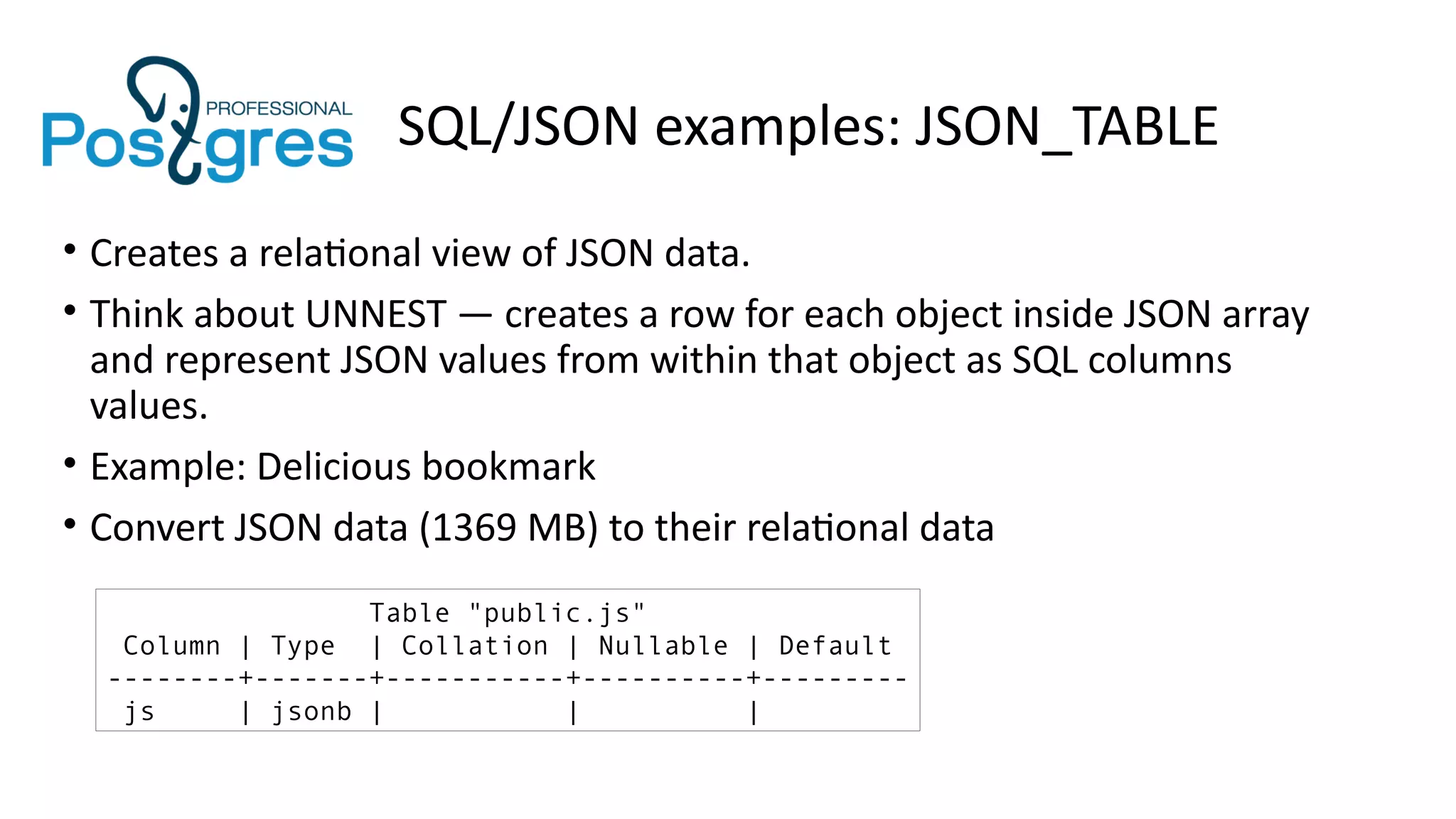
• Creates a relational view of JSON data.
• Think about UNNEST — creates a row for each object inside JSON array
and represent JSON values from within that object as SQL columns
values.
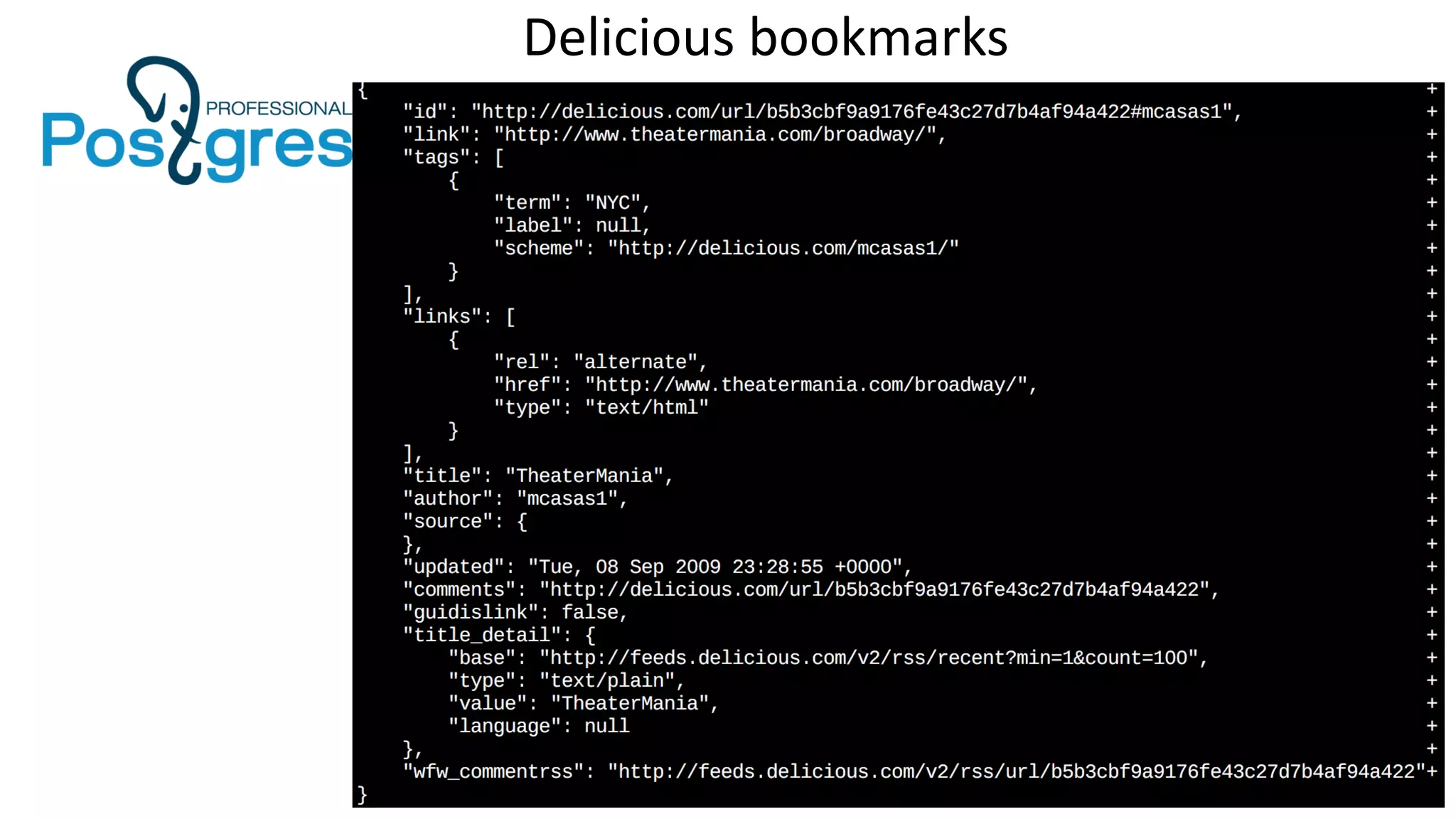
• Example: Delicious bookmark
• Convert JSON data (1369 MB) to their relational data
Table "public.js"
Column | Type | Collation | Nullable | Default
--------+-------+-----------+----------+---------
js | jsonb | | |
SQL/JSON examples: JSON_TABLE
Delicious bookmarks
SQL/JSON examples: JSON_TABLE
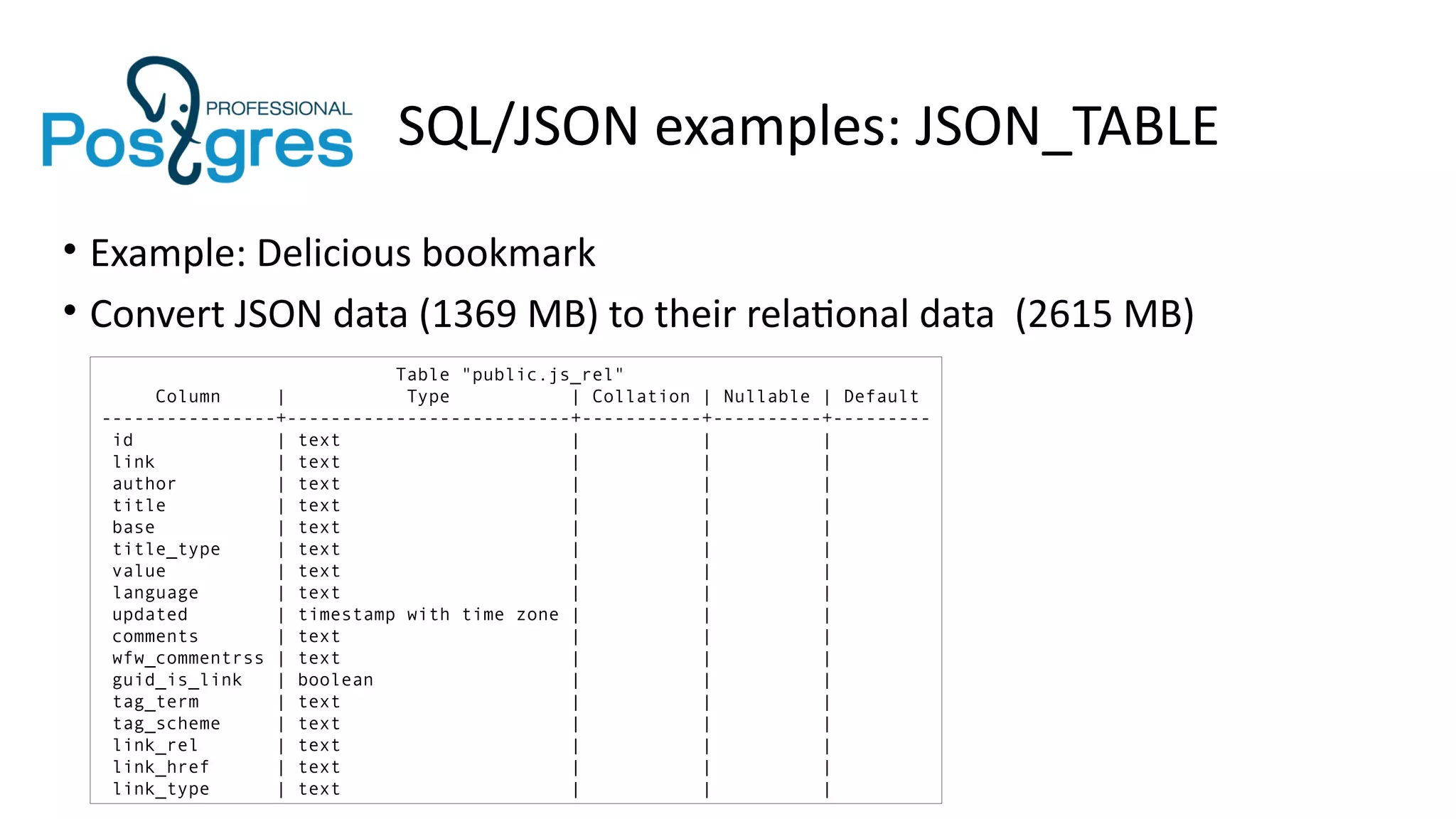
• Example: Delicious bookmark
• Convert JSON data (1369 MB) to their relational data (2615 MB)
Table "public.js_rel"
Column | Type | Collation | Nullable | Default
----------------+--------------------------+-----------+----------+---------
id | text | | |
link | text | | |
author | text | | |
title | text | | |
base | text | | |
title_type | text | | |
value | text | | |
language | text | | |
updated | timestamp with time zone | | |
comments | text | | |
wfw_commentrss | text | | |
guid_is_link | boolean | | |
tag_term | text | | |
tag_scheme | text | | |
link_rel | text | | |
link_href | text | | |
link_type | text | | |
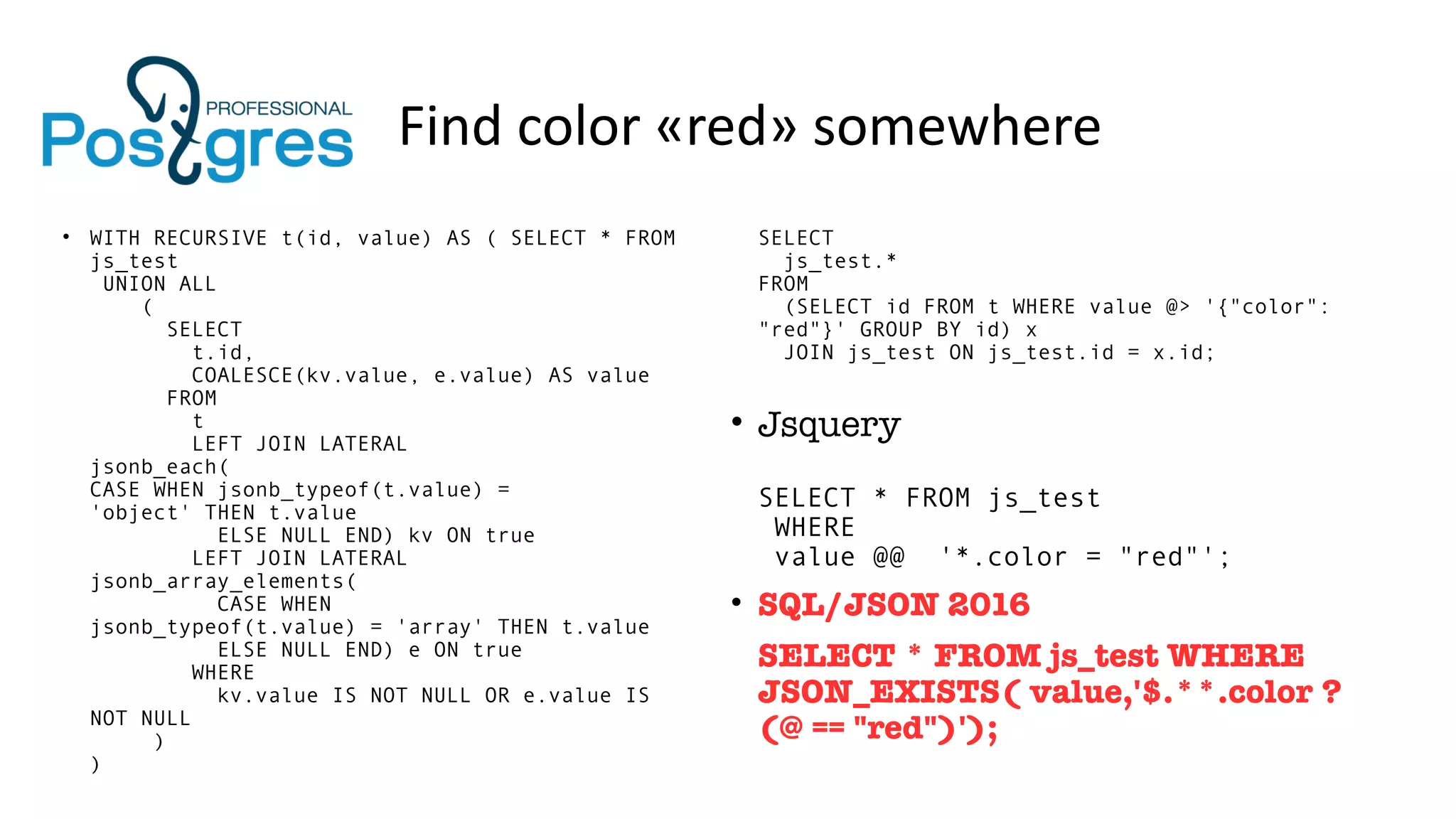
Find color «red» somewhere
• WITH RECURSIVE t(id, value) AS ( SELECT * FROM
js_test
UNION ALL
(
SELECT
t.id,
COALESCE(kv.value, e.value) AS value
FROM
t
LEFT JOIN LATERAL
jsonb_each(
CASE WHEN jsonb_typeof(t.value) =
'object' THEN t.value
ELSE NULL END) kv ON true
LEFT JOIN LATERAL
jsonb_array_elements(
CASE WHEN
jsonb_typeof(t.value) = 'array' THEN t.value
ELSE NULL END) e ON true
WHERE
kv.value IS NOT NULL OR e.value IS
NOT NULL
)
)
SELECT
js_test.*
FROM
(SELECT id FROM t WHERE value @> '{"color":
"red"}' GROUP BY id) x
JOIN js_test ON js_test.id = x.id;
• Jsquery
SELECT * FROM js_test
WHERE
value @@ '*.color = "red"';
• SQL/JSON 2016
SELECT * FROM js_test WHERE
JSON_EXISTS( value,'$.**.color ?
(@ == "red")');
SQL/JSON availability
• Github Postgres Professional repository
https://github.com/postgrespro/sqljson
• SQL/JSON examples
• WEB-interface to play with SQL/JSON
• BNF of SQL/JSON
• We need your feedback, bug reports and suggestions
• Help us writing documentation !
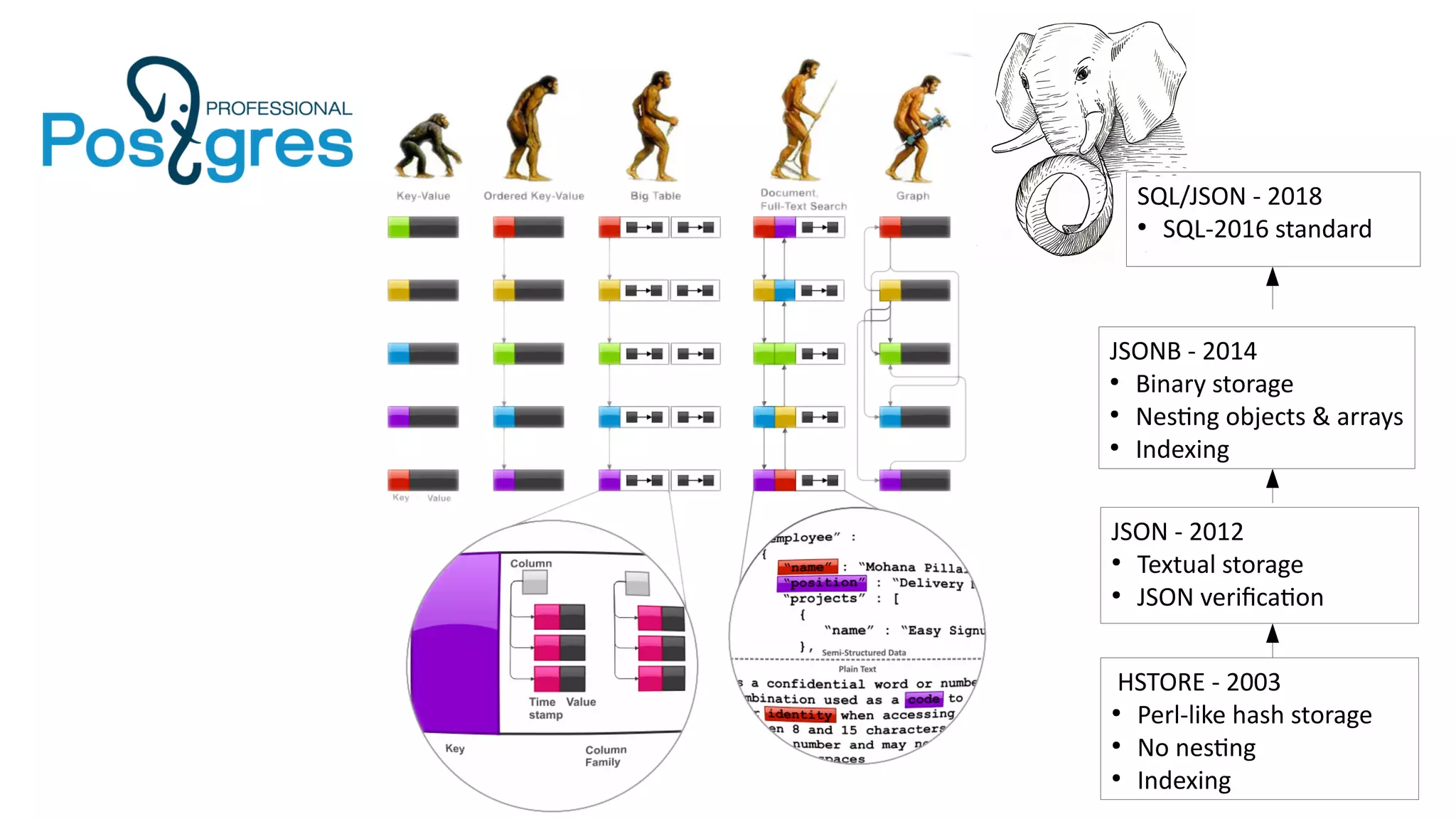
JSONB - 2014
●
Binary storage
●
Nesting objects & arrays
●
Indexing
HSTORE - 2003
●
Perl-like hash storage
●
No nesting
●
Indexing
JSON - 2012
●
Textual storage
●
JSON verification
SQL/JSON - 2018
●
SQL-2016 standard
SQL/JSON TODO
'$.sort(@.a)'
'$.sortBy(@.a)'
'$.sortWith($1 > $2)'
'$.partition(@ > 5)'
'$.groupBy(@.a)'
'$.indexWhere(@ > 5)'
'$.a.zip($.b)' or '$.a zip $.b'
'$.a.zipWithIndex()'
JSON path
:: casts
Postgres operators
'$.tags @> [{"term": "NYC"}]'
-- what about == and &&
'$.a::text || "abc"'
Item methods
'$.sum()'
'$.avg()'
'$.indexOf(5)'
'$.indexWhere(@ > 5)'
'$.maxBy(@.a)'
SQL/JSON ToDO
Postgres functions (including aggregate) support
'$.a[*].map(lower(@))' -- lower(text) used as a function
'$.a[*].lower()' -- lower(text) used as an item method
'$.a[*].concat('foo')' -- concat(any, ...) used as an item method
'avg($.a[*])' -- avg(numeric) aggregate function
Postgres operators support ??? (remember &&, ||, ==)
Item aliases, named parameters in lambdas ???
Reusing PostgreSQL executor???
SQL/JSON ToDO
SQL/JSON functions
SRF (it seems hard to implement now)
JSON_QUERY(json, jsonpath RETURNING SETOF type)
JSON_ITEMS(json, jsonpath)
Insert
JSON_INSERT('{"a": 1}', '$.b = 2') -- {a:1, b:2}
JSON_INSERT('[1,2,3]', '$[0] = 0') -- [0,1,2,3]
JSON_INSERT('[1,2,3]', '$[last] = 4') -- [1,2,3,4]
SQL/JSON ToDO
SQL/JSON functions
Delete
JSON_DELETE('{"a": {"b": 1}, "c": 2}', '$.a.b, $.c') -- {"a":{}}
JSON_DELETE('[1,2,3,4,5]', '$[*] ? (@ > 3)') -- [1,2,3]
Update
JSON_UPDATE('{"counter": 1}', '$.counter = $.counter + 1')
JSON_UPDATE('{"counter": 1}', '$.counter = (@ + $increment)' PASSING 5 AS increment)
JSON_UPDATE('[1,2,3]', '$[*] = (@ + 1)')
JSON_UPDATE('{"a": 1, "b": 2}', '$.a = (@ + 1), $.b = (@ - 1)')
It might be very useful to combine somehow multiple modification operations into a
single expression
SQL/JSON ToDO
Index support?!
Transparent compression of jsonb
+ access to the child elements without full decompression
JSONB COMPRESSION
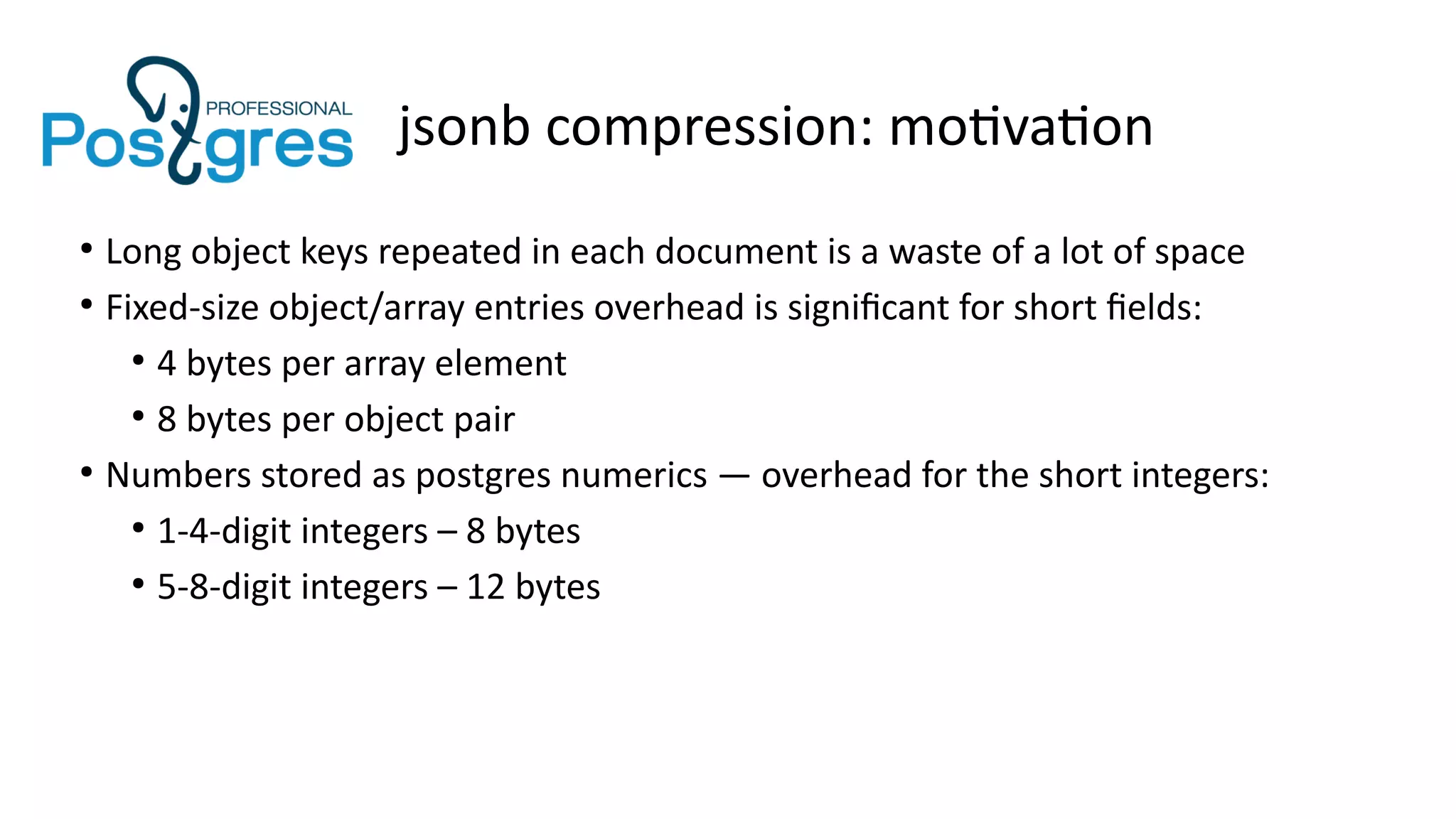
jsonb compression: motivation
●
Long object keys repeated in each document is a waste of a lot of space
●
Fixed-size object/array entries overhead is significant for short fields:
●
4 bytes per array element
●
8 bytes per object pair
●
Numbers stored as postgres numerics — overhead for the short integers:
●
1-4-digit integers – 8 bytes
●
5-8-digit integers – 12 bytes
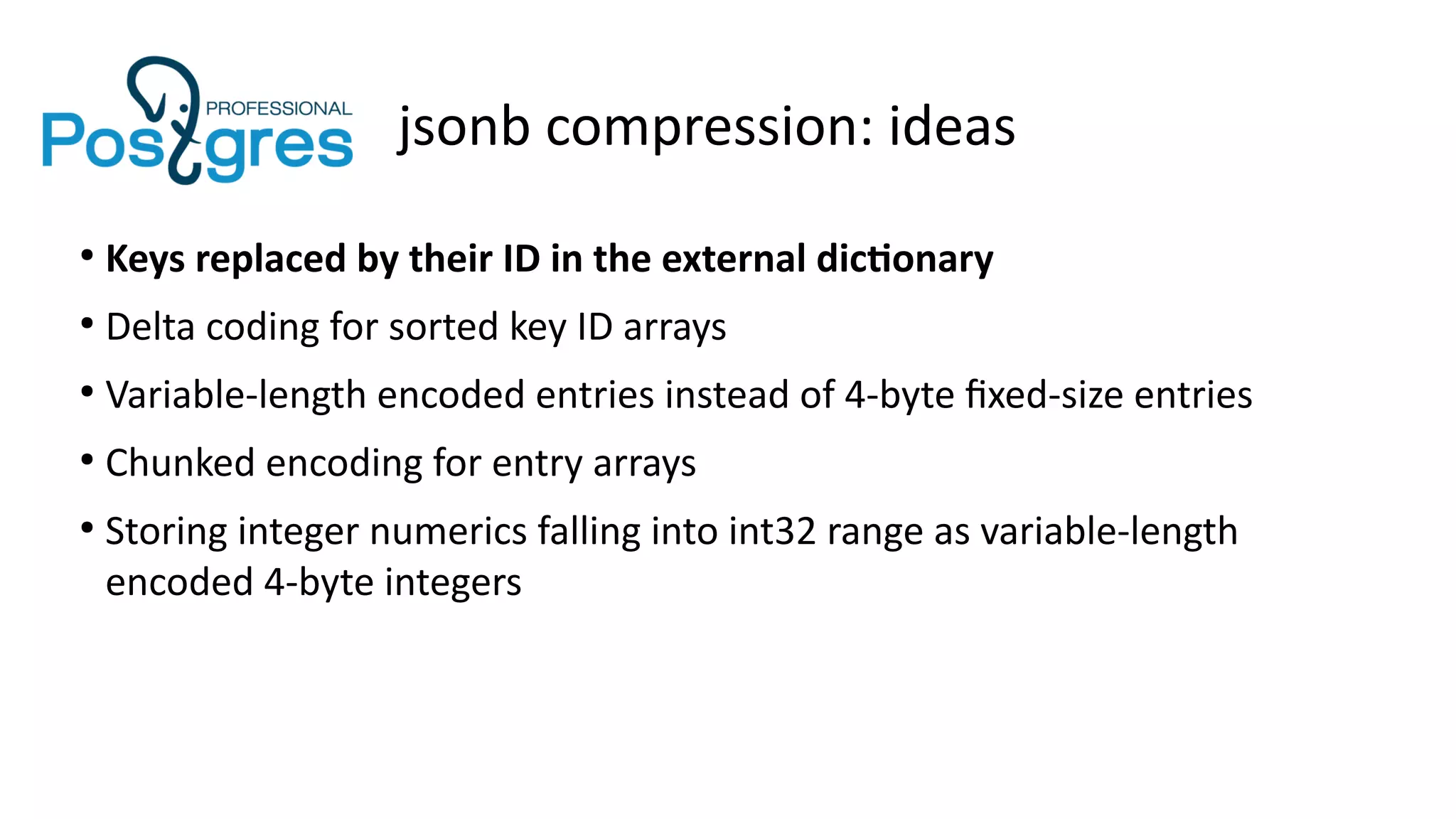
jsonb compression: ideas
●
Keys replaced by their ID in the external dictionary
●
Delta coding for sorted key ID arrays
●
Variable-length encoded entries instead of 4-byte fixed-size entries
●
Chunked encoding for entry arrays
●
Storing integer numerics falling into int32 range as variable-length
encoded 4-byte integers
jsonb compression: implementation
●
Custom column compression methods:
CREATE COMPRESSION METHOD name HANDLER handler_func
CREATE TABLE table_name (
column_name data_type
[ COMPRESSED cm_name [ WITH (option 'value' [, ... ]) ] ] ...
)
ALTER TABLE table_name ALTER column_name
SET COMPRESSED cm_name [ WITH (option 'value' [, ... ]) ]
ALTER TYPE data_type SET COMPRESSED cm_name
●
attcompression, attcmoptions in pg_catalog.pg_attributes
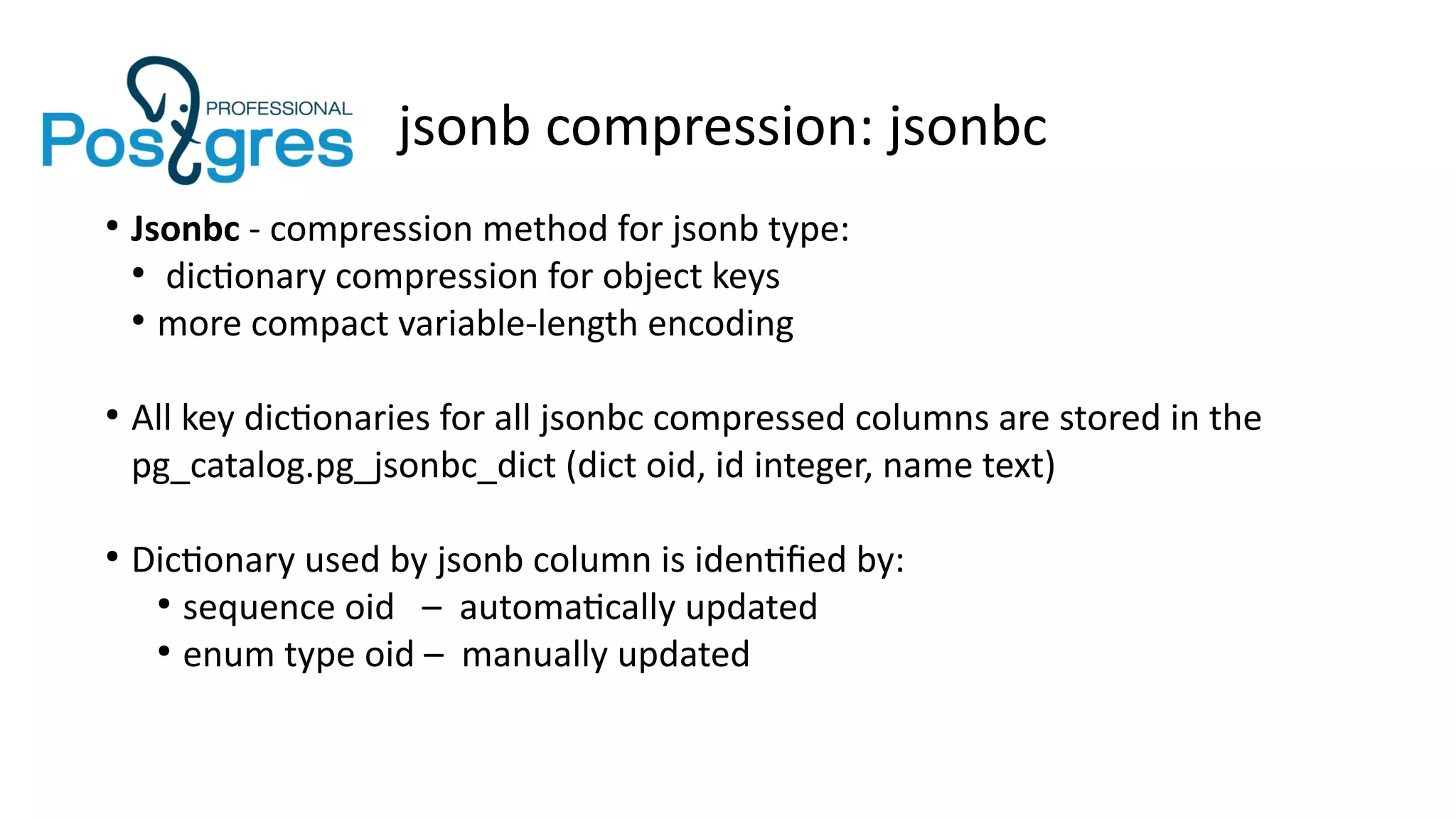
jsonb compression: jsonbc
●
Jsonbc - compression method for jsonb type:
●
dictionary compression for object keys
●
more compact variable-length encoding
●
All key dictionaries for all jsonbc compressed columns are stored in the
pg_catalog.pg_jsonbc_dict (dict oid, id integer, name text)
●
Dictionary used by jsonb column is identified by:
●
sequence oid – automatically updated
●
enum type oid – manually updated
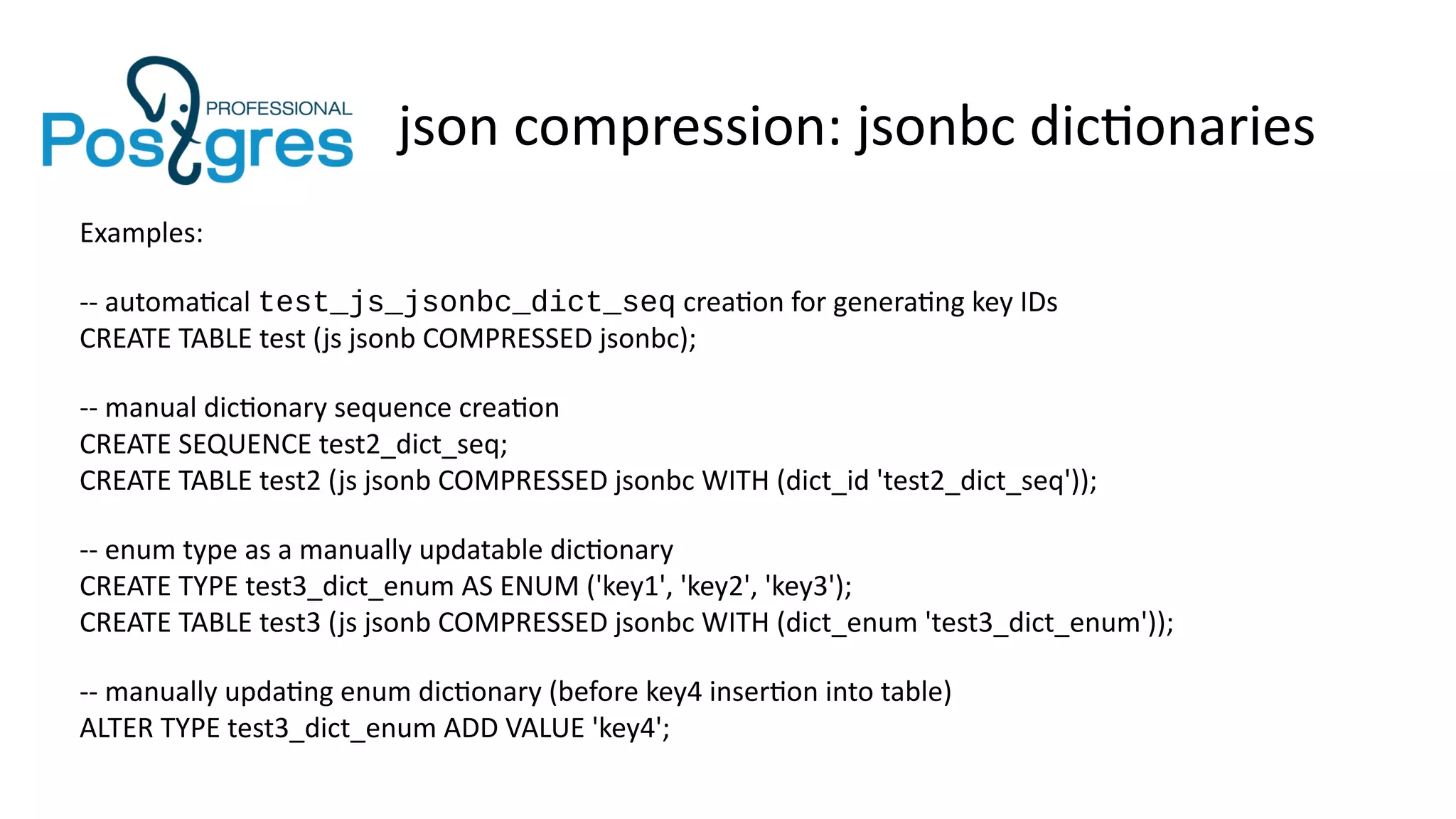
json compression: jsonbc dictionaries
Examples:
-- automatical test_js_jsonbc_dict_seq creation for generating key IDs
CREATE TABLE test (js jsonb COMPRESSED jsonbc);
-- manual dictionary sequence creation
CREATE SEQUENCE test2_dict_seq;
CREATE TABLE test2 (js jsonb COMPRESSED jsonbc WITH (dict_id 'test2_dict_seq'));
-- enum type as a manually updatable dictionary
CREATE TYPE test3_dict_enum AS ENUM ('key1', 'key2', 'key3');
CREATE TABLE test3 (js jsonb COMPRESSED jsonbc WITH (dict_enum 'test3_dict_enum'));
-- manually updating enum dictionary (before key4 insertion into table)
ALTER TYPE test3_dict_enum ADD VALUE 'key4';
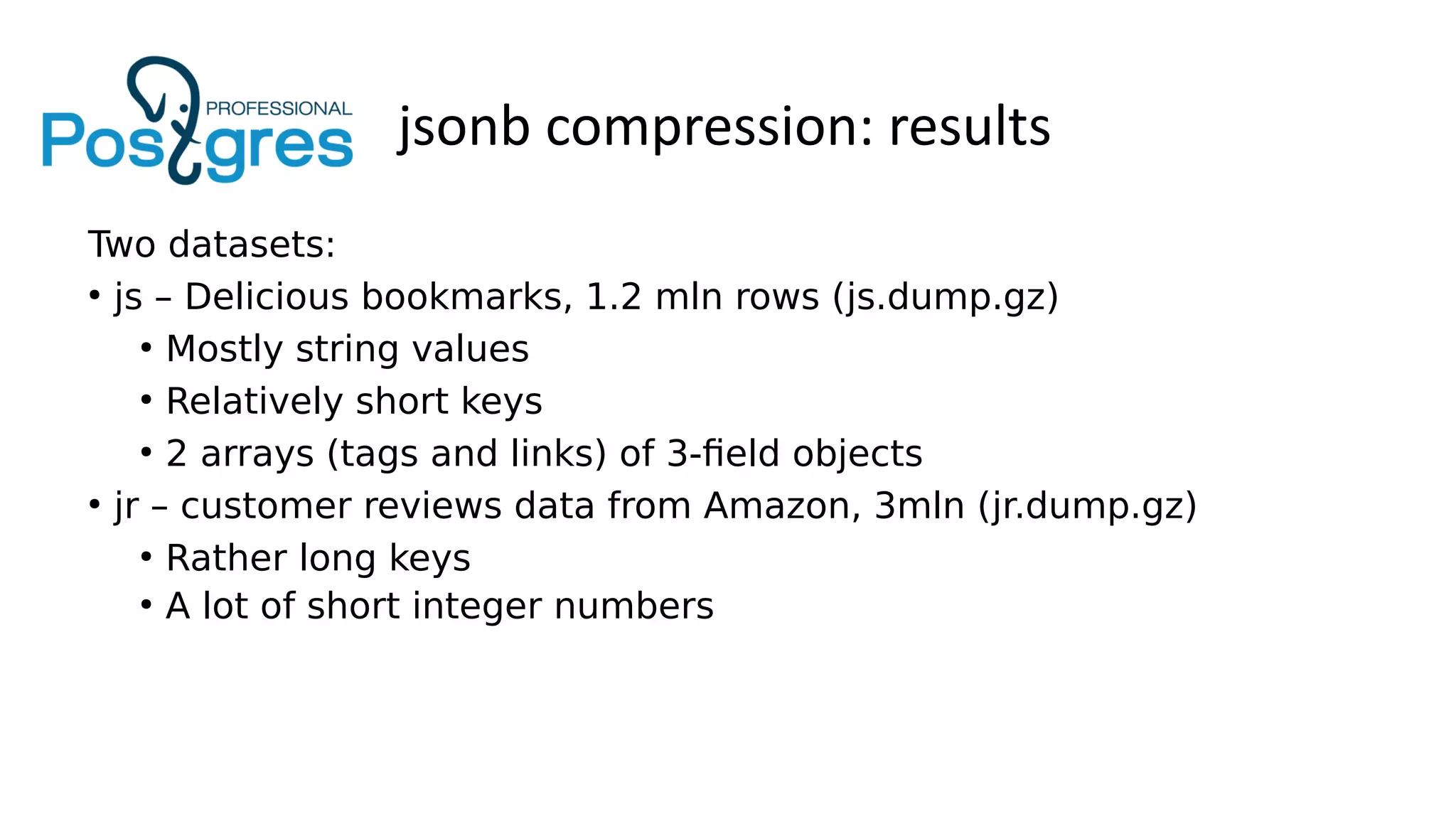
jsonb compression: results
Two datasets:
●
js – Delicious bookmarks, 1.2 mln rows (js.dump.gz)
●
Mostly string values
●
Relatively short keys
●
2 arrays (tags and links) of 3-field objects
●
jr – customer reviews data from Amazon, 3mln (jr.dump.gz)
●
Rather long keys
●
A lot of short integer numbers
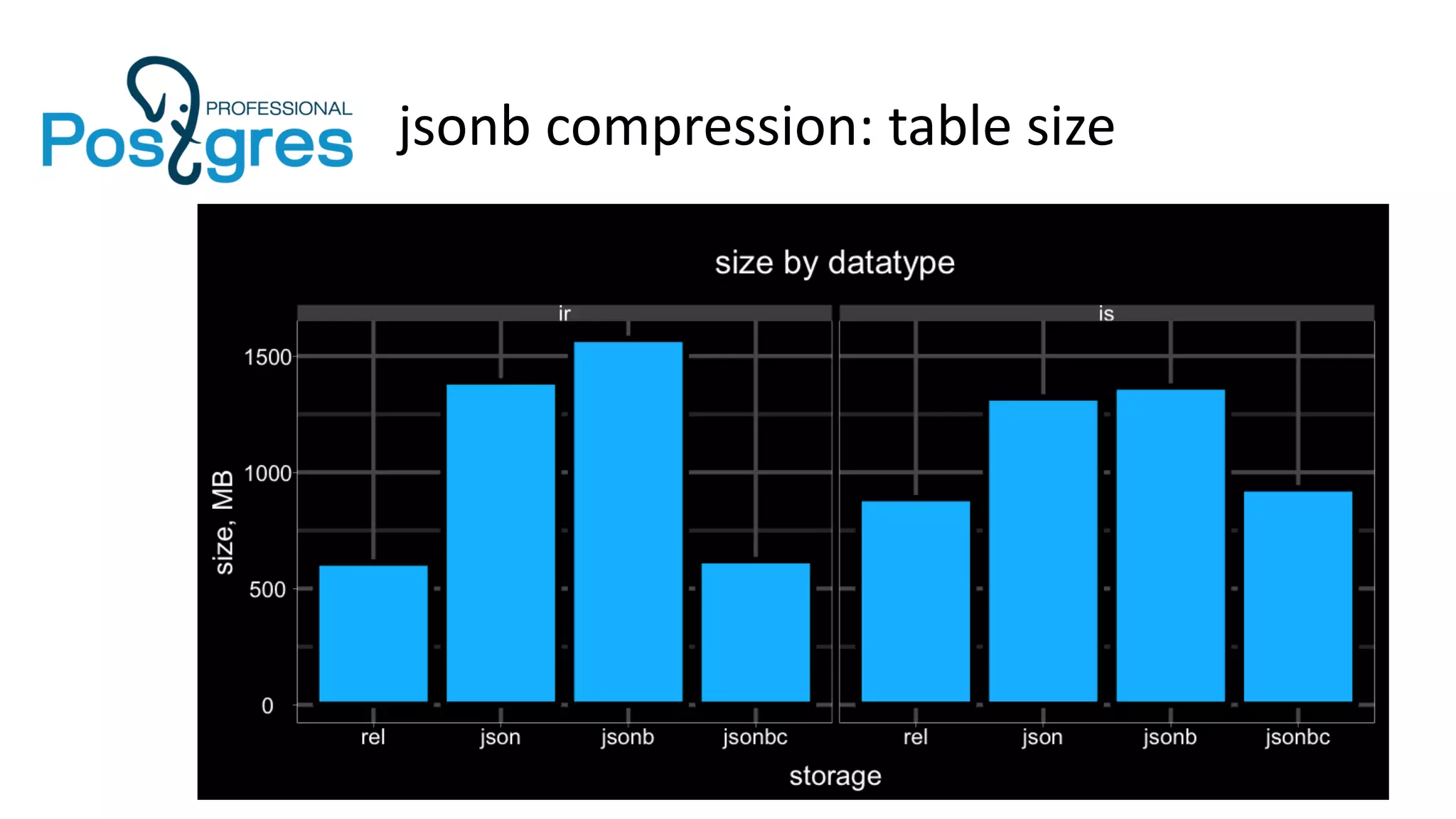
jsonb compression: table size
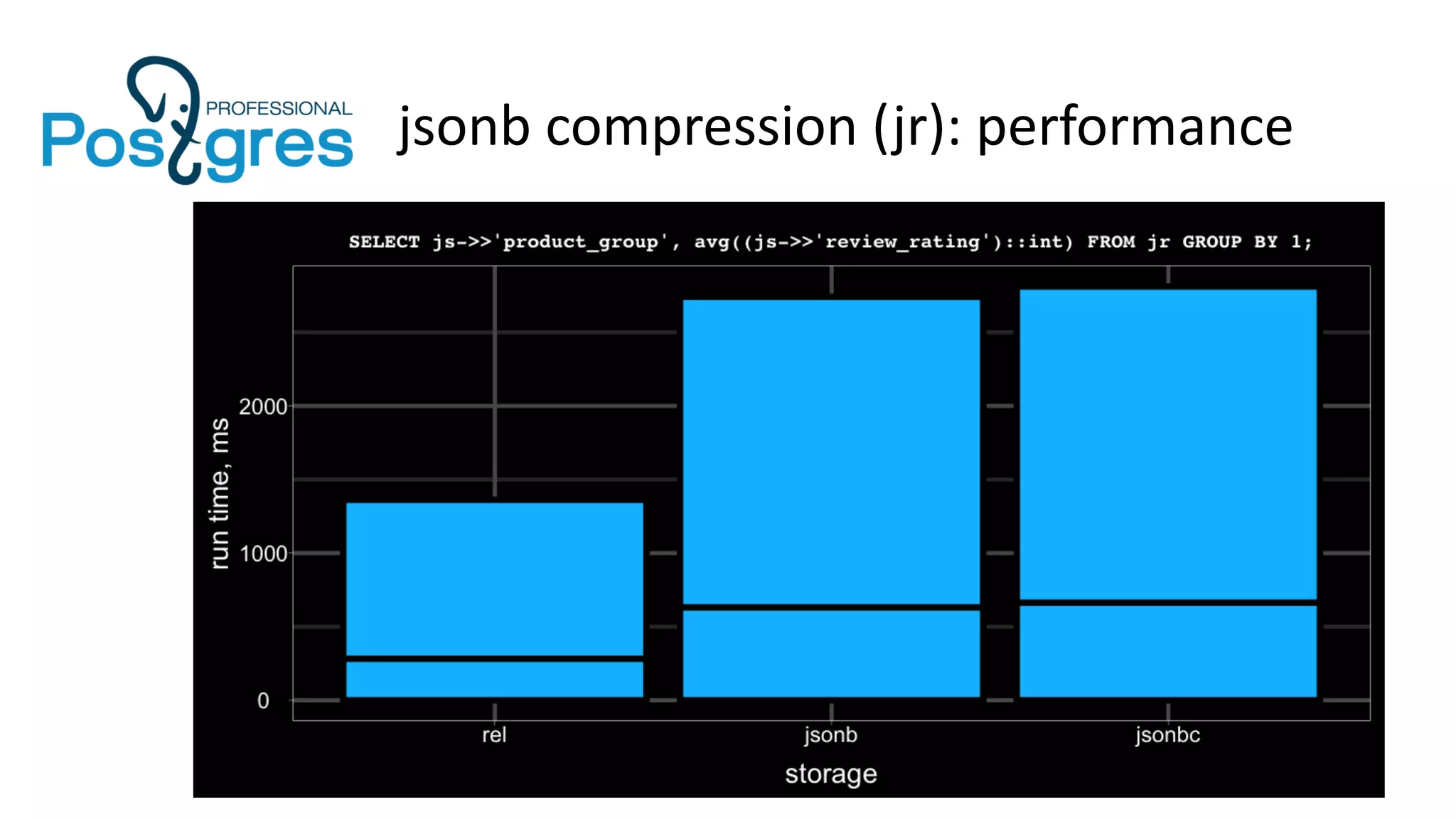
jsonb compression (jr): performance
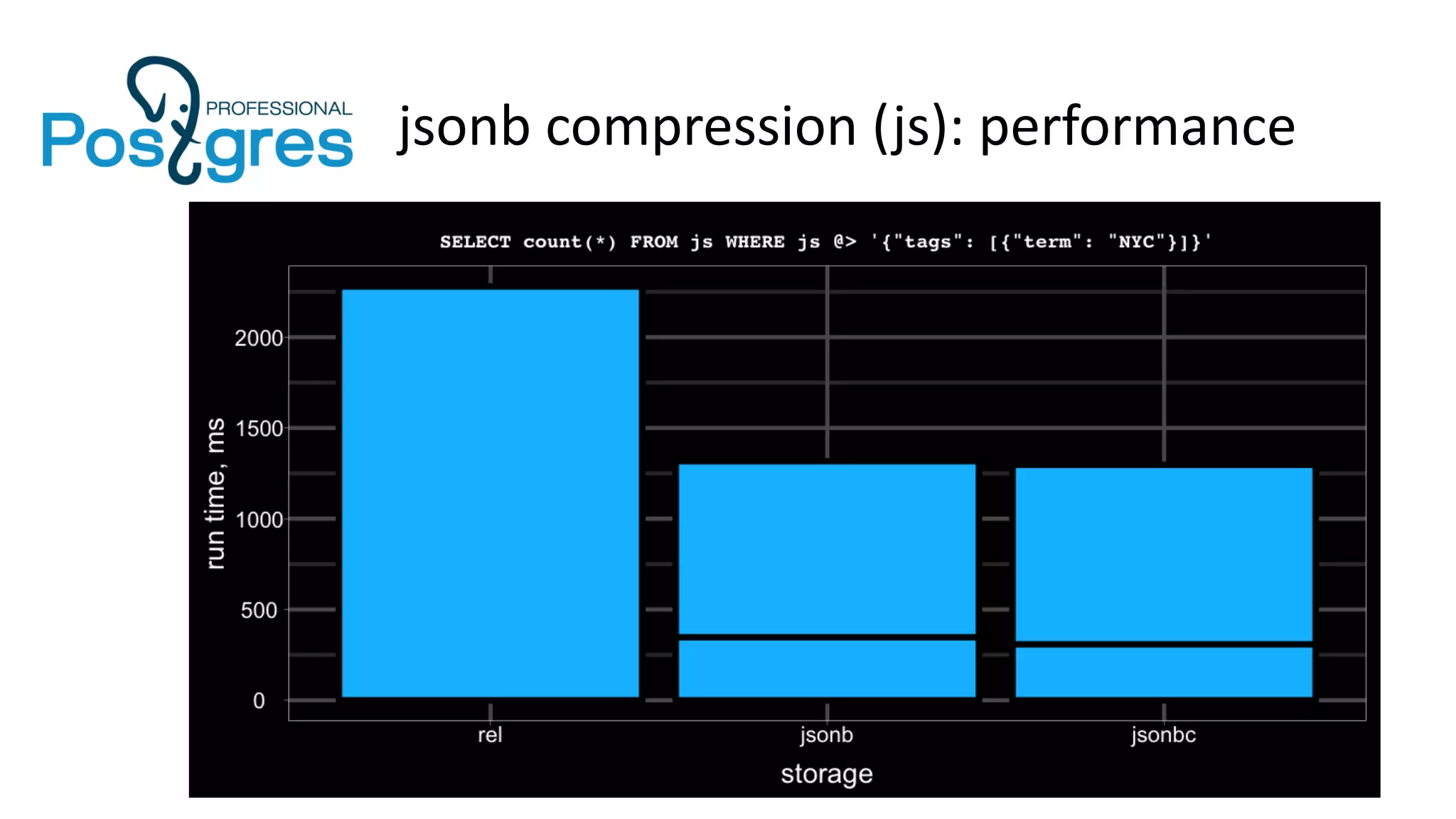
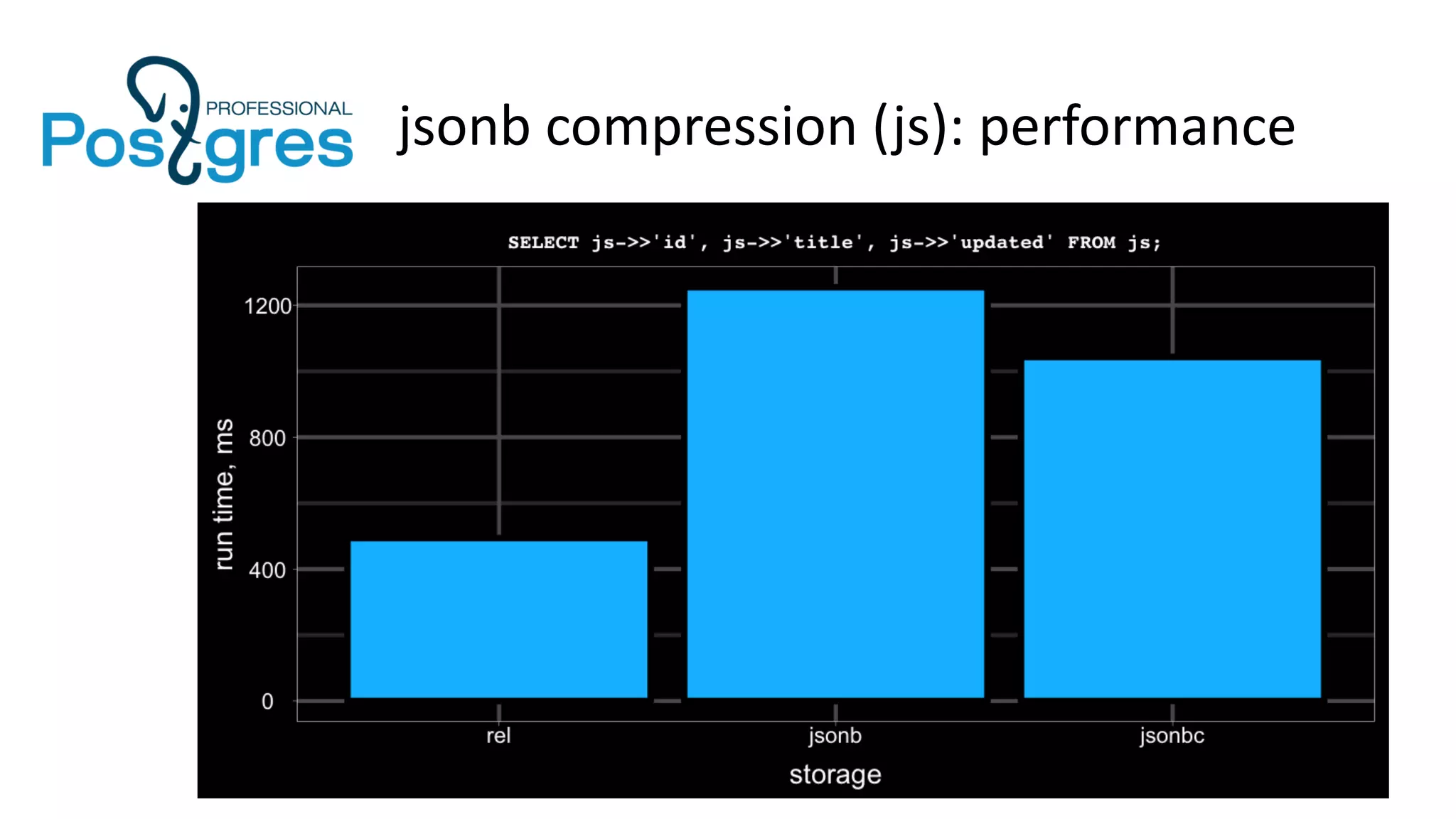
jsonb compression (js): performance
jsonb compression: jsonbc problems
●
Transactional dictionary updates
Currently, automatic dictionary updates uses background
workers, but autonomous transactions would be better
●
Cascading deletion of dictionaries not yet implementing.
Need to track dependency between columns and dictionaries
●
User compression methods for jsonb are not fully supported
(should we ?)
jsonb compression: summary
●
jsonbc can reduce jsonb column size to its relational
equivalent size
●
jsonbc has a very low CPU overhead over jsonb and
sometimes can be even faster than jsonb
●
jsonbc compression ratio is significantly lower than in page
level compression methods
●
Availability:
https://github.com/postgrespro/postgrespro/tree/jsonbc
JSON[B] Text Search
• tsvector(configuration, json[b]) in Postgres 10
select to_tsvector(jb) from (values ('
{
"abstract": "It is a very long story about true and false",
"title": "Peace and War",
"publisher": "Moscow International house"
}
'::json)) foo(jb);
to_tsvector
------------------------------------------------------------------------------------------
'fals':10 'hous':18 'intern':17 'long':5 'moscow':16 'peac':12 'stori':6 'true':8 'war':14
select to_tsvector(jb) from (values ('
{
"abstract": "It is a very long story about true and false",
"title": "Peace and War",
"publisher": "Moscow International house"
}
'::jsonb)) foo(jb);
to_tsvector
------------------------------------------------------------------------------------------
'fals':14 'hous':18 'intern':17 'long':9 'moscow':16 'peac':1 'stori':10 'true':12 'war':3
JSON[B] Text Search
• Phrase search is [properly] supported !
• Kudos to Dmitry Dolgov & Andrew Dunstan !
select phraseto_tsquery('english','war moscow') @@ to_tsvector(jb) from (values ('
{
"abstract": "It is a very long story about true and false",
"title": "Peace and War",
"publisher": "Moscow International house"
}
'::jsonb)) foo(jb);
?column?
----------
f
select phraseto_tsquery('english','moscow international') @@ to_tsvector(jb) from
(values ('
{
"abstract": "It is a very long story about true and false",
"title": "Peace and War",
"publisher": "Moscow International house"
}
'::jsonb)) foo(jb);
?column?
----------
t
Summary
• Postgres is already a good NoSQL database + clear roadmap
• Move from NoSQL to Postgres to avoid nightmare !
• SQL/JSON will provide better flexibility and interoperability
• Expect it in Postgres 11
• Need community help (testing, documentation)
• JSONB dictionary compression (jsonbc) is really useful
• Expect it in Postgres 11
PEOPLE BEHIND JSON[B]
Nikita Glukhov
Thanks !

Oh, that ubiquitous JSON !

  • 1.
    www.postgrespro.ru Oh, that ubiquitousJSON! Oleg Bartunov, Alexander Korotkov, Teodor Sigaev
  • 2.
    JSON way inPostgres • 2003 — hstore (sparse columns, schema-less) • 2006 — hstore as demo of GIN indexing, 8.2 release • 2012 (sep) — JSON in 9.2 (verify and store) • 2012 (dec) — nested hstore proposal • 2013 — PGCon, Ottawa: nested hstore • 2013 — PGCon.eu: binary storage for nested data • 2013 (nov) — nested hstore & jsonb (better/binary) • 2014 (feb-mar) — forget nested hstore for jsonb • Mar 23, 2014 — jsonb committed for 9.4 • Autumn, 2018 — SQL/JSON for 11? jsonb vs hstore
  • 3.
    Two JSON datatypes !!!
  • 4.
    Jsonb vs Json SELECTj::json AS json, j::jsonb AS jsonb FROM (SELECT '{"cc":0, "aa": 2, "aa":1,"b":1}' AS j) AS foo; json | jsonb ----------------------------------+---------------------------- {"cc":0, "aa": 2, "aa":1,"b":1} | {"b": 1, "aa": 1, "cc": 0} (1 row) • json: textual storage «as is» • jsonb: no whitespaces • jsonb: no duplicate keys, last key win • jsonb: keys are sorted by (length, key) • jsonb has a binary storage: no need to parse, has index support
  • 5.
    JSONB is great,BUT no good query language — jsonb is a «black box» for SQL
  • 6.
    Find color «red»somewhere • Table "public.js_test" Column | Type | Modifiers --------+---------+----------- id | integer | not null value | jsonb | select * from js_test; id | value ----+----------------------------------------------------------------------- 1 | [1, "a", true, {"b": "c", "f": false}] 2 | {"a": "blue", "t": [{"color": "red", "width": 100}]} 3 | [{"color": "red", "width": 100}] 4 | {"color": "red", "width": 100} 5 | {"a": "blue", "t": [{"color": "red", "width": 100}], "color": "red"} 6 | {"a": "blue", "t": [{"color": "blue", "width": 100}], "color": "red"} 7 | {"a": "blue", "t": [{"color": "blue", "width": 100}], "colr": "red"} 8 | {"a": "blue", "t": [{"color": "green", "width": 100}]} 9 | {"color": "green", "value": "red", "width": 100} (9 rows)
  • 7.
    Find color «red»somewhere • VERY COMPLEX SQL QUERY WITH RECURSIVE t(id, value) AS ( SELECT * FROM js_test UNION ALL ( SELECT t.id, COALESCE(kv.value, e.value) AS value FROM t LEFT JOIN LATERAL jsonb_each( CASE WHEN jsonb_typeof(t.value) = 'object' THEN t.value ELSE NULL END) kv ON true LEFT JOIN LATERAL jsonb_array_elements( CASE WHEN jsonb_typeof(t.value) = 'array' THEN t.value ELSE NULL END) e ON true WHERE kv.value IS NOT NULL OR e.value IS NOT NULL ) ) SELECT js_test.* FROM (SELECT id FROM t WHERE value @> '{"color": "red"}' GROUP BY id) x JOIN js_test ON js_test.id = x.id; id | value ----+----------------------------------------------------------------------- 2 | {"a": "blue", "t": [{"color": "red", "width": 100}]} 3 | [{"color": "red", "width": 100}] 4 | {"color": "red", "width": 100} 5 | {"a": "blue", "t": [{"color": "red", "width": 100}], "color": "red"} 6 | {"a": "blue", "t": [{"color": "blue", "width": 100}], "color": "red"} (5 rows)
  • 8.
  • 9.
    Find color «red»somewhere • WITH RECURSIVE t(id, value) AS ( SELECT * FROM js_test UNION ALL ( SELECT t.id, COALESCE(kv.value, e.value) AS value FROM t LEFT JOIN LATERAL jsonb_each( CASE WHEN jsonb_typeof(t.value) = 'object' THEN t.value ELSE NULL END) kv ON true LEFT JOIN LATERAL jsonb_array_elements( CASE WHEN jsonb_typeof(t.value) = 'array' THEN t.value ELSE NULL END) e ON true WHERE kv.value IS NOT NULL OR e.value IS NOT NULL ) ) SELECT js_test.* FROM (SELECT id FROM t WHERE value @> '{"color": "red"}' GROUP BY id) x JOIN js_test ON js_test.id = x.id; • Jsquery SELECT * FROM js_test WHERE value @@ '*.color = "red"'; https://github.com/postgrespro/jsquery • A language to query jsonb data type • Search in nested objects and arrays • More comparison operators with indexes support
  • 10.
  • 11.
    JSON in SQL-2016 •ISO/IEC 9075-2:2016(E) - https://www.iso.org/standard/63556.html • BNF https://github.com/elliotchance/sqltest/blob/master/standards/2016/bnf .txt • Discussed at Developers meeting Jan 28, 2017 in Brussels • Post -hackers, Feb 28, 2017 (March commitfest) «Attached patch is an implementation of SQL/JSON data model from SQL-2016 standard (ISO/IEC 9075-2:2016(E)), which was published 2016- 12-15 ...» • Patch was too big (now about 16,000 loc) and too late for Postgres 10 :(
  • 12.
    SQL/JSON in PostgreSQL •It‘s not a new data type, it‘s a JSON data model for SQL • PostgreSQL implementation is a subset of standard: • JSONB – ORDERED and UNIQUE KEYS • JSON – UNORDERED and NONUNIQUE KEYS • jsonpath data type for SQL/JSON path language • nine functions, implemented as SQL CLAUSEs
  • 13.
    SQL/JSON in PostgreSQL •The SQL/JSON construction functions: • JSON_OBJECT - serialization of an JSON object. • json[b]_build_object() • JSON_ARRAY - serialization of an JSON array. • json[b]_build_array() • JSON_ARRAYAGG - serialization of an JSON object from aggregation of SQL data • json[b]_agg() • JSON_OBJECTAGG - serialization of an JSON array from aggregation of SQL data • json[b]_object_agg()
  • 14.
    SQL/JSON in PostgreSQL JSON_OBJECT( [{ expression { VALUE | ':' } json_value_expression }[, ...]] [ { NULL | ABSENT } ON NULL] [ { WITH | WITHOUT } UNIQUE [ KEYS ] ] [ RETURNING data_type [ FORMAT json_representation ] ] ) ... RETURNING {JSON|JSONB|TEXT|BYTEA} ... FORMAT {JSON [ ENCODING { UTF8 | UTF16 | UTF32 } ] | JSONB}
  • 15.
    RETURNING … FORMAT… o_O x RETURNING x RETURNING x FORMAT json[b]* RETURNING x FORMAT json ENCONDING … * bytea (cast without function) + + + string types + + – json[b]** + + – all other + – – Looks like managable cast Returns binary representation of given encoding * In standard, it was designed for DBMS which doesn't have special JSON datatype ** This is our PostgreSQL-specific extension since it has json[b] datatypes
  • 16.
    SQL/JSON in PostgreSQL SELECTJSON_OBJECT( 'key1': 'string', 'key2' VALUE 123, -- alternative syntax for key-value delimiter, but no KEY keyword 'key3': TRUE, 'key4': ARRAY[1, 2, 3], -- postgres arrays 'key5': jsonb '{"a": ["b", 1]}', -- composite json/jsonb 'key6': date '18.03.2017', -- datetime types 'key7': row(1, 'a') -- row types ); {"key1" : "string", "key2" : 123, "key3" : true, "key4" : [1,2,3], "key5" : {"a": ["b", 1]}}
  • 17.
    SQL/JSON in PostgreSQL --used json[b]_build_object() SELECT JSON_OBJECT('a': 1); SELECT JSON_OBJECT('a': 1 RETURNING json); SELECT JSON_OBJECT('a': 1 RETURNING jsonb); -- used json[b]_build_object()::text SELECT JSON_OBJECT('a': 1 RETURNING text FORMAT json); -- used convert_to(json_build_object()::text, 'UTF8') SELECT JSON_OBJECT('a': 1 RETURNING bytea FORMAT JSON ENCODING UTF8);
  • 18.
    SQL/JSON in PostgreSQL InputFORMAT clause (equivalent to ::json/::jsonb): SELECT JSON_OBJECT('a': '[1, 2, 3]' FORMAT JSON); {"a" : [1, 2, 3]} SELECT JSON_OBJECT('a': '[1, 2, 3]'); {"a" : "[1, 2, 3]"} SELECT JSON_OBJECT('a': bytea 'x5b312c20322c20335d' FORMAT JSON); {"a" : [1, 2, 3]} SELECT JSON_OBJECT('a': bytea 'x5b312c20322c20335d'); {"a" : "x5b312c20322c20335d"}
  • 19.
    SQL/JSON in PostgreSQL Options: WITH/WITHOUTUNIQUE KEYS constraint (WITHOUT by default) SELECT JSON_OBJECT('a': 1, 'a': 2 WITH UNIQUE KEYS); ERROR: duplicate JSON key "a" NULL/ABSENT ON NULL (NULL by default): skip NULL values or not SELECT JSON_OBJECT('a': 1, 'b': NULL NULL ON NULL); {"a" : 1, "b": null} SELECT JSON_OBJECT('a': 1, 'b': NULL ABSENT ON NULL); {"a" : 1} NULL keys are not allowed.
  • 20.
    SQL/JSON in PostgreSQL JSON_ARRAY( [json_value_expression [, ...]] [ { NULL | ABSENT } ON NULL ] [ RETURNING data_type [ FORMAT json_representation [ENCODING ...] ] ] ) SELECT JSON_ARRAY( 'string', 123, TRUE, ARRAY[1,2,3], jsonb '{"a": ["b", 1]}' ); ["string", 123, true, [1,2,3], {"a": ["b", 1]}]
  • 21.
    SQL/JSON in PostgreSQL Additionaloptions: NULL/ABSENT ON NULL (ABSENT by default) SELECT JSON_ARRAY(1, NULL, 'a' NULL ON NULL); -> [1, null, "a"] SELECT JSON_ARRAY(1, NULL, 'a' ABSENT ON NULL); -> [1, "a"] Subquery as an argument: JSON_ARRAY ( query_expression [ { NULL | ABSENT } ON NULL ] [ RETURNING data_type [ FORMAT json_representation ] ] ) SELECT JSON_ARRAY(SELECT * FROM generate_series(1, 3)); -> [1, 2, 3]
  • 22.
    SQL/JSON in PostgreSQL SELECTJSON_ARRAYAGG(i) FROM generate_series(1, 5) i; [1, 2, 3, 4, 5] SELECT JSON_OBJECTAGG('key' || i : 'val' || i) FROM generate_series(1, 3) i; { "key1" : "val1", "key2" : "val2", "key3" : "val3" }
  • 23.
    SQL/JSON in PostgreSQL •The SQL/JSON retrieval functions: • JSON_VALUE - Extract an SQL value of a predefined type from a JSON value. • JSON_QUERY - Extract a JSON text from a JSON text using an SQL/JSON path expression. • JSON_TABLE - Query a JSON text and present it as a relational table. • IS [NOT] JSON - test whether a string value is a JSON text. • JSON_EXISTS - test whether a JSON path expression returns any SQL/JSON items
  • 24.
    SQL/JSON in PostgreSQL SELECT Js, jsIS JSON "is json", js IS JSON SCALAR "is scalar", js IS JSON OBJECT "is object", js IS JSON ARRAY "is array" FROM (VALUES ('123'), ('"abc"'), ('{"a": "b"}'), ('[1,2]'), ('abc')) foo(js); js | is json | is scalar | is object | is array 123 | t | t | f | f "abc" | t | t | f | f {"a": "b"} | t | f | t | f [1,2] | t | f | f | t abc | f | f | f | f
  • 25.
    SQL/JSON in PostgreSQL •Jsonpathprovides an ability to operate (in standard specified way) with json structure at SQL-language level • Dot notation — $.a.b.c • Array - [*], [1], [1,2], [1 to 10], [last] • Filter ? - $.a.b.c ? (@.x > 10) • Methods - $.a.b.c.x.type() • Implemented as datatype SELECT * FROM js WHERE JSON_EXISTS(js, 'strict $.tags[*] ? (@.term == "NYC")'); SELECT * FROM js WHERE js @> '{"tags": [{"term": "NYC"}]}';
  • 26.
    SQL/JSON in PostgreSQL --root extraction JSON_QUERY('{"a": {"b" : 1}, "c": 2}', '$') ; -> {"a": {"b" : 1}, "c": 2} -- simple path extraction JSON_QUERY('{"a": {"b" : 1}, "c": 2}', '$.a') -> {"b": 1} JSON_QUERY('{"a": {"b" : 1}, "c": 2}', '$.a.b') -> 1 -- wildcard key extraction JSON_QUERY('{"a": {"b" : 1}, "c": 2}', '$.*' WITH WRAPPER) -> [{"b" : 1}, 2]
  • 27.
    SQL/JSON in PostgreSQL --automatic unwrapping of arrays in lax mode JSON_QUERY('[{"a": 1}, {"a": 2}]', 'lax $.a' WITH WRAPPER) [1, 2] -- error if accessing members of non-object items in strict mode JSON_QUERY(jsonb '[{"a": 1}, {"a": 2}]', 'strict $.a' WITH WRAPPER ERROR ON ERROR); ERROR: SQL/JSON member not found
  • 28.
    SQL/JSON in PostgreSQL JSON_QUERY('[1, 1.3, -3, -3.8]', '$[*].ceiling()' WITH WRAPPER) [1, 2, -3, -3] -- .datetime(): convert string to datetime type using standard formats -- date JSON_QUERY('"2017-03-21"', '$.datetime()') "2017-03-21" JSON_QUERY('"2017-03-21"', '$.datetime().type()') "date"
  • 29.
    SQL/JSON in PostgreSQL SELECTJSON_EXISTS(jsonb '{"a": 1, "b": 2}', '$.* ? (@ > $x && @ < $y)' PASSING 0 AS x, 2 AS y); ?column? ---------- t (1 row) SELECT JSON_EXISTS(jsonb '{"a": 1, "b": 2}', '$.* ? (@ > $x && @ < $y)' PASSING 0 AS x, 1 AS y); ?column? ---------- f (1 row)
  • 30.
    SQL/JSON in PostgreSQL --using jsonb path variables -- (selection of all elements of $[] containing in $js[]) JSON_QUERY('[1, 2, 3, 4]', '$[*] ? (@ == $js[*])' PASSING jsonb '[2, 3, 4, 5]' AS js WITH WRAPPER) [2, 3, 4] -- using datetime path variables JSON_QUERY('["01.01.17", "21.03.17", "01.01.18"]', '$[*] ? (@.datetime("dd.mm.yy") >= $date)' PASSING date '21.03.17' AS date WITH WRAPPER) ["21.03.17", "01.01.18"]
  • 31.
    SQL/JSON in PostgreSQL(Extention) -- object subscripting JSON_QUERY('{"a": 1, "b": 2}', '$[$field]' PASSING 'a' AS field) 1 -- map item method JSON_QUERY('[1,2,3]', '$.map(@ + 10)') [11, 12, 13] -- boolean expressions JSON_VALUE('[1,2,3]', '$[*] > 2' RETURNING bool) t
  • 32.
    SQL/JSON in PostgreSQL JSON_EXISTS( json_api_common_syntax [ { TRUE | FALSE | UNKNOWN | ERROR } ON ERROR ] ) - analogous to jsonb '{"a": 1}' ? 'a' SELECT JSON_EXISTS(jsonb '{"a": 1}', 'strict $.a'); SELECT JSON_EXISTS(jsonb '{"a": [1,2,3]}', 'strict $.a[*] ? (@ > 2)'); Error behavior (FALSE by default): SELECT JSON_EXISTS(jsonb '{"a": [1,2,3]}', 'strict $.a[5]' ERROR ON ERROR); ERROR: Invalid SQL/JSON subscript SELECT JSON_EXISTS(jsonb '{"a": [1,2,3]}', 'lax $.a[5]' ERROR ON ERROR); f
  • 33.
    SQL/JSON in PostgreSQL NativePostgres arrays, record and domain types are also supported for RETURNING (analogous to json[b]_populate_record()): SELECT JSON_QUERY(jsonb '[1,null,"3"]', '$[*]' RETURNING int[] WITH WRAPPER); {1,NULL,3} CREATE TYPE rec AS (i int, t text, js json[]); SELECT * FROM JSON_QUERY(jsonb '{"i": 123, "js": [1, "foo", {}]}', '$' RETURNING rec); i | t | js -----+---+-------------------- 123 | | {1,""foo"","{}"} (1 row)
  • 34.
    SQL/JSON examples: JSON_VALUE SELECTx, JSON_VALUE(jsonb '{"a": 1, "b": 2}','$.* ? (@ > $x)' PASSING x AS x RETURNING int DEFAULT -1 ON EMPTY DEFAULT -2 ON ERROR ) y FROM generate_series(0, 2) x; x | y ---+---- 0 | -2 1 | 2 2 | -1 (3 rows)
  • 35.
    SQL/JSON examples: JSON_QUERY SELECT JSON_QUERY(jsFORMAT JSONB, '$'), JSON_QUERY(js FORMAT JSONB, '$' WITHOUT WRAPPER), JSON_QUERY(js FORMAT JSONB, '$' WITH CONDITIONAL ARRAY WRAPPER), JSON_QUERY(js FORMAT JSONB, '$' WITH UNCONDITIONAL ARRAY WRAPPER), JSON_QUERY(js FORMAT JSONB, '$' WITH ARRAY WRAPPER) FROM (VALUES ('null'), ('12.3'), ('true'), ('"aaa"'), ('[1, null, "2"]'), ('{"a": 1, "b": [2]}') ) foo(js); ?column? | ?column? | ?column? | ?column? | ?column? --------------------+--------------------+--------------------+----------------------+---------------------- null | null | [null] | [null] | [null] 12.3 | 12.3 | [12.3] | [12.3] | [12.3] true | true | [true] | [true] | [true] "aaa" | "aaa" | ["aaa"] | ["aaa"] | ["aaa"] [1, null, "2"] | [1, null, "2"] | [1, null, "2"] | [[1, null, "2"]] | [[1, null, "2"]] {"a": 1, "b": [2]} | {"a": 1, "b": [2]} | {"a": 1, "b": [2]} | [{"a": 1, "b": [2]}] | [{"a": 1, "b": [2]}] (6 rows)
  • 36.
    SQL/JSON examples: Constraints CREATETABLE test_json_constraints ( js text, i int, x jsonb DEFAULT JSON_QUERY(jsonb '[1,2]', '$[*]' WITH WRAPPER) CONSTRAINT test_json_constraint1 CHECK (js IS JSON) CONSTRAINT test_json_constraint2 CHECK (JSON_EXISTS(js FORMAT JSONB, '$.a' PASSING i + 5 AS int, i::text AS txt)) CONSTRAINT test_json_constraint3 CHECK (JSON_VALUE(js::jsonb, '$.a' RETURNING int DEFAULT ('12' || i)::int ON EMPTY ERROR ON ERROR) > i) CONSTRAINT test_json_constraint4 CHECK (JSON_QUERY(js FORMAT JSONB, '$.a' WITH CONDITIONAL WRAPPER EMPTY OBJECT ON ERROR) < jsonb '[10]') );
  • 37.
    SQL/JSON examples: JSON_TABLE •Creates a relational view of JSON data. • Think about UNNEST — creates a row for each object inside JSON array and represent JSON values from within that object as SQL columns values. • Example: Delicious bookmark • Convert JSON data (1369 MB) to their relational data Table "public.js" Column | Type | Collation | Nullable | Default --------+-------+-----------+----------+--------- js | jsonb | | |
  • 38.
  • 40.
    SQL/JSON examples: JSON_TABLE •Example: Delicious bookmark • Convert JSON data (1369 MB) to their relational data (2615 MB) Table "public.js_rel" Column | Type | Collation | Nullable | Default ----------------+--------------------------+-----------+----------+--------- id | text | | | link | text | | | author | text | | | title | text | | | base | text | | | title_type | text | | | value | text | | | language | text | | | updated | timestamp with time zone | | | comments | text | | | wfw_commentrss | text | | | guid_is_link | boolean | | | tag_term | text | | | tag_scheme | text | | | link_rel | text | | | link_href | text | | | link_type | text | | |
  • 41.
    Find color «red»somewhere • WITH RECURSIVE t(id, value) AS ( SELECT * FROM js_test UNION ALL ( SELECT t.id, COALESCE(kv.value, e.value) AS value FROM t LEFT JOIN LATERAL jsonb_each( CASE WHEN jsonb_typeof(t.value) = 'object' THEN t.value ELSE NULL END) kv ON true LEFT JOIN LATERAL jsonb_array_elements( CASE WHEN jsonb_typeof(t.value) = 'array' THEN t.value ELSE NULL END) e ON true WHERE kv.value IS NOT NULL OR e.value IS NOT NULL ) ) SELECT js_test.* FROM (SELECT id FROM t WHERE value @> '{"color": "red"}' GROUP BY id) x JOIN js_test ON js_test.id = x.id; • Jsquery SELECT * FROM js_test WHERE value @@ '*.color = "red"'; • SQL/JSON 2016 SELECT * FROM js_test WHERE JSON_EXISTS( value,'$.**.color ? (@ == "red")');
  • 42.
    SQL/JSON availability • GithubPostgres Professional repository https://github.com/postgrespro/sqljson • SQL/JSON examples • WEB-interface to play with SQL/JSON • BNF of SQL/JSON • We need your feedback, bug reports and suggestions • Help us writing documentation !
  • 43.
    JSONB - 2014 ● Binarystorage ● Nesting objects & arrays ● Indexing HSTORE - 2003 ● Perl-like hash storage ● No nesting ● Indexing JSON - 2012 ● Textual storage ● JSON verification SQL/JSON - 2018 ● SQL-2016 standard
  • 44.
    SQL/JSON TODO '$.sort(@.a)' '$.sortBy(@.a)' '$.sortWith($1 >$2)' '$.partition(@ > 5)' '$.groupBy(@.a)' '$.indexWhere(@ > 5)' '$.a.zip($.b)' or '$.a zip $.b' '$.a.zipWithIndex()' JSON path :: casts Postgres operators '$.tags @> [{"term": "NYC"}]' -- what about == and && '$.a::text || "abc"' Item methods '$.sum()' '$.avg()' '$.indexOf(5)' '$.indexWhere(@ > 5)' '$.maxBy(@.a)'
  • 45.
    SQL/JSON ToDO Postgres functions(including aggregate) support '$.a[*].map(lower(@))' -- lower(text) used as a function '$.a[*].lower()' -- lower(text) used as an item method '$.a[*].concat('foo')' -- concat(any, ...) used as an item method 'avg($.a[*])' -- avg(numeric) aggregate function Postgres operators support ??? (remember &&, ||, ==) Item aliases, named parameters in lambdas ??? Reusing PostgreSQL executor???
  • 46.
    SQL/JSON ToDO SQL/JSON functions SRF(it seems hard to implement now) JSON_QUERY(json, jsonpath RETURNING SETOF type) JSON_ITEMS(json, jsonpath) Insert JSON_INSERT('{"a": 1}', '$.b = 2') -- {a:1, b:2} JSON_INSERT('[1,2,3]', '$[0] = 0') -- [0,1,2,3] JSON_INSERT('[1,2,3]', '$[last] = 4') -- [1,2,3,4]
  • 47.
    SQL/JSON ToDO SQL/JSON functions Delete JSON_DELETE('{"a":{"b": 1}, "c": 2}', '$.a.b, $.c') -- {"a":{}} JSON_DELETE('[1,2,3,4,5]', '$[*] ? (@ > 3)') -- [1,2,3] Update JSON_UPDATE('{"counter": 1}', '$.counter = $.counter + 1') JSON_UPDATE('{"counter": 1}', '$.counter = (@ + $increment)' PASSING 5 AS increment) JSON_UPDATE('[1,2,3]', '$[*] = (@ + 1)') JSON_UPDATE('{"a": 1, "b": 2}', '$.a = (@ + 1), $.b = (@ - 1)') It might be very useful to combine somehow multiple modification operations into a single expression
  • 48.
  • 49.
    Transparent compression ofjsonb + access to the child elements without full decompression JSONB COMPRESSION
  • 50.
    jsonb compression: motivation ● Longobject keys repeated in each document is a waste of a lot of space ● Fixed-size object/array entries overhead is significant for short fields: ● 4 bytes per array element ● 8 bytes per object pair ● Numbers stored as postgres numerics — overhead for the short integers: ● 1-4-digit integers – 8 bytes ● 5-8-digit integers – 12 bytes
  • 51.
    jsonb compression: ideas ● Keysreplaced by their ID in the external dictionary ● Delta coding for sorted key ID arrays ● Variable-length encoded entries instead of 4-byte fixed-size entries ● Chunked encoding for entry arrays ● Storing integer numerics falling into int32 range as variable-length encoded 4-byte integers
  • 52.
    jsonb compression: implementation ● Customcolumn compression methods: CREATE COMPRESSION METHOD name HANDLER handler_func CREATE TABLE table_name ( column_name data_type [ COMPRESSED cm_name [ WITH (option 'value' [, ... ]) ] ] ... ) ALTER TABLE table_name ALTER column_name SET COMPRESSED cm_name [ WITH (option 'value' [, ... ]) ] ALTER TYPE data_type SET COMPRESSED cm_name ● attcompression, attcmoptions in pg_catalog.pg_attributes
  • 53.
    jsonb compression: jsonbc ● Jsonbc- compression method for jsonb type: ● dictionary compression for object keys ● more compact variable-length encoding ● All key dictionaries for all jsonbc compressed columns are stored in the pg_catalog.pg_jsonbc_dict (dict oid, id integer, name text) ● Dictionary used by jsonb column is identified by: ● sequence oid – automatically updated ● enum type oid – manually updated
  • 54.
    json compression: jsonbcdictionaries Examples: -- automatical test_js_jsonbc_dict_seq creation for generating key IDs CREATE TABLE test (js jsonb COMPRESSED jsonbc); -- manual dictionary sequence creation CREATE SEQUENCE test2_dict_seq; CREATE TABLE test2 (js jsonb COMPRESSED jsonbc WITH (dict_id 'test2_dict_seq')); -- enum type as a manually updatable dictionary CREATE TYPE test3_dict_enum AS ENUM ('key1', 'key2', 'key3'); CREATE TABLE test3 (js jsonb COMPRESSED jsonbc WITH (dict_enum 'test3_dict_enum')); -- manually updating enum dictionary (before key4 insertion into table) ALTER TYPE test3_dict_enum ADD VALUE 'key4';
  • 55.
    jsonb compression: results Twodatasets: ● js – Delicious bookmarks, 1.2 mln rows (js.dump.gz) ● Mostly string values ● Relatively short keys ● 2 arrays (tags and links) of 3-field objects ● jr – customer reviews data from Amazon, 3mln (jr.dump.gz) ● Rather long keys ● A lot of short integer numbers
  • 56.
  • 57.
  • 58.
  • 59.
  • 60.
    jsonb compression: jsonbcproblems ● Transactional dictionary updates Currently, automatic dictionary updates uses background workers, but autonomous transactions would be better ● Cascading deletion of dictionaries not yet implementing. Need to track dependency between columns and dictionaries ● User compression methods for jsonb are not fully supported (should we ?)
  • 61.
    jsonb compression: summary ● jsonbccan reduce jsonb column size to its relational equivalent size ● jsonbc has a very low CPU overhead over jsonb and sometimes can be even faster than jsonb ● jsonbc compression ratio is significantly lower than in page level compression methods ● Availability: https://github.com/postgrespro/postgrespro/tree/jsonbc
  • 62.
    JSON[B] Text Search •tsvector(configuration, json[b]) in Postgres 10 select to_tsvector(jb) from (values (' { "abstract": "It is a very long story about true and false", "title": "Peace and War", "publisher": "Moscow International house" } '::json)) foo(jb); to_tsvector ------------------------------------------------------------------------------------------ 'fals':10 'hous':18 'intern':17 'long':5 'moscow':16 'peac':12 'stori':6 'true':8 'war':14 select to_tsvector(jb) from (values (' { "abstract": "It is a very long story about true and false", "title": "Peace and War", "publisher": "Moscow International house" } '::jsonb)) foo(jb); to_tsvector ------------------------------------------------------------------------------------------ 'fals':14 'hous':18 'intern':17 'long':9 'moscow':16 'peac':1 'stori':10 'true':12 'war':3
  • 63.
    JSON[B] Text Search •Phrase search is [properly] supported ! • Kudos to Dmitry Dolgov & Andrew Dunstan ! select phraseto_tsquery('english','war moscow') @@ to_tsvector(jb) from (values (' { "abstract": "It is a very long story about true and false", "title": "Peace and War", "publisher": "Moscow International house" } '::jsonb)) foo(jb); ?column? ---------- f select phraseto_tsquery('english','moscow international') @@ to_tsvector(jb) from (values (' { "abstract": "It is a very long story about true and false", "title": "Peace and War", "publisher": "Moscow International house" } '::jsonb)) foo(jb); ?column? ---------- t
  • 64.
    Summary • Postgres isalready a good NoSQL database + clear roadmap • Move from NoSQL to Postgres to avoid nightmare ! • SQL/JSON will provide better flexibility and interoperability • Expect it in Postgres 11 • Need community help (testing, documentation) • JSONB dictionary compression (jsonbc) is really useful • Expect it in Postgres 11
  • 65.
  • 66.