Brute Force Attack Detection and Mitigation using a SIEM Architecture
Pamela Dempster BEng (Hons) Computer Systems and Networks 40096050@live.napier.ac.uk
Supervisor: Professor W Buchanan Second Marker: Richard Macfarlane
Pamela Dempster BEng (Hons) Computer Systems and Networks 40096050@live.napier.ac.uk
Supervisor: Professor W Buchanan Second Marker: Richard Macfarlane
1. Motivation 4. Implementation 5. Results and Conclusion
2. Aims and Objectives
3. Design and Methodology
With the rise in the number of attacks and the increase in
complexity of these attacks, the traditional layers of
defence; Demilitarized Zones (DMZ), Firewalls (hardware
or software), Intrusion Detection Systems (IDS) and
Intrusion Protection Systems (IPS) are no longer enough
to keep organisations systems and data secure.
Implementing SIEM software with the ability to collect
and analyse large amounts of data from various sources,
gives companies a further layer of defence and the
opportunity to detect and mitigate against these attacks
and future attacks.
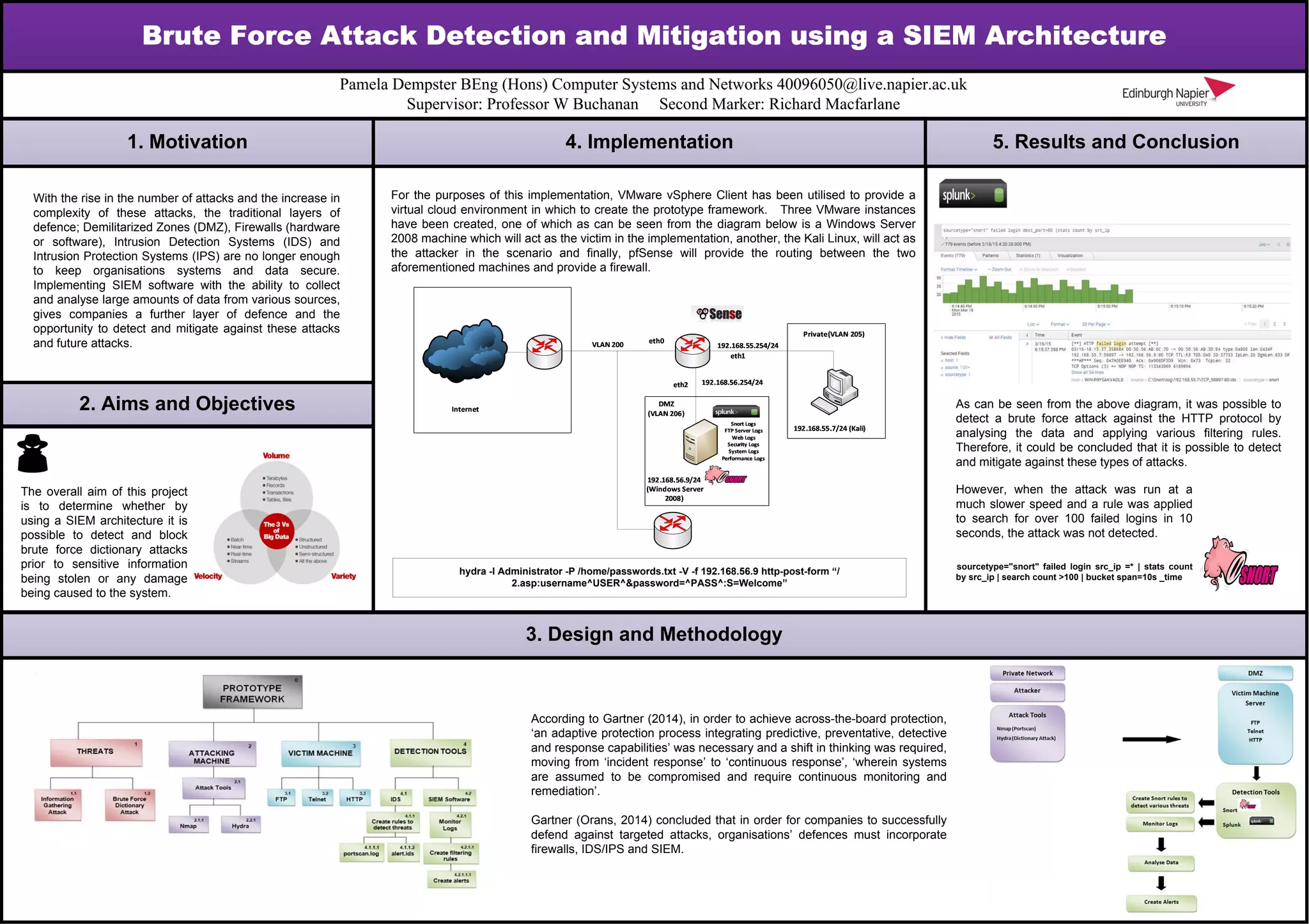
For the purposes of this implementation, VMware vSphere Client has been utilised to provide a
virtual cloud environment in which to create the prototype framework. Three VMware instances
have been created, one of which as can be seen from the diagram below is a Windows Server
2008 machine which will act as the victim in the implementation, another, the Kali Linux, will act as
the attacker in the scenario and finally, pfSense will provide the routing between the two
aforementioned machines and provide a firewall.
The overall aim of this project
is to determine whether by
using a SIEM architecture it is
possible to detect and block
brute force dictionary attacks
prior to sensitive information
being stolen or any damage
being caused to the system.
As can be seen from the above diagram, it was possible to
detect a brute force attack against the HTTP protocol by
analysing the data and applying various filtering rules.
Therefore, it could be concluded that it is possible to detect
and mitigate against these types of attacks.
However, when the attack was run at a
much slower speed and a rule was applied
to search for over 100 failed logins in 10
seconds, the attack was not detected.
sourcetype="snort" failed login src_ip =* | stats count
by src_ip | search count >100 | bucket span=10s _time
According to Gartner (2014), in order to achieve across-the-board protection,
‘an adaptive protection process integrating predictive, preventative, detective
and response capabilities’ was necessary and a shift in thinking was required,
moving from ‘incident response’ to ‘continuous response’, ‘wherein systems
are assumed to be compromised and require continuous monitoring and
remediation’.
Gartner (Orans, 2014) concluded that in order for companies to successfully
defend against targeted attacks, organisations’ defences must incorporate
firewalls, IDS/IPS and SIEM.
hydra -l Administrator -P /home/passwords.txt -V -f 192.168.56.9 http-post-form “/
2.asp:username^USER^&password=^PASS^:S=Welcome”
Poster_PamelaDempster_40096050

Poster_PamelaDempster_40096050

  • 1.
    Brute Force AttackDetection and Mitigation using a SIEM Architecture Pamela Dempster BEng (Hons) Computer Systems and Networks 40096050@live.napier.ac.uk Supervisor: Professor W Buchanan Second Marker: Richard Macfarlane Pamela Dempster BEng (Hons) Computer Systems and Networks 40096050@live.napier.ac.uk Supervisor: Professor W Buchanan Second Marker: Richard Macfarlane 1. Motivation 4. Implementation 5. Results and Conclusion 2. Aims and Objectives 3. Design and Methodology With the rise in the number of attacks and the increase in complexity of these attacks, the traditional layers of defence; Demilitarized Zones (DMZ), Firewalls (hardware or software), Intrusion Detection Systems (IDS) and Intrusion Protection Systems (IPS) are no longer enough to keep organisations systems and data secure. Implementing SIEM software with the ability to collect and analyse large amounts of data from various sources, gives companies a further layer of defence and the opportunity to detect and mitigate against these attacks and future attacks. For the purposes of this implementation, VMware vSphere Client has been utilised to provide a virtual cloud environment in which to create the prototype framework. Three VMware instances have been created, one of which as can be seen from the diagram below is a Windows Server 2008 machine which will act as the victim in the implementation, another, the Kali Linux, will act as the attacker in the scenario and finally, pfSense will provide the routing between the two aforementioned machines and provide a firewall. The overall aim of this project is to determine whether by using a SIEM architecture it is possible to detect and block brute force dictionary attacks prior to sensitive information being stolen or any damage being caused to the system. As can be seen from the above diagram, it was possible to detect a brute force attack against the HTTP protocol by analysing the data and applying various filtering rules. Therefore, it could be concluded that it is possible to detect and mitigate against these types of attacks. However, when the attack was run at a much slower speed and a rule was applied to search for over 100 failed logins in 10 seconds, the attack was not detected. sourcetype="snort" failed login src_ip =* | stats count by src_ip | search count >100 | bucket span=10s _time According to Gartner (2014), in order to achieve across-the-board protection, ‘an adaptive protection process integrating predictive, preventative, detective and response capabilities’ was necessary and a shift in thinking was required, moving from ‘incident response’ to ‘continuous response’, ‘wherein systems are assumed to be compromised and require continuous monitoring and remediation’. Gartner (Orans, 2014) concluded that in order for companies to successfully defend against targeted attacks, organisations’ defences must incorporate firewalls, IDS/IPS and SIEM. hydra -l Administrator -P /home/passwords.txt -V -f 192.168.56.9 http-post-form “/ 2.asp:username^USER^&password=^PASS^:S=Welcome”