FOURSQUARE
AWARE
Prashant Gupta Ricky Hopper Divya Jain
Nikhil Nayak Sandhya Nayak
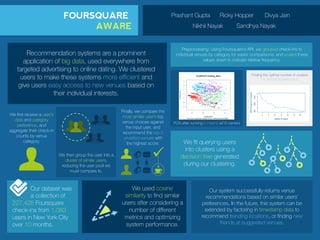
Finding the optimal number of clusters
(vs. sum of squares error)
Recommendation systems are a prominent
application of big data, used everywhere from
targeted advertising to online dating. We clustered
users to make these systems more efficient and
give users easy access to new venues based on
their individual interests.
We first receive a user’s
data and category
preference, and
aggregate their check-in
counts by venue
category.
We then group the user into a
cluster of similar users,
reducing the user pool we
must compare to.
Finally, we compare the
most similar user’s top
venue choices against
the input user, and
recommend the top 3
unvisited venues with
the highest score.
Our dataset was
a collection of
227,428 Foursquare
check-ins from 1,083
users in New York City
over 10 months.
Our system successfully returns venue
recommendations based on similar users’
preferences. In the future, this system can be
extended by factoring in timestamp data to
recommend trending locations, or finding new
friends at suggested venues.
PCA after running k-means w/ 6 centers
We fit querying users
into clusters using a
decision tree generated
during our clustering.
Preprocessing: Using Foursquare’s API, we grouped check-ins to
individual venues by category for easier comparisons, and scaled these
values down to indicate relative frequency.
We used cosine
similarity to find similar
users after considering a
number of different
metrics and optimizing
system performance.

Poster - Recommender system

  • 1.
    FOURSQUARE AWARE Prashant Gupta RickyHopper Divya Jain Nikhil Nayak Sandhya Nayak Finding the optimal number of clusters (vs. sum of squares error) Recommendation systems are a prominent application of big data, used everywhere from targeted advertising to online dating. We clustered users to make these systems more efficient and give users easy access to new venues based on their individual interests. We first receive a user’s data and category preference, and aggregate their check-in counts by venue category. We then group the user into a cluster of similar users, reducing the user pool we must compare to. Finally, we compare the most similar user’s top venue choices against the input user, and recommend the top 3 unvisited venues with the highest score. Our dataset was a collection of 227,428 Foursquare check-ins from 1,083 users in New York City over 10 months. Our system successfully returns venue recommendations based on similar users’ preferences. In the future, this system can be extended by factoring in timestamp data to recommend trending locations, or finding new friends at suggested venues. PCA after running k-means w/ 6 centers We fit querying users into clusters using a decision tree generated during our clustering. Preprocessing: Using Foursquare’s API, we grouped check-ins to individual venues by category for easier comparisons, and scaled these values down to indicate relative frequency. We used cosine similarity to find similar users after considering a number of different metrics and optimizing system performance.