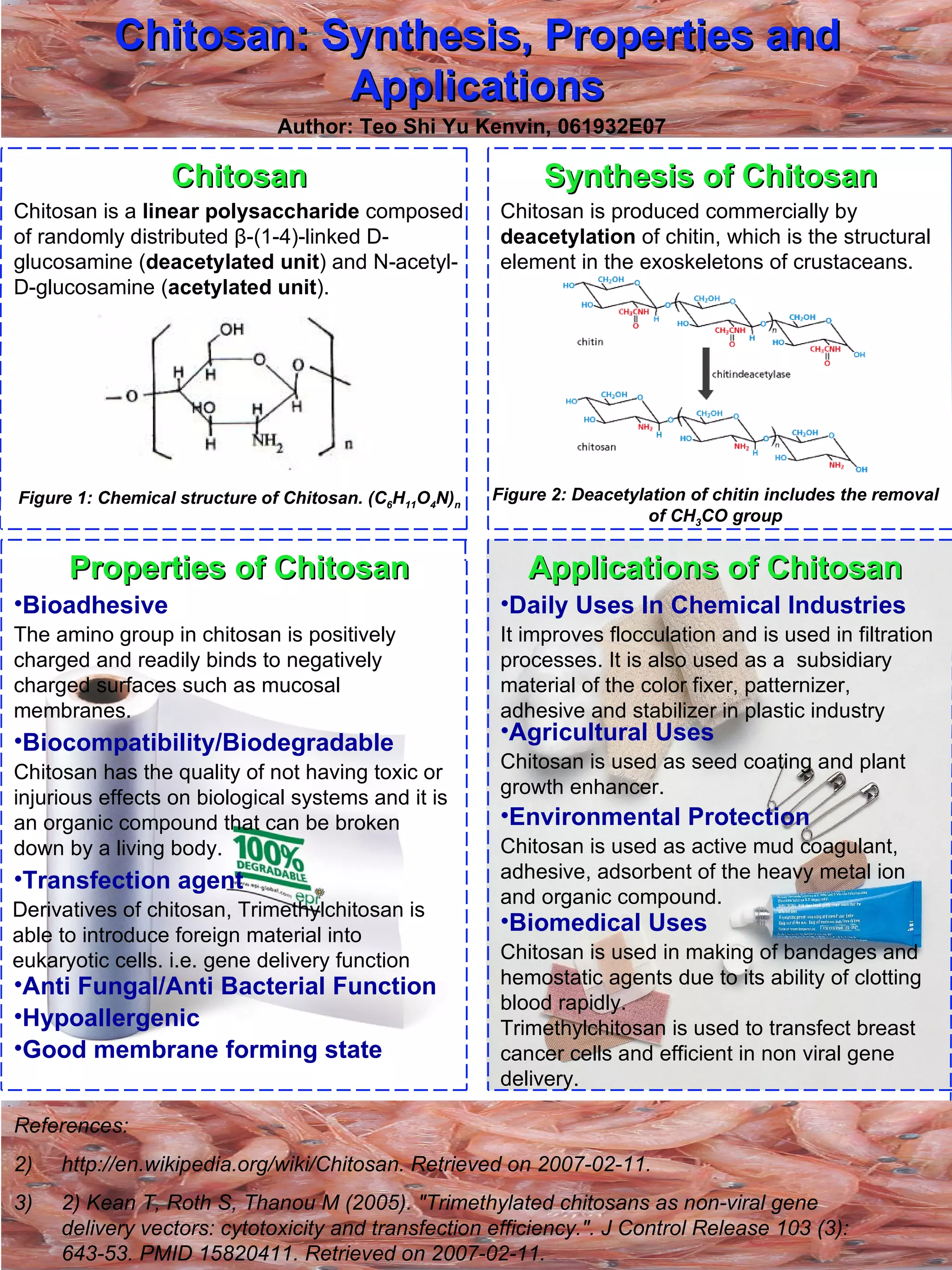
Chitosan: Synthesis, Properties and Applications Author: Teo Shi Yu Kenvin, 061932E07 Chitosan Chitosan is a  linear polysaccharide  composed of randomly distributed  β-(1-4)-linked D-glucosamine ( deacetylated unit ) and N-acetyl-D-glucosamine ( acetylated unit ).  Figure 1: Chemical structure of Chitosan. (C 6 H 11 O 4 N) n   Synthesis of Chitosan  References:  http://en.wikipedia.org/wiki/Chitosan. Retrieved on 2007-02-11. 2) Kean T, Roth S, Thanou M (2005). "Trimethylated chitosans as non-viral gene delivery vectors: cytotoxicity and transfection efficiency.". J Control Release 103 (3): 643-53. PMID 15820411. Retrieved on 2007-02-11.  Chitosan is produced commercially by  deacetylation  of  chitin, which is the structural element in the exoskeletons of crustaceans. Figure 2: Deacetylation of chitin includes the removal of CH 3 CO group Properties of Chitosan The amino group in chitosan is positively charged and readily binds to negatively charged surfaces such as mucosal membranes.  Bioadhesive Biocompatibility/Biodegradable Anti Fungal/Anti Bacterial Function  Chitosan has the quality of not having toxic or injurious effects on biological systems and it is an organic compound that can be broken down by a living body. Transfection agent Applications of Chitosan Biomedical Uses Chitosan is used in making of bandages and hemostatic agents due to its ability of clotting blood rapidly. Trimethylchitosan is used to transfect breast cancer cells and efficient in non viral gene delivery.  Agricultural Uses Derivatives of chitosan, Trimethylchitosan is able to introduce foreign material into eukaryotic cells. i.e. gene delivery function Good membrane forming state Hypoallergenic Chitosan is used as seed coating and plant growth enhancer. Environmental Protection Chitosan is used as active mud coagulant, adhesive, adsorbent of the heavy metal ion and organic compound. Daily Uses In Chemical Industries It improves flocculation and is used in filtration processes. It is also used as a  subsidiary material of the color fixer, patternizer, adhesive and stabilizer in plastic industry

Poster Design for Polymers and Composite

  • 1.
    Chitosan: Synthesis, Propertiesand Applications Author: Teo Shi Yu Kenvin, 061932E07 Chitosan Chitosan is a linear polysaccharide composed of randomly distributed β-(1-4)-linked D-glucosamine ( deacetylated unit ) and N-acetyl-D-glucosamine ( acetylated unit ). Figure 1: Chemical structure of Chitosan. (C 6 H 11 O 4 N) n Synthesis of Chitosan References: http://en.wikipedia.org/wiki/Chitosan. Retrieved on 2007-02-11. 2) Kean T, Roth S, Thanou M (2005). "Trimethylated chitosans as non-viral gene delivery vectors: cytotoxicity and transfection efficiency.". J Control Release 103 (3): 643-53. PMID 15820411. Retrieved on 2007-02-11.  Chitosan is produced commercially by deacetylation of chitin, which is the structural element in the exoskeletons of crustaceans. Figure 2: Deacetylation of chitin includes the removal of CH 3 CO group Properties of Chitosan The amino group in chitosan is positively charged and readily binds to negatively charged surfaces such as mucosal membranes. Bioadhesive Biocompatibility/Biodegradable Anti Fungal/Anti Bacterial Function Chitosan has the quality of not having toxic or injurious effects on biological systems and it is an organic compound that can be broken down by a living body. Transfection agent Applications of Chitosan Biomedical Uses Chitosan is used in making of bandages and hemostatic agents due to its ability of clotting blood rapidly. Trimethylchitosan is used to transfect breast cancer cells and efficient in non viral gene delivery. Agricultural Uses Derivatives of chitosan, Trimethylchitosan is able to introduce foreign material into eukaryotic cells. i.e. gene delivery function Good membrane forming state Hypoallergenic Chitosan is used as seed coating and plant growth enhancer. Environmental Protection Chitosan is used as active mud coagulant, adhesive, adsorbent of the heavy metal ion and organic compound. Daily Uses In Chemical Industries It improves flocculation and is used in filtration processes. It is also used as a subsidiary material of the color fixer, patternizer, adhesive and stabilizer in plastic industry