TRANSDERMAL DRUG
DELIVERY SYSTEM
PREPARED BY;
MR. SHETE SHUBHAM KAILAS
F.Y.M.PHARM
UNDER GUIDENCE OF
DR. S.F. SAYYAD
HOD AND PROFESSOR
DEPARTMENT OF PHARMACEUTICS AVCOP,
SANGAMNER
1
INTRODUCTION:
Transdermal drug delivery system is defined as the
topically administered medication, which when applied to
the skin deliver the drug through the skin at a
predetermined and controlled rate. Eg. Transdermal patch
ADVANTAGES:
•Systemic and local effect
•Easy to use
•Avoid GIT absorption
•Avoid FP metabolism
•Patient compliance
•Self medication
•Reduces frequency of drug
administration
•Therapeutic level maintain for
several days
DISADVANTAGES:
•Local irritation major problem
•Drug requiring high blood
level are not suitable
•Drug with more half life are
not suitable for this
formulation
•Heat, cold, sweating
(perspiring) and showering
prevent the patch from sticking
to the surface of the skin for
more than one day. A new
patch has to be applied daily 2
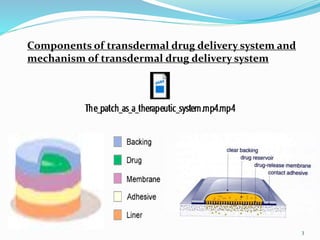
Components of transdermal drug delivery system and
mechanism of transdermal drug delivery system
3
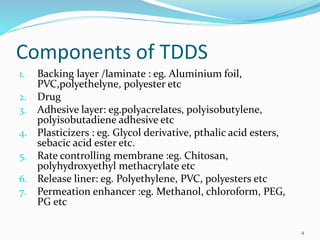
Components of TDDS
1. Backing layer /laminate : eg. Aluminium foil,
PVC,polyethelyne, polyester etc
2. Drug
3. Adhesive layer: eg.polyacrelates, polyisobutylene,
polyisobutadiene adhesive etc
4. Plasticizers : eg. Glycol derivative, pthalic acid esters,
sebacic acid ester etc.
5. Rate controlling membrane :eg. Chitosan,
polyhydroxyethyl methacrylate etc
6. Release liner: eg. Polyethylene, PVC, polyesters etc
7. Permeation enhancer :eg. Methanol, chloroform, PEG,
PG etc
4
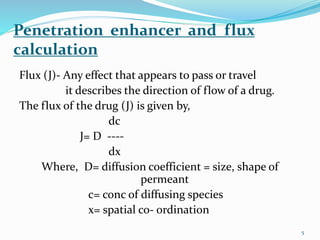
Penetration enhancer and flux
calculation
Flux (J)- Any effect that appears to pass or travel
it describes the direction of flow of a drug.
The flux of the drug (J) is given by,
dc
J= D ----
dx
Where, D= diffusion coefficient = size, shape of
permeant
c= conc of diffusing species
x= spatial co- ordination
5
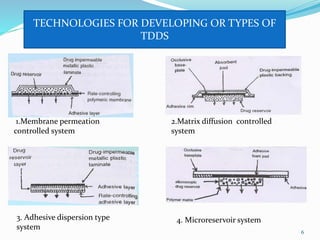
TECHNOLOGIES FOR DEVELOPING OR TYPES OF
TDDS
1.Membrane permeation
controlled system
2.Matrix diffusion controlled
system
3. Adhesive dispersion type
system
4. Microreservoir system
6
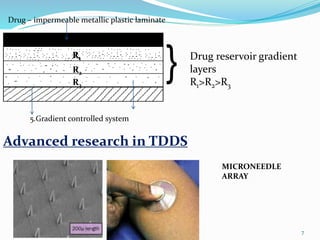
R1R1
R2
R3
Drug reservoir gradient
layers
R1>R2>R3
}
Drug – impermeable metallic plastic laminate
5.Gradient controlled system
Advanced research in TDDS
MICRONEEDLE
ARRAY
7
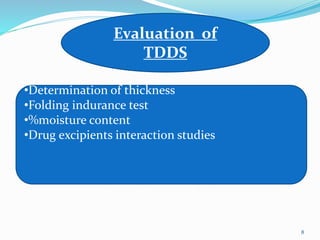
Evaluation of
TDDS
•Determination of thickness
•Folding indurance test
•%moisture content
•Drug excipients interaction studies
8
References:
 1. Misra AN. “Controlled and novel drug delivery, Jain
NK, editors Transdermal drug delivery”, New Delhi,
India, CBS publisher and distributors , 1997, page no
100-110.
 2 KunL. N. Patel, “ Formulation And Characterization
Of Drug in Adhesive Transdermal Patches of
Diclofenac,” Int. journal of pharmacy and
pharmaceutical sciences, vol 4(1),2012, page no 297-
299.
9
Thank
You
10

Transdermal drug delivery system

  • 1.
    TRANSDERMAL DRUG DELIVERY SYSTEM PREPAREDBY; MR. SHETE SHUBHAM KAILAS F.Y.M.PHARM UNDER GUIDENCE OF DR. S.F. SAYYAD HOD AND PROFESSOR DEPARTMENT OF PHARMACEUTICS AVCOP, SANGAMNER 1
  • 2.
    INTRODUCTION: Transdermal drug deliverysystem is defined as the topically administered medication, which when applied to the skin deliver the drug through the skin at a predetermined and controlled rate. Eg. Transdermal patch ADVANTAGES: •Systemic and local effect •Easy to use •Avoid GIT absorption •Avoid FP metabolism •Patient compliance •Self medication •Reduces frequency of drug administration •Therapeutic level maintain for several days DISADVANTAGES: •Local irritation major problem •Drug requiring high blood level are not suitable •Drug with more half life are not suitable for this formulation •Heat, cold, sweating (perspiring) and showering prevent the patch from sticking to the surface of the skin for more than one day. A new patch has to be applied daily 2
  • 3.
    Components of transdermaldrug delivery system and mechanism of transdermal drug delivery system 3
  • 4.
    Components of TDDS 1.Backing layer /laminate : eg. Aluminium foil, PVC,polyethelyne, polyester etc 2. Drug 3. Adhesive layer: eg.polyacrelates, polyisobutylene, polyisobutadiene adhesive etc 4. Plasticizers : eg. Glycol derivative, pthalic acid esters, sebacic acid ester etc. 5. Rate controlling membrane :eg. Chitosan, polyhydroxyethyl methacrylate etc 6. Release liner: eg. Polyethylene, PVC, polyesters etc 7. Permeation enhancer :eg. Methanol, chloroform, PEG, PG etc 4
  • 5.
    Penetration enhancer andflux calculation Flux (J)- Any effect that appears to pass or travel it describes the direction of flow of a drug. The flux of the drug (J) is given by, dc J= D ---- dx Where, D= diffusion coefficient = size, shape of permeant c= conc of diffusing species x= spatial co- ordination 5
  • 6.
    TECHNOLOGIES FOR DEVELOPINGOR TYPES OF TDDS 1.Membrane permeation controlled system 2.Matrix diffusion controlled system 3. Adhesive dispersion type system 4. Microreservoir system 6
  • 7.
    R1R1 R2 R3 Drug reservoir gradient layers R1>R2>R3 } Drug– impermeable metallic plastic laminate 5.Gradient controlled system Advanced research in TDDS MICRONEEDLE ARRAY 7
  • 8.
    Evaluation of TDDS •Determination ofthickness •Folding indurance test •%moisture content •Drug excipients interaction studies 8
  • 9.
    References:  1. MisraAN. “Controlled and novel drug delivery, Jain NK, editors Transdermal drug delivery”, New Delhi, India, CBS publisher and distributors , 1997, page no 100-110.  2 KunL. N. Patel, “ Formulation And Characterization Of Drug in Adhesive Transdermal Patches of Diclofenac,” Int. journal of pharmacy and pharmaceutical sciences, vol 4(1),2012, page no 297- 299. 9
  • 10.