The direct and indirect mechanisms
of facilitation by shrubs play a
central role in maintaining leopard
lizard populations.
Progress Report
Taylor Noble
M.Sc. Candidate
Supervisor: Dr. Christopher Lortie
Committee Member: Dr. Bridget Stutchbury
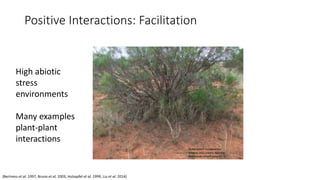
Positive Interactions: Facilitation
High abiotic
stress
environments
Many examples
plant-plant
interactions
Dubai Desert Conservation
Reserve,http://www.ddcr.org
/en/conservation/research/
(Bertness et al. 1997, Bruno et al. 2003, Holzapfel et al. 1999, Liu et al. 2014)
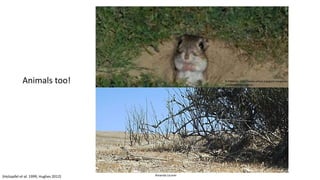
Animals too!
Amanda Liczner
B.Peterson, http://www.arkive.org/giant-kangaroo-
rat/dipodomys-ingens/
(Holzapfel et al. 1999, Hughes 2012)
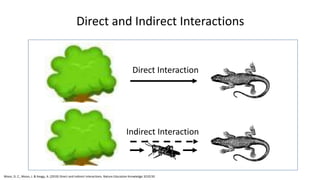
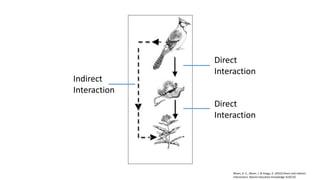
Direct and Indirect Interactions
Moon, D. C., Moon, J. & Keagy, A. (2010) Direct and Indirect Interactions. Nature Education Knowledge 3(10):50
Direct Interaction
Indirect Interaction
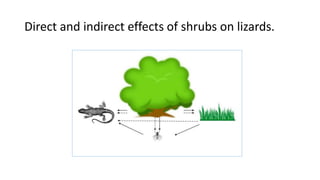
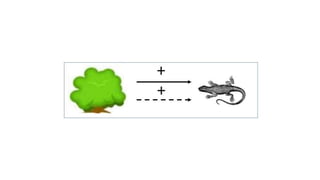
Direct and indirect effects of shrubs on lizards.
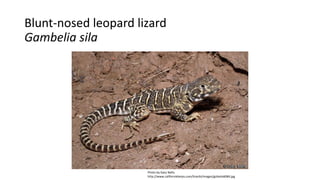
Blunt-nosed leopard lizard
Gambelia sila
Photo by Gary Nafis.
http://www.californiaherps.com/lizards/images/gsilaslo6084.jpg
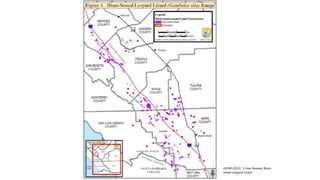
USFWS 2010. 5-Year Review, Blunt-
nosed Leopard Lizard
Karin Jeske
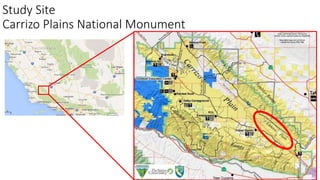
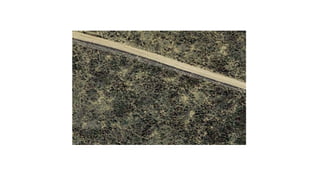
Study Site
Carrizo Plains National Monument
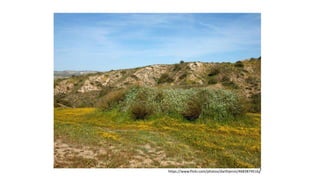
https://www.flickr.com/photos/darthjenni/4683874516/
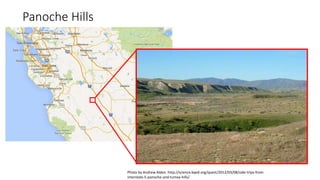
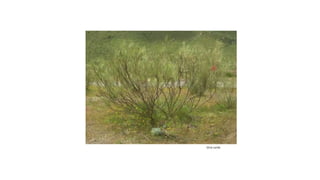
Panoche Hills
Photo by Andrew Alden. http://science.kqed.org/quest/2012/03/08/side-trips-from-
interstate-5-panoche-and-tumey-hills/
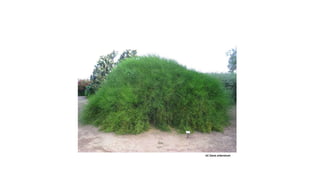
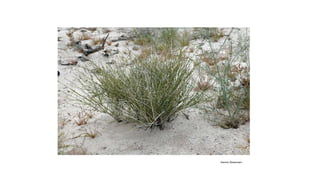
UC Davis arboretum
Dennis Stevensen
Chris Lortie
Hypothesis
Desert shrubs provide direct benefits to small animals such as shelter,
indirect benefits in the form of resources such as prey.
Chapter 1: A systematic review of the effects of
indirect plant-animal interactions.
Moon, D. C., Moon, J. & Keagy, A. (2010) Direct and Indirect
Interactions. Nature Education Knowledge 3(10):50
Indirect
Interaction
Direct
Interaction
Direct
Interaction
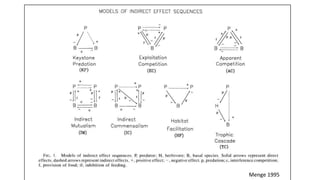
Menge 1995
Predictions
Keystone predation and habitat facilitation.
Intermediate species will most often be a plant species.
Animal abundance or survival will increase.
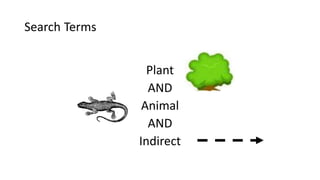
Search Terms
Plant
AND
Animal
AND
Indirect
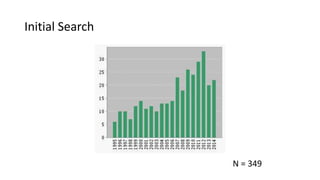
Initial Search
N = 349
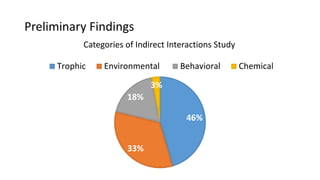
Preliminary Findings
46%
33%
18%
3%
Trophic Environmental Behavioral Chemical
Categories of Indirect Interactions Study
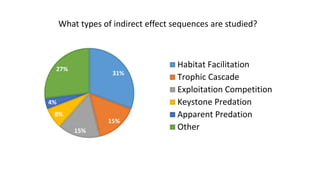
31%
15%
15%
8%
4%
27%
Habitat Facilitation
Trophic Cascade
Exploitation Competition
Keystone Predation
Apparent Predation
Other
What types of indirect effect sequences are studied?
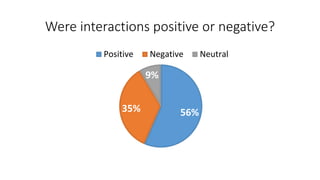
Were interactions positive or negative?
56%35%
9%
Positive Negative Neutral
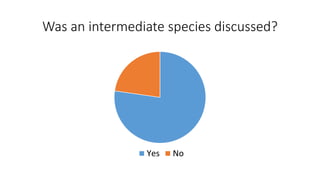
Was an intermediate species discussed?
Yes No
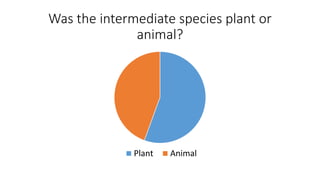
Was the intermediate species plant or
animal?
Plant Animal
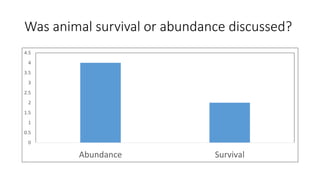
Was animal survival or abundance discussed?
0
0.5
1
1.5
2
2.5
3
3.5
4
4.5
Abundance Survival
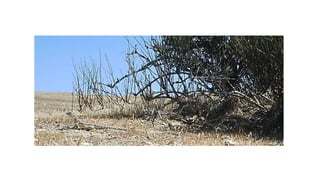
Chapter 2: A field survey of the effects of Ephedra
californica on leopard lizard activity patterns.
Hypothesis: Desert shrubs provide direct benefits to small animals such
as shelter, indirect benefits in the form of resources such as prey, and
indirect benefits by increasing annual-plant density within the canopy
thereby providing additional protection.
Predictions
Lizard activity will be highest under shrubs.
Larger shrubs will have higher lizard activity.
Insect density will be greater under shrubs.
Experimental Design
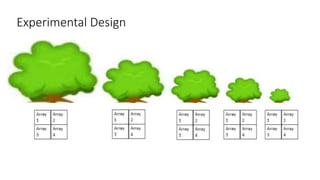
5 shrub size gradients x 4 trap arrays x 10 days
New Shrubs for each day.
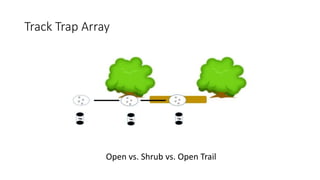
Track Trap Array
Open vs. Shrub vs. Open Trail
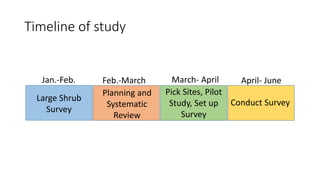
Timeline of study
Jan.-Feb. Feb.-March March- April April- June
Large Shrub
Survey
Planning and
Systematic
Review
Pick Sites, Pilot
Study, Set up
Survey
Conduct Survey
Chapter 3: An experimental manipulation of the
shelter and resource effects of Ephedra californica
on leopard lizard foraging.
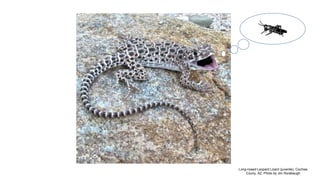
Long-nosed Leopard Lizard (juvenile), Cochise
Couny, AZ. Photo by Jim Rorabaugh
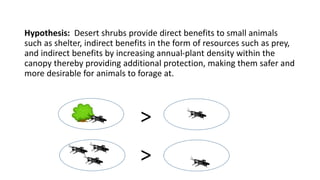
Hypothesis: Desert shrubs provide direct benefits to small animals
such as shelter, indirect benefits in the form of resources such as prey,
and indirect benefits by increasing annual-plant density within the
canopy thereby providing additional protection, making them safer and
more desirable for animals to forage at.
>
>
Predictions
Lizards will forage more frequently under shrubs and other shelters.
Lower giving-up densities (GUD) at shrubs.
Lizards will prefer stations with annuals removed.
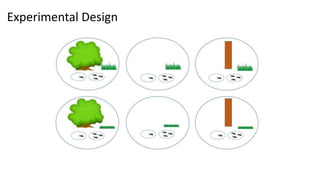
Experimental Design
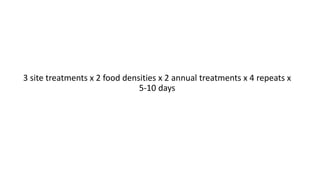
3 site treatments x 2 food densities x 2 annual treatments x 4 repeats x
5-10 days
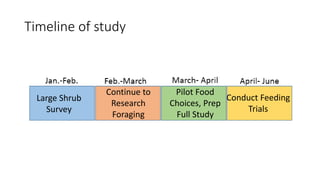
Timeline of study
Large Shrub
Survey
Continue to
Research
Foraging
Pilot Food
Choices, Prep
Full Study
Conduct Feeding
Trials
Acknowledgements
Thanks to:
Dr. Christopher Lortie
Dr. Bridget Stutchbury
Dr. Mike Westphal
Dr. Tim Bean
The Lortie Lab
References
Ahlborn G. 2000. California Wildlife Habitat Relationship System: Blunt-Nosed Leopard Lizard. California Department of Fish and Game, California Interagency Wildlife
Tak Group. Sacramento, CA.
Bertness M and Leonard G. 1997. The role of positive interactions in communities: Lessons from intertidal habitats. Ecology 78(7):1976-89.
Bertness M., Callaway R. 1994. Positive interactions in communities. Trends Ecol Evol 9(5):191-3.
Bortolus A, Schwindt E, Iribarne O. 2002. Positive plant-animal interactions in the high marsh of an Argentinean coastal lagoon. Ecology 83(3):733-742.
Brooker, R. W., F. T. Maestre, R. M. Callaway, C. L. Lortie, L. A. Cavieres, G. Kunstler, P. Liancourt, K. Tielborger, J. M. J. Travis, F. Anthelme, C. Armas, L. Coll, E. Corcket, S.
Delzon, E. Forey, Z. Kikvidze, J. Olofsson, F. I. Pugnaire, C. L. Quiroz, P. Saccone, K. Schiffers, M. Seifan, B. Touzard, and R. Michalet. 2008. Facilitation in plant
communities: the past, the present, and the future. Journal of Ecology 96:18-34.
Bruno J, Stachowicz J, Bertness M. 2003. Inclusion of facilitation into ecological theory. Trends Ecol Evol 18(3):119-25.
Callaway, R. M., and L. R. Walker. 1997. Competition and facilitation: A synthetic approach to interactions in plant communities. Ecology 78:1958-1965.
Callaway R.M. 2007.Positive interactions and interdependence in plant communities. Springer. Dordrecht, Netherlands. 411 p.
Ellison, Aaron M.; Bank, Michael S.; Clinton, Barton D.; Colburn, Elizabeth A.; Elliott, Katherine; Ford, Chelcy R.; Foster, David R.; Kloeppel, Brian D.; Knoepp, Jennifer D.
2005. Loss of foundation species: Consequences for the structure and dynamics of forested ecosystems. Frontiers in Ecology and the Environment 3 (9): 479.
Filazzola A, Lortie C. J. 2014. A systematic review and conceptual framework for the mechanistic pathways of nurse plants. Global Ecology and Biogeography. DOI:
10.1111/geb.12202
Fisher, D. O. 2000. Effects of vegetation structure, food and shelter on the home range and habitat use of an endangered wallaby. Journal of Applied Ecology 37:660-
671.
Forbes, A. R., and J. L. Craig. 2013. Assessing the role of revegetation in achieving restoration goals on Tiritiri Matangi Island. New Zealand Journal of Ecology 37:343-
352.
Fukui, A. 2001. Indirect interactions mediated by leaf shelters in animal-plant communities. Population Ecology 43:31-40.
Galloway D., Riley F.S. U.S. Geological Survey. 1993. San Joaquin Valley, California, Largest Human Alteration of the Earth’s Surface. Menlo Park, CA.
Germano D.J. 2009. The number of census days needed to detect Blunt-Nosed Leopard Lizards, Gambelia sila. California Fish and Game. 95(2): 106-109.
Hansen DM, Kiesbuy HC, Jones CG, Muller CB. 2007. Positive indirect interactions between neighboring plant species via a lizard pollinator. American Naturalist
169(4):534-542.
Holzapfel C, Mahall BE. 1999. Bidirectional facilitation and interference between shrubs and annuals in the Mojave Desert. Ecology 80(5):1747-1761.
Hughes AR. 2012. A neighboring plant species creates associational refuge for consumer and host. Ecology 93(6):1411-1420.
Liu N, Zhu WX, Sun ZY, Yang L, Yuan SF, Ren H. 2014. Canopy Size Dependent Facilitations from the Native Shrub Rhodomyrtus tomentosa to the Early Establishment of
Native Trees Castanopsis fissa and Syzygium hancei in Tropical China. Restoration Ecology 22(4):509-516.
McIntire, E. J. B., and A. Fajardo. 2014. Facilitation as a ubiquitous driver of biodiversity. New Phytologist 201:403-416.
Menge B.A. 1995. Indirect effects in marine rocky intertidal webs: patterns and importance. Ecological Monographs. 65(1):21-74.
Peterson BJ, Heck KL. 2001. Positive interactions between suspension-feeding bivalves and seagrass - a facultative mutualism. Marine Ecology Progress Series 213:143-
155.
Schiffman P.M. 1994. Promotion of exotic weed establishment by endangered giant kangaroo rats (Dipodomys ingens) in a California grassland. Biodiversity and
Conservation. 3:524-537.
Smit, C., C. Vandenberghe, J. den Ouden, and H. Muller-Scharer. 2007. Nurse plants, tree saplings and grazing pressure: changes in facilitation along a biotic
environmental gradient. Oecologia 152:265-273.
Stachowicz, J. J. 2001. Mutualism, facilitation, and the structure of ecological communities. BioScience 51: 235-246.
Stoutjesdijk P., Barkman J.J. 1992. Microclimate, Vegetation, and Fauna. Opulus Press. Grangýrde, Sweden. 216 p.
Strauss S and Irwin R. 2004. Ecological and evolutionary consequences of multispecies plant-animal interactions. Annu Rev Ecol Evol Syst 35:435-66.
Suding K.N., Gross K.L., Houseman G.R. 2004. Alternate states and positive feedbacks in restoration ecology. Trends in Ecology and Evolution. 19(1): 46-53.
Templeton A.R., Brazeal H., Neuwald J.L. 2011. The transition from isolated patches to a metapopulation in the eastern collared lizard in response to prescribed fires.
Ecology. 92(9): 1736- 1747.
Tilman D. 1994. Competition and Biodiversity in Spatially Structured Habitats. Ecology. 75(1):2-16.
Wiiliams D.F., Cypher E.A., Kelly P.A., Miller K.J., Norwell N., Philips S.E., Johnson C.D., Colliver G.W. U.S. Fish and Wildlife Service. 1998. Recovery plan for upland
species of the San Joaquin Valley, California. United States Fish and Wildlife Service, Region 1, Portland, Oregon.
U.S. Fish and Wildlife Service. 2010. Blunt-nosed leopard lizard (Gambelia sila) 5-year review: summary and evaluation. U.S. Fish and Wildlife Service, Sacramento Fish
and Wildlife Office, Sacramento, California.
van Heezik Y., Ludwig K. 2012. Proximity to source populations and untidy gardens predict occurrence of a small lizard in an urban area.

Noble progress report 2014 2015

  • 1.
    The direct andindirect mechanisms of facilitation by shrubs play a central role in maintaining leopard lizard populations. Progress Report Taylor Noble M.Sc. Candidate Supervisor: Dr. Christopher Lortie Committee Member: Dr. Bridget Stutchbury
  • 2.
    Positive Interactions: Facilitation Highabiotic stress environments Many examples plant-plant interactions Dubai Desert Conservation Reserve,http://www.ddcr.org /en/conservation/research/ (Bertness et al. 1997, Bruno et al. 2003, Holzapfel et al. 1999, Liu et al. 2014)
  • 3.
    Animals too! Amanda Liczner B.Peterson,http://www.arkive.org/giant-kangaroo- rat/dipodomys-ingens/ (Holzapfel et al. 1999, Hughes 2012)
  • 4.
    Direct and IndirectInteractions Moon, D. C., Moon, J. & Keagy, A. (2010) Direct and Indirect Interactions. Nature Education Knowledge 3(10):50 Direct Interaction Indirect Interaction
  • 5.
    Direct and indirecteffects of shrubs on lizards.
  • 6.
    Blunt-nosed leopard lizard Gambeliasila Photo by Gary Nafis. http://www.californiaherps.com/lizards/images/gsilaslo6084.jpg
  • 7.
    USFWS 2010. 5-YearReview, Blunt- nosed Leopard Lizard
  • 8.
  • 9.
    Study Site Carrizo PlainsNational Monument
  • 10.
  • 11.
    Panoche Hills Photo byAndrew Alden. http://science.kqed.org/quest/2012/03/08/side-trips-from- interstate-5-panoche-and-tumey-hills/
  • 12.
  • 13.
  • 15.
  • 16.
    Hypothesis Desert shrubs providedirect benefits to small animals such as shelter, indirect benefits in the form of resources such as prey.
  • 17.
    Chapter 1: Asystematic review of the effects of indirect plant-animal interactions.
  • 18.
    Moon, D. C.,Moon, J. & Keagy, A. (2010) Direct and Indirect Interactions. Nature Education Knowledge 3(10):50 Indirect Interaction Direct Interaction Direct Interaction
  • 19.
  • 20.
    Predictions Keystone predation andhabitat facilitation. Intermediate species will most often be a plant species. Animal abundance or survival will increase.
  • 21.
  • 22.
  • 23.
    Preliminary Findings 46% 33% 18% 3% Trophic EnvironmentalBehavioral Chemical Categories of Indirect Interactions Study
  • 24.
    31% 15% 15% 8% 4% 27% Habitat Facilitation Trophic Cascade ExploitationCompetition Keystone Predation Apparent Predation Other What types of indirect effect sequences are studied?
  • 25.
    Were interactions positiveor negative? 56%35% 9% Positive Negative Neutral
  • 26.
    Was an intermediatespecies discussed? Yes No
  • 27.
    Was the intermediatespecies plant or animal? Plant Animal
  • 28.
    Was animal survivalor abundance discussed? 0 0.5 1 1.5 2 2.5 3 3.5 4 4.5 Abundance Survival
  • 29.
    Chapter 2: Afield survey of the effects of Ephedra californica on leopard lizard activity patterns.
  • 31.
    Hypothesis: Desert shrubsprovide direct benefits to small animals such as shelter, indirect benefits in the form of resources such as prey, and indirect benefits by increasing annual-plant density within the canopy thereby providing additional protection.
  • 33.
    Predictions Lizard activity willbe highest under shrubs. Larger shrubs will have higher lizard activity. Insect density will be greater under shrubs.
  • 34.
  • 35.
    5 shrub sizegradients x 4 trap arrays x 10 days New Shrubs for each day.
  • 36.
    Track Trap Array Openvs. Shrub vs. Open Trail
  • 37.
    Timeline of study Jan.-Feb.Feb.-March March- April April- June Large Shrub Survey Planning and Systematic Review Pick Sites, Pilot Study, Set up Survey Conduct Survey
  • 38.
    Chapter 3: Anexperimental manipulation of the shelter and resource effects of Ephedra californica on leopard lizard foraging.
  • 39.
    Long-nosed Leopard Lizard(juvenile), Cochise Couny, AZ. Photo by Jim Rorabaugh
  • 40.
    Hypothesis: Desert shrubsprovide direct benefits to small animals such as shelter, indirect benefits in the form of resources such as prey, and indirect benefits by increasing annual-plant density within the canopy thereby providing additional protection, making them safer and more desirable for animals to forage at. > >
  • 41.
    Predictions Lizards will foragemore frequently under shrubs and other shelters. Lower giving-up densities (GUD) at shrubs. Lizards will prefer stations with annuals removed.
  • 42.
  • 43.
    3 site treatmentsx 2 food densities x 2 annual treatments x 4 repeats x 5-10 days
  • 44.
    Timeline of study LargeShrub Survey Continue to Research Foraging Pilot Food Choices, Prep Full Study Conduct Feeding Trials
  • 45.
    Acknowledgements Thanks to: Dr. ChristopherLortie Dr. Bridget Stutchbury Dr. Mike Westphal Dr. Tim Bean The Lortie Lab
  • 46.
    References Ahlborn G. 2000.California Wildlife Habitat Relationship System: Blunt-Nosed Leopard Lizard. California Department of Fish and Game, California Interagency Wildlife Tak Group. Sacramento, CA. Bertness M and Leonard G. 1997. The role of positive interactions in communities: Lessons from intertidal habitats. Ecology 78(7):1976-89. Bertness M., Callaway R. 1994. Positive interactions in communities. Trends Ecol Evol 9(5):191-3. Bortolus A, Schwindt E, Iribarne O. 2002. Positive plant-animal interactions in the high marsh of an Argentinean coastal lagoon. Ecology 83(3):733-742. Brooker, R. W., F. T. Maestre, R. M. Callaway, C. L. Lortie, L. A. Cavieres, G. Kunstler, P. Liancourt, K. Tielborger, J. M. J. Travis, F. Anthelme, C. Armas, L. Coll, E. Corcket, S. Delzon, E. Forey, Z. Kikvidze, J. Olofsson, F. I. Pugnaire, C. L. Quiroz, P. Saccone, K. Schiffers, M. Seifan, B. Touzard, and R. Michalet. 2008. Facilitation in plant communities: the past, the present, and the future. Journal of Ecology 96:18-34. Bruno J, Stachowicz J, Bertness M. 2003. Inclusion of facilitation into ecological theory. Trends Ecol Evol 18(3):119-25. Callaway, R. M., and L. R. Walker. 1997. Competition and facilitation: A synthetic approach to interactions in plant communities. Ecology 78:1958-1965. Callaway R.M. 2007.Positive interactions and interdependence in plant communities. Springer. Dordrecht, Netherlands. 411 p. Ellison, Aaron M.; Bank, Michael S.; Clinton, Barton D.; Colburn, Elizabeth A.; Elliott, Katherine; Ford, Chelcy R.; Foster, David R.; Kloeppel, Brian D.; Knoepp, Jennifer D. 2005. Loss of foundation species: Consequences for the structure and dynamics of forested ecosystems. Frontiers in Ecology and the Environment 3 (9): 479. Filazzola A, Lortie C. J. 2014. A systematic review and conceptual framework for the mechanistic pathways of nurse plants. Global Ecology and Biogeography. DOI: 10.1111/geb.12202 Fisher, D. O. 2000. Effects of vegetation structure, food and shelter on the home range and habitat use of an endangered wallaby. Journal of Applied Ecology 37:660- 671. Forbes, A. R., and J. L. Craig. 2013. Assessing the role of revegetation in achieving restoration goals on Tiritiri Matangi Island. New Zealand Journal of Ecology 37:343- 352. Fukui, A. 2001. Indirect interactions mediated by leaf shelters in animal-plant communities. Population Ecology 43:31-40. Galloway D., Riley F.S. U.S. Geological Survey. 1993. San Joaquin Valley, California, Largest Human Alteration of the Earth’s Surface. Menlo Park, CA.
  • 47.
    Germano D.J. 2009.The number of census days needed to detect Blunt-Nosed Leopard Lizards, Gambelia sila. California Fish and Game. 95(2): 106-109. Hansen DM, Kiesbuy HC, Jones CG, Muller CB. 2007. Positive indirect interactions between neighboring plant species via a lizard pollinator. American Naturalist 169(4):534-542. Holzapfel C, Mahall BE. 1999. Bidirectional facilitation and interference between shrubs and annuals in the Mojave Desert. Ecology 80(5):1747-1761. Hughes AR. 2012. A neighboring plant species creates associational refuge for consumer and host. Ecology 93(6):1411-1420. Liu N, Zhu WX, Sun ZY, Yang L, Yuan SF, Ren H. 2014. Canopy Size Dependent Facilitations from the Native Shrub Rhodomyrtus tomentosa to the Early Establishment of Native Trees Castanopsis fissa and Syzygium hancei in Tropical China. Restoration Ecology 22(4):509-516. McIntire, E. J. B., and A. Fajardo. 2014. Facilitation as a ubiquitous driver of biodiversity. New Phytologist 201:403-416. Menge B.A. 1995. Indirect effects in marine rocky intertidal webs: patterns and importance. Ecological Monographs. 65(1):21-74. Peterson BJ, Heck KL. 2001. Positive interactions between suspension-feeding bivalves and seagrass - a facultative mutualism. Marine Ecology Progress Series 213:143- 155. Schiffman P.M. 1994. Promotion of exotic weed establishment by endangered giant kangaroo rats (Dipodomys ingens) in a California grassland. Biodiversity and Conservation. 3:524-537. Smit, C., C. Vandenberghe, J. den Ouden, and H. Muller-Scharer. 2007. Nurse plants, tree saplings and grazing pressure: changes in facilitation along a biotic environmental gradient. Oecologia 152:265-273. Stachowicz, J. J. 2001. Mutualism, facilitation, and the structure of ecological communities. BioScience 51: 235-246. Stoutjesdijk P., Barkman J.J. 1992. Microclimate, Vegetation, and Fauna. Opulus Press. Grangýrde, Sweden. 216 p. Strauss S and Irwin R. 2004. Ecological and evolutionary consequences of multispecies plant-animal interactions. Annu Rev Ecol Evol Syst 35:435-66. Suding K.N., Gross K.L., Houseman G.R. 2004. Alternate states and positive feedbacks in restoration ecology. Trends in Ecology and Evolution. 19(1): 46-53. Templeton A.R., Brazeal H., Neuwald J.L. 2011. The transition from isolated patches to a metapopulation in the eastern collared lizard in response to prescribed fires. Ecology. 92(9): 1736- 1747. Tilman D. 1994. Competition and Biodiversity in Spatially Structured Habitats. Ecology. 75(1):2-16. Wiiliams D.F., Cypher E.A., Kelly P.A., Miller K.J., Norwell N., Philips S.E., Johnson C.D., Colliver G.W. U.S. Fish and Wildlife Service. 1998. Recovery plan for upland species of the San Joaquin Valley, California. United States Fish and Wildlife Service, Region 1, Portland, Oregon. U.S. Fish and Wildlife Service. 2010. Blunt-nosed leopard lizard (Gambelia sila) 5-year review: summary and evaluation. U.S. Fish and Wildlife Service, Sacramento Fish and Wildlife Office, Sacramento, California. van Heezik Y., Ludwig K. 2012. Proximity to source populations and untidy gardens predict occurrence of a small lizard in an urban area.

Editor's Notes

  • #20 Indirect defense apparent competition