Looking forward to ideas of
Phenology observation and research
of CERN: How to Start from Zero
Yu Liu
Research assistant
Synthesis Research Center
Key Laboratory of Ecosystem Network Observation and Modeling
(LENOM) of Chinese Academy of Science (CAS)
Institute of Geographical Sciences and Natural Resources Research, CAS
Status of networked phenology
observation in China
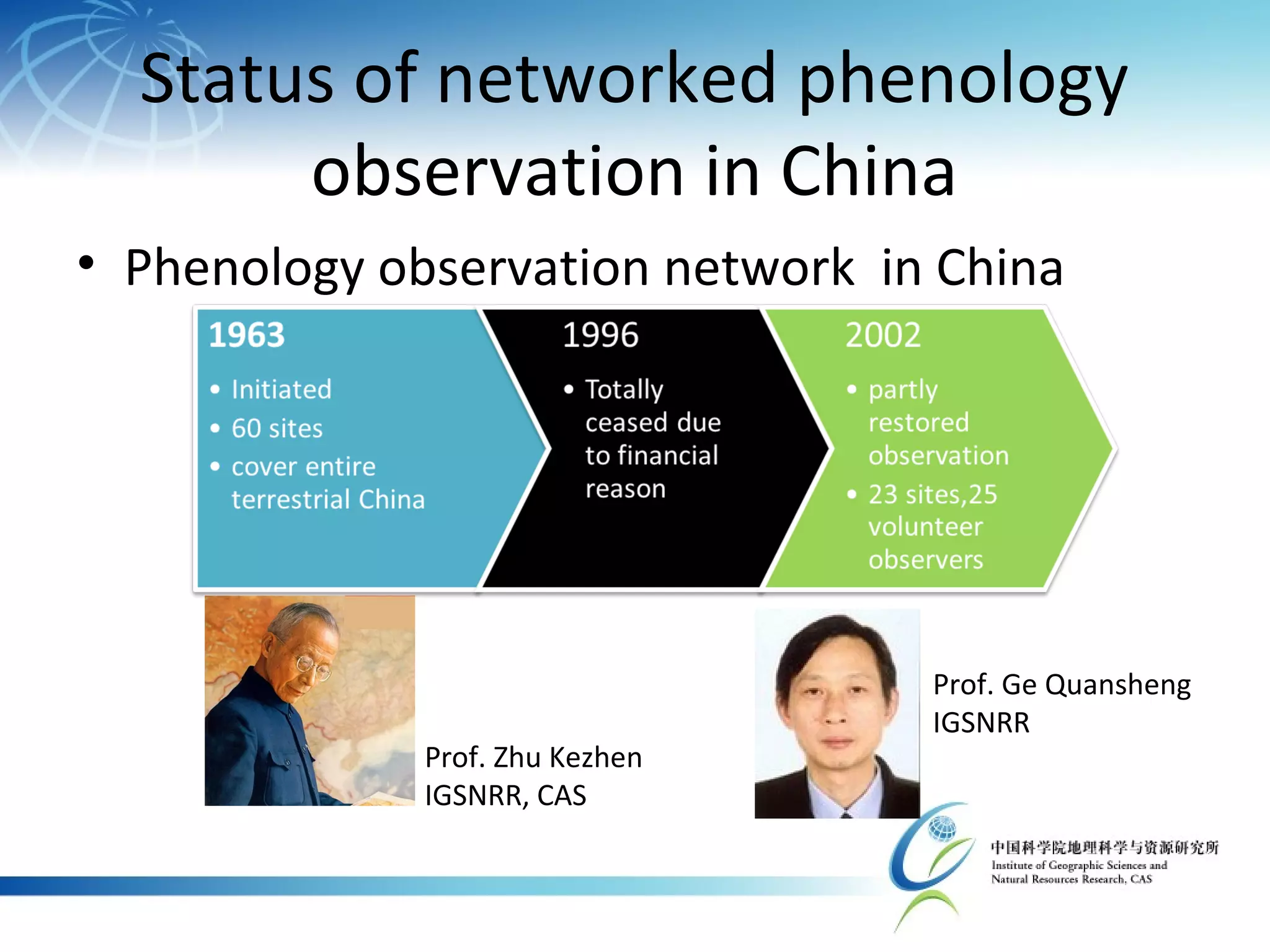
• Phenology observation network in China
Prof. Zhu Kezhen
IGSNRR, CAS
Prof. Ge Quansheng
IGSNRR
Status of networked phenology
observation in China
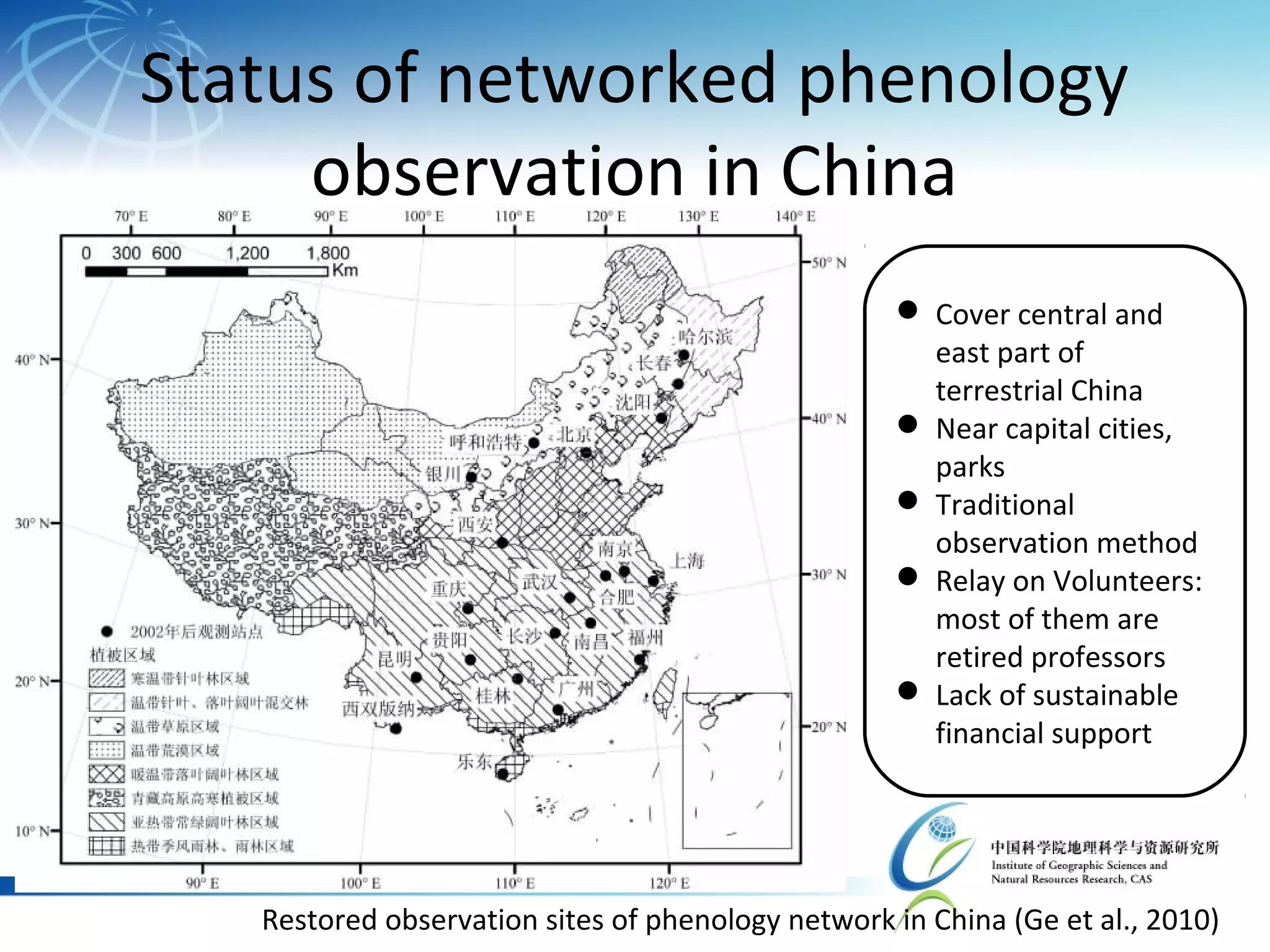
 Cover central and
east part of
terrestrial China
 Near capital cities,
parks
 Traditional
observation method
 Relay on Volunteers:
most of them are
retired professors
 Lack of sustainable
financial support
Restored observation sites of phenology network in China (Ge et al., 2010)
Status of networked phenology
observation in China
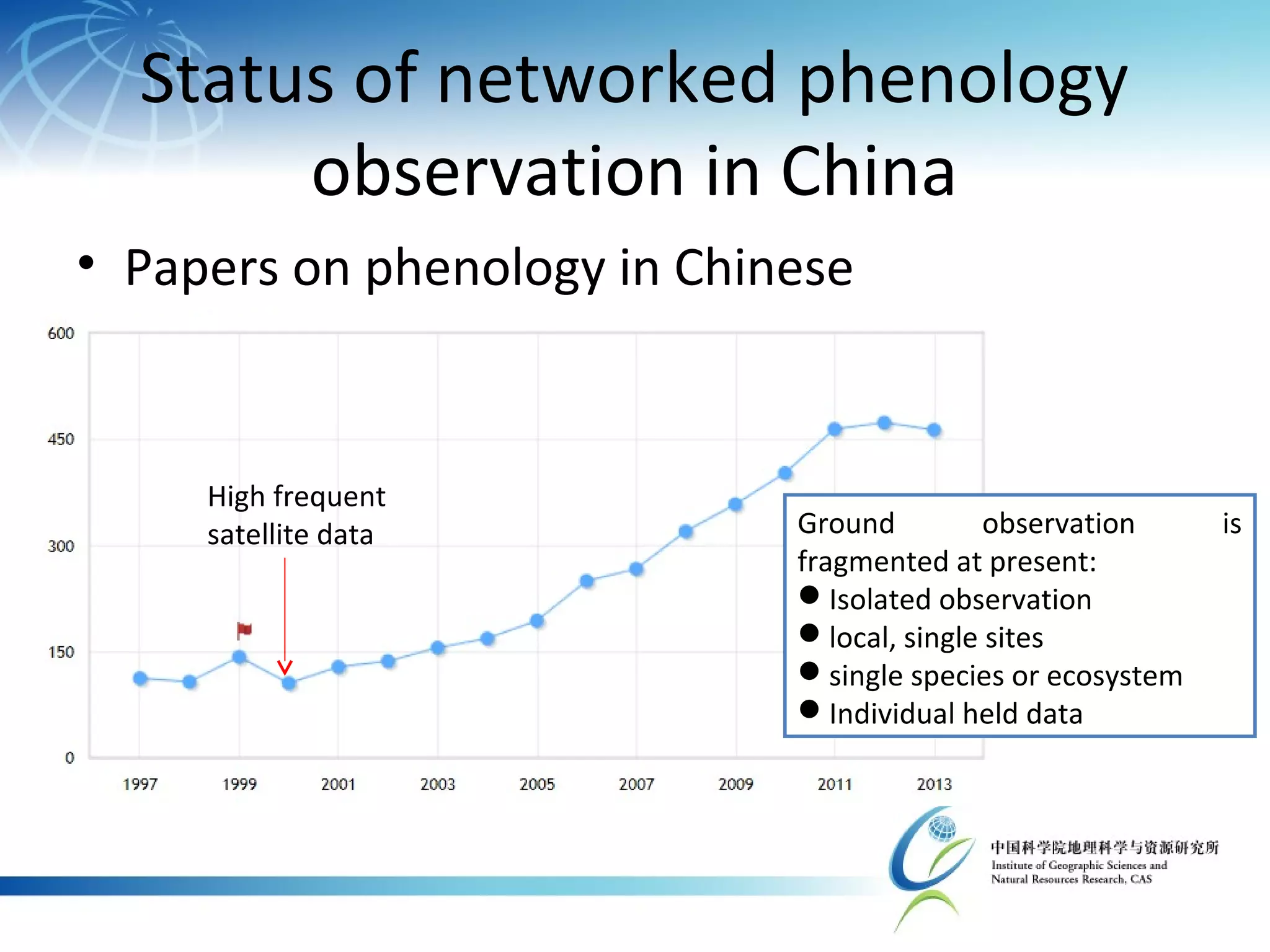
• Papers on phenology in Chinese
High frequent
satellite data Ground observation is
fragmented at present:
Isolated observation
local, single sites
single species or ecosystem
Individual held data
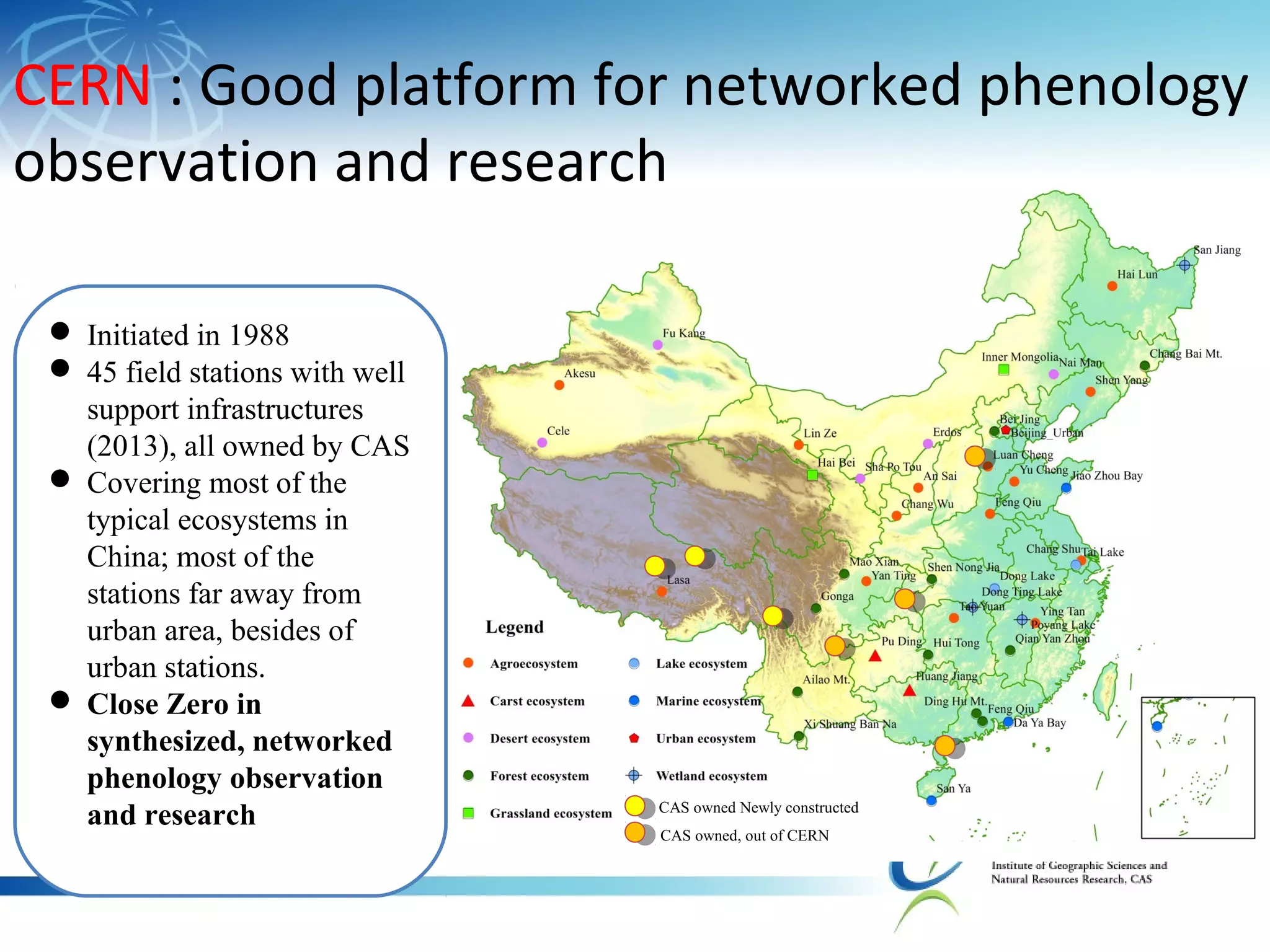
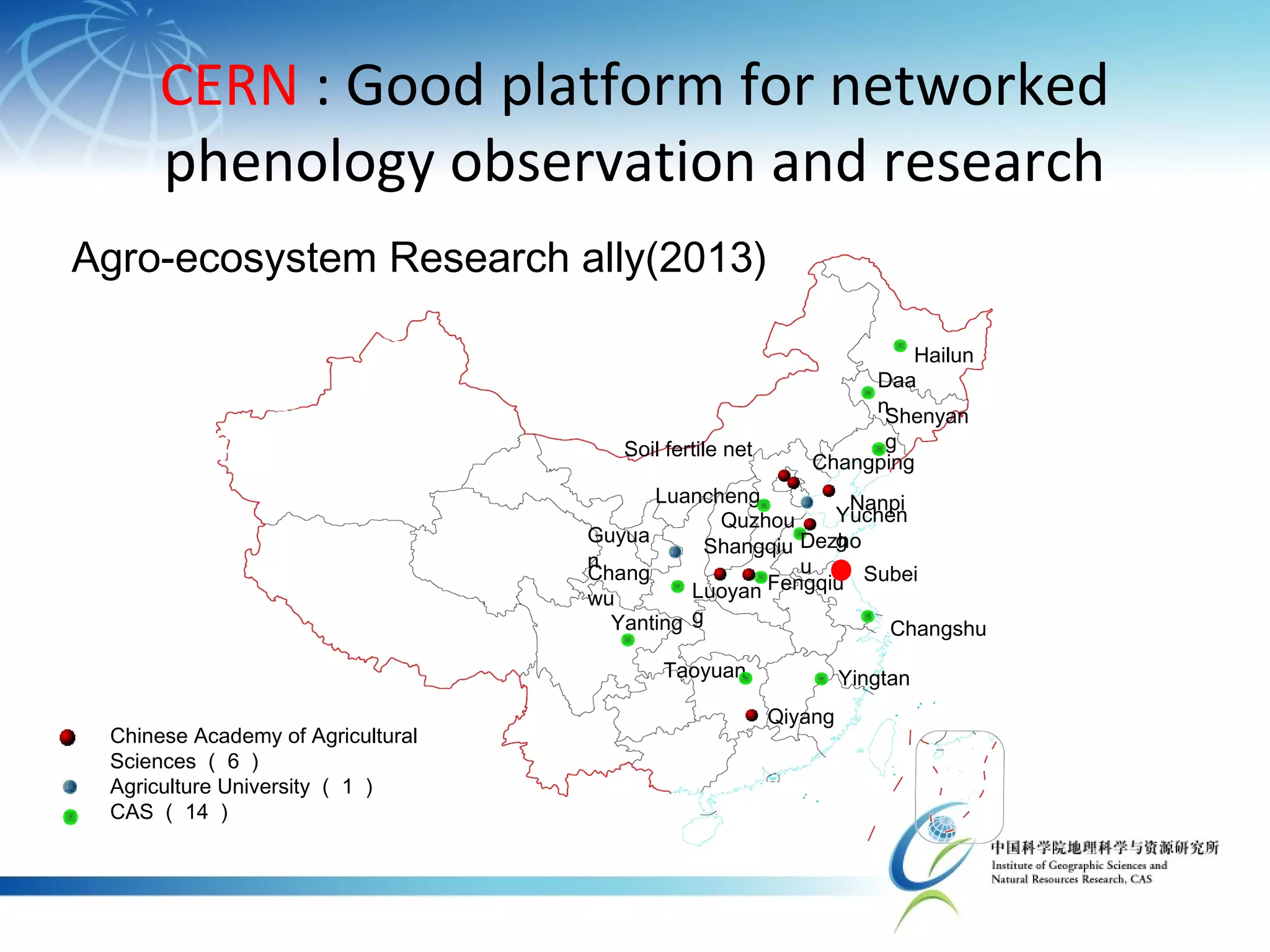
CERN : Good platform for networked phenology
observation and research
 Initiated in 1988
 45 field stations with well
support infrastructures
(2013), all owned by CAS
 Covering most of the
typical ecosystems in
China; most of the
stations far away from
urban area, besides of
urban stations.
 Close Zero in
synthesized, networked
phenology observation
and research CAS owned Newly constructed
CAS owned, out of CERN
Phenology research opportunity and
challenges using CERN
• Opportunity : CERN encourages Networked
observation and research
Network research on Carbon-Nitrogen-Water
coupling Circle (Focus, Longest time in CERN,
Largest financial support)
Network research on forest response to
environmental factor change (Very good funding)
Underground ecological processes network
research(e.g. RhizoNet, outlined in 2013)
……
Network research on forest response to
environmental factor change
Network research on
Carbon-Nitrogen-
Water coupling Circle
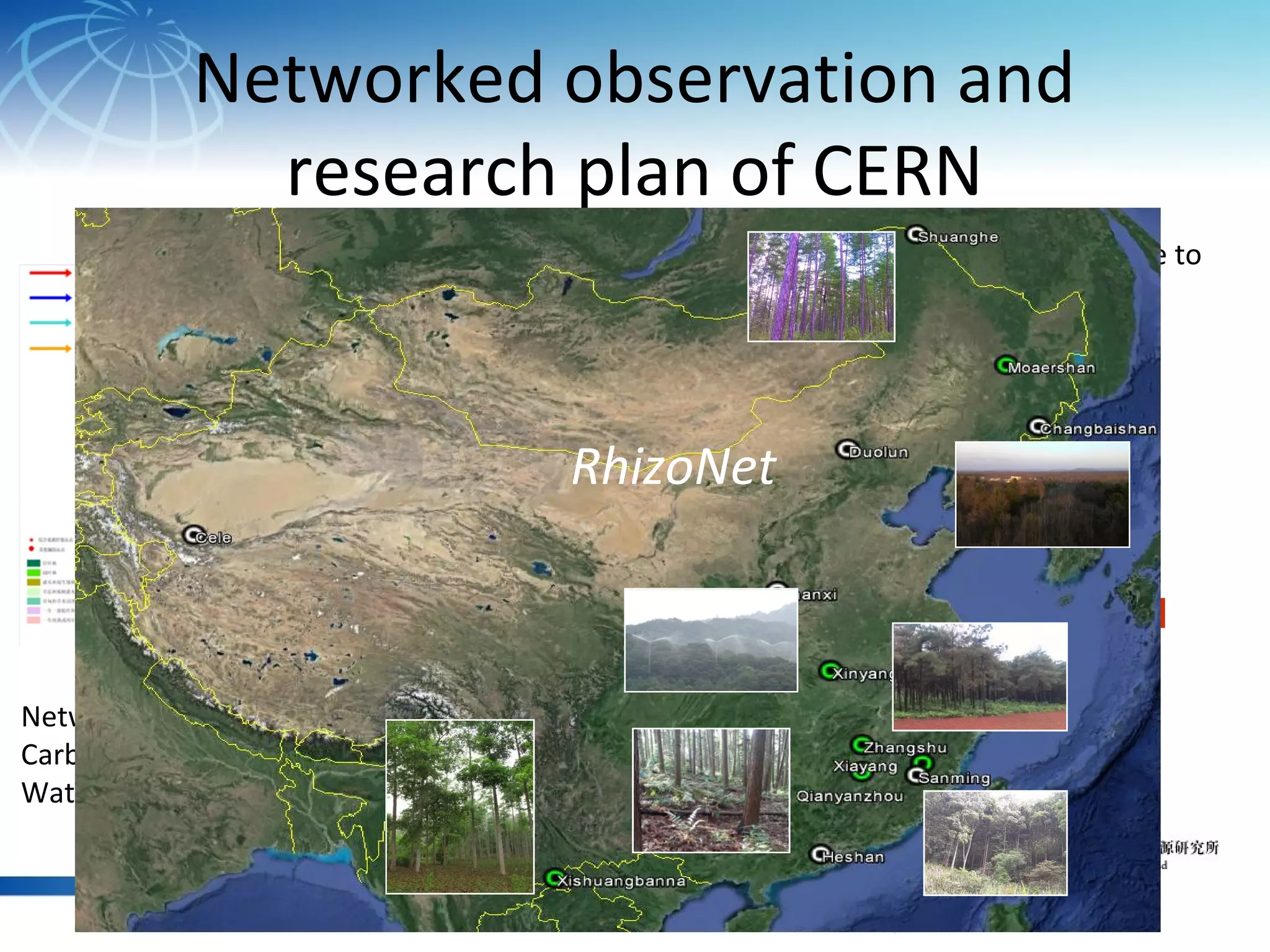
Networked observation and
research plan of CERN
Dongling
Mt.
Changbai Mt.
Nongga
ng Mt.
Xishuangbann
a
Dinghu
Mt.
Badagong
Mt
Gutianshan
Baotianma
n
W
ater gradient
Heatgradient
RhizoNet
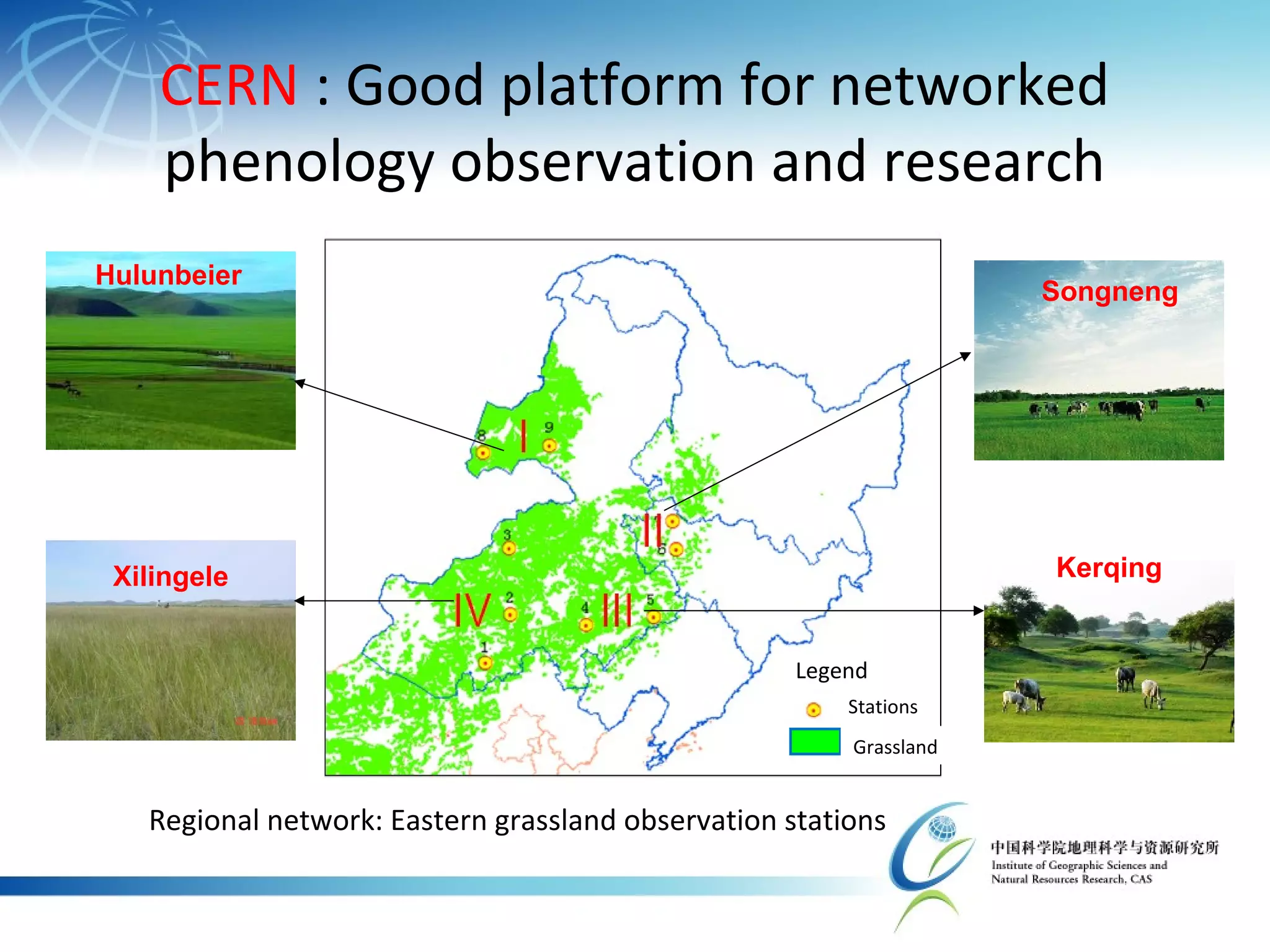
CERN : Good platform for networked
phenology observation and research
Hulunbeier
KerqingXilingele
Songneng
Stations
Legend
Grassland
Regional network: Eastern grassland observation stations
CERN : Good platform for networked
phenology observation and research
Yanting
Shenyan
g
Fengqiu
Changshu
Luancheng
Yuchen
g
Hailun
Taoyuan Yingtan
Shangqiu
Qiyang
Soil fertile net
Chang
wu Luoyan
g
Changping
Quzhou
Dezho
u
Chinese Academy of Agricultural
Sciences ( 6 )
Agriculture University ( 1 )
CAS ( 14 )
Guyua
n
Daa
n
Nanpi
Subei
Agro-ecosystem Research ally(2013)
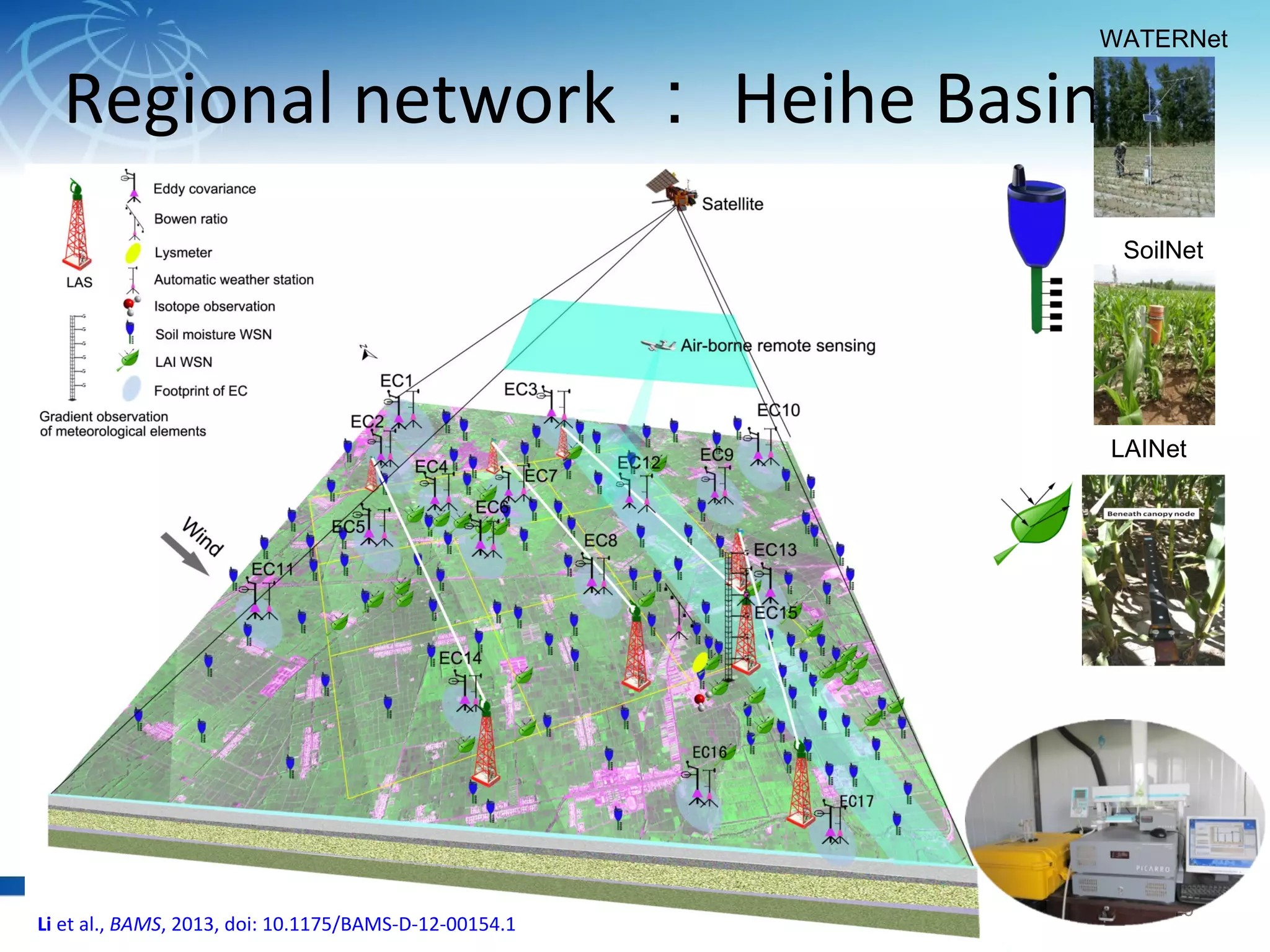
Regional network : Heihe Basin
10
SoilNet
WATERNet
LAINet
Li et al., BAMS, 2013, doi: 10.1175/BAMS-D-12-00154.1
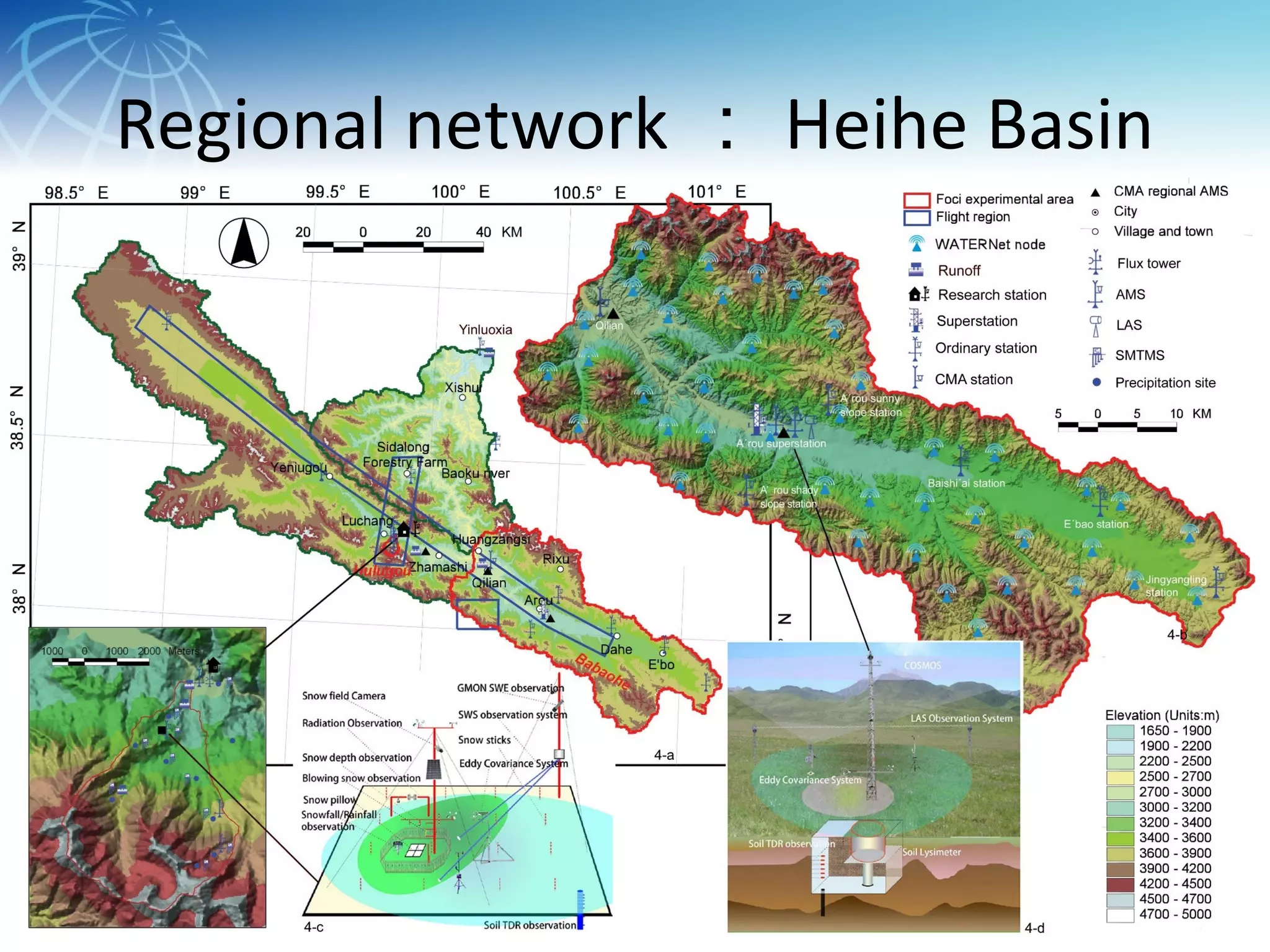
Regional network : Heihe Basin
11
Phenology research opportunity
and challenges
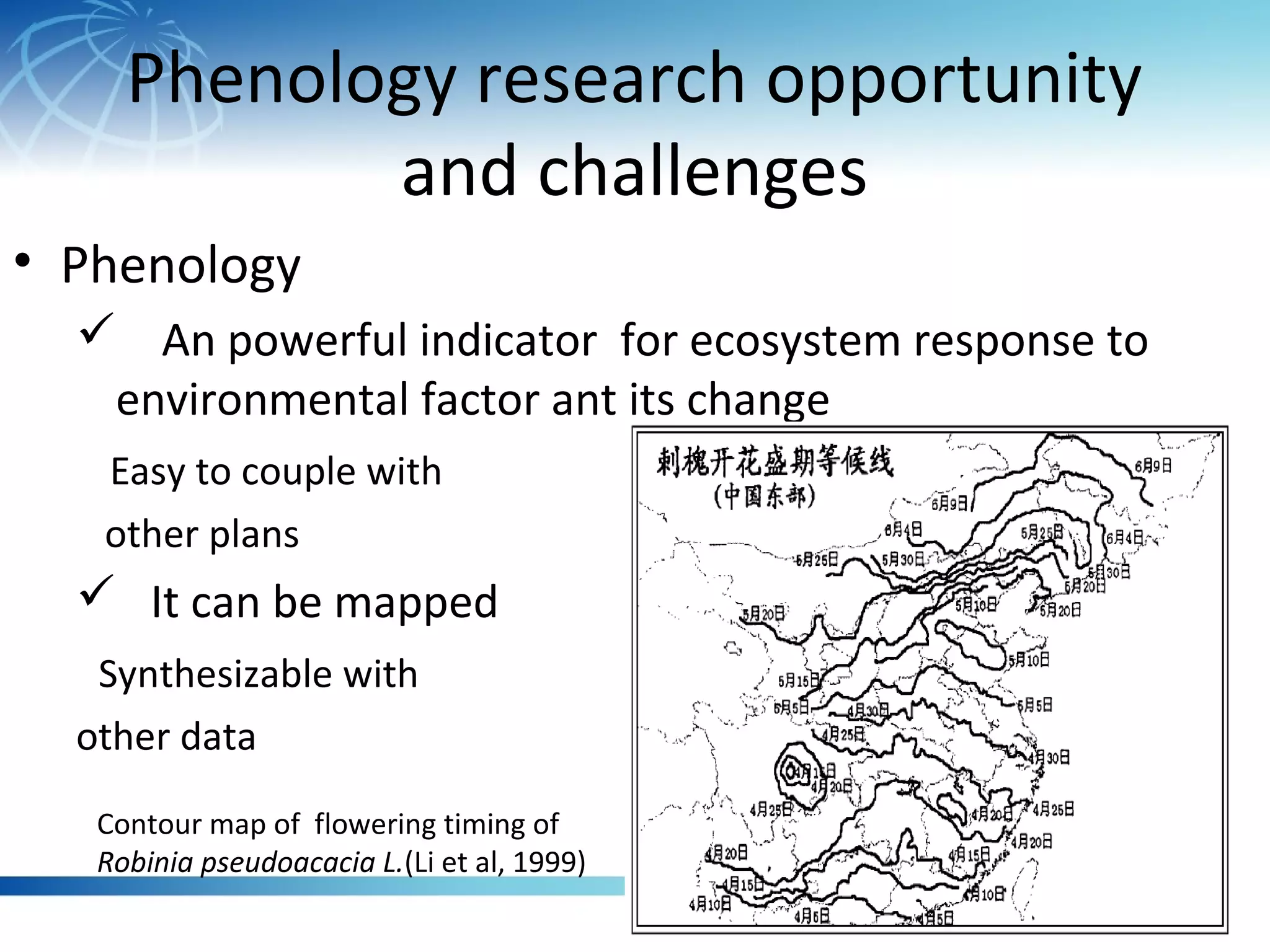
• Phenology
 An powerful indicator for ecosystem response to
environmental factor ant its change
Easy to couple with
other plans
 It can be mapped
Synthesizable with
other data
Contour map of flowering timing of
Robinia pseudoacacia L.(Li et al, 1999)
Phenology research opportunity and
challenges
Personal Questions:
How to couple phenology with other network
observation and researches using phenocam
approach? What’s the common scientific focus?
How to mapping phenology based on
phenocam data?
How to integrate the phenology data to the
spatial land observation data set? Such as land
cover data.
Phenology research opportunity
and challenges
• Challenges: How to use CERN as a networked
phenology observation platform?
Scientific Ideas: Climate change Sciences,
botany sciences…….
Technologies: Phenocam network, satellite
remote sensing, how to design and couple
them?
Sustainability: less output, less support
Push CERN into Phenology
• Scientific outputs forecast?
What can be anticipated?
• International cooperation
• Negotiation
e.g. CERN and China Phenology network
……
Liu Yu phenology observations of CERN

Liu Yu phenology observations of CERN

  • 1.
    Looking forward toideas of Phenology observation and research of CERN: How to Start from Zero Yu Liu Research assistant Synthesis Research Center Key Laboratory of Ecosystem Network Observation and Modeling (LENOM) of Chinese Academy of Science (CAS) Institute of Geographical Sciences and Natural Resources Research, CAS
  • 2.
    Status of networkedphenology observation in China • Phenology observation network in China Prof. Zhu Kezhen IGSNRR, CAS Prof. Ge Quansheng IGSNRR
  • 3.
    Status of networkedphenology observation in China  Cover central and east part of terrestrial China  Near capital cities, parks  Traditional observation method  Relay on Volunteers: most of them are retired professors  Lack of sustainable financial support Restored observation sites of phenology network in China (Ge et al., 2010)
  • 4.
    Status of networkedphenology observation in China • Papers on phenology in Chinese High frequent satellite data Ground observation is fragmented at present: Isolated observation local, single sites single species or ecosystem Individual held data
  • 5.
    CERN : Goodplatform for networked phenology observation and research  Initiated in 1988  45 field stations with well support infrastructures (2013), all owned by CAS  Covering most of the typical ecosystems in China; most of the stations far away from urban area, besides of urban stations.  Close Zero in synthesized, networked phenology observation and research CAS owned Newly constructed CAS owned, out of CERN
  • 6.
    Phenology research opportunityand challenges using CERN • Opportunity : CERN encourages Networked observation and research Network research on Carbon-Nitrogen-Water coupling Circle (Focus, Longest time in CERN, Largest financial support) Network research on forest response to environmental factor change (Very good funding) Underground ecological processes network research(e.g. RhizoNet, outlined in 2013) ……
  • 7.
    Network research onforest response to environmental factor change Network research on Carbon-Nitrogen- Water coupling Circle Networked observation and research plan of CERN Dongling Mt. Changbai Mt. Nongga ng Mt. Xishuangbann a Dinghu Mt. Badagong Mt Gutianshan Baotianma n W ater gradient Heatgradient RhizoNet
  • 8.
    CERN : Goodplatform for networked phenology observation and research Hulunbeier KerqingXilingele Songneng Stations Legend Grassland Regional network: Eastern grassland observation stations
  • 9.
    CERN : Goodplatform for networked phenology observation and research Yanting Shenyan g Fengqiu Changshu Luancheng Yuchen g Hailun Taoyuan Yingtan Shangqiu Qiyang Soil fertile net Chang wu Luoyan g Changping Quzhou Dezho u Chinese Academy of Agricultural Sciences ( 6 ) Agriculture University ( 1 ) CAS ( 14 ) Guyua n Daa n Nanpi Subei Agro-ecosystem Research ally(2013)
  • 10.
    Regional network :Heihe Basin 10 SoilNet WATERNet LAINet Li et al., BAMS, 2013, doi: 10.1175/BAMS-D-12-00154.1
  • 11.
    Regional network :Heihe Basin 11
  • 12.
    Phenology research opportunity andchallenges • Phenology  An powerful indicator for ecosystem response to environmental factor ant its change Easy to couple with other plans  It can be mapped Synthesizable with other data Contour map of flowering timing of Robinia pseudoacacia L.(Li et al, 1999)
  • 13.
    Phenology research opportunityand challenges Personal Questions: How to couple phenology with other network observation and researches using phenocam approach? What’s the common scientific focus? How to mapping phenology based on phenocam data? How to integrate the phenology data to the spatial land observation data set? Such as land cover data.
  • 14.
    Phenology research opportunity andchallenges • Challenges: How to use CERN as a networked phenology observation platform? Scientific Ideas: Climate change Sciences, botany sciences……. Technologies: Phenocam network, satellite remote sensing, how to design and couple them? Sustainability: less output, less support
  • 15.
    Push CERN intoPhenology • Scientific outputs forecast? What can be anticipated? • International cooperation • Negotiation e.g. CERN and China Phenology network ……

Editor's Notes

  • #2 The idea is to give you an opportunity to tell the group what your interest in phenology is, how you see phenocams contributing to your work, and what you would like to get out of the workshop.
  • #3 Phenology has a long history. There huge phenological records in materials. The networked phenology observation and research in China started in 1960s.
  • #4 They also try to build a online system, to motivate public participation. Problem: difficulties in getting funds for process data.
  • #5 Remote sensing, isolated observation, single sites, single species or ecosystem. In a word, phenology observation in china is fragmented at present.
  • #6 CERN provided a platform to conducted networked phenology observation and research. For each station, there are several observation sites.
  • #7 One of the main pillars of CERN. Recently, some research plan are outlined.
  • #9 Some research ally are forming in recently years. Stations out of CERN are joining in.
  • #10 They are discussing the network research scientific focus, observation standards.
  • #11 The highlights of the experiment is that we try to capture the 3-D heterogeneity of water and energy fluxes using a matrix observation. We have a heterogeneous land surface, dominated by crops. The area correspondences to a few medium-resolution remote sensing pixels or model grids. Based on the difference of land covers, irrigation schemes, and . We mounted 17 eddy covariance towers to measure ET and CO2 fluxes.
  • #13 Personally, I think phenology has two inherent advantages. They make phenology can be coupled with many other ecological issues, and data.
  • #14 Personally , I am interest in the two Questions.
  • #15 Why phenology? How phenology? Funding, labour
  • #16 At present, the negotiation is not enough. You, especially TERN and NEON, have experiences. I am looking ford to share your experiences.