Community	Assembly	on	Remote	Islands	
Does	Equilibrium	Theory	apply?
Christophe	Thébaud	
University	of	Toulouse	
ISLANDS	
2012-2015
Islands	are	important	systems	to	understand	how	organisms	
came	to	be	and	why	they	are	distributed	the	way	they	are
remote	oceanic	islands	have	very	limited	faunas	and	
floras	
similarities	between	island	fauna	and	flora	and	nearby	
continents	
uniqueness	of	island	fauna	and	flora	-	in	situ	evolution
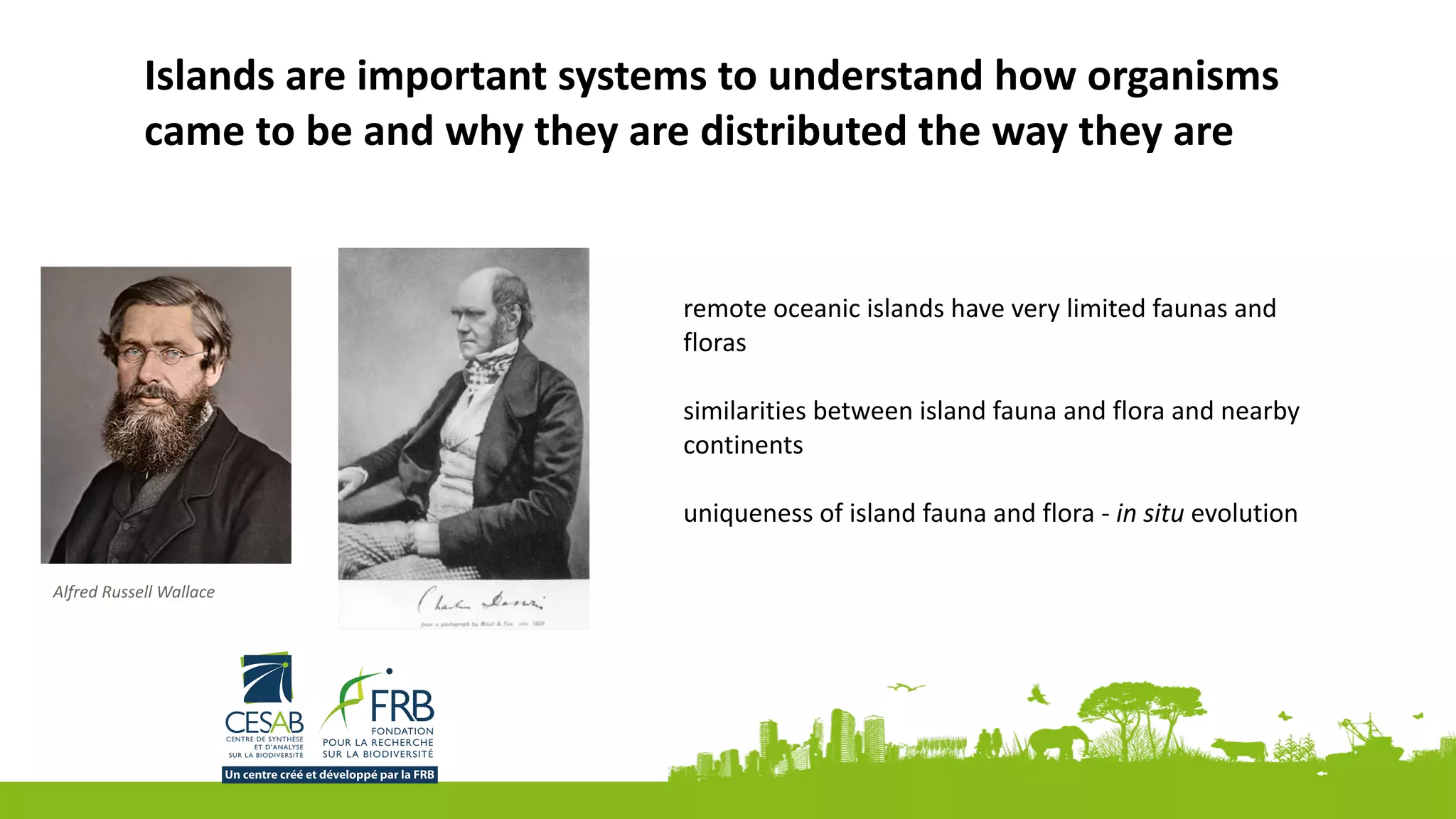
Alfred	Russell	Wallace
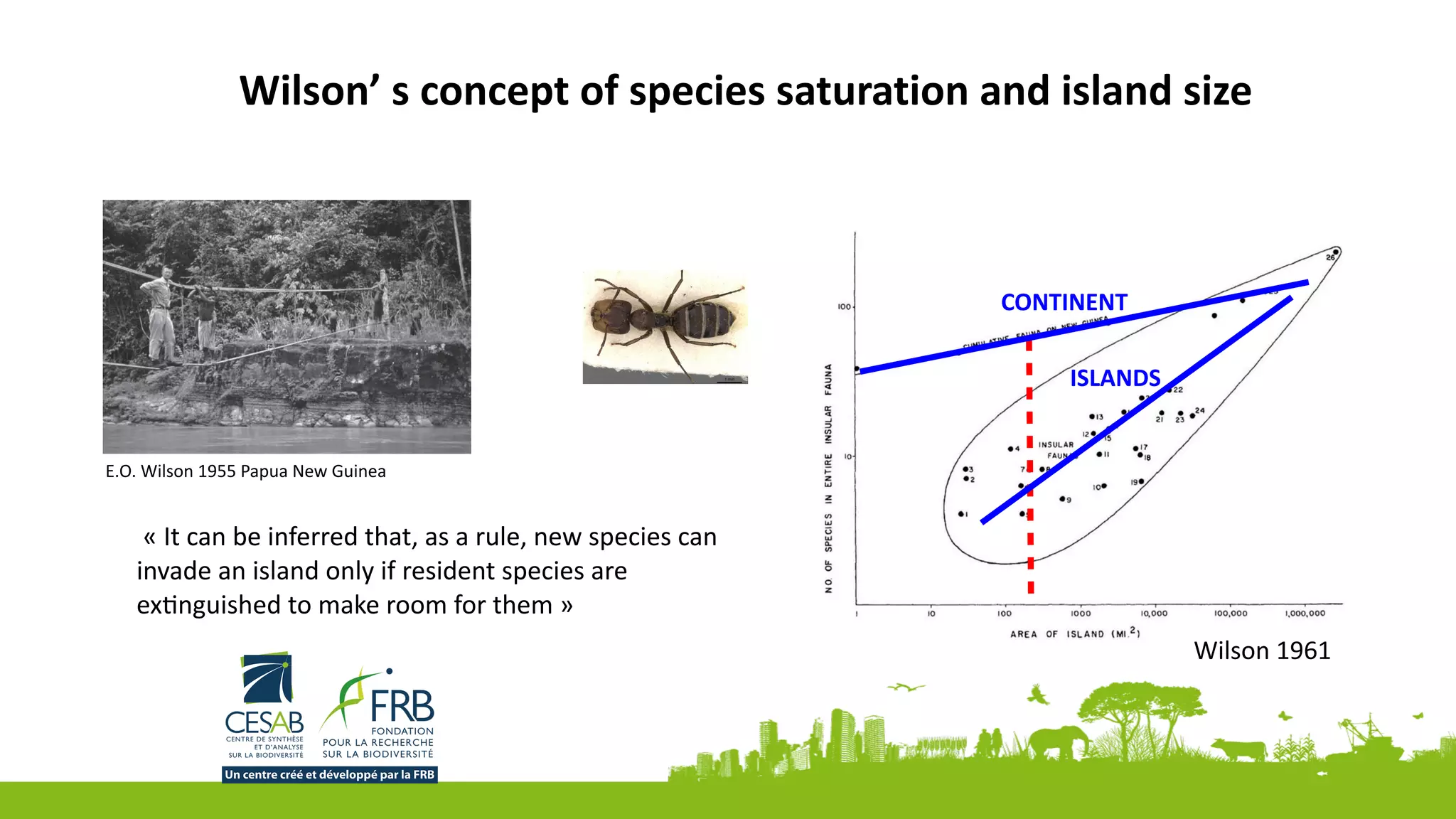
CONTINENT
ISLANDS
Island Biogeography in the 1960s • 3
of geographic variation. They turned out to be mostly specialized on mar-
ginal habitats, those inhabited by relatively small numbers of species.
In Melanesia, the marginal habitats include littoral environments of the
coastal shore, river-edge forests, and savannas. Such are places that are
happenstance staging areas for between-island dispersal. Local populations
Figure 1.1. E. O. Wilson with guard crossing the lower Mongi River, Papua New
Guinea, April 1955.
MelanesiaSoutheastern Asia
Time
Marginal
Habitats
Inner
Rain
Forest
1
2
4
3
5
6
Figure 1.2. The taxon cycle in the Melanesian ant fauna (Wilson 1965, modified
from Wilson 1959).
E.O.	Wilson	1955	Papua	New	Guinea
Wilson	1961
	«	It	can	be	inferred	that,	as	a	rule,	new	species	can	
invade	an	island	only	if	resident	species	are	
exJnguished	to	make	room	for	them	»
Wilson’	s	concept	of	species	saturation	and	island	size
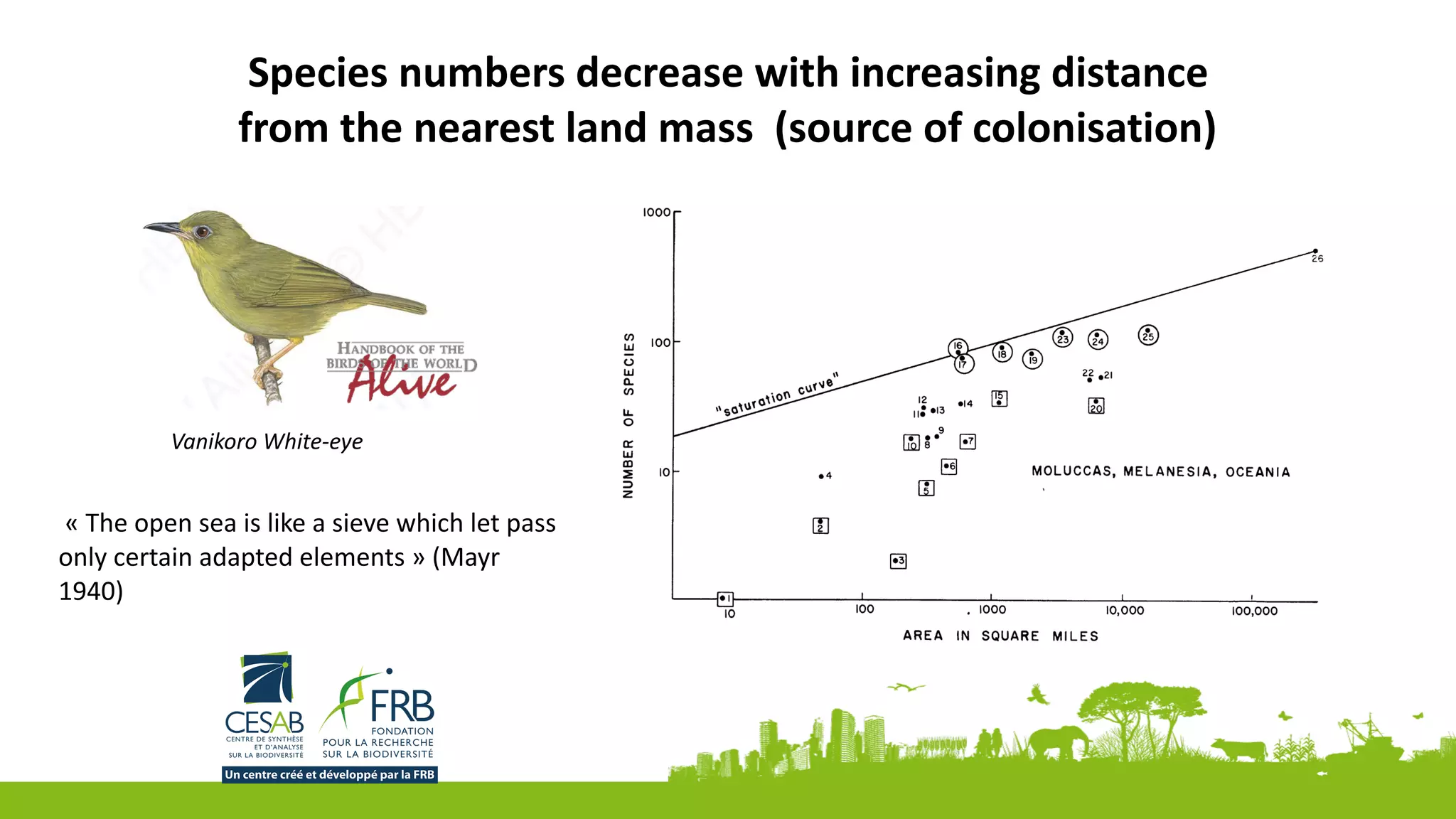
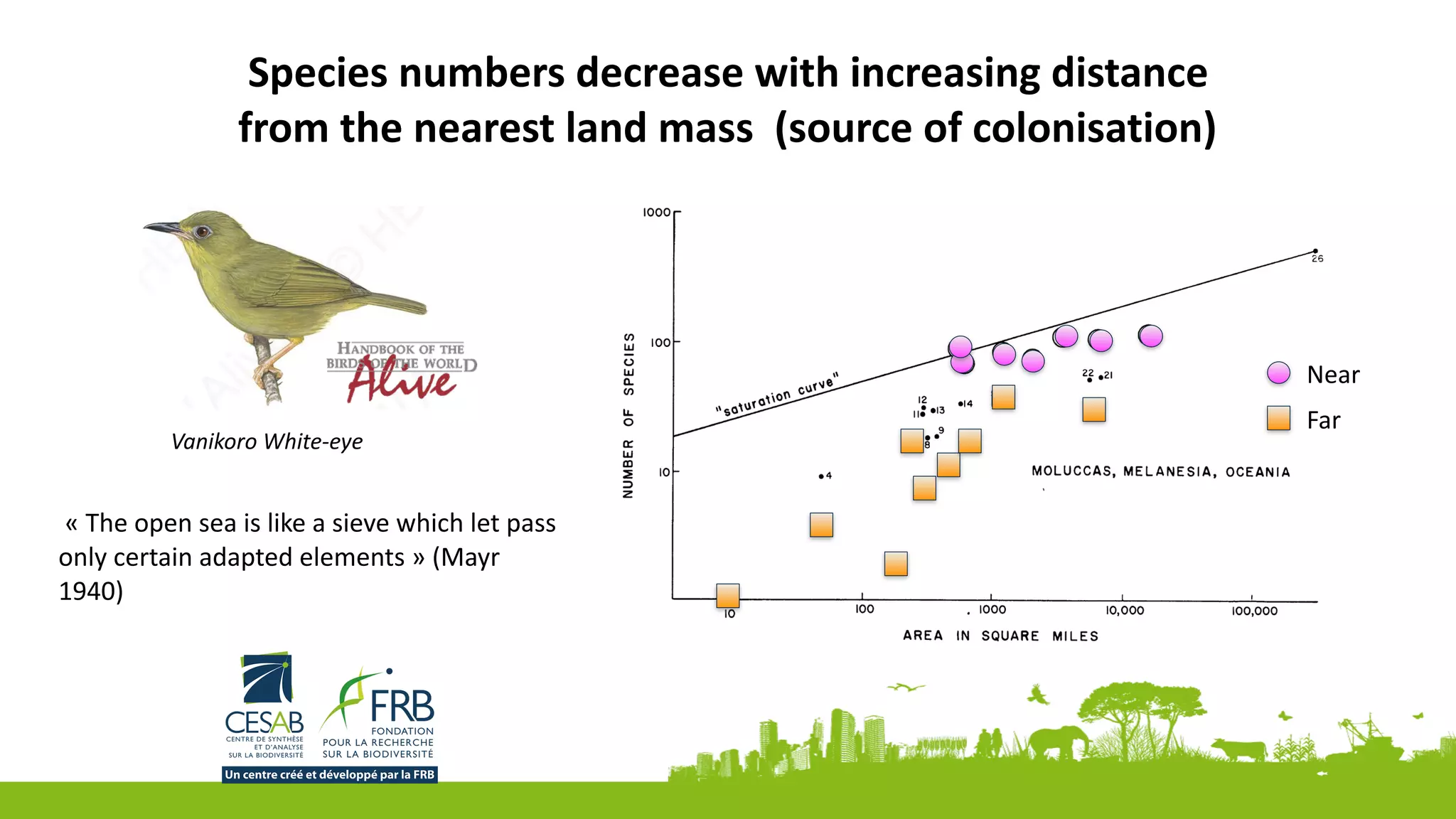
Species	numbers	decrease	with	increasing	distance	
from	the	nearest	land	mass		(source	of	colonisation)
	«	The	open	sea	is	like	a	sieve	which	let	pass	
only	certain	adapted	elements	»	(Mayr	
1940)
Vanikoro	White-eye
Species	numbers	decrease	with	increasing	distance	
from	the	nearest	land	mass		(source	of	colonisation)
	«	The	open	sea	is	like	a	sieve	which	let	pass	
only	certain	adapted	elements	»	(Mayr	
1940)
Vanikoro	White-eye	
Near
Far
What	explains	species	numbers	on	discrete	areas	
with	hard	boundaries	like	islands?
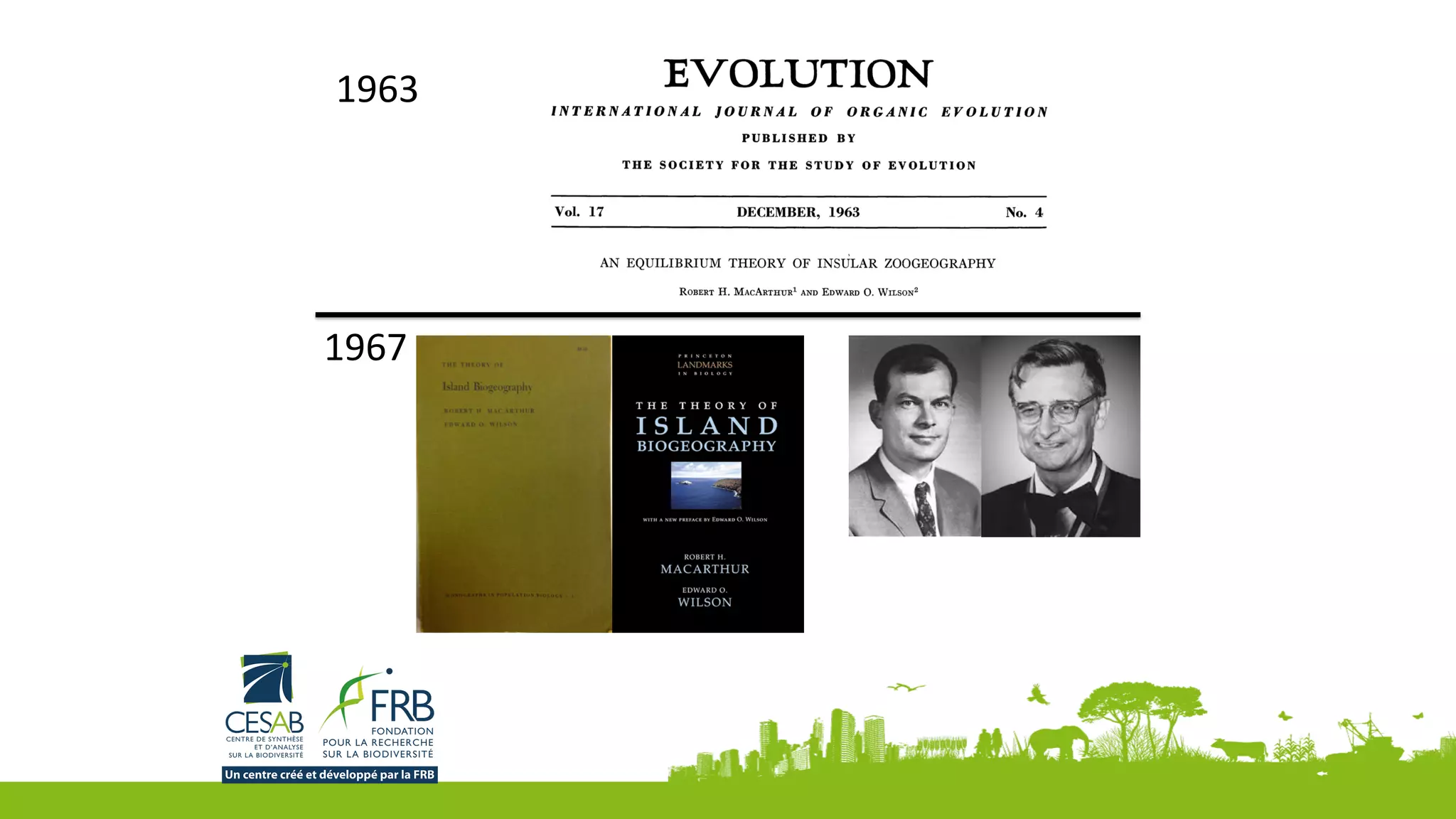
1967	
1963
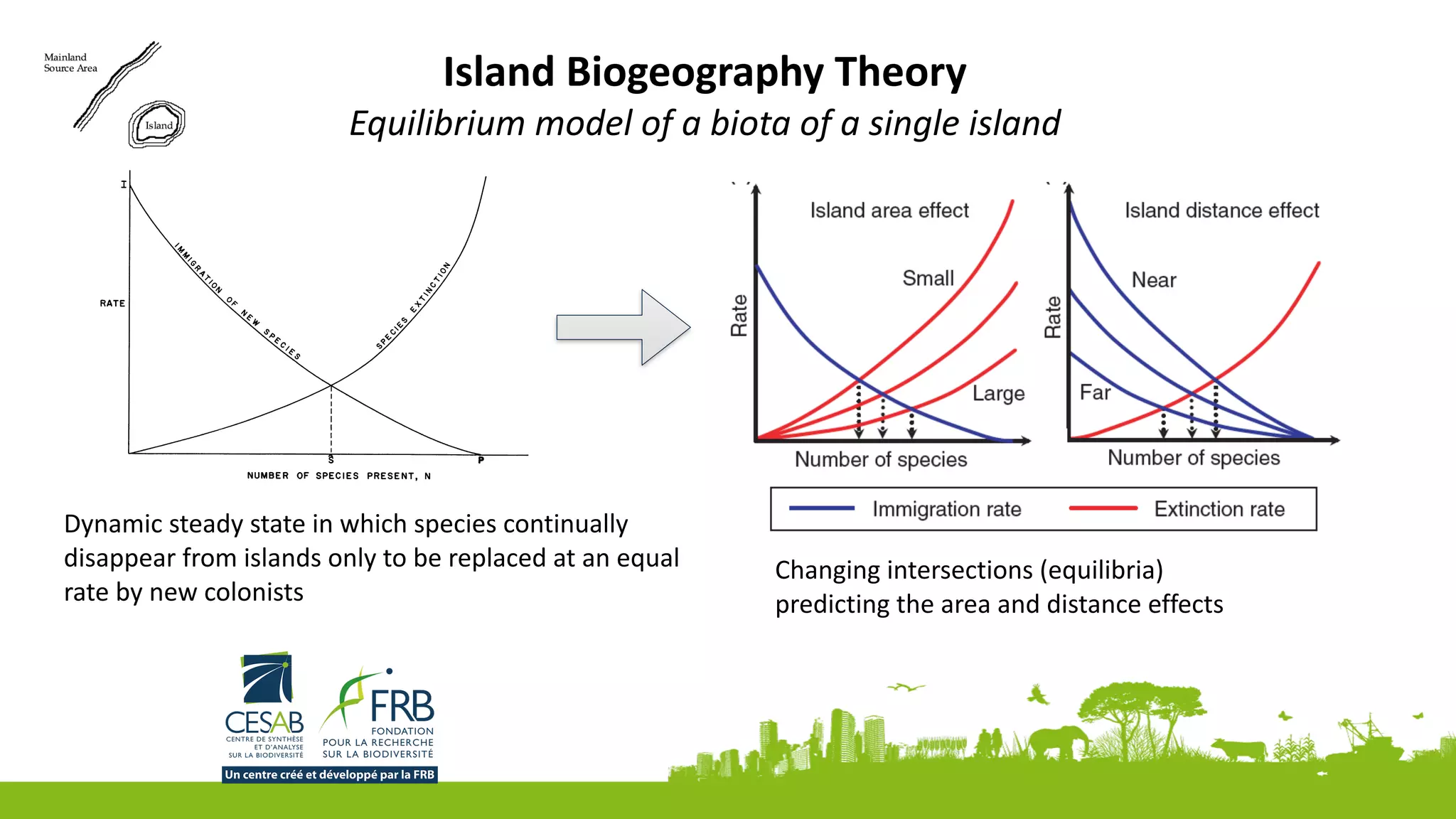
Island	Biogeography	Theory	
Equilibrium	model	of	a	biota	of	a	single	island
Dynamic	steady	state	in	which	species	continually	
disappear	from	islands	only	to	be	replaced	at	an	equal	
rate	by	new	colonists
Changing	intersections	(equilibria)	
predicting	the	area	and	distance	effects
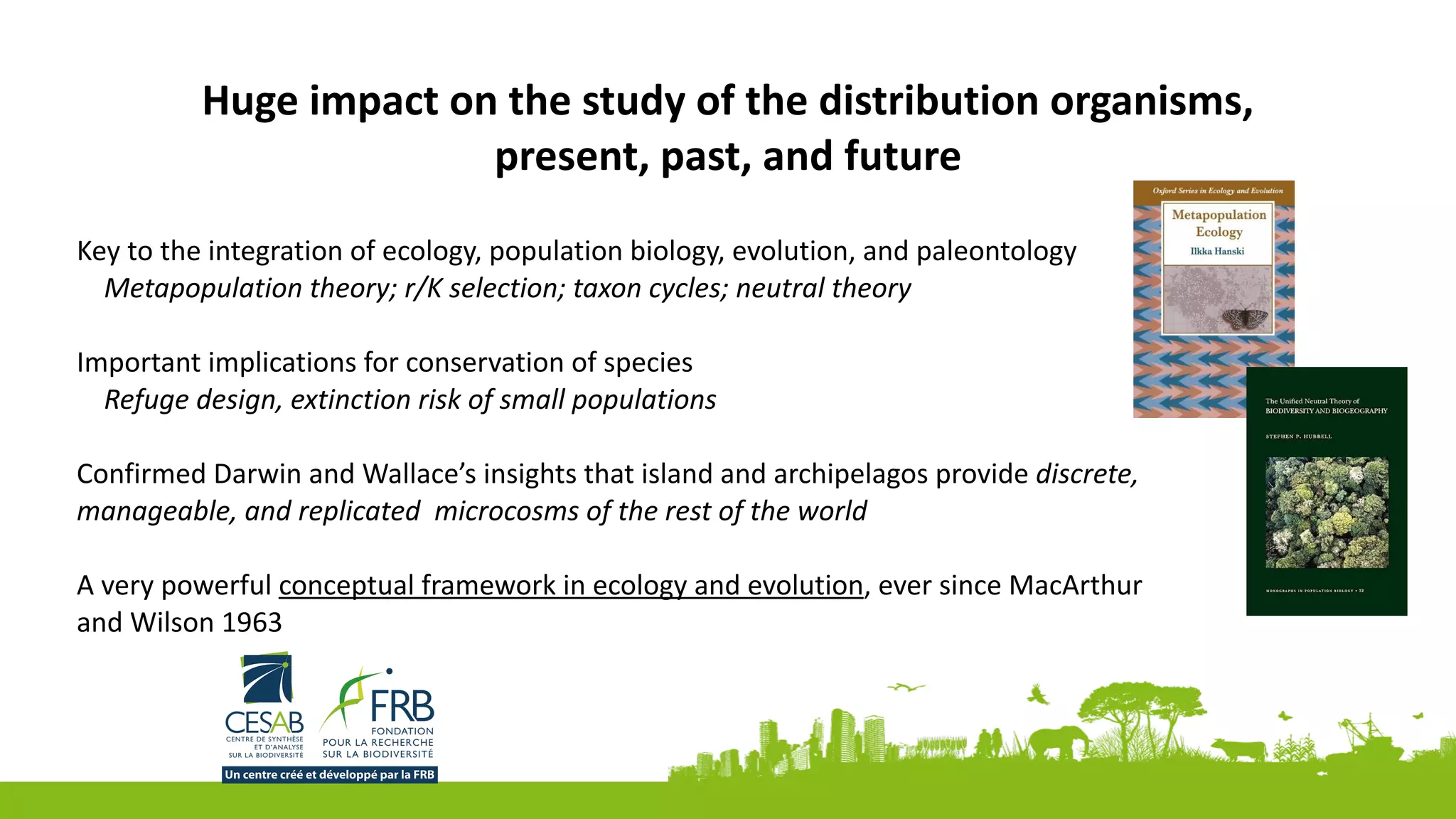
Huge	impact	on	the	study	of	the	distribution	organisms,	
present,	past,	and	future	
Key	to	the	integration	of	ecology,	population	biology,	evolution,	and	paleontology	
Metapopulation	theory;	r/K	selection;	taxon	cycles;	neutral	theory		
Important	implications	for	conservation	of	species	
Refuge	design,	extinction	risk	of	small	populations	
Confirmed	Darwin	and	Wallace’s	insights	that	island	and	archipelagos	provide	discrete,	
manageable,	and	replicated		microcosms	of	the	rest	of	the	world	
A	very	powerful	conceptual	framework	in	ecology	and	evolution,	ever	since	MacArthur	
and	Wilson	1963
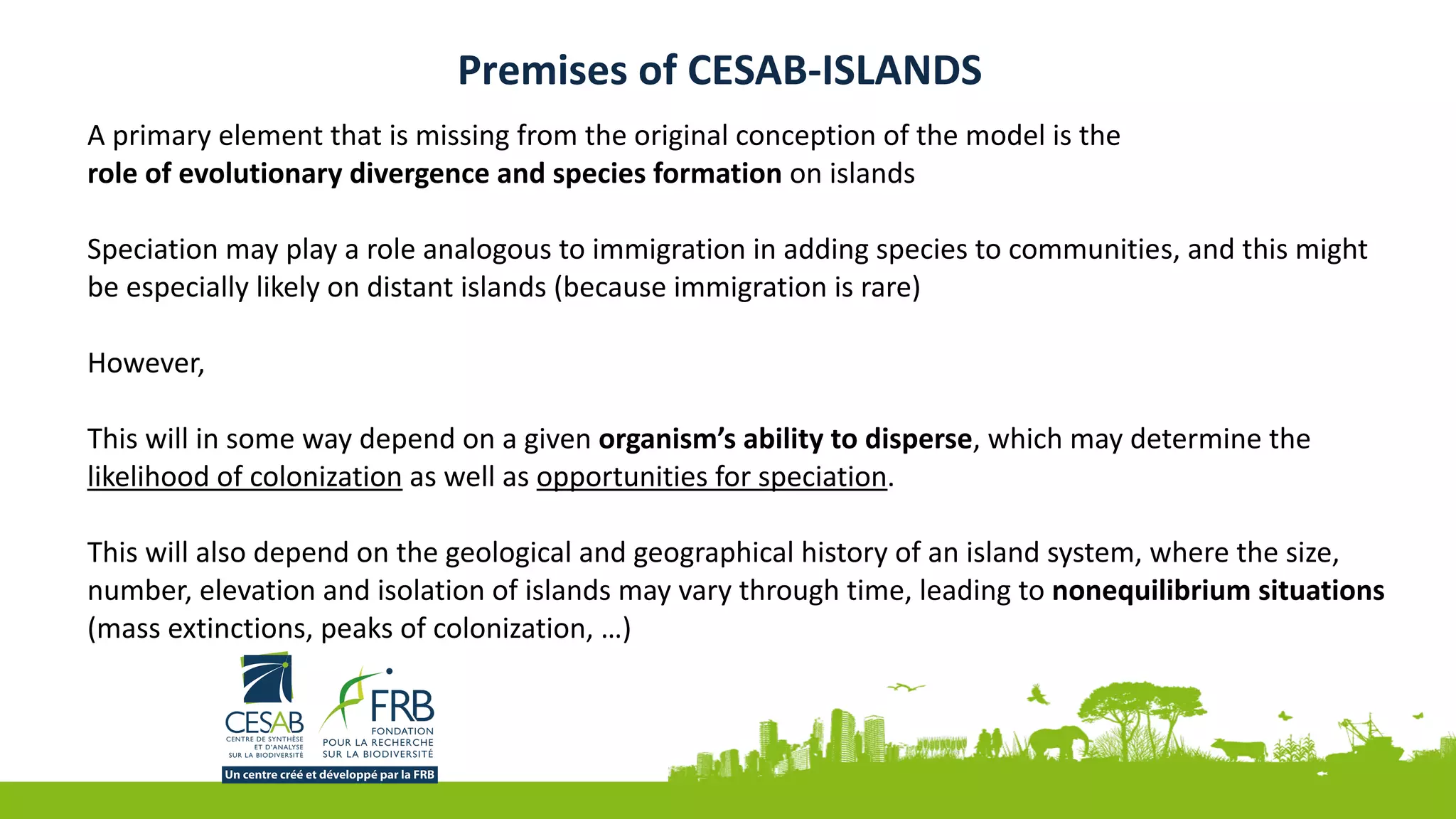
Premises	of	CESAB-ISLANDS
A	primary	element	that	is	missing	from	the	original	conception	of	the	model	is	the	
role	of	evolutionary	divergence	and	species	formation	on	islands	
Speciation	may	play	a	role	analogous	to	immigration	in	adding	species	to	communities,	and	this	might	
be	especially	likely	on	distant	islands	(because	immigration	is	rare)	
However,	
This	will	in	some	way	depend	on	a	given	organism’s	ability	to	disperse,	which	may	determine	the	
likelihood	of	colonization	as	well	as	opportunities	for	speciation.	
This	will	also	depend	on	the	geological	and	geographical	history	of	an	island	system,	where	the	size,	
number,	elevation	and	isolation	of	islands	may	vary	through	time,	leading	to	nonequilibrium	situations	
(mass	extinctions,	peaks	of	colonization,	…)
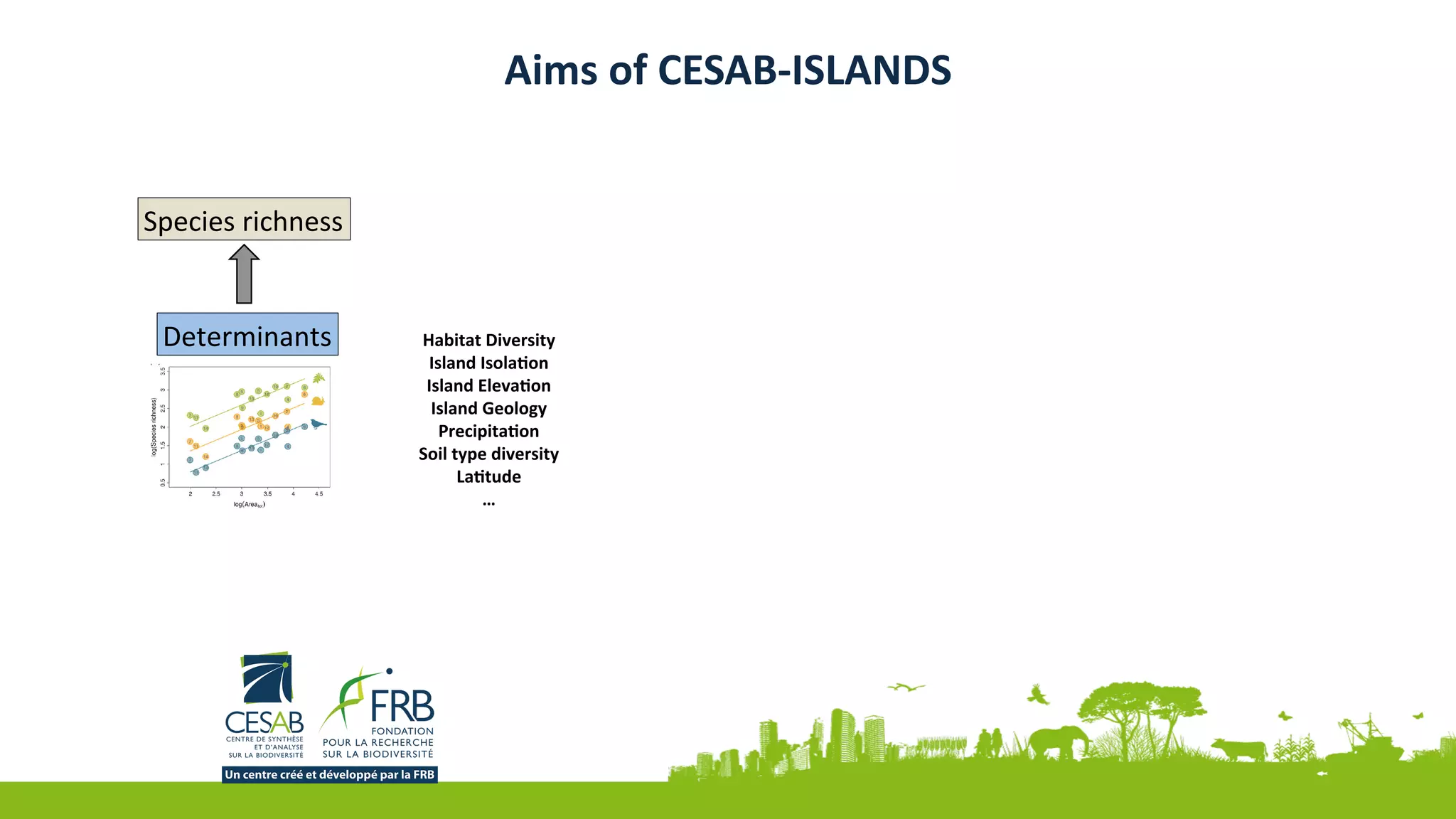
Aims	of	CESAB-ISLANDS
Species	richness	
Determinants	 Habitat	Diversity	
Island	Isola2on	
Island	Eleva2on	
Island	Geology	
Precipita2on	
Soil	type	diversity	
La2tude	
…
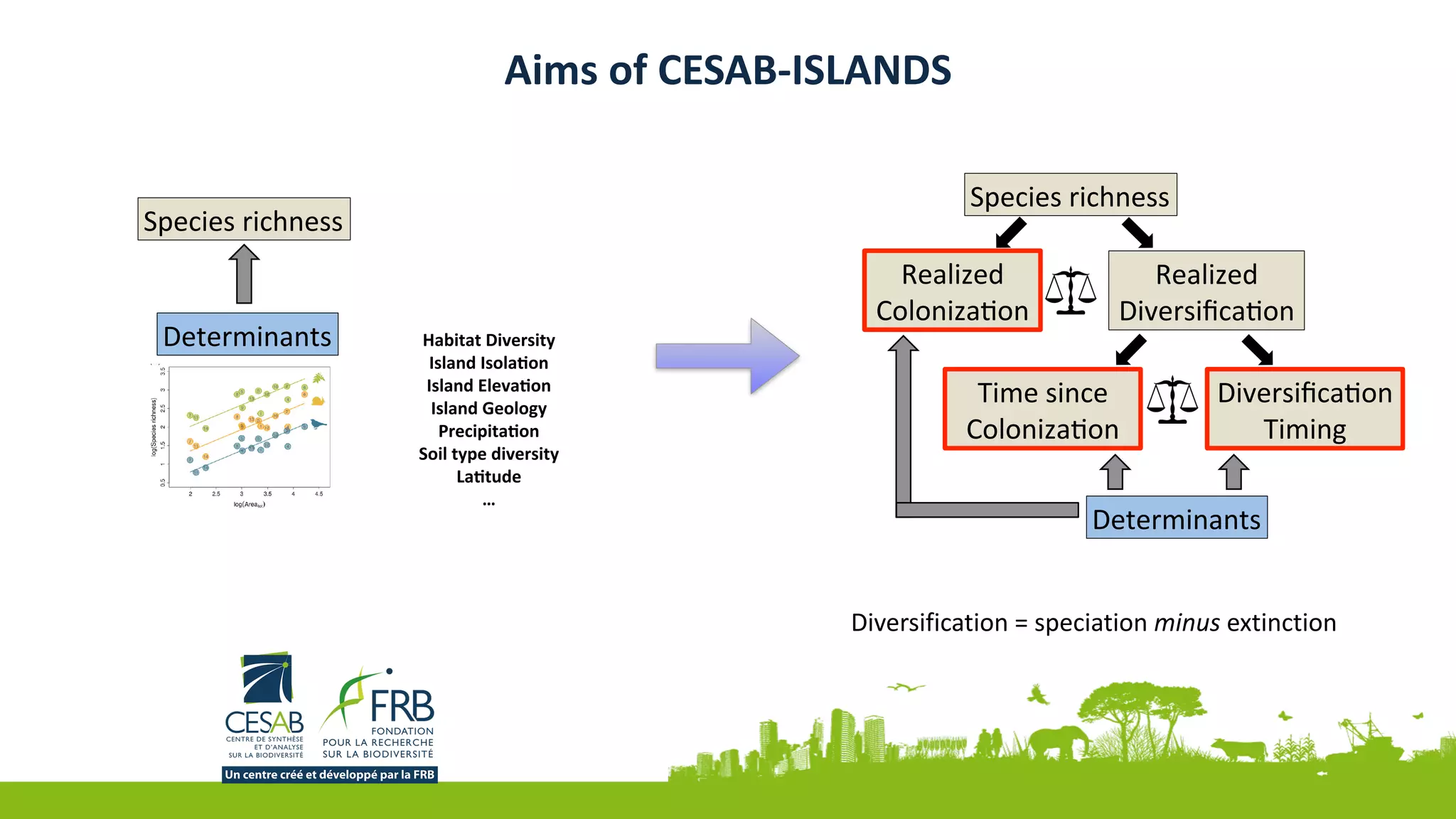
Aims	of	CESAB-ISLANDS
Species	richness	
Determinants	 Habitat	Diversity	
Island	Isola2on	
Island	Eleva2on	
Island	Geology	
Precipita2on	
Soil	type	diversity	
La2tude	
…	
Species	richness	
Realized	
Diversifica3on	
Realized	
Coloniza3on	
Diversifica3on	
Timing	
Time	since	
Coloniza3on	
Determinants	
Diversification	=	speciation	minus	extinction
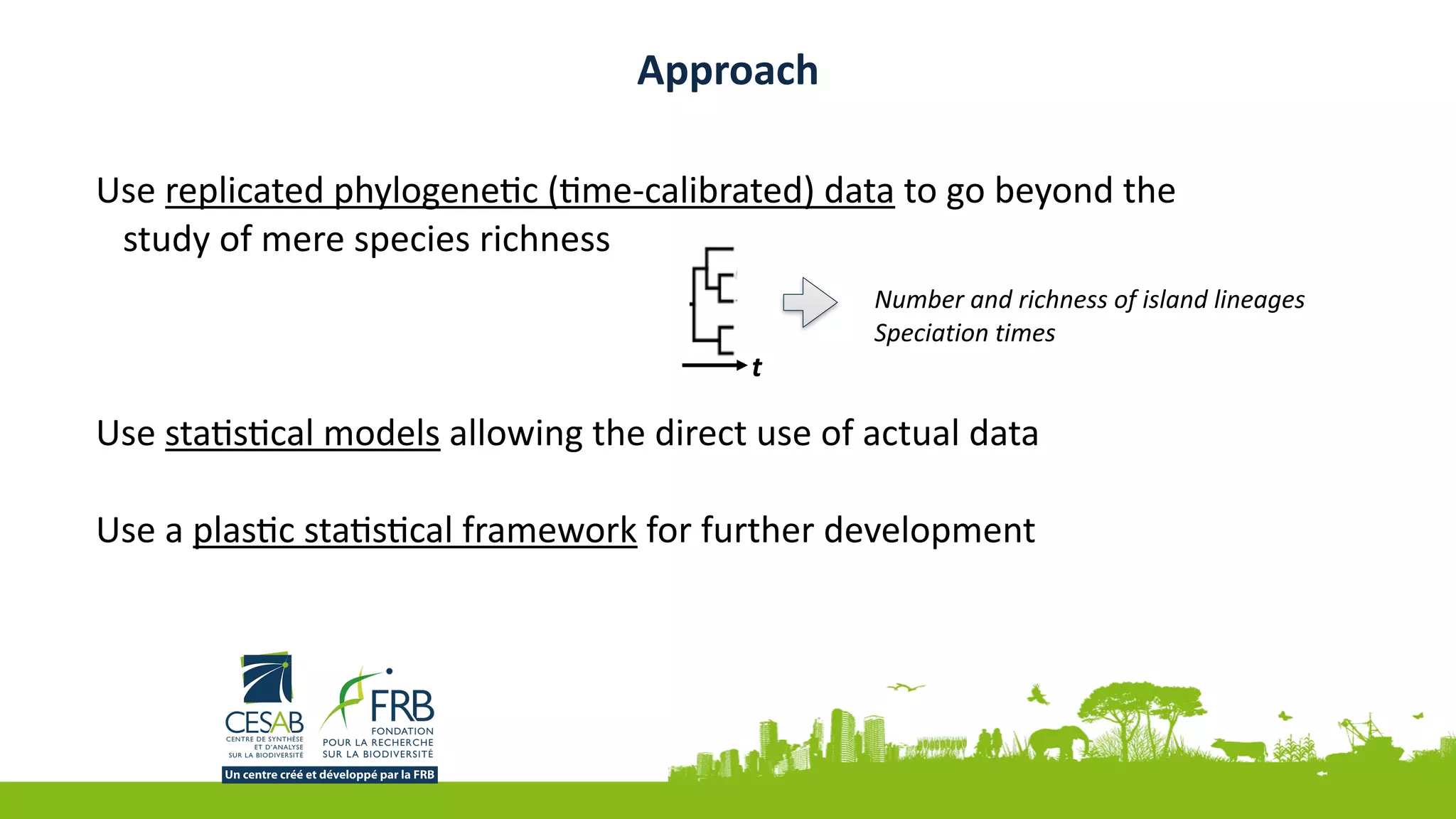
Use	replicated	phylogeneJc	(Jme-calibrated)	data	to	go	beyond	the	
study	of	mere	species	richness	
Use	staJsJcal	models	allowing	the	direct	use	of	actual	data	
Use	a	plasJc	staJsJcal	framework	for	further	development	
Approach
t	
Number	and	richness	of	island	lineages	
Speciation	times
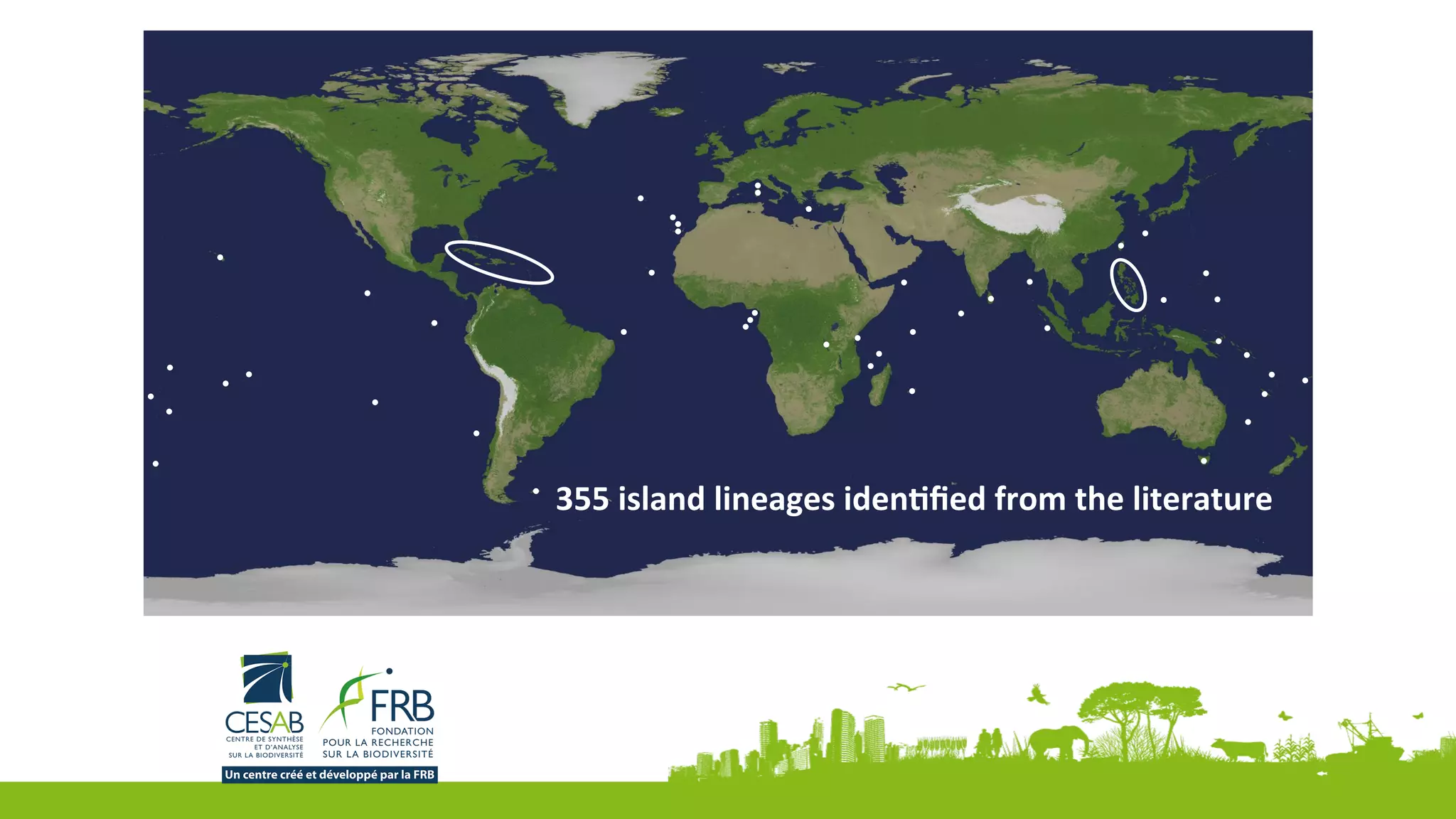
355	island	lineages	iden,fied	from	the	literature
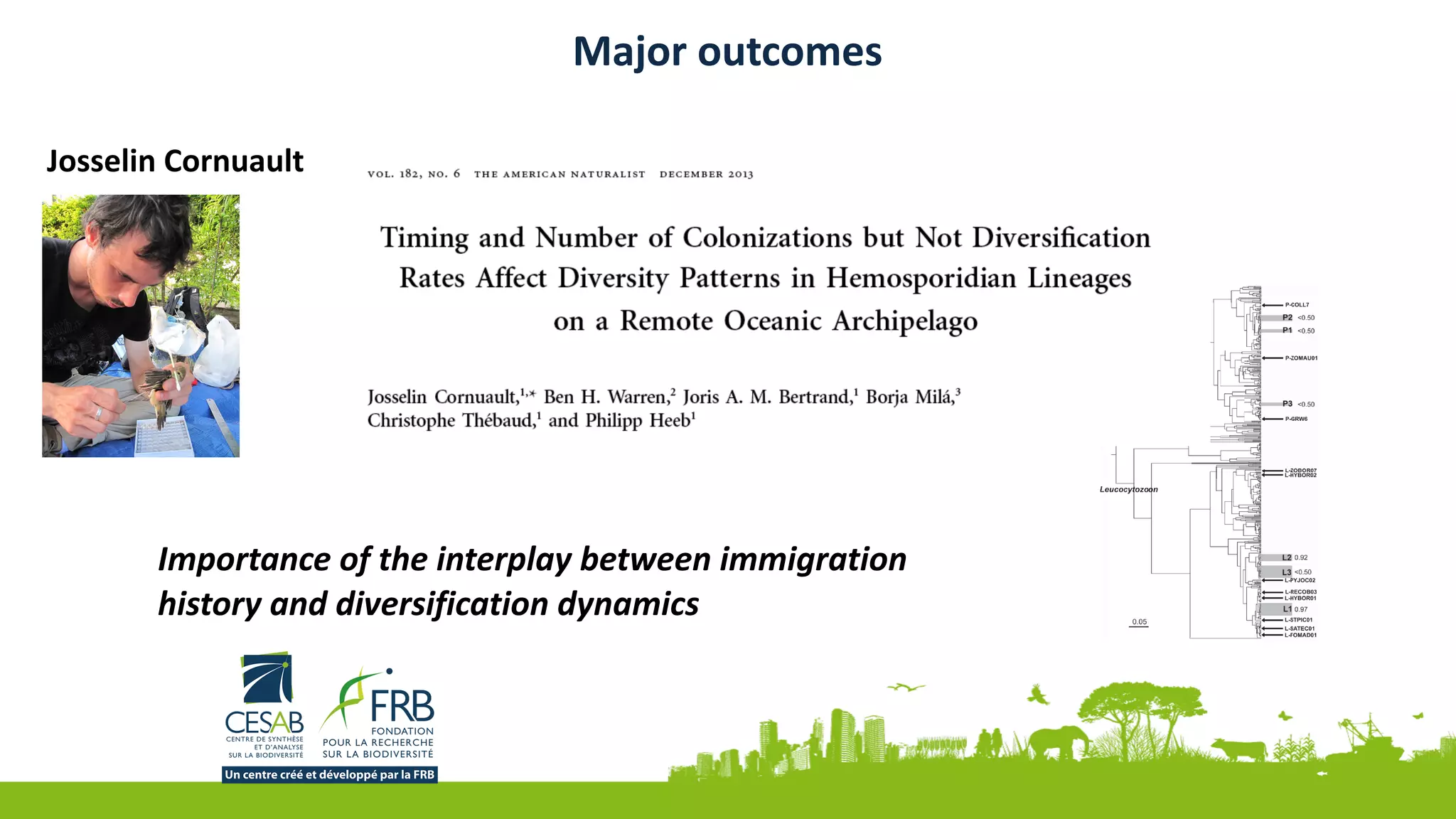
Importance	of	the	interplay	between	immigration	
history	and	diversification	dynamics	
Major	outcomes
Josselin	Cornuault
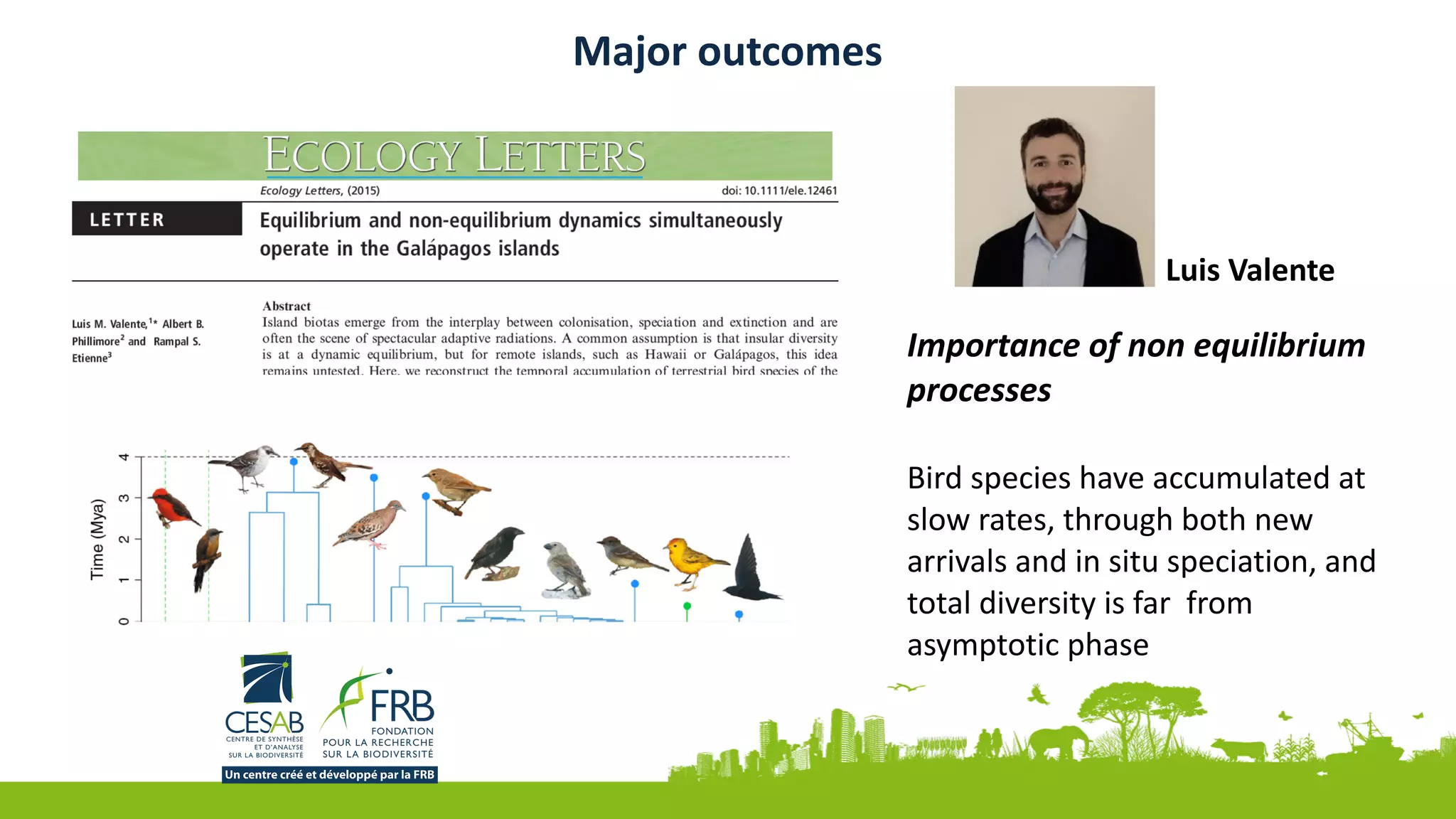
Importance	of	non	equilibrium	
processes	
Bird	species	have	accumulated	at	
slow	rates,	through	both	new	
arrivals	and	in	situ	speciation,	and	
total	diversity	is	far		from	
asymptotic	phase
Major	outcomes
Luis	Valente
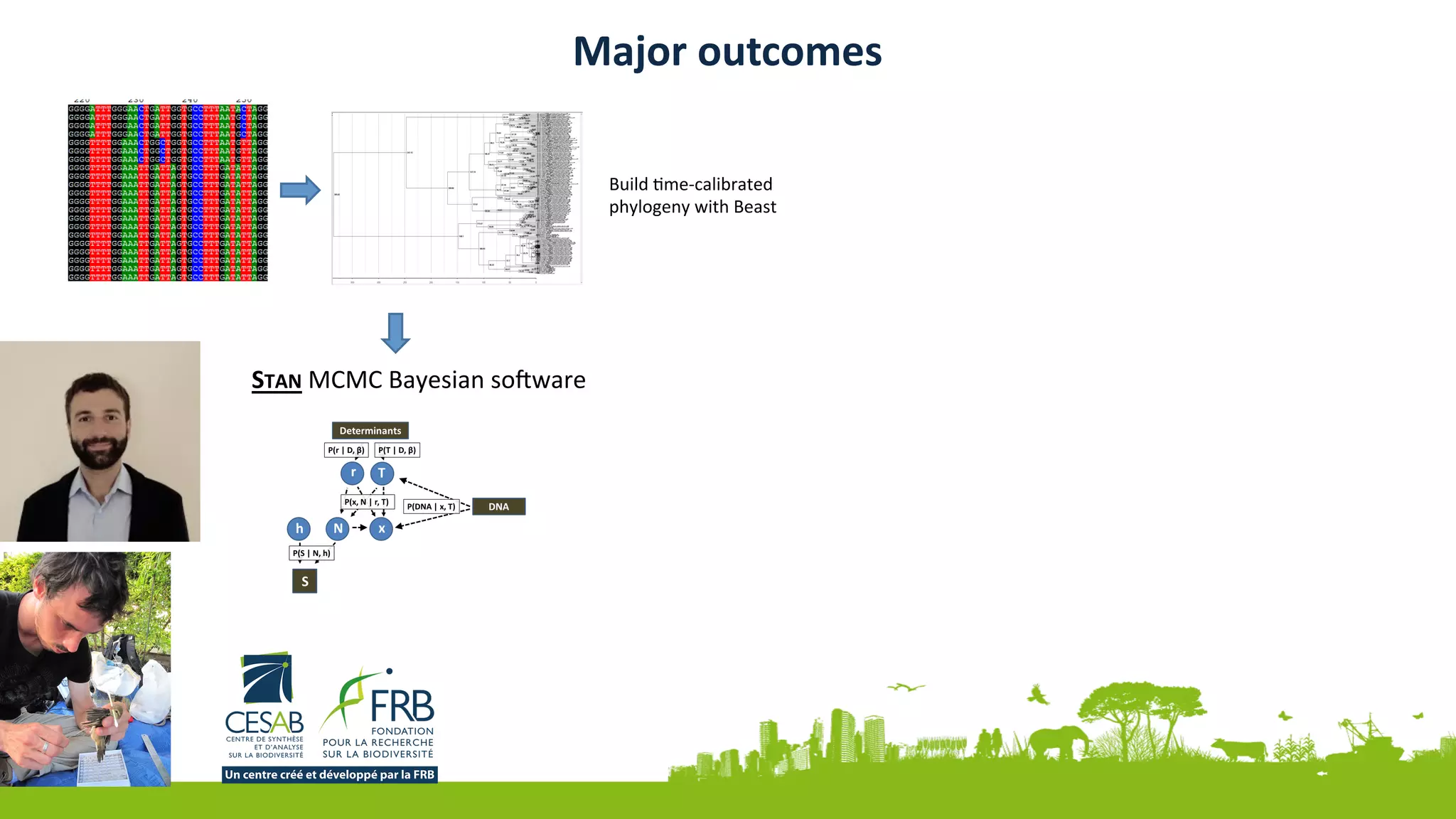
STAN	MCMC	Bayesian	so,ware	
Build	2me-calibrated	
phylogeny	with	Beast	
Major	outcomes
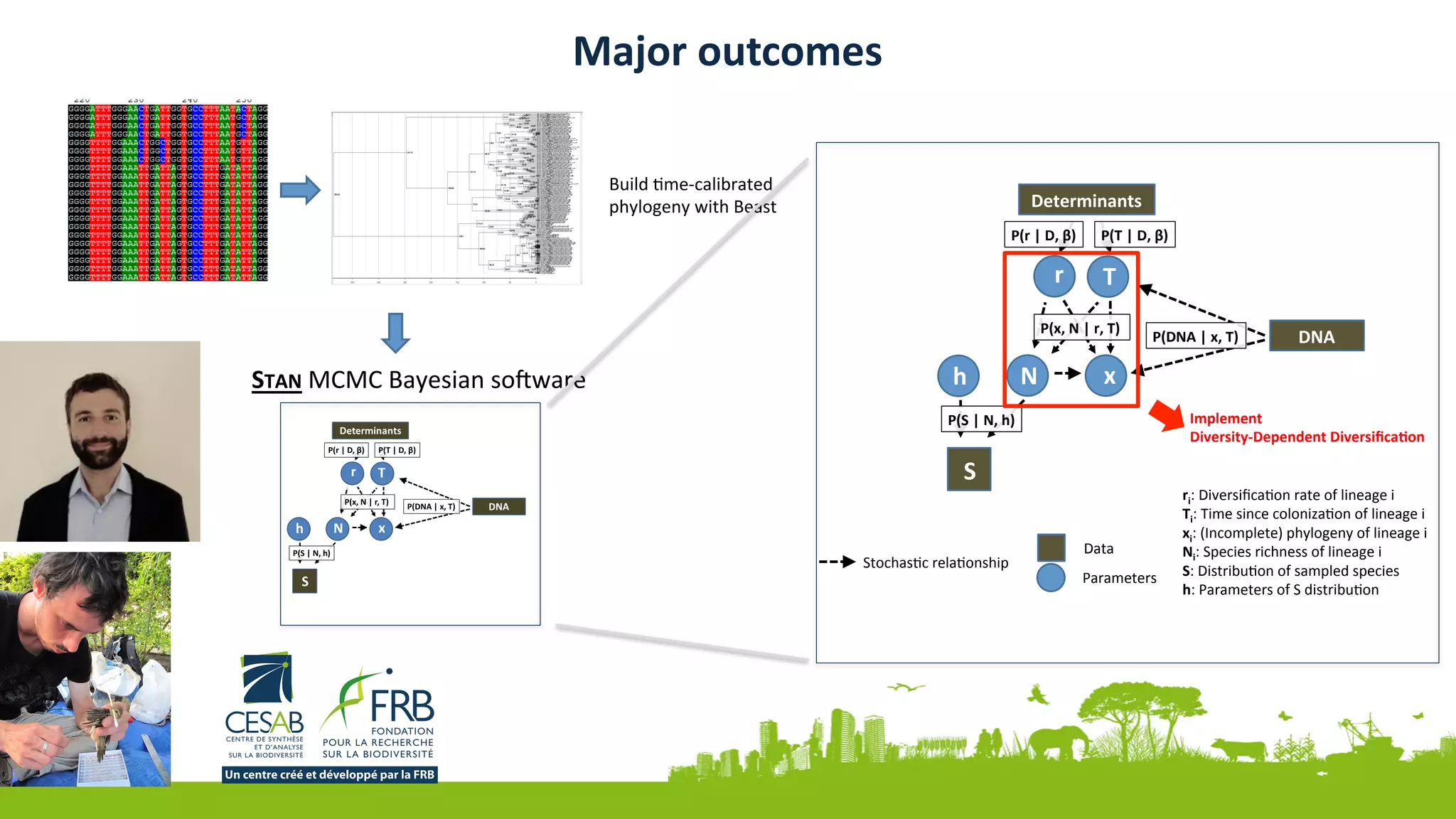
STAN	MCMC	Bayesian	so,ware	
Build	2me-calibrated	
phylogeny	with	Beast	
r		 T		
DNA	P(DNA	|	x,	T)	
P(r	|	D,	β)	 P(T	|	D,	β)	
x		
P(x,	N	|	r,	T)	
S	
h	 N	
P(S	|	N,	h)	
Determinants	
ri:	Diversifica,on	rate	of	lineage	i	
Ti:	Time	since	coloniza,on	of	lineage	i	
xi:	(Incomplete)	phylogeny	of	lineage	i	
Ni:	Species	richness	of	lineage	i	
S:	Distribu,on	of	sampled	species	
h:	Parameters	of	S	distribu,on	
Data	
Parameters	
Stochas,c	rela,onship	
Implement		
Diversity-Dependent	Diversifica@on	
Major	outcomes
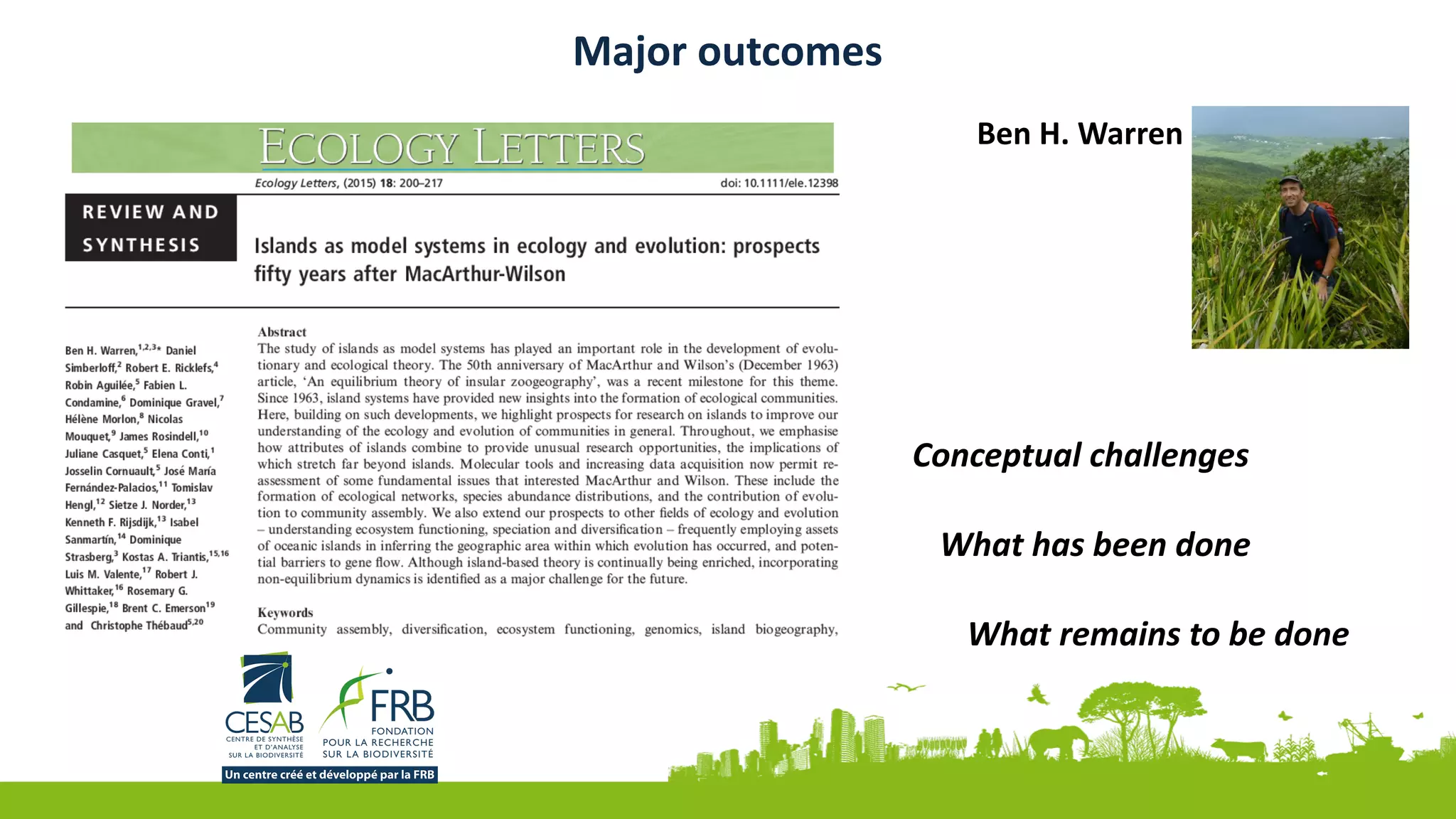
Conceptual	challenges	
What	has	been	done	
What	remains	to	be	done
Major	outcomes
Ben	H.	Warren
Team	&	disciplinary	scope
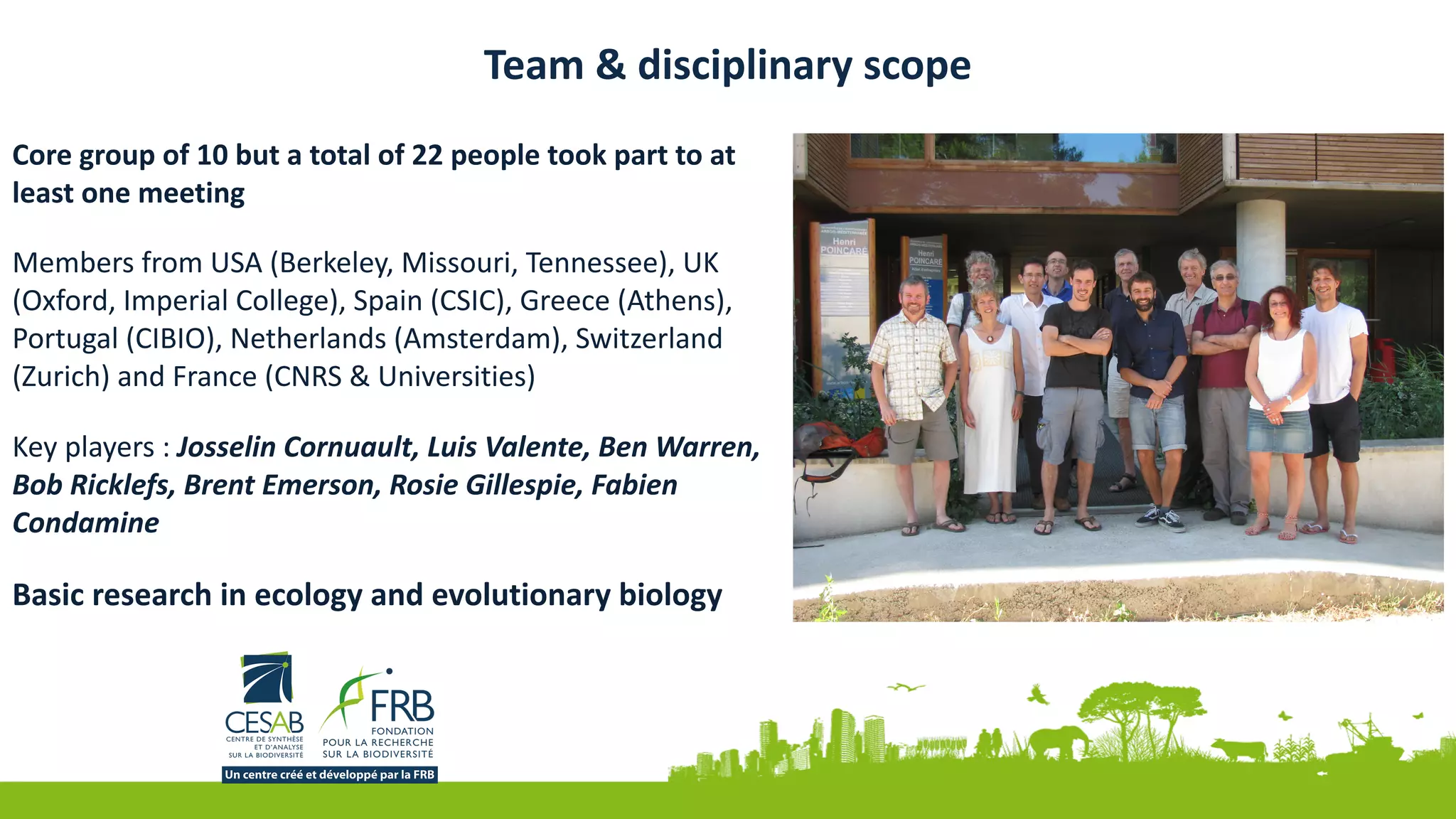
Core	group	of	10	but	a	total	of	22	people	took	part	to	at	
least	one	meeting	
Members	from	USA	(Berkeley,	Missouri,	Tennessee),	UK	
(Oxford,	Imperial	College),	Spain	(CSIC),	Greece	(Athens),	
Portugal	(CIBIO),	Netherlands	(Amsterdam),	Switzerland	
(Zurich)	and	France	(CNRS	&	Universities)	
Key	players	:	Josselin	Cornuault,	Luis	Valente,	Ben	Warren,	
Bob	Ricklefs,	Brent	Emerson,	Rosie	Gillespie,	Fabien	
Condamine	
Basic	research	in	ecology	and	evolutionary	biology
Acknowledgments
FRB	&	its	founding	members	for	funding	through	CESAB	
CESAB	Directors	:	Alison	Specht,	Eric	Garnier	and	Claire	Salomon	
CESAC	Staff	:	Magali	Grana	and	Baptiste	Laporte

Community assembly on remote islands: does equilibrium theory apply?