Postcolonial Studies,
Feminism, Poststructuralism
Literature in English III
Mariel Amez
POSTCOLONIALISMPOSTCOLONIALISM
• new writing in English?
• world fiction?
• international or transcultural writing?
• Commonwealth literature?
Postcolonial literature?
POSTCOLONIALISMPOSTCOLONIALISM
Postcolonial studies/ theory:
Reading
vs
Postcolonial literature: Writing
• Colonial literature: concerned with
colonial perceptions and experience,
written by metropolitans, creoles and
indigenes during colonial times
• Colonialist literature: concerned with
colonial expansion, written by and for
colonizing Europeans about non-
European lands dominated by them.
POSTCOLONIALISMPOSTCOLONIALISM
Colonialist literatureColonialist literature
Eurocentric discourse that assumed
the normality and preeminence of
everything "occidental," correlatively
with its representations of the
"oriental" as an exotic and inferior
other.
Postcolonial literaturePostcolonial literature
Counter-narrative in which the
colonial cultures fight their way back
into a world history written by
Europeans.
Colonialist and PostcolonialColonialist and Postcolonial
literatureliterature
did not simply articulate colonial or
nationalist preoccupations;
also contributed to the making,
definition, and clarification of those
same preoccupations
Colonialist vs PostcolonialColonialist vs Postcolonial
literatureliterature
A valid dichotomy?
An overgeneralisation?
A rewriting of hegemony and
domination?
Otherness Difference
• Marginalised
• Disempowered
• Robbed of their voice and identity
BUT
• Self cannot exist without the other
• Self and other are mirror images connected by
their reflection
Chapter 1 “Imperialism and Textuality” in
Boehmer, Elleke. Colonial and
Postcolonial Literature. Migrant
Metaphors.
How was the colonized other
characterized?
• in need of civilization
• savages lacking the power and ability to
think and rule
• useless, lazy, avoiding to do work through
pretence
Agency, diversity, resistance, voices
screened out
Representations of white men
• hard and careful workers
• sensible, rational
• careful builders
• intellectuals
• profit-makers
• colonial officers part of an elite
Purposes of Othering
• construct superiority of the West
• justify the dispossession of natives
• represent the degradation of other human
beings as natural
• foster nationalism
“Mainstream realist novels could be
of imperial domination even if they
were not about it”.
• a commodity (images of riches and trade)
• a new beginning (transportation; exile)
• “The forbidden”: fascination or fear
Mainly
• took for granted the integrity, superiority,
and strength of the West
• showed acceptance of the Empire
Which “forms of self-validation” of
the Empire in the 19th century are
mentioned?
• ideologies of moral, cultural, and racial
supremacy
• responsible, kind, gentle and morally
uplifting ruling
• selfless, serious, above blame, good
government and peace under the law
• inevitable and historically important: a new
history
Chapter 2 “Colonialist Concerns”
(provided on paper) from Boehmer,
Elleke. Colonial and Postcolonial
Literature. Migrant Metaphors.
What is the attitude towards other
cultures in colonialist texts?
• sources of contamination: infectious and
bewitching
• create vulnerability: closeness to savage
passions; apprehension at racial mixing
• interpreting reality in a European way
• empty of indigenous cultures
• objects of study
• accepting British rule as part of the order
of things
What is the “colonial gaze”?
gaze
to look at someone or something for a
long time, giving it all your attention, often
without realizing you are doing so
Longman Dictionary of Contemporary English
What is the “colonial gaze”?
gaze
• psychological relationship of power
• gazer: superior to object of gaze
Schroeder, J.E. Consuming Representation: A Visual
Approach to Consumer Research. Representing
Consumers: Voices Views and Vision. Routledge
Publishers, 1998.
What is the “colonial gaze”?
normative gaze
• Eurocentric racial identity: lens to view
and construct other races
West, Cornel
What is the “colonial gaze”?
Commanding perspective assumed by
the European in the text
• high vantage point
• knowledgeable position
• bird’s-eye description
• represents authority
How is the white hero characterised
in colonialist texts?
• youth and virility
• model of Christian honour and patriotism
• emissary of progress
• restraint
• moral earnestness
• rationality
• technological skill
• ability to rule
How are women characterised in
colonialist texts?
• seductive distraction or harmful presence
• unmanning and polluting
• black: contamination and degeneration of
excessive pleasure
How is the colonised characterised
in colonialist texts?
• fossilised survival of earlier evolutionary
stages
• irrational, barbaric, primitive, animal-like or
childlike, violent or difficult to control, evil and
harmful
• passive, soft, lazy, weak, inscrutable,
seductive, feminine
• lack of character and individual will: crowd
imagery
• certain nobility due to military skill
How are the colonised countries
characterised in colonialist texts?
• vast and shapeless
• savage and degraded
• sources of threat, trauma and mystery
• treacherous, dark, still
• “the engulfing female”
• places where white men defined their
masculinity and where they bonded
Frantz Fanon (1925 – 1961) – Martinique
•Black Skin, White Masks (1952)
•The Wretched of the Earth (1961)
The category "white" depends for its stability on
its negation, "black." Neither exists without the
other, and both come into being at the moment
of imperial conquest.
Postcolonial StudiesPostcolonial Studies
Frantz Fanon (cont’d)
•Speaking French means accepting the
collective consciousness of the French,
which identifies blackness with evil and sin.
•To escape this association the black man
thinks of himself as a universal subject
equally participating in society.
•The black man is necessarily alienated
from himself.
Postcolonial StudiesPostcolonial Studies
Edward Said (1935-2003) – Jerusalem
• Orientalism (1978)
• Culture and Imperialism (1993)
• Politics of Dispossession (1994)
Examines the ways through which the ‘Orient’
was, and continues to be constructed through
the lens of Europeans, in part defining
Orientalism as a Western style for dominating,
restructuring, and having authority over the
Orient
Postcolonial StudiesPostcolonial Studies
Edward Said (cont’d)
•The European invention of the fiction of the
Orient and the Orientals has served to create not
only knowledge but also the very reality they
appear to describe
•This knowledge tradition has functioned to serve
hegemonic, imperialist ends
•The Occident / Orient distinction has operated on
oppositional terms ensuring that the Orient has
been constructed as a negative, inferior inversion
of Western culture
Postcolonial StudiesPostcolonial Studies
Edward Said (cont’d)
By constructing the ‘Orient’ as culturally static,
eternally uniform and incapable of self-
definition, the ‘Occident’ as its established
opposite is infused with a secure sense of its
own cultural and intellectual superiority. The
West consequently viewed itself as dynamic,
innovative and expanding, which ultimately
secured a sense of imperial conceit and self-
justification for colonial rule.
Postcolonial StudiesPostcolonial Studies
Binary oppositions
The West: dynamic, rational, peaceful, liberal,
logical, capable of holding real values - “male”
The Orient: static, irrational, warlike, passion-
ridden, “immoral” – “female”
Postcolonial StudiesPostcolonial Studies
Homi K. Bhabha (b. 1949) – India
• Nation and Narration (1990)
• The Location of Culture (1993)
• Cosmopolitanism (2002)
Encourages a rigorous rethinking of
nationalism, representation, and resistance
that above all stresses the "ambivalence" or
"hybridity" that characterizes the site of
colonial contestation.
Postcolonial StudiesPostcolonial Studies
Homi K. Bhabha (cont’d.)
•Criticises the supposedly homogenous,
innate, and historically continuous traditions
that falsely define and ensure the subordinate
status of Third World nations.
•Argues that cultures can be understood to
interact, transgress, and transform each other
in a much more complex manner than the
traditional binary oppositions can allow.
Postcolonial StudiesPostcolonial Studies
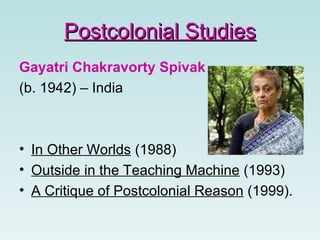
Gayatri Chakravorty Spivak
(b. 1942) – India
• In Other Worlds (1988)
• Outside in the Teaching Machine (1993)
• A Critique of Postcolonial Reason (1999).
Postcolonial StudiesPostcolonial Studies
Gayatri Chakravorty Spivak (cont’d)
Criticises European literary and philosophical
texts for providing ideological support for
European colonialism and develops a feminist
perspective .
Postcolonial StudiesPostcolonial Studies
Gayatri Chakravorty Spivak (cont’d)
•Postcolonial theory focuses too much on past forms of
colonial domination - inadequate to criticise the impact
of contemporary global economic domination
•By speaking out and reclaiming a collective cultural
identity, subalterns will in fact re-inscribe their
subordinate position in society. The academic
assumption of a subaltern collectivity becomes akin to
an ethnocentric extension of Western logos.
Postcolonial StudiesPostcolonial Studies
Postcolonial literature
• Writing from the Empire (before
political independence)
 white settlers
 creoles
 indigenous peoples
Postcolonial literature
• Writing after Independence
 cancelling colonial stereotypes
 becoming subjects
 rewriting history
 establishing identity
Postcolonial literature
• Genres
• Themes or Motifs
• Strategies
Postcolonial literature:
Strategies
• Appropriation
• Indigenous myth
• Language
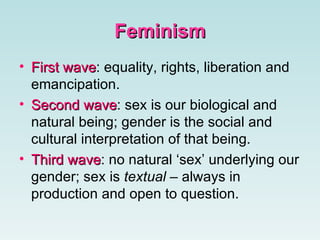
FeminismFeminism
• First waveFirst wave: equality, rights, liberation and
emancipation.
• Second waveSecond wave: sex is our biological and
natural being; gender is the social and
cultural interpretation of that being.
• Third waveThird wave: no natural ‘sex’ underlying our
gender; sex is textual – always in
production and open to question.
Feminist literary criticismFeminist literary criticism
• starts in late 1960’s
• not a unitary theory or procedure
• includes adaptations of psychoanalytic,
Marxist, and poststructuralist theories.
Shared AssumptionsShared Assumptions
• Western civilization is pervasively
patriarchalpatriarchal
• sex is determined by anatomy; gendergender is a
cultural constructcultural construct generated by patriarchal
biases of civilization
• patriarchal ideology pervades writings
traditionally considered great literaturegreat literature,
written mainly by men for menby men for men
• standard selection and critical treatment
gender-biasedgender-biased
Anglo-American Feminist Crit.Anglo-American Feminist Crit.
• do justicejustice to female points of view, concerns,
and values
• enlargeenlarge, reorder, even displace, the literary
canoncanon
• no fundamental difference:no fundamental difference: an undervaluing
of female writing
• analysis of the representationrepresentation of men and
women by male and female authors
• E.g. Gilbert & Gubar (1979): The Madwoman
in the Attic:
French Feminist Crit.French Feminist Crit.
• theorytheory of the role of gender in writing
• fundamental distinctiondistinction based on social
and economic factors
• Western languages male-engendered,
male-constituted, and male-dominated:
phallogocentrismphallogocentrism
• écriture féminineécriture féminine (Cixous)
Post-structuralismPost-structuralism
• late 1960’s
• critiques structuralism
• complements structuralism: alternative
modes of inquiry, explanation and
interpretation.
• Jacques Derrida, Michel Foucault,
Jacques Lacan, Roland Barthes, etc.
Post-structuralismPost-structuralism
• signifier and signified are not only
oppositional but pluralplural
• incommensurateincommensurate qualities of language
• no text can mean what itno text can mean what it seems to sayseems to say
• challengeschallenges (even undermines) traditionaltraditional
conceptionsconceptions of meaning, knowledge, truth,
and the subject or "self" (humanism)
DeconstructionDeconstruction
• language operates in subtle and often
contradictory ways: no certaintiesno certainties
• destabilisationdestabilisation of hierarchical oppositions
• the signified is always a signifier in
another system: infinite deferral ofinfinite deferral of
meaningmeaning
DeconstructionDeconstruction
différancedifférance:: (French différer)
•to deferdefer, postpone, delay and also
•to differdiffer, be different from
The text is an endless sequence of
signifiers which can have no ultimate or
determinate meaning
DeconstructionDeconstruction
• aporia:aporia: tension between what a text
manifestly means to say and what it is
nonetheless constrained to mean
• tracestraces: indications of an absence that
define a presence
• reading under erasureerasure
DeconstructionDeconstruction
• a way of highlighting things that texts do to
themselves and each other
• questioning prioritiesquestioning priorities set up as natural or
self-evident
• demonstrating binary oppositions are
unstableunstable, reversible, and mutually
dependent
• showing how texts subvertsubvert, exceed, even
overturn their author's stated purposes
Literature in English III
Mariel Amez

Postcolonialstudiesfeminismpoststructuralism 110810103255-phpapp02

  • 1.
  • 2.
    POSTCOLONIALISMPOSTCOLONIALISM • new writingin English? • world fiction? • international or transcultural writing? • Commonwealth literature? Postcolonial literature?
  • 3.
  • 4.
    • Colonial literature:concerned with colonial perceptions and experience, written by metropolitans, creoles and indigenes during colonial times • Colonialist literature: concerned with colonial expansion, written by and for colonizing Europeans about non- European lands dominated by them. POSTCOLONIALISMPOSTCOLONIALISM
  • 5.
    Colonialist literatureColonialist literature Eurocentricdiscourse that assumed the normality and preeminence of everything "occidental," correlatively with its representations of the "oriental" as an exotic and inferior other.
  • 6.
    Postcolonial literaturePostcolonial literature Counter-narrativein which the colonial cultures fight their way back into a world history written by Europeans.
  • 7.
    Colonialist and PostcolonialColonialistand Postcolonial literatureliterature did not simply articulate colonial or nationalist preoccupations; also contributed to the making, definition, and clarification of those same preoccupations
  • 8.
    Colonialist vs PostcolonialColonialistvs Postcolonial literatureliterature A valid dichotomy? An overgeneralisation? A rewriting of hegemony and domination?
  • 9.
    Otherness Difference • Marginalised •Disempowered • Robbed of their voice and identity BUT • Self cannot exist without the other • Self and other are mirror images connected by their reflection
  • 10.
    Chapter 1 “Imperialismand Textuality” in Boehmer, Elleke. Colonial and Postcolonial Literature. Migrant Metaphors.
  • 11.
    How was thecolonized other characterized? • in need of civilization • savages lacking the power and ability to think and rule • useless, lazy, avoiding to do work through pretence Agency, diversity, resistance, voices screened out
  • 12.
    Representations of whitemen • hard and careful workers • sensible, rational • careful builders • intellectuals • profit-makers • colonial officers part of an elite
  • 13.
    Purposes of Othering •construct superiority of the West • justify the dispossession of natives • represent the degradation of other human beings as natural • foster nationalism
  • 14.
    “Mainstream realist novelscould be of imperial domination even if they were not about it”. • a commodity (images of riches and trade) • a new beginning (transportation; exile) • “The forbidden”: fascination or fear Mainly • took for granted the integrity, superiority, and strength of the West • showed acceptance of the Empire
  • 15.
    Which “forms ofself-validation” of the Empire in the 19th century are mentioned? • ideologies of moral, cultural, and racial supremacy • responsible, kind, gentle and morally uplifting ruling • selfless, serious, above blame, good government and peace under the law • inevitable and historically important: a new history
  • 16.
    Chapter 2 “ColonialistConcerns” (provided on paper) from Boehmer, Elleke. Colonial and Postcolonial Literature. Migrant Metaphors.
  • 17.
    What is theattitude towards other cultures in colonialist texts? • sources of contamination: infectious and bewitching • create vulnerability: closeness to savage passions; apprehension at racial mixing • interpreting reality in a European way • empty of indigenous cultures • objects of study • accepting British rule as part of the order of things
  • 18.
    What is the“colonial gaze”? gaze to look at someone or something for a long time, giving it all your attention, often without realizing you are doing so Longman Dictionary of Contemporary English
  • 19.
    What is the“colonial gaze”? gaze • psychological relationship of power • gazer: superior to object of gaze Schroeder, J.E. Consuming Representation: A Visual Approach to Consumer Research. Representing Consumers: Voices Views and Vision. Routledge Publishers, 1998.
  • 20.
    What is the“colonial gaze”? normative gaze • Eurocentric racial identity: lens to view and construct other races West, Cornel
  • 21.
    What is the“colonial gaze”? Commanding perspective assumed by the European in the text • high vantage point • knowledgeable position • bird’s-eye description • represents authority
  • 22.
    How is thewhite hero characterised in colonialist texts? • youth and virility • model of Christian honour and patriotism • emissary of progress • restraint • moral earnestness • rationality • technological skill • ability to rule
  • 23.
    How are womencharacterised in colonialist texts? • seductive distraction or harmful presence • unmanning and polluting • black: contamination and degeneration of excessive pleasure
  • 24.
    How is thecolonised characterised in colonialist texts? • fossilised survival of earlier evolutionary stages • irrational, barbaric, primitive, animal-like or childlike, violent or difficult to control, evil and harmful • passive, soft, lazy, weak, inscrutable, seductive, feminine • lack of character and individual will: crowd imagery • certain nobility due to military skill
  • 25.
    How are thecolonised countries characterised in colonialist texts? • vast and shapeless • savage and degraded • sources of threat, trauma and mystery • treacherous, dark, still • “the engulfing female” • places where white men defined their masculinity and where they bonded
  • 26.
    Frantz Fanon (1925– 1961) – Martinique •Black Skin, White Masks (1952) •The Wretched of the Earth (1961) The category "white" depends for its stability on its negation, "black." Neither exists without the other, and both come into being at the moment of imperial conquest. Postcolonial StudiesPostcolonial Studies
  • 27.
    Frantz Fanon (cont’d) •SpeakingFrench means accepting the collective consciousness of the French, which identifies blackness with evil and sin. •To escape this association the black man thinks of himself as a universal subject equally participating in society. •The black man is necessarily alienated from himself. Postcolonial StudiesPostcolonial Studies
  • 28.
    Edward Said (1935-2003)– Jerusalem • Orientalism (1978) • Culture and Imperialism (1993) • Politics of Dispossession (1994) Examines the ways through which the ‘Orient’ was, and continues to be constructed through the lens of Europeans, in part defining Orientalism as a Western style for dominating, restructuring, and having authority over the Orient Postcolonial StudiesPostcolonial Studies
  • 29.
    Edward Said (cont’d) •TheEuropean invention of the fiction of the Orient and the Orientals has served to create not only knowledge but also the very reality they appear to describe •This knowledge tradition has functioned to serve hegemonic, imperialist ends •The Occident / Orient distinction has operated on oppositional terms ensuring that the Orient has been constructed as a negative, inferior inversion of Western culture Postcolonial StudiesPostcolonial Studies
  • 30.
    Edward Said (cont’d) Byconstructing the ‘Orient’ as culturally static, eternally uniform and incapable of self- definition, the ‘Occident’ as its established opposite is infused with a secure sense of its own cultural and intellectual superiority. The West consequently viewed itself as dynamic, innovative and expanding, which ultimately secured a sense of imperial conceit and self- justification for colonial rule. Postcolonial StudiesPostcolonial Studies
  • 31.
    Binary oppositions The West:dynamic, rational, peaceful, liberal, logical, capable of holding real values - “male” The Orient: static, irrational, warlike, passion- ridden, “immoral” – “female” Postcolonial StudiesPostcolonial Studies
  • 32.
    Homi K. Bhabha(b. 1949) – India • Nation and Narration (1990) • The Location of Culture (1993) • Cosmopolitanism (2002) Encourages a rigorous rethinking of nationalism, representation, and resistance that above all stresses the "ambivalence" or "hybridity" that characterizes the site of colonial contestation. Postcolonial StudiesPostcolonial Studies
  • 33.
    Homi K. Bhabha(cont’d.) •Criticises the supposedly homogenous, innate, and historically continuous traditions that falsely define and ensure the subordinate status of Third World nations. •Argues that cultures can be understood to interact, transgress, and transform each other in a much more complex manner than the traditional binary oppositions can allow. Postcolonial StudiesPostcolonial Studies
  • 34.
    Gayatri Chakravorty Spivak (b.1942) – India • In Other Worlds (1988) • Outside in the Teaching Machine (1993) • A Critique of Postcolonial Reason (1999). Postcolonial StudiesPostcolonial Studies
  • 35.
    Gayatri Chakravorty Spivak(cont’d) Criticises European literary and philosophical texts for providing ideological support for European colonialism and develops a feminist perspective . Postcolonial StudiesPostcolonial Studies
  • 36.
    Gayatri Chakravorty Spivak(cont’d) •Postcolonial theory focuses too much on past forms of colonial domination - inadequate to criticise the impact of contemporary global economic domination •By speaking out and reclaiming a collective cultural identity, subalterns will in fact re-inscribe their subordinate position in society. The academic assumption of a subaltern collectivity becomes akin to an ethnocentric extension of Western logos. Postcolonial StudiesPostcolonial Studies
  • 37.
    Postcolonial literature • Writingfrom the Empire (before political independence)  white settlers  creoles  indigenous peoples
  • 38.
    Postcolonial literature • Writingafter Independence  cancelling colonial stereotypes  becoming subjects  rewriting history  establishing identity
  • 39.
    Postcolonial literature • Genres •Themes or Motifs • Strategies
  • 40.
  • 41.
    FeminismFeminism • First waveFirstwave: equality, rights, liberation and emancipation. • Second waveSecond wave: sex is our biological and natural being; gender is the social and cultural interpretation of that being. • Third waveThird wave: no natural ‘sex’ underlying our gender; sex is textual – always in production and open to question.
  • 42.
    Feminist literary criticismFeministliterary criticism • starts in late 1960’s • not a unitary theory or procedure • includes adaptations of psychoanalytic, Marxist, and poststructuralist theories.
  • 43.
    Shared AssumptionsShared Assumptions •Western civilization is pervasively patriarchalpatriarchal • sex is determined by anatomy; gendergender is a cultural constructcultural construct generated by patriarchal biases of civilization • patriarchal ideology pervades writings traditionally considered great literaturegreat literature, written mainly by men for menby men for men • standard selection and critical treatment gender-biasedgender-biased
  • 44.
    Anglo-American Feminist Crit.Anglo-AmericanFeminist Crit. • do justicejustice to female points of view, concerns, and values • enlargeenlarge, reorder, even displace, the literary canoncanon • no fundamental difference:no fundamental difference: an undervaluing of female writing • analysis of the representationrepresentation of men and women by male and female authors • E.g. Gilbert & Gubar (1979): The Madwoman in the Attic:
  • 45.
    French Feminist Crit.FrenchFeminist Crit. • theorytheory of the role of gender in writing • fundamental distinctiondistinction based on social and economic factors • Western languages male-engendered, male-constituted, and male-dominated: phallogocentrismphallogocentrism • écriture féminineécriture féminine (Cixous)
  • 46.
    Post-structuralismPost-structuralism • late 1960’s •critiques structuralism • complements structuralism: alternative modes of inquiry, explanation and interpretation. • Jacques Derrida, Michel Foucault, Jacques Lacan, Roland Barthes, etc.
  • 47.
    Post-structuralismPost-structuralism • signifier andsignified are not only oppositional but pluralplural • incommensurateincommensurate qualities of language • no text can mean what itno text can mean what it seems to sayseems to say • challengeschallenges (even undermines) traditionaltraditional conceptionsconceptions of meaning, knowledge, truth, and the subject or "self" (humanism)
  • 48.
    DeconstructionDeconstruction • language operatesin subtle and often contradictory ways: no certaintiesno certainties • destabilisationdestabilisation of hierarchical oppositions • the signified is always a signifier in another system: infinite deferral ofinfinite deferral of meaningmeaning
  • 49.
    DeconstructionDeconstruction différancedifférance:: (French différer) •todeferdefer, postpone, delay and also •to differdiffer, be different from The text is an endless sequence of signifiers which can have no ultimate or determinate meaning
  • 50.
    DeconstructionDeconstruction • aporia:aporia: tensionbetween what a text manifestly means to say and what it is nonetheless constrained to mean • tracestraces: indications of an absence that define a presence • reading under erasureerasure
  • 51.
    DeconstructionDeconstruction • a wayof highlighting things that texts do to themselves and each other • questioning prioritiesquestioning priorities set up as natural or self-evident • demonstrating binary oppositions are unstableunstable, reversible, and mutually dependent • showing how texts subvertsubvert, exceed, even overturn their author's stated purposes
  • 52.
    Literature in EnglishIII Mariel Amez