TRACING THE TRAJECTORIES
OF
POST COLONIALISM
G.Priyadharshini
Assistant Professor of English
Mannar Thirumalai Naicker College(Autonomous)
Madurai.
“Until the lion learns how to write, every story will
glorify the hunter.” Dr.J. Nozipo Maraire
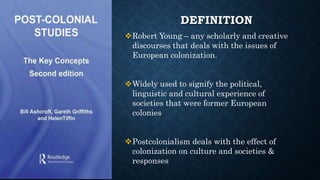
DEFINITION
Robert Young – any scholarly and creative
discourses that deals with the issues of
European colonization.
Widely used to signify the political,
linguistic and cultural experience of
societies that were former European
colonies
Postcolonialism deals with the effect of
colonization on culture and societies &
responses
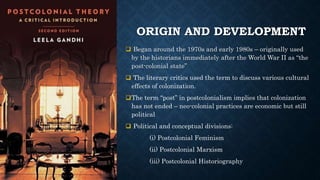
ORIGIN AND DEVELOPMENT
 Began around the 1970s and early 1980s – originally used
by the historians immediately after the World War II as “the
post-colonial state”
 The literary critics used the term to discuss various cultural
effects of colonization.
The term “post” in postcolonialism implies that colonization
has not ended – neo-colonial practices are economic but still
political
 Political and conceptual divisions:
(i) Postcolonial Feminism
(ii) Postcolonial Marxism
(iii) Postcolonial Historiography
LIMITATIONS OF POSTCOLONIAL WRITINGS
• Appropriation of colonial writing – use of native language in writings
• Rewriting history – difference in perspectives; no true history
• Valorization of Cultural Identity – yielding to indigenous culture
• Nationhood and nationalism – highlighting nation's cultural, political and social
identity
• Reclaiming spaces and places - indentured labor, and migration forced many
indigenous populations to move from homeland; counteract the result of alienation.
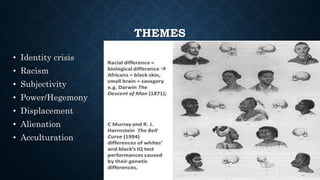
THEMES
• Identity crisis
• Racism
• Subjectivity
• Power/Hegemony
• Displacement
• Alienation
• Acculturation
WHAT DO POSTCOLONIAL CRITICS DO?
• Reject universalism.
• Examine the representation of other cultures in literature. Whether a work of
literature is silent or does mention the issues of colonialism.
• Foreground questions of cultural differences and diversity.
• Celebrate Hybridity and ‘cultural polyvalency’.
• Develop a perspective, not just applicable to postcolonial literature, of power relation
and potential change.
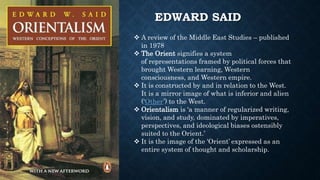
EDWARD SAID
 A review of the Middle East Studies – published
in 1978
 The Orient signifies a system
of representations framed by political forces that
brought Western learning, Western
consciousness, and Western empire.
 It is constructed by and in relation to the West.
It is a mirror image of what is inferior and alien
(‘Other’) to the West.
 Orientalism is ‘a manner of regularized writing,
vision, and study, dominated by imperatives,
perspectives, and ideological biases ostensibly
suited to the Orient.’
 It is the image of the ‘Orient’ expressed as an
entire system of thought and scholarship.
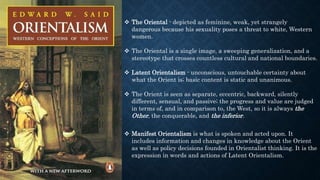
 The Oriental - depicted as feminine, weak, yet strangely
dangerous because his sexuality poses a threat to white, Western
women.
 The Oriental is a single image, a sweeping generalization, and a
stereotype that crosses countless cultural and national boundaries.
 Latent Orientalism - unconscious, untouchable certainty about
what the Orient is; basic content is static and unanimous.
 The Orient is seen as separate, eccentric, backward, silently
different, sensual, and passive; the progress and value are judged
in terms of, and in comparison to, the West, so it is always the
Other, the conquerable, and the inferior.
 Manifest Orientalism is what is spoken and acted upon. It
includes information and changes in knowledge about the Orient
as well as policy decisions founded in Orientalist thinking. It is the
expression in words and actions of Latent Orientalism.
FRANTZ FANON
It is the settler who has brought the native into existence and who
perpetuates his existence.
 Fanon means the idea of the native is a product of the
settler's thinking.
 “The settler paints the native as a sort of quintessence of evil”
 A systematic negation of the other person [the native].
 “The settler” denies the other person all attributes of
humanity
 The settler’s skin is not of any more value than a native’s
skin.
 Expresses how the violence of colonial rule is turned against
the settler
 Through violent uprising, the native discovers reality
 Acclaims that native can “transform” reality, shaping it into
the pattern of his customs, into the practice of violence and
into his plan for freedom
 The question is whether the violence will burn out and give
rise to neocolonialism, or shape a new nation
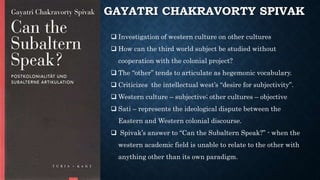
GAYATRI CHAKRAVORTY SPIVAK
 Investigation of western culture on other cultures
 How can the third world subject be studied without
cooperation with the colonial project?
 The “other” tends to articulate as hegemonic vocabulary.
 Criticizes the intellectual west’s “desire for subjectivity”.
 Western culture – subjective; other cultures – objective
 Sati – represents the ideological dispute between the
Eastern and Western colonial discourse.
 Spivak’s answer to “Can the Subaltern Speak?” - when the
western academic field is unable to relate to the other with
anything other than its own paradigm.
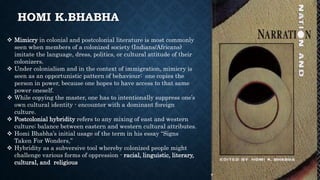
HOMI K.BHABHA
 Mimicry in colonial and postcolonial literature is most commonly
seen when members of a colonized society (Indians/Africans)
imitate the language, dress, politics, or cultural attitude of their
colonizers.
 Under colonialism and in the context of immigration, mimicry is
seen as an opportunistic pattern of behaviour: one copies the
person in power, because one hopes to have access to that same
power oneself.
 While copying the master, one has to intentionally suppress one’s
own cultural identity - encounter with a dominant foreign
culture.
 Postcolonial hybridity refers to any mixing of east and western
culture; balance between eastern and western cultural attributes.
 Homi Bhabha’s initial usage of the term in his essay “Signs
Taken For Wonders,”
 Hybridity as a subversive tool whereby colonized people might
challenge various forms of oppression - racial, linguistic, literary,
cultural, and religious
KEY TEXTS
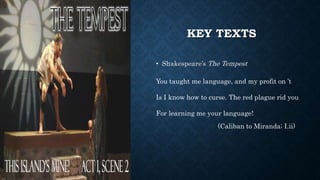
• Shakespeare’s The Tempest
You taught me language, and my profit on ’t
Is I know how to curse. The red plague rid you
For learning me your language!
(Caliban to Miranda; I.ii)
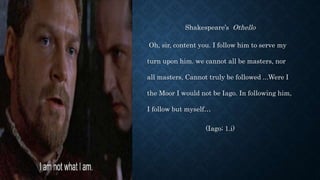
Shakespeare’s Othello
Oh, sir, content you. I follow him to serve my
turn upon him. we cannot all be masters, nor
all masters, Cannot truly be followed ...Were I
the Moor I would not be Iago. In following him,
I follow but myself…
(Iago; 1.i)
AFRICA
 Significance of the Title - Ibo culture of Nigeria
 Identity crisis - woman without children – not
recognized
 Nnu Ego lived within the cultural space of her own
primary culture – protection of her family and patronage
 Move to the city renders her entire existence precarious.
 Nnaife - colonized male identity
If you had dared come to my father’s compound to ask for
me, my bothers would have thrown you out. My people only
let me come to you here because they thought you were like
your brother [a “man”], not like this. . .. I would have not
left the house of Amatokwu to come and live with a man
who washes women’s underwear. AS Man Indeed!
 understanding the material impact of a colonized space
on the creation of colonized identities
 Marginalized by the white society/ colonizers
 Precarious nature of life within the colonized urban spaces -
experiences of the colonized male and female subjects
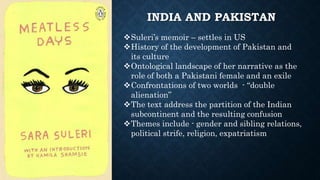
INDIA AND PAKISTAN
Suleri’s memoir – settles in US
History of the development of Pakistan and
its culture
Ontological landscape of her narrative as the
role of both a Pakistani female and an exile
Confrontations of two worlds - “double
alienation”
The text address the partition of the Indian
subcontinent and the resulting confusion
Themes include - gender and sibling relations,
political strife, religion, expatriatism
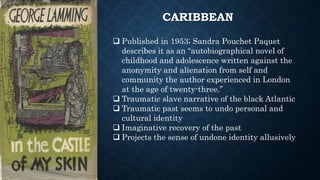
CARIBBEAN
 Published in 1953; Sandra Pouchet Paquet
describes it as an “autobiographical novel of
childhood and adolescence written against the
anonymity and alienation from self and
community the author experienced in London
at the age of twenty-three.”
 Traumatic slave narrative of the black Atlantic
 Traumatic past seems to undo personal and
cultural identity
 Imaginative recovery of the past
 Projects the sense of undone identity allusively
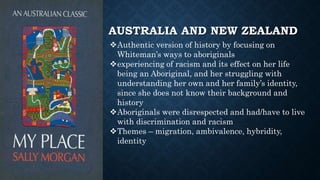
AUSTRALIA AND NEW ZEALAND
Authentic version of history by focusing on
Whiteman’s ways to aboriginals
experiencing of racism and its effect on her life
being an Aboriginal, and her struggling with
understanding her own and her family’s identity,
since she does not know their background and
history
Aboriginals were disrespected and had/have to live
with discrimination and racism
Themes – migration, ambivalence, hybridity,
identity
IN THE PRESENT…
• It emphasizes the importance of the cultural, economic, political and military
dominance of the past
• “Postcolonial” has becomes a successor term for both “Commonwealth” and “Third
World”
• Moving away from nation-centric conceptions of culture via translation as a vital
tool of globalization.
• Some areas of postcolonial studies are underrepresented – Dalit literature and its
criticism
• Recommended reference works
1. Bill Ashcroft, Gareth Griffiths and Helen Tiffin. Key Concepts in Post-Colonial Studies
2. John Thieme. Post-Colonial Studies: The Essential Glossary

Postcolonialism

  • 1.
    TRACING THE TRAJECTORIES OF POSTCOLONIALISM G.Priyadharshini Assistant Professor of English Mannar Thirumalai Naicker College(Autonomous) Madurai. “Until the lion learns how to write, every story will glorify the hunter.” Dr.J. Nozipo Maraire
  • 2.
    DEFINITION Robert Young –any scholarly and creative discourses that deals with the issues of European colonization. Widely used to signify the political, linguistic and cultural experience of societies that were former European colonies Postcolonialism deals with the effect of colonization on culture and societies & responses
  • 3.
    ORIGIN AND DEVELOPMENT Began around the 1970s and early 1980s – originally used by the historians immediately after the World War II as “the post-colonial state”  The literary critics used the term to discuss various cultural effects of colonization. The term “post” in postcolonialism implies that colonization has not ended – neo-colonial practices are economic but still political  Political and conceptual divisions: (i) Postcolonial Feminism (ii) Postcolonial Marxism (iii) Postcolonial Historiography
  • 4.
    LIMITATIONS OF POSTCOLONIALWRITINGS • Appropriation of colonial writing – use of native language in writings • Rewriting history – difference in perspectives; no true history • Valorization of Cultural Identity – yielding to indigenous culture • Nationhood and nationalism – highlighting nation's cultural, political and social identity • Reclaiming spaces and places - indentured labor, and migration forced many indigenous populations to move from homeland; counteract the result of alienation.
  • 5.
    THEMES • Identity crisis •Racism • Subjectivity • Power/Hegemony • Displacement • Alienation • Acculturation
  • 6.
    WHAT DO POSTCOLONIALCRITICS DO? • Reject universalism. • Examine the representation of other cultures in literature. Whether a work of literature is silent or does mention the issues of colonialism. • Foreground questions of cultural differences and diversity. • Celebrate Hybridity and ‘cultural polyvalency’. • Develop a perspective, not just applicable to postcolonial literature, of power relation and potential change.
  • 7.
    EDWARD SAID  Areview of the Middle East Studies – published in 1978  The Orient signifies a system of representations framed by political forces that brought Western learning, Western consciousness, and Western empire.  It is constructed by and in relation to the West. It is a mirror image of what is inferior and alien (‘Other’) to the West.  Orientalism is ‘a manner of regularized writing, vision, and study, dominated by imperatives, perspectives, and ideological biases ostensibly suited to the Orient.’  It is the image of the ‘Orient’ expressed as an entire system of thought and scholarship.
  • 8.
     The Oriental- depicted as feminine, weak, yet strangely dangerous because his sexuality poses a threat to white, Western women.  The Oriental is a single image, a sweeping generalization, and a stereotype that crosses countless cultural and national boundaries.  Latent Orientalism - unconscious, untouchable certainty about what the Orient is; basic content is static and unanimous.  The Orient is seen as separate, eccentric, backward, silently different, sensual, and passive; the progress and value are judged in terms of, and in comparison to, the West, so it is always the Other, the conquerable, and the inferior.  Manifest Orientalism is what is spoken and acted upon. It includes information and changes in knowledge about the Orient as well as policy decisions founded in Orientalist thinking. It is the expression in words and actions of Latent Orientalism.
  • 9.
    FRANTZ FANON It isthe settler who has brought the native into existence and who perpetuates his existence.  Fanon means the idea of the native is a product of the settler's thinking.  “The settler paints the native as a sort of quintessence of evil”  A systematic negation of the other person [the native].  “The settler” denies the other person all attributes of humanity  The settler’s skin is not of any more value than a native’s skin.  Expresses how the violence of colonial rule is turned against the settler  Through violent uprising, the native discovers reality  Acclaims that native can “transform” reality, shaping it into the pattern of his customs, into the practice of violence and into his plan for freedom  The question is whether the violence will burn out and give rise to neocolonialism, or shape a new nation
  • 10.
    GAYATRI CHAKRAVORTY SPIVAK Investigation of western culture on other cultures  How can the third world subject be studied without cooperation with the colonial project?  The “other” tends to articulate as hegemonic vocabulary.  Criticizes the intellectual west’s “desire for subjectivity”.  Western culture – subjective; other cultures – objective  Sati – represents the ideological dispute between the Eastern and Western colonial discourse.  Spivak’s answer to “Can the Subaltern Speak?” - when the western academic field is unable to relate to the other with anything other than its own paradigm.
  • 11.
    HOMI K.BHABHA  Mimicryin colonial and postcolonial literature is most commonly seen when members of a colonized society (Indians/Africans) imitate the language, dress, politics, or cultural attitude of their colonizers.  Under colonialism and in the context of immigration, mimicry is seen as an opportunistic pattern of behaviour: one copies the person in power, because one hopes to have access to that same power oneself.  While copying the master, one has to intentionally suppress one’s own cultural identity - encounter with a dominant foreign culture.  Postcolonial hybridity refers to any mixing of east and western culture; balance between eastern and western cultural attributes.  Homi Bhabha’s initial usage of the term in his essay “Signs Taken For Wonders,”  Hybridity as a subversive tool whereby colonized people might challenge various forms of oppression - racial, linguistic, literary, cultural, and religious
  • 12.
    KEY TEXTS • Shakespeare’sThe Tempest You taught me language, and my profit on ’t Is I know how to curse. The red plague rid you For learning me your language! (Caliban to Miranda; I.ii)
  • 13.
    Shakespeare’s Othello Oh, sir,content you. I follow him to serve my turn upon him. we cannot all be masters, nor all masters, Cannot truly be followed ...Were I the Moor I would not be Iago. In following him, I follow but myself… (Iago; 1.i)
  • 14.
    AFRICA  Significance ofthe Title - Ibo culture of Nigeria  Identity crisis - woman without children – not recognized  Nnu Ego lived within the cultural space of her own primary culture – protection of her family and patronage  Move to the city renders her entire existence precarious.  Nnaife - colonized male identity If you had dared come to my father’s compound to ask for me, my bothers would have thrown you out. My people only let me come to you here because they thought you were like your brother [a “man”], not like this. . .. I would have not left the house of Amatokwu to come and live with a man who washes women’s underwear. AS Man Indeed!  understanding the material impact of a colonized space on the creation of colonized identities  Marginalized by the white society/ colonizers  Precarious nature of life within the colonized urban spaces - experiences of the colonized male and female subjects
  • 15.
    INDIA AND PAKISTAN Suleri’smemoir – settles in US History of the development of Pakistan and its culture Ontological landscape of her narrative as the role of both a Pakistani female and an exile Confrontations of two worlds - “double alienation” The text address the partition of the Indian subcontinent and the resulting confusion Themes include - gender and sibling relations, political strife, religion, expatriatism
  • 16.
    CARIBBEAN  Published in1953; Sandra Pouchet Paquet describes it as an “autobiographical novel of childhood and adolescence written against the anonymity and alienation from self and community the author experienced in London at the age of twenty-three.”  Traumatic slave narrative of the black Atlantic  Traumatic past seems to undo personal and cultural identity  Imaginative recovery of the past  Projects the sense of undone identity allusively
  • 17.
    AUSTRALIA AND NEWZEALAND Authentic version of history by focusing on Whiteman’s ways to aboriginals experiencing of racism and its effect on her life being an Aboriginal, and her struggling with understanding her own and her family’s identity, since she does not know their background and history Aboriginals were disrespected and had/have to live with discrimination and racism Themes – migration, ambivalence, hybridity, identity
  • 18.
    IN THE PRESENT… •It emphasizes the importance of the cultural, economic, political and military dominance of the past • “Postcolonial” has becomes a successor term for both “Commonwealth” and “Third World” • Moving away from nation-centric conceptions of culture via translation as a vital tool of globalization. • Some areas of postcolonial studies are underrepresented – Dalit literature and its criticism • Recommended reference works 1. Bill Ashcroft, Gareth Griffiths and Helen Tiffin. Key Concepts in Post-Colonial Studies 2. John Thieme. Post-Colonial Studies: The Essential Glossary