TOPIC : post-colonial studies
• NAME :- Pandya Dharmishtha D.
• CLASS:- M.A. Part-1 (Sem-2)
• ROLL NO.:- 24
• YEAR :- 2016
• PAPER NO.:- 8 (The Culture Studies)
• SUBMITTED:- Department of English
 What is post-colonialism?
 Colonialism :-
control or governing influence of
a nation over a dependent a
country, territory, or people.
 Post-colonialism
 Is an intellectual direction that exist since around
the middle to the 20th century.
 It developed from and mainly refers to the time
after colonialism.
 The post-colonial direction was created as colonial
countries became independent.
 Now days, aspects of post-colonialism can be
found not only in sciences concerning history,
literature and politics, but also in approach to
culture and identity.
 The three pillars of Postcolonial
Theory:-
 Edward said
 Gayatri Chakravorty Spivak
Hami K. Bhabha
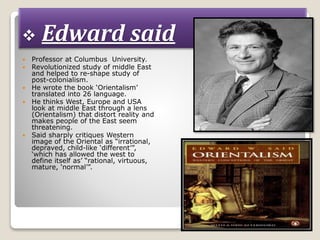
 Edward said
 Professor at Columbus University.
 Revolutionized study of middle East
and helped to re-shape study of
post-colonialism.
 He wrote the book ‘Orientalism’
translated into 26 language.
 He thinks West, Europe and USA
look at middle East through a lens
(Orientalism) that distort reality and
makes people of the East seem
threatening.
 Said sharply critiques Western
image of the Oriental as “irrational,
depraved, child-like ‘different’”,
‘which has allowed the west to
define itself as’ “rational, virtuous,
mature, ‘normal’”.
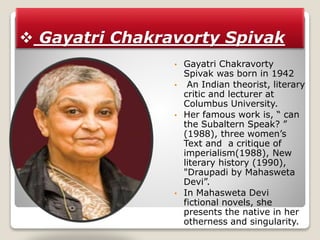
 Gayatri Chakravorty Spivak
• Gayatri Chakravorty
Spivak was born in 1942
• An Indian theorist, literary
critic and lecturer at
Columbus University.
• Her famous work is, “ can
the Subaltern Speak? ”
(1988), three women’s
Text and a critique of
imperialism(1988), New
literary history (1990),
"Draupadi by Mahasweta
Devi”.
• In Mahasweta Devi
fictional novels, she
presents the native in her
otherness and singularity.
• conti……
• Is thought of as one of the three co-founders
of post- colonial theory.
•An Indian theorist, literary critic and lecturer
at Columbus University.
• Her main work on the postcolonial theory was
her Critique of Postcolonial Reason: Toward a
History of the Vanishing Present (1999).
• She describe herself as a “Practical Marxism,
feminism, and deconstruction”.
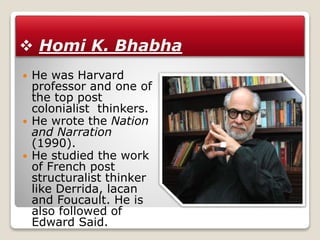
 Homi K. Bhabha
 He was Harvard
professor and one of
the top post
colonialist thinkers.
 He wrote the Nation
and Narration
(1990).
 He studied the work
of French post
structuralist thinker
like Derrida, lacan
and Foucault. He is
also followed of
Edward Said.
Post-colonialism:
Example in media
 “Saunders of the River”(1935)
portrayed ideologies naturalizing
colonization.
 “The four features”(1939) suggested
the key role of the British army was to
bring a civilizing influence to India and
Egypt.
 “Zulu” (1964) represented the Zulu
tribe in Africa as violent savages.
Pandya ppt 8

Pandya ppt 8

  • 1.
    TOPIC : post-colonialstudies • NAME :- Pandya Dharmishtha D. • CLASS:- M.A. Part-1 (Sem-2) • ROLL NO.:- 24 • YEAR :- 2016 • PAPER NO.:- 8 (The Culture Studies) • SUBMITTED:- Department of English
  • 2.
     What ispost-colonialism?  Colonialism :- control or governing influence of a nation over a dependent a country, territory, or people.
  • 3.
     Post-colonialism  Isan intellectual direction that exist since around the middle to the 20th century.  It developed from and mainly refers to the time after colonialism.  The post-colonial direction was created as colonial countries became independent.  Now days, aspects of post-colonialism can be found not only in sciences concerning history, literature and politics, but also in approach to culture and identity.
  • 4.
     The threepillars of Postcolonial Theory:-  Edward said  Gayatri Chakravorty Spivak Hami K. Bhabha
  • 5.
     Edward said Professor at Columbus University.  Revolutionized study of middle East and helped to re-shape study of post-colonialism.  He wrote the book ‘Orientalism’ translated into 26 language.  He thinks West, Europe and USA look at middle East through a lens (Orientalism) that distort reality and makes people of the East seem threatening.  Said sharply critiques Western image of the Oriental as “irrational, depraved, child-like ‘different’”, ‘which has allowed the west to define itself as’ “rational, virtuous, mature, ‘normal’”.
  • 6.
     Gayatri ChakravortySpivak • Gayatri Chakravorty Spivak was born in 1942 • An Indian theorist, literary critic and lecturer at Columbus University. • Her famous work is, “ can the Subaltern Speak? ” (1988), three women’s Text and a critique of imperialism(1988), New literary history (1990), "Draupadi by Mahasweta Devi”. • In Mahasweta Devi fictional novels, she presents the native in her otherness and singularity.
  • 7.
    • conti…… • Isthought of as one of the three co-founders of post- colonial theory. •An Indian theorist, literary critic and lecturer at Columbus University. • Her main work on the postcolonial theory was her Critique of Postcolonial Reason: Toward a History of the Vanishing Present (1999). • She describe herself as a “Practical Marxism, feminism, and deconstruction”.
  • 8.
     Homi K.Bhabha  He was Harvard professor and one of the top post colonialist thinkers.  He wrote the Nation and Narration (1990).  He studied the work of French post structuralist thinker like Derrida, lacan and Foucault. He is also followed of Edward Said.
  • 9.
    Post-colonialism: Example in media “Saunders of the River”(1935) portrayed ideologies naturalizing colonization.  “The four features”(1939) suggested the key role of the British army was to bring a civilizing influence to India and Egypt.  “Zulu” (1964) represented the Zulu tribe in Africa as violent savages.