 Name :- Aarti Hareshbhai
Vadher
 Sem :- 2 M.A (English)
 Roll no :-5
 Paper no :-5
 Topic :- Postcolonial studies
 Email Id :-
artivadher10@gmail.com
 Submitted :- Smt.Gardi
MKBU, Department of English,
 Year :- 2016-2018
WHAT ISPOSTCOLONIALSTUDIES???
Postcolonialism or postcolonial studies is an academic discipline
that analyses, explains, and responds to the cultural legacy of
colonialism and imperialism. Postcolonialism speaks about the
human consequences of external control and economic exploitation
of native people and their lands.
DEFINITIONS
 POST-COLONIALISM : The time after colonialism-
after the colonies had become independent
 Postcolonial studies: The study of the interactions
between European nations and the societies
they colonized
HISTORICAL BACKGROUND
 Decolonialization after ww2
 Disbanding of British Empire – commonwealth of Nations
 Independence = (bloody) conflicts – no boundaries between
ethnic groups(e.g. civil war in Kenya)
 Attempt to return to their former culture
 USA= role model for high standard of living- dependence
on USA- corruption- neocolonialism
Postcolonial identity
A decolonised people develops a postcolonial identity that is based
on cultural interactions between different identities (cultural, national,
and ethnic as well as gender and class based) which are assigned
varying degrees of social power by the colonial society. In postcolonial
literature, the anti-conquest narrative analyses the identity politics that
are the social and cultural perspectives of the subaltern colonial
subjects—their creative resistance to the culture of the coloniser; how
such cultural resistance complicated the establishment of a colonial
society; how the colonisers developed their postcolonial identity; and
how neo-colonialism actively employs the Us-and-Them binary social
relation to view the non-Western world as inhabited by The Other.
Cont.……
The neo-colonial discourse of geopolitical homogeneity relegating the decolonised
peoples, their cultures, and their countries, to an imaginary place, such as "the Third
World", an over-inclusive term that usually comprises continents and seas, i.e. Africa, Asia,
Latin America, and Oceania. The postcolonial critique analyses the self-justifying discourse
of neo-colonialism and the functions (philosophic and political) of its over-inclusive
terms, to establish the factual and cultural inaccuracy of homogeneous concepts, such as
"the Arabs" and "the First World", "Christendom" and "the Muslim World", actually
comprise heterogeneous peoples, cultures, and geography, and that realistic descriptions of
the world's peoples, places, and things require nuanced and accurate terms.[5]
LITERATURE
Written by….
a) Colonized people
b)People of the colonial powers
LITRATURE(CONT.)
 Attempt to assimilate their experience….
a) ….during the time of colonialization
b) ….of today’s “neo-colonialism”
 Since the 1970s/80s
Edward said: “Orientalism”(1978)
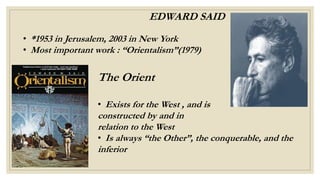
EDWARD SAID
• *1953 in Jerusalem, 2003 in New York
• Most important work : “Orientalism”(1979)
The Orient
• Exists for the West , and is
constructed by and in
relation to the West
• Is always “the Other”, the conquerable, and the
inferior
R. Siva Kumar
In 1997, on the occasion of the 50th anniversary of
India's Independence, Santiniketan: The Making of a
Contextual Modernism was an important exhibition
curated by R. Siva Kumar at the National Gallery of
Modern Art.
In his catalogue essay, R. Siva Kumar introduced the
term Contextual Modernism, which later emerged as a
postcolonial critical tool in the understanding of Indian
art, specifically the works of Nandalal
Bose, Rabindranath Tagore, Ramkinkar
Baij and Benode Behari Mukherjee.
Derek Gregory
Derek Gregory argues the long trajectory through history of
British and American colonization is an ongoing process still
happening today. In The Colonial Present, Gregory traces
connections between the geopolitics of events happening in
modern-day Afghanistan, Palestine, and Iraq and links it back to
the us-and-them binary relation between the Western and
Eastern world. Building upon the ideas of the other and Said's
work on orientialism, Gregory critiques the economic policy,
military apparatus, and transnational corporations as vehicles
driving present day colonialism. Emphasizing ideas of discussing
ideas around colonialism in the present tense, Gregory utilizes
modern events such as the September 11 attacks to tell spatial
stories around the colonial behavior happening due to the War
Dipesh Chakrabarty
In Provincializing Europe (2000), Dipesh
Chakrabarty charted the subaltern history of the
Indian struggle for independence, and countered
Eurocentric, Western scholarship about non-
Western peoples and cultures, by proposing that
Western Europe simply be considered as
culturally equal to the other cultures of the
world, that is, as "one region among many" in
human geography
paper no: 8 cultural studies,: Post colonial studies

paper no: 8 cultural studies,: Post colonial studies

  • 2.
     Name :-Aarti Hareshbhai Vadher  Sem :- 2 M.A (English)  Roll no :-5  Paper no :-5  Topic :- Postcolonial studies  Email Id :- artivadher10@gmail.com  Submitted :- Smt.Gardi MKBU, Department of English,  Year :- 2016-2018
  • 3.
    WHAT ISPOSTCOLONIALSTUDIES??? Postcolonialism orpostcolonial studies is an academic discipline that analyses, explains, and responds to the cultural legacy of colonialism and imperialism. Postcolonialism speaks about the human consequences of external control and economic exploitation of native people and their lands.
  • 4.
    DEFINITIONS  POST-COLONIALISM :The time after colonialism- after the colonies had become independent  Postcolonial studies: The study of the interactions between European nations and the societies they colonized
  • 6.
    HISTORICAL BACKGROUND  Decolonializationafter ww2  Disbanding of British Empire – commonwealth of Nations  Independence = (bloody) conflicts – no boundaries between ethnic groups(e.g. civil war in Kenya)  Attempt to return to their former culture  USA= role model for high standard of living- dependence on USA- corruption- neocolonialism
  • 7.
    Postcolonial identity A decolonisedpeople develops a postcolonial identity that is based on cultural interactions between different identities (cultural, national, and ethnic as well as gender and class based) which are assigned varying degrees of social power by the colonial society. In postcolonial literature, the anti-conquest narrative analyses the identity politics that are the social and cultural perspectives of the subaltern colonial subjects—their creative resistance to the culture of the coloniser; how such cultural resistance complicated the establishment of a colonial society; how the colonisers developed their postcolonial identity; and how neo-colonialism actively employs the Us-and-Them binary social relation to view the non-Western world as inhabited by The Other.
  • 8.
    Cont.…… The neo-colonial discourseof geopolitical homogeneity relegating the decolonised peoples, their cultures, and their countries, to an imaginary place, such as "the Third World", an over-inclusive term that usually comprises continents and seas, i.e. Africa, Asia, Latin America, and Oceania. The postcolonial critique analyses the self-justifying discourse of neo-colonialism and the functions (philosophic and political) of its over-inclusive terms, to establish the factual and cultural inaccuracy of homogeneous concepts, such as "the Arabs" and "the First World", "Christendom" and "the Muslim World", actually comprise heterogeneous peoples, cultures, and geography, and that realistic descriptions of the world's peoples, places, and things require nuanced and accurate terms.[5]
  • 9.
    LITERATURE Written by…. a) Colonizedpeople b)People of the colonial powers
  • 11.
    LITRATURE(CONT.)  Attempt toassimilate their experience…. a) ….during the time of colonialization b) ….of today’s “neo-colonialism”  Since the 1970s/80s Edward said: “Orientalism”(1978)
  • 12.
    EDWARD SAID • *1953in Jerusalem, 2003 in New York • Most important work : “Orientalism”(1979) The Orient • Exists for the West , and is constructed by and in relation to the West • Is always “the Other”, the conquerable, and the inferior
  • 13.
    R. Siva Kumar In1997, on the occasion of the 50th anniversary of India's Independence, Santiniketan: The Making of a Contextual Modernism was an important exhibition curated by R. Siva Kumar at the National Gallery of Modern Art. In his catalogue essay, R. Siva Kumar introduced the term Contextual Modernism, which later emerged as a postcolonial critical tool in the understanding of Indian art, specifically the works of Nandalal Bose, Rabindranath Tagore, Ramkinkar Baij and Benode Behari Mukherjee.
  • 14.
    Derek Gregory Derek Gregoryargues the long trajectory through history of British and American colonization is an ongoing process still happening today. In The Colonial Present, Gregory traces connections between the geopolitics of events happening in modern-day Afghanistan, Palestine, and Iraq and links it back to the us-and-them binary relation between the Western and Eastern world. Building upon the ideas of the other and Said's work on orientialism, Gregory critiques the economic policy, military apparatus, and transnational corporations as vehicles driving present day colonialism. Emphasizing ideas of discussing ideas around colonialism in the present tense, Gregory utilizes modern events such as the September 11 attacks to tell spatial stories around the colonial behavior happening due to the War
  • 15.
    Dipesh Chakrabarty In ProvincializingEurope (2000), Dipesh Chakrabarty charted the subaltern history of the Indian struggle for independence, and countered Eurocentric, Western scholarship about non- Western peoples and cultures, by proposing that Western Europe simply be considered as culturally equal to the other cultures of the world, that is, as "one region among many" in human geography