PEP for Occupational HIV Exposure:
What Every Pharmacist Should Know
Elva Angelique Van Devender, Ph.D., Pharm.D., BCPS
Clinical Pharmacy Specialist, Emergency Medicine
Legacy Good Samaritan Medical Center
Portland, Oregon
This is not a PEP talk in the traditional sense…
2
Objectives
 Understand what PEP regimen is appropriate when a
healthcare worker has been exposed to HIV
 Know the most common adverse reactions of PEP therapy
 Identify what follow up steps are necessary in the patient
receiving PEP treatment
3
A True Story
 A 27 yo male dialysis worker gets a needle stick after the
needle has been used on an HIV patient…he rushes himself to
the local hospital, as he remembers that time is of the
essence in getting treatment.
 Chaos ensues. The local hospital does not know what to do,
eventually the patient is given one dose of truvada and
combivir in the ED and is sent to Walgreens for a prescription
for indinavir and combivir.
 More chaos. Walgreens does not stock indinavir and the
patient is desperately calling pharmacies trying to find one
that can fill his prescription.
 How would you rewrite this man’s story?
4
PEP for HIV: The Basics
 An exposure that might place a healthcare worker at risk for HIV infection
is defined as a percutaneous injury (e.g., a needlestick or cut with a sharp
object) or contact of mucous membrane or nonintact skin (e.g., exposed
skin that is chapped, abraded, or afflicted with dermatitis) with blood,
tissue, or other body fluids that are potentially infectious.
 Body fluids which are considered infectious
• Blood, visibly bloody body fluids, cerebrospinal fluid, synovial fluid,
pleural fluid, peritoneal fluid, pericardial fluid, and amniotic fluid, and
semen and vaginal secretions
 Body fluids which are NOT considered infectious
• Feces, nasal secretions, saliva, sputum, sweat, tears, urine, and
vomitus (unless visibly bloody)
 Whether or not the person is really exposed or not: washing the affected
area is a great first step!
5
PEP for HIV: The Basics
 HIV PEP should be started immediately (within hours) and be
continued for 28 days (4 weeks).
 Pregnancy does not preclude PEP therapy.
 Obtain baseline CBC, SCr, liver enzyme tests (AST, ALT, alk
phosphatase, total bilirubin), and HIV antibody testing.
 Follow up with exposed healthcare worker 72 hours post
exposure, especially after additional information about the
exposure or source person becomes available.
6
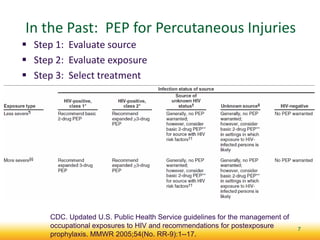
In the Past: PEP for Percutaneous Injuries
 Step 1: Evaluate source
 Step 2: Evaluate exposure
 Step 3: Select treatment
7
CDC. Updated U.S. Public Health Service guidelines for the management of
occupational exposures to HIV and recommendations for postexposure
prophylaxis. MMWR 2005;54(No. RR-9):1--17.
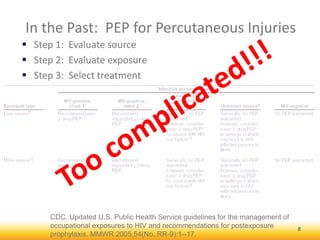
In the Past: PEP for Percutaneous Injuries
 Step 1: Evaluate source
 Step 2: Evaluate exposure
 Step 3: Select treatment
8
CDC. Updated U.S. Public Health Service guidelines for the management of
occupational exposures to HIV and recommendations for postexposure
prophylaxis. MMWR 2005;54(No. RR-9):1--17.
Preferred HIV PEP Regimen
PEP is now recommended for ALL occupational exposures to HIV!
Raltegravir (Isentress: RAL) 400 mg PO twice daily
Plus
Truvada, 1 PO daily
(Tenofovir [Viread; TDF] 300 mg + emtricitabine [Emtriva; FTC] 200 mg)
Watch for Stribald (alternative therapy):
Stribild (elvitegravir, cobicistat, tenofovir DF, emtricitabine)
1 pill, once daily dosing
9
Preferred HIV PEP Regimen
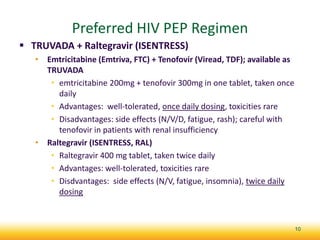
 TRUVADA + Raltegravir (ISENTRESS)
• Emtricitabine (Emtriva, FTC) + Tenofovir (Viread, TDF); available as
TRUVADA
• emtricitabine 200mg + tenofovir 300mg in one tablet, taken once
daily
• Advantages: well-tolerated, once daily dosing, toxicities rare
• Disadvantages: side effects (N/V/D, fatigue, rash); careful with
tenofovir in patients with renal insufficiency
• Raltegravir (ISENTRESS, RAL)
• Raltegravir 400 mg tablet, taken twice daily
• Advantages: well-tolerated, toxicities rare
• Disdvantages: side effects (N/V, fatigue, insomnia), twice daily
dosing
10
Alternative Regimens
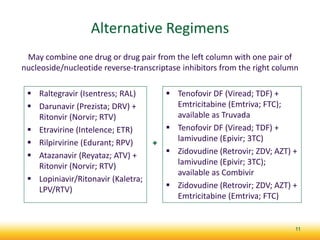
May combine one drug or drug pair from the left column with one pair of
nucleoside/nucleotide reverse-transcriptase inhibitors from the right column
 Raltegravir (Isentress; RAL)
 Darunavir (Prezista; DRV) +
Ritonvir (Norvir; RTV)
 Etravirine (Intelence; ETR)
 Rilpirvirine (Edurant; RPV)
 Atazanavir (Reyataz; ATV) +
Ritonvir (Norvir; RTV)
 Lopiniavir/Ritonavir (Kaletra;
LPV/RTV)
 Tenofovir DF (Viread; TDF) +
Emtricitabine (Emtriva; FTC);
available as Truvada
 Tenofovir DF (Viread; TDF) +
lamivudine (Epivir; 3TC)
 Zidovudine (Retrovir; ZDV; AZT) +
lamivudine (Epivir; 3TC);
available as Combivir
 Zidovudine (Retrovir; ZDV; AZT) +
Emtricitabine (Emtriva; FTC)
+
11
Side Effects
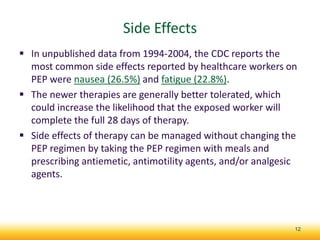
 In unpublished data from 1994-2004, the CDC reports the
most common side effects reported by healthcare workers on
PEP were nausea (26.5%) and fatigue (22.8%).
 The newer therapies are generally better tolerated, which
could increase the likelihood that the exposed worker will
complete the full 28 days of therapy.
 Side effects of therapy can be managed without changing the
PEP regimen by taking the PEP regimen with meals and
prescribing antiemetic, antimotility agents, and/or analgesic
agents.
12
Important Follow Up
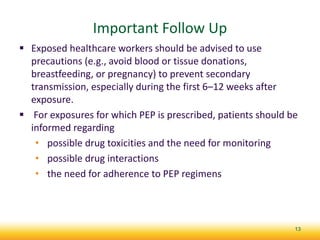
 Exposed healthcare workers should be advised to use
precautions (e.g., avoid blood or tissue donations,
breastfeeding, or pregnancy) to prevent secondary
transmission, especially during the first 6–12 weeks after
exposure.
 For exposures for which PEP is prescribed, patients should be
informed regarding
• possible drug toxicities and the need for monitoring
• possible drug interactions
• the need for adherence to PEP regimens
13
Important Follow Up
 Monitor patient taking PEP for drug toxicity at baseline and in
2 weeks after treatment initiation.
 HIV antibody testing should be performed at baseline, 6
weeks, 3 months, and 6 months. If a fourth generation HIV
Ag/Ab combination immunoassay is used, HIV testing can be
modified to baseline, 6 weeks, and be concluded at 4 months
after exposure.
14
What Happened To Our Patient?
 After many unsuccessful calls to neighborhood pharmacies
and his local hospital, he came to our ER at Legacy Good
Samaritan Medical Center in Portland, Oregon.
 His prescription was changed to Truvada and Raltegravir, and
he was able to pick up these meds at his local pharmacy
without difficulty.
15
Apply Your Knowledge
 A physician in your ED is examining a patient with advanced AIDS. While the
patient is talking to the MD, the doctor feels some spittle from the patient’s mouth
land in his right eye. The MD leaves the patient room and freaks out, “I have AIDS
in my eye! AIDS in my eye! Agghhhhh! He turns to you, the pharmacy student.
“What should I do? I have two small kids at home and a wife,” he says with a sob.
Thankfully, you have had a PEP talk at Midyear 2013, so you can tell him:
16
A. “Sorry buddy, you are a goner, there are some things even
pharmacists can’t fix.”
B. “Your risk of exposure means you should definitely double
up on truvada and combivir. If some is good, more is
definitely better.”
C. “Truvada and raltegravir are the preferred regimen for
occupational PEP and you should be started on them
straightaway.”
D. “Saliva is not considered infectious unless it is visibly
bloody: You’d be the first person in the history of the world
to contract HIV this way.”
Apply Your Knowledge
 A physician in your ED is examining a patient with advanced AIDS. While the
patient is talking to the MD, the doctor feels some spittle from the patient’s mouth
land in his right eye. The MD leaves the patient room and freaks out, “I have AIDS
in my eye! AIDS in my eye! Agghhhhh! He turns to you, the pharmacy student.
“What should I do? I have two small kids at home and a wife,” he says with a sob.
Thankfully, you have had a PEP talk at Midyear 2013, so you can tell him:
17
A. “Sorry buddy, you are a goner, there are some things even
pharmacists can’t fix.”
B. “Your risk of exposure means you should definitely double
up on truvada and combivir. If some is good, more is
definitely better.”
C. “Truvada and raltegravir are the preferred regimen for
occupational PEP and you should be started on them
straightaway.”
D. “Saliva is not considered infectious unless it is visibly
bloody: You’d be the first person in the history of the
world to contract HIV this way.”
References and Resources
 Kuhar DT, Henderson DK, Struble KA, et al. Updated U.S. Public Health
Service guidelines for the management of occupational exposures to HIV
and recommendations for postexposure prophylaxis. Infect Control Hosp
Epidemiol 2013;34(9):875-892
 Bell DM. Occupational risk of human immunodeficiency virus infection in
health-care workers: an overview. Am J Med 1997;102(5B): 9–15.
 National Clinicians Post-Exposure Prophylaxis (PEP) Hotline. 1-888-448-
4911 (http://www.nccc.ucsf.edu/about_nccc/pepline)
 Centers for Disease Control and Prevention (CDC). 1-800-893-0485.
 National HIV Telephone Consultation Service. 1-800-933-3413
 Mountain Plains Email Clinical Consultation Service for HIV Infection.
hivconsulation@UCHSC.edu
18
PEP for Occupational HIV Exposure:
What Every Pharmacist Should Know
Elva Angelique Van Devender, Ph.D., Pharm.D., BCPS
Clinical Pharmacy Specialist, Emergency Medicine
Legacy Good Samaritan Medical Center
Portland, Oregon

PEP pearl 110413

  • 1.
    PEP for OccupationalHIV Exposure: What Every Pharmacist Should Know Elva Angelique Van Devender, Ph.D., Pharm.D., BCPS Clinical Pharmacy Specialist, Emergency Medicine Legacy Good Samaritan Medical Center Portland, Oregon
  • 2.
    This is nota PEP talk in the traditional sense… 2
  • 3.
    Objectives  Understand whatPEP regimen is appropriate when a healthcare worker has been exposed to HIV  Know the most common adverse reactions of PEP therapy  Identify what follow up steps are necessary in the patient receiving PEP treatment 3
  • 4.
    A True Story A 27 yo male dialysis worker gets a needle stick after the needle has been used on an HIV patient…he rushes himself to the local hospital, as he remembers that time is of the essence in getting treatment.  Chaos ensues. The local hospital does not know what to do, eventually the patient is given one dose of truvada and combivir in the ED and is sent to Walgreens for a prescription for indinavir and combivir.  More chaos. Walgreens does not stock indinavir and the patient is desperately calling pharmacies trying to find one that can fill his prescription.  How would you rewrite this man’s story? 4
  • 5.
    PEP for HIV:The Basics  An exposure that might place a healthcare worker at risk for HIV infection is defined as a percutaneous injury (e.g., a needlestick or cut with a sharp object) or contact of mucous membrane or nonintact skin (e.g., exposed skin that is chapped, abraded, or afflicted with dermatitis) with blood, tissue, or other body fluids that are potentially infectious.  Body fluids which are considered infectious • Blood, visibly bloody body fluids, cerebrospinal fluid, synovial fluid, pleural fluid, peritoneal fluid, pericardial fluid, and amniotic fluid, and semen and vaginal secretions  Body fluids which are NOT considered infectious • Feces, nasal secretions, saliva, sputum, sweat, tears, urine, and vomitus (unless visibly bloody)  Whether or not the person is really exposed or not: washing the affected area is a great first step! 5
  • 6.
    PEP for HIV:The Basics  HIV PEP should be started immediately (within hours) and be continued for 28 days (4 weeks).  Pregnancy does not preclude PEP therapy.  Obtain baseline CBC, SCr, liver enzyme tests (AST, ALT, alk phosphatase, total bilirubin), and HIV antibody testing.  Follow up with exposed healthcare worker 72 hours post exposure, especially after additional information about the exposure or source person becomes available. 6
  • 7.
    In the Past:PEP for Percutaneous Injuries  Step 1: Evaluate source  Step 2: Evaluate exposure  Step 3: Select treatment 7 CDC. Updated U.S. Public Health Service guidelines for the management of occupational exposures to HIV and recommendations for postexposure prophylaxis. MMWR 2005;54(No. RR-9):1--17.
  • 8.
    In the Past:PEP for Percutaneous Injuries  Step 1: Evaluate source  Step 2: Evaluate exposure  Step 3: Select treatment 8 CDC. Updated U.S. Public Health Service guidelines for the management of occupational exposures to HIV and recommendations for postexposure prophylaxis. MMWR 2005;54(No. RR-9):1--17.
  • 9.
    Preferred HIV PEPRegimen PEP is now recommended for ALL occupational exposures to HIV! Raltegravir (Isentress: RAL) 400 mg PO twice daily Plus Truvada, 1 PO daily (Tenofovir [Viread; TDF] 300 mg + emtricitabine [Emtriva; FTC] 200 mg) Watch for Stribald (alternative therapy): Stribild (elvitegravir, cobicistat, tenofovir DF, emtricitabine) 1 pill, once daily dosing 9
  • 10.
    Preferred HIV PEPRegimen  TRUVADA + Raltegravir (ISENTRESS) • Emtricitabine (Emtriva, FTC) + Tenofovir (Viread, TDF); available as TRUVADA • emtricitabine 200mg + tenofovir 300mg in one tablet, taken once daily • Advantages: well-tolerated, once daily dosing, toxicities rare • Disadvantages: side effects (N/V/D, fatigue, rash); careful with tenofovir in patients with renal insufficiency • Raltegravir (ISENTRESS, RAL) • Raltegravir 400 mg tablet, taken twice daily • Advantages: well-tolerated, toxicities rare • Disdvantages: side effects (N/V, fatigue, insomnia), twice daily dosing 10
  • 11.
    Alternative Regimens May combineone drug or drug pair from the left column with one pair of nucleoside/nucleotide reverse-transcriptase inhibitors from the right column  Raltegravir (Isentress; RAL)  Darunavir (Prezista; DRV) + Ritonvir (Norvir; RTV)  Etravirine (Intelence; ETR)  Rilpirvirine (Edurant; RPV)  Atazanavir (Reyataz; ATV) + Ritonvir (Norvir; RTV)  Lopiniavir/Ritonavir (Kaletra; LPV/RTV)  Tenofovir DF (Viread; TDF) + Emtricitabine (Emtriva; FTC); available as Truvada  Tenofovir DF (Viread; TDF) + lamivudine (Epivir; 3TC)  Zidovudine (Retrovir; ZDV; AZT) + lamivudine (Epivir; 3TC); available as Combivir  Zidovudine (Retrovir; ZDV; AZT) + Emtricitabine (Emtriva; FTC) + 11
  • 12.
    Side Effects  Inunpublished data from 1994-2004, the CDC reports the most common side effects reported by healthcare workers on PEP were nausea (26.5%) and fatigue (22.8%).  The newer therapies are generally better tolerated, which could increase the likelihood that the exposed worker will complete the full 28 days of therapy.  Side effects of therapy can be managed without changing the PEP regimen by taking the PEP regimen with meals and prescribing antiemetic, antimotility agents, and/or analgesic agents. 12
  • 13.
    Important Follow Up Exposed healthcare workers should be advised to use precautions (e.g., avoid blood or tissue donations, breastfeeding, or pregnancy) to prevent secondary transmission, especially during the first 6–12 weeks after exposure.  For exposures for which PEP is prescribed, patients should be informed regarding • possible drug toxicities and the need for monitoring • possible drug interactions • the need for adherence to PEP regimens 13
  • 14.
    Important Follow Up Monitor patient taking PEP for drug toxicity at baseline and in 2 weeks after treatment initiation.  HIV antibody testing should be performed at baseline, 6 weeks, 3 months, and 6 months. If a fourth generation HIV Ag/Ab combination immunoassay is used, HIV testing can be modified to baseline, 6 weeks, and be concluded at 4 months after exposure. 14
  • 15.
    What Happened ToOur Patient?  After many unsuccessful calls to neighborhood pharmacies and his local hospital, he came to our ER at Legacy Good Samaritan Medical Center in Portland, Oregon.  His prescription was changed to Truvada and Raltegravir, and he was able to pick up these meds at his local pharmacy without difficulty. 15
  • 16.
    Apply Your Knowledge A physician in your ED is examining a patient with advanced AIDS. While the patient is talking to the MD, the doctor feels some spittle from the patient’s mouth land in his right eye. The MD leaves the patient room and freaks out, “I have AIDS in my eye! AIDS in my eye! Agghhhhh! He turns to you, the pharmacy student. “What should I do? I have two small kids at home and a wife,” he says with a sob. Thankfully, you have had a PEP talk at Midyear 2013, so you can tell him: 16 A. “Sorry buddy, you are a goner, there are some things even pharmacists can’t fix.” B. “Your risk of exposure means you should definitely double up on truvada and combivir. If some is good, more is definitely better.” C. “Truvada and raltegravir are the preferred regimen for occupational PEP and you should be started on them straightaway.” D. “Saliva is not considered infectious unless it is visibly bloody: You’d be the first person in the history of the world to contract HIV this way.”
  • 17.
    Apply Your Knowledge A physician in your ED is examining a patient with advanced AIDS. While the patient is talking to the MD, the doctor feels some spittle from the patient’s mouth land in his right eye. The MD leaves the patient room and freaks out, “I have AIDS in my eye! AIDS in my eye! Agghhhhh! He turns to you, the pharmacy student. “What should I do? I have two small kids at home and a wife,” he says with a sob. Thankfully, you have had a PEP talk at Midyear 2013, so you can tell him: 17 A. “Sorry buddy, you are a goner, there are some things even pharmacists can’t fix.” B. “Your risk of exposure means you should definitely double up on truvada and combivir. If some is good, more is definitely better.” C. “Truvada and raltegravir are the preferred regimen for occupational PEP and you should be started on them straightaway.” D. “Saliva is not considered infectious unless it is visibly bloody: You’d be the first person in the history of the world to contract HIV this way.”
  • 18.
    References and Resources Kuhar DT, Henderson DK, Struble KA, et al. Updated U.S. Public Health Service guidelines for the management of occupational exposures to HIV and recommendations for postexposure prophylaxis. Infect Control Hosp Epidemiol 2013;34(9):875-892  Bell DM. Occupational risk of human immunodeficiency virus infection in health-care workers: an overview. Am J Med 1997;102(5B): 9–15.  National Clinicians Post-Exposure Prophylaxis (PEP) Hotline. 1-888-448- 4911 (http://www.nccc.ucsf.edu/about_nccc/pepline)  Centers for Disease Control and Prevention (CDC). 1-800-893-0485.  National HIV Telephone Consultation Service. 1-800-933-3413  Mountain Plains Email Clinical Consultation Service for HIV Infection. hivconsulation@UCHSC.edu 18
  • 19.
    PEP for OccupationalHIV Exposure: What Every Pharmacist Should Know Elva Angelique Van Devender, Ph.D., Pharm.D., BCPS Clinical Pharmacy Specialist, Emergency Medicine Legacy Good Samaritan Medical Center Portland, Oregon