Post exposure prophylaxiscommonly known as PEP is
a medical treatment aimed at preventing infection
after an individual has been exposed to a pathogen
such as virus or bacteria . The primary goal of PEP is to
stop the pathogen from establishing as infection in the
body thereby preventing diseases . PEP is most
commonly used after exposure to blood-borne
pathogens such as HIV , Hepatitis B and rabies .
INTRODUCTION
3.
WHY IS PEP
IMPORTANT
PEPis critical because certain exposures
like needle-stick injuries , bites from
infected animals , or unprotected sexual
encounters, sexual assault, and accidental exposure
to HIV or other blood-borne pathogens can place
individuals at high risk of contracting potentially life
threatening infection, offering an essential line of
defense in post- exposure scenarios.
4.
HOW DOES PEPWORK
PEP works by using specific medications
such as anti-retrovirals for HIV or
immune globulin for rabies to target
the pathogen . These treatments can
inhibit the pathogen’s ability to replicate
and spread within the body , giving the
immune system a chance to prevent the
onset of illness.
5.
TYPES OF EXPOSURE
1.OccupationalExposure: Occurs in workplace
settings, especially among healthcare workers exposed
to
blood or body fluids.
2. Non-Occupational Exposure: Includes sexual
exposure, needle-sharing during drug use, or exposure
through sexual assault.
What is Post-ExposureProphylaxis (PEP)?
• • PEP is a preventive treatment for HIV after potential exposure.
• • Involves taking antiretroviral (ARV) medications for 28 days.
• • Must be started within 72 hours of exposure to reduce HIV
infection risk.
• • Aimed at preventing the virus from establishing an infection.
8.
How PEP Works
•• ARVs inhibit the replication of HIV in the body.
• • Blocks HIV from entering and infecting CD4 cells.
• • Prevents the virus from spreading and establishing permanent
infection.
• • Best results when taken as soon as possible after exposure.
9.
When is PEPUsed?
• PEP is used after a potential HIV exposure, such as:
• Unprotected sexual intercourse with a person living with HIV
infection.
• Sharing needles or other injection equipment.
• Occupational exposure (e.g., needle-stick injuries in healthcare).
• Sexual assault or rape.
• In some cases, exposure to contaminated blood or bodily fluids.
10.
Importance of EarlyTreatment
• • PEP is most effective when started within 2 hours of exposure.
• • Must begin treatment within 72 hours of exposure to be
effective.
• • Delayed initiation reduces effectiveness and increases the risk of
infection.
• • Early treatment provides the best chance of preventing HIV
transmission.
11.
PEP Medication Regimen
•• PEP involves a 28-day course of antiretroviral medications.
• Common drugs include:n - Tenofovir + Emtricitabine (NRTIs) -
Raltegravir (Integrase Inhibitor)
• • Other drug combinations may be used, depending on the
exposure risk and individual health conditions.
• • The full 28-day course must be completed for optimal results.
12.
Efficacy of PEP
•• When taken correctly, PEP can reduce the risk of HIV
transmission by up to 80%.
• • PEP effectiveness depends on the timing and adherence to the
regimen
• • If treatment is not started within 72 hours, efficacy significantly
decreases.
• • PEP is not a 100% guarantee against HIV infection, but
significantly reduces risk.
13.
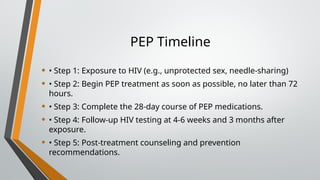
PEP Timeline
• •Step 1: Exposure to HIV (e.g., unprotected sex, needle-sharing)
• • Step 2: Begin PEP treatment as soon as possible, no later than 72
hours.
• • Step 3: Complete the 28-day course of PEP medications.
• • Step 4: Follow-up HIV testing at 4-6 weeks and 3 months after
exposure.
• • Step 5: Post-treatment counseling and prevention
recommendations.
14.
Who Should TakePEP?
• PEP is recommended for individuals who have experienced high-
risk HIV exposure, including:
• Individuals with a known HIV-positive sexual partner.
• Victims of sexual assault or rape.
• Healthcare workers after occupational exposure (e.g., needle-
stick injury).
• People who inject drugs and share needles.
• Individuals involved in high-risk sexual activities.
15.
Potential Side Effectsof PEP
• PEP medications may cause mild to moderate side effects, such as:
• Nausea and vomiting.
• Diarrhea.
• Fatigue and dizziness.
• Headaches.
• Muscle pain.
• Most side effects are temporary and resolve after completing the
regimen.
16.
PEP and Pregnancy
•• PEP is generally safe during pregnancy when medically indicated.
• ARVs used in PEP are typically not harmful to the developing
fetus.
• Pregnant women should be closely monitored by a healthcare
provider during treatment.
• The benefits of preventing HIV outweigh potential risks in high-
risk cases.
17.
HIV Testing AfterPEP
• • HIV testing should be done 4-6 weeks after completing PEP.
• • A follow-up test at 3 months post-PEP is recommended to
confirm HIV status.
• • If HIV is detected, early initiation of ART (antiretroviral therapy) is
essential.
• • Negative test results confirm that the treatment was successful.
18.
PEP and PreventionStrategy
• • PEP is an emergency measure, not a routine HIV prevention
method.
• • PEP should be combined with other preventive strategies like:
- Consistent condom use.
- Pre-exposure prophylaxis (PrEP) for ongoing HIV risk.
- Safe needle practices for people who inject drugs.
• • Regular HIV testing and counseling are also essential.
19.
Global Access toPEP
• • PEP is available in many countries, particularly in high HIV
prevalence areas.
• • Access to PEP can be limited in some regions, especially in
resource-limited settings.
• • Governments and NGOs work to improve access to PEP through
healthcare services.
• • Emergency PEP services are available in hospitals, clinics, and
sexual assault centers.
20.
Conclusion and KeyTakeaways
• • PEP is a critical tool in preventing HIV after potential exposure.
• • Timely initiation and adherence are crucial for effectiveness.
• • PEP is most effective when used alongside other HIV prevention
strategies.
• • Ongoing HIV testing and counseling are essential for
maintaining health.







![Infection prevention & control general orientation [compatibility mode]](https://cdn.slidesharecdn.com/ss_thumbnails/infectionpreventioncontrolgeneralorientationcompatibilitymode-140123020536-phpapp01-thumbnail.jpg?width=640&height=640&fit=bounds)


