Positive
Psychology
By Ginger Gairani
For PSY10000
What is Positive Psychology?
 “The study of the conditions and processes that
contribute to the flourishing or optimal
functioning of people, groups, and institutions”
-Gable & Haidt
What is Positive Psychology
Attempting to Understand?
 How things go right in our lives
 The relationship between what makes people
happy and able to be successful and it’s impact
on their mental health
 Coping with adversity
 Preventing depression
 Increasing satisfaction and productivity
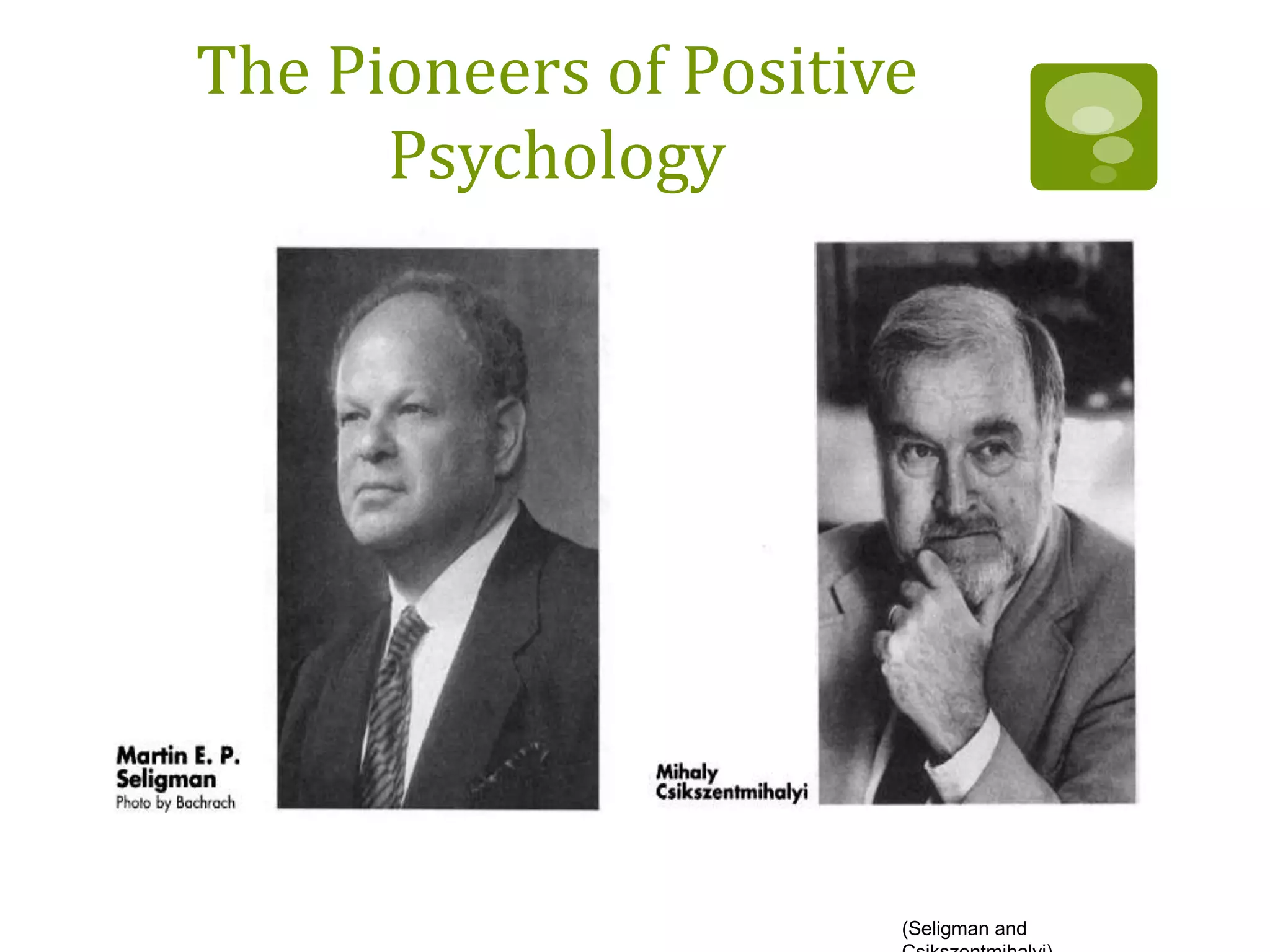
The Pioneers of Positive
Psychology
(Seligman and
How Does This Differ From the
Traditional View of
Psychology?
 Promotes certain characteristics; Strengths of
Character and good relationships are “buffers”
against mental illness
 Seligman and Csikszentmihalyi describe four
positive traits that are the backbone of positive
psychology:
 Subjective wellbeing
 Optimism
 Happiness
 Self-determination
-Seligman and Csikszentmihalyi
Drawbacks of Positive
Psychology
 Some may fail to identify with negative
experiences, causing a “Pollyanna view of the
world” (Gable & Haidt)
 Others view the word “positive” in positive
psychology to mean that the opposite must be
negative psychology
 There is no “negative psychology”; only
psychology that works to solve different
puzzles of the mind and psyche
Positive Psychology Put Into
Practice
 Plays a part in recovery during psychiatric rehabilitation
 Used by U.S. Department of Veterans Affairs and the U.S.
Army
 The U.S. Army offers resiliency training to officers, where
they will then pass down their experience with it to their
soldiers
 This training seeks to nurture characteristics such as:
 Optimism
 Effective Problem Solving
 Faith
 A Sense of Meaning
 Self-efficacy
 Flexibility
 Impulse Control
 Empathy
 Close Relationships
 Spirituality
-Moran & Nemec
Positive Psychology Put Into
Practice
 Normal psychiatric rehabilitation focuses on the
shortfalls and limitations of patients, whereas
positive psychology emphasizes the importance
of what is going right in a client’s life
 Positive psychology can be used as a
preventative measure and a rehabilitation
measure
 As a preventative measure, positive
psychology searches to strengthen innate
characteristics that build a strong foundation
for mental health
In Conclusion…
 Positive psychology is a movement pioneered by
Martin Seligman and Mihaly Csikszentmihalyi
 It seeks to answer the question: How can we
improve on the strength, character, and
attributes already present to make people more
mentally healthy or resilient?
 Positive psychology is practiced in organizations
such as the U.S. Army and focuses on what is
going right, as opposed to what is wrong
References
 Gable, S. L., & Haidt, J. (2005). What (and why) is positive
psychology?. Review Of General Psychology, 9(2), 103-110.
doi:10.1037/1089-2680.9.2.103
 Moran, G. S., & Nemec, P. B. (2013). Walking on the sunny side:
what positive psychology can contribute to psychiatric
rehabilitation concepts and practice. Psychiatric
Rehabilitation Journal, 36(3), 202-208. doi:10.1037/
prj0000012
 Seligman, M. P., & Csikszentmihalyi, M. (2000). Positive
psychology: An introduction. American Psychologist, 55(1), 5-
14. doi: 10.1037/0003-066X.55.1.5

Positive psychology 2014

  • 1.
  • 2.
    What is PositivePsychology?  “The study of the conditions and processes that contribute to the flourishing or optimal functioning of people, groups, and institutions” -Gable & Haidt
  • 3.
    What is PositivePsychology Attempting to Understand?  How things go right in our lives  The relationship between what makes people happy and able to be successful and it’s impact on their mental health  Coping with adversity  Preventing depression  Increasing satisfaction and productivity
  • 4.
    The Pioneers ofPositive Psychology (Seligman and
  • 5.
    How Does ThisDiffer From the Traditional View of Psychology?  Promotes certain characteristics; Strengths of Character and good relationships are “buffers” against mental illness  Seligman and Csikszentmihalyi describe four positive traits that are the backbone of positive psychology:  Subjective wellbeing  Optimism  Happiness  Self-determination -Seligman and Csikszentmihalyi
  • 6.
    Drawbacks of Positive Psychology Some may fail to identify with negative experiences, causing a “Pollyanna view of the world” (Gable & Haidt)  Others view the word “positive” in positive psychology to mean that the opposite must be negative psychology  There is no “negative psychology”; only psychology that works to solve different puzzles of the mind and psyche
  • 7.
    Positive Psychology PutInto Practice  Plays a part in recovery during psychiatric rehabilitation  Used by U.S. Department of Veterans Affairs and the U.S. Army  The U.S. Army offers resiliency training to officers, where they will then pass down their experience with it to their soldiers  This training seeks to nurture characteristics such as:  Optimism  Effective Problem Solving  Faith  A Sense of Meaning  Self-efficacy  Flexibility  Impulse Control  Empathy  Close Relationships  Spirituality -Moran & Nemec
  • 8.
    Positive Psychology PutInto Practice  Normal psychiatric rehabilitation focuses on the shortfalls and limitations of patients, whereas positive psychology emphasizes the importance of what is going right in a client’s life  Positive psychology can be used as a preventative measure and a rehabilitation measure  As a preventative measure, positive psychology searches to strengthen innate characteristics that build a strong foundation for mental health
  • 9.
    In Conclusion…  Positivepsychology is a movement pioneered by Martin Seligman and Mihaly Csikszentmihalyi  It seeks to answer the question: How can we improve on the strength, character, and attributes already present to make people more mentally healthy or resilient?  Positive psychology is practiced in organizations such as the U.S. Army and focuses on what is going right, as opposed to what is wrong
  • 10.
    References  Gable, S.L., & Haidt, J. (2005). What (and why) is positive psychology?. Review Of General Psychology, 9(2), 103-110. doi:10.1037/1089-2680.9.2.103  Moran, G. S., & Nemec, P. B. (2013). Walking on the sunny side: what positive psychology can contribute to psychiatric rehabilitation concepts and practice. Psychiatric Rehabilitation Journal, 36(3), 202-208. doi:10.1037/ prj0000012  Seligman, M. P., & Csikszentmihalyi, M. (2000). Positive psychology: An introduction. American Psychologist, 55(1), 5- 14. doi: 10.1037/0003-066X.55.1.5