APPROACHESTODEALING
WITHCHALLENGING
BEHAVIOUR
Rainbow Nursery
October 2019
Sammy Fugler
Developed by Sammy Fugler
BA (Hons), PGCE, MA, MBA
Today’s aims
■ To improve behaviour in the classrooms
■ For staff to have higher expectations of the children’s behaviour
■ To support staff to develop a consistent approach
■ For staff to develop skills and strategies to respond quickly and authoritatively to
behaviour
Key messages
1. Clear expectations
2. Positive learningenvironment
3. Consistent framework
4. Reflect
Key messages
1. Clear expectations
2. Positive learningenvironment
3. Consistent framework
4. Reflect
Ground Rules
Use ground rules as a basis for promotingpositive
behaviour and discouraging unwanted behaviour
Ground Rules
Think about the ground rules
You are about to see, and think
about WHY
We have chosen to show you these?
Ground Rules
1. No Pushing
2. No Biting
3. No Bikes inside
4. No bullying
5. Always have fun
What ground rules do you have in the
gan?
■ Eating only at the table
■ Outside toys stay outside
■ Treat our friends gently
■ Sit down through the whole circle time…
Ground Rules
■ Use ground rules as a basis for promoting positive behaviour and
discouraging unwanted behaviour
■ Use only positive language in the rules
■ A few rules, that are clearly reinforced; regularly (Catchy)
■ Consider displaying them
Thinking about your rules
Spend some time in your team groups
considering the kinds of rules that may
be relevant to your classroom right
now… create a list, and discuss how
and where you may display these and
discuss them with your children
Make some rules!
Using books about behaviour can
help to reinforce and provide
‘rationale’ for rules that you have
in the classroom.
The books can help children
understand the reasons for the
rules
The books can provide
opportunities to talk positively
about the rules, away from
stressful situations or specific
behaviour incidents
Rules for the practitioners
Key messages
1. Clear expectations
2. Positive learningenvironment
3. Consistent framework
4. Reflect
Language is powerful
Write a list of all the
NEGATIVE
languageyou
can think of…
THROW IT
AWAY!
KEEP IT CLOSE
Look after and cherish these words, keep
them close to your soul, and use them
forever more!
Write a list of all the
POSITIVE language
you can think of…
Avoid ‘nagging’ – be clear and positive
with children
List of positive behaviour
Positive behaviour
■ Co-operating with each other
■ Encouraging each other
■ Helping others
■ Asserting oneself
■ Full involvement in a chosen activity
■ Taking on new challenges
■ Showing empathy
■ Taking responsibility
■ Sharing
Encouraging positive behaviour
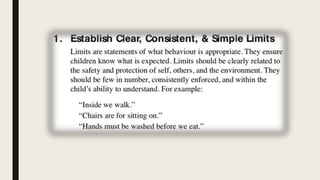
■ Clear rules
■ listen to and observe what children communicate both verbally and
non-verbally;
■ praise and respond appropriately to all forms of children's positive
behaviour
■ promote and reinforce positive behaviour by example;
Focus on desired and not undesired
behaviour
State what youWANT the child to do…. Rather than commenting on what you do NOT
want the child to do
Make sure the environment you have
created will ENGAGE children
Make sure that children know whatthey
are doing / what their options are
Stop that! Do
something
sensible!
Play nicely
Everyone
tidy up
Choose
something
to do…
Just
wait!
out here for
10 minutes
Praise quickly and consistently. Make sure
children understandWHY you’re praising
them
It was lovely that
Good job!
I can see you
you helpedJilli
settle when she
Thank you for
letting Eddie go
have got really
messy – well
done for taking
part so well!
came in this
morning!
Wow!Great
first with the
scissors, great
sharing!
Look out for ‘good’ behaviour (catch
them being ‘good!)
State what is expected… rather than
pose as questions
Would you
like to go
outside now?
Can you go with
Sivan now?
Do you want to
tell me what
happened?
Can you
pick that
up?
Do you want to
help me tidy up?
Key concept
Children should not be allowed to hurt
themselves or other people either physically or
verbally, or destroy property.They must learn
how to control themselves instead of other
people controlling them.
Tips and thoughts for developing self-
control
■ Children learn emotional regulation from our modeling
■ Children take their cues about anxiety from the adults and peers around them
■ Every time we set a limit that the child accepts, they are practicing self-control
(three more, and then its Romi’s turn)
■ Punishment doesn't encourage self-discipline because the child isn't actually
choosing to stop; they are being forced
Talk clearly, simply, and often about
behaviours that matter
Now is the
time to listen
andfollow
directions
Being helpful
can make you
and others feel
Take turns
with the
bimbas
Reading
time is
quiet time
happy
Keep rules and expectations simple, and remind children often when it’s time to follow them
Establish routines
Young children may not be able to
tell time, but they do become
accustomed to the cadence of a
regular schedule.When they know
that story time will be followed by
outdoor play, active children may be
more able to sit quietly while their
teacher reads.
Realistic expectations |Attention span
Acknowledge that young children have limited
attention spans by alternating learning activities that
require quiet, focused attention with opportunities for
independent play and learning activities that include
movement.
Gain attention respectfully
"We can’t control the world, but we can controlhow
we respond to it. Once you realise that will power is
just a matter of learning how to control your
attention and thoughts, you can really begin to
increase it."
Children making choices
The process of learning self-control and self-discipline is
linked closely with how a child feels about themselves and
their relationship with the world. Its our role to help build and
strengthen children’s ability to determine for themselves
what is right and what is wrong, and how to control their own
behaviour.
Proximity and touch
• Closeness can help children stay
calm and focused
• Consider sitting between two
children
• Hold a child on your lap
• The ‘shoulder’ touch
• Show affection (especially in
relation to unwanted touching -
hitting, pushing etc)
Key messages
1. Clear expectations
2. Positive learningenvironment
3. Consistent framework
4. Reflect
Unwanted Behaviour
What is it?
The context of behaviour is important
3 Key behviour considerations:
■ Disengaged
■ Disruptive
■ Unacceptable
Matching game
#Disengaged #Disruptive #Unacceptable
Some strategies
■ Counting down…
■ Clapping or clicking
■ Distraction
■ Eye contact
■ Reassuring physical contact
■ Tones of voices andvolume
■ Very clear instructions – bite size
■ Key words ‘focus’ or ‘welcome back’ or ‘and… listen’
■ Honesty… “I’mfeeling….”
■ Moving a child
Respond positively
■ Promptly identify children’s unwanted behaviour when it occurs
■ Identify changes in that child’s behaviour that are unusual for them
■ Use knowledge of the child and their background to interpret their behaviour
■ Use strategies appropriate to that child, when responding to their behaviour
■ Give the child support if required
■ Regularly review the strategies that you use
■ Create effective opportunities for children to express their negative feelings safely
Steps to Intervention…
• Help the child understand that his/her behaviour is up to them
• If necessary, remove the child from the situation and keep him/her
with you. If behaviour persists, act calmly and promptly.
• Discuss feelings and rules after a reasonable period of calm.
• Involve the child in the decision of when to go back because taking
responsibility for his/her own behaviour is an important part of
instilling self-control
• Help the child be acceptable when he/she does come back so that
he/she has the experience of substituting unacceptable behaviour
for acceptable
Be consistent
Provide choices
Providing choices is also a valid prevention
strategy for children, which often avoids
power struggles
Model problem solving skills
■ Did you ask for it back?
■ Is there another one you can use?
■ What else could you do?
■ What could you say to him?
■ Shall we look for it?
Summarise how you dealt with the
problem, this will support them for ‘next
time’
Use natural and logical consequences
■ Jumping off the wall bars onto other
children
■ Emptying the earth from the plant pots
all over the floor
■ Peeing over the toilet seat on purpose
■ Jumping around on the stairs
■ Putting gan toys in their bags
■ Running away to the lobby when going
to the garden
Provide opportunities for children to
make amends
Avoid asking children to say ‘sorry’
Quick think!
Effective strategy or not?
Key messages
1. Clear expectations
2. Positive learningenvironment
3. Consistent framework
4. Reflect
Every Child is different
Every child is different, every situation is different,
therefore; every response needs to be different.
There is not one approach, but there are many
approaches. We must find the right approach and the
right strategy for each situation
Reflective Practitioner
Reflective Practice tour…
Key messages
1. Clear expectations
2. Positive learningenvironment
3. Consistent framework
4. Reflect
Lets review our earlier scenarios…
■ Green - Disengaged
■ Orange – Disruptive
■ Red - Unacceptable
■ 1st Response
■ Follow up response
How can you support and develop self
control?
HOWWILLYOURCHANGE
YOURAPPROACHAFTER
TODAY?
Reflective practice

Approaches to Dealing with Behavior.pptx

  • 1.
  • 2.
    Developed by SammyFugler BA (Hons), PGCE, MA, MBA
  • 3.
    Today’s aims ■ Toimprove behaviour in the classrooms ■ For staff to have higher expectations of the children’s behaviour ■ To support staff to develop a consistent approach ■ For staff to develop skills and strategies to respond quickly and authoritatively to behaviour
  • 5.
    Key messages 1. Clearexpectations 2. Positive learningenvironment 3. Consistent framework 4. Reflect
  • 6.
    Key messages 1. Clearexpectations 2. Positive learningenvironment 3. Consistent framework 4. Reflect
  • 7.
    Ground Rules Use groundrules as a basis for promotingpositive behaviour and discouraging unwanted behaviour
  • 8.
    Ground Rules Think aboutthe ground rules You are about to see, and think about WHY We have chosen to show you these?
  • 9.
    Ground Rules 1. NoPushing 2. No Biting 3. No Bikes inside 4. No bullying 5. Always have fun
  • 10.
    What ground rulesdo you have in the gan? ■ Eating only at the table ■ Outside toys stay outside ■ Treat our friends gently ■ Sit down through the whole circle time…
  • 11.
    Ground Rules ■ Useground rules as a basis for promoting positive behaviour and discouraging unwanted behaviour ■ Use only positive language in the rules ■ A few rules, that are clearly reinforced; regularly (Catchy) ■ Consider displaying them
  • 12.
    Thinking about yourrules Spend some time in your team groups considering the kinds of rules that may be relevant to your classroom right now… create a list, and discuss how and where you may display these and discuss them with your children
  • 17.
  • 18.
    Using books aboutbehaviour can help to reinforce and provide ‘rationale’ for rules that you have in the classroom. The books can help children understand the reasons for the rules The books can provide opportunities to talk positively about the rules, away from stressful situations or specific behaviour incidents
  • 19.
    Rules for thepractitioners
  • 20.
    Key messages 1. Clearexpectations 2. Positive learningenvironment 3. Consistent framework 4. Reflect
  • 21.
    Language is powerful Writea list of all the NEGATIVE languageyou can think of… THROW IT AWAY! KEEP IT CLOSE Look after and cherish these words, keep them close to your soul, and use them forever more! Write a list of all the POSITIVE language you can think of…
  • 22.
    Avoid ‘nagging’ –be clear and positive with children
  • 24.
  • 25.
    Positive behaviour ■ Co-operatingwith each other ■ Encouraging each other ■ Helping others ■ Asserting oneself ■ Full involvement in a chosen activity ■ Taking on new challenges ■ Showing empathy ■ Taking responsibility ■ Sharing
  • 26.
    Encouraging positive behaviour ■Clear rules ■ listen to and observe what children communicate both verbally and non-verbally; ■ praise and respond appropriately to all forms of children's positive behaviour ■ promote and reinforce positive behaviour by example;
  • 27.
    Focus on desiredand not undesired behaviour State what youWANT the child to do…. Rather than commenting on what you do NOT want the child to do
  • 28.
    Make sure theenvironment you have created will ENGAGE children
  • 29.
    Make sure thatchildren know whatthey are doing / what their options are Stop that! Do something sensible! Play nicely Everyone tidy up Choose something to do… Just wait! out here for 10 minutes
  • 30.
    Praise quickly andconsistently. Make sure children understandWHY you’re praising them It was lovely that Good job! I can see you you helpedJilli settle when she Thank you for letting Eddie go have got really messy – well done for taking part so well! came in this morning! Wow!Great first with the scissors, great sharing!
  • 31.
    Look out for‘good’ behaviour (catch them being ‘good!)
  • 32.
    State what isexpected… rather than pose as questions Would you like to go outside now? Can you go with Sivan now? Do you want to tell me what happened? Can you pick that up? Do you want to help me tidy up?
  • 33.
    Key concept Children shouldnot be allowed to hurt themselves or other people either physically or verbally, or destroy property.They must learn how to control themselves instead of other people controlling them.
  • 45.
    Tips and thoughtsfor developing self- control ■ Children learn emotional regulation from our modeling ■ Children take their cues about anxiety from the adults and peers around them ■ Every time we set a limit that the child accepts, they are practicing self-control (three more, and then its Romi’s turn) ■ Punishment doesn't encourage self-discipline because the child isn't actually choosing to stop; they are being forced
  • 46.
    Talk clearly, simply,and often about behaviours that matter Now is the time to listen andfollow directions Being helpful can make you and others feel Take turns with the bimbas Reading time is quiet time happy Keep rules and expectations simple, and remind children often when it’s time to follow them
  • 48.
    Establish routines Young childrenmay not be able to tell time, but they do become accustomed to the cadence of a regular schedule.When they know that story time will be followed by outdoor play, active children may be more able to sit quietly while their teacher reads.
  • 49.
    Realistic expectations |Attentionspan Acknowledge that young children have limited attention spans by alternating learning activities that require quiet, focused attention with opportunities for independent play and learning activities that include movement.
  • 50.
  • 51.
    "We can’t controlthe world, but we can controlhow we respond to it. Once you realise that will power is just a matter of learning how to control your attention and thoughts, you can really begin to increase it."
  • 52.
    Children making choices Theprocess of learning self-control and self-discipline is linked closely with how a child feels about themselves and their relationship with the world. Its our role to help build and strengthen children’s ability to determine for themselves what is right and what is wrong, and how to control their own behaviour.
  • 53.
    Proximity and touch •Closeness can help children stay calm and focused • Consider sitting between two children • Hold a child on your lap • The ‘shoulder’ touch • Show affection (especially in relation to unwanted touching - hitting, pushing etc)
  • 54.
    Key messages 1. Clearexpectations 2. Positive learningenvironment 3. Consistent framework 4. Reflect
  • 55.
  • 56.
    The context ofbehaviour is important
  • 57.
    3 Key behviourconsiderations: ■ Disengaged ■ Disruptive ■ Unacceptable
  • 58.
  • 59.
    Some strategies ■ Countingdown… ■ Clapping or clicking ■ Distraction ■ Eye contact ■ Reassuring physical contact ■ Tones of voices andvolume ■ Very clear instructions – bite size ■ Key words ‘focus’ or ‘welcome back’ or ‘and… listen’ ■ Honesty… “I’mfeeling….” ■ Moving a child
  • 60.
    Respond positively ■ Promptlyidentify children’s unwanted behaviour when it occurs ■ Identify changes in that child’s behaviour that are unusual for them ■ Use knowledge of the child and their background to interpret their behaviour ■ Use strategies appropriate to that child, when responding to their behaviour ■ Give the child support if required ■ Regularly review the strategies that you use ■ Create effective opportunities for children to express their negative feelings safely
  • 61.
    Steps to Intervention… •Help the child understand that his/her behaviour is up to them • If necessary, remove the child from the situation and keep him/her with you. If behaviour persists, act calmly and promptly. • Discuss feelings and rules after a reasonable period of calm. • Involve the child in the decision of when to go back because taking responsibility for his/her own behaviour is an important part of instilling self-control • Help the child be acceptable when he/she does come back so that he/she has the experience of substituting unacceptable behaviour for acceptable
  • 62.
  • 64.
    Provide choices Providing choicesis also a valid prevention strategy for children, which often avoids power struggles
  • 65.
    Model problem solvingskills ■ Did you ask for it back? ■ Is there another one you can use? ■ What else could you do? ■ What could you say to him? ■ Shall we look for it?
  • 66.
    Summarise how youdealt with the problem, this will support them for ‘next time’
  • 67.
    Use natural andlogical consequences ■ Jumping off the wall bars onto other children ■ Emptying the earth from the plant pots all over the floor ■ Peeing over the toilet seat on purpose ■ Jumping around on the stairs ■ Putting gan toys in their bags ■ Running away to the lobby when going to the garden
  • 68.
    Provide opportunities forchildren to make amends Avoid asking children to say ‘sorry’
  • 69.
  • 70.
    Key messages 1. Clearexpectations 2. Positive learningenvironment 3. Consistent framework 4. Reflect
  • 71.
    Every Child isdifferent Every child is different, every situation is different, therefore; every response needs to be different. There is not one approach, but there are many approaches. We must find the right approach and the right strategy for each situation
  • 72.
  • 73.
  • 75.
    Key messages 1. Clearexpectations 2. Positive learningenvironment 3. Consistent framework 4. Reflect
  • 76.
    Lets review ourearlier scenarios… ■ Green - Disengaged ■ Orange – Disruptive ■ Red - Unacceptable ■ 1st Response ■ Follow up response How can you support and develop self control?
  • 77.