
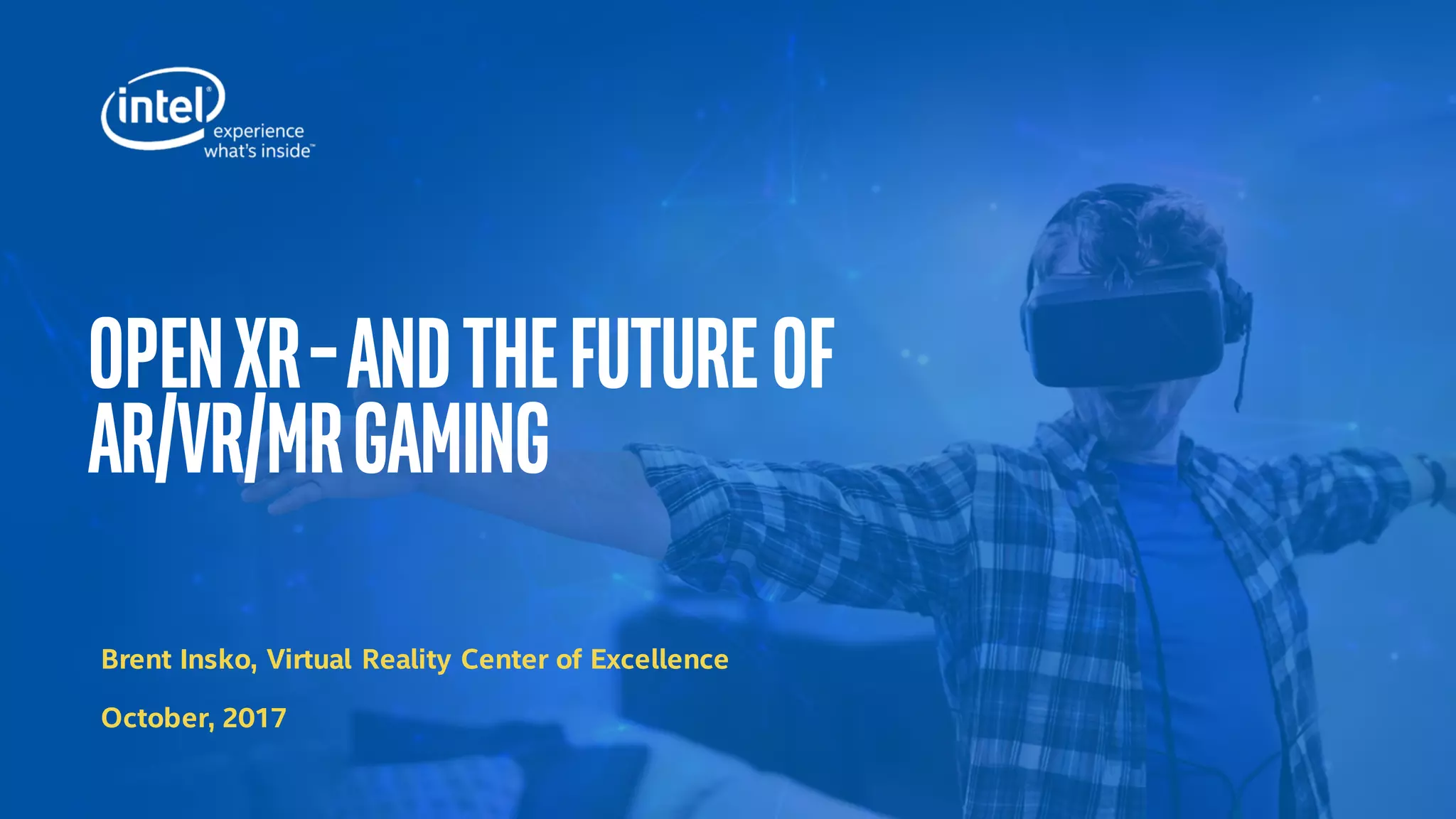






OpenXR–AndtheFutureof
AR/VR/MRGaming
Brent Insko, Virtual Reality Center of Excellence
October, 2017
Where is VR today?
2
3
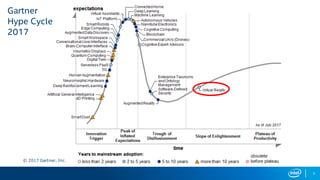
Gartner
Hype Cycle
2017
© 2017 Gartner, Inc.
What is holding VR back?
4
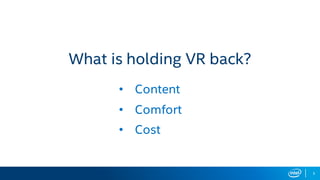
What is holding VR back?
• Content
• Comfort
• Cost
5
6
7
Platforms
8
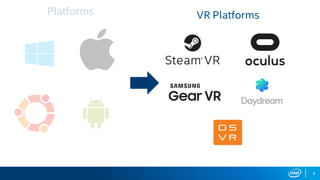
Platforms VR Platforms
9
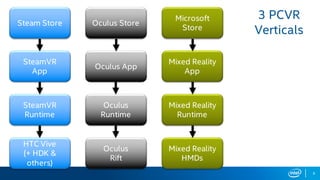
3 PCVR
Verticals
Oculus Store
Microsoft
Store
Mixed Reality
App
Mixed Reality
Runtime
Oculus App
Oculus
Runtime
Mixed Reality
HMDs
Oculus
Rift
Steam Store
SteamVR
App
SteamVR
Runtime
HTC Vive
(+ HDK &
others)
10
11
12
13
What is a VR Runtime?
14
15
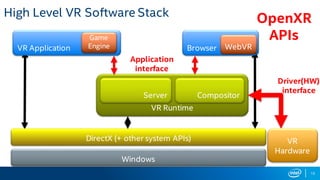
High Level VR Software Stack
VR Runtime
Server Compositor
DirectX (+ other system APIs)
Windows
VR Application Browser
VR
Hardware
OpenXR
APIs
WebVR
Game
Engine
Application
interface
Driver(HW)
interface
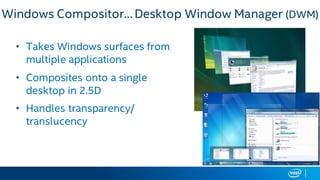
• Takes Windows surfaces from
multiple applications
• Composites onto a single
desktop in 2.5D
• Handles transparency/
translucency
Windows Compositor… Desktop Window Manager (DWM)
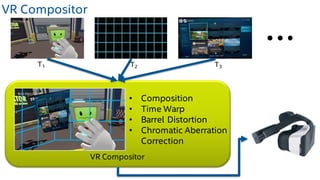
VR Compositor
T1 T2 T3
• Composition
• Time Warp
• Barrel Distortion
• Chromatic Aberration
Correction
VR Compositor
18
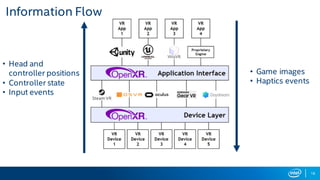
• Head and
controller positions
• Controller state
• Input events
• Game images
• Haptics events
Information Flow
19
Why does Intel care?
20
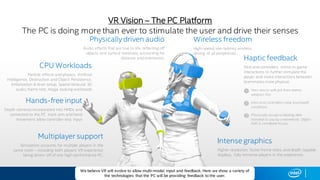
VR Vision – The PC Platform
The PC is doing more than ever to stimulate the user and drive their senses
Physicallydriven audio
Audio effects that are true to life, reflecting off
objects and surface materials, accounting for
distance and orientation.
Intense graphics
Higher resolution, faster frame rates, and depth capable
displays, fully immerse players in the experience.
Hands-free input
Depth cameras incorporated into HMDs and
connected to the PC track arm and hand
movement allow controller-less input
Multiplayer support
Simulation accounts for multiple players in the
same room – including both players VR experience
being driven off of one high-performance PC.
Wireless freedom
High-speed, low-latency wireless
driving of all peripherals.
Haptic feedback
Vest and controllers mimic in-game
interactions to further stimulate the
player and make interactions between
teammates more physical.
Vest reacts with jolt from enemy
weapon fire.
Vest and controllers relay low health
condition.
Physically accept a healing item
handed to you by a teammate. Object
heft is conveyed to you.
1
2
3
We believe VR will evolve to allow multi-modal input and feedback. Here we show a variety of
the technologies that the PC will be providing feedback to the user.
CPU Workloads
Particle effects and physics, Artificial
intelligence, Destruction and Object Persistence,
Initialization & level setup, Spatial binaural 3D
audio, frame rate, mega-tasking workloads
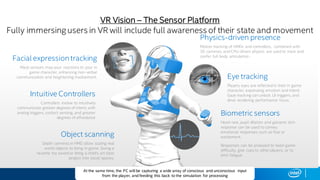
VR Vision – The Sensor Platform
Fully immersing users in VR will include full awareness of their state and movement
Facialexpressiontracking
Mask sensors map your reactions to your in
game character, enhancing non-verbal
communication and heightening involvement.
Object scanning
Depth cameras in HMD allow scaling real
world objects to bring in game. Swing a
favorite toy sword or bring a child’s art class
project into social spaces.
Eye tracking
Players eyes are reflected in their in game
character, expressing emotion and intent.
Gaze tracking can unlock UI triggers, and
drive rendering performance focus.
Biometric sensors
Heart rate, pupil dilation and galvanic skin
response can be used to convey
emotional responses such as fear or
excitement.
Responses can be analyzed to tailor game
difficulty, give cues to other players, or to
limit fatigue.
At the same time, the PC will be capturing a wide array of conscious and unconscious input
from the player, and feeding this back to the simulation for processing
Intuitive Controllers
Controllers evolve to intuitively
communicate greater degrees of intent, with
analog triggers, contact sensing, and greater
degrees of affordance
Physics-driven presence
Motion tracking of HMDs and controllers, combined with
3D cameras, and CPU-driven physics are used to track and
confer full body articulation .
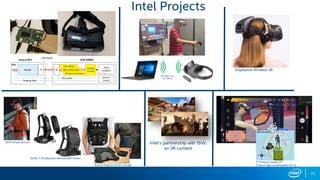
23
3rd
Person Camera AI
(Yoann PignoleGamasutra2015)
GFX
Source	(PC) Sink	(HMD)
Panel
(Output)
Sensors
(Input)
Render
Time	Warp	
Barrel	Distortion
Chroma	Correction
Display
(Scalar)
Pose	Input
Imaging	Data
Tx Rx
USB	Display
Displaylink Wireless VR
Intel’s partnership with ISVs
on VR content
Intel Projects
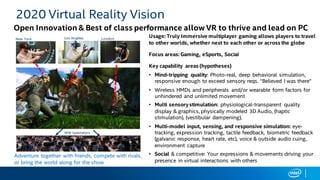
2020 Virtual Reality Vision
Adventure together with friends, compete with rivals,
or bring the world along for the show
Open Innovation & Best of class performance allow VR to thrive and lead on PC
Usage: Truly Immersive multiplayer gaming allows players to travel
to other worlds, whether next to each other or across the globe
Focus areas: Gaming, eSports, Social
Key capability areas (hypotheses)
• Mind-tripping quality: Photo-real, deep behavioral simulation,
responsive enough to exceed sensory reqs. “Believed I was there”
• Wireless HMDs and peripherals and/or wearable form factors for
unhindered and unlimited movement
• Multi sensorystimulation: physiological-transparent quality
display & graphics, physically modeled 3D Audio, (haptic
stimulation), (vestibular dampening),
• Multi-model input, sensing, and responsive simulation: eye-
tracking, expression tracking, tactile feedback, biometric feedback
(galvanic response, heart rate, etc), voice & outside audio cuing,
environment capture
• Social & competitive: Your expressions & movements driving your
presence in virtual interactions with others
New York Los Angeles London
WW Spectators
The Future of AR/VR/MR Gaming & OpenXR
• Engaging more senses, better experiences
à more immersion
à more presence
• More innovation
25
The Future of AR/VR/MR Gaming & OpenXR
• Engaging more senses, better experiences
à more immersion
à more presence
• More innovation
• Dependent on:
à more content more places
à more hardware more places
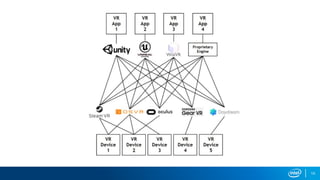
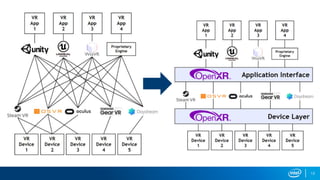
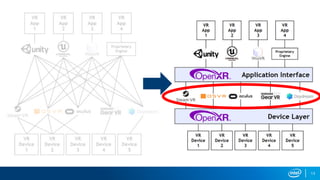
à easier cross-platform development & testing
26
PlaceholderFooterCopy /BULogo orName Goes Here
28
à more content more places
à more hardware more places
à easier cross-platform development & testing

Portland vr-meetup-deck-final-shareable

  • 1.
    OpenXR–AndtheFutureof AR/VR/MRGaming Brent Insko, VirtualReality Center of Excellence October, 2017
  • 2.
    Where is VRtoday? 2
  • 3.
  • 4.
    What is holdingVR back? 4
  • 5.
    What is holdingVR back? • Content • Comfort • Cost 5
  • 6.
  • 7.
  • 8.
  • 9.
    9 3 PCVR Verticals Oculus Store Microsoft Store MixedReality App Mixed Reality Runtime Oculus App Oculus Runtime Mixed Reality HMDs Oculus Rift Steam Store SteamVR App SteamVR Runtime HTC Vive (+ HDK & others)
  • 10.
  • 11.
  • 12.
  • 13.
  • 14.
    What is aVR Runtime? 14
  • 15.
    15 High Level VRSoftware Stack VR Runtime Server Compositor DirectX (+ other system APIs) Windows VR Application Browser VR Hardware OpenXR APIs WebVR Game Engine Application interface Driver(HW) interface
  • 16.
    • Takes Windowssurfaces from multiple applications • Composites onto a single desktop in 2.5D • Handles transparency/ translucency Windows Compositor… Desktop Window Manager (DWM)
  • 17.
    VR Compositor T1 T2T3 • Composition • Time Warp • Barrel Distortion • Chromatic Aberration Correction VR Compositor
  • 18.
    18 • Head and controllerpositions • Controller state • Input events • Game images • Haptics events Information Flow
  • 19.
  • 20.
  • 21.
    VR Vision –The PC Platform The PC is doing more than ever to stimulate the user and drive their senses Physicallydriven audio Audio effects that are true to life, reflecting off objects and surface materials, accounting for distance and orientation. Intense graphics Higher resolution, faster frame rates, and depth capable displays, fully immerse players in the experience. Hands-free input Depth cameras incorporated into HMDs and connected to the PC track arm and hand movement allow controller-less input Multiplayer support Simulation accounts for multiple players in the same room – including both players VR experience being driven off of one high-performance PC. Wireless freedom High-speed, low-latency wireless driving of all peripherals. Haptic feedback Vest and controllers mimic in-game interactions to further stimulate the player and make interactions between teammates more physical. Vest reacts with jolt from enemy weapon fire. Vest and controllers relay low health condition. Physically accept a healing item handed to you by a teammate. Object heft is conveyed to you. 1 2 3 We believe VR will evolve to allow multi-modal input and feedback. Here we show a variety of the technologies that the PC will be providing feedback to the user. CPU Workloads Particle effects and physics, Artificial intelligence, Destruction and Object Persistence, Initialization & level setup, Spatial binaural 3D audio, frame rate, mega-tasking workloads
  • 22.
    VR Vision –The Sensor Platform Fully immersing users in VR will include full awareness of their state and movement Facialexpressiontracking Mask sensors map your reactions to your in game character, enhancing non-verbal communication and heightening involvement. Object scanning Depth cameras in HMD allow scaling real world objects to bring in game. Swing a favorite toy sword or bring a child’s art class project into social spaces. Eye tracking Players eyes are reflected in their in game character, expressing emotion and intent. Gaze tracking can unlock UI triggers, and drive rendering performance focus. Biometric sensors Heart rate, pupil dilation and galvanic skin response can be used to convey emotional responses such as fear or excitement. Responses can be analyzed to tailor game difficulty, give cues to other players, or to limit fatigue. At the same time, the PC will be capturing a wide array of conscious and unconscious input from the player, and feeding this back to the simulation for processing Intuitive Controllers Controllers evolve to intuitively communicate greater degrees of intent, with analog triggers, contact sensing, and greater degrees of affordance Physics-driven presence Motion tracking of HMDs and controllers, combined with 3D cameras, and CPU-driven physics are used to track and confer full body articulation .
  • 23.
    23 3rd Person Camera AI (YoannPignoleGamasutra2015) GFX Source (PC) Sink (HMD) Panel (Output) Sensors (Input) Render Time Warp Barrel Distortion Chroma Correction Display (Scalar) Pose Input Imaging Data Tx Rx USB Display Displaylink Wireless VR Intel’s partnership with ISVs on VR content Intel Projects
  • 24.
    2020 Virtual RealityVision Adventure together with friends, compete with rivals, or bring the world along for the show Open Innovation & Best of class performance allow VR to thrive and lead on PC Usage: Truly Immersive multiplayer gaming allows players to travel to other worlds, whether next to each other or across the globe Focus areas: Gaming, eSports, Social Key capability areas (hypotheses) • Mind-tripping quality: Photo-real, deep behavioral simulation, responsive enough to exceed sensory reqs. “Believed I was there” • Wireless HMDs and peripherals and/or wearable form factors for unhindered and unlimited movement • Multi sensorystimulation: physiological-transparent quality display & graphics, physically modeled 3D Audio, (haptic stimulation), (vestibular dampening), • Multi-model input, sensing, and responsive simulation: eye- tracking, expression tracking, tactile feedback, biometric feedback (galvanic response, heart rate, etc), voice & outside audio cuing, environment capture • Social & competitive: Your expressions & movements driving your presence in virtual interactions with others New York Los Angeles London WW Spectators
  • 25.
    The Future ofAR/VR/MR Gaming & OpenXR • Engaging more senses, better experiences à more immersion à more presence • More innovation 25
  • 26.
    The Future ofAR/VR/MR Gaming & OpenXR • Engaging more senses, better experiences à more immersion à more presence • More innovation • Dependent on: à more content more places à more hardware more places à easier cross-platform development & testing 26
  • 27.
  • 28.
    28 à more contentmore places à more hardware more places à easier cross-platform development & testing