x
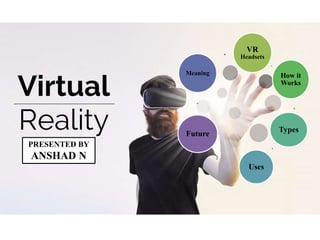
VR
Headsets
How it
Works
Types
Uses
Meaning
Future
PRESENTED BY
ANSHAD N
VIRTUAL REALITY
 VR is a computer technology that uses virtual reality
headsets to generate realistic images, sounds and other
sensations that simulate a user’s physical presence in a
virtual or imaginary environment.
 VR refers to a high-end user interface that involves real time
simulation and interaction through multiple sensorial
channels.
VR Headsets
Playstation VR
by Sony Interactive Entertainment
HTC Vive
by HTC and Value
Corporation
Oculus Rift
by Facebook
Google Cardboard
by Google
Samsung Gear VR
by Samsung
HOW IT WORKS?
 STERIOSCOPIC DISPLAY
This works by displaying two slightly different angles of the scene
to each eye, simulating depth.
 Frames Per Second
FPS is how fast the GPU can display images, per second.
 Refresh Rate
How fast the monitor can display images per second, measured in
hertz (Hz)
 Field of View
FOW is the extent of the visible world that can be seen at any
given time.
 Latency
Is the time between the computer’s detection of head motion to
the time it displays motion in the image.
 3D Audio
Virtual placement of sound in a three dimensional environment
emulating sounds from different angles.
TYPES OF VR
Window on World
Immersive System
Telepresence
Mixed Reality
Window on World
 Also called Desktop VR.
 Using a conventional
computer monitor to
display the 3D virtual
world.
 Perfect for the field of
medicine.
Immersive System
 Completely immerse the
user’s personal
viewpoint inside the
virtual 3D world.
 User has no visual
contact with the physical
world.
 Often equipped with a
Head Mounted Device
(HMD)
Telepresence
 Allows a person to interact
with another live, real place
at a different location.
 Involves life size images.
 Participants may be able to
manipulate device or the
environment in the remote
location.
Mixed Reality
 Combination of VR system
and telepresence.
 Here the computer
generated inputs are
brought together with
telepresence inputs.
 User can see, hear virtual
world and can operate.
APPLICATIONS
Video Games Military
Movies Automobile Manufacturing
Medical Field Education
Video Games
VR is evident in video
games. Now you can
physically interact with a
game by using your body
and motions to control
characters and other
elements of the game that
years ago people would
only imagine.
Military
 Adopted in air force, navy
and army.
 Used to train soldiers in a
simulated battlefield.
 Soldiers have the
opportunity to learn
without the risk of being
killed or injured.
Movies
 Lot of cinemas have
adopted VR technology
now.
 Head mouted view and
powerful speakers gives
serious immersion.
 Movies are six time
interesting and horror
movies are twenty times
more real and scarier.
Automobile Manufacturing
 Ford Motors already
embraced VR in the
manufacturing process.
 Prototype of any vehicles
can be uploaded on VR
platform where engineers
can make decisions before
manufacturing.
 This saves a lot of money,
time and effort.
Medical Field
 Surgeons now make use of
VR to figure out all the
positions of unwanted
tumours.
 Adopted in the treatment of
phobia by exposing the
patient to relevant simulated
phobia.
 Now VR is used for robotic
surgery.
Education
 Improves teaching and
learning.
 A large group of students can
interact with one another
within a 3D environment.
 It can be simulated certain
industrial processes on VR
platforms.
FUTURE OF VR
Virtual Reality

Virtual Reality

  • 1.
  • 2.
  • 3.
    VIRTUAL REALITY  VRis a computer technology that uses virtual reality headsets to generate realistic images, sounds and other sensations that simulate a user’s physical presence in a virtual or imaginary environment.  VR refers to a high-end user interface that involves real time simulation and interaction through multiple sensorial channels.
  • 4.
    VR Headsets Playstation VR bySony Interactive Entertainment
  • 5.
    HTC Vive by HTCand Value Corporation Oculus Rift by Facebook
  • 6.
  • 7.
  • 8.
     STERIOSCOPIC DISPLAY Thisworks by displaying two slightly different angles of the scene to each eye, simulating depth.
  • 9.
     Frames PerSecond FPS is how fast the GPU can display images, per second.  Refresh Rate How fast the monitor can display images per second, measured in hertz (Hz)  Field of View FOW is the extent of the visible world that can be seen at any given time.  Latency Is the time between the computer’s detection of head motion to the time it displays motion in the image.  3D Audio Virtual placement of sound in a three dimensional environment emulating sounds from different angles.
  • 10.
    TYPES OF VR Windowon World Immersive System Telepresence Mixed Reality
  • 11.
    Window on World Also called Desktop VR.  Using a conventional computer monitor to display the 3D virtual world.  Perfect for the field of medicine.
  • 12.
    Immersive System  Completelyimmerse the user’s personal viewpoint inside the virtual 3D world.  User has no visual contact with the physical world.  Often equipped with a Head Mounted Device (HMD)
  • 13.
    Telepresence  Allows aperson to interact with another live, real place at a different location.  Involves life size images.  Participants may be able to manipulate device or the environment in the remote location.
  • 14.
    Mixed Reality  Combinationof VR system and telepresence.  Here the computer generated inputs are brought together with telepresence inputs.  User can see, hear virtual world and can operate.
  • 15.
    APPLICATIONS Video Games Military MoviesAutomobile Manufacturing Medical Field Education
  • 16.
    Video Games VR isevident in video games. Now you can physically interact with a game by using your body and motions to control characters and other elements of the game that years ago people would only imagine.
  • 17.
    Military  Adopted inair force, navy and army.  Used to train soldiers in a simulated battlefield.  Soldiers have the opportunity to learn without the risk of being killed or injured.
  • 18.
    Movies  Lot ofcinemas have adopted VR technology now.  Head mouted view and powerful speakers gives serious immersion.  Movies are six time interesting and horror movies are twenty times more real and scarier.
  • 19.
    Automobile Manufacturing  FordMotors already embraced VR in the manufacturing process.  Prototype of any vehicles can be uploaded on VR platform where engineers can make decisions before manufacturing.  This saves a lot of money, time and effort.
  • 20.
    Medical Field  Surgeonsnow make use of VR to figure out all the positions of unwanted tumours.  Adopted in the treatment of phobia by exposing the patient to relevant simulated phobia.  Now VR is used for robotic surgery.
  • 21.
    Education  Improves teachingand learning.  A large group of students can interact with one another within a 3D environment.  It can be simulated certain industrial processes on VR platforms.
  • 22.