Portfolios: A Comprehensive Overview
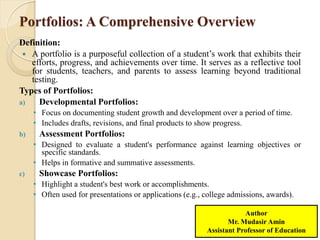
Definition:
 A portfolio is a purposeful collection of a student’s work that exhibits their
efforts, progress, and achievements over time. It serves as a reflective tool
for students, teachers, and parents to assess learning beyond traditional
testing.
Types of Portfolios:
a) Developmental Portfolios:
• Focus on documenting student growth and development over a period of time.
• Includes drafts, revisions, and final products to show progress.
b) Assessment Portfolios:
• Designed to evaluate a student's performance against learning objectives or
specific standards.
• Helps in formative and summative assessments.
c) Showcase Portfolios:
• Highlight a student's best work or accomplishments.
• Often used for presentations or applications (e.g., college admissions, awards).
Author
Mr. Mudasir Amin
Assistant Professor of Education
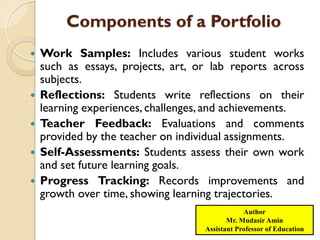
Components of a Portfolio
 Work Samples: Includes various student works
such as essays, projects, art, or lab reports across
subjects.
 Reflections: Students write reflections on their
learning experiences, challenges, and achievements.
 Teacher Feedback: Evaluations and comments
provided by the teacher on individual assignments.
 Self-Assessments: Students assess their own work
and set future learning goals.
 Progress Tracking: Records improvements and
growth over time, showing learning trajectories.
Author
Mr. Mudasir Amin
Assistant Professor of Education
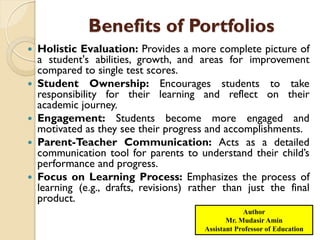
Benefits of Portfolios
 Holistic Evaluation: Provides a more complete picture of
a student's abilities, growth, and areas for improvement
compared to single test scores.
 Student Ownership: Encourages students to take
responsibility for their learning and reflect on their
academic journey.
 Engagement: Students become more engaged and
motivated as they see their progress and accomplishments.
 Parent-Teacher Communication: Acts as a detailed
communication tool for parents to understand their child’s
performance and progress.
 Focus on Learning Process: Emphasizes the process of
learning (e.g., drafts, revisions) rather than just the final
product.
Author
Mr. Mudasir Amin
Assistant Professor of Education
Digital Portfolios
 Tools: Digital portfolios can be created using
platforms like Google Sites, Seesaw, Class
Dojo, or other learning management systems.
 Benefits of Digital: Easy to store, update,
share, and assess. Allows for multimedia
integration (videos, audio, images).
 Accessibility: Can be accessed by students,
teachers, and parents anytime, offering a more
interactive and dynamic experience.
Author
Mr. Mudasir Amin
Assistant Professor of Education
Uses of Portfolios in Education
 Formative Assessment: Used to monitor
ongoing student progress and provide feedback
during the learning process.
 Summative Assessment: Acts as a final
evaluation tool to determine student
achievement at the end of a term or unit.
 Goal Setting: Students set academic or
personal learning goals based on their portfolio
reflections.
 Parent-Teacher Conferences: Portfolios
provide a tangible and detailed resource for
discussing a student's performance during
conferences. Author
Mr. Mudasir Amin
Assistant Professor of Education
Challenges of Using Portfolios
 Time-Consuming: Collecting, reviewing, and
assessing portfolio contents can be time-
intensive for both students and teachers.
 Subjectivity: Without clear rubrics, portfolio
assessment may become subjective, affecting
fairness and consistency.
 Organization: Students need guidance in
organizing portfolio items in a meaningful way
that showcases their learning effectively.
Author
Mr. Mudasir Amin
Assistant Professor of Education
Portfolio Assessment Criteria
 Clear Rubrics: Use rubrics to evaluate
different elements like creativity, depth of
understanding, effort, and alignment with
learning objectives.
 Quality Over Quantity: Emphasize the
quality of the work and its reflection of
learning, rather than the volume of work
included.
 Student Growth: Focus on how the
portfolio demonstrates learning growth, not
just the final results. Author
Mr. Mudasir Amin
Assistant Professor of Education
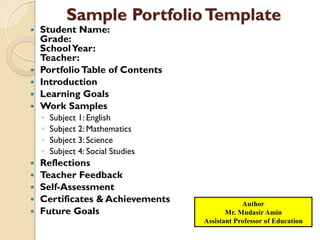
Sample PortfolioTemplate
 Student Name:
Grade:
SchoolYear:
Teacher:
 PortfolioTable of Contents
 Introduction
 Learning Goals
 Work Samples
◦ Subject 1: English
◦ Subject 2: Mathematics
◦ Subject 3: Science
◦ Subject 4: Social Studies
 Reflections
 Teacher Feedback
 Self-Assessment
 Certificates & Achievements
 Future Goals
Author
Mr. Mudasir Amin
Assistant Professor of Education
Portfolios : A Comprehensive Overview and Sample Template

Portfolios : A Comprehensive Overview and Sample Template

  • 2.
    Portfolios: A ComprehensiveOverview Definition:  A portfolio is a purposeful collection of a student’s work that exhibits their efforts, progress, and achievements over time. It serves as a reflective tool for students, teachers, and parents to assess learning beyond traditional testing. Types of Portfolios: a) Developmental Portfolios: • Focus on documenting student growth and development over a period of time. • Includes drafts, revisions, and final products to show progress. b) Assessment Portfolios: • Designed to evaluate a student's performance against learning objectives or specific standards. • Helps in formative and summative assessments. c) Showcase Portfolios: • Highlight a student's best work or accomplishments. • Often used for presentations or applications (e.g., college admissions, awards). Author Mr. Mudasir Amin Assistant Professor of Education
  • 3.
    Components of aPortfolio  Work Samples: Includes various student works such as essays, projects, art, or lab reports across subjects.  Reflections: Students write reflections on their learning experiences, challenges, and achievements.  Teacher Feedback: Evaluations and comments provided by the teacher on individual assignments.  Self-Assessments: Students assess their own work and set future learning goals.  Progress Tracking: Records improvements and growth over time, showing learning trajectories. Author Mr. Mudasir Amin Assistant Professor of Education
  • 4.
    Benefits of Portfolios Holistic Evaluation: Provides a more complete picture of a student's abilities, growth, and areas for improvement compared to single test scores.  Student Ownership: Encourages students to take responsibility for their learning and reflect on their academic journey.  Engagement: Students become more engaged and motivated as they see their progress and accomplishments.  Parent-Teacher Communication: Acts as a detailed communication tool for parents to understand their child’s performance and progress.  Focus on Learning Process: Emphasizes the process of learning (e.g., drafts, revisions) rather than just the final product. Author Mr. Mudasir Amin Assistant Professor of Education
  • 5.
    Digital Portfolios  Tools:Digital portfolios can be created using platforms like Google Sites, Seesaw, Class Dojo, or other learning management systems.  Benefits of Digital: Easy to store, update, share, and assess. Allows for multimedia integration (videos, audio, images).  Accessibility: Can be accessed by students, teachers, and parents anytime, offering a more interactive and dynamic experience. Author Mr. Mudasir Amin Assistant Professor of Education
  • 6.
    Uses of Portfoliosin Education  Formative Assessment: Used to monitor ongoing student progress and provide feedback during the learning process.  Summative Assessment: Acts as a final evaluation tool to determine student achievement at the end of a term or unit.  Goal Setting: Students set academic or personal learning goals based on their portfolio reflections.  Parent-Teacher Conferences: Portfolios provide a tangible and detailed resource for discussing a student's performance during conferences. Author Mr. Mudasir Amin Assistant Professor of Education
  • 7.
    Challenges of UsingPortfolios  Time-Consuming: Collecting, reviewing, and assessing portfolio contents can be time- intensive for both students and teachers.  Subjectivity: Without clear rubrics, portfolio assessment may become subjective, affecting fairness and consistency.  Organization: Students need guidance in organizing portfolio items in a meaningful way that showcases their learning effectively. Author Mr. Mudasir Amin Assistant Professor of Education
  • 8.
    Portfolio Assessment Criteria Clear Rubrics: Use rubrics to evaluate different elements like creativity, depth of understanding, effort, and alignment with learning objectives.  Quality Over Quantity: Emphasize the quality of the work and its reflection of learning, rather than the volume of work included.  Student Growth: Focus on how the portfolio demonstrates learning growth, not just the final results. Author Mr. Mudasir Amin Assistant Professor of Education
  • 9.
    Sample PortfolioTemplate  StudentName: Grade: SchoolYear: Teacher:  PortfolioTable of Contents  Introduction  Learning Goals  Work Samples ◦ Subject 1: English ◦ Subject 2: Mathematics ◦ Subject 3: Science ◦ Subject 4: Social Studies  Reflections  Teacher Feedback  Self-Assessment  Certificates & Achievements  Future Goals Author Mr. Mudasir Amin Assistant Professor of Education