Sports Footwear and Apparel
Industry Analysis


       Nike Corporation
                              Group 4:
                            Josh Fernino
                             Brent Hare
                          Victor Hemmati
                          Lance Hollister
                          Chris Kerschen
                             Ty Parasiliti
                           Vincent Ukwu
Defining The Industry
Industry Defined
 20,000 retail accounts throughout the U. S.
  using independent distributors and also has
  contracts with 110 other countries
 Also has agreements with Internet
  companies and subsidiaries
 Operates within the sports footwear and
  apparel market.
 Originally designing and producing running
  shoes, their portfolio has broadened to
  include a wide range of sports and leisure
  wear. This is all endorsed by top sporting
  personalities
NAICS Codes
 North American Industry Classification System
 The standard used by Federal statistical agencies
  in classifying business establishments for the
  purpose of collecting, analyzing, and publishing
  statistical data related to the U.S. business
  economy
 The first two digits of code designate the sector,
  the third designates the subsector, the fourth
  digit designates the industry group, the fifth digit
  designates the NAICS industry, and sixth digit
  designates the U.S. detail industry
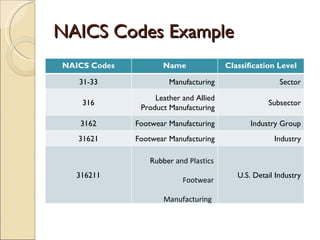
NAICS Codes Example
NAICS Codes          Name               Classification Level

   31-33               Manufacturing                    Sector

                   Leather and Allied
    316                                             Subsector
               Product Manufacturing
   3162       Footwear Manufacturing           Industry Group
   31621      Footwear Manufacturing                  Industry

                  Rubber and Plastics
  316211                                   U.S. Detail Industry
                           Footwear

                      Manufacturing
Nike Products
             They design, develop, and
              market high quality active
              sports apparel, equipment,
              and accessory products
             Nike distributes one new
              shoe style every single day
             Nike’s critical factors for
              success are maintaining
              current standards, closer
              working relationships, and
              retaining customer loyalty
              by guaranteed standard of
              product
Nike Products
 Their products are
  made for men, women,
  and children of all ages.
 The company presently
  sells roughly 300 models
  of athletic shoes in 900
  styles for 25 different
  sports.
 Nike's target market for
  their shoes is males and
  females between 18 and
  35 years old.
Nike Products
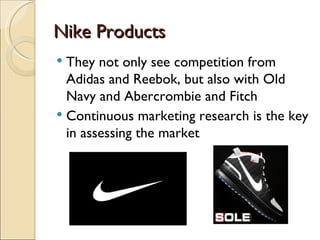
 They not only see competition from
  Adidas and Reebok, but also with Old
  Navy and Abercrombie and Fitch
 Continuous marketing research is the key
  in assessing the market
Nike Expansion
 Nike has success as a result of
  collaborating with other companies
  within the sports and fitness industry
 But at other times, Nike expanded into
  markets for which it is not strategically
  suited
 Nike has realized to initiate more
  aggressive programs to review product
  partnerships that are outside of its core
  basis of products
Nike’s Biggest Competitor


   Consist of 3 companies:
    ◦ Adidas
    ◦ Reebok
    ◦ TaylorMade
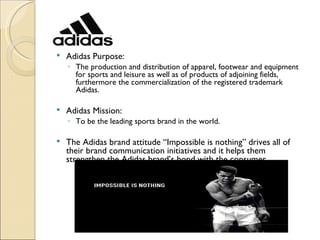
   Adidas Purpose:
    ◦ The production and distribution of apparel, footwear and equipment
      for sports and leisure as well as of products of adjoining fields,
      furthermore the commercialization of the registered trademark
      Adidas.

   Adidas Mission:
    ◦ To be the leading sports brand in the world.

   The Adidas brand attitude “Impossible is nothing” drives all of
    their brand communication initiatives and it helps them
    strengthen the Adidas brand’s bond with the consumer.
   Reebok’s Mission:
    ◦ Always challenge and lead through creativity.
 At the core of the Reebok brand is the affirmation of the uniqueness of all
  people.
 Reebok Strategic Focus:
    ◦ to become a consumer-driven brand that reflects the emphasis on individuality.

   Athletes Endorsed by Reebok:
    ◦   Sidney Crosby
    ◦   Alexander Ovechkin
    ◦   Allen Iverson
    ◦   Yao Ming
    ◦   Thierry Henry

   Reebok Partnerships:
    ◦ NFL
    ◦ NHL
    ◦ MLB
   TaylorMade’s Mission:
    ◦ To have the leading performance golf brands in the world.

   TaylorMade changed the game of golf by bringing the metalwood
    to the public 27 years ago, and today is the market leader in the
    metalwood category.

   Strive to continually extend their brands’ positions as leaders in
    the development and implementation of advanced performance
    technologies in all of their products including clubs, balls, footwear
    and apparel.

   Just to give you an idea of how well TaylorMade is doing, they
    currently endorse 55 professional golfers, one of which is Sergio
    Garcia, and as of February 17, 2009 he is ranked number two in
    world.
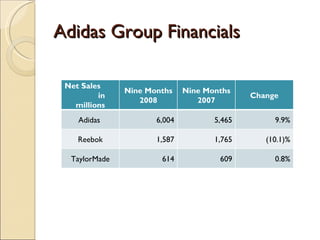
Adidas Group Financials

 Net Sales
               Nine Months    Nine Months
         in                                  Change
                  2008           2007
   millions
    Adidas            6,004          5,465        9.9%

    Reebok            1,587          1,765      (10.1)%

  TaylorMade           614            609         0.8%
Industry Structure
Growth in Recent Decades
 Nike and Reebok set the standard
 Nike gained popularity
 Lurking competitors
    ◦ Adidas Group
    ◦ Under Armour
Industry Weakening
 Internet skyrocketed sales in late 90’s
 Upcoming companies took advantage of
  new technologies
 Sales have slumped tremendously in past
  year
 Nike making 4% cut
 Under Armour stated that analyst’s
  estimates are far below earlier
  predictions
Threat of New Entrants
 Highly saturated and challenging industry
 Depend in large part on first mover
  advantage and scale economies
 Areas to focus: Technologies, pricing, and
  costs of production
Innovator
 Sports Apparel and Footwear industry
  relies mainly on innovations and creativity
 Innovative Ideas=Key success factor
 Company could have an advantage
 Without proper funding and resources a
  firm could be at a severe disadvantage
 Threat of new entrants based on first-
  mover advantage is minimal
Economies of Scale
 Difficult to compete with large
  economies of scale
 Hard to handle all levels, more
  experienced firms are able to disperse
 New entrants suffer a severe cost
  disadvantage
 Significant amount of assets needed
Bargaining Power of Buyers and
Suppliers
 Power of buyers can be determined by
  supply vs. demand and number of buyers
 Price sensitivity effects demand
 Customers more affected by price
 Suppliers are more powerful when the
  ratio to buyers is more
 The vast range of products in the Athletic
  Apparel industry leads to a dissimilar
  amount of bargaining power for the
  supplier
Substitute products and services

   The threat of substitute products
    The existence of close substitute
    products increases the propensity of
    customers to switch to alternatives in
    response to price increases
Substitute products and services
   Substitutes are a threat because:
    1) They are an attractive alternative product or
    service, which customers can easily shift to if
    there are low switching costs.
    2) The availability of substitutes invites customers
    to make price, quality and performance
    comparisons
    3) Competitively priced substitutes impose a
    maximum value on prices relevant industry can
    charge for its products or services
Substitute products and services


 1) They are an attractive alternative
 product or service, which customers can
 easily shift to if there are low switching
 costs


                    OR
Substitute products and services

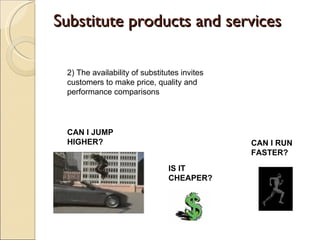
 2) The availability of substitutes invites
 customers to make price, quality and
 performance comparisons


 CAN I JUMP
 HIGHER?                                      CAN I RUN
                                              FASTER?
                                IS IT
                                CHEAPER?
Substitute products and services

   3) Competitively priced substitutes
    impose a maximum value on prices
    relevant industry can charge for its
    products or services


                  What is
                  worth ?
Rivalry Among Participants


   Competitive rivalry
 This   is the major determinant of
    the competitiveness of the
    industry. Sometimes rivals
    compete aggressively and
    sometimes rivals compete in non-
    price dimensions such as
    innovation, marketing, etc.
Rivalry Among Participants
   Generally competitive rivalry will be
    high if:
   There is little differentiation between the products sold
    between customers.

   Competitors are approximately the same size of each other

   If the competitors all have similar strategies.

   It is costly to leave the industry hence they fight to just
    stay in

   High fixed or storage costs, which encourages fast turnover
    of inventory.
Rivalry Among Participants

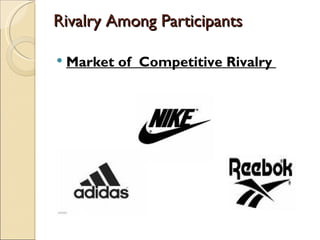
   Market of Competitive Rivalry
Industry Environment
Nike vs. The Economy
  As the economy slows, consumer
  purchases are down. The biggest threat for
  Nike would be economic recession.
 Asian economic crisis also affects Nike since
  its goods are manufactured in Asia.
    ◦ The labor costs and material prices are going up.
      Nike's growth is not just affected by the local
      economy but also in the international economy.
    ◦ A weak Euro and an Asian recession could mean
      weak sales for Nike.
Nike vs. Ethics
   In 1996, the ethical issue of child labor
    came to the surface regarding the hiring
    of young employees by Nike’s Asian and
    Latin subcontractors whose ages ranged
    from very young to teenagers. The teen
    workers would have not been so
    controversial; however, there were no
    regulations or work permits issued.
Nike vs. Ethics
 Without proper management leading and
  planning in the Nike Corporation, the
  company would have suffered from the
  child labor issue.
 Nike has made a true bounce-back from
  the negative media attention, and
  continues to be successful due to their
  strong business ethic philosophy.
Nike vs. Society
   People are more health conscious
    nowadays. Consequently, more and more
    people are joining fitness clubs. There is
    an accompanying growth for demands of
    fitness products particularly exercise
    apparels, shoes and equipment. Nike
    naturally is at the forefront of this surge
    in demand as people are looking for
    sports shoes, apparels and equipment.
Nike vs. Society
   The largest among Nike’s objectives, the
    women’s athletic market will be a top
    priority in the next ten years. The
    number of women collegiate athletes
    have increased from a few thousand in
    the 1960’s to almost one million today.
Technology
 Product technology must evolve as fitness
  evolves, in order to give competitors an
  advantage
 Nike introduced Nike Shox, which
  revolutionized the cushioning foam used
  in shoes
 Nike also collaborated with Apple and is
  launching new apparel and footwear that
  will easily carry the consumer’s iPod
Technology
 Product innovation is an ongoing process
  and is vital to stay ahead of competition
 Companies in this industry invest money
  in R&D to keep up with the new
  demands of today’s athletes
 Nike employs many specialists including
  engineers, athletes, biomechanics, and
  industrial designers to work together in
  the design process
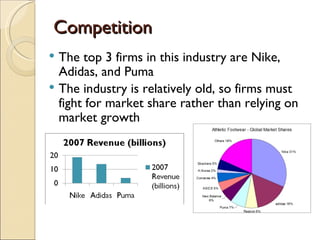
Competition
 The top 3 firms in this industry are Nike,
  Adidas, and Puma
 The industry is relatively old, so firms must
  fight for market share rather than relying on
  market growth
Areas Firms Compete On
 Product offerings
 Technologies
 Marketing Expenditures (endorsements
  and advertising)
 Pricing
 Costs of Production
 Customer Service
Competition
 Firms in athletic footwear and apparel
  also compete with firms that provide
  other substitutes (such as leisure and
  casual wear)
 Skechers, K Swiss, New Balance, and
  Aasics
 Nike has created their own lines of casual
  shoes to compete in these markets as
  well
    ◦ Example: Converse
Competition
 During hard economic times, people
  consume less retail goods such as clothes
  and footwear
 Bureau of the Census estimates that retail
  and food service sales for January 2009 are
  9.7% below a year ago
 Consequently, the industry has turned to
  emerging markets to continue sales growth
    ◦ China
    ◦ Russia
    ◦ Latin America
Geography
   Production is outsourced to plants in Asia,
    Latin America, and Africa
    ◦ This reduces costs because labor is cheaper
    ◦ Puts sources of production closer to where they
      will be sold
 Firms who outsource lose the ability to
  closely monitor product quality and working
  conditions
 Although some people find this unethical,
  firms cannot afford to keep production close
  to home and still compete on profit margins
Geography
 Plants are also located in many different
  countries, rather than being concentrated in
  one area
 Diversification of production plants reduces
  the risk that a firm will greatly be affected by
  a problem in any particular country
    ◦ Example: Nike’s largest footwear factory
      accounts for only 6% of the total footwear
      production
    ◦ Nike claims it can recover from any loss in
      production within one year’s time
Conclusion
Overview of the Industry
•   In this industry there is intense
    competition, fashion trends, and price
    conscious consumers that have slowed
    growth in this industry.

•   This creates difficult situations for
    companies to produce a brand image that
    appeals to consumers that want to shop
    for cheaper apparel, but also apparel that
    has quality.
Where the Industry is Now
 Financially, the company must be aware
  that economies are not up to par and
  that costs must be kept low to bring in
  the revenue.
 With the internet being a huge entry to
  Nike’s products, the company must find a
  way to keep their consumers to see them
  as being more user friendly as compared
  to their competitors.
Cont.
 Ways for Nike to do this is to keep the
  site simple, fresh, and easy to use.
 By using new designs and better deals for
  orders made online for the customers, it
  has the potential to bring in more
  revenue, as well as improve the
  relationship between the company and its
  clients.
Industry Forecast
   Technology is always changing, and if
    Nike can create apparel and athletic
    equipment that the competitors cannot
    match, then Nike will grow even higher
    than its rivals.

    Technology can be based around
    anything from softer and more durable
    running shoes, to a baseball bat with a
    new metal to make the ball go further.

Nike industry analysis presentation

  • 1.
    Sports Footwear andApparel Industry Analysis Nike Corporation Group 4: Josh Fernino Brent Hare Victor Hemmati Lance Hollister Chris Kerschen Ty Parasiliti Vincent Ukwu
  • 2.
  • 3.
    Industry Defined  20,000retail accounts throughout the U. S. using independent distributors and also has contracts with 110 other countries  Also has agreements with Internet companies and subsidiaries  Operates within the sports footwear and apparel market.  Originally designing and producing running shoes, their portfolio has broadened to include a wide range of sports and leisure wear. This is all endorsed by top sporting personalities
  • 4.
    NAICS Codes  NorthAmerican Industry Classification System  The standard used by Federal statistical agencies in classifying business establishments for the purpose of collecting, analyzing, and publishing statistical data related to the U.S. business economy  The first two digits of code designate the sector, the third designates the subsector, the fourth digit designates the industry group, the fifth digit designates the NAICS industry, and sixth digit designates the U.S. detail industry
  • 5.
    NAICS Codes Example NAICSCodes Name Classification Level 31-33 Manufacturing Sector Leather and Allied 316 Subsector Product Manufacturing 3162 Footwear Manufacturing Industry Group 31621 Footwear Manufacturing Industry Rubber and Plastics 316211 U.S. Detail Industry Footwear Manufacturing
  • 6.
    Nike Products  They design, develop, and market high quality active sports apparel, equipment, and accessory products  Nike distributes one new shoe style every single day  Nike’s critical factors for success are maintaining current standards, closer working relationships, and retaining customer loyalty by guaranteed standard of product
  • 7.
    Nike Products  Theirproducts are made for men, women, and children of all ages.  The company presently sells roughly 300 models of athletic shoes in 900 styles for 25 different sports.  Nike's target market for their shoes is males and females between 18 and 35 years old.
  • 8.
    Nike Products  Theynot only see competition from Adidas and Reebok, but also with Old Navy and Abercrombie and Fitch  Continuous marketing research is the key in assessing the market
  • 9.
    Nike Expansion  Nikehas success as a result of collaborating with other companies within the sports and fitness industry  But at other times, Nike expanded into markets for which it is not strategically suited  Nike has realized to initiate more aggressive programs to review product partnerships that are outside of its core basis of products
  • 10.
    Nike’s Biggest Competitor  Consist of 3 companies: ◦ Adidas ◦ Reebok ◦ TaylorMade
  • 11.
    Adidas Purpose: ◦ The production and distribution of apparel, footwear and equipment for sports and leisure as well as of products of adjoining fields, furthermore the commercialization of the registered trademark Adidas.  Adidas Mission: ◦ To be the leading sports brand in the world.  The Adidas brand attitude “Impossible is nothing” drives all of their brand communication initiatives and it helps them strengthen the Adidas brand’s bond with the consumer.
  • 12.
    Reebok’s Mission: ◦ Always challenge and lead through creativity.  At the core of the Reebok brand is the affirmation of the uniqueness of all people.  Reebok Strategic Focus: ◦ to become a consumer-driven brand that reflects the emphasis on individuality.  Athletes Endorsed by Reebok: ◦ Sidney Crosby ◦ Alexander Ovechkin ◦ Allen Iverson ◦ Yao Ming ◦ Thierry Henry  Reebok Partnerships: ◦ NFL ◦ NHL ◦ MLB
  • 13.
    TaylorMade’s Mission: ◦ To have the leading performance golf brands in the world.  TaylorMade changed the game of golf by bringing the metalwood to the public 27 years ago, and today is the market leader in the metalwood category.  Strive to continually extend their brands’ positions as leaders in the development and implementation of advanced performance technologies in all of their products including clubs, balls, footwear and apparel.  Just to give you an idea of how well TaylorMade is doing, they currently endorse 55 professional golfers, one of which is Sergio Garcia, and as of February 17, 2009 he is ranked number two in world.
  • 14.
    Adidas Group Financials Net Sales Nine Months Nine Months in Change 2008 2007 millions Adidas 6,004 5,465 9.9% Reebok 1,587 1,765 (10.1)% TaylorMade 614 609 0.8%
  • 15.
  • 16.
    Growth in RecentDecades  Nike and Reebok set the standard  Nike gained popularity  Lurking competitors ◦ Adidas Group ◦ Under Armour
  • 17.
    Industry Weakening  Internetskyrocketed sales in late 90’s  Upcoming companies took advantage of new technologies  Sales have slumped tremendously in past year  Nike making 4% cut  Under Armour stated that analyst’s estimates are far below earlier predictions
  • 18.
    Threat of NewEntrants  Highly saturated and challenging industry  Depend in large part on first mover advantage and scale economies  Areas to focus: Technologies, pricing, and costs of production
  • 19.
    Innovator  Sports Appareland Footwear industry relies mainly on innovations and creativity  Innovative Ideas=Key success factor  Company could have an advantage  Without proper funding and resources a firm could be at a severe disadvantage  Threat of new entrants based on first- mover advantage is minimal
  • 20.
    Economies of Scale Difficult to compete with large economies of scale  Hard to handle all levels, more experienced firms are able to disperse  New entrants suffer a severe cost disadvantage  Significant amount of assets needed
  • 21.
    Bargaining Power ofBuyers and Suppliers  Power of buyers can be determined by supply vs. demand and number of buyers  Price sensitivity effects demand  Customers more affected by price  Suppliers are more powerful when the ratio to buyers is more  The vast range of products in the Athletic Apparel industry leads to a dissimilar amount of bargaining power for the supplier
  • 22.
    Substitute products andservices  The threat of substitute products The existence of close substitute products increases the propensity of customers to switch to alternatives in response to price increases
  • 23.
    Substitute products andservices  Substitutes are a threat because: 1) They are an attractive alternative product or service, which customers can easily shift to if there are low switching costs. 2) The availability of substitutes invites customers to make price, quality and performance comparisons 3) Competitively priced substitutes impose a maximum value on prices relevant industry can charge for its products or services
  • 24.
    Substitute products andservices 1) They are an attractive alternative product or service, which customers can easily shift to if there are low switching costs OR
  • 25.
    Substitute products andservices 2) The availability of substitutes invites customers to make price, quality and performance comparisons CAN I JUMP HIGHER? CAN I RUN FASTER? IS IT CHEAPER?
  • 26.
    Substitute products andservices  3) Competitively priced substitutes impose a maximum value on prices relevant industry can charge for its products or services What is worth ?
  • 27.
    Rivalry Among Participants  Competitive rivalry  This is the major determinant of the competitiveness of the industry. Sometimes rivals compete aggressively and sometimes rivals compete in non- price dimensions such as innovation, marketing, etc.
  • 28.
    Rivalry Among Participants  Generally competitive rivalry will be high if:  There is little differentiation between the products sold between customers.  Competitors are approximately the same size of each other  If the competitors all have similar strategies.  It is costly to leave the industry hence they fight to just stay in  High fixed or storage costs, which encourages fast turnover of inventory.
  • 29.
    Rivalry Among Participants  Market of Competitive Rivalry
  • 30.
  • 31.
    Nike vs. TheEconomy   As the economy slows, consumer purchases are down. The biggest threat for Nike would be economic recession.  Asian economic crisis also affects Nike since its goods are manufactured in Asia. ◦ The labor costs and material prices are going up. Nike's growth is not just affected by the local economy but also in the international economy. ◦ A weak Euro and an Asian recession could mean weak sales for Nike.
  • 32.
    Nike vs. Ethics  In 1996, the ethical issue of child labor came to the surface regarding the hiring of young employees by Nike’s Asian and Latin subcontractors whose ages ranged from very young to teenagers. The teen workers would have not been so controversial; however, there were no regulations or work permits issued.
  • 33.
    Nike vs. Ethics Without proper management leading and planning in the Nike Corporation, the company would have suffered from the child labor issue.  Nike has made a true bounce-back from the negative media attention, and continues to be successful due to their strong business ethic philosophy.
  • 34.
    Nike vs. Society  People are more health conscious nowadays. Consequently, more and more people are joining fitness clubs. There is an accompanying growth for demands of fitness products particularly exercise apparels, shoes and equipment. Nike naturally is at the forefront of this surge in demand as people are looking for sports shoes, apparels and equipment.
  • 35.
    Nike vs. Society  The largest among Nike’s objectives, the women’s athletic market will be a top priority in the next ten years. The number of women collegiate athletes have increased from a few thousand in the 1960’s to almost one million today.
  • 36.
    Technology  Product technologymust evolve as fitness evolves, in order to give competitors an advantage  Nike introduced Nike Shox, which revolutionized the cushioning foam used in shoes  Nike also collaborated with Apple and is launching new apparel and footwear that will easily carry the consumer’s iPod
  • 37.
    Technology  Product innovationis an ongoing process and is vital to stay ahead of competition  Companies in this industry invest money in R&D to keep up with the new demands of today’s athletes  Nike employs many specialists including engineers, athletes, biomechanics, and industrial designers to work together in the design process
  • 38.
    Competition  The top3 firms in this industry are Nike, Adidas, and Puma  The industry is relatively old, so firms must fight for market share rather than relying on market growth
  • 39.
    Areas Firms CompeteOn  Product offerings  Technologies  Marketing Expenditures (endorsements and advertising)  Pricing  Costs of Production  Customer Service
  • 40.
    Competition  Firms inathletic footwear and apparel also compete with firms that provide other substitutes (such as leisure and casual wear)  Skechers, K Swiss, New Balance, and Aasics  Nike has created their own lines of casual shoes to compete in these markets as well ◦ Example: Converse
  • 41.
    Competition  During hardeconomic times, people consume less retail goods such as clothes and footwear  Bureau of the Census estimates that retail and food service sales for January 2009 are 9.7% below a year ago  Consequently, the industry has turned to emerging markets to continue sales growth ◦ China ◦ Russia ◦ Latin America
  • 42.
    Geography  Production is outsourced to plants in Asia, Latin America, and Africa ◦ This reduces costs because labor is cheaper ◦ Puts sources of production closer to where they will be sold  Firms who outsource lose the ability to closely monitor product quality and working conditions  Although some people find this unethical, firms cannot afford to keep production close to home and still compete on profit margins
  • 43.
    Geography  Plants arealso located in many different countries, rather than being concentrated in one area  Diversification of production plants reduces the risk that a firm will greatly be affected by a problem in any particular country ◦ Example: Nike’s largest footwear factory accounts for only 6% of the total footwear production ◦ Nike claims it can recover from any loss in production within one year’s time
  • 44.
  • 45.
    Overview of theIndustry • In this industry there is intense competition, fashion trends, and price conscious consumers that have slowed growth in this industry. • This creates difficult situations for companies to produce a brand image that appeals to consumers that want to shop for cheaper apparel, but also apparel that has quality.
  • 46.
    Where the Industryis Now  Financially, the company must be aware that economies are not up to par and that costs must be kept low to bring in the revenue.  With the internet being a huge entry to Nike’s products, the company must find a way to keep their consumers to see them as being more user friendly as compared to their competitors.
  • 47.
    Cont.  Ways forNike to do this is to keep the site simple, fresh, and easy to use.  By using new designs and better deals for orders made online for the customers, it has the potential to bring in more revenue, as well as improve the relationship between the company and its clients.
  • 48.
    Industry Forecast  Technology is always changing, and if Nike can create apparel and athletic equipment that the competitors cannot match, then Nike will grow even higher than its rivals.  Technology can be based around anything from softer and more durable running shoes, to a baseball bat with a new metal to make the ball go further.