Analysis and study on
Presented by,
Sagar Karmakar
Aditya Garg
Vatsala Dikshit
Nirmayee Dixit
Vasudev Pol
Shubham Hedau
Founded on January 25, 1964, as Blue Ribbon Sports, by Bill
Bowerman and Phil Knight, and officially became Nike, Inc. on May 30, 1971.
Products offered includes– Athletic shoes, Apparels,
Sports equipment and Accessories
Introduction
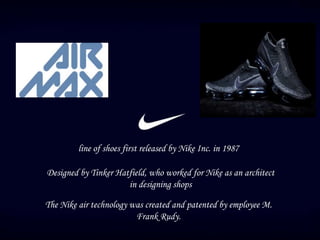
line of shoes first released by Nike Inc. in 1987
Designed by Tinker Hatfield, who worked for Nike as an architect
in designing shops
The Nike air technology was created and patented by employee M.
Frank Rudy.
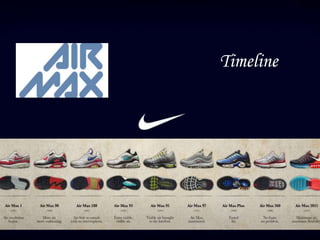
Timeline
Features
Improved designs
Foam and Air technology
Foam breaks but air doesn’t
Number 1 selling trainers
STP Analysis
S
‱ Demographic: Men, Women, Boys, Girls
‱ Geographic: Northern America, Southern America,
Europe, Asia Pacific, Middle East, Africa
‱ Psychographic: Lifestyles, Social Class, Personality
‱ Behavioral: Athletes, Fashion enthusiasts, Tech-
savy people
STP Analysis
T
‱ Generally caters to niche market
‱ People from the ages of 16 to 36
‱ Sports enthusiast
‱ Urban areas
‱ Focus on higher income group
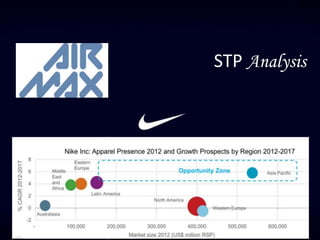
‱ They target Asia Pacific, Western Europe,
North America
STP Analysis
P
‱ High brand value
‱ High Performance
‱ Comfort
‱ Style
Marketing Mix
PRODUCT
‱ Newest product features:
i. Mix of engineered mesh
ii. Reflective 3M swoosh
iii. Full length visible air
‱ USP: Air supporting for heels, Flexibility,
Durability
‱ Differentiation: Within the Air Max
collection there are more than 50 styles
Marketing Mix
PRICE
‱ Prices are adjusted based on differences of
target market and location
‱ Different retailers take different prices
‱ Variable for adults and children
Marketing Mix
PLACE
‱ Around the globe 20,000 stores in 200
countries
‱ Nike flagship stores
‱ Online retailing for customers Retailers in
form of licensees, subsidiaries and
distributors are present
Marketing Mix
PROMOTION
‱ Popularity among celebrities
‱ Promotes Nike is a brand with most
popular sports personalities and teams
‱ Advertising campaign focus on emotional
connect
‱ Digital customization of Air Max trainers
online or at Nike ID studio
Recommendations
Product
Product differentiation
tailored at international
level to attain a greater
competitive advantage.
Place
Reach out to the African
continent with the use of
strategical marketing to
develop new markets for
global recognition
Target audience
Target older generation
with innovative initiatives
and the use of global media
to stay healthy
Conclusion
‱ Need to maintain current product portfolio and marketing strategies of Air Max in
order to sustain their competitive advantage.
‱ Need to target newer segment to capture a market with mass customer base.
‱ Current youthful and fashion image may hinder older generation market segment
penetration.
‱ Nike brand loyalty and innovative designs will be key success factors when going
to the African market.
Individual Contribution
‱ Research: Everyone
‱ Study of Nike and Air Max: Sagar Karmakar and
Aditya Garg
‱ STP analysis: Nirmayee Dixit, Vasudev Pol and
Vatsala Dikshit
‱ Marketing Mix: Nirmayee Dixit, Vasudev Pol,
Vatsala Dikshit and Shubham Hedau
‱ Recommendation and Conclusion: Shubham Hedau
‱ Compilation and Formatting: Shubham Hedau

Analysis and Study on Nike

  • 1.
    Analysis and studyon Presented by, Sagar Karmakar Aditya Garg Vatsala Dikshit Nirmayee Dixit Vasudev Pol Shubham Hedau
  • 2.
    Founded on January25, 1964, as Blue Ribbon Sports, by Bill Bowerman and Phil Knight, and officially became Nike, Inc. on May 30, 1971. Products offered includes– Athletic shoes, Apparels, Sports equipment and Accessories Introduction
  • 3.
    line of shoesfirst released by Nike Inc. in 1987 Designed by Tinker Hatfield, who worked for Nike as an architect in designing shops The Nike air technology was created and patented by employee M. Frank Rudy.
  • 4.
  • 5.
    Features Improved designs Foam andAir technology Foam breaks but air doesn’t Number 1 selling trainers
  • 6.
    STP Analysis S ‱ Demographic:Men, Women, Boys, Girls ‱ Geographic: Northern America, Southern America, Europe, Asia Pacific, Middle East, Africa ‱ Psychographic: Lifestyles, Social Class, Personality ‱ Behavioral: Athletes, Fashion enthusiasts, Tech- savy people
  • 7.
    STP Analysis T ‱ Generallycaters to niche market ‱ People from the ages of 16 to 36 ‱ Sports enthusiast ‱ Urban areas ‱ Focus on higher income group ‱ They target Asia Pacific, Western Europe, North America
  • 8.
    STP Analysis P ‱ Highbrand value ‱ High Performance ‱ Comfort ‱ Style
  • 9.
    Marketing Mix PRODUCT ‱ Newestproduct features: i. Mix of engineered mesh ii. Reflective 3M swoosh iii. Full length visible air ‱ USP: Air supporting for heels, Flexibility, Durability ‱ Differentiation: Within the Air Max collection there are more than 50 styles
  • 10.
    Marketing Mix PRICE ‱ Pricesare adjusted based on differences of target market and location ‱ Different retailers take different prices ‱ Variable for adults and children
  • 11.
    Marketing Mix PLACE ‱ Aroundthe globe 20,000 stores in 200 countries ‱ Nike flagship stores ‱ Online retailing for customers Retailers in form of licensees, subsidiaries and distributors are present
  • 12.
    Marketing Mix PROMOTION ‱ Popularityamong celebrities ‱ Promotes Nike is a brand with most popular sports personalities and teams ‱ Advertising campaign focus on emotional connect ‱ Digital customization of Air Max trainers online or at Nike ID studio
  • 13.
    Recommendations Product Product differentiation tailored atinternational level to attain a greater competitive advantage. Place Reach out to the African continent with the use of strategical marketing to develop new markets for global recognition Target audience Target older generation with innovative initiatives and the use of global media to stay healthy
  • 14.
    Conclusion ‱ Need tomaintain current product portfolio and marketing strategies of Air Max in order to sustain their competitive advantage. ‱ Need to target newer segment to capture a market with mass customer base. ‱ Current youthful and fashion image may hinder older generation market segment penetration. ‱ Nike brand loyalty and innovative designs will be key success factors when going to the African market.
  • 15.
    Individual Contribution ‱ Research:Everyone ‱ Study of Nike and Air Max: Sagar Karmakar and Aditya Garg ‱ STP analysis: Nirmayee Dixit, Vasudev Pol and Vatsala Dikshit ‱ Marketing Mix: Nirmayee Dixit, Vasudev Pol, Vatsala Dikshit and Shubham Hedau ‱ Recommendation and Conclusion: Shubham Hedau ‱ Compilation and Formatting: Shubham Hedau