1. Background
2. SWOT Analysis
3. Porter’s Five Forces
4. Business Model Canvas
5. Blue Ocean Strategy Canvas
6. ERRC Grid
▪ Nike, an American multinational sports brand selling clothing,
apparel, footwear and accessories. It was founded in 1964 and is now
one of the world’s valuable sports brand. Sponsoring major athletes
and significant sports events, Nike has a high brand awareness. Its
logo and trademark “Just Do It” is highly recognized by people
around the world.
▪ This case study mainly focuses on Nike’s footwear products.
Strengths
Threats
Weakness
Opportunities
1. Customer loyalty
§ According to The Brand Keys 2017 Consumer Loyalty Leaders, Nike ranked #12.
2. Rich fashion resources
3. High quality
§ Comments from consumers
§ Nike has a top technology innovation group
§ e.g. Air technology, Invertex
1. Customer loyalty
§ According to The Brand Keys 2017 Consumer Loyalty Leaders, Nike ranked #12.
2. Rich fashion resources
3. High quality
§ Comments from consumers
§ Nike has a top technology innovation group
§ e.g. Air technology, Invertex
4. Shoes Customization
▪ Consumers can design and make their own Nike shoes.
5. Wide range of distribution
▪ Nike owns countless of branches around the world
▪ There are a large number of dealers and retailers (both online and offline).
➢e.g. Sportshouse, Marathon (Hong Kong)
6. Low cost
▪ The production is outsourced.
▪ There is no factory burden.
7. Releasing new arrivals frequently
▪ Nike released more than 400 pairs of basketball shoes every year, which took
50% of the new released basketball shoes in America that year.
8. High brand awareness
▪ Nike is one of the most popular brand around the world which is also the
prime leader of the whole industry.
▪ Nike has superstars as their spokesman and superstar endorsement like
Jordan and Roger Federer.They also sponsor worldwide events, such as
Olympics.
▪ NIKE has its core value:“Just do it”, selling more than just the product but also
the brand value
1. Common challenges for large enterprises
▪ There is a complex corporate structure which leads to slow decision making.
2. Expensive products
▪ From 2016 to 2018, 50% of the consumers are young adults who are in their
20s. However, Nike products are relatively expensive.
1. Expanding their target audience to those aged between 30-40
▪ These people are also purchasing their products (please refer to the chart in last
slide)
2. Expanding their market to the female consumers
▪ In 2017, 55.5% of the consumers are male who contribute 59.4% of the total sales
revenue. However, the female consumers contribute 40.6% in the sales revenue
while only 44.5% of the consumers are women.
▪ Nike could put more resources in promoting their products to female consumers
3. Exploring overseas markets
▪ Nike could expand the market to some cities of the developing countries, such as
Chinese third-tier and fourth-tier market
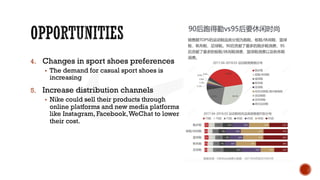
4. Changes in sport shoes preferences
▪ The demand for casual sport shoes is
increasing
5. Increase distribution channels
▪ Nike could sell their products through
online platforms and new media platforms
like Instagram, Facebook,WeChat to lower
their cost.
1. Media pressure
▪ Scandal (e.g. Nike Selling Sneakers in China Without 'Air’)
2. Counterfeit products
3. Imposition of the new American tax policy
▪ In 2018, the annual sales revenue is 36.397 billion in US Dollars, which has
increased by 6%. However, because of the new American policy, the annual
net profit is 1.933 billion in US Dollars which has decreased by 54.41%.
4. An increase in the cost of labour
5. New releases and advanced technology from competitor
▪ Only one pair of Nike sports shoes entered Lyst’s 2017 Best Sports shoes.
▪ According to Yahoo!, in 2017, the market share of Nike fell from 35.9% to
34.7% while Adidas’ market share rose from 6.3% to 11.3%. In May 2017, the
sales volume of Nike’s sports shoes decreased while Adidas had a 74% growth
in sales volume.
▪ In recent years, the young generation is into causal shoes. Competitors like
Adidas released series of causal shoes which gained a lot of popularity.The
collaboration between fashion and other sports brand like Adidas enlarged
the market share for the competitors.
5. New releases and advanced technology from competitor
▪ Only one pair of Nike sports shoes entered Lyst’s 2017 Best Sports shoes.
▪ According to Yahoo!, in 2017, the market share of Nike fell from 35.9% to
34.7% while Adidas’ market share rose from 6.3% to 11.3%. In May 2017, the
sales volume of Nike’s sports shoes decreased while Adidas had a 74% growth
in sales volume.
▪ In recent years, the young generation is into causal shoes. Competitors like
Adidas released series of causal shoes which gained a lot of popularity.The
collaboration between fashion and other sports brand like Adidas enlarged
the market share for the competitors.
Threats of New Entry
Threat of Substitution
Intensity of Rivalry among Established Firms
Bargaining Power of Customers
Bargaining Power of Suppliers
Difficult for new companies to enter the industry
1. Nike has a high brand recognition and high customer loyalty.
2. A large capital resources are required for creating sports brand.
The threat of substitution is high to some extent
▪ Nike owns advanced technology in producing sport shoes
▪ Such as its Air technology which improve the quality of the products.
▪ There are also Nike Hyperfuse, Nike Foamposite, Nike Flywire, Nike
Flyknit, Nike Flyweave.
▪ However, competitors like Adidas and Puma offer similar products.
▪ In Mainland China, there are brands like Lao Bei Jing, Hui Li and Li
Ning which offer high-quality products with a cheaper price.
The threat of substitution is high to some extent
▪ Nike owns advanced technology in producing sport shoes
▪ Such as its Air technology which improve the quality of the products.
▪ There are also Nike Hyperfuse, Nike Foamposite, Nike Flywire, Nike
Flyknit, Nike Flyweave.
▪ However, competitors like Adidas and Puma offer similar products.
▪ In Mainland China, there are brands like Lao Bei Jing, Hui Li and Li
Ning which offer high-quality products with a cheaper price.
The rivalry intensity is high
▪ Puma, Adidas,V.F Corporation, Asics, lululemon (yoga-focused apparel)
▪ e.g. According toYahoo!, in 2017, the market share of Nike fell from
35.9% to 34.7% while Adidas’ market share rose from 6.3% to 11.3%.
▪ More intensified competition because of existence of local brand (such
as Lining and Anta in China)
The bargaining power of customers is low
1. Nike owns a large market share
2. Nike is a well-known brand with a great brand image
3. Nike offers high-quality and innovative products
4. The customer loyalty is high
▪ However, there is a lot of competitors and the price of Nike products
is relatively high
The bargaining power of suppliers is limited
1. There is a large number of potential suppliers
2. Since Nike is an international brand and they outsources their
production to other manufacturers, Nike holds a dominant position.
3. Nike outsources their production to manufacturing companies in
other countries like China,Vietnam and Indonesia.They can easily
switch to a cheaper alternative.
▪ In the footwear market, the Nike’s high-quality products and
advanced technology and superior marketing has made Nike a
valuable brand.The bargaining power of both suppliers and
customers are limited as Nike holds a dominant position.
▪ Although it is difficult for for new companies to enter the industry,
there are intensified competition from rival brands such as Adidas.
Outsourcing
suppliers
Resellers
Other brands
(e.g. Fashion,
Apple)
Sports events
Superstar
spokesman
Research &
Development
Designing
Marketing
(promotion,
advertising,
sponsorship, PR)
R&D and deign team
Relationship
management
Technological patents
High quality &
professional
Classification:
- Different types of
sports shoes
- Casual shoes
focused on fashion
design
Common language
and pop culture
Optional prices
Regional culture
Fixed cost: R&D and design , building
physical stores
Variable cost: labour, outsourcing production cost,
promotion, endorsement, advertising
Economic of scale, Economic of scope
Lovemark
Community
Long-term
Co-creation
(Custom Shoes,
customer reviews)
Distribution:
- official/agency
- physical/online store
Communication:
- SNS, official website,
video streaming
website,TV
Professionals
- young athletes
Public
- sports enthusiasts
- fashion enthusiasts
Younger generation
Consumption level:
high vs. medium vs.
low income
Geographic:
North America,
South America,
Europe, Asia Pacific,
Middle East, Africa
Bulk sales
Direct sales
Peripheral souvenir sales
Professionals NIKE targets at the athletes by developing high-tech air
and sponsoring international sports competition like the
Olympics. Particularly, it is more devoted to targeting at
the young athletes in order to develop their brand
loyalty.
High quality,
professional sports
shoes (air technique)
Younger
generation
Nike also targets at the younger generation with its brand
highlighting vigor and energy. And its footwear contains
a lot of fashion elements catering the need of the younger
generation and even creating common language and pop
culture in younger generation.
Shoes focused on
fashion and design
(e.g., special popular
product line like AJ)
Public NIKE’s footwear can be mainly classified into two
categories, one focusing on the sport function for the
sport enthusiasts, the other focusing on the fashion
function for the fashion enthusiasts
Casual shoes &
Different types of sport
shoes (e.g., basketball,
football, tennis, hiking)
Consumption
level
NIKE has various shoes with different price, targeting
consumers from all consumption levels (i.e. high v.s.
medium v.s. low consumption)
Optional prices for
different kinds of
shoes
Geographic
markets
NIKE’s target markets can be divided into six areas
geographically (i.e., North America, South America,
Europe, Asia Pacific, Middle East, Africa), and special
products will be designed towards specific markets.
For example, NIKE has designed a shoe featuring kite
for the Chinese markets.
Designing and
releasing special
shoes relating to
the specific culture
Consumption
level
NIKE has various shoes with different price, targeting
consumers from all consumption levels (i.e. high v.s.
medium v.s. low consumption)
Optional prices for
different kinds of
shoes
Geographic
markets
NIKE’s target markets can be divided into six areas
geographically (i.e., North America, South America,
Europe, Asia Pacific, Middle East, Africa), and special
products will be designed towards specific markets.
For example, NIKE has designed a shoe featuring kite
for the Chinese markets.
Designing and
releasing special
shoes relating to
the specific culture
1. Sale distribution and after sale channels
▪ Physical (offline) stores
✓Nike official store (normal & flagship store)
✓Retail store (e.g., Sportshouse, marathon)
▪ Online stores
✓Nike official website (i.e. Nike.com)
✓Online retailers (e.g., Amazon,Taobao, Jingdong)
2. Communication channels
▪ Online communication
✓Social networking site (e.g., Instagram,Twitter, Facebook,WeChat)
✓Nike official website (i.e. Nike.com)
✓Video streaming website (e.g.,Youtube)
▪ Offline communication
✓Poster (e.g., in MTR, on billboard)
Lovemark Community
Long-term
Co-creation (custom shoes, customer reviews)
Bulk shoes order (bulk sales from retailers)
Direct shoes order (direct sales from customers)
Peripheral souvenir products (e.g. breastpin)
1. Research and development, design team
2. Relationship management
▪ Relationships with superstar spokesman, sports organizers, suppliers, sales
outlets and distribution networks
3. Technological patents & Intellectual property
1. Research and development (design)
2. Marketing
▪ e.g. promotion, advertising, sponsorship, public relations
Outsourcing suppliers
Sorts of resellers
Partnership with another brand (fashion brand, apple)
Sports events
Superstar spokesman
1. Fixed cost
▪ Research and development costs
▪ Cost of NIKE physical stores
2. Variable cost
▪ Cost of labour
▪ Cost of outsourcing production
▪ Promotion cost (endorsement, advertising)
3. Economic of scale
▪ Outsourcing production
4. Economic of scope
▪ Sponsoring significant sports events where more than one kind of shoe is
being promoted
§ Competing factors
Ø Price competitiveness
Ø Fashion
Ø Comfort
Ø Professional
Ø Customer service
Ø Speed of new arrival
Ø Accessibility (number of branches, dealers and retailers)
Ø Product exposure extent
Eliminate Reduce
/ Product exposure extent
Raise Create
Comfort
Customer service
Sole-interchangeable shoes
Fluorescent shoes
Waterproof shoes
§ Product exposure extent
§ Nike owned enough exposure
resources, so it should use more
budget to R&D instead of doing
grant campaign.
§ Comfort
§ Customer service
§ Especially for the China market
Sole-interchangeable
shoes
Fluorescent shoes Waterproof shoes
1. Brand Keys Loyalty Leaders List 2017
§ http://brandkeys.com/wp-content/uploads/2017/10/Press-Release-2017-Loyalty-Leaders.pdf
2. Nike races ahead of Adidas and New Balance on Quality
§ https://today.yougov.com/topics/consumer/articles-reports/2017/09/19/nike-races-ahead-adidas-and-new-balance-quality
3. 跑鞋“领跑” 休闲鞋“领涨”
§ http://industry.people.com.cn/n1/2018/0822/c413883-30243171.html
4. 315央视曝光耐克气垫门 耐克正式道歉:每双赔4500元!
§ http://m.techweb.com.cn/article/2017-03-17/2501580.shtml
5. Nike面临重重困难 在印度大规模裁员并关闭35%的门店
§ http://news.winshang.com/html/062/5138.html
6. CBNData发布线上运动鞋相关消费系列研究报告 跑步鞋卖最好
§ http://outletscn.com/news/data/sjt10815/
7. OECD 2016全球假货制造商最爱四大名牌:劳力士、耐克、雷朋和 LV
§ http://www.qdaily.com/articles/25693.html
8. Under Armour's losing market share — and it risks falling behind New Balance (UA)
§ https://markets.businessinsider.com/news/stocks/under-armour-stock-price-market-share-risks-losing-new-balance-2018-4-
1021521315
Case study_Nike

Case study_Nike

  • 2.
    1. Background 2. SWOTAnalysis 3. Porter’s Five Forces 4. Business Model Canvas 5. Blue Ocean Strategy Canvas 6. ERRC Grid
  • 3.
    ▪ Nike, anAmerican multinational sports brand selling clothing, apparel, footwear and accessories. It was founded in 1964 and is now one of the world’s valuable sports brand. Sponsoring major athletes and significant sports events, Nike has a high brand awareness. Its logo and trademark “Just Do It” is highly recognized by people around the world. ▪ This case study mainly focuses on Nike’s footwear products.
  • 4.
  • 5.
    1. Customer loyalty §According to The Brand Keys 2017 Consumer Loyalty Leaders, Nike ranked #12. 2. Rich fashion resources 3. High quality § Comments from consumers § Nike has a top technology innovation group § e.g. Air technology, Invertex
  • 6.
    1. Customer loyalty §According to The Brand Keys 2017 Consumer Loyalty Leaders, Nike ranked #12. 2. Rich fashion resources 3. High quality § Comments from consumers § Nike has a top technology innovation group § e.g. Air technology, Invertex
  • 7.
    4. Shoes Customization ▪Consumers can design and make their own Nike shoes. 5. Wide range of distribution ▪ Nike owns countless of branches around the world ▪ There are a large number of dealers and retailers (both online and offline). ➢e.g. Sportshouse, Marathon (Hong Kong) 6. Low cost ▪ The production is outsourced. ▪ There is no factory burden.
  • 8.
    7. Releasing newarrivals frequently ▪ Nike released more than 400 pairs of basketball shoes every year, which took 50% of the new released basketball shoes in America that year. 8. High brand awareness ▪ Nike is one of the most popular brand around the world which is also the prime leader of the whole industry. ▪ Nike has superstars as their spokesman and superstar endorsement like Jordan and Roger Federer.They also sponsor worldwide events, such as Olympics. ▪ NIKE has its core value:“Just do it”, selling more than just the product but also the brand value
  • 9.
    1. Common challengesfor large enterprises ▪ There is a complex corporate structure which leads to slow decision making. 2. Expensive products ▪ From 2016 to 2018, 50% of the consumers are young adults who are in their 20s. However, Nike products are relatively expensive.
  • 10.
    1. Expanding theirtarget audience to those aged between 30-40 ▪ These people are also purchasing their products (please refer to the chart in last slide) 2. Expanding their market to the female consumers ▪ In 2017, 55.5% of the consumers are male who contribute 59.4% of the total sales revenue. However, the female consumers contribute 40.6% in the sales revenue while only 44.5% of the consumers are women. ▪ Nike could put more resources in promoting their products to female consumers 3. Exploring overseas markets ▪ Nike could expand the market to some cities of the developing countries, such as Chinese third-tier and fourth-tier market
  • 11.
    4. Changes insport shoes preferences ▪ The demand for casual sport shoes is increasing 5. Increase distribution channels ▪ Nike could sell their products through online platforms and new media platforms like Instagram, Facebook,WeChat to lower their cost.
  • 12.
    1. Media pressure ▪Scandal (e.g. Nike Selling Sneakers in China Without 'Air’) 2. Counterfeit products 3. Imposition of the new American tax policy ▪ In 2018, the annual sales revenue is 36.397 billion in US Dollars, which has increased by 6%. However, because of the new American policy, the annual net profit is 1.933 billion in US Dollars which has decreased by 54.41%. 4. An increase in the cost of labour
  • 13.
    5. New releasesand advanced technology from competitor ▪ Only one pair of Nike sports shoes entered Lyst’s 2017 Best Sports shoes. ▪ According to Yahoo!, in 2017, the market share of Nike fell from 35.9% to 34.7% while Adidas’ market share rose from 6.3% to 11.3%. In May 2017, the sales volume of Nike’s sports shoes decreased while Adidas had a 74% growth in sales volume. ▪ In recent years, the young generation is into causal shoes. Competitors like Adidas released series of causal shoes which gained a lot of popularity.The collaboration between fashion and other sports brand like Adidas enlarged the market share for the competitors.
  • 14.
    5. New releasesand advanced technology from competitor ▪ Only one pair of Nike sports shoes entered Lyst’s 2017 Best Sports shoes. ▪ According to Yahoo!, in 2017, the market share of Nike fell from 35.9% to 34.7% while Adidas’ market share rose from 6.3% to 11.3%. In May 2017, the sales volume of Nike’s sports shoes decreased while Adidas had a 74% growth in sales volume. ▪ In recent years, the young generation is into causal shoes. Competitors like Adidas released series of causal shoes which gained a lot of popularity.The collaboration between fashion and other sports brand like Adidas enlarged the market share for the competitors.
  • 15.
    Threats of NewEntry Threat of Substitution Intensity of Rivalry among Established Firms Bargaining Power of Customers Bargaining Power of Suppliers
  • 16.
    Difficult for newcompanies to enter the industry 1. Nike has a high brand recognition and high customer loyalty. 2. A large capital resources are required for creating sports brand.
  • 17.
    The threat ofsubstitution is high to some extent ▪ Nike owns advanced technology in producing sport shoes ▪ Such as its Air technology which improve the quality of the products. ▪ There are also Nike Hyperfuse, Nike Foamposite, Nike Flywire, Nike Flyknit, Nike Flyweave. ▪ However, competitors like Adidas and Puma offer similar products. ▪ In Mainland China, there are brands like Lao Bei Jing, Hui Li and Li Ning which offer high-quality products with a cheaper price.
  • 18.
    The threat ofsubstitution is high to some extent ▪ Nike owns advanced technology in producing sport shoes ▪ Such as its Air technology which improve the quality of the products. ▪ There are also Nike Hyperfuse, Nike Foamposite, Nike Flywire, Nike Flyknit, Nike Flyweave. ▪ However, competitors like Adidas and Puma offer similar products. ▪ In Mainland China, there are brands like Lao Bei Jing, Hui Li and Li Ning which offer high-quality products with a cheaper price.
  • 19.
    The rivalry intensityis high ▪ Puma, Adidas,V.F Corporation, Asics, lululemon (yoga-focused apparel) ▪ e.g. According toYahoo!, in 2017, the market share of Nike fell from 35.9% to 34.7% while Adidas’ market share rose from 6.3% to 11.3%. ▪ More intensified competition because of existence of local brand (such as Lining and Anta in China)
  • 20.
    The bargaining powerof customers is low 1. Nike owns a large market share 2. Nike is a well-known brand with a great brand image 3. Nike offers high-quality and innovative products 4. The customer loyalty is high ▪ However, there is a lot of competitors and the price of Nike products is relatively high
  • 21.
    The bargaining powerof suppliers is limited 1. There is a large number of potential suppliers 2. Since Nike is an international brand and they outsources their production to other manufacturers, Nike holds a dominant position. 3. Nike outsources their production to manufacturing companies in other countries like China,Vietnam and Indonesia.They can easily switch to a cheaper alternative.
  • 22.
    ▪ In thefootwear market, the Nike’s high-quality products and advanced technology and superior marketing has made Nike a valuable brand.The bargaining power of both suppliers and customers are limited as Nike holds a dominant position. ▪ Although it is difficult for for new companies to enter the industry, there are intensified competition from rival brands such as Adidas.
  • 24.
    Outsourcing suppliers Resellers Other brands (e.g. Fashion, Apple) Sportsevents Superstar spokesman Research & Development Designing Marketing (promotion, advertising, sponsorship, PR) R&D and deign team Relationship management Technological patents High quality & professional Classification: - Different types of sports shoes - Casual shoes focused on fashion design Common language and pop culture Optional prices Regional culture Fixed cost: R&D and design , building physical stores Variable cost: labour, outsourcing production cost, promotion, endorsement, advertising Economic of scale, Economic of scope Lovemark Community Long-term Co-creation (Custom Shoes, customer reviews) Distribution: - official/agency - physical/online store Communication: - SNS, official website, video streaming website,TV Professionals - young athletes Public - sports enthusiasts - fashion enthusiasts Younger generation Consumption level: high vs. medium vs. low income Geographic: North America, South America, Europe, Asia Pacific, Middle East, Africa Bulk sales Direct sales Peripheral souvenir sales
  • 25.
    Professionals NIKE targetsat the athletes by developing high-tech air and sponsoring international sports competition like the Olympics. Particularly, it is more devoted to targeting at the young athletes in order to develop their brand loyalty. High quality, professional sports shoes (air technique) Younger generation Nike also targets at the younger generation with its brand highlighting vigor and energy. And its footwear contains a lot of fashion elements catering the need of the younger generation and even creating common language and pop culture in younger generation. Shoes focused on fashion and design (e.g., special popular product line like AJ) Public NIKE’s footwear can be mainly classified into two categories, one focusing on the sport function for the sport enthusiasts, the other focusing on the fashion function for the fashion enthusiasts Casual shoes & Different types of sport shoes (e.g., basketball, football, tennis, hiking)
  • 26.
    Consumption level NIKE has variousshoes with different price, targeting consumers from all consumption levels (i.e. high v.s. medium v.s. low consumption) Optional prices for different kinds of shoes Geographic markets NIKE’s target markets can be divided into six areas geographically (i.e., North America, South America, Europe, Asia Pacific, Middle East, Africa), and special products will be designed towards specific markets. For example, NIKE has designed a shoe featuring kite for the Chinese markets. Designing and releasing special shoes relating to the specific culture
  • 27.
    Consumption level NIKE has variousshoes with different price, targeting consumers from all consumption levels (i.e. high v.s. medium v.s. low consumption) Optional prices for different kinds of shoes Geographic markets NIKE’s target markets can be divided into six areas geographically (i.e., North America, South America, Europe, Asia Pacific, Middle East, Africa), and special products will be designed towards specific markets. For example, NIKE has designed a shoe featuring kite for the Chinese markets. Designing and releasing special shoes relating to the specific culture
  • 28.
    1. Sale distributionand after sale channels ▪ Physical (offline) stores ✓Nike official store (normal & flagship store) ✓Retail store (e.g., Sportshouse, marathon) ▪ Online stores ✓Nike official website (i.e. Nike.com) ✓Online retailers (e.g., Amazon,Taobao, Jingdong) 2. Communication channels ▪ Online communication ✓Social networking site (e.g., Instagram,Twitter, Facebook,WeChat) ✓Nike official website (i.e. Nike.com) ✓Video streaming website (e.g.,Youtube) ▪ Offline communication ✓Poster (e.g., in MTR, on billboard)
  • 29.
  • 30.
    Bulk shoes order(bulk sales from retailers) Direct shoes order (direct sales from customers) Peripheral souvenir products (e.g. breastpin)
  • 31.
    1. Research anddevelopment, design team 2. Relationship management ▪ Relationships with superstar spokesman, sports organizers, suppliers, sales outlets and distribution networks 3. Technological patents & Intellectual property
  • 32.
    1. Research anddevelopment (design) 2. Marketing ▪ e.g. promotion, advertising, sponsorship, public relations
  • 33.
    Outsourcing suppliers Sorts ofresellers Partnership with another brand (fashion brand, apple) Sports events Superstar spokesman
  • 34.
    1. Fixed cost ▪Research and development costs ▪ Cost of NIKE physical stores 2. Variable cost ▪ Cost of labour ▪ Cost of outsourcing production ▪ Promotion cost (endorsement, advertising) 3. Economic of scale ▪ Outsourcing production 4. Economic of scope ▪ Sponsoring significant sports events where more than one kind of shoe is being promoted
  • 35.
    § Competing factors ØPrice competitiveness Ø Fashion Ø Comfort Ø Professional Ø Customer service Ø Speed of new arrival Ø Accessibility (number of branches, dealers and retailers) Ø Product exposure extent
  • 37.
    Eliminate Reduce / Productexposure extent Raise Create Comfort Customer service Sole-interchangeable shoes Fluorescent shoes Waterproof shoes
  • 38.
    § Product exposureextent § Nike owned enough exposure resources, so it should use more budget to R&D instead of doing grant campaign.
  • 39.
    § Comfort § Customerservice § Especially for the China market
  • 40.
  • 41.
    1. Brand KeysLoyalty Leaders List 2017 § http://brandkeys.com/wp-content/uploads/2017/10/Press-Release-2017-Loyalty-Leaders.pdf 2. Nike races ahead of Adidas and New Balance on Quality § https://today.yougov.com/topics/consumer/articles-reports/2017/09/19/nike-races-ahead-adidas-and-new-balance-quality 3. 跑鞋“领跑” 休闲鞋“领涨” § http://industry.people.com.cn/n1/2018/0822/c413883-30243171.html 4. 315央视曝光耐克气垫门 耐克正式道歉:每双赔4500元! § http://m.techweb.com.cn/article/2017-03-17/2501580.shtml 5. Nike面临重重困难 在印度大规模裁员并关闭35%的门店 § http://news.winshang.com/html/062/5138.html 6. CBNData发布线上运动鞋相关消费系列研究报告 跑步鞋卖最好 § http://outletscn.com/news/data/sjt10815/ 7. OECD 2016全球假货制造商最爱四大名牌:劳力士、耐克、雷朋和 LV § http://www.qdaily.com/articles/25693.html 8. Under Armour's losing market share — and it risks falling behind New Balance (UA) § https://markets.businessinsider.com/news/stocks/under-armour-stock-price-market-share-risks-losing-new-balance-2018-4- 1021521315