Porters Five Force
Analysis For Banking
Sector
Presented by F.Y.BMS (B)
SR NO. NAMES OF STUDENT ROLL NO SEAT NO
1 Shabina Babu Shaikh 35 MS24125
2 Laxmidevi Tejaram Choudhary 06 MS24025
3 Chetaniya Gupta 52 MS24037
4 Suchit Lalchandra Futane 09 MS24031
5 Raj Devaram Gowari 10 MS24036
6 Riya Ravindra Darge 07 MS24027
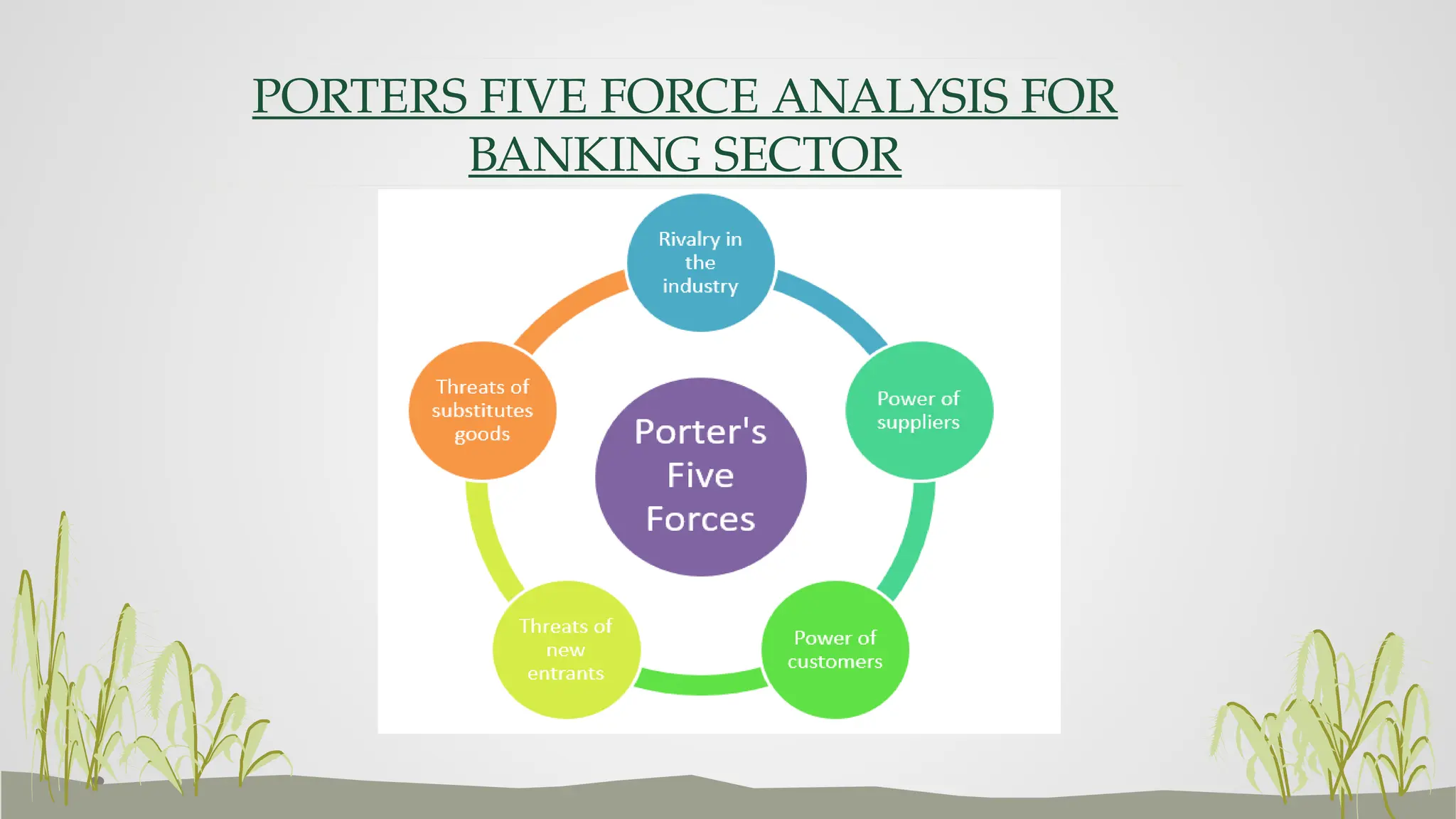
PORTERS FIVE FORCE ANALYSIS FOR
BANKING SECTOR
Introduction
Porter's Five Forces Analysis is a strategic framework developed by
Michael E. Porter to assess the competitiveness and profitability of an
industry. It helps businesses understand the underlying forces that
shape their industry and identify potential opportunities and threats.
If you are learning about financial services industry
five forces of banking industry; then you should keep in mind the
abovementioned bargaining power of suppliers and buyers; threat of
new entrants and substitutes; and intense rivalry as
competitive forces in strategic management.
Threat of new entrants in banking sector
The threat of new entrants in the banking
industry is relatively high due to the regulatory
barriers and capital requirements involved.
Banks face stringent regulations and oversight,
making it challenging for new players to enter
the market.
The banking sector faces various threats from new
entrants, including:
1. Fintech companies: Non-traditional financial services providers
offering digital payment, lending, and investment solutions.
2. Digital banks: Online-only banks with lower operational costs
and innovative services.
3. Big Tech companies: Tech giants expanding into financial services
(e.g., Google Pay, Apple Card).
4. Peer-to-peer lending platforms: Connecting borrowers directly
with investors.
Bargaining power of suppliers in
banking sector
 Low bargaining power:
1. Technology vendors: Many banks use standardized software,
reducing vendor lock-in.
2. ATM and card network providers: Banks have alternatives (e.g.,
Visa, Mastercard).
3. Consultancy services: Banks can choose from numerous
consulting firms.
4. Office suppliers: Commoditized products with multiple
vendors.
Moderate bargaining power:
1. Core banking system providers (e.g., Temenos, FIS): High
switching costs.
2. IT infrastructure providers (e.g., IBM, Oracle): Some banks
rely heavily on specific vendors.
3. Cybersecurity providers: Specialized services with limited
substitutes.
4. Payment processing companies: Some banks depend on
specific processors.
High bargaining power:
1. Central banks and regulators: Significant influence on
banking operations.
2. Key technology partners (e.g., cloud providers like AWS,
Azure): Banks rely heavily on their services.
To mitigate supplier bargaining power, banks:
• Diversify vendors
• Negotiate long-term contracts
• Invest in in-house development
• Collaborate with other banks
• Monitor market trends and alternatives
Bargaining power of buyers:
The bargaining power of buyers in the banking sector refers to the ability
of customers to influence the terms and conditions of banking services.
1. Low Switching Costs: Customers can easily switch between banks,
enhancing their bargaining power. This forces banks to offer
competitive rates and better services.
2. Access to Information: With online resources and comparison tools,
customers can quickly gather information about different banks’
offerings, increasing their ability to negotiate.
3. Consumer Choice: A wide range of financial products (e.g., loans,
credit cards, savings accounts) gives customers options, pushing
banks to improve their offerings.
4. Corporate Clients: Larger businesses often have significant
bargaining power due to their volume of transactions, leading
banks to tailor products and negotiate terms.
5. Regulatory Environment: Regulations promoting transparency
and competition can empower consumers, as they expect fair
practices and better services.
Threats of Substitute in banking sector:
 Direct substitutes:
1. Digital wallets (e.g., PayPal, Apple Pay): Replace traditional payment
methods.
2. Peer-to-peer lending platforms: Bypass banks for borrowing and lending.
3. Cryptocurrencies and decentralized finance (DeFi): Offer alternative
financial services.
4. Mobile payment apps (e.g., Venmo, Zelle): Substitute for traditional
banking transactions.
5. Online lenders: Provide alternative funding options.
 Indirect substitutes:
1. Big Tech companies: Offer financial services (e.g., Google Pay,
Facebook Pay).
2. E-commerce platforms: Provide payment and financing
options.
3. Telecommunication companies: Offer mobile financial services.
4. Retailers' in-house financing: Offer consumer credit options.
5. Prepaid cards and gift cards: Substitute for traditional banking
products.
 Impact on banks:
1. Disintermediation
2. Reduced market share
3. Decreased revenue
4. Increased competition
5. Need for innovation and adaptation
Competitive rivalry in banking sector
 High competitive rivalry:
1. Large number of banks and financial institutions
2. Globalization and international competition
3. Deregulation and liberalization
4. Technological advancements and digital banking
5. Low switching costs for customers
 Emerging trends:
1. Digital banking and mobile payments
2. Blockchain and cryptocurrency adoption
3. Artificial intelligence and machine learning
4. Open banking and API-based services
5. Increased focus on customer experience and
personalization
CONCLUSION
In summary, Porter’s Five Forces analysis highlights the
highly competitive environment of the banking industry,
with potential opportunities for new entrants due to
technological advancements, and moderate threat of
substitute products.
By understanding the competitive forces at play, banks
can develop effective strategies to navigate the
challenges and opportunities in the banking sector.

Porters Five Force Analysis For Banking Sector.pptx

  • 1.
    Porters Five Force AnalysisFor Banking Sector Presented by F.Y.BMS (B)
  • 2.
    SR NO. NAMESOF STUDENT ROLL NO SEAT NO 1 Shabina Babu Shaikh 35 MS24125 2 Laxmidevi Tejaram Choudhary 06 MS24025 3 Chetaniya Gupta 52 MS24037 4 Suchit Lalchandra Futane 09 MS24031 5 Raj Devaram Gowari 10 MS24036 6 Riya Ravindra Darge 07 MS24027
  • 3.
    PORTERS FIVE FORCEANALYSIS FOR BANKING SECTOR
  • 4.
    Introduction Porter's Five ForcesAnalysis is a strategic framework developed by Michael E. Porter to assess the competitiveness and profitability of an industry. It helps businesses understand the underlying forces that shape their industry and identify potential opportunities and threats. If you are learning about financial services industry five forces of banking industry; then you should keep in mind the abovementioned bargaining power of suppliers and buyers; threat of new entrants and substitutes; and intense rivalry as competitive forces in strategic management.
  • 5.
    Threat of newentrants in banking sector The threat of new entrants in the banking industry is relatively high due to the regulatory barriers and capital requirements involved. Banks face stringent regulations and oversight, making it challenging for new players to enter the market.
  • 6.
    The banking sectorfaces various threats from new entrants, including: 1. Fintech companies: Non-traditional financial services providers offering digital payment, lending, and investment solutions. 2. Digital banks: Online-only banks with lower operational costs and innovative services. 3. Big Tech companies: Tech giants expanding into financial services (e.g., Google Pay, Apple Card). 4. Peer-to-peer lending platforms: Connecting borrowers directly with investors.
  • 7.
    Bargaining power ofsuppliers in banking sector  Low bargaining power: 1. Technology vendors: Many banks use standardized software, reducing vendor lock-in. 2. ATM and card network providers: Banks have alternatives (e.g., Visa, Mastercard). 3. Consultancy services: Banks can choose from numerous consulting firms. 4. Office suppliers: Commoditized products with multiple vendors.
  • 8.
    Moderate bargaining power: 1.Core banking system providers (e.g., Temenos, FIS): High switching costs. 2. IT infrastructure providers (e.g., IBM, Oracle): Some banks rely heavily on specific vendors. 3. Cybersecurity providers: Specialized services with limited substitutes. 4. Payment processing companies: Some banks depend on specific processors.
  • 9.
    High bargaining power: 1.Central banks and regulators: Significant influence on banking operations. 2. Key technology partners (e.g., cloud providers like AWS, Azure): Banks rely heavily on their services. To mitigate supplier bargaining power, banks: • Diversify vendors • Negotiate long-term contracts • Invest in in-house development • Collaborate with other banks • Monitor market trends and alternatives
  • 10.
    Bargaining power ofbuyers: The bargaining power of buyers in the banking sector refers to the ability of customers to influence the terms and conditions of banking services. 1. Low Switching Costs: Customers can easily switch between banks, enhancing their bargaining power. This forces banks to offer competitive rates and better services. 2. Access to Information: With online resources and comparison tools, customers can quickly gather information about different banks’ offerings, increasing their ability to negotiate. 3. Consumer Choice: A wide range of financial products (e.g., loans, credit cards, savings accounts) gives customers options, pushing banks to improve their offerings.
  • 11.
    4. Corporate Clients:Larger businesses often have significant bargaining power due to their volume of transactions, leading banks to tailor products and negotiate terms. 5. Regulatory Environment: Regulations promoting transparency and competition can empower consumers, as they expect fair practices and better services.
  • 12.
    Threats of Substitutein banking sector:  Direct substitutes: 1. Digital wallets (e.g., PayPal, Apple Pay): Replace traditional payment methods. 2. Peer-to-peer lending platforms: Bypass banks for borrowing and lending. 3. Cryptocurrencies and decentralized finance (DeFi): Offer alternative financial services. 4. Mobile payment apps (e.g., Venmo, Zelle): Substitute for traditional banking transactions. 5. Online lenders: Provide alternative funding options.
  • 13.
     Indirect substitutes: 1.Big Tech companies: Offer financial services (e.g., Google Pay, Facebook Pay). 2. E-commerce platforms: Provide payment and financing options. 3. Telecommunication companies: Offer mobile financial services. 4. Retailers' in-house financing: Offer consumer credit options. 5. Prepaid cards and gift cards: Substitute for traditional banking products.  Impact on banks: 1. Disintermediation 2. Reduced market share 3. Decreased revenue 4. Increased competition 5. Need for innovation and adaptation
  • 14.
    Competitive rivalry inbanking sector  High competitive rivalry: 1. Large number of banks and financial institutions 2. Globalization and international competition 3. Deregulation and liberalization 4. Technological advancements and digital banking 5. Low switching costs for customers  Emerging trends: 1. Digital banking and mobile payments 2. Blockchain and cryptocurrency adoption 3. Artificial intelligence and machine learning 4. Open banking and API-based services 5. Increased focus on customer experience and personalization
  • 15.
    CONCLUSION In summary, Porter’sFive Forces analysis highlights the highly competitive environment of the banking industry, with potential opportunities for new entrants due to technological advancements, and moderate threat of substitute products. By understanding the competitive forces at play, banks can develop effective strategies to navigate the challenges and opportunities in the banking sector.