




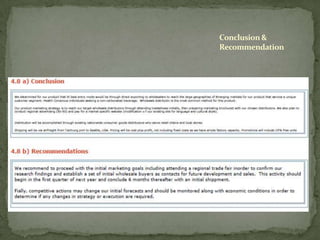


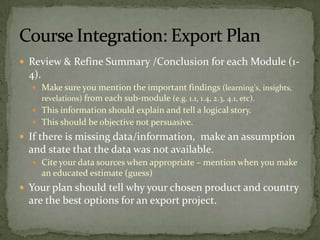
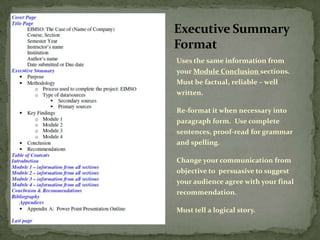
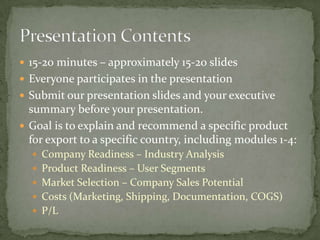



Export Management System Onlinewww.eimso2.comDeveloped by:Dr. Basil J. JanavarasProfessor of International BusinessMinnesota State University, Mankato, USAfunded by Tunghai International Business for the Practice of International Business Course
Suggestions to Start:Preview all four Modules to see the big picturePrint & review our Case Example (Select Bedding)Review Porters 5 Forces Model:eLearning Document (Mindspring)EIMSO link orInternational Business textbookReview SWOT Models:eLearning Document (Mindspring, Southwest Airlines)Management textbooks or online sourcesPrint out & follow complete EIMSO User Guide (help)
Company situationModule 1:
OverviewChoose Industry & CompanyConduct internal analysisDetermine international experience (if any)Conduct Porters 5 Forces analysis: evaluate the profitability or power dynamics of the specific industry Select a specific product line or service of the chosen company (to export)Analyze companies readiness to exportConduct a SWOT AnalysisEvaluate your company’s competitive positionBriefly state conclusions and recommendations for Module 1Module 1:  Company Situation Analysis
1.1 Company Analysis(a) Background(b) Mission(c) Sales/Profits for 3 Years(d) International StrategiesNo. of countries (resources, risk, experience)Sales, Assets, HROperating Subsidiaries(e) Intl. SituationExperienceMotivesCompany SelectionChoose a company that you know about or have an interest inSelect one that has information readily availablePublic traded company or private one that you have a relationship withTry to find a company from Taiwan or Asia
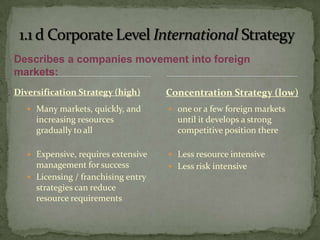
Describes a companies movement into foreign markets:Concentration Strategy (low)Diversification Strategy (high)Many markets, quickly, and increasing resources gradually to allExpensive, requires extensive management for successLicensing / franchising entry strategies can reduce resource requirementsone or a few foreign markets until it develops a strong competitive position thereLess resource intensiveLess risk intensive1.1 d Corporate Level International Strategy
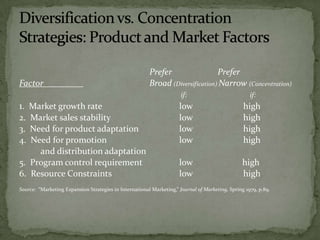
Prefer	     	   PreferFactorBroad(Diversification) Narrow (Concentration)if:		   if:1.  Market growth rate		      	low	high2.  Market sales stability	 		low    		high3.  Need for product adaptation	low	high4.  Need for promotion 			low	high	and distribution adaptation5.  Program control requirement	low         high6.  Resource Constraints                 	low	highSource:  “Marketing Expansion Strategies in International Marketing,” Journal of Marketing, Spring 1979, p.89.Diversification vs. Concentration Strategies: Product and Market Factors
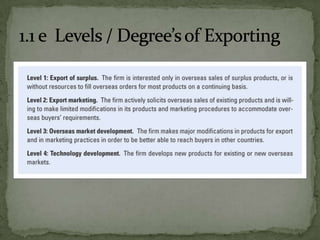
1.1 e  Levels / Degree’s of Exporting
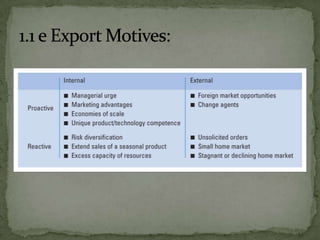
1.1 e Export Motives:
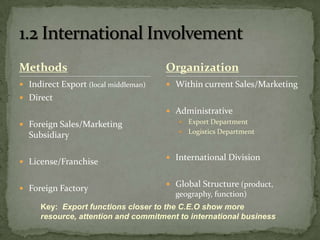
MethodsIndirect Export (local middleman)
Direct
Foreign Sales/Marketing Subsidiary
License/Franchise
Foreign Factory
Within current Sales/Marketing
Administrative
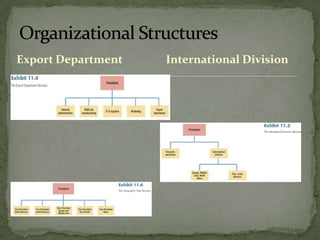
Export Department
Logistics Department
International Division
Global Structure (product, geography, function)1.2 International InvolvementOrganizationKey:  Export functions closer to the C.E.O show more resource, attention and commitment to international business
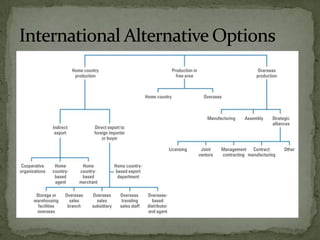
International Alternative Options
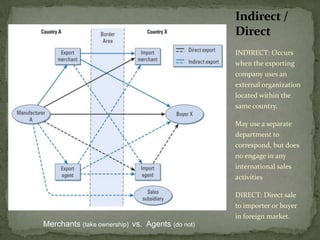
Indirect / DirectINDIRECT: Occurs when the exporting company uses an external organization located within the same country.  May use a separate department to correspond, but does no engage in any international sales activitiesDIRECT: Direct sale to importer or buyer in foreign market.Merchants (take ownership)  vs.  Agents (do not)
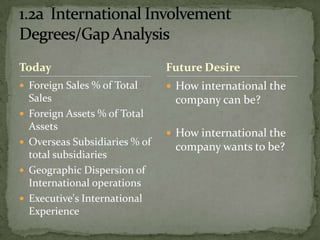
TodayForeign Sales % of Total SalesForeign Assets % of Total AssetsOverseas Subsidiaries % of total subsidiariesGeographic Dispersion of International operationsExecutive's International ExperienceHow international the company can be?How international the company wants to be?1.2a  International Involvement Degrees/Gap AnalysisFuture Desire
Export DepartmentOrganizational StructuresInternational Division
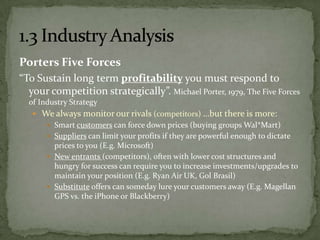
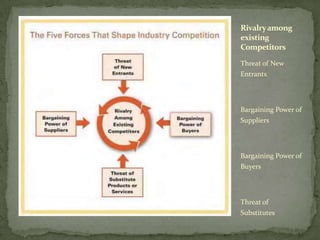
Porters Five Forces“To Sustain long term profitability you must respond to your competition strategically”. Michael Porter, 1979, The Five Forces of Industry StrategyWe always monitor our rivals (competitors) …but there is more:
Smart customers can force down prices (buying groups Wal*Mart)
Suppliers can limit your profits if they are powerful enough to dictate prices to you (E.g. Microsoft)
New entrants (competitors), often with lower cost structures and hungry for success can require you to increase investments/upgrades to maintain your position (E.g. Ryan Air UK, GolBrasil)
Substitute offers can someday lure your customers away (E.g. Magellan GPS vs. the iPhone or Blackberry)1.3 Industry Analysis
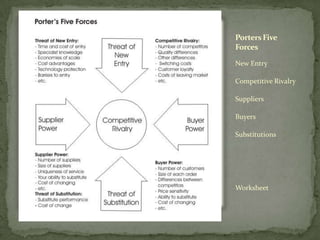
Threat of New EntrantsBargaining Power of SuppliersBargaining Power of BuyersThreat of SubstitutesRivalry among existing Competitors
Supplier & Buyer PowerSupplier Power: how easy it is for suppliers to drive up prices. This is driven by the number of suppliers of each key input, the uniqueness of their product or service, their strength and control over you or the cost of switching from one to another. The fewer the supplier choices you have, and the more you and the more you need suppliers' help, the more powerful your suppliers are.Buyer Power: how easy it is for buyers to drive prices down. Again, this is driven by the number of buyers, the importance of each individual buyer to your business, the cost to them of switching from your products and services to those of someone else, and so on. If you deal with few, powerful buyers, they are often able to dictate terms to you.
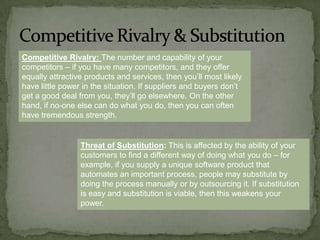
Competitive Rivalry & SubstitutionCompetitive Rivalry: The number and capability of your competitors – if you have many competitors, and they offer equally attractive products and services, then you’ll most likely have little power in the situation. If suppliers and buyers don’t get a good deal from you, they’ll go elsewhere. On the other hand, if no-one else can do what you do, then you can often have tremendous strength.Threat of Substitution: This is affected by the ability of your customers to find a different way of doing what you do – for example, if you supply a unique software product that automates an important process, people may substitute by doing the process manually or by outsourcing it. If substitution is easy and substitution is viable, then this weakens your power.
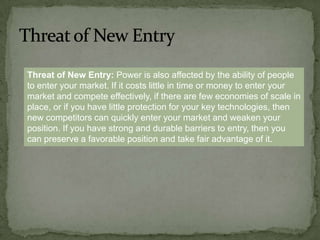
Threat of New EntryThreat of New Entry: Power is also affected by the ability of people to enter your market. If it costs little in time or money to enter your market and compete effectively, if there are few economies of scale in place, or if you have little protection for your key technologies, then new competitors can quickly enter your market and weaken your position. If you have strong and durable barriers to entry, then you can preserve a favorable position and take fair advantage of it.
Desire to gain market share puts pressure on prices downwardRaises costs of Capital / BorrowingTherefore,  the threat of new entry (competitors) puts a cap on the profit potentialBarriers: Economies of scaleThreat of New Entrants
Porters Five ForcesNew EntryCompetitive RivalrySuppliersBuyersSubstitutionsWorksheet
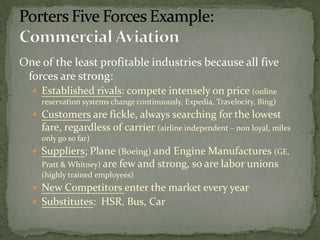
One of the least profitable industries because all five forces are strong:Established rivals: compete intensely on price (online reservation systems change continuously, Expedia, Travelocity, Bing)Customers are fickle, always searching for the lowest fare, regardless of carrier (airline independent – non loyal, miles only go so far)Suppliers; Plane (Boeing) and Engine Manufactures (GE, Pratt & Whitney) are few and strong, so are labor unions (highly trained employees)New Competitors enter the market every yearSubstitutes:  HSR, Bus, CarPorters Five Forces Example: Commercial Aviation
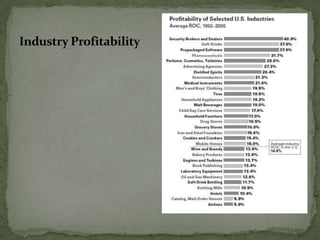
Industry Profitability
A theory explaining the relationship between principals, such as a shareholders, and agents, such as a company'sexecutives. In this relationship the principal delegates or hires an agent to perform work. The theory attempts to deal with two specific problems: first, that the goals of the principal and agent are not in conflict (agency problem), and second, that the principal and agent reconcile different tolerances for risk.Agency TheoryWho is your agent?
End User Description:Gender, Age, Income, Education, Frequency of PurchasesHousehold Types (large, multi-family, singles)Differences between Domestic and Target MarketsCustomizations required (physical, energy, package,  user guide)1.4 Target Market Profile
Key advantages and disadvantages
For the user
Compared to the competition
Selling Price (maybe average for a family of products)
Product Comparison (H-M-L)
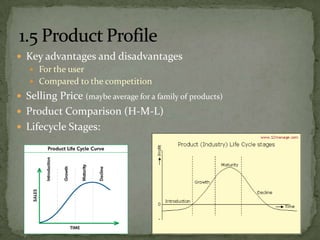
Lifecycle Stages:1.5 Product Profile
Computer assisted scoring.Team review & analysis.1.6 Export Readiness
Strengths = Internal to Company or ProductWeaknesses = Internal to Company or ProductOpportunities =external provided by market)Threats =external attacks from market forcesTrends = What is happening over time (3-5 yrs)Provides us a better insight over time.1.7  SWOT + “T”
Conclusion
Brief summary of significant results or new insight based on analysis in this Module
Ideally one statement for each sub-section
E.g. Custom index relevant to your product
Final comment: most important revelation for your product/industry
Recommendation
Decision on what next steps to pursue (go – no go) and how new information may be useful in next step (need to pre-view Module 2)Conclusion and Recommendation
Global Market SearchModule 2:
Research & Select CountriesSelect Criteria relevant to determine market successDetermine a “weighted value” of importance for each criteriaConclusion and recommendationsReport GenerationModule 2 Agenda
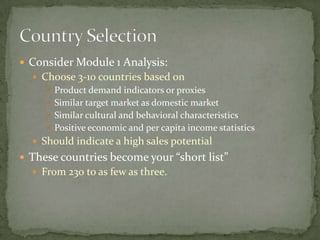
Consider Module 1 Analysis:Choose 3-10 countries based onProduct demand indicators or proxiesSimilar target market as domestic marketSimilar cultural and behavioral characteristicsPositive economic and per capita income statisticsShould indicate a high sales potentialThese countries become your “short list”From 230 to as few as three.Country Selection
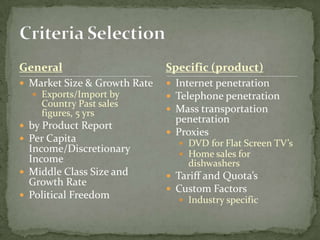
GeneralMarket Size & Growth Rate
Exports/Import by Country Past sales figures, 5 yrs
by Product Report
Per Capita Income/Discretionary Income
Middle Class Size and Growth Rate
Political Freedom
Internet penetration
Telephone penetration
Mass transportation penetration
Proxies
DVD for Flat Screen TV’s
Home sales for dishwashers
Tariff and Quota’s
Custom Factors
Industry specificCriteria SelectionSpecific (product)
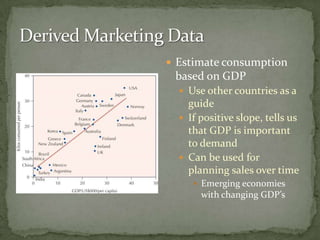
Derived Marketing DataEstimate consumption based on GDPUse other countries as a guideIf positive slope, tells us that GDP is important to demandCan be used for planning sales over timeEmerging economies with changing GDP’s
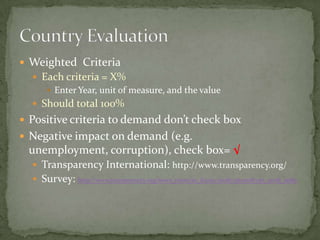
Weighted  CriteriaEach criteria = X%Enter Year, unit of measure, and the valueShould total 100%Positive criteria to demand don’t check boxNegative impact on demand (e.g. unemployment, corruption), check box= √Transparency International: http://www.transparency.org/Survey: http://www.transparency.org/news_room/in_focus/2008/cpi2008/cpi_2008_tableCountry Evaluation
US Commercial Servicewww.export.govDoing business in>www.doingbusinessin.orgSee EIMSO website resourcesCIA FactbookYahoo.finance.comSources
Conclusion
Brief summary of significant results or new insight based on analysis in this Module
Ideally one statement for each sub-section
E.g. Custom index relevant to your product
Final comment: most important learning for your product/industry
Recommendation
Decision on what next steps to pursue (go – no go) and how new information may be useful in next step (need to pre-view Module 3)Conclusion and Recommendation
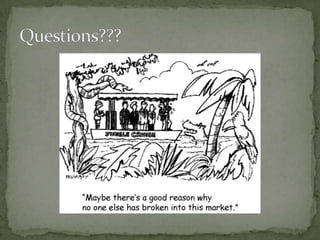
Questions???
IN-Depth Market ANALYSISModule 3:
Select top 2 countriesDevelop business contacts that may assist with exportingAgents/Distributors
Government agencies, etc.Determine market sales potential Develop a profile of the top two competitorsModule 3 Agenda (part I)
Consider all sources of information:Government Trade offices (www.export.gov)Associations, Journals, Reports, NewspapersProvide leads or contact names.Trade Fair Schedules (by country)Names and coordinators of industry leads/contactsDistributors from online databasesAlibaba, ebay, Make a list and prioritize from strong to weak.3.1 Contacts
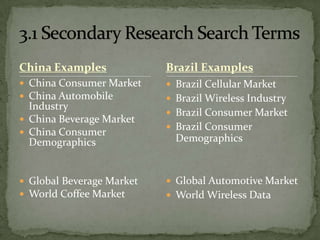
China ExamplesChina Consumer Market
China Automobile Industry
China Beverage Market
China Consumer Demographics
Global Beverage Market
World Coffee Market

Practice of International Trade EIMSO2 Lecture V3

  • 1.
    Export Management SystemOnlinewww.eimso2.comDeveloped by:Dr. Basil J. JanavarasProfessor of International BusinessMinnesota State University, Mankato, USAfunded by Tunghai International Business for the Practice of International Business Course
  • 2.
    Suggestions to Start:Previewall four Modules to see the big picturePrint & review our Case Example (Select Bedding)Review Porters 5 Forces Model:eLearning Document (Mindspring)EIMSO link orInternational Business textbookReview SWOT Models:eLearning Document (Mindspring, Southwest Airlines)Management textbooks or online sourcesPrint out & follow complete EIMSO User Guide (help)
  • 3.
  • 4.
    OverviewChoose Industry &CompanyConduct internal analysisDetermine international experience (if any)Conduct Porters 5 Forces analysis: evaluate the profitability or power dynamics of the specific industry Select a specific product line or service of the chosen company (to export)Analyze companies readiness to exportConduct a SWOT AnalysisEvaluate your company’s competitive positionBriefly state conclusions and recommendations for Module 1Module 1: Company Situation Analysis
  • 5.
    1.1 Company Analysis(a)Background(b) Mission(c) Sales/Profits for 3 Years(d) International StrategiesNo. of countries (resources, risk, experience)Sales, Assets, HROperating Subsidiaries(e) Intl. SituationExperienceMotivesCompany SelectionChoose a company that you know about or have an interest inSelect one that has information readily availablePublic traded company or private one that you have a relationship withTry to find a company from Taiwan or Asia
  • 6.
    Describes a companiesmovement into foreign markets:Concentration Strategy (low)Diversification Strategy (high)Many markets, quickly, and increasing resources gradually to allExpensive, requires extensive management for successLicensing / franchising entry strategies can reduce resource requirementsone or a few foreign markets until it develops a strong competitive position thereLess resource intensiveLess risk intensive1.1 d Corporate Level International Strategy
  • 7.
    Prefer PreferFactorBroad(Diversification) Narrow (Concentration)if: if:1. Market growth rate low high2. Market sales stability low high3. Need for product adaptation low high4. Need for promotion low high and distribution adaptation5. Program control requirement low high6. Resource Constraints low highSource: “Marketing Expansion Strategies in International Marketing,” Journal of Marketing, Spring 1979, p.89.Diversification vs. Concentration Strategies: Product and Market Factors
  • 8.
    1.1 e Levels / Degree’s of Exporting
  • 9.
    1.1 e ExportMotives:
  • 10.
  • 11.
  • 12.
  • 13.
  • 14.
  • 15.
  • 16.
  • 17.
  • 18.
  • 19.
  • 20.
    Global Structure (product,geography, function)1.2 International InvolvementOrganizationKey: Export functions closer to the C.E.O show more resource, attention and commitment to international business
  • 21.
  • 22.
    Indirect / DirectINDIRECT:Occurs when the exporting company uses an external organization located within the same country. May use a separate department to correspond, but does no engage in any international sales activitiesDIRECT: Direct sale to importer or buyer in foreign market.Merchants (take ownership) vs. Agents (do not)
  • 24.
    TodayForeign Sales %of Total SalesForeign Assets % of Total AssetsOverseas Subsidiaries % of total subsidiariesGeographic Dispersion of International operationsExecutive's International ExperienceHow international the company can be?How international the company wants to be?1.2a International Involvement Degrees/Gap AnalysisFuture Desire
  • 25.
  • 27.
    Porters Five Forces“ToSustain long term profitability you must respond to your competition strategically”. Michael Porter, 1979, The Five Forces of Industry StrategyWe always monitor our rivals (competitors) …but there is more:
  • 28.
    Smart customers canforce down prices (buying groups Wal*Mart)
  • 29.
    Suppliers can limityour profits if they are powerful enough to dictate prices to you (E.g. Microsoft)
  • 30.
    New entrants (competitors),often with lower cost structures and hungry for success can require you to increase investments/upgrades to maintain your position (E.g. Ryan Air UK, GolBrasil)
  • 31.
    Substitute offers cansomeday lure your customers away (E.g. Magellan GPS vs. the iPhone or Blackberry)1.3 Industry Analysis
  • 32.
    Threat of NewEntrantsBargaining Power of SuppliersBargaining Power of BuyersThreat of SubstitutesRivalry among existing Competitors
  • 33.
    Supplier & BuyerPowerSupplier Power: how easy it is for suppliers to drive up prices. This is driven by the number of suppliers of each key input, the uniqueness of their product or service, their strength and control over you or the cost of switching from one to another. The fewer the supplier choices you have, and the more you and the more you need suppliers' help, the more powerful your suppliers are.Buyer Power: how easy it is for buyers to drive prices down. Again, this is driven by the number of buyers, the importance of each individual buyer to your business, the cost to them of switching from your products and services to those of someone else, and so on. If you deal with few, powerful buyers, they are often able to dictate terms to you.
  • 34.
    Competitive Rivalry &SubstitutionCompetitive Rivalry: The number and capability of your competitors – if you have many competitors, and they offer equally attractive products and services, then you’ll most likely have little power in the situation. If suppliers and buyers don’t get a good deal from you, they’ll go elsewhere. On the other hand, if no-one else can do what you do, then you can often have tremendous strength.Threat of Substitution: This is affected by the ability of your customers to find a different way of doing what you do – for example, if you supply a unique software product that automates an important process, people may substitute by doing the process manually or by outsourcing it. If substitution is easy and substitution is viable, then this weakens your power.
  • 35.
    Threat of NewEntryThreat of New Entry: Power is also affected by the ability of people to enter your market. If it costs little in time or money to enter your market and compete effectively, if there are few economies of scale in place, or if you have little protection for your key technologies, then new competitors can quickly enter your market and weaken your position. If you have strong and durable barriers to entry, then you can preserve a favorable position and take fair advantage of it.
  • 36.
    Desire to gainmarket share puts pressure on prices downwardRaises costs of Capital / BorrowingTherefore, the threat of new entry (competitors) puts a cap on the profit potentialBarriers: Economies of scaleThreat of New Entrants
  • 37.
    Porters Five ForcesNewEntryCompetitive RivalrySuppliersBuyersSubstitutionsWorksheet
  • 38.
    One of theleast profitable industries because all five forces are strong:Established rivals: compete intensely on price (online reservation systems change continuously, Expedia, Travelocity, Bing)Customers are fickle, always searching for the lowest fare, regardless of carrier (airline independent – non loyal, miles only go so far)Suppliers; Plane (Boeing) and Engine Manufactures (GE, Pratt & Whitney) are few and strong, so are labor unions (highly trained employees)New Competitors enter the market every yearSubstitutes: HSR, Bus, CarPorters Five Forces Example: Commercial Aviation
  • 39.
  • 40.
    A theory explainingthe relationship between principals, such as a shareholders, and agents, such as a company'sexecutives. In this relationship the principal delegates or hires an agent to perform work. The theory attempts to deal with two specific problems: first, that the goals of the principal and agent are not in conflict (agency problem), and second, that the principal and agent reconcile different tolerances for risk.Agency TheoryWho is your agent?
  • 41.
    End User Description:Gender,Age, Income, Education, Frequency of PurchasesHousehold Types (large, multi-family, singles)Differences between Domestic and Target MarketsCustomizations required (physical, energy, package, user guide)1.4 Target Market Profile
  • 42.
    Key advantages anddisadvantages
  • 43.
  • 44.
    Compared to thecompetition
  • 45.
    Selling Price (maybeaverage for a family of products)
  • 46.
  • 47.
  • 48.
    Computer assisted scoring.Teamreview & analysis.1.6 Export Readiness
  • 49.
    Strengths = Internalto Company or ProductWeaknesses = Internal to Company or ProductOpportunities =external provided by market)Threats =external attacks from market forcesTrends = What is happening over time (3-5 yrs)Provides us a better insight over time.1.7 SWOT + “T”
  • 50.
  • 51.
    Brief summary ofsignificant results or new insight based on analysis in this Module
  • 52.
    Ideally one statementfor each sub-section
  • 53.
    E.g. Custom indexrelevant to your product
  • 54.
    Final comment: mostimportant revelation for your product/industry
  • 55.
  • 56.
    Decision on whatnext steps to pursue (go – no go) and how new information may be useful in next step (need to pre-view Module 2)Conclusion and Recommendation
  • 57.
  • 58.
    Research & SelectCountriesSelect Criteria relevant to determine market successDetermine a “weighted value” of importance for each criteriaConclusion and recommendationsReport GenerationModule 2 Agenda
  • 59.
    Consider Module 1Analysis:Choose 3-10 countries based onProduct demand indicators or proxiesSimilar target market as domestic marketSimilar cultural and behavioral characteristicsPositive economic and per capita income statisticsShould indicate a high sales potentialThese countries become your “short list”From 230 to as few as three.Country Selection
  • 60.
  • 61.
    Exports/Import by CountryPast sales figures, 5 yrs
  • 62.
  • 63.
  • 64.
    Middle Class Sizeand Growth Rate
  • 65.
  • 66.
  • 67.
  • 68.
  • 69.
  • 70.
    DVD for FlatScreen TV’s
  • 71.
    Home sales fordishwashers
  • 72.
  • 73.
  • 74.
  • 75.
    Derived Marketing DataEstimateconsumption based on GDPUse other countries as a guideIf positive slope, tells us that GDP is important to demandCan be used for planning sales over timeEmerging economies with changing GDP’s
  • 76.
    Weighted CriteriaEachcriteria = X%Enter Year, unit of measure, and the valueShould total 100%Positive criteria to demand don’t check boxNegative impact on demand (e.g. unemployment, corruption), check box= √Transparency International: http://www.transparency.org/Survey: http://www.transparency.org/news_room/in_focus/2008/cpi2008/cpi_2008_tableCountry Evaluation
  • 77.
    US Commercial Servicewww.export.govDoingbusiness in>www.doingbusinessin.orgSee EIMSO website resourcesCIA FactbookYahoo.finance.comSources
  • 78.
  • 79.
    Brief summary ofsignificant results or new insight based on analysis in this Module
  • 80.
    Ideally one statementfor each sub-section
  • 81.
    E.g. Custom indexrelevant to your product
  • 82.
    Final comment: mostimportant learning for your product/industry
  • 83.
  • 84.
    Decision on whatnext steps to pursue (go – no go) and how new information may be useful in next step (need to pre-view Module 3)Conclusion and Recommendation
  • 85.
  • 86.
  • 87.
    Select top 2countriesDevelop business contacts that may assist with exportingAgents/Distributors
  • 88.
    Government agencies, etc.Determinemarket sales potential Develop a profile of the top two competitorsModule 3 Agenda (part I)
  • 89.
    Consider all sourcesof information:Government Trade offices (www.export.gov)Associations, Journals, Reports, NewspapersProvide leads or contact names.Trade Fair Schedules (by country)Names and coordinators of industry leads/contactsDistributors from online databasesAlibaba, ebay, Make a list and prioritize from strong to weak.3.1 Contacts
  • 90.
  • 91.
  • 92.
  • 93.
  • 94.
  • 95.

Editor's Notes

  • #13 Degree of control and risk, information feedback. Payment.
  • #18 The configuration of the five forces differs byindustry. In the market for commercial aircraft,fierce rivalry between dominant producersAirbus and Boeing and the bargainingpower of the airlines that place huge ordersfor aircraft are strong, while the threat of entry,the threat of substitutes, and the power ofsuppliers are more benign. In the movie theaterindustry, the proliferation of substituteforms of entertainment and the power of themovie producers and distributors who supplymovies, the critical input, are important.The strongest competitive force or forces determinethe profitability of an industry and becomethe most important to strategy formulation.The most salient force, however, is notalways obvious.For example, even though rivalry is oftenfierce in commodity industries, it may not bethe factor limiting profitability. Low returns inthe photographic film industry, for instance,are the result of a superior substitute product—as Kodak and Fuji, the world’s leadingproducers of photographic film, learned withthe advent of digital photography. In such a situation,coping with the substitute product becomes
  • #23 New entrants to an industrybring new capacity and a desire to gainmarket share that puts pressure on prices,costs, and the rate of investment necessary tocompete. Particularly when new entrants arediversifying from other markets, they can leverageexisting capabilities and cash flows toshake up competition, as Pepsi did when it enteredthe bottled water industry, Microsoft didwhen it began to offer internet browsers, andApple did when it entered the music distributionbusiness.The threat of entry, therefore, puts a cap onthe profit potential of an industry. When thethreat is high, incumbents must hold downtheir prices or boost investment to deter newcompetitors. In specialty coffee retailing, forexample, relatively low entry barriers meanthat Starbucks must invest aggressively inmodernizing stores and menus.The threat of entry in an industry dependson the height of entry barriers that are presentand on the reaction entrants can expect fromincumbents. If entry barriers are low and newcomersexpect little retaliation from the entrenchedcompetitors, the threat of entry ishigh and industry profitability is moderated. Itis thethreatof entry, not whether entry actuallyoccurs, that holds down profitability.Barriers to entry.Entry barriers are advantagesthat incumbents have relative to new entrants.There are seven major sources:1.Supply-side economies of scale.These economiesarise when firms that produce at largervolumes enjoy lower costs per unit becausethey can spread fixed costs over more units,employ more efficient technology, or commandbetter terms from suppliers. Supplysidescale economies deter entry by forcingthe aspiring entrant either to come into theindustry on a large scale, which requires dislodgingentrenched competitors, or to accepta cost disadvantage.Scale economies can be found in virtuallyevery activity in the value chain; which ones
  • #57 Anti-trust (Competition Law): It may prohibit agreements or practices that restrict free trading and competition between business entities. This includes in particular the repression of cartels. It may ban abusive behaviour by a firm dominating a market, or anti-competitive practices that tend to lead to such a dominant position. Practices controlled in this way may include predatory pricing, tying, price gouging, refusal to deal and many others. It may supervise the mergers and acquisitions of large corporations, including some joint ventures. Transactions that are considered to threaten the competitive process can be prohibited altogether, or approved subject to "remedies" such as an obligation to divest part of the merged business or to offer licences or access to facilities to enable other businesses to continue competing.