



1M.Ali Asghar& M.Hammad Saeed
2M.Ali Asghar& M.Hammad Saeed
Introduction
Morphology
Types
Properties
Synthesis
Application
questions
3M.Ali Asghar& M.Hammad Saeed
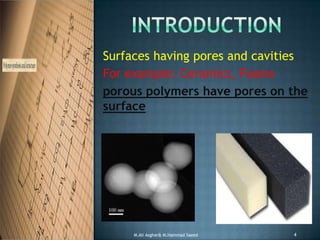
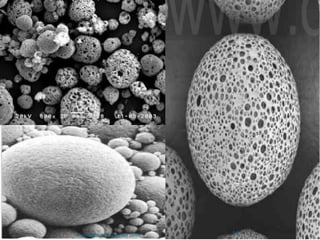
Surfaces having pores and cavities
For example: Ceramics, Foams
porous polymers have pores on the
surface
M.Ali Asghar& M.Hammad Saeed 4
Morphology
The study of shape, size, texture and
phase distribution of physical objects.
Gels, Sorbents & porous polymer
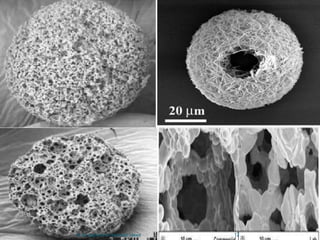
Pores and cavities on the surface,
formed by the cross linking or
5M.Ali Asghar& M.Hammad Saeed
Types of porous polymers
Micro porous
Macro porous
High internal phase emulsion
(HIPE)
6M.Ali Asghar& M.Hammad Saeed
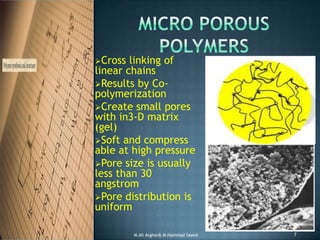
Cross linking of
linear chains
Results by Co-
polymerization
Create small pores
with in3-D matrix
(gel)
Soft and compress
able at high pressure
Pore size is usually
less than 30
angstrom
Pore distribution is
uniform
7M.Ali Asghar& M.Hammad Saeed
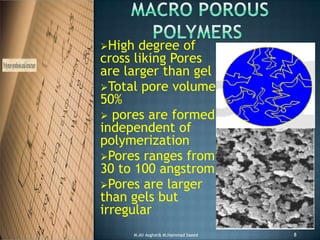
High degree of
cross liking Pores
are larger than gel
Total pore volume
50%
 pores are formed
independent of
polymerization
Pores ranges from
30 to 100 angstrom
Pores are larger
than gels but
irregular
8M.Ali Asghar& M.Hammad Saeed
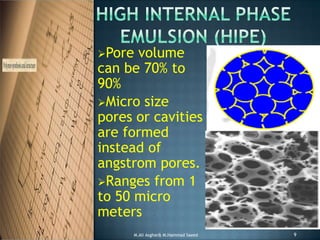
Pore volume
can be 70% to
90%
Micro size
pores or cavities
are formed
instead of
angstrom pores.
Ranges from 1
to 50 micro
meters
9M.Ali Asghar& M.Hammad Saeed
Following properties will effect the
morphology of porous polymers
Phase volume
 density
surface area
 cavity size
Reactivity
Liquid uptake
10M.Ali Asghar& M.Hammad Saeed
11M.Ali Asghar& M.Hammad Saeed
12M.Ali Asghar& M.Hammad Saeed
13M.Ali Asghar& M.Hammad Saeed
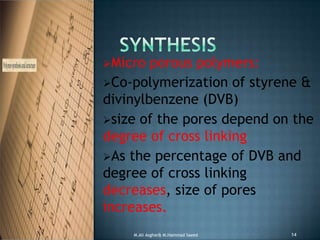
Micro porous polymers:
Co-polymerization of styrene &
divinylbenzene (DVB)
size of the pores depend on the
degree of cross linking
As the percentage of DVB and
degree of cross linking
decreases, size of pores
increases.
M.Ali Asghar& M.Hammad Saeed 14
M.Ali Asghar& M.Hammad Saeed 15
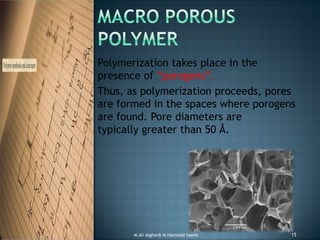
Polymerization takes place in the
presence of “porogens”.
Thus, as polymerization proceeds, pores
are formed in the spaces where porogens
are found. Pore diameters are
typically greater than 50 Å.
M.Ali Asghar& M.Hammad Saeed 16
 HIPE structures are formed when
an oil, water and suitable
emulsifier are mixed with
agitation.
 The water becomes dispersed
in the oil phase and as its
concentration increases the
consistency of the mixture changes
to a thick liquid.
 This resulting substance is the high
internal phase emulsion and is
quite stable sphere like structure.
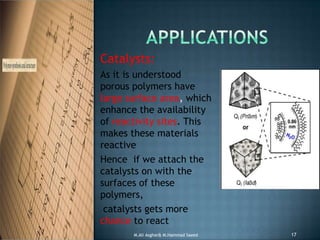
Catalysts:
As it is understood
porous polymers have
large surface area, which
enhance the availability
of reactivity sites. This
makes these materials
reactive
Hence if we attach the
catalysts on with the
surfaces of these
polymers,
catalysts gets more
chance to react
M.Ali Asghar& M.Hammad Saeed 17
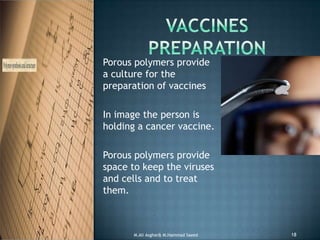
Porous polymers provide
a culture for the
preparation of vaccines
In image the person is
holding a cancer vaccine.
Porous polymers provide
space to keep the viruses
and cells and to treat
them.
M.Ali Asghar& M.Hammad Saeed 18
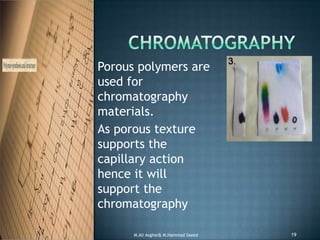
Porous polymers are
used for
chromatography
materials.
As porous texture
supports the
capillary action
hence it will
support the
chromatography
M.Ali Asghar& M.Hammad Saeed 19
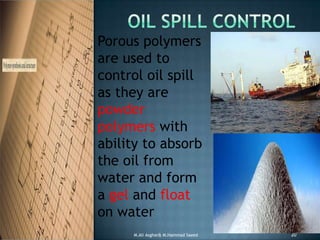
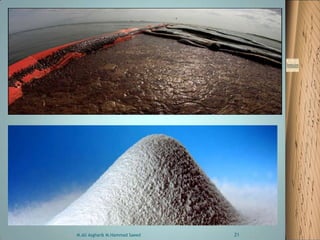
Porous polymers
are used to
control oil spill
as they are
powder
polymers with
ability to absorb
the oil from
water and form
a gel and float
on water
M.Ali Asghar& M.Hammad Saeed 20
M.Ali Asghar& M.Hammad Saeed 21
22M.Ali Asghar& M.Hammad Saeed
23M.Ali Asghar& M.Hammad Saeed

Porous Polymers with their synthesis

  • 1.
  • 2.
  • 3.
  • 4.
    Surfaces having poresand cavities For example: Ceramics, Foams porous polymers have pores on the surface M.Ali Asghar& M.Hammad Saeed 4
  • 5.
    Morphology The study ofshape, size, texture and phase distribution of physical objects. Gels, Sorbents & porous polymer Pores and cavities on the surface, formed by the cross linking or 5M.Ali Asghar& M.Hammad Saeed
  • 6.
    Types of porouspolymers Micro porous Macro porous High internal phase emulsion (HIPE) 6M.Ali Asghar& M.Hammad Saeed
  • 7.
    Cross linking of linearchains Results by Co- polymerization Create small pores with in3-D matrix (gel) Soft and compress able at high pressure Pore size is usually less than 30 angstrom Pore distribution is uniform 7M.Ali Asghar& M.Hammad Saeed
  • 8.
    High degree of crossliking Pores are larger than gel Total pore volume 50%  pores are formed independent of polymerization Pores ranges from 30 to 100 angstrom Pores are larger than gels but irregular 8M.Ali Asghar& M.Hammad Saeed
  • 9.
    Pore volume can be70% to 90% Micro size pores or cavities are formed instead of angstrom pores. Ranges from 1 to 50 micro meters 9M.Ali Asghar& M.Hammad Saeed
  • 10.
    Following properties willeffect the morphology of porous polymers Phase volume  density surface area  cavity size Reactivity Liquid uptake 10M.Ali Asghar& M.Hammad Saeed
  • 11.
  • 12.
  • 13.
  • 14.
    Micro porous polymers: Co-polymerizationof styrene & divinylbenzene (DVB) size of the pores depend on the degree of cross linking As the percentage of DVB and degree of cross linking decreases, size of pores increases. M.Ali Asghar& M.Hammad Saeed 14
  • 15.
    M.Ali Asghar& M.HammadSaeed 15 Polymerization takes place in the presence of “porogens”. Thus, as polymerization proceeds, pores are formed in the spaces where porogens are found. Pore diameters are typically greater than 50 Å.
  • 16.
    M.Ali Asghar& M.HammadSaeed 16  HIPE structures are formed when an oil, water and suitable emulsifier are mixed with agitation.  The water becomes dispersed in the oil phase and as its concentration increases the consistency of the mixture changes to a thick liquid.  This resulting substance is the high internal phase emulsion and is quite stable sphere like structure.
  • 17.
    Catalysts: As it isunderstood porous polymers have large surface area, which enhance the availability of reactivity sites. This makes these materials reactive Hence if we attach the catalysts on with the surfaces of these polymers, catalysts gets more chance to react M.Ali Asghar& M.Hammad Saeed 17
  • 18.
    Porous polymers provide aculture for the preparation of vaccines In image the person is holding a cancer vaccine. Porous polymers provide space to keep the viruses and cells and to treat them. M.Ali Asghar& M.Hammad Saeed 18
  • 19.
    Porous polymers are usedfor chromatography materials. As porous texture supports the capillary action hence it will support the chromatography M.Ali Asghar& M.Hammad Saeed 19
  • 20.
    Porous polymers are usedto control oil spill as they are powder polymers with ability to absorb the oil from water and form a gel and float on water M.Ali Asghar& M.Hammad Saeed 20
  • 21.
  • 22.
  • 23.