PONDICHERRY UNIVERSITY  & TNP ACT 2 ND  CONFERENCE   Conference Theme Media Education   Topic  Media Education for Empowerment    Paper Title     Media Education and the marginalized - A critical study of the Gaps and Needs Author Dr.B.K.Ravi ,  M.A., M.S., Ph.D Associate Professor ,  Department of Communication,  Bangalore University,  Bangalore, KARNATAKA, INDIA Ph:  +91-9448271938 ,  e-mail:bkravibu@gmail.com
INTRODUCTION Research studies on Media Education- no accomplishment, if any, v. less  - experimental stage  - very little feedback  -concepts geared to Western hemisphere.    Indian media with social responsibility Education for critical use  Today’s accessibility, reach and utility  -  limited to only some sections  “  An overwhelming majority of newspersons personally interviewed, 1967 (!), supported the notion of training. Though, as now, there were a few doubting Thomases also who believed  journalists are born, not made”. (sic!) - Prof K.E Eapen, The Hindu [2007]  ‘ Educational  technology ’
INDIAN EDUCATION Then an   organized education - Gurukul system  - Nalanda, etc.  Current system - western style and content [Macaulay]  - modified version of English education Higher education In India $30 billion a year on subsidies  > student aid programs, + grants  2008 grants - $2.3 billion;  aided programs - $27.6 billion
Table 1: Enrolment in higher education Central Scheme to provide interest Subsidy  (CSIS)  economically weaker sections  educational loan scheme of Indian Banks’ Association (IBA) [May 2010]  Source:  UNESCO, the World Education Report - 2000 Country Percent Canada 87.30 USA 80.90 Australia 79.80 Finland 74.10 New Zealand 62.60 Norway 62 Belgium 56.3 UK 52.30 France 51 China 15 India 7
Privatisation of Education in India The lack of Policies  “ Casualty - not just equity, but also in quality”  -  Jandhyala B.G. Tilak, economist, NIEPA, New Delhi  Private universities, Deemed University status  [Companies allowed to invest in higher Education in India (The Indian Companies Act 1956). The UGC  Gross Enrolment Ratio
MEDIA IN INDIA Pre independence – major role in gaining freedom  All forms of media were brought to India on experimental basis  Developed at a slower pace - lack of Technology, lack of media knowledge + prevailing social system  - lack of Infrastructure, funds, policies of Governments - Obstacles, Technological developments +lack of education  Age of Communication & Information  - vital role in Development  -up’s and downs -growth - very unsystematic > pulled down due to various factors of governance  ‘ Watch dog’  ; billion dollar industry
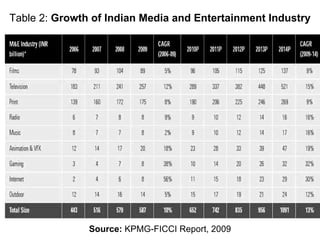
Table 2:  Growth of Indian Media and Entertainment Industry Source:  KPMG-FICCI Report, 2009
MEDIA EDUCATION IN INDIA  Importance of Training - Press Commissions  (1954 & 1984)  Rural -urban dichotomy  Courses in MC&J with different nomenclatures Most offer only English medium, yet write exams in regional language UNESCO efforts in Media Education ,  esp. in the developing world.  - need for ‘media and information literacy’  rather than Media Education MacBride Report - NWICO - a powerful influence
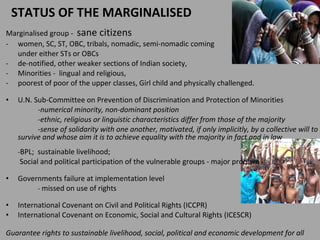
STATUS OF THE MARGINALISED  Marginalised group  -  sane citizens women, SC, ST, OBC, tribals, nomadic, semi-nomadic coming  under either STs or OBCs  de-notified, other weaker sections of Indian society,  Minorities -  lingual and religious,  poorest of poor of the upper classes,  Girl child and physically challenged. U.N. Sub-Committee on Prevention of Discrimination and Protection of Minorities -numerical minority, non-dominant position  -ethnic, religious or linguistic characteristics differ from those of the majority  -sense of solidarity with one another, motivated, if only implicitly, by a collective will to survive and whose aim it is to achieve equality with the majority in fact and in law - BPL;  sustainable livelihood;   Social and political participation of the vulnerable groups - major problem  Governments failure at implementation level -  missed on use of rights International Covenant on Civil and Political Rights (ICCPR)  International Covenant on Economic, Social and Cultural Rights (ICESCR)  Guarantee rights to sustainable livelihood, social, political and economic development for all
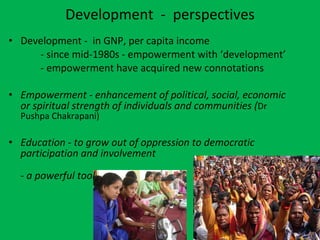
Development  -  perspectives Development -  in GNP, per capita income - since mid-1980s - empowerment with ‘development’ - empowerment have acquired new connotations Empowerment - enhancement of political, social, economic or spiritual strength of individuals and communities ( Dr Pushpa Chakrapani) Education - to grow out of oppression to democratic participation and involvement - a powerful tool
GAPS AND NEEDS SO FAR Uneven access to education -  Caste System  Dr. B R Ambedkar  caution to the under-privileged –  ‘ forego material benefits, but  not  our right /opportunities to reap the benefit of the highest education to the fullest extent.’ Methods and systems to modernise and liberalize  Dichotomies in Globalization made further marginalized Under Indian Constitution,  - women also are stated as marginalized Caste based census [last in 1931], recently 2011.  The 55 th  National Sample Survey (NSS) report
CONFININGS IN HIGHER EDUCATION  To increase educational opportunities for all; the IIT's, Medical Institutes, IIM's 1978- Second Backward Classes Commission [Mandal Commission] report of 1980 [during  V.P Singh  as PM] UGC Report - Inclusiveness and Equal Access India’s 11 th  Five Year Plan on Higher Education-  - an exclusive cell called ‘Equal Opportunity Office’  Article 14 and 16 (A) of Indian Constitution  Article 46  2011 census Absence of media criticism, media watch and media monitoring -  the marginalised being deprived of skills of technology, justifies the need for formal Media Education.
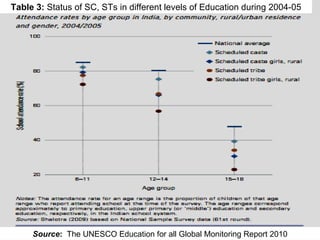
Table 3:  Status of SC, STs in different levels of Education during 2004-05 Source :  The UNESCO Education for all Global Monitoring Report 2010
Statement of the Problem Accessibility, reach and utility of media  not representative  Reasons  - poor quality of education  and  competency levels.  Media should include socially downtrodden groups , empower them.  Social Justice Theory - an illusion.    Significance  Relook into current definitions  of-  Mass Media, Communication, expectations of the media industry, training, post-students role in media organizations + Check on media confinements to groups and castes;    Scope   Look for gaps in different levels of education  and the supportive structures
The Study approach Objectives   Alerting stakeholders  to participate, explore strategies  to acquire prominent positions + conserve & disseminate indigenous knowledge to society Methodology Theoretical type with  Critical study Theoretical framework  Denis McQuail’s Social Responsibility Theory  <  > normative theories under Marketing Theory  fulfil certain obligations to society; self-regulating, pluralist, diverse; rights of reply, FOR marginalized
Findings and Discussions Higher education -  boon for the marginalized  Subsidising Education  - greater opportunities ; can slowly be relaxed. Universalising of English Medium - marginalised feel good for survival, economic & social security -encourage Social Mobility, not Social Hierarchy. Central universities have an edge in imparting better quality- opportunity for the marginalised   Knowledge Commission report - “ The proportion of our population......... are simply not adequate in relation to our needs..... quality of higher education ......leaves much to be desired”.    Privatisation of Higher Education - solution to some extent;  Drop out rate due to social system can be reduced
Findings /Discussions . . . . 2 Government - mechanisms to regulate private institutions  Affordability - a major issue  Distance education  - a good alternative  Media educators, professionals, policy makers  to debate upon serious issues, challenges and  responsibilities involved in Media Education  Policy inputs for result oriented and purposeful outcomes organized resources and systematic management – in teaching Media, training, research and extension activities, especially in Indian languages  Medium of instruction - mother tongue vs. English medium
Case Studies Case Study (#1): [ survey, 2007, Bangalore city] Displayed hoardings  Table 4: Reaction of respondents about PSM Source:  Survey (2007) in Bangalore City by the author Messages are randomly picked Catch-line of Advts. that are translated into multiple languages fails to convey the right message Media Message Response [percent] Non-comprehension of the message 70 Established connect with the message 30
Discussion  . . . . .(contd.) Educators with  advanced degrees and diplomas not in plenty Private managements take  teachers for granted Training  not imparted on the basis of sound vision, expertise, recognition and patronage Vernacular Media  Education - unplanned and disorganized -greed of making profits  Expectation  of funds and technology not understood by policy makers  Purpose  of Mass Communication education – beyond skills Regionalising  Media Education gives better job opportunities to minority Not merely language command but for characteristic features of media professionals  empathy, observation, sensitivity, fairness, unbiased thinking
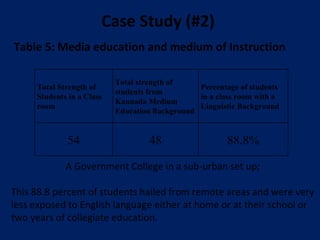
Case Study (#2)  Table 5: Media education and medium of Instruction   A Government College in a sub-urban set up;  This 88.8 percent of students hailed from remote areas and were very less exposed to English language either at home or at their school or two years of collegiate education. Total Strength of Students in a Class room Total strength of students from  Kannada Medium Education Background Percentage of students in a class room with a Linguistic Background 54 48 88.8%
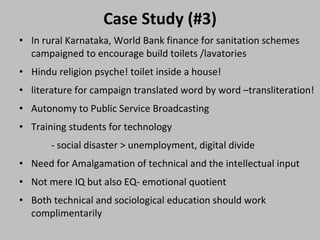
Case Study (#3) In rural Karnataka, World Bank finance for sanitation schemes campaigned to encourage build toilets /lavatories  Hindu religion psyche! toilet inside a house!  literature for campaign translated word by word –transliteration! Autonomy to Public Service Broadcasting  Training students for technology  - social disaster > unemployment, digital divide  Need for Amalgamation of technical and the intellectual input  Not mere IQ but also EQ- emotional quotient  Both technical and sociological education should work complimentarily
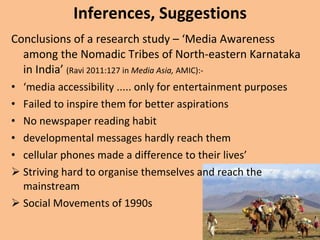
Inferences, Suggestions Conclusions of a research study – ‘Media Awareness among the Nomadic Tribes of North-eastern Karnataka in India’  (Ravi 2011:127 in  Media Asia,  AMIC):- ‘ media accessibility ..... only for entertainment purposes Failed to inspire them for better aspirations No newspaper reading habit developmental messages hardly reach them cellular phones made a difference to their lives’  Striving hard to organise themselves and reach the mainstream  Social Movements of 1990s
. . . . . .Inferences, Suggestions  (contd. 2) Mandal Commission Report - partially implemented Judicial queries pending with the issues  - whether reservation should be extended to non-aided institutions  ? - what exemption to students of OBCs  ? - age relaxation in recruitment, the criteria of eligibility  ? - scholarships and Training programmes (UGC Fellowships)  ?
. . . . . Inferences, Suggestions  (contd. 3) Today convinced that reporting, editing and research can be taught.  Subsidized institutions of Government colleges and universities still not able to implement effectively Dominant languages make regional dialects survival threatened -   snubbed by the fashioned professionals - rural aspirants are ignored -  drawback in their quest for a Profession.
. . . . . Inferences, Suggestions  (contd. 4) The issue of infrastructure in subsidized education Private Institutions - commercialization of education Need for comprehensive Communication Policy Learning to be made mandatory right from primary education ~ Indian Constitution, New Media  Official Commission for grievances of media professionals
Conclusion Need for professionalism aspects  - etiquettes, mannerisms, sensitivity  Not just quick profits, Social Responsibility  Importance of Media Education increasing  Media Education has a bright future because of the changing techno-potentialities - fully equipped knowledgeable professional Media Studies means  -  content, behaviour, reach, priorities of media  Consumerism and social health - concerned areas  Rural India   should be concentrated on. A Good Media Education would create a Healthy Media for the future Generations.
       Thank You

Pondi me, dr.bk ravi - final (a2)

  • 1.
    PONDICHERRY UNIVERSITY & TNP ACT 2 ND CONFERENCE   Conference Theme Media Education   Topic Media Education for Empowerment    Paper Title     Media Education and the marginalized - A critical study of the Gaps and Needs Author Dr.B.K.Ravi , M.A., M.S., Ph.D Associate Professor , Department of Communication, Bangalore University, Bangalore, KARNATAKA, INDIA Ph: +91-9448271938 , e-mail:bkravibu@gmail.com
  • 2.
    INTRODUCTION Research studieson Media Education- no accomplishment, if any, v. less - experimental stage - very little feedback -concepts geared to Western hemisphere.   Indian media with social responsibility Education for critical use Today’s accessibility, reach and utility - limited to only some sections “ An overwhelming majority of newspersons personally interviewed, 1967 (!), supported the notion of training. Though, as now, there were a few doubting Thomases also who believed journalists are born, not made”. (sic!) - Prof K.E Eapen, The Hindu [2007] ‘ Educational technology ’
  • 3.
    INDIAN EDUCATION Thenan organized education - Gurukul system - Nalanda, etc. Current system - western style and content [Macaulay] - modified version of English education Higher education In India $30 billion a year on subsidies > student aid programs, + grants 2008 grants - $2.3 billion; aided programs - $27.6 billion
  • 4.
    Table 1: Enrolmentin higher education Central Scheme to provide interest Subsidy (CSIS) economically weaker sections educational loan scheme of Indian Banks’ Association (IBA) [May 2010] Source: UNESCO, the World Education Report - 2000 Country Percent Canada 87.30 USA 80.90 Australia 79.80 Finland 74.10 New Zealand 62.60 Norway 62 Belgium 56.3 UK 52.30 France 51 China 15 India 7
  • 5.
    Privatisation of Educationin India The lack of Policies “ Casualty - not just equity, but also in quality” - Jandhyala B.G. Tilak, economist, NIEPA, New Delhi Private universities, Deemed University status [Companies allowed to invest in higher Education in India (The Indian Companies Act 1956). The UGC Gross Enrolment Ratio
  • 6.
    MEDIA IN INDIAPre independence – major role in gaining freedom All forms of media were brought to India on experimental basis Developed at a slower pace - lack of Technology, lack of media knowledge + prevailing social system - lack of Infrastructure, funds, policies of Governments - Obstacles, Technological developments +lack of education Age of Communication & Information - vital role in Development -up’s and downs -growth - very unsystematic > pulled down due to various factors of governance ‘ Watch dog’ ; billion dollar industry
  • 7.
    Table 2: Growth of Indian Media and Entertainment Industry Source: KPMG-FICCI Report, 2009
  • 8.
    MEDIA EDUCATION ININDIA Importance of Training - Press Commissions (1954 & 1984) Rural -urban dichotomy Courses in MC&J with different nomenclatures Most offer only English medium, yet write exams in regional language UNESCO efforts in Media Education , esp. in the developing world. - need for ‘media and information literacy’ rather than Media Education MacBride Report - NWICO - a powerful influence
  • 9.
    STATUS OF THEMARGINALISED Marginalised group - sane citizens women, SC, ST, OBC, tribals, nomadic, semi-nomadic coming under either STs or OBCs de-notified, other weaker sections of Indian society, Minorities - lingual and religious, poorest of poor of the upper classes, Girl child and physically challenged. U.N. Sub-Committee on Prevention of Discrimination and Protection of Minorities -numerical minority, non-dominant position -ethnic, religious or linguistic characteristics differ from those of the majority -sense of solidarity with one another, motivated, if only implicitly, by a collective will to survive and whose aim it is to achieve equality with the majority in fact and in law - BPL; sustainable livelihood; Social and political participation of the vulnerable groups - major problem Governments failure at implementation level - missed on use of rights International Covenant on Civil and Political Rights (ICCPR) International Covenant on Economic, Social and Cultural Rights (ICESCR) Guarantee rights to sustainable livelihood, social, political and economic development for all
  • 10.
    Development - perspectives Development - in GNP, per capita income - since mid-1980s - empowerment with ‘development’ - empowerment have acquired new connotations Empowerment - enhancement of political, social, economic or spiritual strength of individuals and communities ( Dr Pushpa Chakrapani) Education - to grow out of oppression to democratic participation and involvement - a powerful tool
  • 11.
    GAPS AND NEEDSSO FAR Uneven access to education - Caste System Dr. B R Ambedkar caution to the under-privileged – ‘ forego material benefits, but not our right /opportunities to reap the benefit of the highest education to the fullest extent.’ Methods and systems to modernise and liberalize Dichotomies in Globalization made further marginalized Under Indian Constitution, - women also are stated as marginalized Caste based census [last in 1931], recently 2011. The 55 th National Sample Survey (NSS) report
  • 12.
    CONFININGS IN HIGHEREDUCATION To increase educational opportunities for all; the IIT's, Medical Institutes, IIM's 1978- Second Backward Classes Commission [Mandal Commission] report of 1980 [during V.P Singh as PM] UGC Report - Inclusiveness and Equal Access India’s 11 th Five Year Plan on Higher Education- - an exclusive cell called ‘Equal Opportunity Office’ Article 14 and 16 (A) of Indian Constitution Article 46 2011 census Absence of media criticism, media watch and media monitoring - the marginalised being deprived of skills of technology, justifies the need for formal Media Education.
  • 13.
    Table 3: Status of SC, STs in different levels of Education during 2004-05 Source : The UNESCO Education for all Global Monitoring Report 2010
  • 14.
    Statement of theProblem Accessibility, reach and utility of media not representative Reasons - poor quality of education and competency levels. Media should include socially downtrodden groups , empower them. Social Justice Theory - an illusion.   Significance Relook into current definitions of- Mass Media, Communication, expectations of the media industry, training, post-students role in media organizations + Check on media confinements to groups and castes;   Scope Look for gaps in different levels of education and the supportive structures
  • 15.
    The Study approachObjectives Alerting stakeholders to participate, explore strategies to acquire prominent positions + conserve & disseminate indigenous knowledge to society Methodology Theoretical type with Critical study Theoretical framework Denis McQuail’s Social Responsibility Theory < > normative theories under Marketing Theory fulfil certain obligations to society; self-regulating, pluralist, diverse; rights of reply, FOR marginalized
  • 16.
    Findings and DiscussionsHigher education - boon for the marginalized Subsidising Education - greater opportunities ; can slowly be relaxed. Universalising of English Medium - marginalised feel good for survival, economic & social security -encourage Social Mobility, not Social Hierarchy. Central universities have an edge in imparting better quality- opportunity for the marginalised Knowledge Commission report - “ The proportion of our population......... are simply not adequate in relation to our needs..... quality of higher education ......leaves much to be desired”.   Privatisation of Higher Education - solution to some extent; Drop out rate due to social system can be reduced
  • 17.
    Findings /Discussions .. . . 2 Government - mechanisms to regulate private institutions Affordability - a major issue Distance education - a good alternative Media educators, professionals, policy makers to debate upon serious issues, challenges and responsibilities involved in Media Education Policy inputs for result oriented and purposeful outcomes organized resources and systematic management – in teaching Media, training, research and extension activities, especially in Indian languages Medium of instruction - mother tongue vs. English medium
  • 18.
    Case Studies CaseStudy (#1): [ survey, 2007, Bangalore city] Displayed hoardings Table 4: Reaction of respondents about PSM Source: Survey (2007) in Bangalore City by the author Messages are randomly picked Catch-line of Advts. that are translated into multiple languages fails to convey the right message Media Message Response [percent] Non-comprehension of the message 70 Established connect with the message 30
  • 19.
    Discussion .. . . .(contd.) Educators with advanced degrees and diplomas not in plenty Private managements take teachers for granted Training not imparted on the basis of sound vision, expertise, recognition and patronage Vernacular Media Education - unplanned and disorganized -greed of making profits Expectation of funds and technology not understood by policy makers Purpose of Mass Communication education – beyond skills Regionalising Media Education gives better job opportunities to minority Not merely language command but for characteristic features of media professionals empathy, observation, sensitivity, fairness, unbiased thinking
  • 20.
    Case Study (#2) Table 5: Media education and medium of Instruction   A Government College in a sub-urban set up; This 88.8 percent of students hailed from remote areas and were very less exposed to English language either at home or at their school or two years of collegiate education. Total Strength of Students in a Class room Total strength of students from Kannada Medium Education Background Percentage of students in a class room with a Linguistic Background 54 48 88.8%
  • 21.
    Case Study (#3)In rural Karnataka, World Bank finance for sanitation schemes campaigned to encourage build toilets /lavatories Hindu religion psyche! toilet inside a house! literature for campaign translated word by word –transliteration! Autonomy to Public Service Broadcasting Training students for technology - social disaster > unemployment, digital divide Need for Amalgamation of technical and the intellectual input Not mere IQ but also EQ- emotional quotient Both technical and sociological education should work complimentarily
  • 22.
    Inferences, Suggestions Conclusionsof a research study – ‘Media Awareness among the Nomadic Tribes of North-eastern Karnataka in India’ (Ravi 2011:127 in Media Asia, AMIC):- ‘ media accessibility ..... only for entertainment purposes Failed to inspire them for better aspirations No newspaper reading habit developmental messages hardly reach them cellular phones made a difference to their lives’  Striving hard to organise themselves and reach the mainstream Social Movements of 1990s
  • 23.
    . . .. . .Inferences, Suggestions (contd. 2) Mandal Commission Report - partially implemented Judicial queries pending with the issues - whether reservation should be extended to non-aided institutions ? - what exemption to students of OBCs ? - age relaxation in recruitment, the criteria of eligibility ? - scholarships and Training programmes (UGC Fellowships) ?
  • 24.
    . . .. . Inferences, Suggestions (contd. 3) Today convinced that reporting, editing and research can be taught. Subsidized institutions of Government colleges and universities still not able to implement effectively Dominant languages make regional dialects survival threatened - snubbed by the fashioned professionals - rural aspirants are ignored - drawback in their quest for a Profession.
  • 25.
    . . .. . Inferences, Suggestions (contd. 4) The issue of infrastructure in subsidized education Private Institutions - commercialization of education Need for comprehensive Communication Policy Learning to be made mandatory right from primary education ~ Indian Constitution, New Media Official Commission for grievances of media professionals
  • 26.
    Conclusion Need forprofessionalism aspects - etiquettes, mannerisms, sensitivity Not just quick profits, Social Responsibility  Importance of Media Education increasing Media Education has a bright future because of the changing techno-potentialities - fully equipped knowledgeable professional Media Studies means - content, behaviour, reach, priorities of media Consumerism and social health - concerned areas Rural India should be concentrated on. A Good Media Education would create a Healthy Media for the future Generations.
  • 27.
      Thank You