“Social Media Participatory Cultures -
A Study of the Dynamics between User
    Personality and Facebook Use”


           Dr. Kalyani Suresh
           Assistant Professor,
    Amrita School of Communication,
     Amrita Vishwa Vidyapeetham,
           Coimbatore, India
        s_kalyani@cb.amrita.edu
 The Uses and Gratifications Theory suggests that
 people have different socio-psychological traits, which
 may affect the way and the reasons they use social
 media to satisfy their personal needs.
 In the Internet environment, users are even more
 actively engaged communication participants,
 compared to other traditional media.
 Created in 2004, as of April 2011, Facebook has above
 660 million users worldwide. It is reported to have
 more than 23 million users in India, with more than
 20 million being above 18 years of age and over 3
 million in the below 18 years category.
 Researchers have found high levels of correlation
 between personality traits and use of social
 networking sites.

 Most common personality traits studied come under
 the broad dimensions of Extraversion, Emotional
 Stability, Openness to Experiences, Agreeableness, and
 Conscientiousness
 Openness to Experience: curious, intelligent and
  imaginative. High scorers tend to be artistic and
  sophisticated in taste and appreciate diverse
  views, ideas, and experiences.
 Conscientiousness: responsible, organized,
  persevering. Conscientious individuals are extremely
  reliable and tend to be high achievers, hard workers,
  and planners.
 Extraversion: outgoing, amicable, assertive.
  Friendly and energetic, extroverts draw inspiration
  from social situations.
 Agreeableness: cooperative, helpful, nurturing.
 People who score high in agreeableness are peace-
 keepers who are generally optimistic and trusting of
 others.

 Neuroticism (Emotional Stability): anxious,
 insecure, sensitive. Neurotics are moody, tense, and
 easily tipped into experiencing negative emotions.
 Studies on gratifications of Facebook users and
 individual personality characteristics have used the
 student community as their samples.
This study uses wider age groups as samples to find
out whether there is a relationship between
personality traits and various indicators of Facebook
use in terms of age and gender
 An online survey was conducted among Indian
 respondents between October and November 2011.
 The survey was conducted using the Kwik Survey host
 45% of the respondents were men and 55% were
 women. Ages ranged from ‘below 15 years’ to ‘32 years
 and above’.

 A majority of respondents in the ‘older’ age category
 (96%) were early adopters of Facebook.
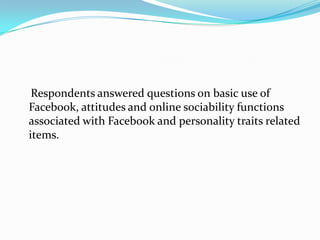
Respondents answered questions on basic use of
Facebook, attitudes and online sociability functions
associated with Facebook and personality traits related
items.
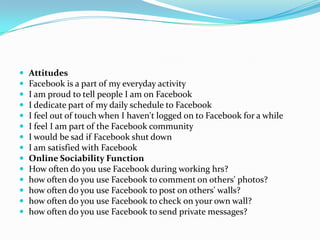
   Attitudes
   Facebook is a part of my everyday activity
   I am proud to tell people I am on Facebook
   I dedicate part of my daily schedule to Facebook
   I feel out of touch when I haven't logged on to Facebook for a while
   I feel I am part of the Facebook community
   I would be sad if Facebook shut down
   I am satisfied with Facebook
   Online Sociability Function
   How often do you use Facebook during working hrs?
   how often do you use Facebook to comment on others' photos?
   how often do you use Facebook to post on others' walls?
   how often do you use Facebook to check on your own wall?
   how often do you use Facebook to send private messages?
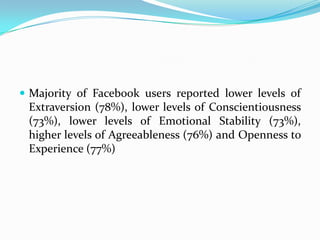
 Majority of Facebook users reported lower levels of
 Extraversion (78%), lower levels of Conscientiousness
 (73%), lower levels of Emotional Stability (73%),
 higher levels of Agreeableness (76%) and Openness to
 Experience (77%)
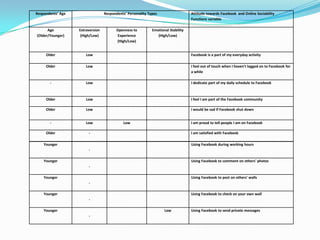
Respondents’ Age                  Respondents’ Personality Types                   Attitude towards Facebook and Online Sociability
                                                                                   Functions variable

      Age          Extraversion          Openness to         Emotional Stability
(Older/Younger)     (High/Low)           Experience             (High/Low)
                                         (High/Low)


     Older             Low                                                         Facebook is a part of my everyday activity

     Older             Low                                                         I feel out of touch when I haven't logged on to Facebook for
                                                                                   a while

       -               Low                                                         I dedicate part of my daily schedule to Facebook


     Older             Low                                                         I feel I am part of the Facebook community

     Older             Low                                                         I would be sad if Facebook shut down


       -               Low                  Low                                    I am proud to tell people I am on Facebook

     Older              -                                                          I am satisfied with Facebook

    Younger                                                                        Using Facebook during working hours
                        -

    Younger                                                                        Using Facebook to comment on others' photos
                        -

    Younger                                                                        Using Facebook to post on others' walls
                        -

    Younger                                                                        Using Facebook to check on your own wall
                        -

    Younger                                                         Low            Using Facebook to send private messages
                        -
 The equal time spent using Facebook (10 to 30 min per
 day) by respondents, regardless of extraversion score
 (high/low) suggests that online introverts behaved in
 a similar manner to extraverts.
 This suggests that Facebook was a “level playing field”
 for introverts and extraverts alike.
 Older people were more engaged on Facebook as a
  daily routine.

 Younger respondents used Facebook communicatively
  and interpersonally.

 No significant differences in terms of gender on
  Attitudes and Online Sociability functions of
  Facebook users.

Pondy conf ppt presentation

  • 1.
    “Social Media ParticipatoryCultures - A Study of the Dynamics between User Personality and Facebook Use” Dr. Kalyani Suresh Assistant Professor, Amrita School of Communication, Amrita Vishwa Vidyapeetham, Coimbatore, India s_kalyani@cb.amrita.edu
  • 2.
     The Usesand Gratifications Theory suggests that people have different socio-psychological traits, which may affect the way and the reasons they use social media to satisfy their personal needs.
  • 3.
     In theInternet environment, users are even more actively engaged communication participants, compared to other traditional media.
  • 4.
     Created in2004, as of April 2011, Facebook has above 660 million users worldwide. It is reported to have more than 23 million users in India, with more than 20 million being above 18 years of age and over 3 million in the below 18 years category.
  • 5.
     Researchers havefound high levels of correlation between personality traits and use of social networking sites.  Most common personality traits studied come under the broad dimensions of Extraversion, Emotional Stability, Openness to Experiences, Agreeableness, and Conscientiousness
  • 6.
     Openness toExperience: curious, intelligent and imaginative. High scorers tend to be artistic and sophisticated in taste and appreciate diverse views, ideas, and experiences.  Conscientiousness: responsible, organized, persevering. Conscientious individuals are extremely reliable and tend to be high achievers, hard workers, and planners.  Extraversion: outgoing, amicable, assertive. Friendly and energetic, extroverts draw inspiration from social situations.
  • 7.
     Agreeableness: cooperative,helpful, nurturing. People who score high in agreeableness are peace- keepers who are generally optimistic and trusting of others.  Neuroticism (Emotional Stability): anxious, insecure, sensitive. Neurotics are moody, tense, and easily tipped into experiencing negative emotions.
  • 8.
     Studies ongratifications of Facebook users and individual personality characteristics have used the student community as their samples.
  • 9.
    This study useswider age groups as samples to find out whether there is a relationship between personality traits and various indicators of Facebook use in terms of age and gender
  • 10.
     An onlinesurvey was conducted among Indian respondents between October and November 2011. The survey was conducted using the Kwik Survey host
  • 11.
     45% ofthe respondents were men and 55% were women. Ages ranged from ‘below 15 years’ to ‘32 years and above’.  A majority of respondents in the ‘older’ age category (96%) were early adopters of Facebook.
  • 12.
    Respondents answered questionson basic use of Facebook, attitudes and online sociability functions associated with Facebook and personality traits related items.
  • 13.
    Attitudes  Facebook is a part of my everyday activity  I am proud to tell people I am on Facebook  I dedicate part of my daily schedule to Facebook  I feel out of touch when I haven't logged on to Facebook for a while  I feel I am part of the Facebook community  I would be sad if Facebook shut down  I am satisfied with Facebook  Online Sociability Function  How often do you use Facebook during working hrs?  how often do you use Facebook to comment on others' photos?  how often do you use Facebook to post on others' walls?  how often do you use Facebook to check on your own wall?  how often do you use Facebook to send private messages?
  • 14.
     Majority ofFacebook users reported lower levels of Extraversion (78%), lower levels of Conscientiousness (73%), lower levels of Emotional Stability (73%), higher levels of Agreeableness (76%) and Openness to Experience (77%)
  • 15.
    Respondents’ Age Respondents’ Personality Types Attitude towards Facebook and Online Sociability Functions variable Age Extraversion Openness to Emotional Stability (Older/Younger) (High/Low) Experience (High/Low) (High/Low) Older Low Facebook is a part of my everyday activity Older Low I feel out of touch when I haven't logged on to Facebook for a while - Low I dedicate part of my daily schedule to Facebook Older Low I feel I am part of the Facebook community Older Low I would be sad if Facebook shut down - Low Low I am proud to tell people I am on Facebook Older - I am satisfied with Facebook Younger Using Facebook during working hours - Younger Using Facebook to comment on others' photos - Younger Using Facebook to post on others' walls - Younger Using Facebook to check on your own wall - Younger Low Using Facebook to send private messages -
  • 16.
     The equaltime spent using Facebook (10 to 30 min per day) by respondents, regardless of extraversion score (high/low) suggests that online introverts behaved in a similar manner to extraverts.
  • 17.
     This suggeststhat Facebook was a “level playing field” for introverts and extraverts alike.
  • 18.
     Older peoplewere more engaged on Facebook as a daily routine.  Younger respondents used Facebook communicatively and interpersonally.  No significant differences in terms of gender on Attitudes and Online Sociability functions of Facebook users.