Polynomial FunctionsGage GirtenB2
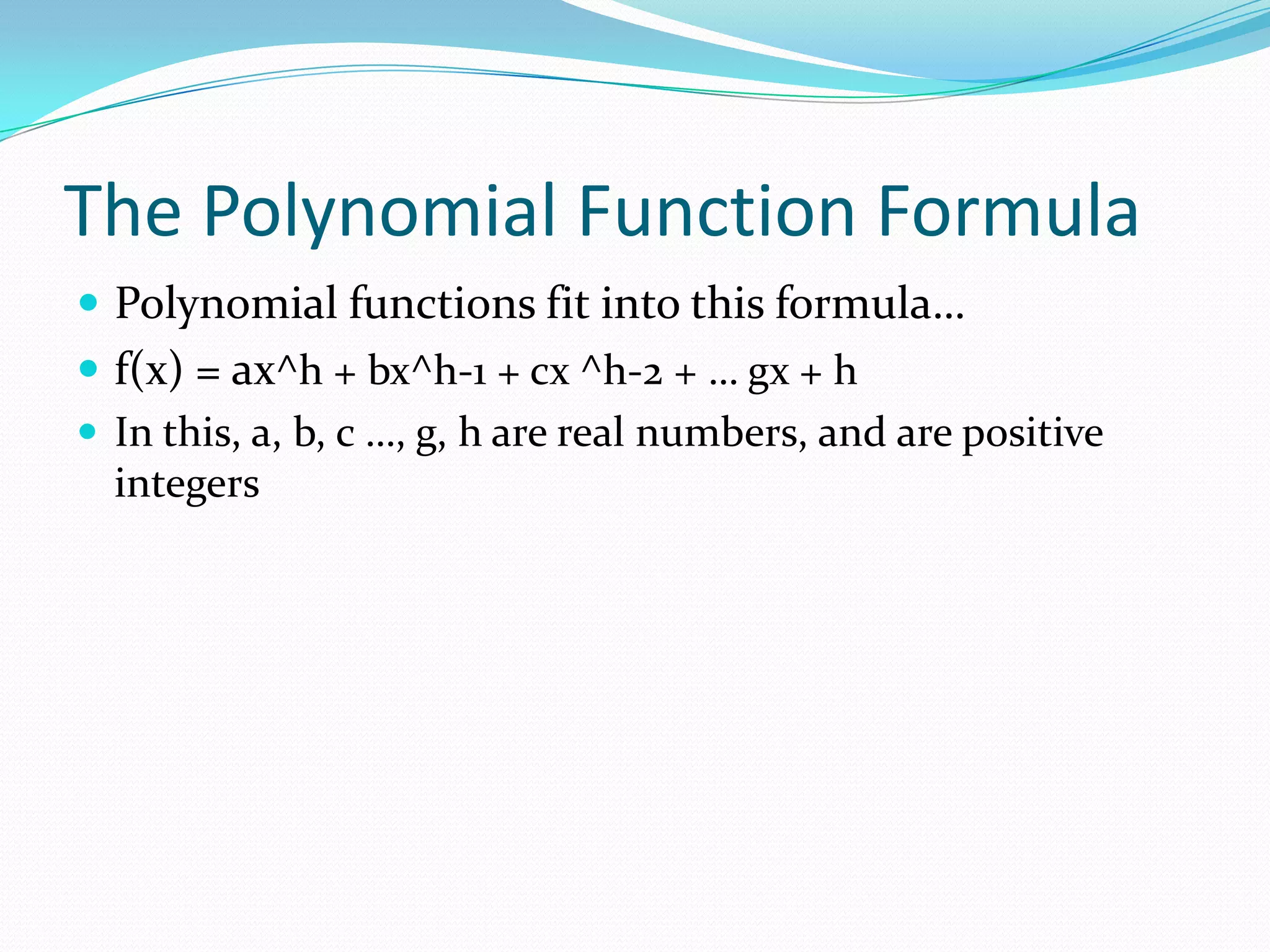
The Polynomial Function FormulaPolynomial functions fit into this formula…f(x) = ax^h + bx^h-1 + cx ^h-2 + … gx + hIn this, a, b, c …, g, h are real numbers, and are positive integers
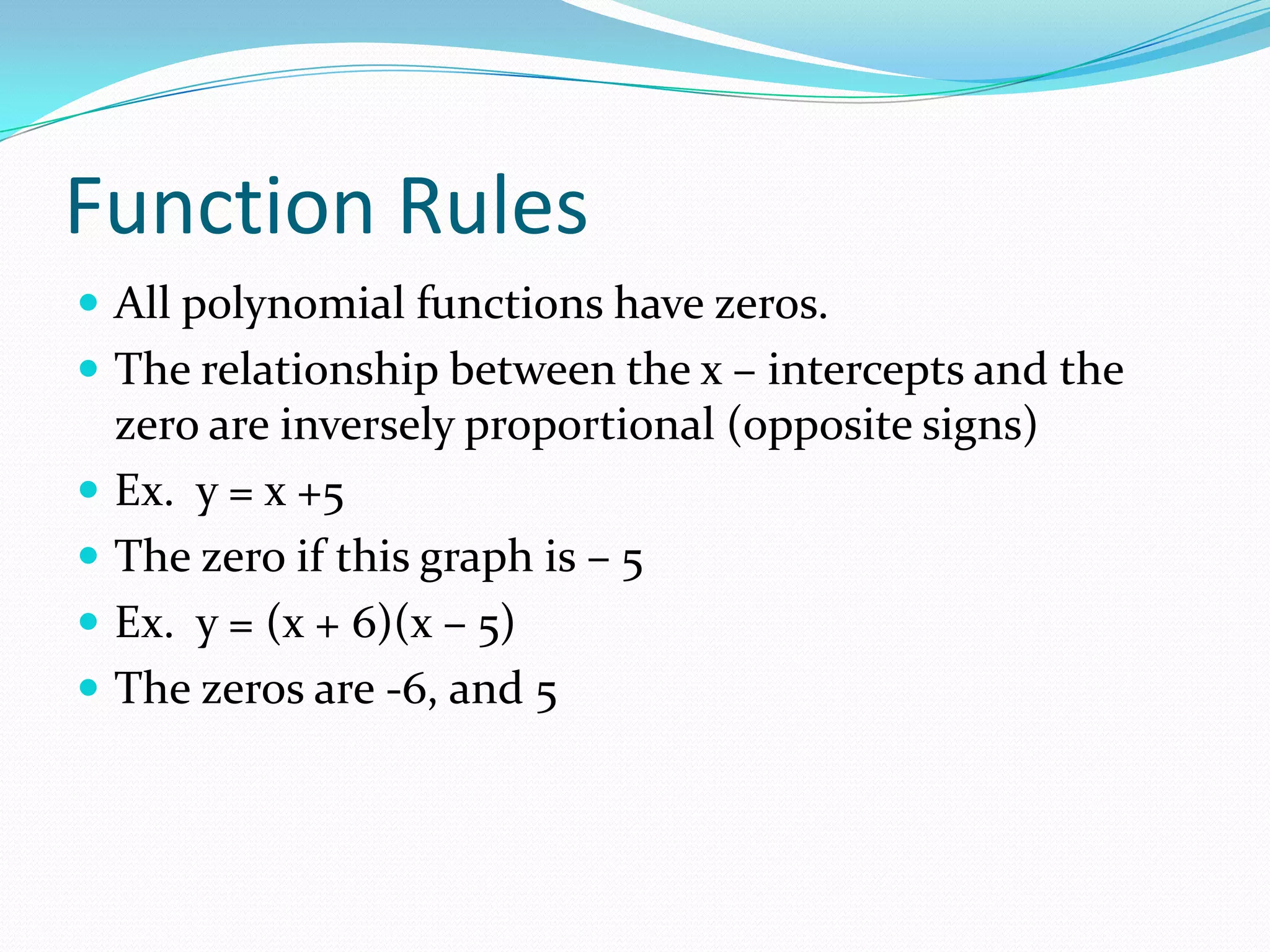
Function RulesAll polynomial functions have zeros. The relationship between the x – intercepts and the zero are inversely proportional (opposite signs)Ex.  y = x +5The zero if this graph is – 5Ex.  y = (x + 6)(x – 5)The zeros are -6, and 5
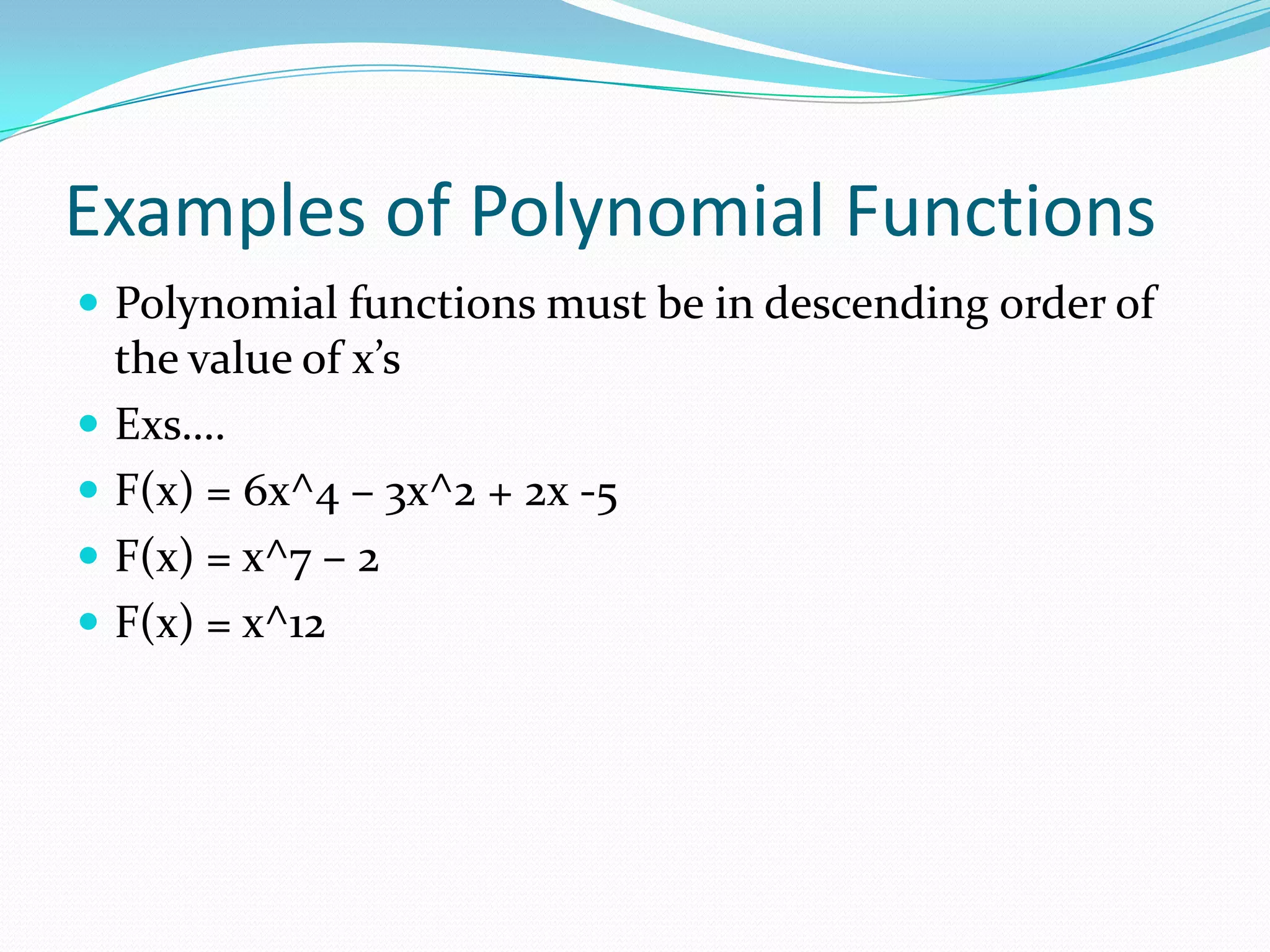
Examples of Polynomial FunctionsPolynomial functions must be in descending order of the value of x’sExs….F(x) = 6x^4 – 3x^2 + 2x -5F(x) = x^7 – 2F(x) = x^12
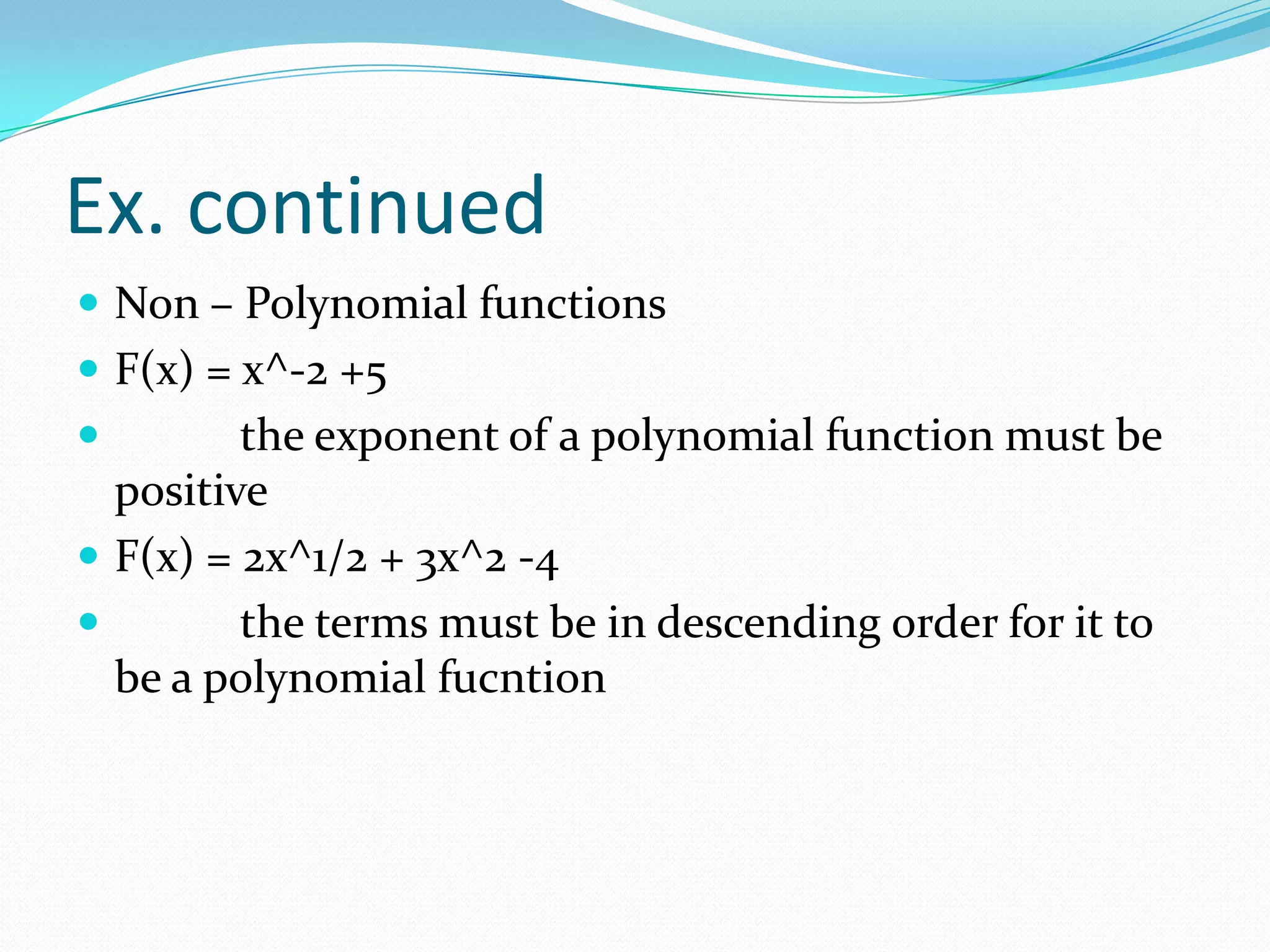
Ex. continuedNon – Polynomial functionsF(x) = x^-2 +5           the exponent of a polynomial function must be positiveF(x) = 2x^1/2 + 3x^2 -4          the terms must be in descending order for it to be a polynomial fucntion
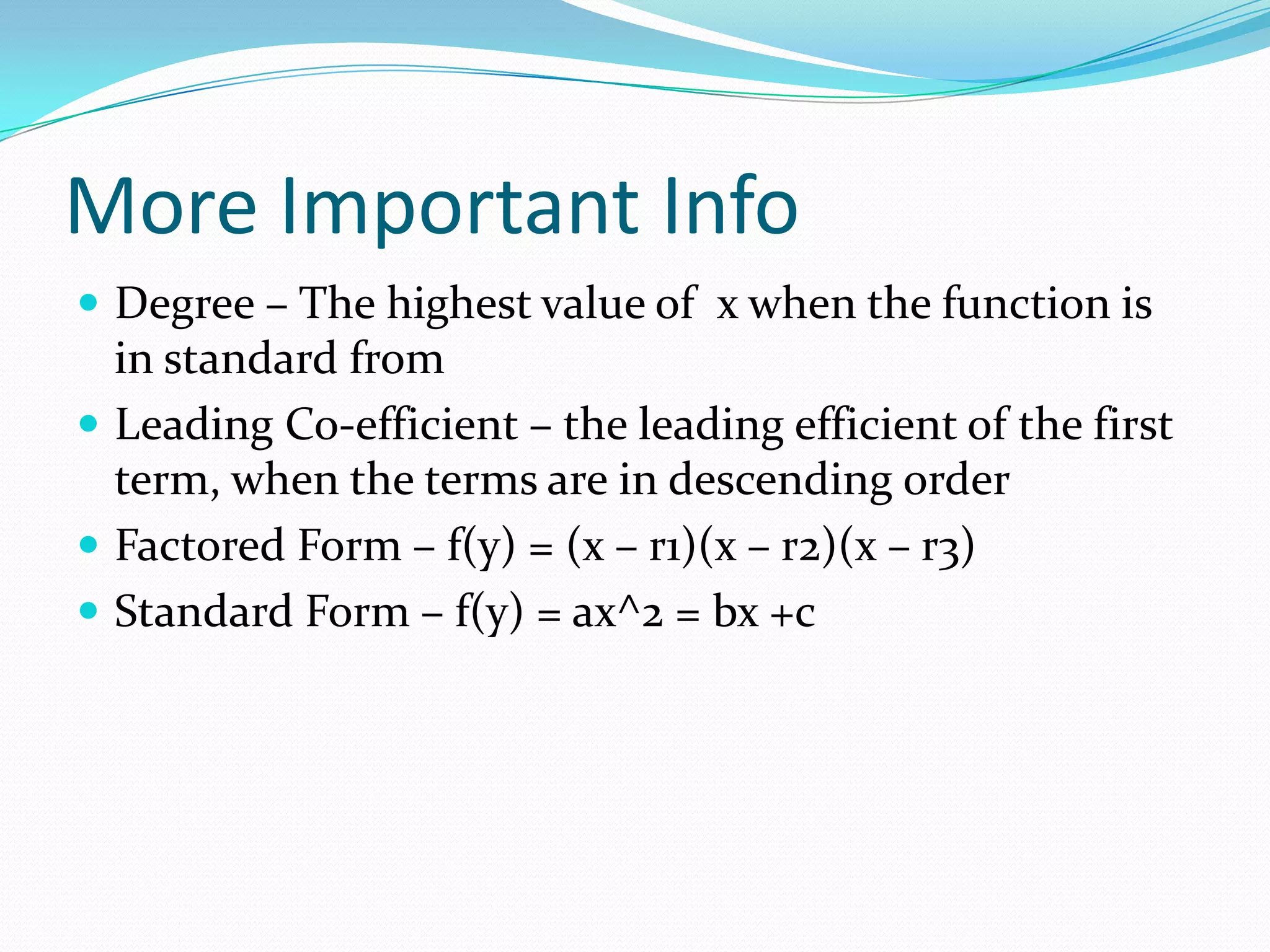
More Important InfoDegree – The highest value of  x when the function is in standard fromLeading Co-efficient – the leading efficient of the first term, when the terms are in descending orderFactored Form – f(y) = (x – r1)(x – r2)(x – r3)Standard Form – f(y) = ax^2 = bx +c
The End

Polynomial functions

  • 1.
  • 2.
    The Polynomial FunctionFormulaPolynomial functions fit into this formula…f(x) = ax^h + bx^h-1 + cx ^h-2 + … gx + hIn this, a, b, c …, g, h are real numbers, and are positive integers
  • 3.
    Function RulesAll polynomialfunctions have zeros. The relationship between the x – intercepts and the zero are inversely proportional (opposite signs)Ex. y = x +5The zero if this graph is – 5Ex. y = (x + 6)(x – 5)The zeros are -6, and 5
  • 4.
    Examples of PolynomialFunctionsPolynomial functions must be in descending order of the value of x’sExs….F(x) = 6x^4 – 3x^2 + 2x -5F(x) = x^7 – 2F(x) = x^12
  • 5.
    Ex. continuedNon –Polynomial functionsF(x) = x^-2 +5 the exponent of a polynomial function must be positiveF(x) = 2x^1/2 + 3x^2 -4 the terms must be in descending order for it to be a polynomial fucntion
  • 6.
    More Important InfoDegree– The highest value of x when the function is in standard fromLeading Co-efficient – the leading efficient of the first term, when the terms are in descending orderFactored Form – f(y) = (x – r1)(x – r2)(x – r3)Standard Form – f(y) = ax^2 = bx +c
  • 7.