POLYMERS
POLYMER
S
LONG CHAIN
MOLECULES COMPLEX
[CH2 ]n
CLASSIFICATION
Based on,
structure
molecular forces
source
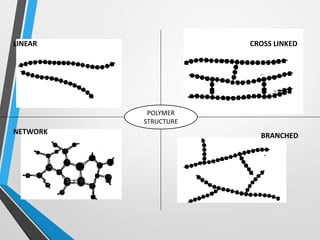
POLYMER
STRUCTURE
LINEAR
BRANCHED
CROSS LINKED
NETWORK
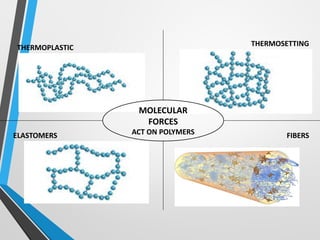
MOLECULAR
FORCES
ACT ON POLYMERS FIBERS
THERMOPLASTIC
ELASTOMERS
THERMOSETTING
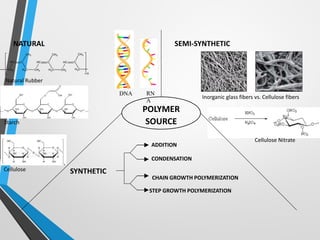
POLYMER
SOURCE
NATURAL SEMI-SYNTHETIC
SYNTHETIC
CONDENSATION
ADDITION
STEP GROWTH POLYMERIZATION
CHAIN GROWTH POLYMERIZATION
Starch
Natural Rubber
DNA RN
A
Cellulose
Inorganic glass fibers vs. Cellulose fibers
Cellulose Nitrate
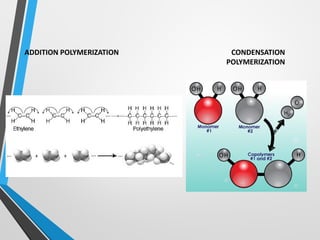
ADDITION POLYMERIZATION CONDENSATION
POLYMERIZATION
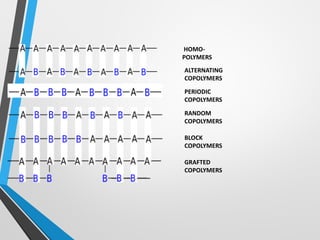
BLOCK
COPOLYMERS
HOMO-
POLYMERS
RANDOM
COPOLYMERS
ALTERNATING
COPOLYMERS
GRAFTED
COPOLYMERS
PERIODIC
COPOLYMERS
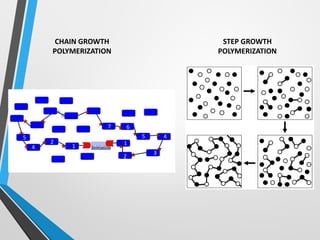
CHAIN GROWTH
POLYMERIZATION
STEP GROWTH
POLYMERIZATION
Initiation
1
7 6
4
3
5
2
2
1
5
4
PROPERTIES OF POLYMERS
DEPENDS ON
TYPE OF MONOMER
UNIT
MOLECULAR WEIGHT OF
POLYMER PRODUCT
DISTRIBUTION OF
MOLECULAR WEIGHT
POLYTHENE
TYPE OF MONOMER UNIT
POLY(TETRAFLUOROETHELENE)
• Comparatively high strength
• Heat resistant
• Low strength
• Comparatively low melting point
(melting temperature depends on the
type of polyethylene)
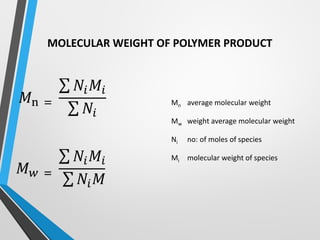
MOLECULAR WEIGHT OF POLYMER PRODUCT
Mn average molecular weight
Mw weight average molecular weight
Ni no: of moles of species
Mi molecular weight of species
DISTRIBUTION OF MOLECULAR WEIGHT
MECHANICAL PROPERTIES OF POLYMERS
1. TENSILE STRENGTH 2. YOUNG’S MODULUS
3. MELTING TEMPERATURE
4. GLASS TRANSITION
TEMPERATURE
Crystaline Solid
Melted
Glass
Rubber
y
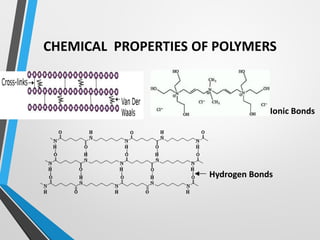
CHEMICAL PROPERTIES OF POLYMERS
Hydrogen Bonds
Ionic Bonds
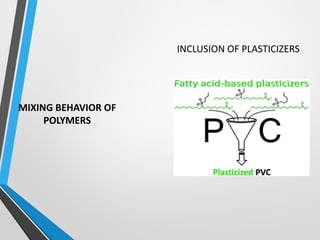
MIXING BEHAVIOR OF
POLYMERS
INCLUSION OF PLASTICIZERS
APPLICATIONS OF POLYMERS
Poly(Methyl Methacrylate) PMMA
• Contact lenses
• Bone cement
• Membrane of dialysis
• Dental restoration
• Linear chain polymer
• Hydrophobic
• Very good light
transmittance
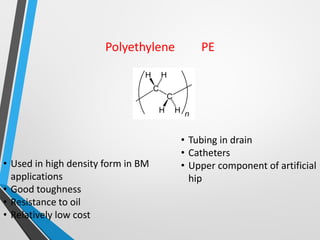
Polyethylene PE
• Used in high density form in BM
applications
• Good toughness
• Resistance to oil
• Relatively low cost
• Tubing in drain
• Catheters
• Upper component of artificial
hip
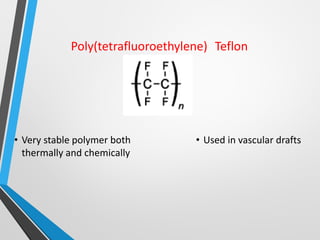
Poly(tetrafluoroethylene) Teflon
• Very stable polymer both
thermally and chemically
• Used in vascular drafts
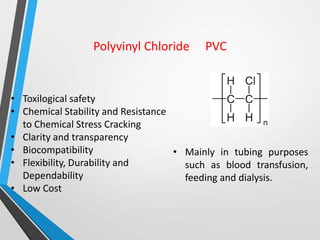
Polyvinyl Chloride PVC
• Mainly in tubing purposes
such as blood transfusion,
feeding and dialysis.
• Toxilogical safety
• Chemical Stability and Resistance
to Chemical Stress Cracking
• Clarity and transparency
• Biocompatibility
• Flexibility, Durability and
Dependability
• Low Cost
Nylon
• Sutures
widely used for general
closure of tissues
• Not recommended for
artificial prostheses in
cardiovascular surgeries
• Non-absorbable
• Excellent tensile strength
• Excellent knot security
properties
• Can be easily removed without
tissue adherence
• Infection resistant
IMPLANTABLE POLYMERS
• Used with biomedical additives to provide visibility on x-ray or stimulate bone
growth.
• Two types based on anticipated duration of the polymer in the body.
1. Long-Term Implantable Polymers
biodurable (non-resorbable) polymers
ex:- polyethylene
limited structural applications
polyketones (PEEK) for spinal applications or sutures
2. Bio resorbable Polymers
polylactide (PLA), polyglycolide (PGA) and copolymers of PLA/PGA
tailored to meet mechanical performance and resorption rates
non-structural drug delivery polymer applications
Polymers
Polymers

Polymers