OTTO CYCLE
Objective: Explain what is the Otto
cycle, how it works and application
By: Jonathan Tang
Otto Cycle
 Also known as 4 stroke cycle in technical
terms
 A Cycle used in internal combustion
engines
 The first such engine was built by the
German engineer Otto in 1861
4 Strokes of the Otto Cycle
 Cycle contains 4 strokes
1)Intake stroke
2)Compression stroke
3)Power stroke
4)Exhaust stroke
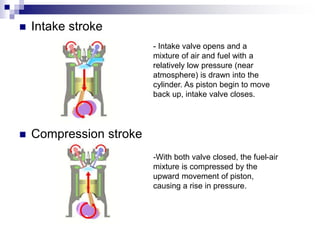
 Intake stroke
 Compression stroke
- Intake valve opens and a
mixture of air and fuel with a
relatively low pressure (near
atmosphere) is drawn into the
cylinder. As piston begin to move
back up, intake valve closes.
-With both valve closed, the fuel-air
mixture is compressed by the
upward movement of piston,
causing a rise in pressure.
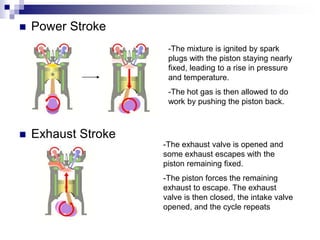
 Power Stroke
 Exhaust Stroke
-The mixture is ignited by spark
plugs with the piston staying nearly
fixed, leading to a rise in pressure
and temperature.
-The hot gas is then allowed to do
work by pushing the piston back.
-The exhaust valve is opened and
some exhaust escapes with the
piston remaining fixed.
-The piston forces the remaining
exhaust to escape. The exhaust
valve is then closed, the intake valve
opened, and the cycle repeats
Applications
 Common cycle used in internal combustion
engines.
 Otto cycle (4 stroke) engines are commonly
used in most cars and trucks today
Conclusion:
 Otto cycle engines are most commonly used
compare to 2 stroke or Wankel (rotary) engine
References
 http://en.wikipedia.org/wiki/Otto_cycle
 http://scienceworld.wolfram.com/physics/OttoCycle.html
 http://www.keveney.com/otto.html
 http://www.grc.nasa.gov/WWW/K12/airplane/engopt.html

Otto cycle

  • 1.
    OTTO CYCLE Objective: Explainwhat is the Otto cycle, how it works and application By: Jonathan Tang
  • 2.
    Otto Cycle  Alsoknown as 4 stroke cycle in technical terms  A Cycle used in internal combustion engines  The first such engine was built by the German engineer Otto in 1861
  • 3.
    4 Strokes ofthe Otto Cycle  Cycle contains 4 strokes 1)Intake stroke 2)Compression stroke 3)Power stroke 4)Exhaust stroke
  • 4.
     Intake stroke Compression stroke - Intake valve opens and a mixture of air and fuel with a relatively low pressure (near atmosphere) is drawn into the cylinder. As piston begin to move back up, intake valve closes. -With both valve closed, the fuel-air mixture is compressed by the upward movement of piston, causing a rise in pressure.
  • 5.
     Power Stroke Exhaust Stroke -The mixture is ignited by spark plugs with the piston staying nearly fixed, leading to a rise in pressure and temperature. -The hot gas is then allowed to do work by pushing the piston back. -The exhaust valve is opened and some exhaust escapes with the piston remaining fixed. -The piston forces the remaining exhaust to escape. The exhaust valve is then closed, the intake valve opened, and the cycle repeats
  • 6.
    Applications  Common cycleused in internal combustion engines.  Otto cycle (4 stroke) engines are commonly used in most cars and trucks today Conclusion:  Otto cycle engines are most commonly used compare to 2 stroke or Wankel (rotary) engine
  • 7.
    References  http://en.wikipedia.org/wiki/Otto_cycle  http://scienceworld.wolfram.com/physics/OttoCycle.html http://www.keveney.com/otto.html  http://www.grc.nasa.gov/WWW/K12/airplane/engopt.html