29/08/2021 SEU, DTE 1
Textile Fiber II (Tex-229)
7. Polyester fiber
Dept. of Textile Engineering
Southeast University
Introduction
● Polyester is the most used synthetic fiber.
● can be manufactured in different shapes and sizes
for specific purposes.
● most commonly are prepared from a condensation
reaction
● between an organic alcohol (containing hydroxyl
[OH] groups) and a carboxylic acid (containing
carboxyl [COOH] groups).
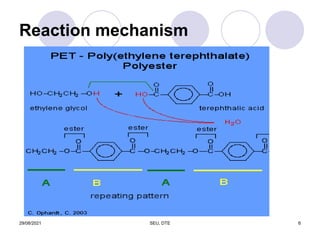
● These two functional groups react to form the
characteristic ester linkage, a chemical group with
the structure.
29/08/2021 SEU, DTE 2
29/08/2021 SEU, DTE 3
29/08/2021 SEU, DTE 4
29/08/2021 SEU, DTE 5
Reaction mechanism
29/08/2021 SEU, DTE 6
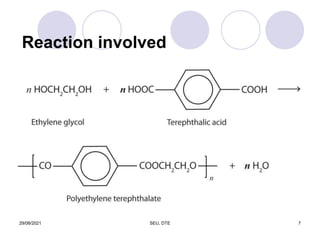
Reaction involved
29/08/2021 SEU, DTE 7
29/08/2021 SEU, DTE 8
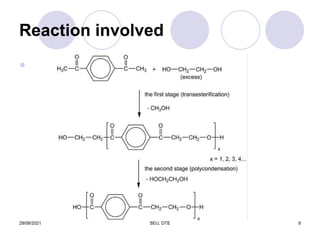
Reaction involved
●
29/08/2021 SEU, DTE 9
29/08/2021 SEU, DTE 10
29/08/2021 SEU, DTE 11
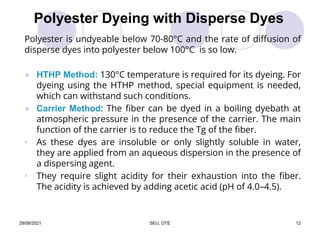
Polyester Dyeing with Disperse Dyes
Polyester is undyeable below 70-80°C and the rate of diffusion of
disperse dyes into polyester below 100°C is so low.
● HTHP Method: 130°C temperature is required for its dyeing. For
dyeing using the HTHP method, special equipment is needed,
which can withstand such conditions.
● Carrier Method: The fiber can be dyed in a boiling dyebath at
atmospheric pressure in the presence of the carrier. The main
function of the carrier is to reduce the Tg of the fiber.
• As these dyes are insoluble or only slightly soluble in water,
they are applied from an aqueous dispersion in the presence of
a dispersing agent.
• They require slight acidity for their exhaustion into the fiber.
The acidity is achieved by adding acetic acid (pH of 4.0–4.5).
29/08/2021 SEU, DTE 12
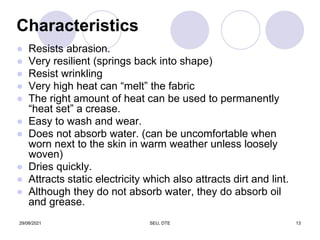
Characteristics
● Resists abrasion.
● Very resilient (springs back into shape)
● Resist wrinkling
● Very high heat can “melt” the fabric
● The right amount of heat can be used to permanently
“heat set” a crease.
● Easy to wash and wear.
● Does not absorb water. (can be uncomfortable when
worn next to the skin in warm weather unless loosely
woven)
● Dries quickly.
● Attracts static electricity which also attracts dirt and lint.
● Although they do not absorb water, they do absorb oil
and grease.
29/08/2021 SEU, DTE 13
Advantages and Disadvantages
● The fabrics made from polyester fiber have
● good elasticity,
● wrinkle resistance,
● shape retention,
● excellent wash-and-wear performance
● durability, and so on
● so that it is widely used in all kinds of apparel
fabrics.
● However, because polyester fibre is poor in
moisture absorption, its clothing makes the wearer
feel hot and sticky, produces static electricity easily
which results in clothing absorbing dust and
clinging to the body, and has poor comfort.
29/08/2021 SEU, DTE 14
29/08/2021 SEU, DTE 15
Uses of Polyester
29/08/2021 SEU, DTE 16
29/08/2021 SEU, DTE 17
Thanks to all
29/08/2021 SEU, DTE 18

Polyester Fiber & its all about information.pptx

  • 1.
    29/08/2021 SEU, DTE1 Textile Fiber II (Tex-229) 7. Polyester fiber Dept. of Textile Engineering Southeast University
  • 2.
    Introduction ● Polyester isthe most used synthetic fiber. ● can be manufactured in different shapes and sizes for specific purposes. ● most commonly are prepared from a condensation reaction ● between an organic alcohol (containing hydroxyl [OH] groups) and a carboxylic acid (containing carboxyl [COOH] groups). ● These two functional groups react to form the characteristic ester linkage, a chemical group with the structure. 29/08/2021 SEU, DTE 2
  • 3.
  • 4.
  • 5.
  • 6.
  • 7.
  • 8.
  • 9.
  • 10.
  • 11.
  • 12.
    Polyester Dyeing withDisperse Dyes Polyester is undyeable below 70-80°C and the rate of diffusion of disperse dyes into polyester below 100°C is so low. ● HTHP Method: 130°C temperature is required for its dyeing. For dyeing using the HTHP method, special equipment is needed, which can withstand such conditions. ● Carrier Method: The fiber can be dyed in a boiling dyebath at atmospheric pressure in the presence of the carrier. The main function of the carrier is to reduce the Tg of the fiber. • As these dyes are insoluble or only slightly soluble in water, they are applied from an aqueous dispersion in the presence of a dispersing agent. • They require slight acidity for their exhaustion into the fiber. The acidity is achieved by adding acetic acid (pH of 4.0–4.5). 29/08/2021 SEU, DTE 12
  • 13.
    Characteristics ● Resists abrasion. ●Very resilient (springs back into shape) ● Resist wrinkling ● Very high heat can “melt” the fabric ● The right amount of heat can be used to permanently “heat set” a crease. ● Easy to wash and wear. ● Does not absorb water. (can be uncomfortable when worn next to the skin in warm weather unless loosely woven) ● Dries quickly. ● Attracts static electricity which also attracts dirt and lint. ● Although they do not absorb water, they do absorb oil and grease. 29/08/2021 SEU, DTE 13
  • 14.
    Advantages and Disadvantages ●The fabrics made from polyester fiber have ● good elasticity, ● wrinkle resistance, ● shape retention, ● excellent wash-and-wear performance ● durability, and so on ● so that it is widely used in all kinds of apparel fabrics. ● However, because polyester fibre is poor in moisture absorption, its clothing makes the wearer feel hot and sticky, produces static electricity easily which results in clothing absorbing dust and clinging to the body, and has poor comfort. 29/08/2021 SEU, DTE 14
  • 15.
  • 16.
  • 17.
  • 18.