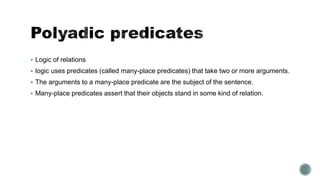
 Logic of relations
 logic uses predicates (called many-place predicates) that take two or more arguments.
 The arguments to a many-place predicate are the subject of the sentence.
 Many-place predicates assert that their objects stand in some kind of relation.
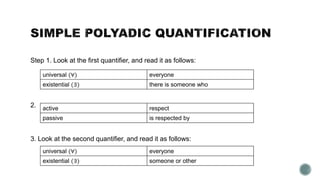
Step 1. Look at the first quantifier, and read it as follows:
2.
3. Look at the second quantifier, and read it as follows:
universal (∀) everyone
existential (∃) there is someone who
active respect
passive is respected by
universal (∀) everyone
existential (∃) someone or other
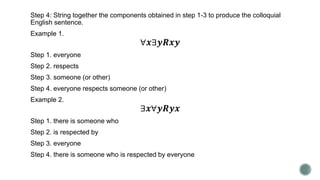
Step 4: String together the components obtained in step 1-3 to produce the colloquial
English sentence.
Example 1.
∀𝒙∃𝒚𝑹𝒙𝒚
Step 1. everyone
Step 2. respects
Step 3. someone (or other)
Step 4. everyone respects someone (or other)
Example 2.
∃𝒙∀𝒚𝑹𝒚𝒙
Step 1. there is someone who
Step 2. is respected by
Step 3. everyone
Step 4. there is someone who is respected by everyone
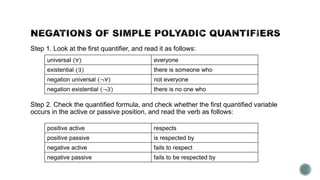
Step 1. Look at the first quantifier, and read it as follows:
Step 2. Check the quantified formula, and check whether the first quantified variable
occurs in the active or passive position, and read the verb as follows:
universal (∀) everyone
existential (∃) there is someone who
negation universal (¬∀) not everyone
negation existential (¬∃) there is no one who
positive active respects
positive passive is respected by
negative active fails to respect
negative passive fails to be respected by
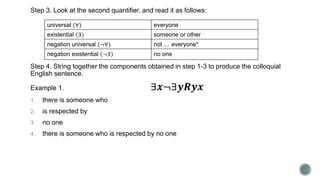
Step 3. Look at the second quantifier, and read it as follows:
Step 4. String together the components obtained in step 1-3 to produce the colloquial
English sentence.
Example 1. ∃𝒙¬∃𝒚𝑹𝒚𝒙
1. there is someone who
2. is respected by
3. no one
4. there is someone who is respected by no one
universal (∀) everyone
existential (∃) someone or other
negation universal (¬∀) not … everyone*
negation existential (¬∃) no one
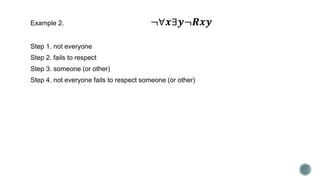
Example 2. ¬∀𝒙∃𝒚¬𝑹𝒙𝒚
Step 1. not everyone
Step 2. fails to respect
Step 3. someone (or other)
Step 4. not everyone fails to respect someone (or other)
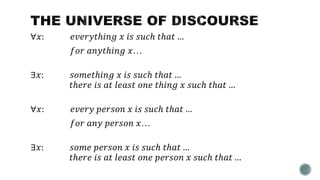
∀𝑥: 𝑒𝑣𝑒𝑟𝑦𝑡ℎ𝑖𝑛𝑔 𝑥 𝑖𝑠 𝑠𝑢𝑐ℎ 𝑡ℎ𝑎𝑡 …
𝑓𝑜𝑟 𝑎𝑛𝑦𝑡ℎ𝑖𝑛𝑔 𝑥…
∃𝑥: 𝑠𝑜𝑚𝑒𝑡ℎ𝑖𝑛𝑔 𝑥 𝑖𝑠 𝑠𝑢𝑐ℎ 𝑡ℎ𝑎𝑡 …
𝑡ℎ𝑒𝑟𝑒 𝑖𝑠 𝑎𝑡 𝑙𝑒𝑎𝑠𝑡 𝑜𝑛𝑒 𝑡ℎ𝑖𝑛𝑔 𝑥 𝑠𝑢𝑐ℎ 𝑡ℎ𝑎𝑡 …
∀𝑥: 𝑒𝑣𝑒𝑟𝑦 𝑝𝑒𝑟𝑠𝑜𝑛 𝑥 𝑖𝑠 𝑠𝑢𝑐ℎ 𝑡ℎ𝑎𝑡 …
𝑓𝑜𝑟 𝑎𝑛𝑦 𝑝𝑒𝑟𝑠𝑜𝑛 𝑥…
∃𝑥: 𝑠𝑜𝑚𝑒 𝑝𝑒𝑟𝑠𝑜𝑛 𝑥 𝑖𝑠 𝑠𝑢𝑐ℎ 𝑡ℎ𝑎𝑡 …
𝑡ℎ𝑒𝑟𝑒 𝑖𝑠 𝑎𝑡 𝑙𝑒𝑎𝑠𝑡 𝑜𝑛𝑒 𝑝𝑒𝑟𝑠𝑜𝑛 𝑥 𝑠𝑢𝑐ℎ 𝑡ℎ𝑎𝑡 …
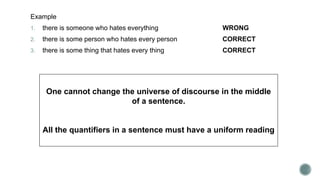
Example
1. there is someone who hates everything WRONG
2. there is some person who hates every person CORRECT
3. there is some thing that hates every thing CORRECT
One cannot change the universe of discourse in the middle
of a sentence.
All the quantifiers in a sentence must have a uniform reading
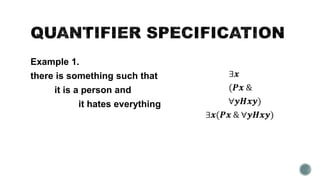
Example 1.
there is something such that
it is a person and
it hates everything
Example 2.
everything is such that
if it is a person,
then it hates something (or other)
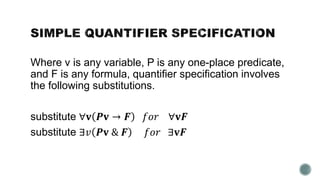
Where v is any variable, P is any one-place predicate,
and F is any formula, quantifier specification involves
the following substitutions.
substitute ∀𝐯 𝑷𝐯 → 𝑭 𝑓𝑜𝑟 ∀𝐯𝑭
substitute ∃𝑣 𝑷𝐯 & 𝑭 𝑓𝑜𝑟 ∃𝐯𝑭
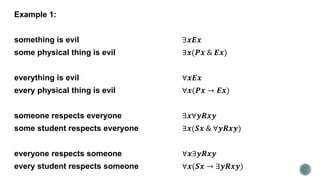
Example 1:
something is evil ∃𝒙𝑬𝒙
some physical thing is evil ∃𝒙(𝑷𝒙 & 𝑬𝒙)
everything is evil ∀𝒙𝑬𝒙
every physical thing is evil ∀𝒙(𝑷𝒙 → 𝑬𝒙)
someone respects everyone ∃𝒙∀𝒚𝑹𝒙𝒚
some student respects everyone ∃𝒙(𝑺𝒙 & ∀𝒚𝑹𝒙𝒚)
everyone respects someone ∀𝒙∃𝒚𝑹𝒙𝒚
every student respects someone ∀𝒙(𝑺𝒙 → ∃𝒚𝑹𝒙𝒚)
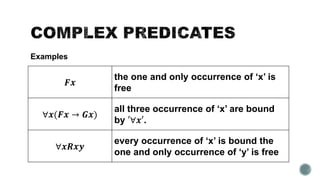
Examples
𝑭𝒙
the one and only occurrence of ‘x’ is
free
∀𝒙(𝑭𝒙 → 𝑮𝒙)
all three occurrence of ‘x’ are bound
by ′∀𝒙′.
∀𝒙𝑹𝒙𝒚
every occurrence of ‘x’ is bound the
one and only occurrence of ‘y’ is free
Example 1
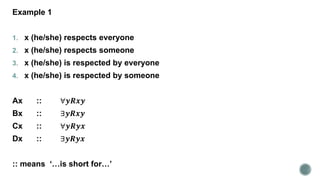
1. x (he/she) respects everyone
2. x (he/she) respects someone
3. x (he/she) is respected by everyone
4. x (he/she) is respected by someone
Ax :: ∀𝒚𝑹𝒙𝒚
Bx :: ∃𝒚𝑹𝒙𝒚
Cx :: ∀𝒚𝑹𝒚𝒙
Dx :: ∃𝒚𝑹𝒚𝒙
:: means ‘…is short for…’
1. some Freshman is A
2. every Freshman is B
3. no Freshman is C
4. some Freshman is not D
some Freshman respect everyone
every Freshman respects someone
no Freshman is respected by everyone
some Freshman is not respected by someone
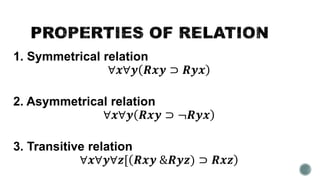
1. Symmetrical relation
∀𝒙∀𝒚 𝑹𝒙𝒚 ⊃ 𝑹𝒚𝒙
2. Asymmetrical relation
∀𝒙∀𝒚 𝑹𝒙𝒚 ⊃ ¬𝑹𝒚𝒙
3. Transitive relation
∀𝒙∀𝒚∀𝒛[ 𝑹𝒙𝒚 &𝑹𝒚𝒛) ⊃ 𝑹𝒙𝒛
4. Intransitive relation
∀𝒙∀𝒚∀𝒛[ 𝑹𝒙𝒚 &𝑹𝒚𝒛) ⊃ ¬𝑹𝒙𝒛
5. Reflexive relation
∀𝒙[∃𝒚 (𝑹𝒙𝒚 𝐯 𝑹𝒚𝒙) ⊃ 𝑹𝒙𝒙]
6. Irreflexive relation
∀𝒙¬𝑹𝒙𝒙
Activity
1. there is someone who respects everyone
2. there is a student who respects every professor
3. there is a professor who respects every student
4. there is someone who is respected by everyone
5. there is a student who is respected by every professor
6. there is a professor who is respected by every student

Polyadic predicates

  • 2.
     Logic ofrelations  logic uses predicates (called many-place predicates) that take two or more arguments.  The arguments to a many-place predicate are the subject of the sentence.  Many-place predicates assert that their objects stand in some kind of relation.
  • 3.
    Step 1. Lookat the first quantifier, and read it as follows: 2. 3. Look at the second quantifier, and read it as follows: universal (∀) everyone existential (∃) there is someone who active respect passive is respected by universal (∀) everyone existential (∃) someone or other
  • 4.
    Step 4: Stringtogether the components obtained in step 1-3 to produce the colloquial English sentence. Example 1. ∀𝒙∃𝒚𝑹𝒙𝒚 Step 1. everyone Step 2. respects Step 3. someone (or other) Step 4. everyone respects someone (or other) Example 2. ∃𝒙∀𝒚𝑹𝒚𝒙 Step 1. there is someone who Step 2. is respected by Step 3. everyone Step 4. there is someone who is respected by everyone
  • 5.
    Step 1. Lookat the first quantifier, and read it as follows: Step 2. Check the quantified formula, and check whether the first quantified variable occurs in the active or passive position, and read the verb as follows: universal (∀) everyone existential (∃) there is someone who negation universal (¬∀) not everyone negation existential (¬∃) there is no one who positive active respects positive passive is respected by negative active fails to respect negative passive fails to be respected by
  • 6.
    Step 3. Lookat the second quantifier, and read it as follows: Step 4. String together the components obtained in step 1-3 to produce the colloquial English sentence. Example 1. ∃𝒙¬∃𝒚𝑹𝒚𝒙 1. there is someone who 2. is respected by 3. no one 4. there is someone who is respected by no one universal (∀) everyone existential (∃) someone or other negation universal (¬∀) not … everyone* negation existential (¬∃) no one
  • 7.
    Example 2. ¬∀𝒙∃𝒚¬𝑹𝒙𝒚 Step1. not everyone Step 2. fails to respect Step 3. someone (or other) Step 4. not everyone fails to respect someone (or other)
  • 8.
    ∀𝑥: 𝑒𝑣𝑒𝑟𝑦𝑡ℎ𝑖𝑛𝑔 𝑥𝑖𝑠 𝑠𝑢𝑐ℎ 𝑡ℎ𝑎𝑡 … 𝑓𝑜𝑟 𝑎𝑛𝑦𝑡ℎ𝑖𝑛𝑔 𝑥… ∃𝑥: 𝑠𝑜𝑚𝑒𝑡ℎ𝑖𝑛𝑔 𝑥 𝑖𝑠 𝑠𝑢𝑐ℎ 𝑡ℎ𝑎𝑡 … 𝑡ℎ𝑒𝑟𝑒 𝑖𝑠 𝑎𝑡 𝑙𝑒𝑎𝑠𝑡 𝑜𝑛𝑒 𝑡ℎ𝑖𝑛𝑔 𝑥 𝑠𝑢𝑐ℎ 𝑡ℎ𝑎𝑡 … ∀𝑥: 𝑒𝑣𝑒𝑟𝑦 𝑝𝑒𝑟𝑠𝑜𝑛 𝑥 𝑖𝑠 𝑠𝑢𝑐ℎ 𝑡ℎ𝑎𝑡 … 𝑓𝑜𝑟 𝑎𝑛𝑦 𝑝𝑒𝑟𝑠𝑜𝑛 𝑥… ∃𝑥: 𝑠𝑜𝑚𝑒 𝑝𝑒𝑟𝑠𝑜𝑛 𝑥 𝑖𝑠 𝑠𝑢𝑐ℎ 𝑡ℎ𝑎𝑡 … 𝑡ℎ𝑒𝑟𝑒 𝑖𝑠 𝑎𝑡 𝑙𝑒𝑎𝑠𝑡 𝑜𝑛𝑒 𝑝𝑒𝑟𝑠𝑜𝑛 𝑥 𝑠𝑢𝑐ℎ 𝑡ℎ𝑎𝑡 …
  • 9.
    Example 1. there issomeone who hates everything WRONG 2. there is some person who hates every person CORRECT 3. there is some thing that hates every thing CORRECT One cannot change the universe of discourse in the middle of a sentence. All the quantifiers in a sentence must have a uniform reading
  • 10.
    Example 1. there issomething such that it is a person and it hates everything
  • 11.
    Example 2. everything issuch that if it is a person, then it hates something (or other)
  • 12.
    Where v isany variable, P is any one-place predicate, and F is any formula, quantifier specification involves the following substitutions. substitute ∀𝐯 𝑷𝐯 → 𝑭 𝑓𝑜𝑟 ∀𝐯𝑭 substitute ∃𝑣 𝑷𝐯 & 𝑭 𝑓𝑜𝑟 ∃𝐯𝑭
  • 13.
    Example 1: something isevil ∃𝒙𝑬𝒙 some physical thing is evil ∃𝒙(𝑷𝒙 & 𝑬𝒙) everything is evil ∀𝒙𝑬𝒙 every physical thing is evil ∀𝒙(𝑷𝒙 → 𝑬𝒙) someone respects everyone ∃𝒙∀𝒚𝑹𝒙𝒚 some student respects everyone ∃𝒙(𝑺𝒙 & ∀𝒚𝑹𝒙𝒚) everyone respects someone ∀𝒙∃𝒚𝑹𝒙𝒚 every student respects someone ∀𝒙(𝑺𝒙 → ∃𝒚𝑹𝒙𝒚)
  • 14.
    Examples 𝑭𝒙 the one andonly occurrence of ‘x’ is free ∀𝒙(𝑭𝒙 → 𝑮𝒙) all three occurrence of ‘x’ are bound by ′∀𝒙′. ∀𝒙𝑹𝒙𝒚 every occurrence of ‘x’ is bound the one and only occurrence of ‘y’ is free
  • 15.
    Example 1 1. x(he/she) respects everyone 2. x (he/she) respects someone 3. x (he/she) is respected by everyone 4. x (he/she) is respected by someone Ax :: ∀𝒚𝑹𝒙𝒚 Bx :: ∃𝒚𝑹𝒙𝒚 Cx :: ∀𝒚𝑹𝒚𝒙 Dx :: ∃𝒚𝑹𝒚𝒙 :: means ‘…is short for…’
  • 16.
    1. some Freshmanis A 2. every Freshman is B 3. no Freshman is C 4. some Freshman is not D some Freshman respect everyone every Freshman respects someone no Freshman is respected by everyone some Freshman is not respected by someone
  • 17.
    1. Symmetrical relation ∀𝒙∀𝒚𝑹𝒙𝒚 ⊃ 𝑹𝒚𝒙 2. Asymmetrical relation ∀𝒙∀𝒚 𝑹𝒙𝒚 ⊃ ¬𝑹𝒚𝒙 3. Transitive relation ∀𝒙∀𝒚∀𝒛[ 𝑹𝒙𝒚 &𝑹𝒚𝒛) ⊃ 𝑹𝒙𝒛
  • 18.
    4. Intransitive relation ∀𝒙∀𝒚∀𝒛[𝑹𝒙𝒚 &𝑹𝒚𝒛) ⊃ ¬𝑹𝒙𝒛 5. Reflexive relation ∀𝒙[∃𝒚 (𝑹𝒙𝒚 𝐯 𝑹𝒚𝒙) ⊃ 𝑹𝒙𝒙] 6. Irreflexive relation ∀𝒙¬𝑹𝒙𝒙
  • 19.
    Activity 1. there issomeone who respects everyone 2. there is a student who respects every professor 3. there is a professor who respects every student 4. there is someone who is respected by everyone 5. there is a student who is respected by every professor 6. there is a professor who is respected by every student

Editor's Notes

  • #4 Step 1: Step 2: Look to see which variable is quantified (is it ‘x’ or ‘y’?), then check where that variable appears in the quantified formula; does it appear in the first (active) position, or does it appear in the second (passive) position? If it appears in the first (active) position, then read the verb in the active voice as ‘respects’. If it appears in the second (passive) position, then read the verb in the passive voice as ‘is respected by’ (passive voice).
  • #9 As you have noticed, quantifiers are read in different manner. The usual readings are ……… on the other hand, the following readings are used. In other words, depending on the specific example, the various quantifiers are read differently. If we are taking exclusively about persons, then it is convenient to read ‘Ax’ as ‘everyone’ and “Ex” as someone rather than “everything” and “something”. If we are taking exclusively in numbers then the most convenient to read is “every number” and “some number”. The universe of discourse is, in any given context, the set of all the possible things that the constants and variables refer to.
  • #10 In symbolizing English sentences, one must first established exactly what Universal discourse is. In our case, we allow two possible choices for U. In some cases, both ‘everyone’ and ‘everything’ appear in the same sentence. In such cases, one must explicitly supply the predicate’…is a person’ in order to symbolize the sentence. Consider the following example….. which means that “there is some person who hates every thing” The following is not a correct translation. The principle here is….
  • #11 So, how do we symbolize? First, we must choose a universe of discourse that is large enough to encompass everything that we are taking about. Lets have an example.
  • #15 Complex predicates stand to simple (ordinary) predicates as complex (molecular) formulas stand to simple (atomic) formulas. Like ordinary predicates, complex predicates have places; there are one-place, two-place, etc., complex predicates. However, we are going to concentrate exclusively on one-place complex predicates. The notion of a complex one-place predicate depends on the notion of a free occurrence of a variable. An occurrence of a variable in a formula is bound if it falls inside the scope of a quantifier governing that variable; otherwise, the occurrence is free. Note: Any formula with exactly one free variable
  • #16 To see how it works, let us translate the following formulas into colloquial English. Now, if we say of someone that he/she respects everyone, then we are attributing a complex predicate to that person. We can abbreviate this complex predicates’ Ax’, which stands for ‘x respects everyone’.
  • #17 Now, complex predicates can be used in sentences just like ordinary predicates. For example………Recalling what A, B, C, and D are short for, these are read colloquially as …..
  • #18 Symmetrical – R is a symmetrical relation if aRb implies bRa. Ex. If Matt is the twin of Mark, then Mark is the twin of Matt. 2. Asymmetrical – having two sides or halves that are not the same Ex. If Raff is the father of Elijah, then Elijah cannot be the father of Raff. 3. Transitive – a relation with the property that if the relation holds between a first element and a second and between the second element and a third, it holds between the first and third elements Ex. If Regine is older than Jhoremar, and Jhoremar is older than Amy, then Regine is older then Amy.
  • #19 4. Intransitive – characterized by not having or containing a direct object Ex. Paul is the father Neil, and Neil is the father of Derreck, then Paul is not the father of Derreck. 5. Reflexive – a relation that exist between an entity and itself Ex. If Raff is the same age as Neil, it follows that Raff is the same age as himself. 6. Irreflexive – a relation for which the reflexive property does not hold for any element of a given set Ex. If Jhoremar is the brother of Neil, it follows that he is not the brother of himself.