I/O DEVICES
SUBJECT: English for Computer Science
Semester 2 - 2024 - 2025
Trần Quang Minh
INTRODUCTION
1. What is a microphone
and how it was invented
2. Structure and working
principle of microphone
3. Types of microphone
4. Applications of
microphone
Nguyễn Thành Tài - 23110309
Trần Quang Minh - 23110269
Trần Trí Tình - 23110341
Huỳnh Duy Nguyên - 23110270
Trần Quang Minh
TERMINOLOGY
Microphone (Mic) – Micrô (thiết bị thu âm)
Acoustic signals – Tín hiệu âm thanh
Broadcasting – Phát thanh, truyền hình
Speech recognition – Nhận diện giọng nói
Carbon Microphone – Micrô than
Diaphragm – Màng rung
Transducer – Bộ chuyển đổi tín hiệu
Electromagnetic induction – Cảm ứng điện từ
Piezoelectric effect – Hiệu ứng áp điện
Preamplifier – Bộ tiền khuếch đại
Phantom power – Nguồn điện ảo (48V)
Ribbon Microphone – Micrô dải băng
Surveillance – Giám sát
Voice recognition – Nhận diện giọng nói
Trần Quang Minh
What is a
microphone
&
how it was
invented
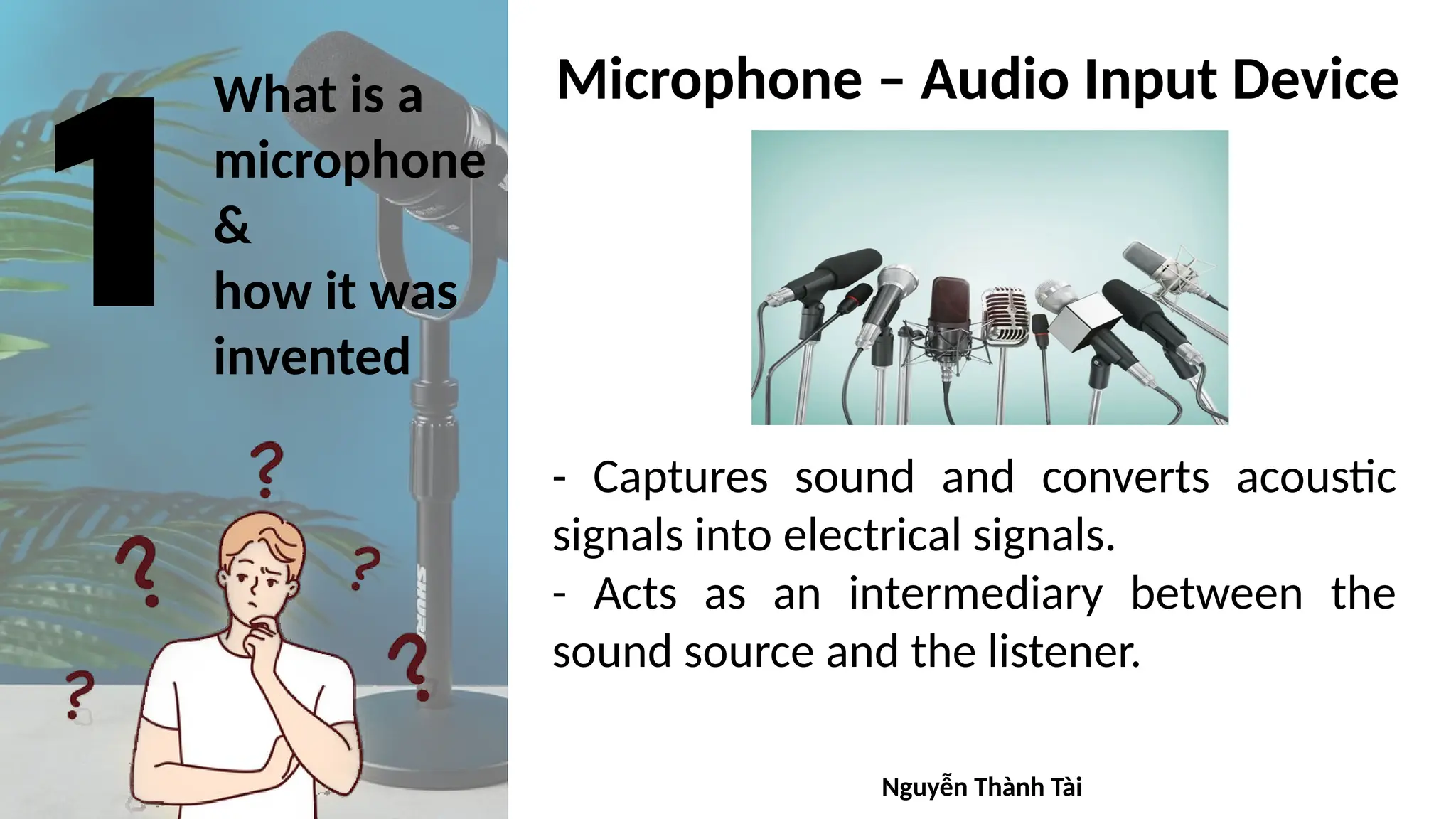
- Captures sound and converts acoustic
signals into electrical signals.
- Acts as an intermediary between the
sound source and the listener.
Microphone – Audio Input Device
Nguyễn Thành Tài
What is a
microphone
&
How it was
invented
Such a genius invention!!!
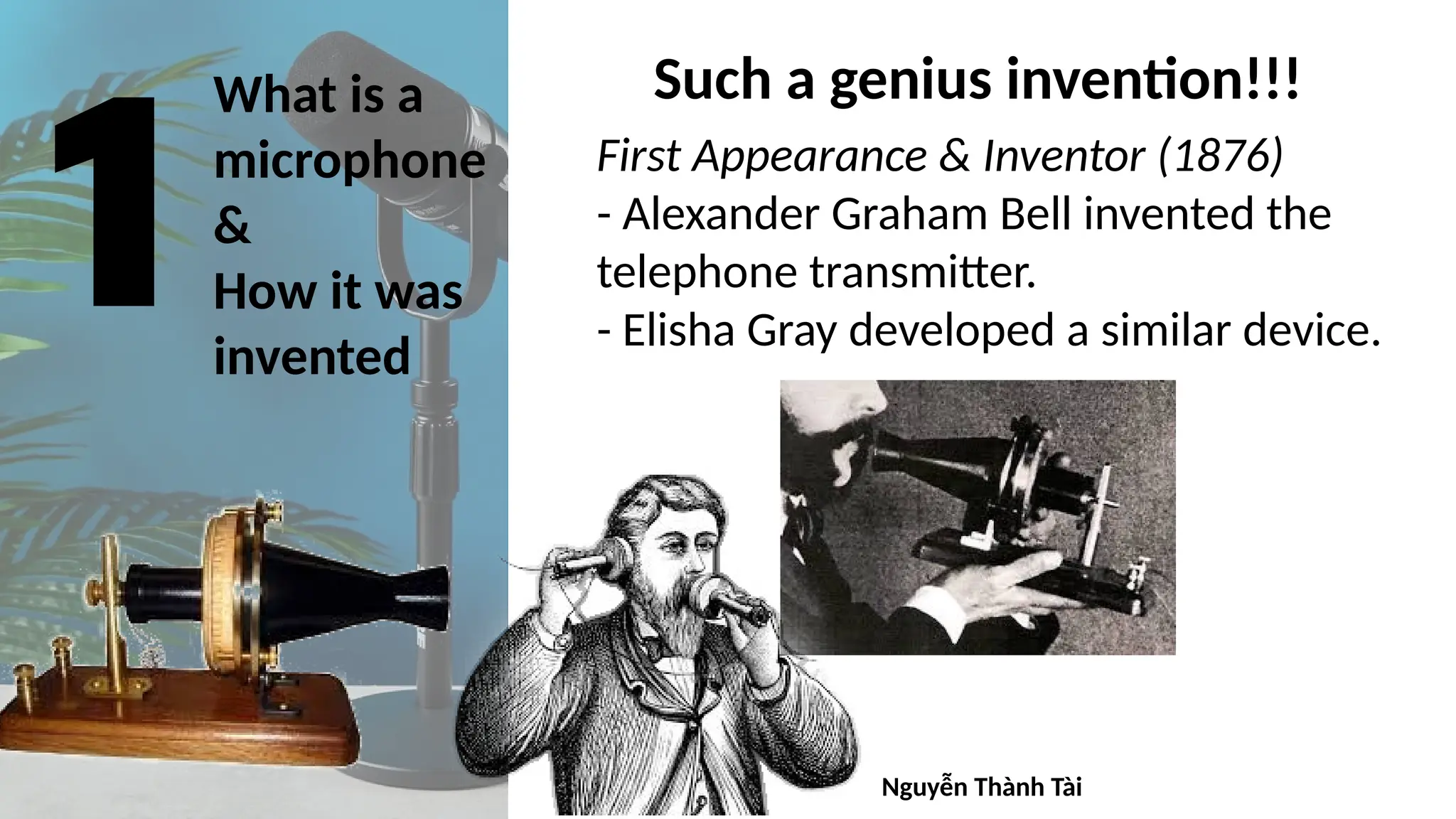
First Appearance & Inventor (1876)
- Alexander Graham Bell invented the
telephone transmitter.
- Elisha Gray developed a similar device.
Nguyễn Thành Tài
What is a
microphone
&
How it was
invented
Such a genius invention!!!
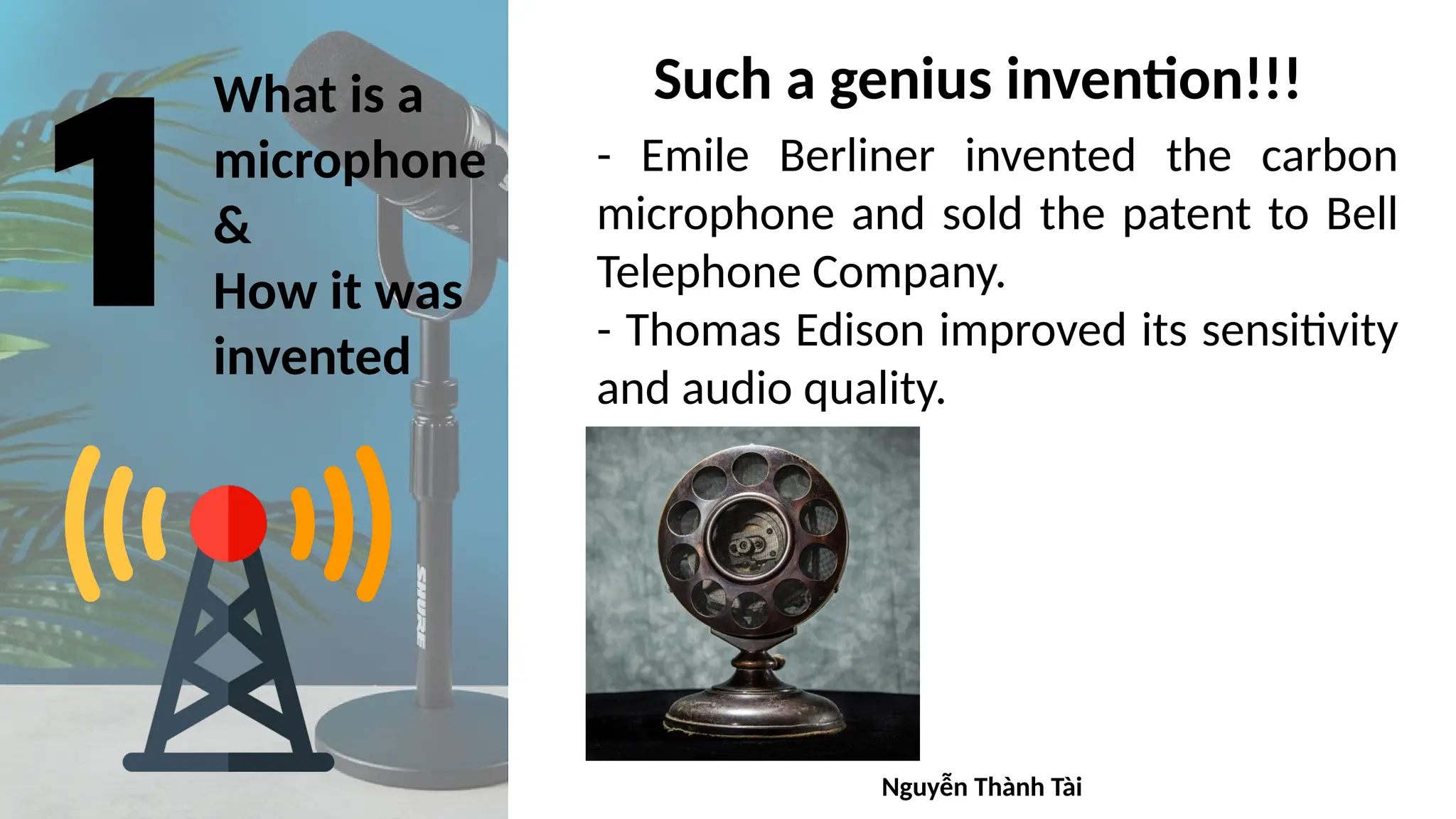
- Emile Berliner invented the carbon
microphone and sold the patent to Bell
Telephone Company.
- Thomas Edison improved its sensitivity
and audio quality.
Nguyễn Thành Tài
Types of
microphone
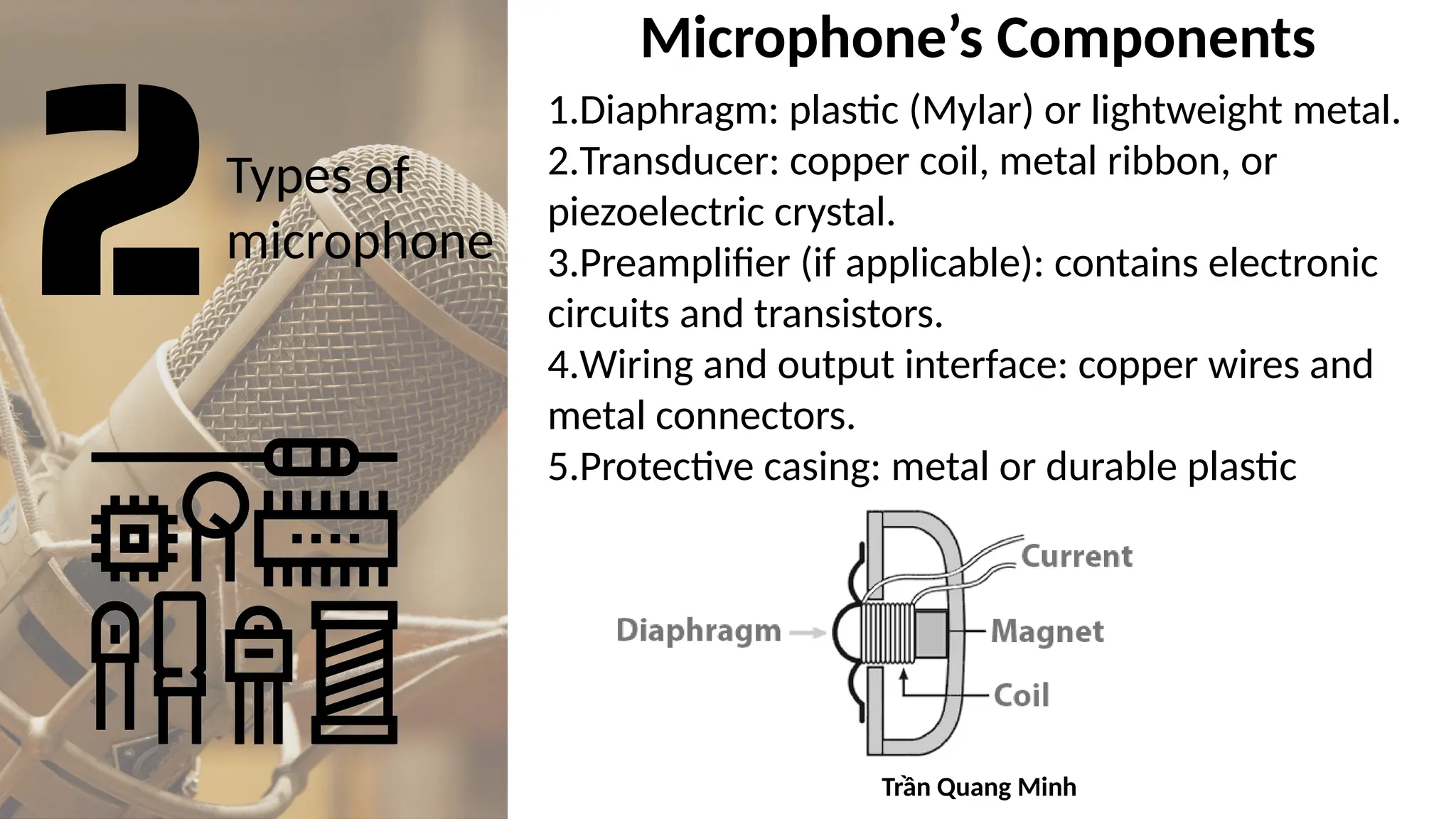
Microphone’s Components
1.Diaphragm: plastic (Mylar) or lightweight metal.
2.Transducer: copper coil, metal ribbon, or
piezoelectric crystal.
3.Preamplifier (if applicable): contains electronic
circuits and transistors.
4.Wiring and output interface: copper wires and
metal connectors.
5.Protective casing: metal or durable plastic
Trần Quang Minh
Structure
&
Working
principle of
microphone
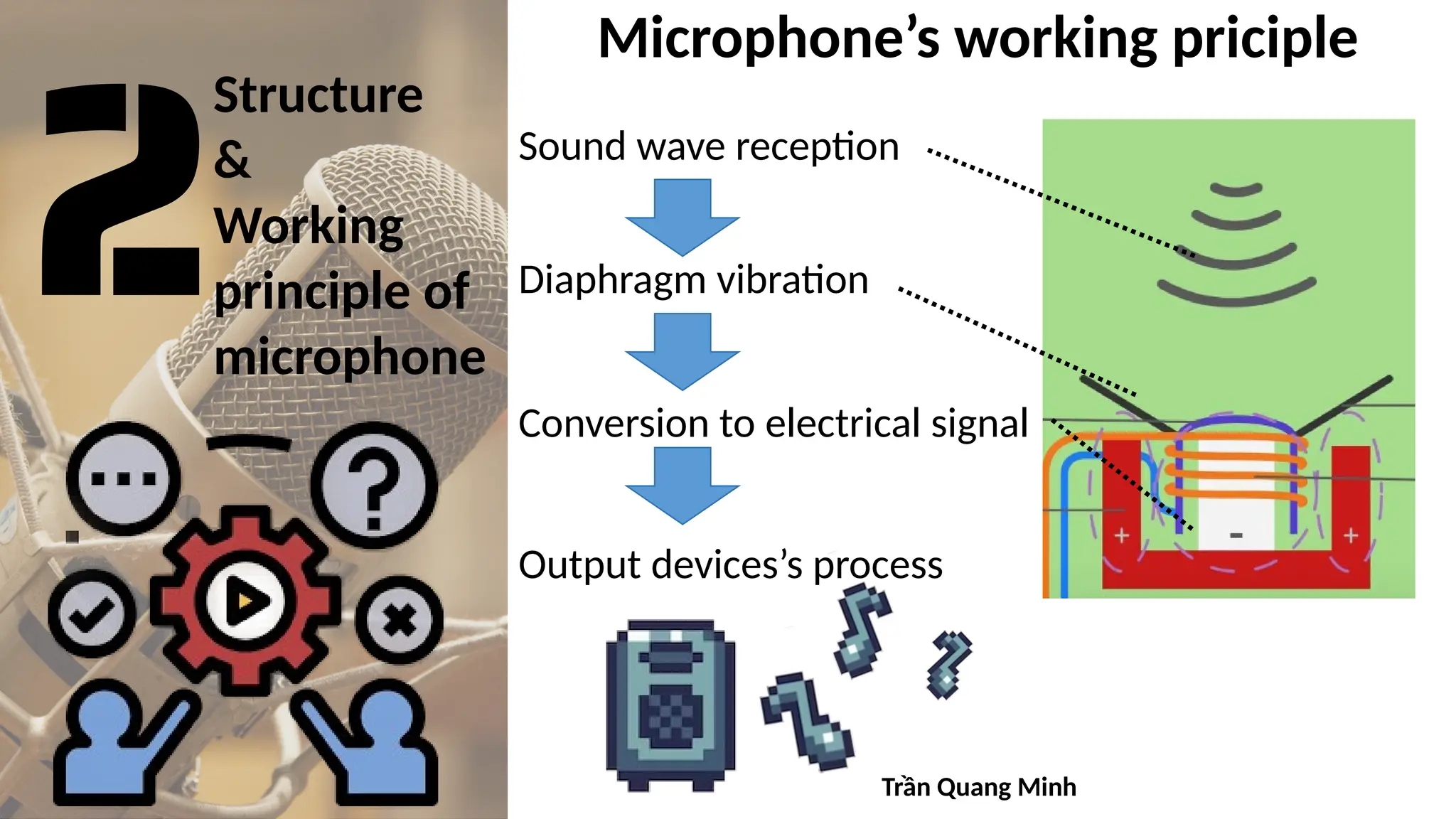
Microphone’s working priciple
Sound wave reception
Conversion to electrical signal
Diaphragm vibration
Output devices’s process
Trần Quang Minh
Structure
&
Working
principle of
microphone
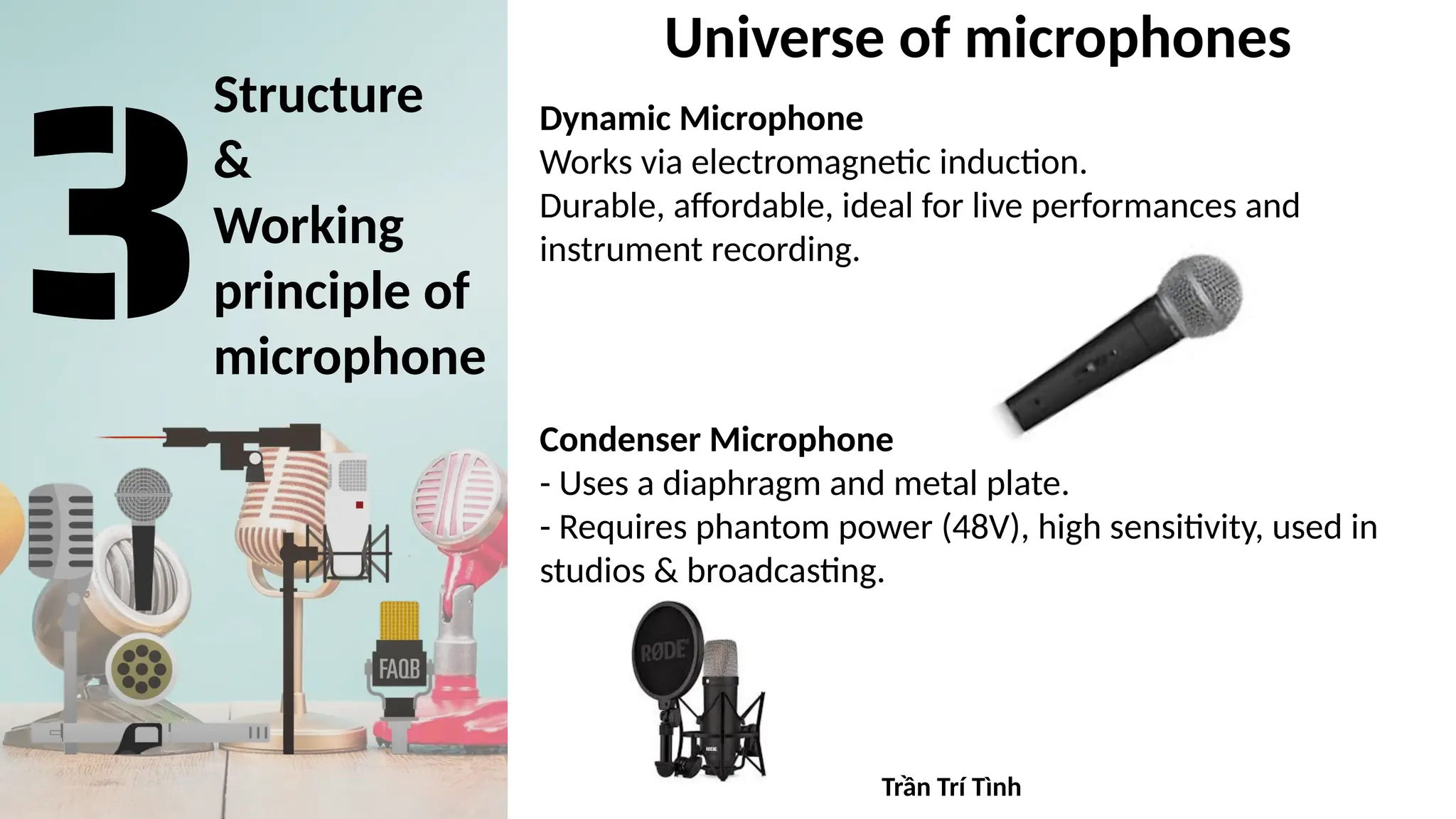
Universe of microphones
Dynamic Microphone
Works via electromagnetic induction.
Durable, affordable, ideal for live performances and
instrument recording.
Condenser Microphone
- Uses a diaphragm and metal plate.
- Requires phantom power (48V), high sensitivity, used in
studios & broadcasting.
Trần Trí Tình
Structure
&
Working
principle of
microphone
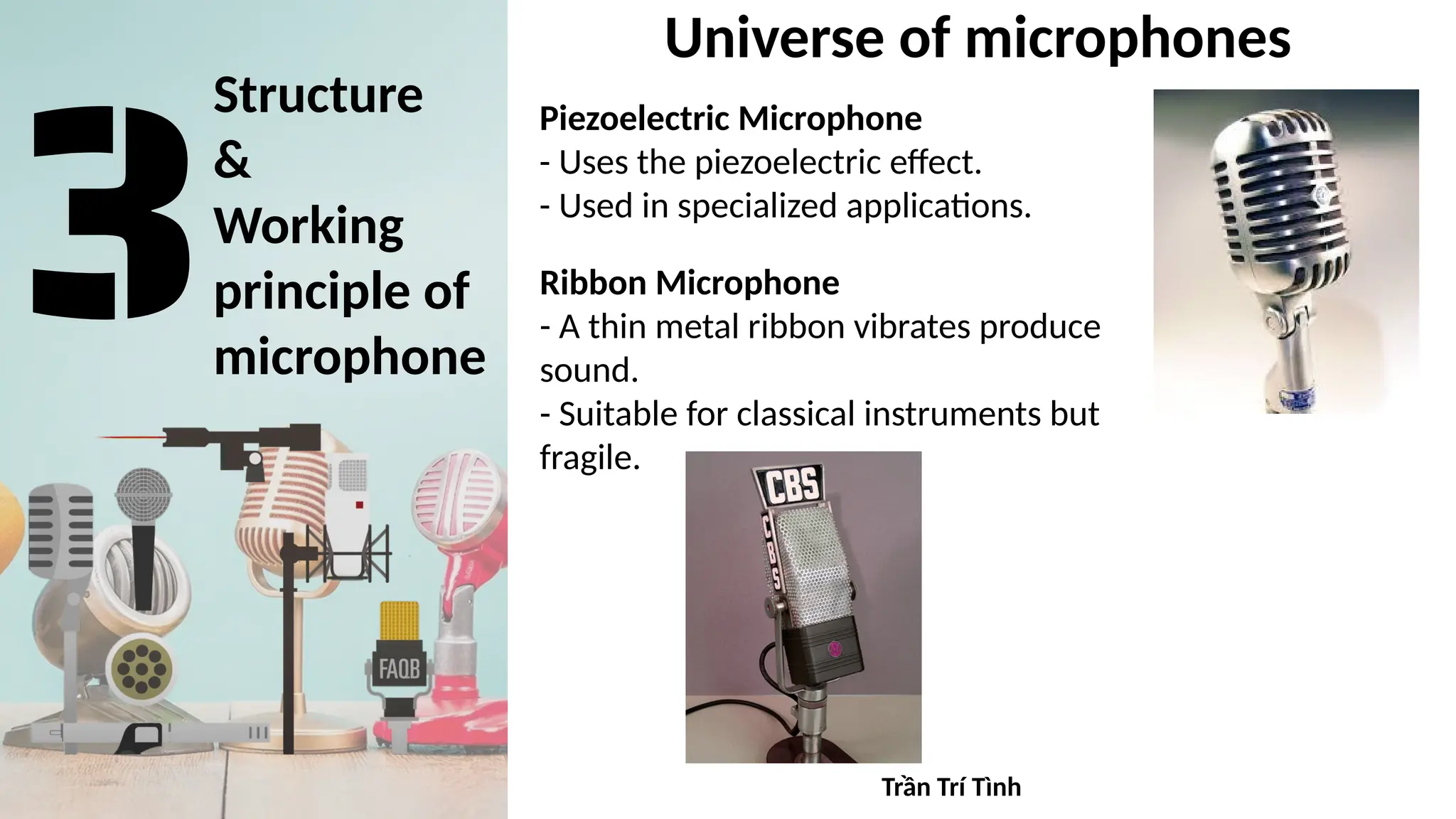
Universe of microphones
Piezoelectric Microphone
- Uses the piezoelectric effect.
- Used in specialized applications.
Ribbon Microphone
- A thin metal ribbon vibrates produce
sound.
- Suitable for classical instruments but
fragile.
Trần Trí Tình
Structure
&
Working
principle of
microphone
Universe of microphones
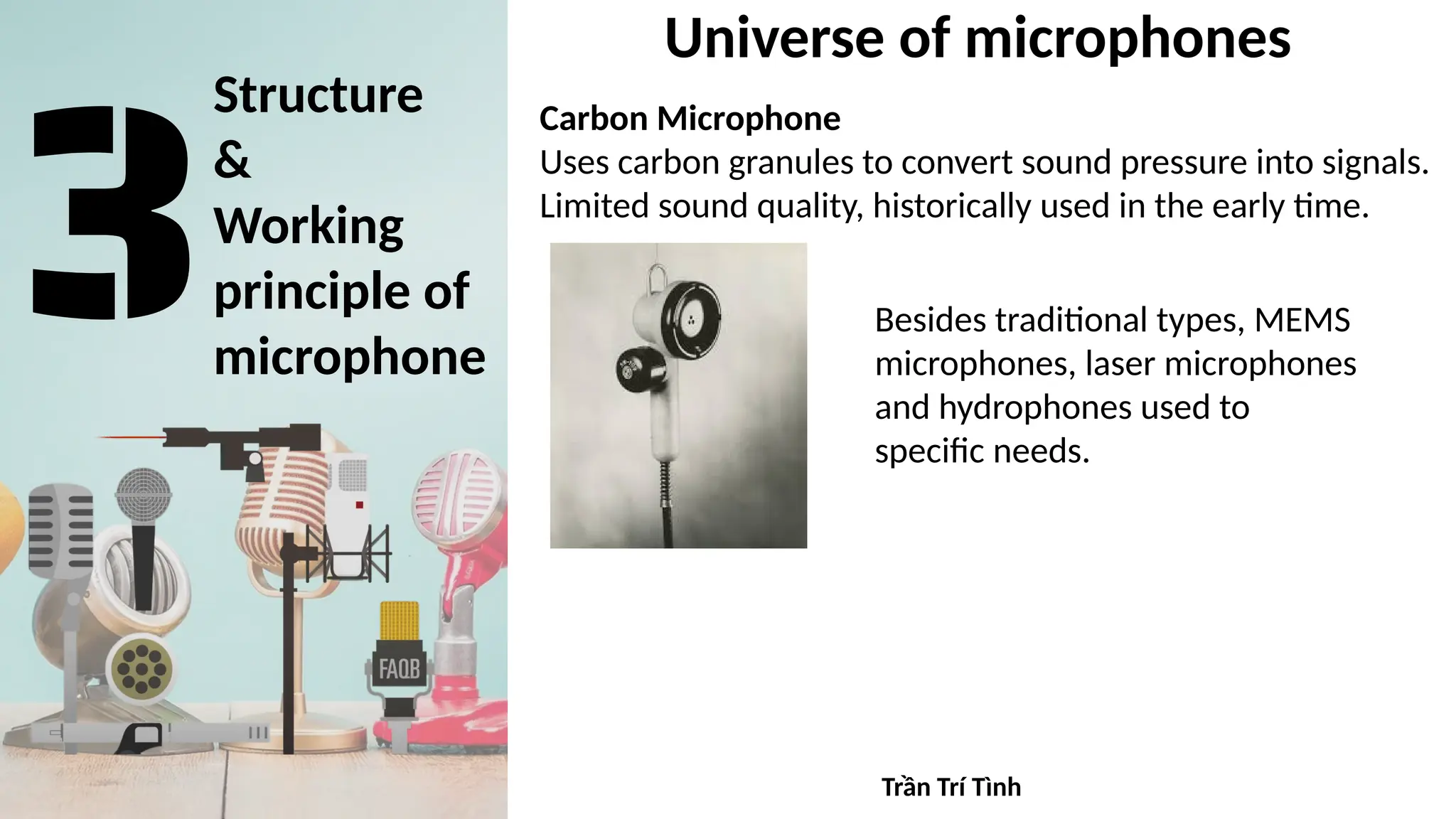
Carbon Microphone
Uses carbon granules to convert sound pressure into signals.
Limited sound quality, historically used in the early time.
Besides traditional types, MEMS
microphones, laser microphones
and hydrophones used to
specific needs.
Trần Trí Tình
Applications
of
microphone
Microphone in our life
Communication
Used in online meetings,
public speaking, broadcasting,
and by teachers, journalists,
and politicians for clear voice
projection.
Entertainment & Media
Essential for concerts,
recordings, films, podcasts,
and content creators to
enhance audio quality.
Huỳnh Duy Nguyên
Applications
of
microphone
Microphone in our life
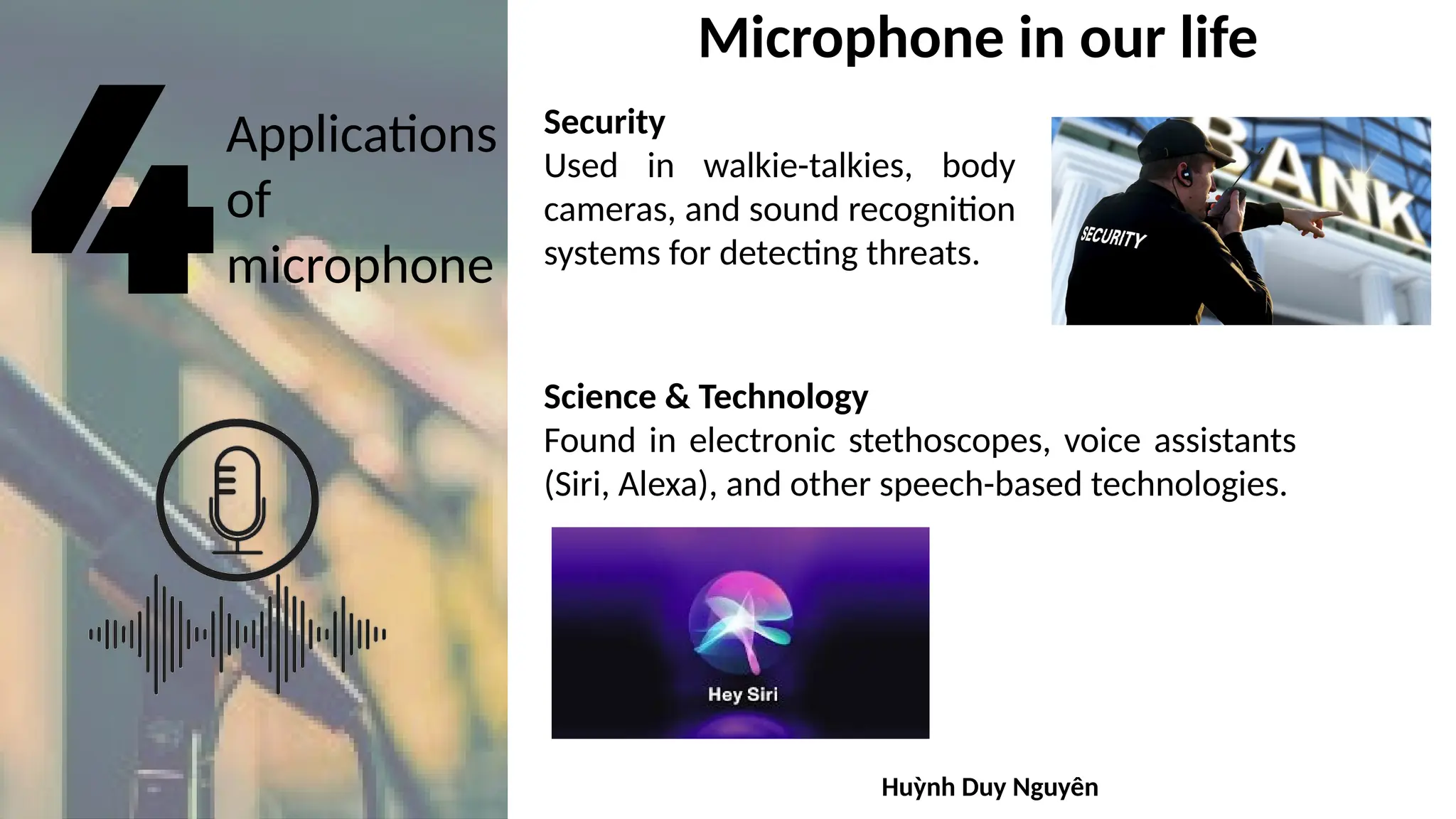
Security
Used in walkie-talkies, body
cameras, and sound recognition
systems for detecting threats.
Science & Technology
Found in electronic stethoscopes, voice assistants
(Siri, Alexa), and other speech-based technologies.
Huỳnh Duy Nguyên
CONCLUSION
Microphones convert sound into
electrical signals, revolutionizing
communication, entertainment, and
technology. As they evolve, they
remain essential for innovation and
daily life.
Trần Quang Minh
REVIEW QUESTION
1. What is the main function of a microphone?
A. Playing music
B. Capturing and converting sound into an
electrical signal
C. Increasing speaker volume
D. Recording images
Trần Quang Minh
REVIEW QUESTION
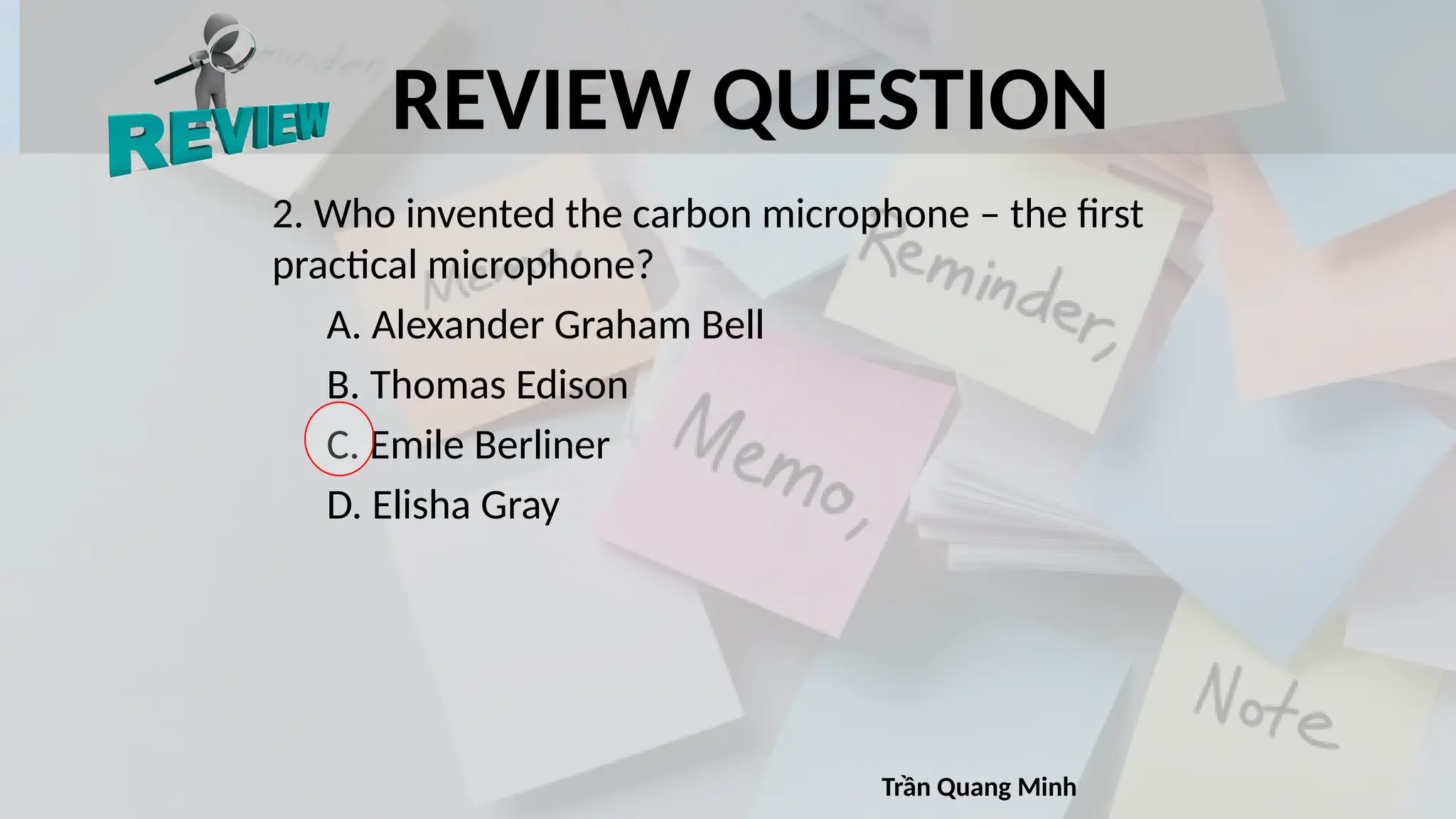
2. Who invented the carbon microphone – the first
practical microphone?
A. Alexander Graham Bell
B. Thomas Edison
C. Emile Berliner
D. Elisha Gray
Trần Quang Minh
REVIEW QUESTION
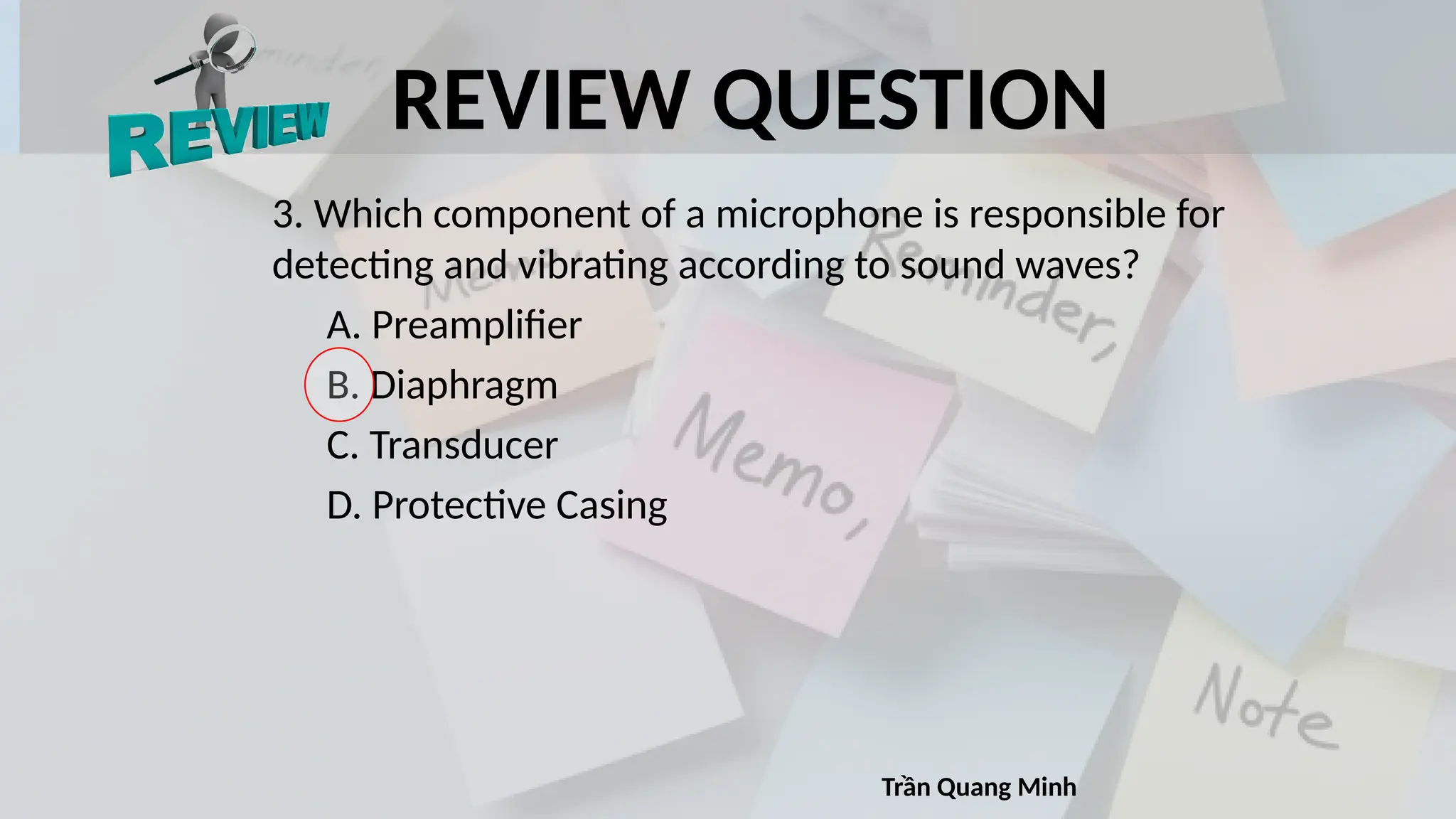
3. Which component of a microphone is responsible for
detecting and vibrating according to sound waves?
A. Preamplifier
B. Diaphragm
C. Transducer
D. Protective Casing
Trần Quang Minh
REVIEW QUESTION
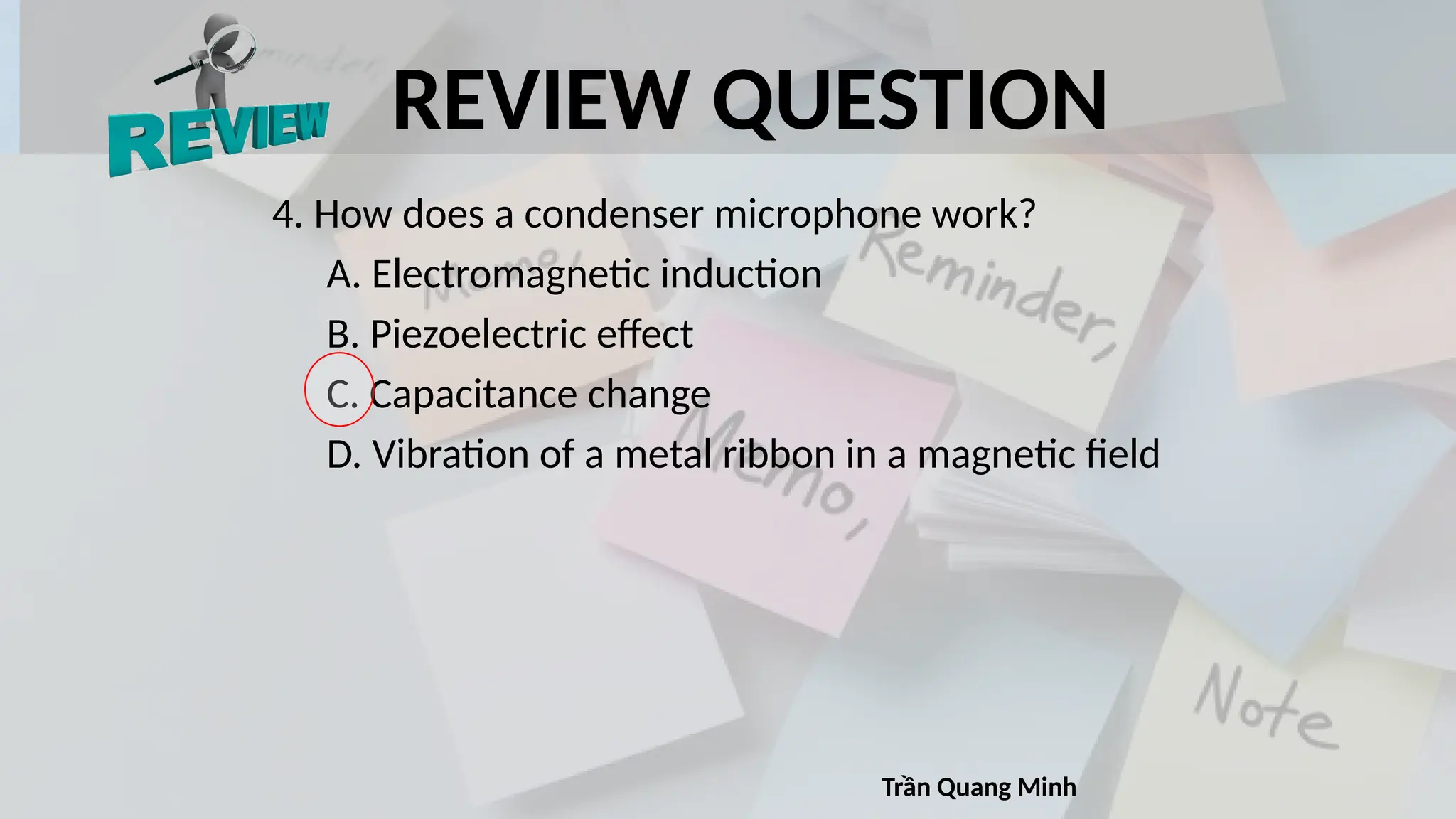
4. How does a condenser microphone work?
A. Electromagnetic induction
B. Piezoelectric effect
C. Capacitance change
D. Vibration of a metal ribbon in a magnetic field
Trần Quang Minh
REVIEW QUESTION
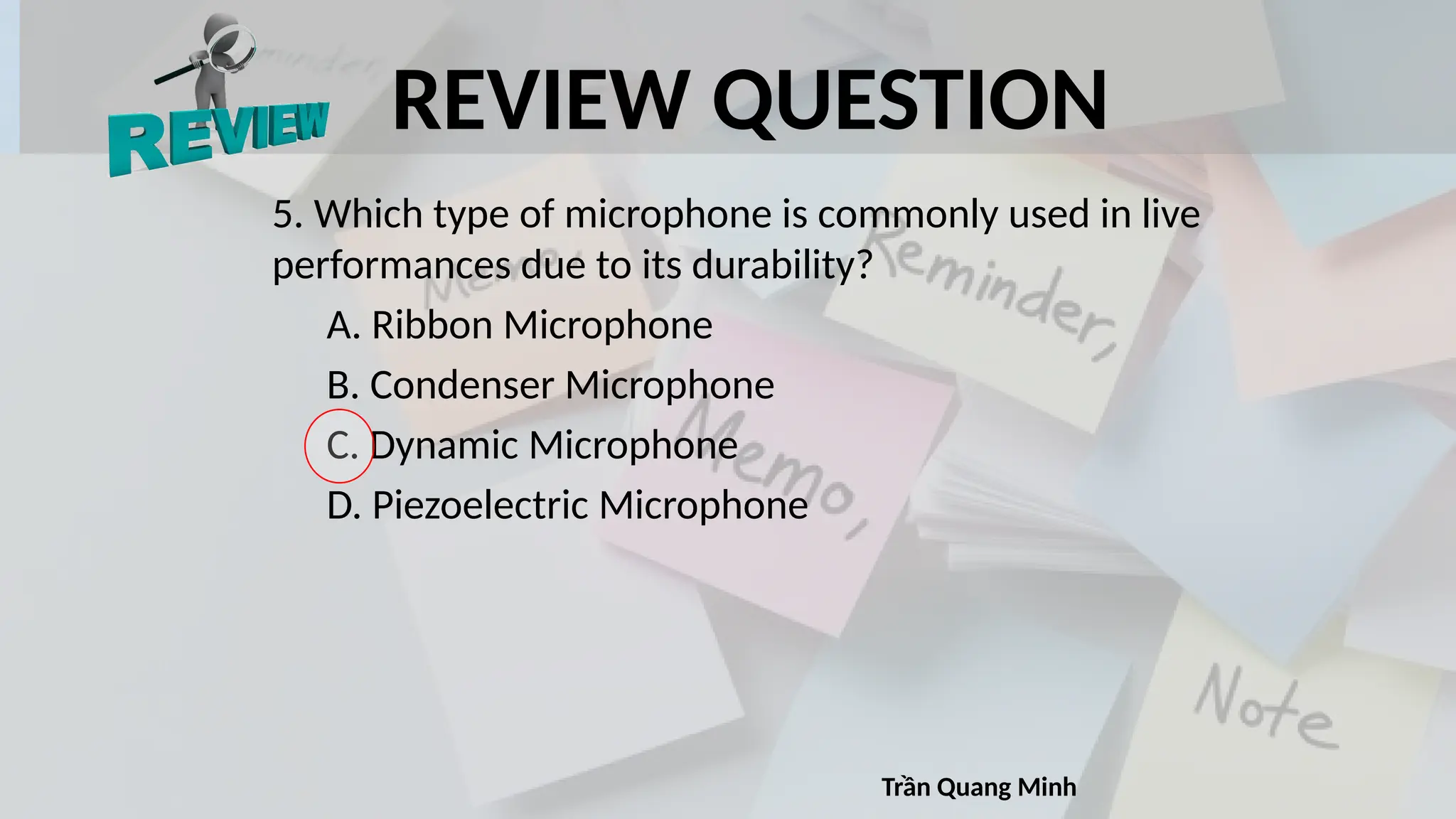
5. Which type of microphone is commonly used in live
performances due to its durability?
A. Ribbon Microphone
B. Condenser Microphone
C. Dynamic Microphone
D. Piezoelectric Microphone
Trần Quang Minh
REVIEW QUESTION
6. Which of the following is NOT a common application
of microphones?
A. Communication and broadcasting
B. Security and surveillance
C. Night photography
D. Artificial intelligence (AI) assistance
Trần Quang Minh
REVIEW QUESTION
7. Why is a microphone important in aviation?
A. To record flight journeys
B. To help pilots communicate with air traffic
controllers
C. To entertain pilots during flights
D. To capture engine sounds for performance analysis
Trần Quang Minh
THANK FOR YOUR ATTENTION

Microphone slides for midterm project ENCN UTE

  • 1.
    I/O DEVICES SUBJECT: Englishfor Computer Science Semester 2 - 2024 - 2025 Trần Quang Minh
  • 2.
    INTRODUCTION 1. What isa microphone and how it was invented 2. Structure and working principle of microphone 3. Types of microphone 4. Applications of microphone Nguyễn Thành Tài - 23110309 Trần Quang Minh - 23110269 Trần Trí Tình - 23110341 Huỳnh Duy Nguyên - 23110270 Trần Quang Minh
  • 3.
    TERMINOLOGY Microphone (Mic) –Micrô (thiết bị thu âm) Acoustic signals – Tín hiệu âm thanh Broadcasting – Phát thanh, truyền hình Speech recognition – Nhận diện giọng nói Carbon Microphone – Micrô than Diaphragm – Màng rung Transducer – Bộ chuyển đổi tín hiệu Electromagnetic induction – Cảm ứng điện từ Piezoelectric effect – Hiệu ứng áp điện Preamplifier – Bộ tiền khuếch đại Phantom power – Nguồn điện ảo (48V) Ribbon Microphone – Micrô dải băng Surveillance – Giám sát Voice recognition – Nhận diện giọng nói Trần Quang Minh
  • 4.
    What is a microphone & howit was invented - Captures sound and converts acoustic signals into electrical signals. - Acts as an intermediary between the sound source and the listener. Microphone – Audio Input Device Nguyễn Thành Tài
  • 5.
    What is a microphone & Howit was invented Such a genius invention!!! First Appearance & Inventor (1876) - Alexander Graham Bell invented the telephone transmitter. - Elisha Gray developed a similar device. Nguyễn Thành Tài
  • 6.
    What is a microphone & Howit was invented Such a genius invention!!! - Emile Berliner invented the carbon microphone and sold the patent to Bell Telephone Company. - Thomas Edison improved its sensitivity and audio quality. Nguyễn Thành Tài
  • 7.
    Types of microphone Microphone’s Components 1.Diaphragm:plastic (Mylar) or lightweight metal. 2.Transducer: copper coil, metal ribbon, or piezoelectric crystal. 3.Preamplifier (if applicable): contains electronic circuits and transistors. 4.Wiring and output interface: copper wires and metal connectors. 5.Protective casing: metal or durable plastic Trần Quang Minh
  • 8.
    Structure & Working principle of microphone Microphone’s workingpriciple Sound wave reception Conversion to electrical signal Diaphragm vibration Output devices’s process Trần Quang Minh
  • 9.
    Structure & Working principle of microphone Universe ofmicrophones Dynamic Microphone Works via electromagnetic induction. Durable, affordable, ideal for live performances and instrument recording. Condenser Microphone - Uses a diaphragm and metal plate. - Requires phantom power (48V), high sensitivity, used in studios & broadcasting. Trần Trí Tình
  • 10.
    Structure & Working principle of microphone Universe ofmicrophones Piezoelectric Microphone - Uses the piezoelectric effect. - Used in specialized applications. Ribbon Microphone - A thin metal ribbon vibrates produce sound. - Suitable for classical instruments but fragile. Trần Trí Tình
  • 11.
    Structure & Working principle of microphone Universe ofmicrophones Carbon Microphone Uses carbon granules to convert sound pressure into signals. Limited sound quality, historically used in the early time. Besides traditional types, MEMS microphones, laser microphones and hydrophones used to specific needs. Trần Trí Tình
  • 12.
    Applications of microphone Microphone in ourlife Communication Used in online meetings, public speaking, broadcasting, and by teachers, journalists, and politicians for clear voice projection. Entertainment & Media Essential for concerts, recordings, films, podcasts, and content creators to enhance audio quality. Huỳnh Duy Nguyên
  • 13.
    Applications of microphone Microphone in ourlife Security Used in walkie-talkies, body cameras, and sound recognition systems for detecting threats. Science & Technology Found in electronic stethoscopes, voice assistants (Siri, Alexa), and other speech-based technologies. Huỳnh Duy Nguyên
  • 14.
    CONCLUSION Microphones convert soundinto electrical signals, revolutionizing communication, entertainment, and technology. As they evolve, they remain essential for innovation and daily life. Trần Quang Minh
  • 15.
    REVIEW QUESTION 1. Whatis the main function of a microphone? A. Playing music B. Capturing and converting sound into an electrical signal C. Increasing speaker volume D. Recording images Trần Quang Minh
  • 16.
    REVIEW QUESTION 2. Whoinvented the carbon microphone – the first practical microphone? A. Alexander Graham Bell B. Thomas Edison C. Emile Berliner D. Elisha Gray Trần Quang Minh
  • 17.
    REVIEW QUESTION 3. Whichcomponent of a microphone is responsible for detecting and vibrating according to sound waves? A. Preamplifier B. Diaphragm C. Transducer D. Protective Casing Trần Quang Minh
  • 18.
    REVIEW QUESTION 4. Howdoes a condenser microphone work? A. Electromagnetic induction B. Piezoelectric effect C. Capacitance change D. Vibration of a metal ribbon in a magnetic field Trần Quang Minh
  • 19.
    REVIEW QUESTION 5. Whichtype of microphone is commonly used in live performances due to its durability? A. Ribbon Microphone B. Condenser Microphone C. Dynamic Microphone D. Piezoelectric Microphone Trần Quang Minh
  • 20.
    REVIEW QUESTION 6. Whichof the following is NOT a common application of microphones? A. Communication and broadcasting B. Security and surveillance C. Night photography D. Artificial intelligence (AI) assistance Trần Quang Minh
  • 21.
    REVIEW QUESTION 7. Whyis a microphone important in aviation? A. To record flight journeys B. To help pilots communicate with air traffic controllers C. To entertain pilots during flights D. To capture engine sounds for performance analysis Trần Quang Minh
  • 22.
    THANK FOR YOURATTENTION